
Secondary structure prediction Secondary structure prediction Amino acid
- Slides: 45
Secondary structure prediction
Secondary structure prediction Amino acid sequence -> Secondary structure Alpha helix Beta strand Disordered/coil 70% accuracy 1991, 81% accuracy in 2009
Secondary structure prediction Limits: Limited to globular proteins Not for membrane proteins
Secondary structure prediction Applications Site directed mutagenesis Locate functionally important residues Find structural units / domains
Secondary structure prediction Techniques Linear statistics Physicochemical properties Linear discrimination Machine learning Neural Networks K-nearest neighbours Evolutionary trees Residue substitution matrices Using evolutionary information = Multiple sequence alignments.
Secondary structure prediction Jnet Cuff and Barton (2000) Neural Network Training set: 480 proteins (non homologous) Construction of MSA for each using BLAST
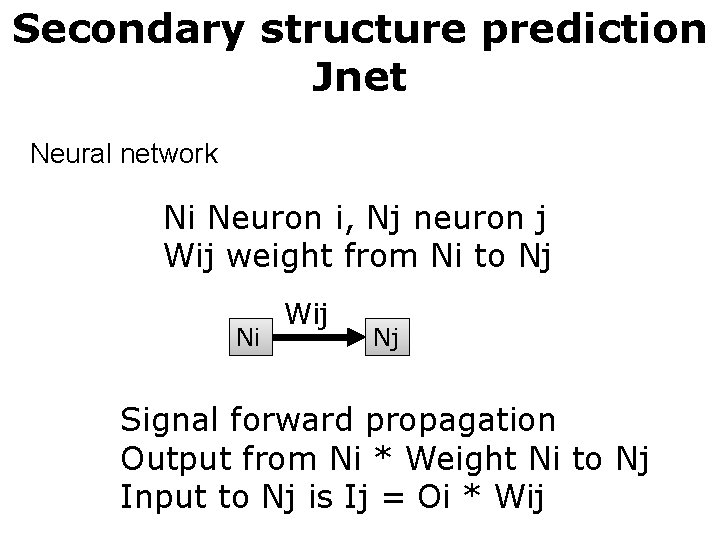
Secondary structure prediction Jnet Neural network Ni Neuron i, Nj neuron j Wij weight from Ni to Nj Ni Wij Nj Signal forward propagation Output from Ni * Weight Ni to Nj Input to Nj is Ij = Oi * Wij
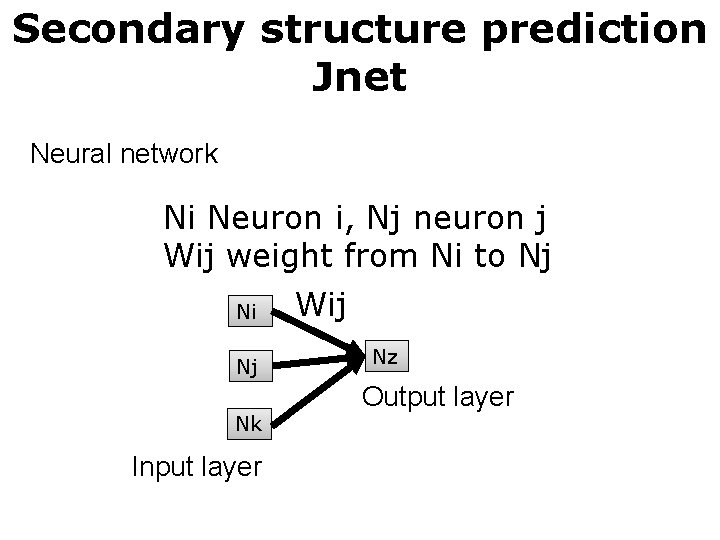
Secondary structure prediction Jnet Neural network Ni Neuron i, Nj neuron j Wij weight from Ni to Nj Ni Nj Nk Input layer Wij Nz Output layer
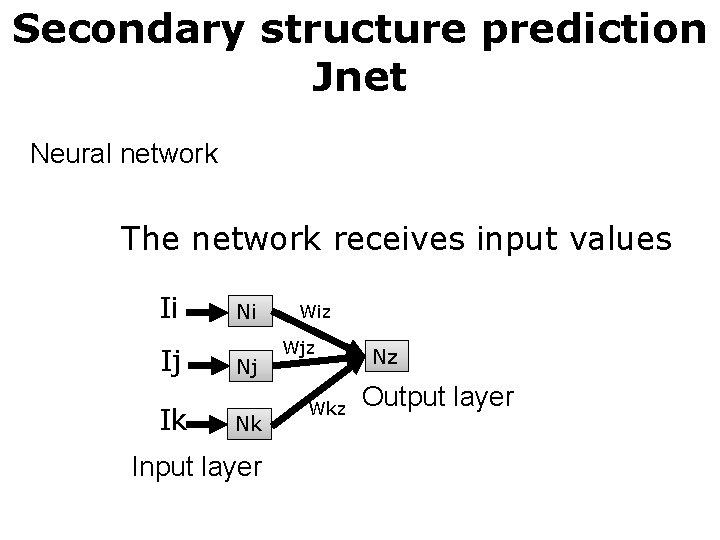
Secondary structure prediction Jnet Neural network The network receives input values Ii Ij Ik Ni Nj Nk Input layer Wiz Wjz Wkz Nz Output layer
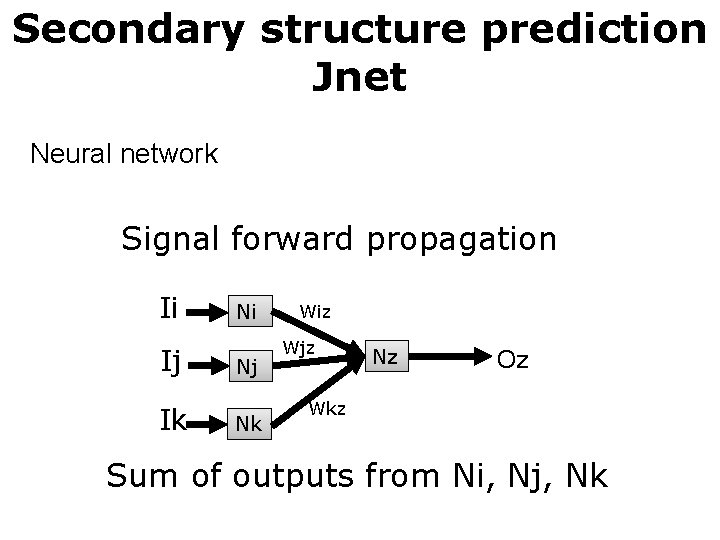
Secondary structure prediction Jnet Neural network Signal forward propagation Ii Ij Ik Ni Nj Nk Wiz Wjz Nz Oz Wkz Sum of outputs from Ni, Nj, Nk
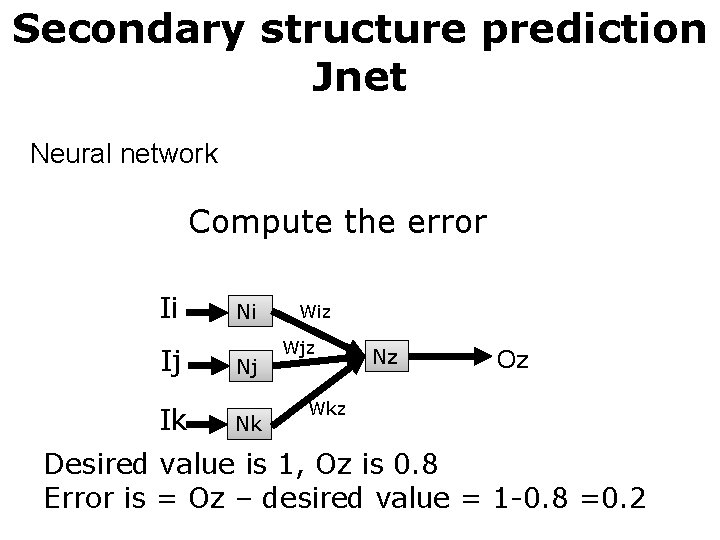
Secondary structure prediction Jnet Neural network Compute the error Ii Ij Ik Ni Nj Nk Wiz Wjz Nz Oz Wkz Desired value is 1, Oz is 0. 8 Error is = Oz – desired value = 1 -0. 8 =0. 2
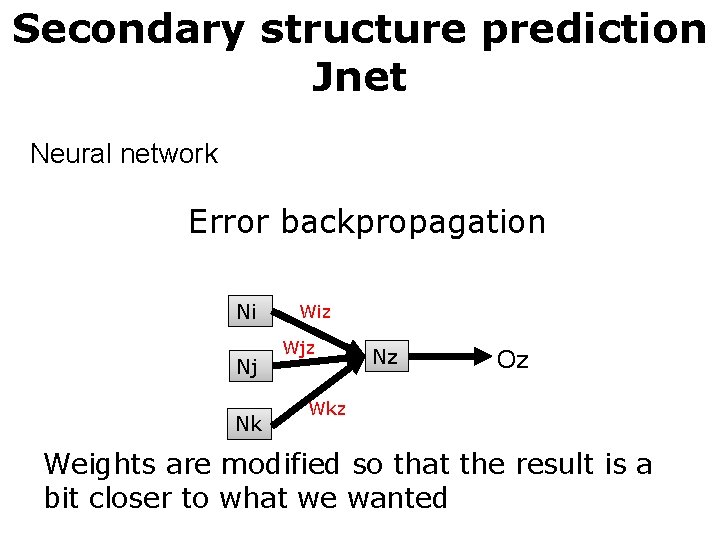
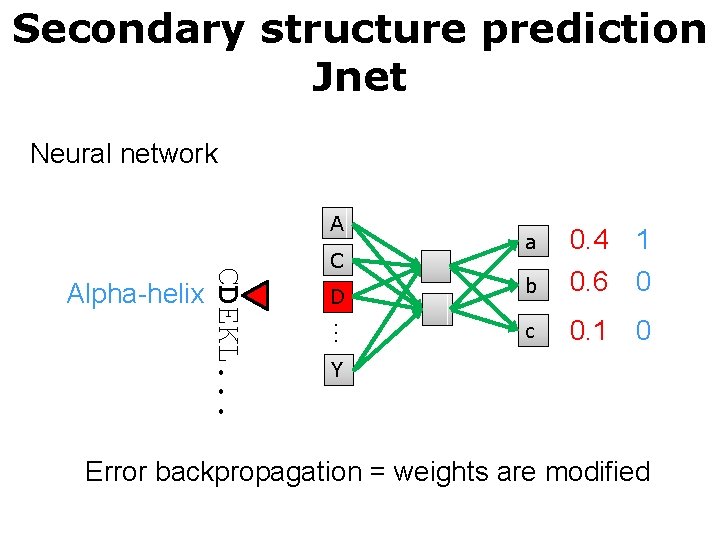
Secondary structure prediction Jnet Neural network Error backpropagation Ni Nj Nk Wiz Wjz Nz Oz Wkz Weights are modified so that the result is a bit closer to what we wanted
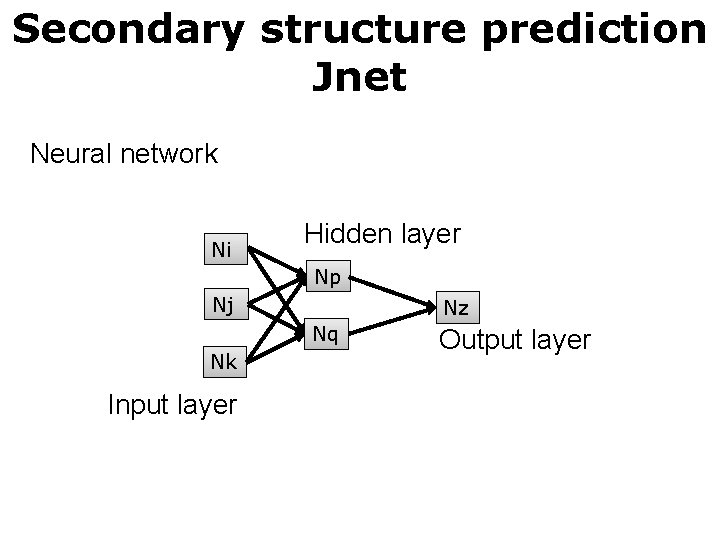
Secondary structure prediction Jnet Neural network Ni Hidden layer Np Nj Nz Nq Nk Input layer Output layer
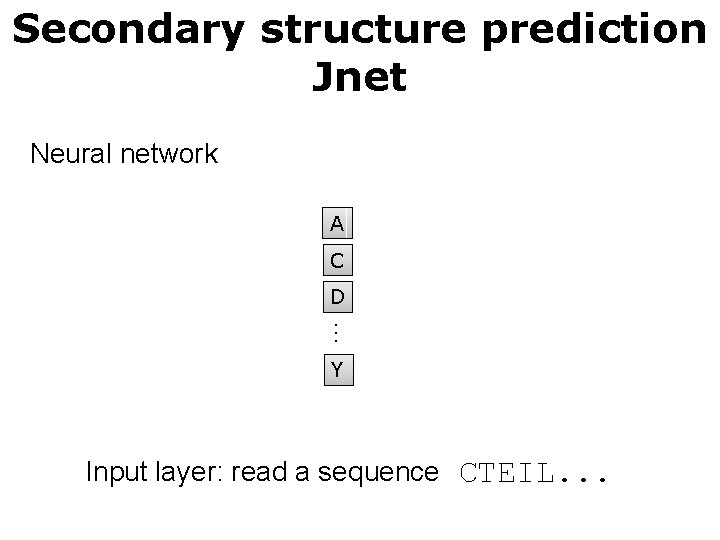
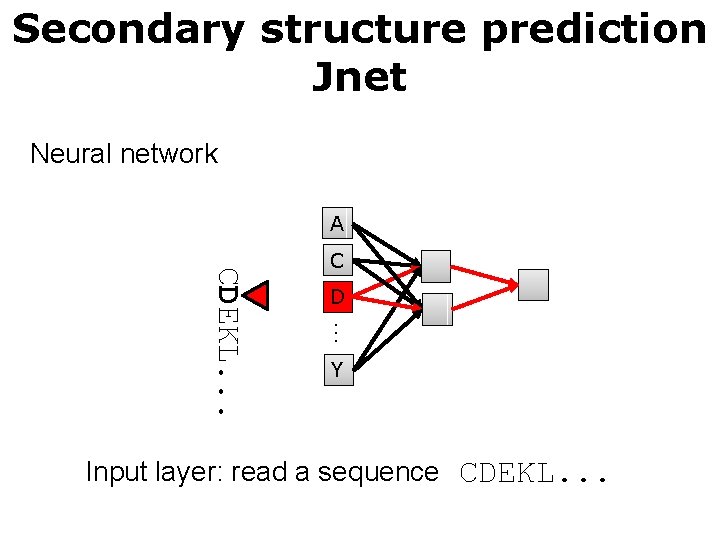
Secondary structure prediction Jnet Neural network A C D … Y Input layer: read a sequence CTEIL. . .
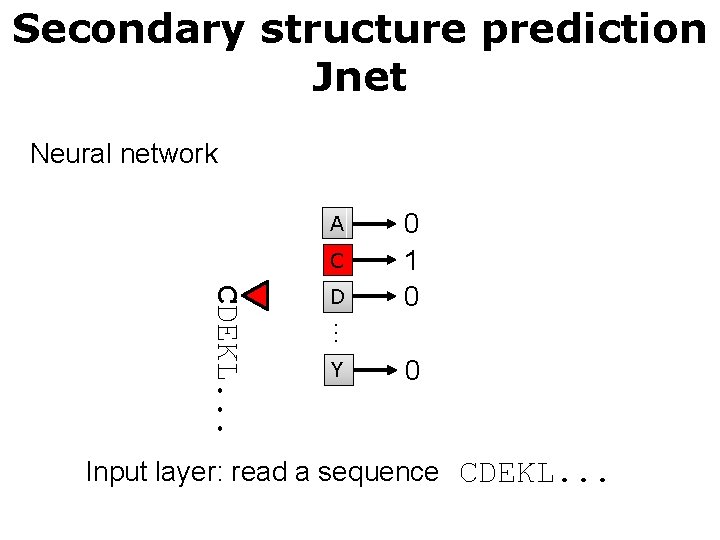
Secondary structure prediction Jnet Neural network A C … CDEKL. . . D 0 1 0 Y 0 Input layer: read a sequence CDEKL. . .
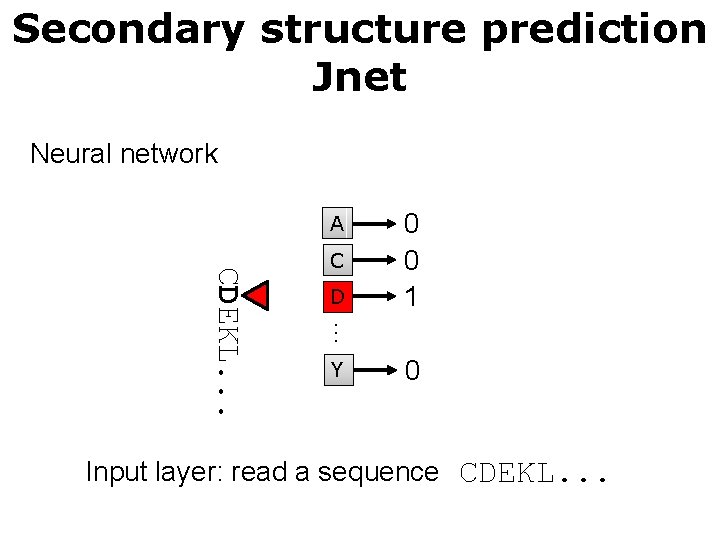
Secondary structure prediction Jnet Neural network A D … CDEKL. . . C 0 0 1 Y 0 Input layer: read a sequence CDEKL. . .
Secondary structure prediction Jnet Neural network A D … CDEKL. . . C Y Input layer: read a sequence CDEKL. . .
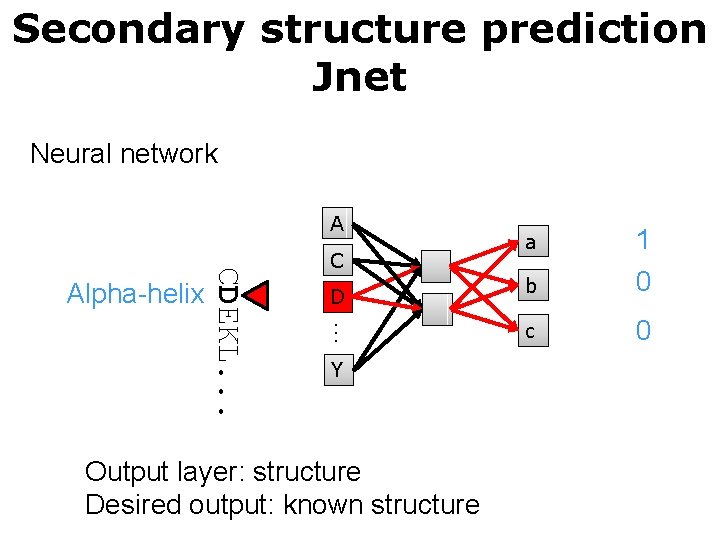
Secondary structure prediction Jnet Neural network A D … CDEKL. . . Alpha-helix C Y Output layer: structure Desired output: known structure a 1 b 0 c 0
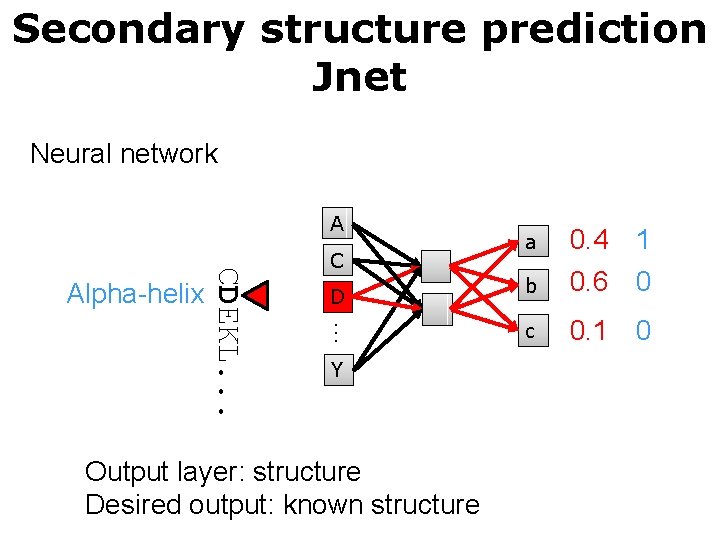
Secondary structure prediction Jnet Neural network A D … CDEKL. . . Alpha-helix C Y Output layer: structure Desired output: known structure a 0. 4 1 b 0. 6 0 c 0. 1 0
Secondary structure prediction Jnet Neural network A D … CDEKL. . . Alpha-helix C a 0. 4 1 b 0. 6 0 c 0. 1 0 Y Error backpropagation = weights are modified
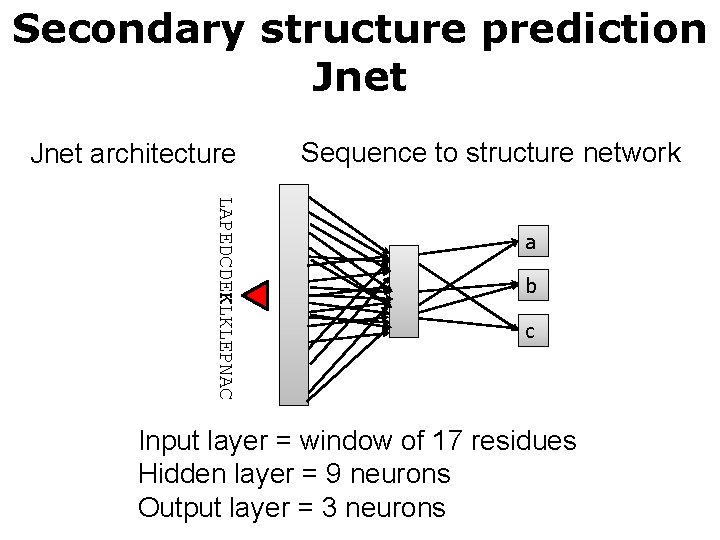
Secondary structure prediction Jnet architecture Sequence to structure network LAPEDCDEKLKLEPNAC a b c Input layer = window of 17 residues Hidden layer = 9 neurons Output layer = 3 neurons
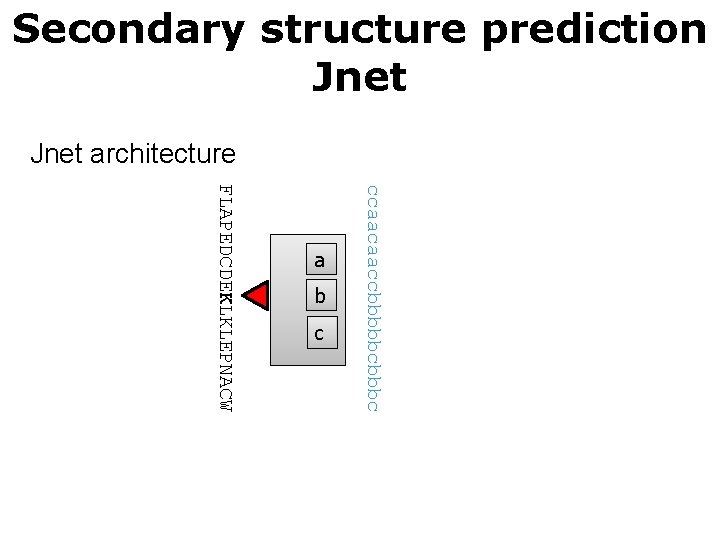
Secondary structure prediction Jnet architecture b c ccaacaaccbbbbbc FLAPEDCDEKLKLEPNACW a
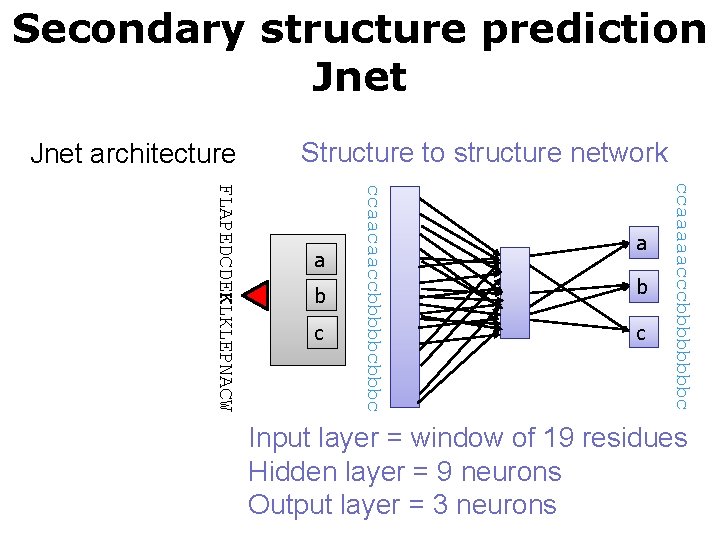
Secondary structure prediction Jnet architecture Structure to structure network c b c ccaaaaacccbbbbc b ccaacaaccbbbbbc FLAPEDCDEKLKLEPNACW a a Input layer = window of 19 residues Hidden layer = 9 neurons Output layer = 3 neurons
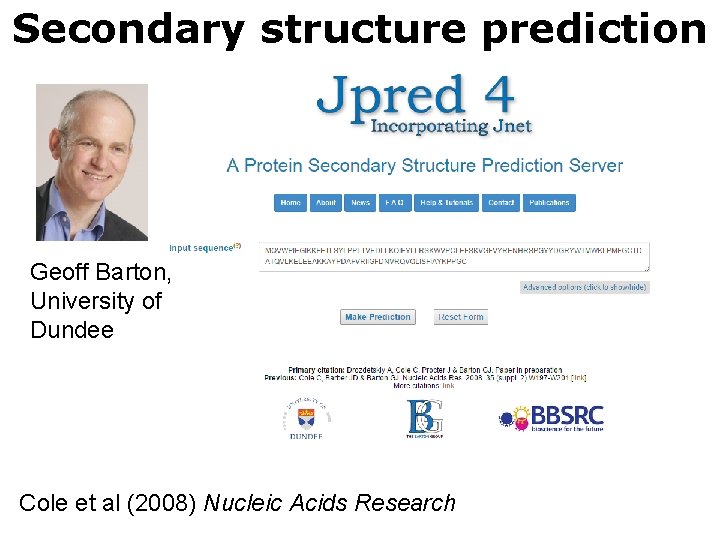
Secondary structure prediction Geoff Barton, University of Dundee Cole et al (2008) Nucleic Acids Research
Secondary structure prediction Jpred Uses algorithm Jnet 2. 0 Three state prediction Alpha, beta, coil Accuracy 81. 5% (2008) But if no homolog (orphan sequence) 65. 9%! PSIBLAST PSSM matrix HMMer profiles (instead of aa frequencies) Multiple neural networks 100 hidden layer units
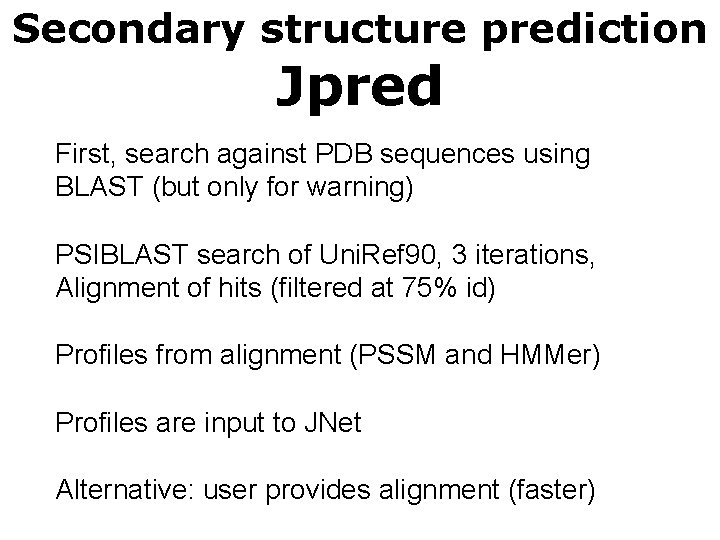
Secondary structure prediction Jpred First, search against PDB sequences using BLAST (but only for warning) PSIBLAST search of Uni. Ref 90, 3 iterations, Alignment of hits (filtered at 75% id) Profiles from alignment (PSSM and HMMer) Profiles are input to JNet Alternative: user provides alignment (faster)
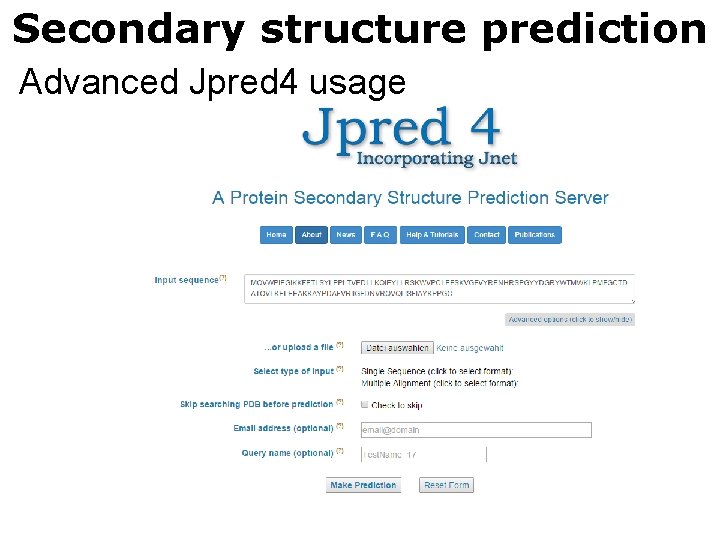
Secondary structure prediction Advanced Jpred 4 usage
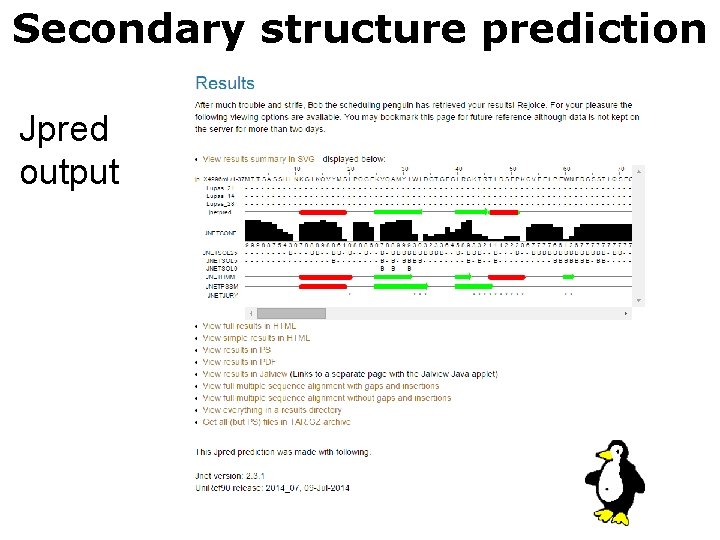
Secondary structure prediction Jpred output
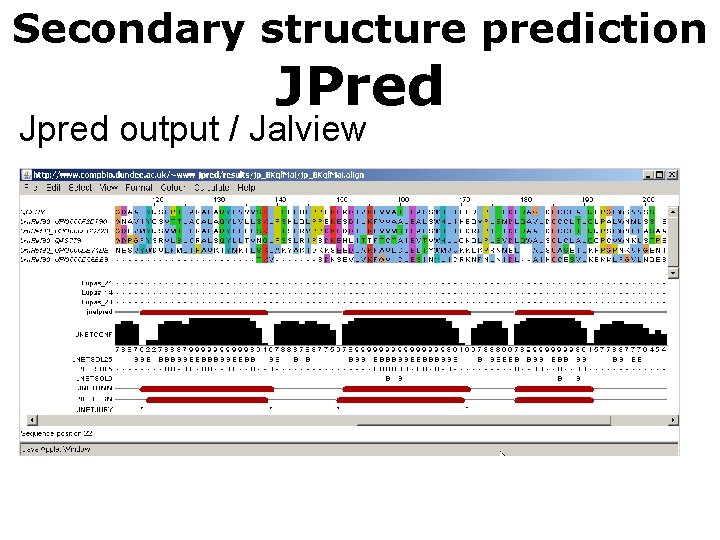
Secondary structure prediction JPred Jpred output / Jalview
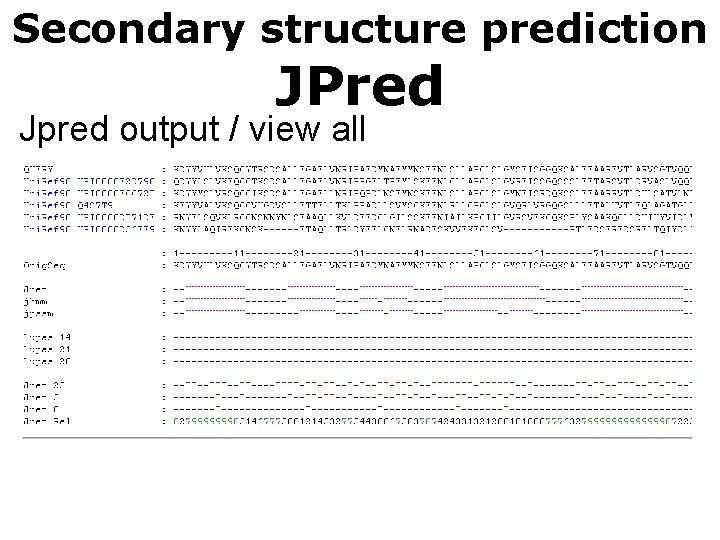
Secondary structure prediction JPred Jpred output / view all
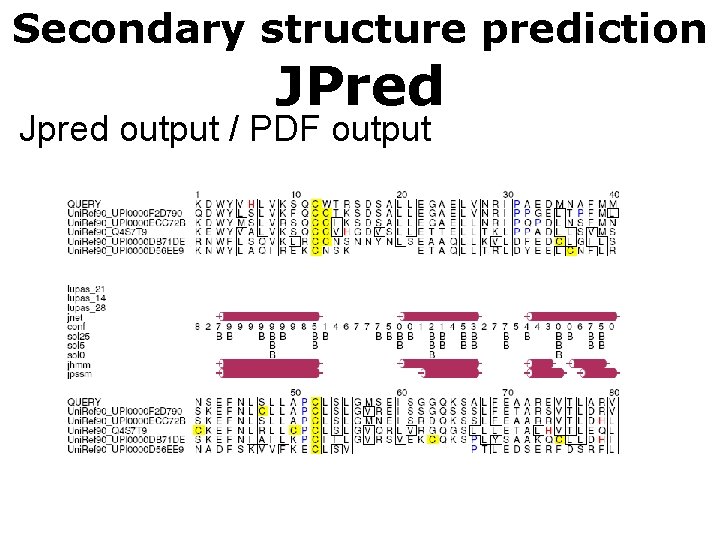
Secondary structure prediction JPred Jpred output / PDF output
Exercise 1/3 Jalview 2 D prediction Starting Jalview Open Firefox with JRE (from ZDV) Go to http: //www. jalview. org Click the pink arrow “Launch Jalview Desktop” You can close all the demo windows that appear
Exercise 1/3 Jalview 2 D prediction Load an alignment Use MR 1_fasta. txt This is an alignment of a fragment of the mineralocorticoid receptor Open it from File > Input alignment > From file (Hint: You can load it directly as an URL, e. g. https: //cbdm. unimainz. de/files/2015/02/MR 1_fasta. txt) The alignment has its own Menu tabs Try Colour > Clustalx to see conservation
Exercise 2/3 Jalview 2 D prediction Web service -> Secondary Structure Prediction -> Jnet secondary str pred No selection (or all sequences selected) = Jnet runs on top sequence using the alignment (fast) One sequence (or region) selected = Jnet runs on that sequence using homologs (slow) Some sequences selected = Jnet runs on top one using homologs (slow) Try with no sequences selected
Exercise 2/3 Jalview 2 D prediction If this doesn’t work you can run directly MR 1_fasta. txt on jpred 4. Use the advanced option Upload a file option Select type of input = Multiple alignment (use format FASTA) Tick the skip PDB search option There is an option to view output in Jalview
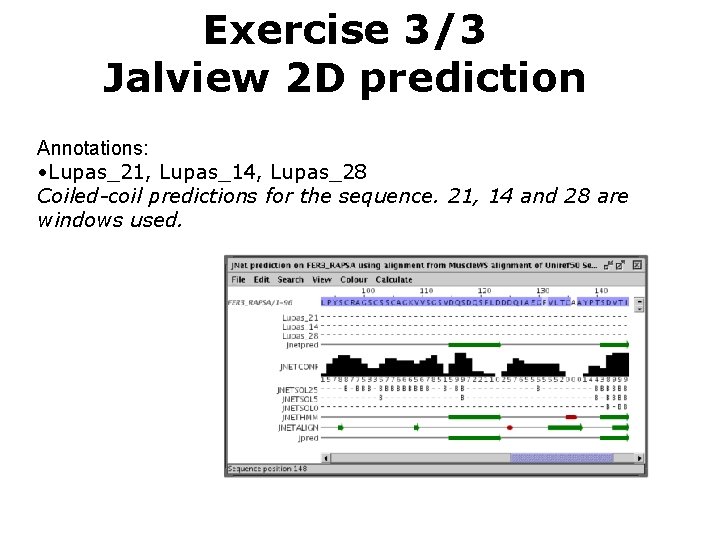
Exercise 3/3 Jalview 2 D prediction Annotations: • Lupas_21, Lupas_14, Lupas_28 Coiled-coil predictions for the sequence. 21, 14 and 28 are windows used.
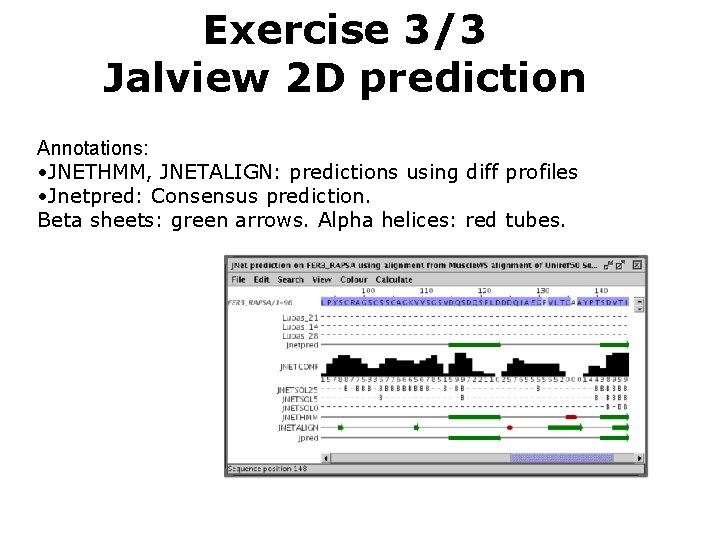
Exercise 3/3 Jalview 2 D prediction Annotations: • JNETHMM, JNETALIGN: predictions using diff profiles • Jnetpred: Consensus prediction. Beta sheets: green arrows. Alpha helices: red tubes.
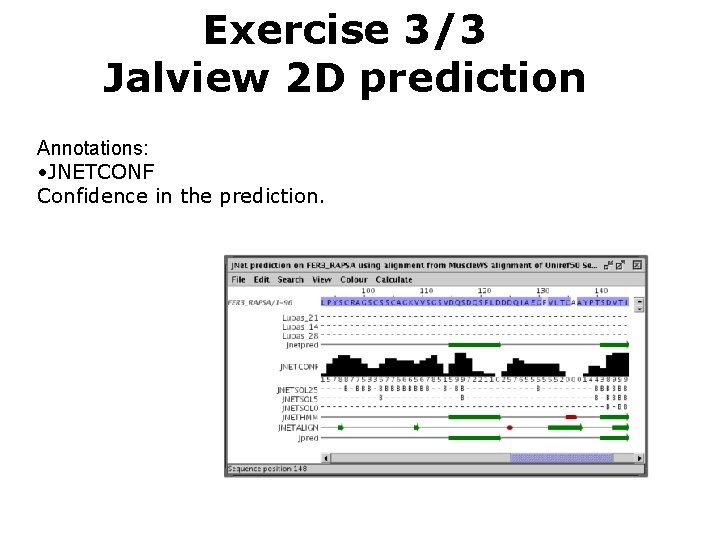
Exercise 3/3 Jalview 2 D prediction Annotations: • JNETCONF Confidence in the prediction.
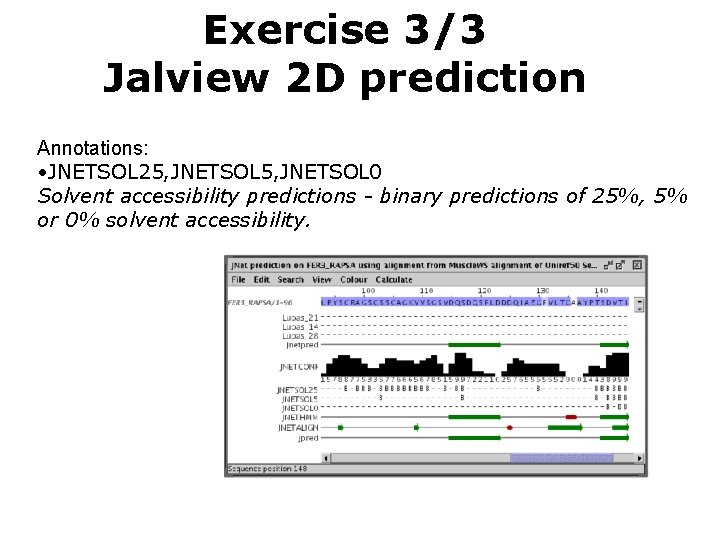
Exercise 3/3 Jalview 2 D prediction Annotations: • JNETSOL 25, JNETSOL 0 Solvent accessibility predictions - binary predictions of 25%, 5% or 0% solvent accessibility.
Exercise 3/3 2 D prediction of known 3 D Obtain the sequence of the human glutamine synthetase. Run BLAST with the human sequence against: 1) the archaea Methanosarcina 2) the bacteria Escherichia coli 3) the fungi Pseudozima Antarctica Get the best homolog, align the sequences (including the human protein, on top) and use the input in Jalview.
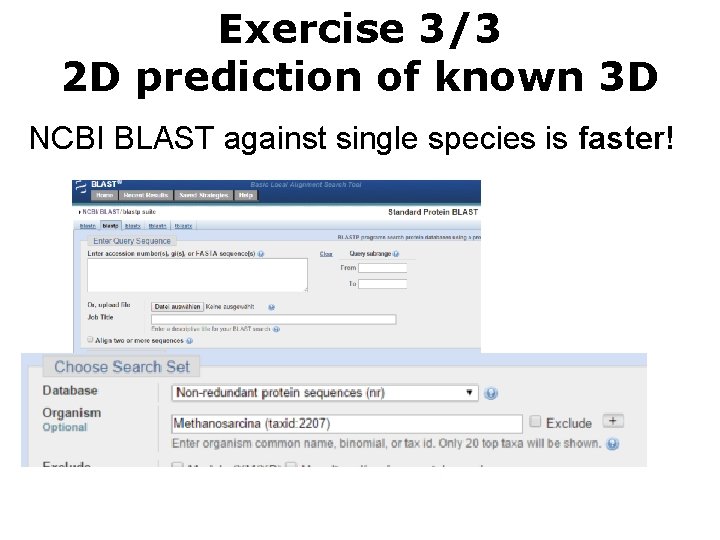
Exercise 3/3 2 D prediction of known 3 D NCBI BLAST against single species is faster!
Exercise 3/3 2 D prediction of known 3 D Obtain the sequence of the human glutamine synthetase. Run BLAST with the human sequence against: 1) the archaea Methanosarcina 2) the bacteria Escherichia coli 3) the fungi Pseudozima Antarctica Get the best homolog from each, align the sequences and use the input in Jalview. Put the human protein on top.
Exercise 3/3 2 D prediction of known 3 D Load the alignment in Jalview and run web prediction. Alternative. Run the alignment in the Jpred 4 server. (Hint: You could run the human sequence alone but that will search for homologs and will take very long) Compare the prediction with the known 3 D of the human protein (open it in Chimera, File > Fetch by ID > PDB 2 QC 8)
Exercise 3/3 2 D prediction of known 3 D We need to hide all chains except one. Select one of the chains (ctrl + click on a residue, then arrow up). Invert selection (press arrow right). Actions > Ribbon > Hide Actions > Atoms/bonds > Hide Select the chain and focus on it Actions > Focus
Exercise 3/3 2 D prediction of known 3 D Compare the output of jpred/jalview 2 D pref with the 3 D structure of this protein. For example, locate a predicted helix or beta-strand in Jalview. Find out the start and end positions hovering over the human sequence with the mouse (the numbers on top of the alignment are different from the amino acid positions in each sequence). Color the corresponding residues it in the 3 D view using Select > Atom specifier And ranges: e. g. : 113 -126 (predicted as helix) Actions > color > red Apply color some helices red and strands in green. Do you see differences? Where are they? Would you say that the 2 D prediction was reasonable?