
Secondary Glaucoma Dated 05 05 2017 Prof Sanjeev

![1] lens induced glaucoma/Phakogenic i. iii. iv. Phacomorphic glaucoma Phacolytic glaucoma Phacoanaphylactic glaucoma Glaucoma](https://slidetodoc.com/presentation_image_h/90f99995b0a71cc205cf3c4b7ff753da/image-4.jpg "1] lens induced glaucoma/Phakogenic i. iii. iv. Phacomorphic glaucoma Phacolytic glaucoma Phacoanaphylactic glaucoma Glaucoma")
![• Intra ocular inflammation (inflammatory glaucoma): ▪ Associated with uveitis Inflammatory glaucoma 1]](https://slidetodoc.com/presentation_image_h/90f99995b0a71cc205cf3c4b7ff753da/image-6.jpg "• Intra ocular inflammation (inflammatory glaucoma): ▪ Associated with uveitis Inflammatory glaucoma 1]")
![3] Steroid-induced glaucoma i. Iatrogenic cause ii. It is associated with topical, periocular, systemic](https://slidetodoc.com/presentation_image_h/90f99995b0a71cc205cf3c4b7ff753da/image-7.jpg "3] Steroid-induced glaucoma i. Iatrogenic cause ii. It is associated with topical, periocular, systemic")
![4] Pigmentary Glaucoma • Young myopic males • Deposition of iris pigments in trabecular](https://slidetodoc.com/presentation_image_h/90f99995b0a71cc205cf3c4b7ff753da/image-11.jpg "4] Pigmentary Glaucoma • Young myopic males • Deposition of iris pigments in trabecular")
![Post-traumatic Glaucoma [A] Blunt injury • Rise in IOP is biphasic - early which](https://slidetodoc.com/presentation_image_h/90f99995b0a71cc205cf3c4b7ff753da/image-14.jpg "Post-traumatic Glaucoma [A] Blunt injury • Rise in IOP is biphasic - early which")
- Slides: 23
Secondary Glaucoma Dated : 05 -05 -2017 - Prof Sanjeev Kumar Mittal
• • Definition Types Causes Treatment
Secondary Glaucoma • Conditions with raised intraocular pressure due to pre existing ocular causes. • May manifest asa. Secondary open angle Glaucoma b. Secondary angle closure Glaucoma c. Mixed pattern
1] lens induced glaucoma/Phakogenic i. iii. iv. Phacomorphic glaucoma Phacolytic glaucoma Phacoanaphylactic glaucoma Glaucoma associated with dislocated lens [phakotopic] v. Glaucoma capsulare/ Pseudoexfoliation syndrome
• Intra ocular inflammation (inflammatory glaucoma): ▪ Associated with uveitis Inflammatory glaucoma 1] Iridocyclitis (both in acute phase & chronic phases) 2] Glaucomato-cyclitic crisis /Hypertensive uveitis (Posner and Schlossmann’s syndrome) 3] Following perforated corneal ulcer 4] As a complication of Keratitis & scleritis
3] Steroid-induced glaucoma i. Iatrogenic cause ii. It is associated with topical, periocular, systemic or intraocular steroid therapy. iii. IOP rise after steroid therapy occurs more often with topical administration than with systemic administration. iv. Periocular injection of a long action steroid is the most dangerous route. v. Intravitreal steroid use (Triamcinolone injection to treat intraocular neovascular or inflammatory disease) can also cause a rise in IOP.
vi. The response of IOP to steroids is genetically determined vii. Rise in IOP occurs 6 weeks to 2 months viii. Response varies in people ix. Reversible X. But we need to treat till it comes down
Pathogenesis: i. deposition of mucopolysaccharides in trabecular meshwork ii. Reduced endothelial phagocytic activity iii. Inhibit synthesis of prostaglandins E and F which otherwise increase aqueous out flow.
Treatment: i. Stop steroid ii. Treat with Drug for POAG iii. Surgery if medical treatment is unable to prevent damage to optic nerve
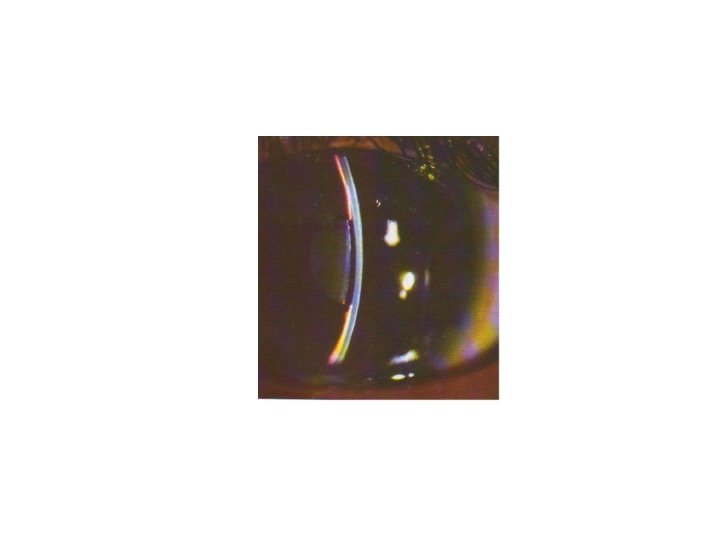
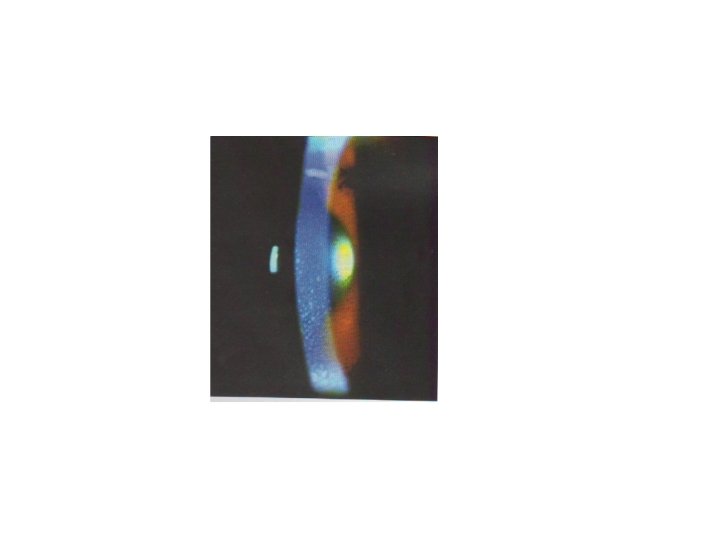
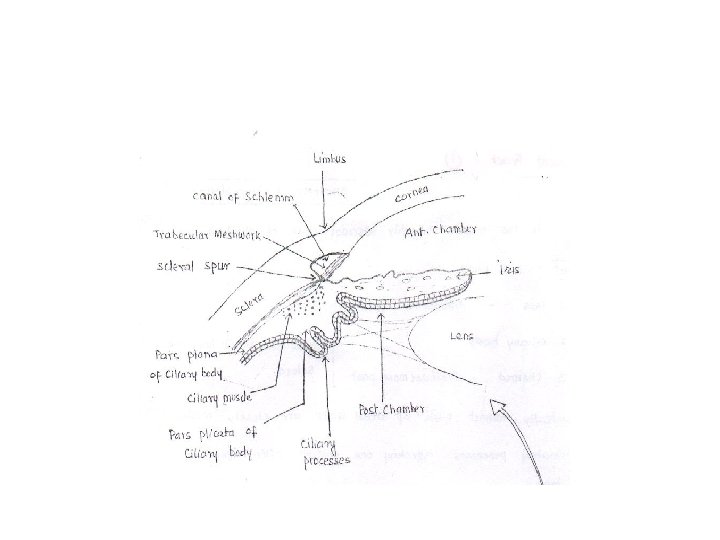
4] Pigmentary Glaucoma • Young myopic males • Deposition of iris pigments in trabecular meshwork damage • Krukenberg’s spindle (over corneal endothelium) • Gonioscopy (Sampaolesi’s line)
Glaucoma associated with intra ocular tumours Causes: i. Episcleral venous hypertension (obstruction beyond trabecular meshwork) ii. Obstruction of angle by seeding of tumour cells iii. Forward displacement of Lens-iris diaphragm eg- Thyroid exophthalmos, Carotico-cavernous fistula Superior vena cava syndrome metastatic carcinoma of orbit Retinoblastoma Iris melanoma
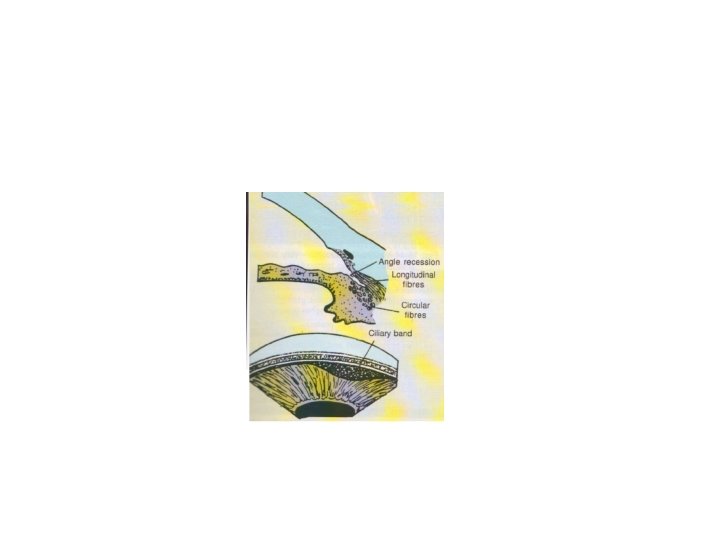
Post-traumatic Glaucoma [A] Blunt injury • Rise in IOP is biphasic - early which lasts for few hours - After few months/years (angle recession) • Gonioscopy is confimatory diagnosis- deeper angle recess with widening of ciliary band [B] Penetrating injury [C] Chemical injury
1. Neovascular glaucoma may be associated with all of the following except: a. Diabetes b. Hypertension c. Central retinal vein occlusion d. Intraocular tumours
1. Treatment of malignant glaucoma includes all except: a. Topical atropine b. Topical pilocarpine c. IV mannitol d. Vitreous aspiration
1. Secondary glaucoma following corneal perforation is due to: a. Central anterior synechiae formation b. Peripheral anterior synechiae c. Intraocular haemorrhage d. Angle recession
1. Glaukomflecken is a feature of: a. Acute narrow-angle glaucoma b. Pseudoexfoliative glaucoma c. Juvenile glaucoma d. Phacolytic glaucoma
1. All of the following are true about pigmentary glaucoma except: a. It occurs more often in young myopic men b. Iris transillumination defects are noted c. It is associated with Krukenberg’s spindle d. The intensity of pigment deposit in the angle is related to iris colour
• After blunt trauma to eye Raja develops circumcorneal congestion. Now, which test should be done? • (a) Ultrasonography • (b) Perimetry • (c) Direct ophthalmoscopy • (d) intraocular pressure measurement.
Thank you • Photographs taken from Clinical ophthalmology by Kanski