
Secondary Education Section Committee TEACHING AND LEARNING IN

- Slides: 17
Secondary Education Section Committee TEACHING AND LEARNING IN THE FOUNDATION SUBJECTS Geographical Association Conference 2002
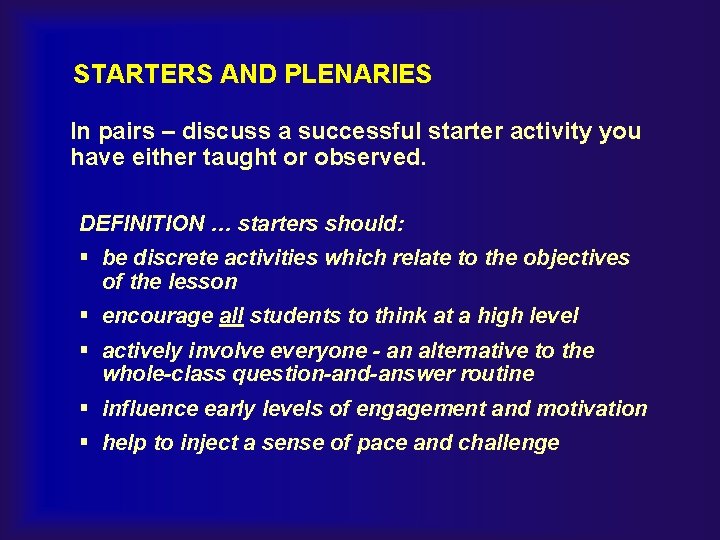
STARTERS AND PLENARIES In pairs – discuss a successful starter activity you have either taught or observed. DEFINITION … starters should: § be discrete activities which relate to the objectives of the lesson § encourage all students to think at a high level § actively involve everyone - an alternative to the whole-class question-and-answer routine § influence early levels of engagement and motivation § help to inject a sense of pace and challenge
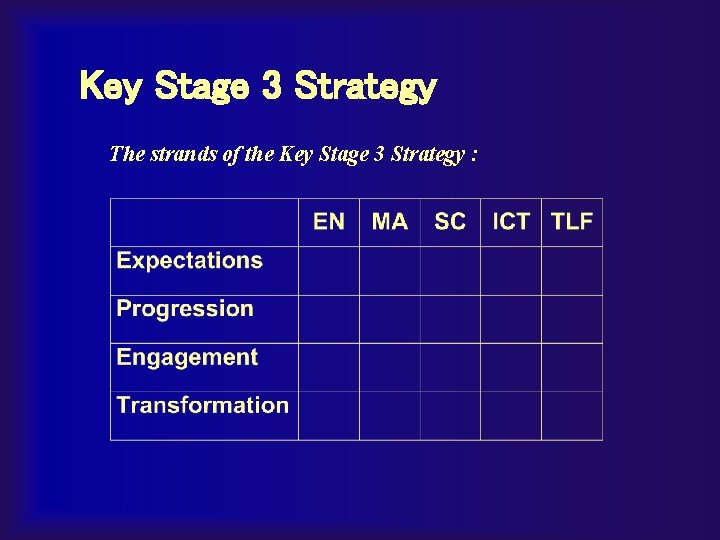
Key Stage 3 Strategy The strands of the Key Stage 3 Strategy :
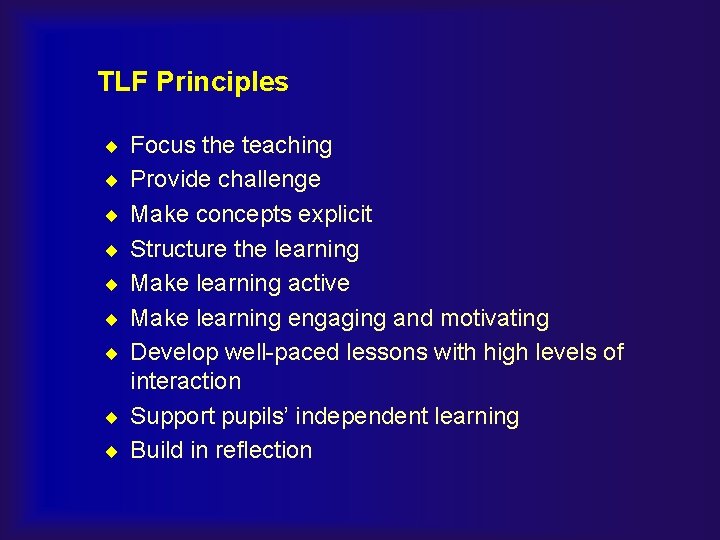
TLF Principles ¨ Focus the teaching ¨ Provide challenge ¨ Make concepts explicit ¨ Structure the learning ¨ Make learning active ¨ Make learning engaging and motivating ¨ Develop well-paced lessons with high levels of interaction ¨ Support pupils’ independent learning ¨ Build in reflection
Teaching and Learning in the Foundation Subjects Training Modules
Secondary Education Section Committee Let’s talk about… Starters and Plenaries
STARTERS AND PLENARIES Successful starters can help create: § engagement § pace § challenge
Ready Steady Teach
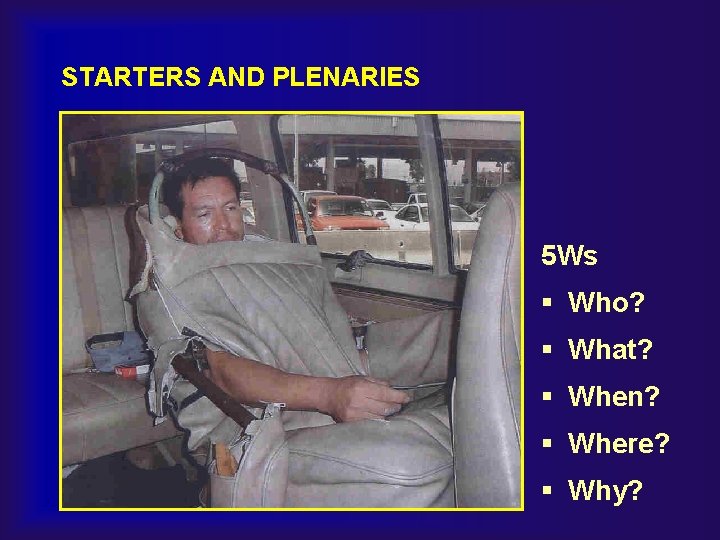
STARTERS AND PLENARIES 5 Ws § Who? § What? § When? § Where? § Why?
STARTERS AND PLENARIES Card sequencing
STARTERS AND PLENARIES Hazards of Starters Pitfalls commonly cited are that they: w take too long w take over the whole lesson … often a problem if extended writing is called for w lose pace or direction w become a fixed routine and lack variety w may be engaging but lack challenge (see Bloom’s Levels of Thinking)
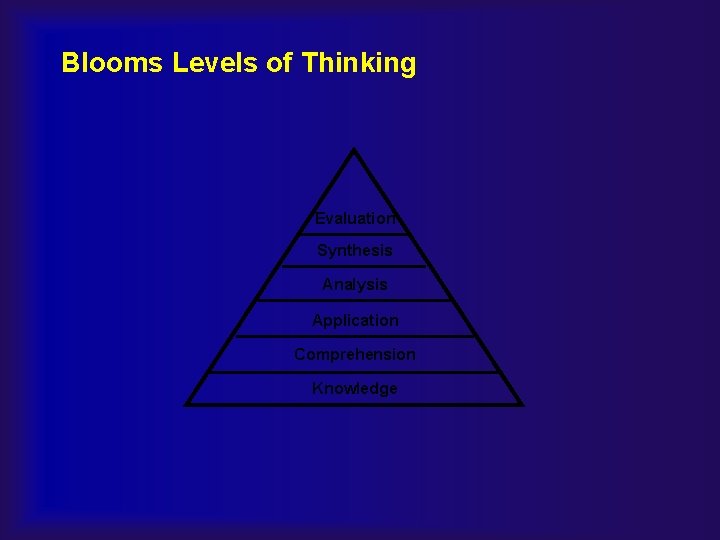
Blooms Levels of Thinking Evaluation Synthesis Analysis Application Comprehension Knowledge
STARTERS AND PLENARIES Plenaries: § draw together the whole group § take stock of learning so far § direct students to the next phase of learning § occur at strategic moments in the teaching sequence § often occur at the end of lessons § can occur at other points in the lesson § highlight not only what students learn, but also how they learn
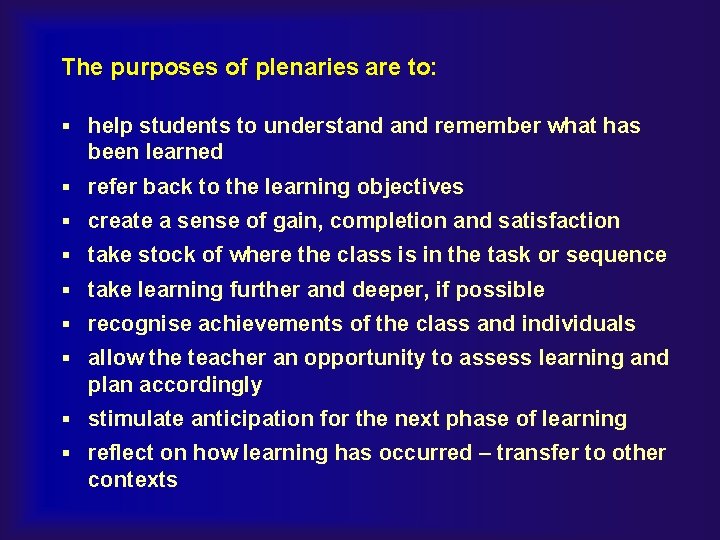
The purposes of plenaries are to: § help students to understand remember what has been learned § refer back to the learning objectives § create a sense of gain, completion and satisfaction § take stock of where the class is in the task or sequence § take learning further and deeper, if possible § recognise achievements of the class and individuals § allow the teacher an opportunity to assess learning and plan accordingly § stimulate anticipation for the next phase of learning § reflect on how learning has occurred – transfer to other contexts
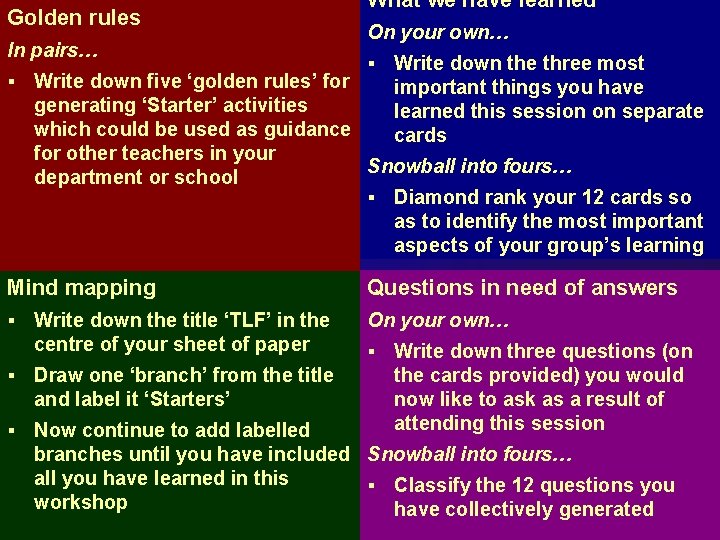
Golden rules In pairs… § On your own… § Write down the three most important things you have learned this session on separate cards Write down five ‘golden rules’ for generating ‘Starter’ activities which could be used as guidance for other teachers in your Snowball into fours… department or school § Diamond rank your 12 cards so as to identify the most important aspects of your group’s learning Mind mapping § What we have learned Write down the title ‘TLF’ in the centre of your sheet of paper Questions in need of answers On your own… § Write down three questions (on the cards provided) you would now like to ask as a result of attending this session § Draw one ‘branch’ from the title and label it ‘Starters’ § Now continue to add labelled branches until you have included Snowball into fours… all you have learned in this § Classify the 12 questions you workshop have collectively generated
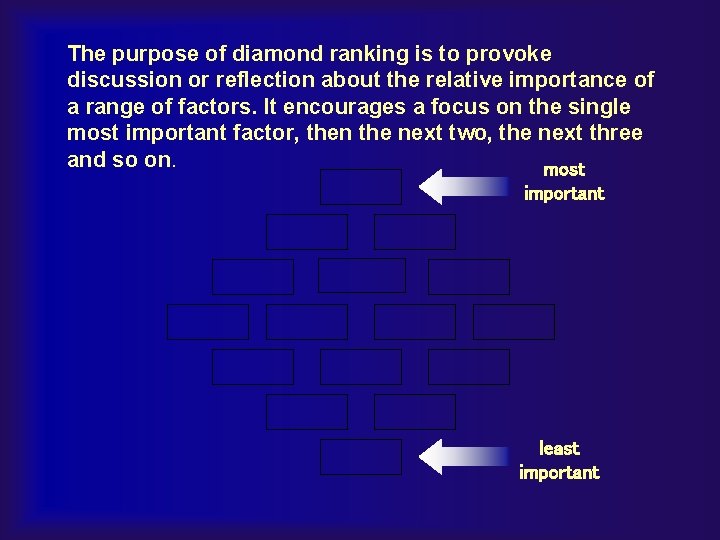
The purpose of diamond ranking is to provoke discussion or reflection about the relative importance of a range of factors. It encourages a focus on the single most important factor, then the next two, the next three and so on. most important least important
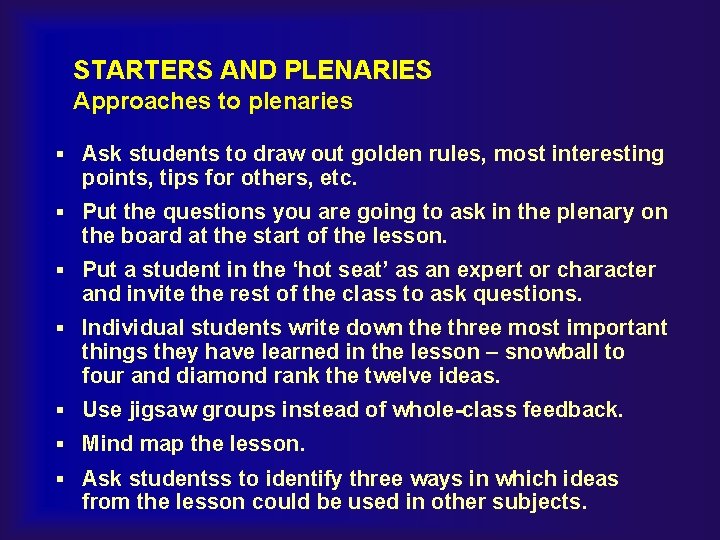
STARTERS AND PLENARIES Approaches to plenaries § Ask students to draw out golden rules, most interesting points, tips for others, etc. § Put the questions you are going to ask in the plenary on the board at the start of the lesson. § Put a student in the ‘hot seat’ as an expert or character and invite the rest of the class to ask questions. § Individual students write down the three most important things they have learned in the lesson – snowball to four and diamond rank the twelve ideas. § Use jigsaw groups instead of whole-class feedback. § Mind map the lesson. § Ask studentss to identify three ways in which ideas from the lesson could be used in other subjects.