
Secondary Curriculum Review New curriculum new opportunities Secondary

- Slides: 30
Secondary Curriculum Review New curriculum, new opportunities
Secondary Curriculum Review This presentation divides into three sections: 1. Why are we changing the curriculum? 2. What is in the new curriculum? A guide to the changes 3. What opportunities do schools have for changing the curriculum? … and a short final section summarising key messages 2
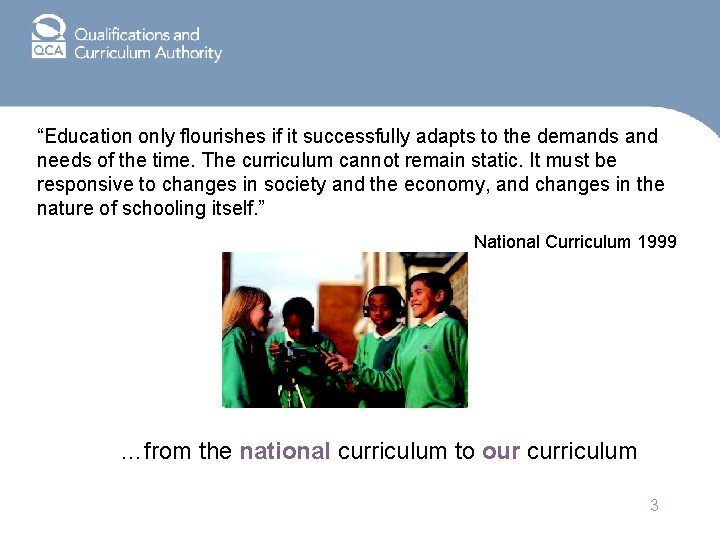
“Education only flourishes if it successfully adapts to the demands and needs of the time. The curriculum cannot remain static. It must be responsive to changes in society and the economy, and changes in the nature of schooling itself. ” National Curriculum 1999 …from the national curriculum to our curriculum 3
1. Why are we changing the secondary curriculum?
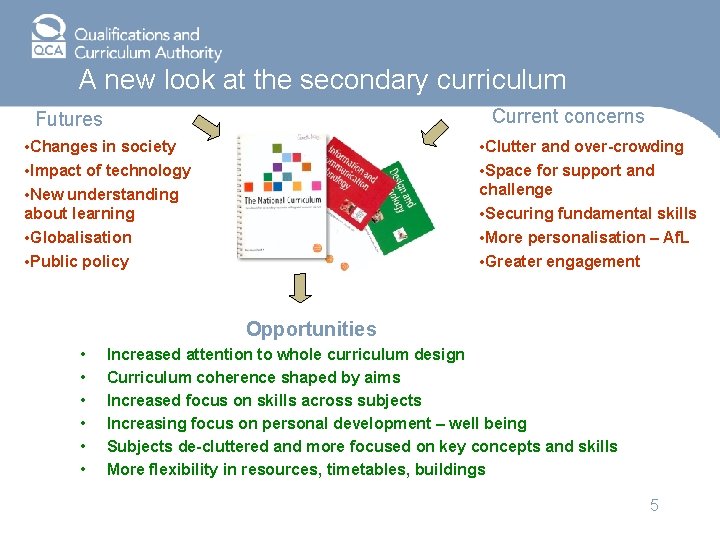
A new look at the secondary curriculum Current concerns Futures • Changes in society • Impact of technology • New understanding about learning • Globalisation • Public policy • Clutter and over-crowding • Space for support and challenge • Securing fundamental skills • More personalisation – Af. L • Greater engagement Opportunities • • • Increased attention to whole curriculum design Curriculum coherence shaped by aims Increased focus on skills across subjects Increasing focus on personal development – well being Subjects de-cluttered and more focused on key concepts and skills More flexibility in resources, timetables, buildings 5
Secondary curriculum review Why? – A curriculum fit for the future – Every Child Matters – Social cohesion What? – Flexibility – Coherence – Relevance – Challenge The opportunity for teachers: - Linger longer, dig deeper, cross boundaries 6
2. What is in the new curriculum? A guide to the propose changes
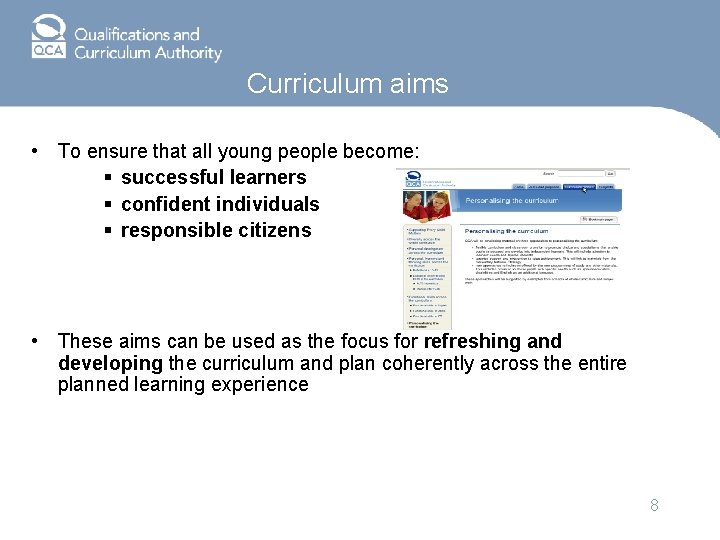
Curriculum aims • To ensure that all young people become: § successful learners § confident individuals § responsible citizens • These aims can be used as the focus for refreshing and developing the curriculum and plan coherently across the entire planned learning experience 8
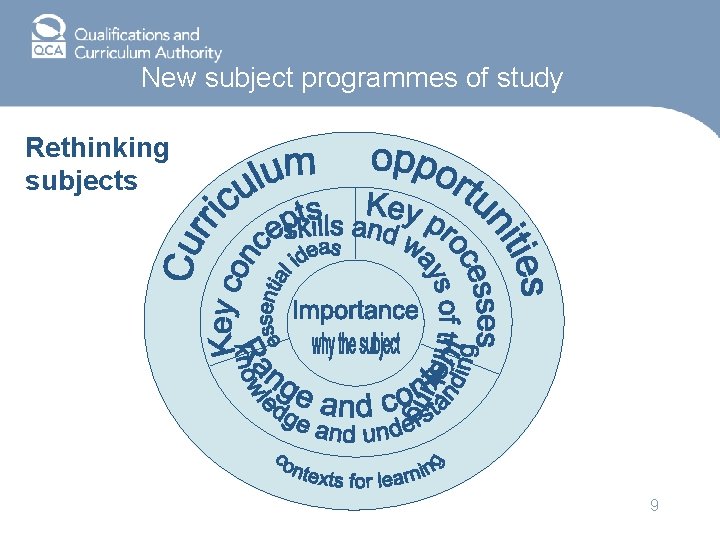
New subject programmes of study Rethinking subjects 9
This are section provides support Curriculum and guidance dimensions within can provide a contextand across The revised programmes of study designed to improve coherence subjects on personalising the curriculum andthrough focus for work within and between This section supportclear and guidance the curriculum andprovides to ensure progression between keyand stages approaches to inclusion and targeted subjects across the whole curriculum. to help curriculum planners examine their intervention pupils They who have give opportunities fallen for pupils to engage current provision andrevised refresh the whole- to support All the programmes of study follow the same structure. or who withgift important or talent. ideas and issues that affect school curriculum plan to take behind advantage of have a particular It also explores ways in which their pupils lives can and be the world beyond school. the increased flexibilities focuses in each programme of study. Teaching Curriculum aims are givenand atnew the start of given more choice in their learning Curriculum and have dimensions can provideand rich learning the revised programmes of study. subjects should help learners achieve these aims. greater opportunities to develop contexts specialisms for learning with authentic audiences and purposes. in all The importance statement describes the important aspects of the subject, why it is necessary for learners to study the subject and what they can expect to gain from it. Each programme of study is supplemented by concepts supporting guidance howheart to develop Key are atonthe of each discipline and underpin the study of the subject. They coherent approaches to teaching and identify what learners need to learn in order to deepen and broaden their knowledge, skills and learning. understanding in the subject. This is presented in two sections. Key processes are the essential skills and processes that learners need to learn to make progress Links to the whole-school curriculum in the subject. Developing the subject curriculum Range and content outlines the breadth of subject matter from which the areas of study should be drawn. Curriculum opportunities identifies opportunities that are integral to learning and enhance learners' engagement with the subject. Explanatory notes are included in each programme of study, signposted by the blue note icon. These explain the scope of the requirements in the programmes of study, clarifying phrases and terms and giving examples. They are included in full in the downloadable versions of the programmes of study. 10
A structure that creates new opportunities • Key concepts: Creativity: Art & Design, Design & Technology, English, Mathematics, MFL, Music, PE • Key concepts: Identity: Citizenship, RE • Key processes: Critical reflection: History, Personal Well-being • Key processes: Evaluate: ICT, RE • Key processes: Analyse: Mathematics, RE, Science 11
Level descriptions for national curriculum subjects at levels 4 to 8 have been modified to: – complement revised programmes of study – maintain standards A new level description for citizenship had been developed with levels 1 to Exceptional Performance The non- statutory level descriptions for RE remain unchanged. 12
3. What opportunities do schools have for changing the curriculum?
When planning, think out about the context of • the local community and the young people living in it • the school and its wider context, values and priorities • meeting the needs of the full range of learners • the curriculum priorities for subjects 14
In the community or school …. To what extent do young people: • enjoy and achieve? • engage and participate positively? • use their learning to make wise, healthy and safe choices? • pursue social, economic or environmental goals? • value and understand each other, and appreciate diversity in society? 15
In the school or department … • Are young people independent enough in their learning? • Do learners recognise their own success, express their own needs and chart their own future progress? • Can young people make connections between their needs, interests and aspirations and what they are learning? 16
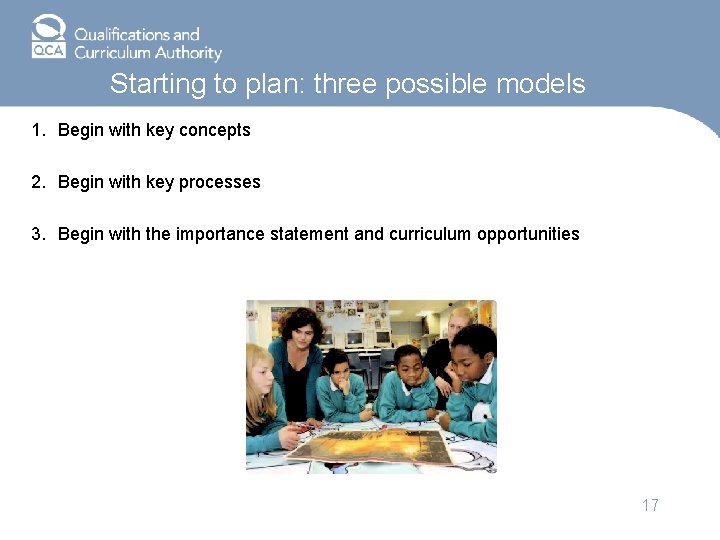
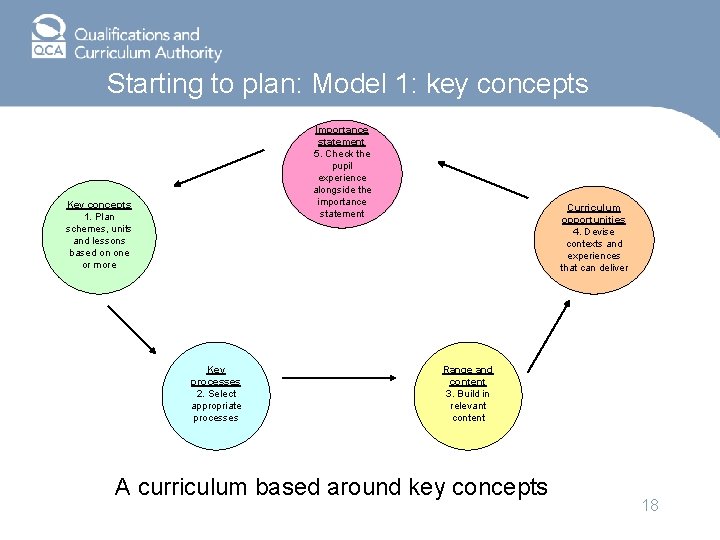
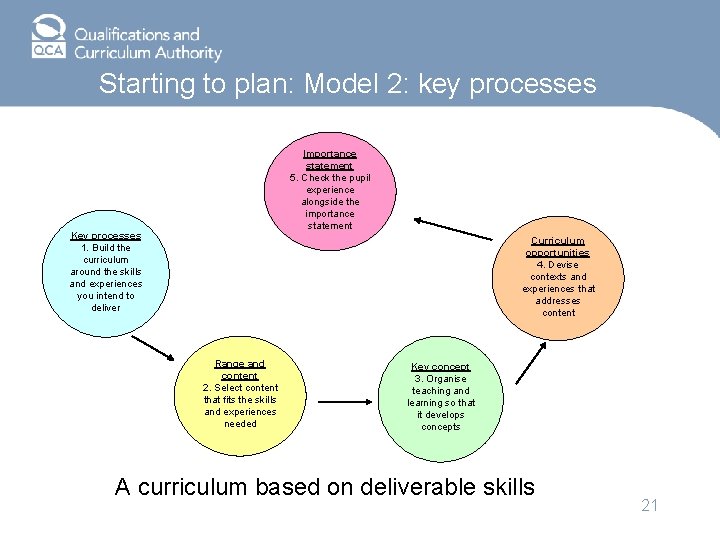
Starting to plan: three possible models 1. Begin with key concepts 2. Begin with key processes 3. Begin with the importance statement and curriculum opportunities 17
Starting to plan: Model 1: key concepts Importance statement 5. Check the pupil experience alongside the importance statement Key concepts 1. Plan schemes, units and lessons based on one or more Key processes 2. Select appropriate processes Curriculum opportunities 4. Devise contexts and experiences that can deliver Range and content 3. Build in relevant content A curriculum based around key concepts 18
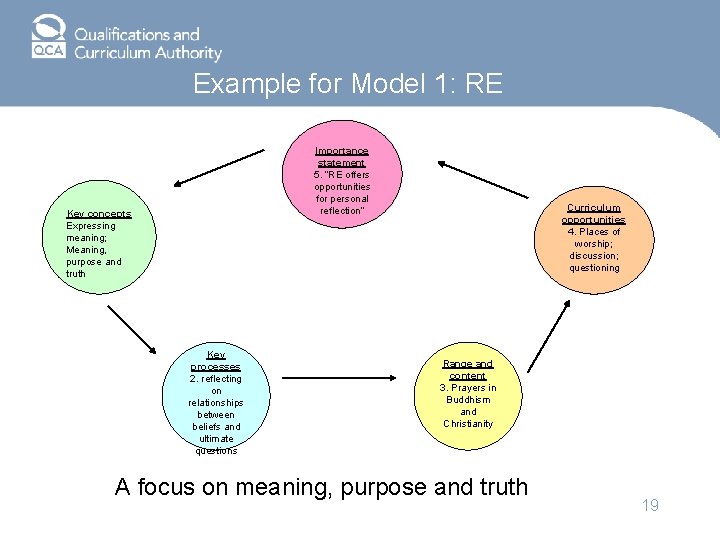
Example for Model 1: RE Importance statement 5. “RE offers opportunities for personal reflection” Key concepts Expressing meaning; Meaning, purpose and truth Key processes 2. reflecting on relationships between beliefs and ultimate questions Curriculum opportunities 4. Places of worship; discussion; questioning Range and content 3. Prayers in Buddhism and Christianity A focus on meaning, purpose and truth 19
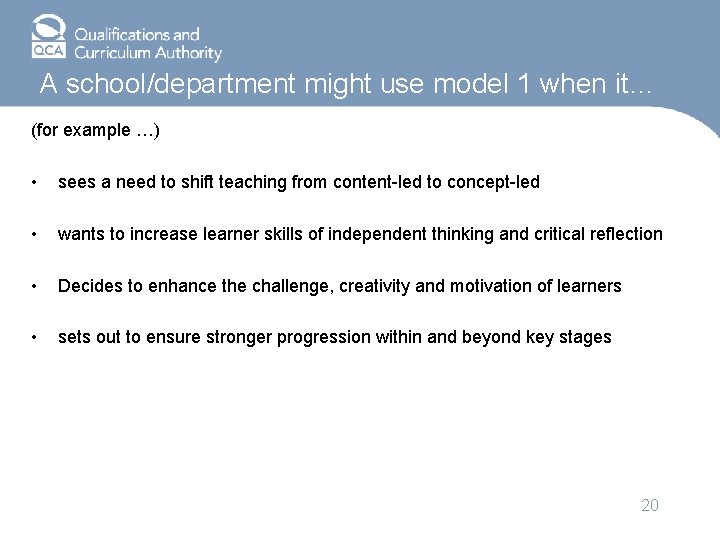
A school/department might use model 1 when it… (for example …) • sees a need to shift teaching from content-led to concept-led • wants to increase learner skills of independent thinking and critical reflection • Decides to enhance the challenge, creativity and motivation of learners • sets out to ensure stronger progression within and beyond key stages 20
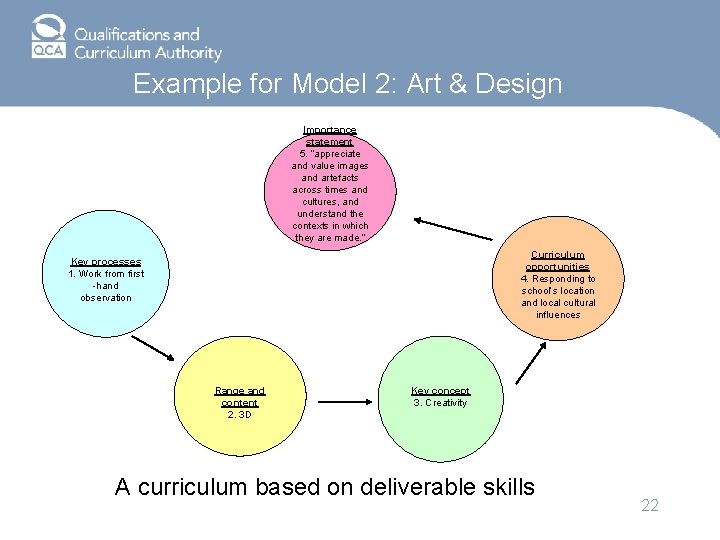
Starting to plan: Model 2: key processes Importance statement 5. Check the pupil experience alongside the importance statement Key processes 1. Build the curriculum around the skills and experiences you intend to deliver Curriculum opportunities 4. Devise contexts and experiences that addresses content Range and content 2. Select content that fits the skills and experiences needed Key concept 3. Organise teaching and learning so that it develops concepts A curriculum based on deliverable skills 21
Example for Model 2: Art & Design Importance statement 5. “appreciate and value images and artefacts across times and cultures, and understand the contexts in which they are made. ” Curriculum opportunities 4. Responding to school’s location and local cultural influences Key processes 1. Work from first -hand observation Range and content 2. 3 D Key concept 3. Creativity A curriculum based on deliverable skills 22
A school/department might use model 2 when it … (for example …) • intends to focus more systematically on developing skills • use skills to create connections within and between subjects • identifies a need to make teaching approaches more interactive and diverse • decides to use the routines and learning experiences of a particular key stage or year group to reinforce learning across subjects 23
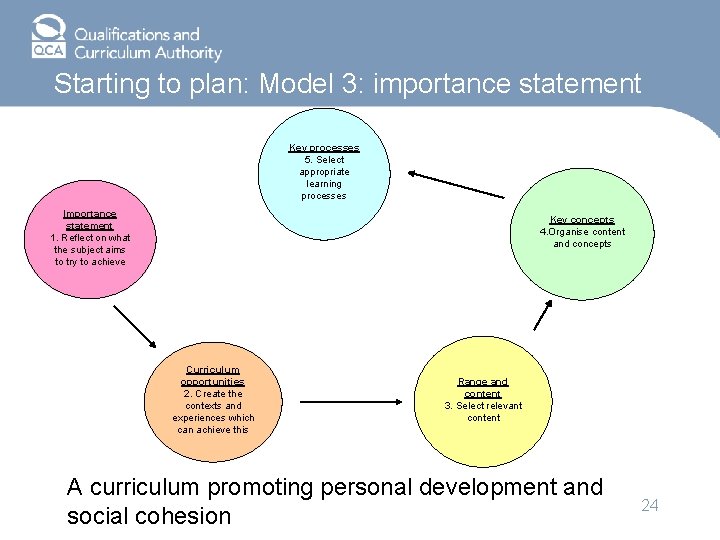
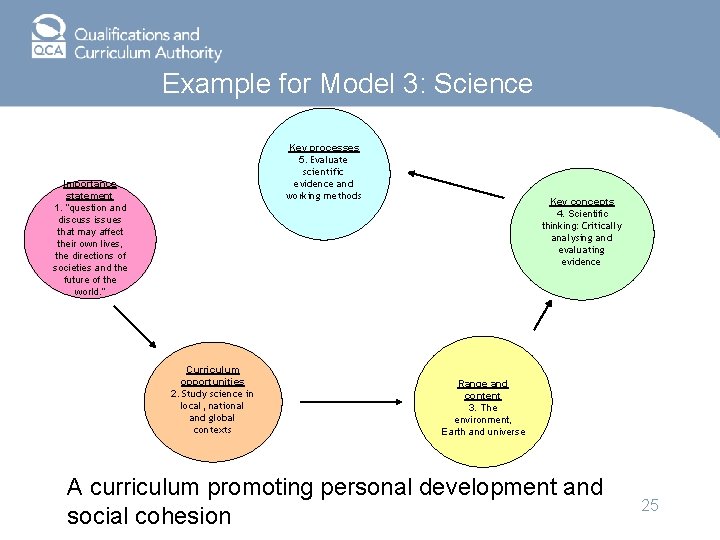
Starting to plan: Model 3: importance statement Key processes 5. Select appropriate learning processes Importance statement 1. Reflect on what the subject aims to try to achieve Key concepts 4. Organise content and concepts Curriculum opportunities 2. Create the contexts and experiences which can achieve this Range and content 3. Select relevant content A curriculum promoting personal development and social cohesion 24
Example for Model 3: Science Key processes 5. Evaluate scientific evidence and working methods Importance statement 1. “question and discuss issues that may affect their own lives, the directions of societies and the future of the world. ” Curriculum opportunities 2. Study science in local, national and global contexts Key concepts 4. Scientific thinking: Critically analysing and evaluating evidence Range and content 3. The environment, Earth and universe A curriculum promoting personal development and social cohesion 25
A school/department might use model 3 when it … (for example …) • wishes to place its teaching and learning into a wider social, cultural, economic or environmental dimension • decides to emphasise values and promote Every Child Matters • wishes to create stronger connections between the aims of the curriculum and the contribution of subjects • intends to improve, diversify or enrich the contexts for learning • needs to move forward from challenging circumstances 26
4. Final key messages
Timeline: next steps • 30 April 2007 - consultation ends • 5 June 2007 - final proposals • 1 September 2007 – new curriculum on-line and training begins • 1 September 2008 – implementation for year 7 • May 2011 – first assessments on new level descriptions 28
Potential of the new curriculum The new curriculum enables schools to: • Inspire and challenge all learners • Personalise learning, building on young people’s interests and enthusiasms • Offer a coherent curriculum • Diversify learning experiences, content and contexts • Promote community cohesion and understanding about living together 29
Curriculum website • A web-based tool to review and refresh the whole curriculum – organising the curriculum (personalisation, T&L, assessment) – ‘Curriculum lenses’ or perspectives (aims, personal development, skills) – ‘dimensions’ that link areas of learning (eg global, enterprise, cultural understanding and diversity, creativity) – Subjects (revised Po. S and level descriptions, case studies) www. qca. org. uk/secondarycurriculumreview 30