
Secondary amenorrhea Dr Zainab A A Jaafar Definition

Secondary amenorrhea Dr. Zainab A. A. Jaafar
Definition: • Secondary amenorrhoea: The absence of menses for 6 or more months in a woman who had menses previously. • Oligomenorrhoea the occurrence of five or fewer menstrual periods over 12 month , in which the cycle lasts longer than 35 days. Menstruation may be both infrequent and irregular, or may be regularly infrequent.
Prevalence: about 3%

Classification: Uterine causes q. Synechiae (ASherman's syndrome) q. Ablation of endometrium (eg. by laser, resectoscope) q. Tubercular endometritis q. Postradiation q. Surgical remove of uterus
Classification: Ovarian Causes q Premature ovarian failure q Resistant ovarian syndrome q Polycystic ovarian syndrome q pelvic radiation q ovarian tumer: eg. Granulosa cell tumor, Sertoli-leydig cell tumor)
Classification: Pituitary Causes • Adenoma (eg. Prolactinoma) • Sheehan’s syndrome: postpartum pituitary gland necrosis • Acromegaly
Classification: Hypothalamic factors q. Psychological shock, stress, Anorexia nervosa qstrenuous exercise qcongenital malformation q. Trauma : Accidents, surgery or radiotherapy q. Infection : Tubercular or sarcoid granulomas q. CNS Tumors : e. g. craniopharyngioma, meningioma
Classification: systemic causes e. g. malnutrition, tuberculosis, chronic nephritis, diabetes,
Classification: thyroid factors Hypothyroid state
Classification: Adrenal factors Adrenal tumor or hyperplasia cushing syndrome
Classification: Iatrogenic -druges q depot medroxyprogesterone acetate contraceptive injection, q Psychotropic phenothiazine derivative drugs q Antihypertensive drugs like reserpine q dopamine antagonists q radiotherapy, chemotherapy
management history q. Mode of onset — whether sudden or gradual preceded by oligomenorrhea. q History of stress/psychological shock q. History of eating disorder (anorexia nervosa). q. Recent changes in weight (loss or gain) q. History of physical exercise
History Appearance of abnormal symptoms either coinciding or preceding the amenorrhea, such as: 1. Acne, hirsutism (excessive growth of hair in normal and abnormal sites in female) , change in voice. 2. (galactorrhea): abnormal secretion of milk unrelated to pregnancy and lactation 3. Symptoms of hypothalamic-pituitary disease( Headache, visual field defects, fatigue, polyuria, or polydipsia ) 4. symptoms of estrogen deficiency(Hot flushes, vaginal dryness, poor sleep, decreased libido )
History • Obstetric history : – Cesarean section may be extended to hysterectomy of which the patient may be unaware. – Severe postpartum hemorrhage, or shock or infection. – Postpartum or postabortal uterine curettage. overzealous curettage leading to synechiae
History – Prolonged lactation — the patient may be amenorrheic since childbirth or she may have one or two periods, followed by amenorrhea. Even though the patient states that she is not breastfeeding her baby but she may putting the baby to the breast at night. This is sufficient to make the patient remain amenorrheic.
History Medical history : 1. tuberculosis (pulmonary or extrapulmonary) 2. diabetes 3. chronic nephritis 4. hypothyroid state
History Drug history: 1. antipsychotics 2. antihypertensive drugs like reserpine or methyldopa 3. Recent use of oral contraceptive pill or its recent withdrawal 4. radiotherapy and chemotherapy or surgery 5. danazol 6. high-dose progestogens 7. metoclopramide
History • Family history — premature menopause often runs in the family (mother or sisters).
Examination General examination – BMI—obesity as well as low BMI – Evidence of thyroid disease, e. g. goiter, tachycardia, tremors – Features of PCOS, e. g. hirsutism, acne, striae, acanthosis nigricans – Signs of virilization, e. g. deep voice, clitoromegaly in addition to hirsutism, and acne
Examination General examination – Look for signs of Cushing syndrome(central obesity, moon face , buffalo hump , thin skin) – Breast examination for galactorrhoea – Fundoscopy, assessment of visual fields and CNS examinations if there is suspicion of pituitary tumor.
Abdominal examination q. Presence of striae associated with obesity may be related to Cushing disease. q. Mass in lower abdomen may be a malignant mass
Pelvic examination –Enlargement of clitoris. –Genital examination for evidence of estrogen deficiency. –Adnexal mass may be tubercular, tubo -ovarian mass or ovarian tumor.
Investigation q. The first step is pregnancy test; once the pregnancy has been ruled out do other investigation qa CBC, urinalysis, and serum chemistries should be carried out to rule out systemic disease qfor thyroid disease : TSH, T 3, T 4
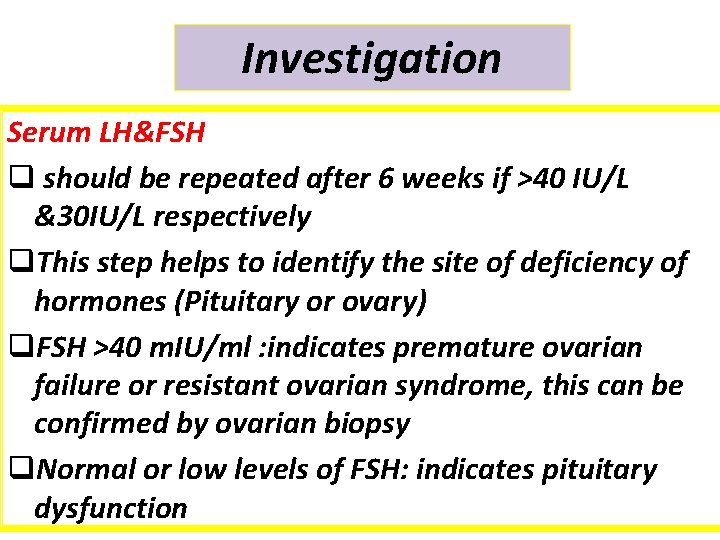
Investigation Serum LH&FSH q should be repeated after 6 weeks if >40 IU/L &30 IU/L respectively q. This step helps to identify the site of deficiency of hormones (Pituitary or ovary) q. FSH >40 m. IU/ml : indicates premature ovarian failure or resistant ovarian syndrome, this can be confirmed by ovarian biopsy q. Normal or low levels of FSH: indicates pituitary dysfunction
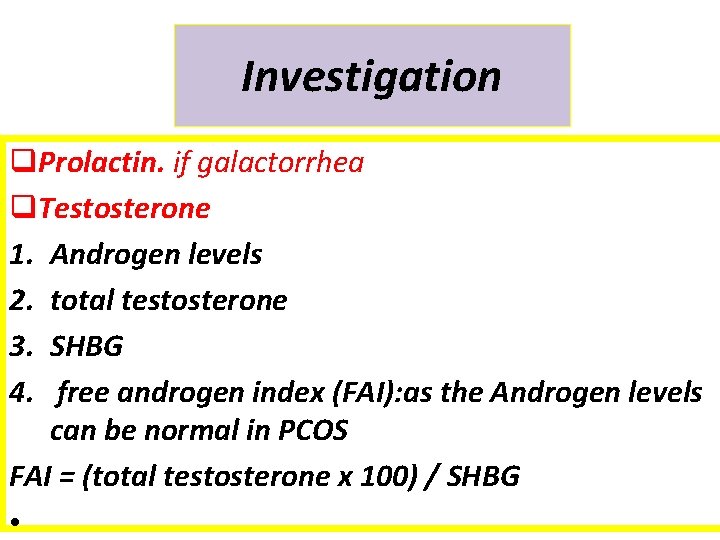
Investigation q. Prolactin. if galactorrhea q. Testosterone 1. Androgen levels 2. total testosterone 3. SHBG 4. free androgen index (FAI): as the Androgen levels can be normal in PCOS FAI = (total testosterone x 100) / SHBG •
Investigation The progesterone challenge test • To evaluate ovarian production of estrogen indirectly. • the administration of either: • medroxyprogesterone acetate (10 mg orally for 5– 10 days) • or intramuscular progesterone (100– 200 mg once)
Investigation The progesterone challenge test • A positive test: withdrawal bleeding 2– 7 days after completing the course indicates that HPO axis is normal, the ovaries are producing estrogen, functional uterus with an intact endometrium and a patent outflow tract.
Investigation The progesterone challenge test • Modern measurement of serum estradiol levels is now usually sufficient to provide this evidence. • If the patient does not bleed in response to progesterone this mean there is lack of progesterone receptor in endothelium
Investigation Estrogen-progesterone challenge test: qcourse of OCP then observe if withdrawal bleeding occurs or not q. If there is no bleeding: local endometrial lesions like synechiae, which intern is confirmed by HSG q. If bleeding occurs: endometrium is responsive but there is estrogen deficiency.
Investigation Gn. RH stimulation test: If Gn. RH administered qincrease pituitary gonadotropins( LH, FSH) indicat the probable cause is hypothalamic dysfunction qno rise of gonadotropins( LH, FSH): indicate pituitary disorders
Investigation Pelvic ultrasound : qevidence of polycystic ovary syndrome qovarian tumors q. Abnormalities of the lower genital tract.
Investigation q Pituitary MRI or CT scan for any pituitary tumors q. Hystrosalpigogram(HSG), Hysterosc opy to assess the uterus q. Karyotyping if required
Management Is based on the etiology
treatment If no abnormality detected v. If patient is not anxious about amenorrhea : No treatment, but reassurance v the patient is anxious about amenorrhea, start on OCP
treatment Uterine causes 1 -If Asherman s syndrom: For synechiae: q. Adhesiolysis either by D& C or Hysteroscopic release of adhesions using scissors or electrocautery followed by insretion of IUCD q. To prevent recurrence of adhesion high dose estrogen and progestin therapy is given monthly for withdrawal bleed 2 -Cervical stenosis: Careful cervical dilatation
treatment Ovarian Causes PCOS : Depending on the woman’s desires 1. Contraceptive pills to regularize the menses 2. Ovulation induction to restore fertility 3. Progestogen induced withdrawal bleeds to reduce the risk of endometrial hyperplasia.
treatment Ovarian Causes Premature ovarian failure(spontaneous or iatrogenic) • Hormone replacement therapy (HRT) to prevent bone loss (osteoporosis). • Fertility is only a possibility by ovum donation and in vitro fertilization (IVF) and total replacement of hormones • Corticosteroids in autoimmune disorders
treatment Ovarian Causes • Ovarian tumor: excision
treatment Pituitary Causes Sheehan's syndrome : q. Treatment is lifelong hormone replacement therapy for the missing hormones q. Estrogen/progesterone therapy for restoration of menses. q. Gonadotropins for induction of ovulation
treatment Pituitary Causes • Hyperprolactinemia q. Thyroxine if the hyperprolactinemia is due to hypothyroidism. q. Microadenomas—dopamine agonists such as bromocriptine and cabergoline q. Macroadenomas—may require surgery
treatment Hypothalamic factors • Anxiety, stress: provide assurance and psychotherapy • Exercise induced amenorrhea : limit the physical activity • Brain tumer eg. Craniopharngioma, glioma treated surgically
treatment systemic causes Malnourished and systemic illness: treat the cause
treatment thyroid factors • Hypothyroidism: thyroxine supplementation
treatment Adrenal disorders Adrenal tumor(simple adrenalectomy) For adult onset adrenal hyperplasia: dexamethasone
treatment Iatrogenic –druges: Contraceptive-related amenorrhoea: The management is, Expectant

Thank you
- Slides: 47