
Secondary 15 Note to teachers and students To

- Slides: 12
Secondary 15 Note to teachers and students: To look more closely at the following topics, try our 45 minute lesson: • Where do uncontacted tribes live? • What threatens their survival? • Is it ethical to leave uncontacted tribes alone?
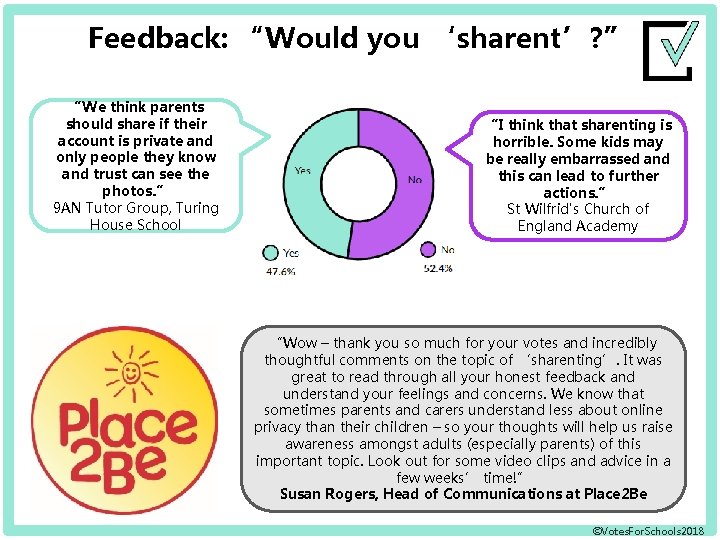
Feedback: “Would you ‘sharent’? ” “We think parents should share if their account is private and only people they know and trust can see the photos. ” 9 AN Tutor Group, Turing House School “I think that sharenting is horrible. Some kids may be really embarrassed and this can lead to further actions. ” St Wilfrid's Church of England Academy “Wow – thank you so much for your votes and incredibly thoughtful comments on the topic of ‘sharenting’. It was great to read through all your honest feedback and understand your feelings and concerns. We know that sometimes parents and carers understand less about online privacy than their children – so your thoughts will help us raise awareness amongst adults (especially parents) of this important topic. Look out for some video clips and advice in a few weeks’ time!” Susan Rogers, Head of Communications at Place 2 Be ©Votes. For. Schools 2018
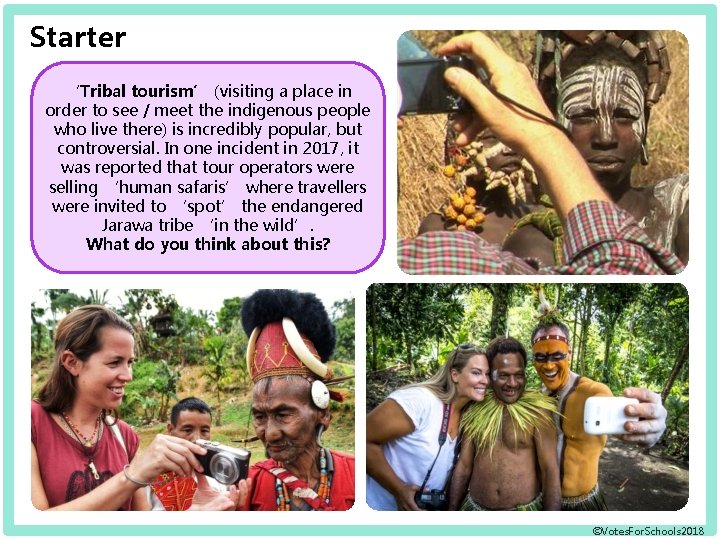
Starter ‘Tribal tourism’ (visiting a place in order to see / meet the indigenous people who live there) is incredibly popular, but controversial. In one incident in 2017, it was reported that tour operators were selling ‘human safaris’ where travellers were invited to ‘spot’ the endangered Jarawa tribe ‘in the wild’. What do you think about this? ©Votes. For. Schools 2018
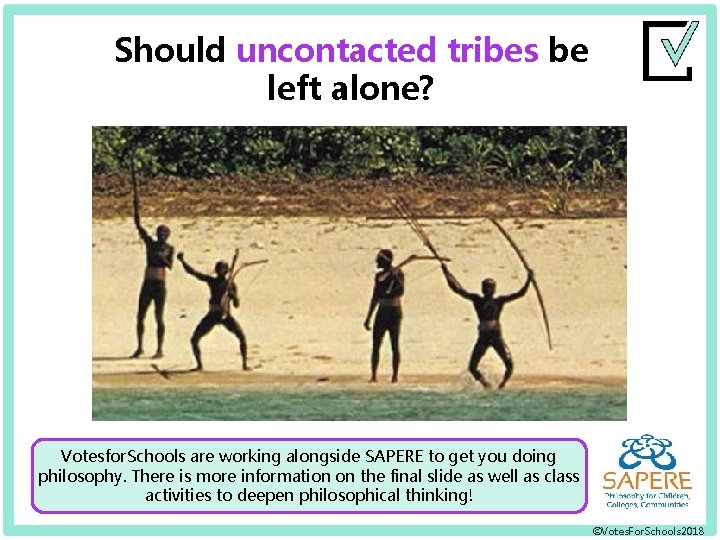
Should uncontacted tribes be left alone? Votesfor. Schools are working alongside SAPERE to get you doing philosophy. There is more information on the final slide as well as class activities to deepen philosophical thinking! ©Votes. For. Schools 2018
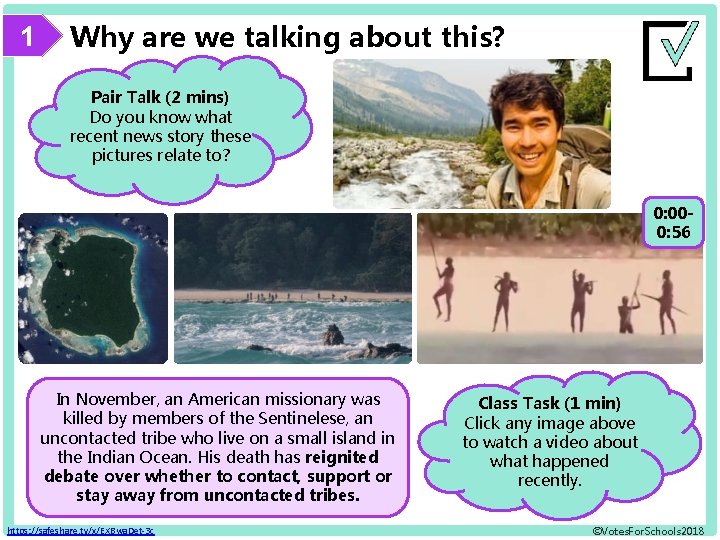
1 Why are we talking about this? Pair Talk (2 mins) Do you know what recent news story these pictures relate to? 0: 000: 56 In November, an American missionary was killed by members of the Sentinelese, an uncontacted tribe who live on a small island in the Indian Ocean. His death has reignited debate over whether to contact, support or stay away from uncontacted tribes. https: //safeshare. tv/x/EXBwa. Det-3 c Class Task (1 min) Click any image above to watch a video about what happened recently. ©Votes. For. Schools 2018
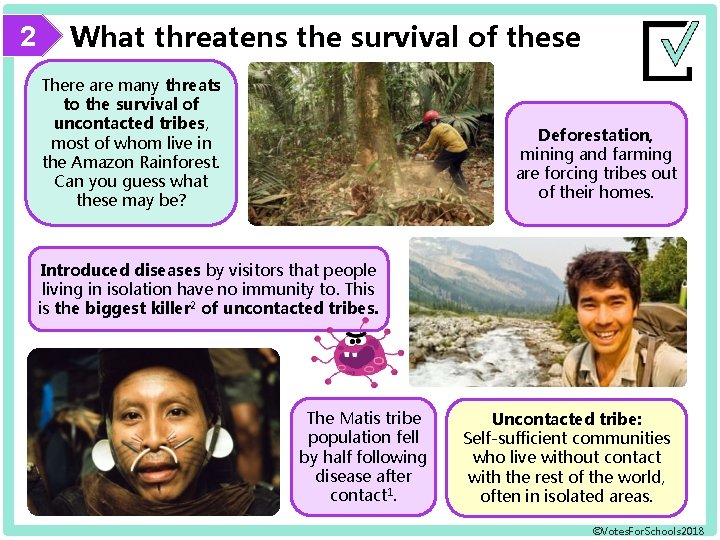
2 What threatens the survival of these tribes? There are many threats to the survival of uncontacted tribes, most of whom live in the Amazon Rainforest. Can you guess what these may be? Deforestation, mining and farming are forcing tribes out of their homes. Introduced diseases by visitors that people living in isolation have no immunity to. This is the biggest killer 2 of uncontacted tribes. The Matis tribe population fell by half following disease after contact 1. Uncontacted tribe: Self-sufficient communities who live without contact with the rest of the world, often in isolated areas. ©Votes. For. Schools 2018
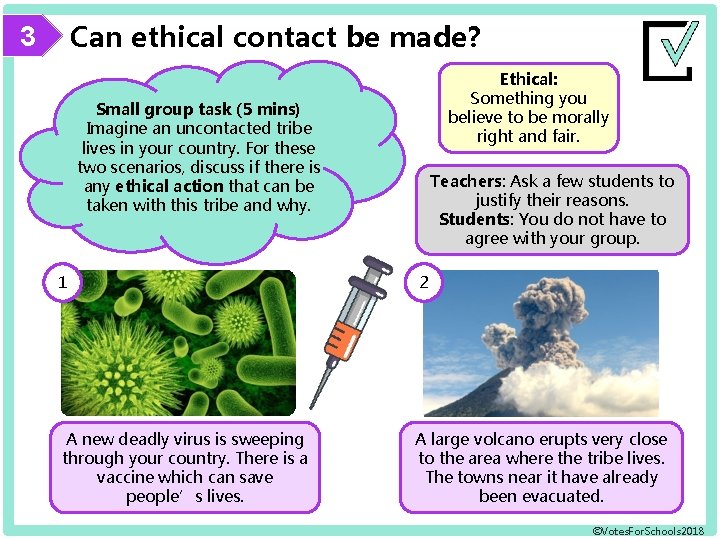
Can ethical contact be made? 3 Ethical: Something you believe to be morally right and fair. Small group task (5 mins) Imagine an uncontacted tribe lives in your country. For these two scenarios, discuss if there is any ethical action that can be taken with this tribe and why. Teachers: Ask a few students to justify their reasons. Students: You do not have to agree with your group. 1 2 A new deadly virus is sweeping through your country. There is a vaccine which can save people’s lives. A large volcano erupts very close to the area where the tribe lives. The towns near it have already been evacuated. ©Votes. For. Schools 2018
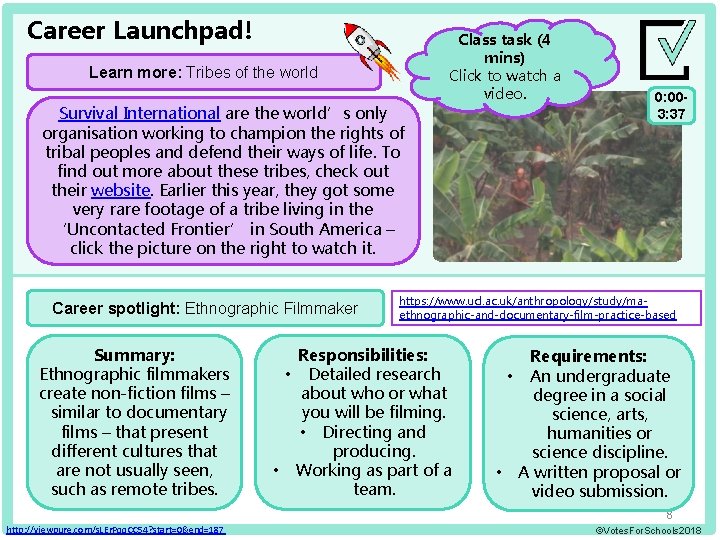
Career Launchpad! Learn more: Tribes of the world Survival International are the world’s only organisation working to champion the rights of tribal peoples and defend their ways of life. To find out more about these tribes, check out their website. Earlier this year, they got some very rare footage of a tribe living in the ‘Uncontacted Frontier’ in South America – click the picture on the right to watch it. Career spotlight: Ethnographic Filmmaker Summary: Ethnographic filmmakers create non-fiction films – similar to documentary films – that present different cultures that are not usually seen, such as remote tribes. Class task (4 mins) Click to watch a video. 0: 003: 37 https: //www. ucl. ac. uk/anthropology/study/maethnographic-and-documentary-film-practice-based Responsibilities: • Detailed research about who or what you will be filming. • Directing and producing. • Working as part of a team. Requirements: • An undergraduate degree in a social science, arts, humanities or science discipline. • A written proposal or video submission. 8 http: //viewpure. com/s. LEr. Pqq. CC 54? start=0&end=187 ©Votes. For. Schools 2018
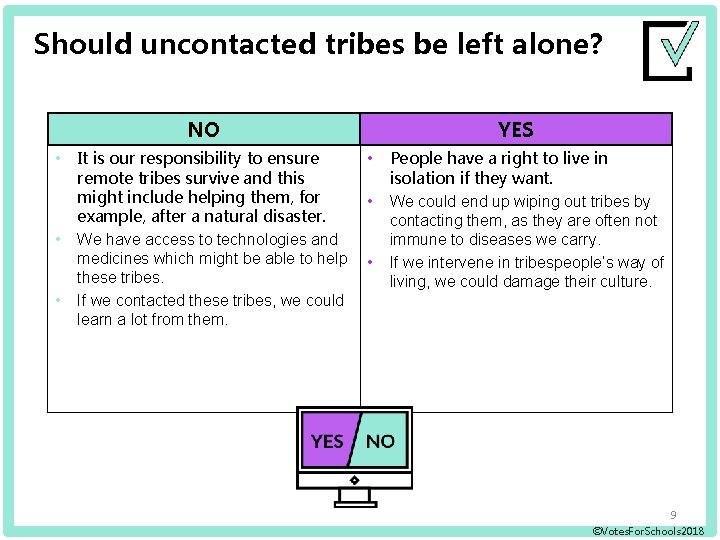
Should uncontacted tribes be left alone? NO • • • It is our responsibility to ensure remote tribes survive and this might include helping them, for example, after a natural disaster. We have access to technologies and medicines which might be able to help these tribes. If we contacted these tribes, we could learn a lot from them. YES • • • People have a right to live in isolation if they want. We could end up wiping out tribes by contacting them, as they are often not immune to diseases we carry. If we intervene in tribespeople’s way of living, we could damage their culture. 9 ©Votes. For. Schools 2018
Vote Now on… www. votesforschools. com 10 ©Votes. For. Schools 2018
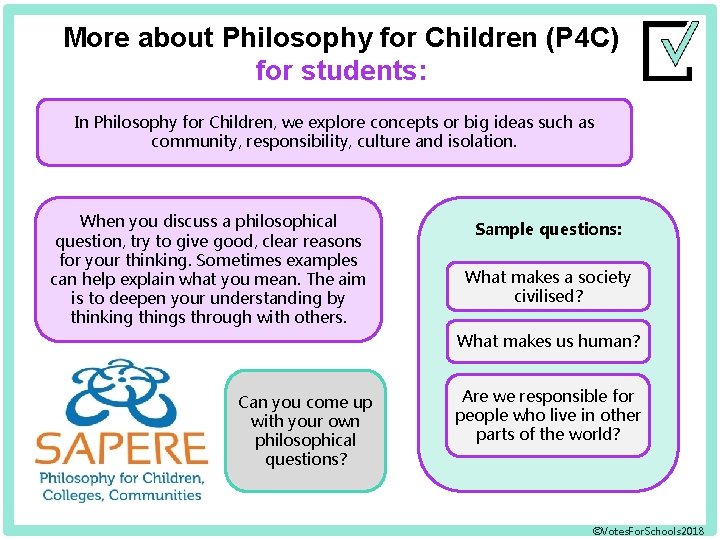
More about Philosophy for Children (P 4 C) for students: In Philosophy for Children, we explore concepts or big ideas such as community, responsibility, culture and isolation. When you discuss a philosophical question, try to give good, clear reasons for your thinking. Sometimes examples can help explain what you mean. The aim is to deepen your understanding by thinking things through with others. Sample questions: What makes a society civilised? What makes us human? Can you come up with your own philosophical questions? Are we responsible for people who live in other parts of the world? ©Votes. For. Schools 2018
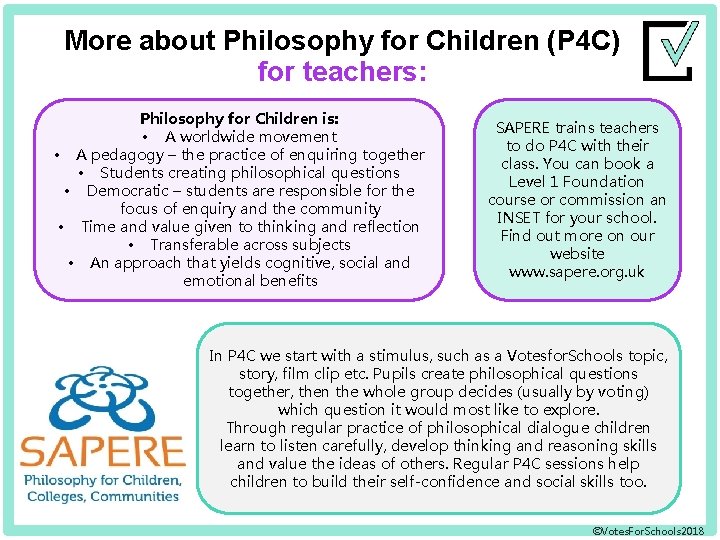
More about Philosophy for Children (P 4 C) for teachers: Philosophy for Children is: • A worldwide movement • A pedagogy – the practice of enquiring together • Students creating philosophical questions • Democratic – students are responsible for the focus of enquiry and the community • Time and value given to thinking and reflection • Transferable across subjects • An approach that yields cognitive, social and emotional benefits SAPERE trains teachers to do P 4 C with their class. You can book a Level 1 Foundation course or commission an INSET for your school. Find out more on our website www. sapere. org. uk In P 4 C we start with a stimulus, such as a Votesfor. Schools topic, story, film clip etc. Pupils create philosophical questions together, then the whole group decides (usually by voting) which question it would most like to explore. Through regular practice of philosophical dialogue children learn to listen carefully, develop thinking and reasoning skills and value the ideas of others. Regular P 4 C sessions help children to build their self-confidence and social skills too. ©Votes. For. Schools 2018