
Second Year Phonetic Courses TEACHER Dr RAHMANI A


![4. Nasal: Nasals require air to flow out of the nose. m [n] [ŋ]](https://slidetodoc.com/presentation_image_h/063349fd336b47a164a6e4e836dcc034/image-19.jpg "4. Nasal: Nasals require air to flow out of the nose. m [n] [ŋ]")
![Diphthongs (8 in number) *[ʊə] — as in poor /pʊə/ *[oʊ] — as in](https://slidetodoc.com/presentation_image_h/063349fd336b47a164a6e4e836dcc034/image-30.jpg "Diphthongs (8 in number) *[ʊə] — as in poor /pʊə/ *[oʊ] — as in")
![The triphthong [aʊə] is often pronounced just as /ɑː/, especially in some words like](https://slidetodoc.com/presentation_image_h/063349fd336b47a164a6e4e836dcc034/image-35.jpg "The triphthong [aʊə] is often pronounced just as /ɑː/, especially in some words like")

- Slides: 49
Second Year Phonetic Courses TEACHER. Dr. RAHMANI. A Academic year 2020 -2021
Course one: Articulatory phonetics q. A review of English Speech Sound VOWELS AND CONSONANTS q. Speech Chain
üPHONETICS vs PHONOLOGY üConsonants vs vowels üClassification of consonants üWhat are pure vowel sounds üWhat makes them different from consonants sounds üHow many vowel sounds does English have
üWhat is a Diphthong üWhat is a Triphthong üWhat is Smoothing üSpeech chain definition üSpeech chain levels
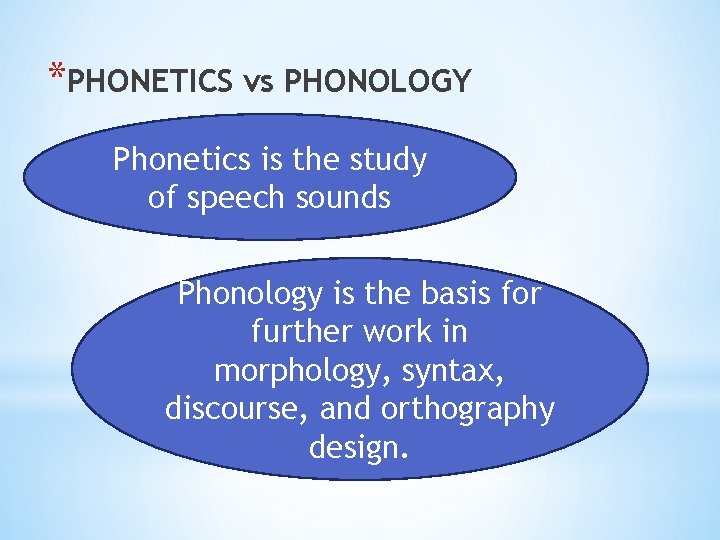
*PHONETICS vs PHONOLOGY Phonetics is the study of speech sounds Phonology is the basis for further work in morphology, syntax, discourse, and orthography design.
The branches of phonetics
Articulatory Phonetics: How we physically (or physiologically) produce sounds. Phonetics is the area of the language Acoustic Phonetics: How we analyze the sound transmissions and patterns including the conditions in which they are produced. Auditory Phonetics: How our ears, auditory system and brain filter and process these sounds once they receive them.
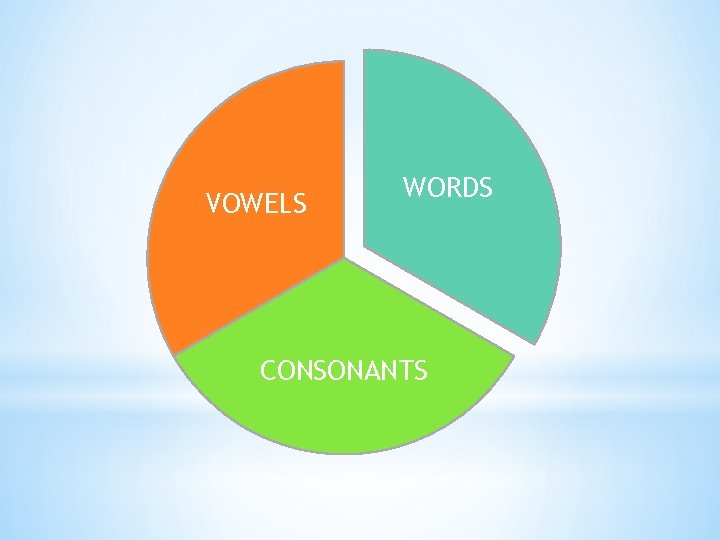
VOWELS WORDS CONSONANTS
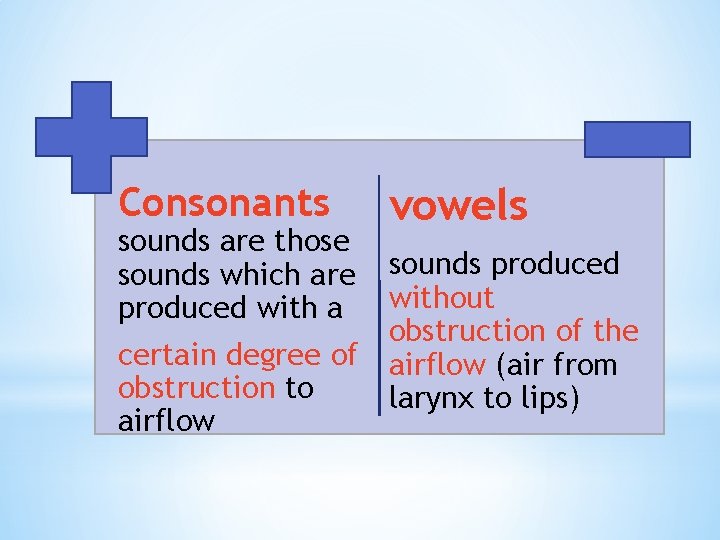
Consonants sounds are those sounds which are produced with a vowels sounds produced without obstruction of the certain degree of airflow (air from obstruction to larynx to lips) airflow
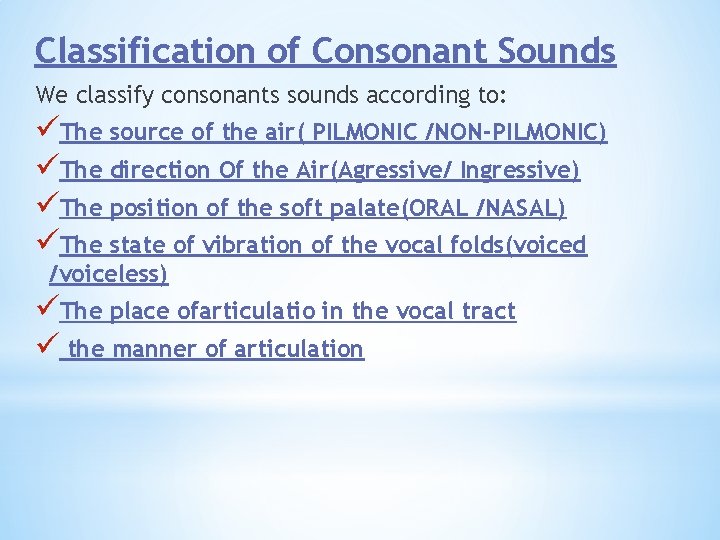
Classification of Consonant Sounds We classify consonants sounds according to: üThe source of the air( PILMONIC /NON-PILMONIC) üThe direction Of the Air(Agressive/ Ingressive) üThe position of the soft palate(ORAL /NASAL) üThe state of vibration of the vocal folds(voiced /voiceless) üThe place ofarticulatio in the vocal tract ü the manner of articulation
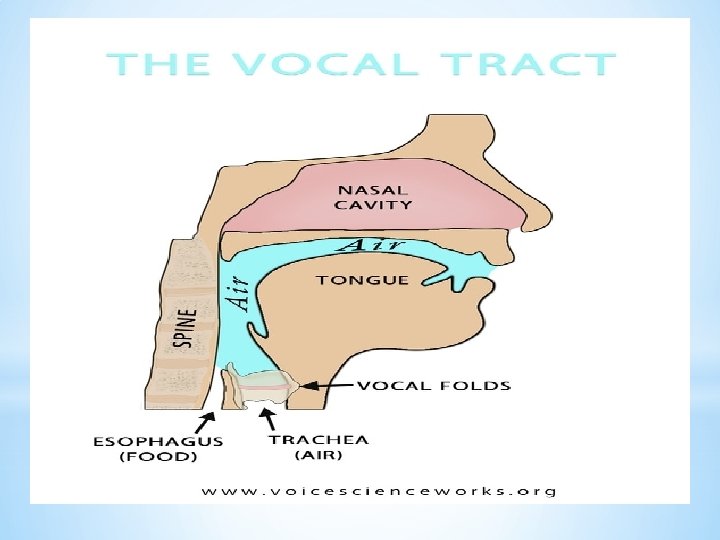
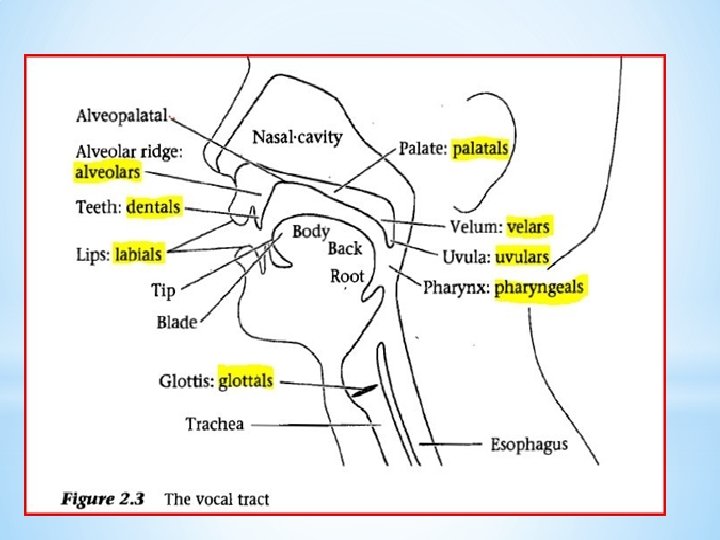
ØThe vocal tract is a container of air that starts from the top of the vocal folds and goes all the way to the edge of the lips. ØThe average length of a vocal tract for males is about 17 cm and 14 cm for females.
cal folds.
PLACE OF ARTICULATION 1. Bilabials are produced through upper and lower lips. /p/ as in “purse” and “rap“ /b/ as in “back” and “cab“ /m/ as in “mad” and “clam“ 2. Labiodentals. Labiodental sounds are produced through the upper teeth and the lower lip. f/ as in “fro” and “calf“ /v/ as in “vine” and “have” 3. Dentals. Dental sound is produced by placing the tongue tip or blade behind the upper front teeth. /θ/ as is “thick” and “bath“ */ð/ as in “the” and “rather”
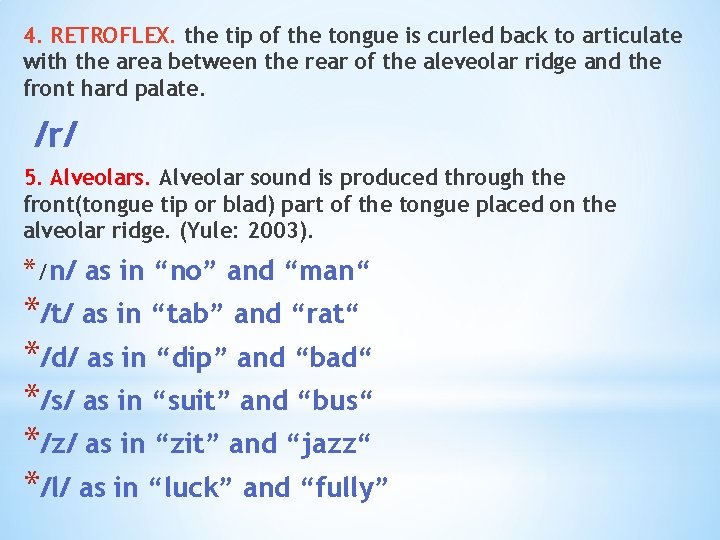
4. RETROFLEX. the tip of the tongue is curled back to articulate with the area between the rear of the aleveolar ridge and the front hard palate. /r/ 5. Alveolars. Alveolar sound is produced through the front(tongue tip or blad) part of the tongue placed on the alveolar ridge. (Yule: 2003). */n/ as in “no” and “man“ */t/ as in “tab” and “rat“ */d/ as in “dip” and “bad“ */s/ as in “suit” and “bus“ */z/ as in “zit” and “jazz“ */l/ as in “luck” and “fully”
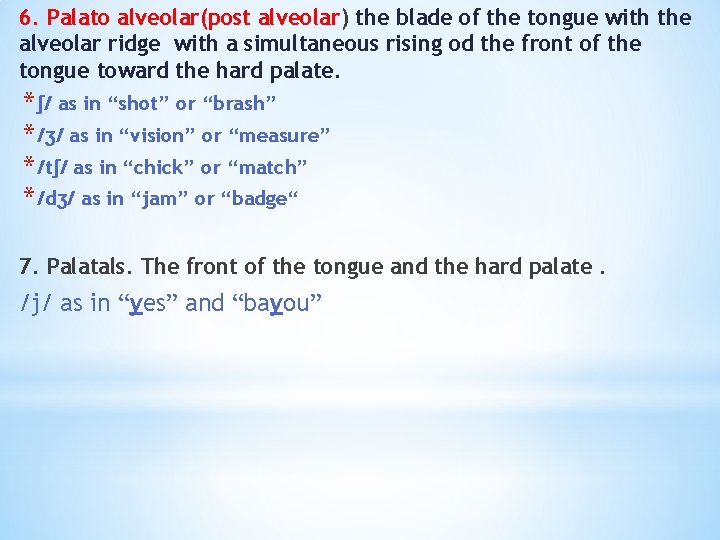
6. Palato alveolar(post alveolar) the blade of the tongue with the alveolar ridge with a simultaneous rising od the front of the tongue toward the hard palate. * ʃ/ as in “shot” or “brash” * /ʒ/ as in “vision” or “measure” * /tʃ/ as in “chick” or “match” * /dʒ/ as in “jam” or “badge“ 7. Palatals. The front of the tongue and the hard palate. /j/ as in “yes” and “bayou”
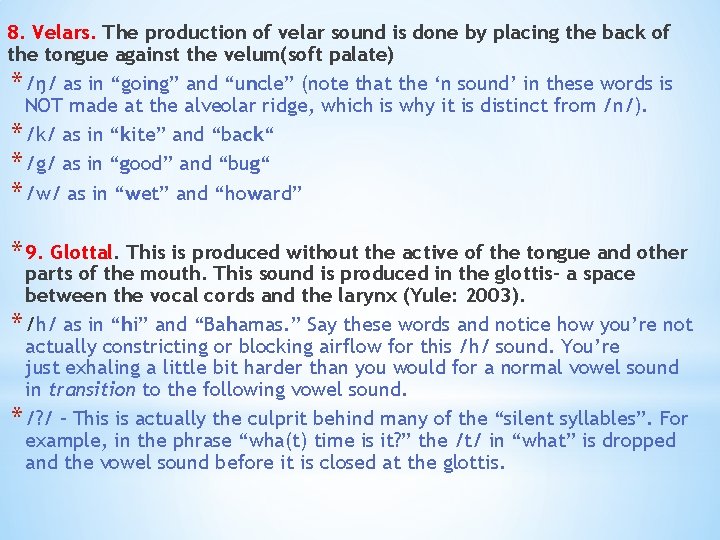
8. Velars. The production of velar sound is done by placing the back of the tongue against the velum(soft palate) * /ŋ/ as in “going” and “uncle” (note that the ‘n sound’ in these words is NOT made at the alveolar ridge, which is why it is distinct from /n/). * /k/ as in “kite” and “back“ * /g/ as in “good” and “bug“ * /w/ as in “wet” and “howard” * 9. Glottal. This is produced without the active of the tongue and other parts of the mouth. This sound is produced in the glottis- a space between the vocal cords and the larynx (Yule: 2003). * /h/ as in “hi” and “Bahamas. ” Say these words and notice how you’re not actually constricting or blocking airflow for this /h/ sound. You’re just exhaling a little bit harder than you would for a normal vowel sound in transition to the following vowel sound. * /? / – This is actually the culprit behind many of the “silent syllables”. For example, in the phrase “wha(t) time is it? ” the /t/ in “what” is dropped and the vowel sound before it is closed at the glottis.
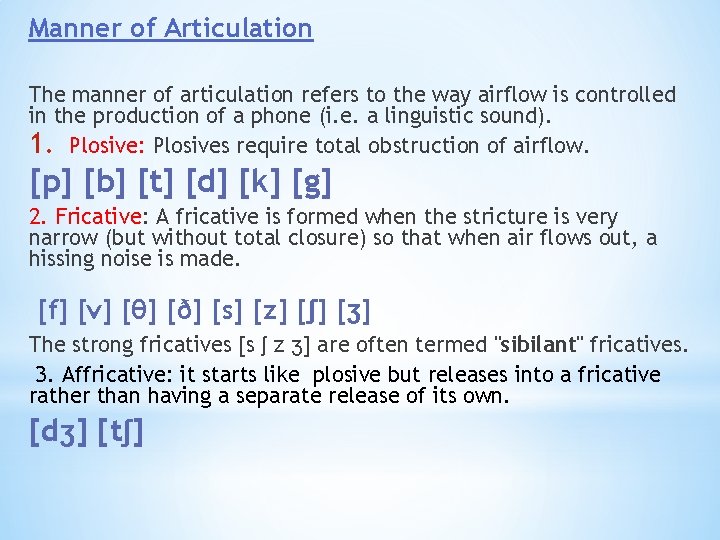
Manner of Articulation The manner of articulation refers to the way airflow is controlled in the production of a phone (i. e. a linguistic sound). 1. Plosive: Plosives require total obstruction of airflow. [p] [b] [t] [d] [k] [g] 2. Fricative: A fricative is formed when the stricture is very narrow (but without total closure) so that when air flows out, a hissing noise is made. [f] [v] [θ] [ð] [s] [z] [ʃ] [ʒ] The strong fricatives [s ʃ z ʒ] are often termed "sibilant" fricatives. 3. Affricative: it starts like plosive but releases into a fricative rather than having a separate release of its own. [dʒ] [tʃ]
4. Nasal: Nasals require air to flow out of the nose. m [n] [ŋ] 5. Lateral : A lateral is made when air flows out of the sides of the mouth. [l] 6. Approximant: An approximant is a phone made when the obstruction of airflow does not produce any audible friction. [h] [r] [j] [w]
Classification of Vowel Sounds We classify vowel sounds according to : üQuality üQuantity üPart of the tongue which is raised üHeight of the tongue üLip position
ØQuantity and Quality According to quantity, vowel sounds can be either short or long. According to quality, vowel sounds can be either strong or weak, depending on the stress of the syllable.
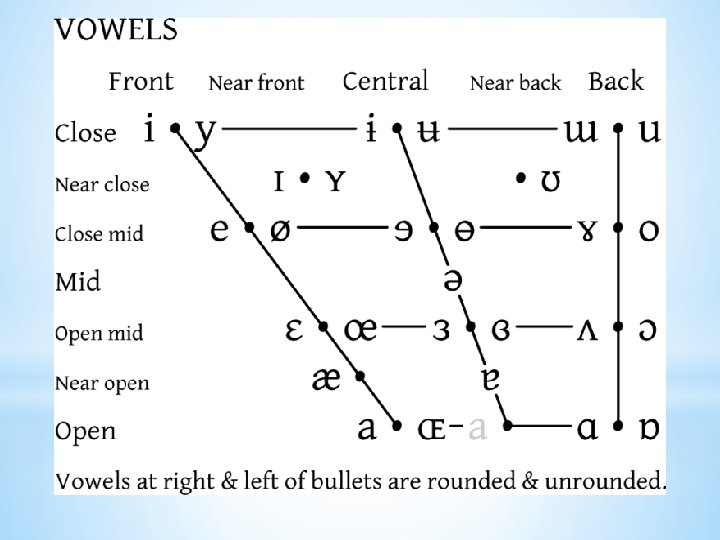
The diagram is a representation of the vowel space in the centre of the mouth where vowel sounds are articulated. It indicates tongue position: §Part of the tongue which is raised §Height of the tongue.
ØPart of the tongue and height of the tongue According to the height of the tongue, vowel sounds can be close, half clase (or close-mid), mid, half open (or open- mid) and open. ØHeight of the tongue refers to the distance between the tongue and the roof of the mouth. ØAccording to the part of the tongue which is raised, vowel sounds can be front, central or back.
ØPosition of the lips According to the position of the lips, vowel sounds can be rounded, spread and neutral. These are the basic lip positions which are used in describing the articulation of vowel sounds.
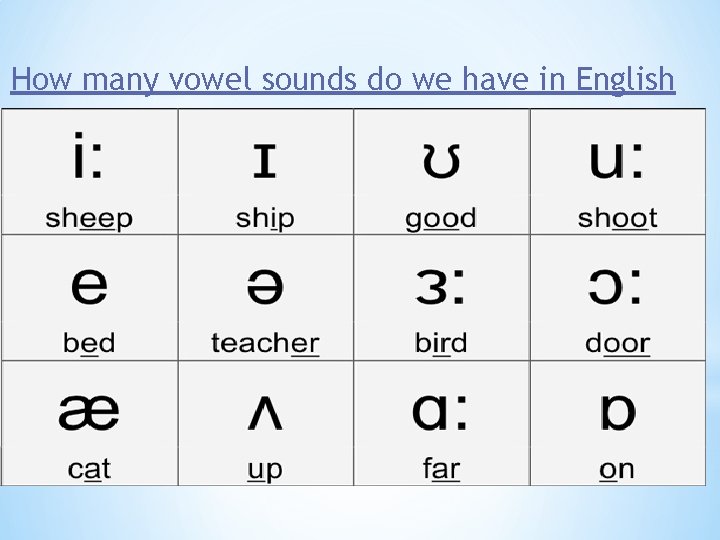
How many vowel sounds do we have in English *
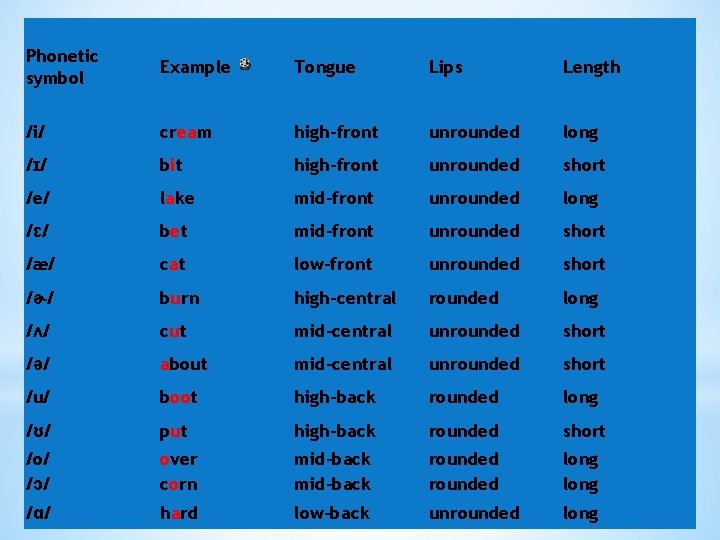
Phonetic symbol Example Tongue Lips Length /i/ cream high-front unrounded long /ɪ/ bit high-front unrounded short /e/ lake mid-front unrounded long /ɛ/ bet mid-front unrounded short /æ/ cat low-front unrounded short /ɚ/ burn high-central rounded long /ʌ/ cut mid-central unrounded short /ə/ about mid-central unrounded short /u/ boot high-back rounded long /ʊ/ put high-back rounded short /o/ /ɔ/ over corn mid-back rounded long /ɑ/ hard low-back unrounded long
What is a Diphthong ØA diphthong is a long, complex vowel which starts with the sound quality of one vowel and ends with the sound quality of another one. ØAlthough they are classified as single phonemes, diphthongs are given a double symbol to show both the quality they start with and the quality they end with.
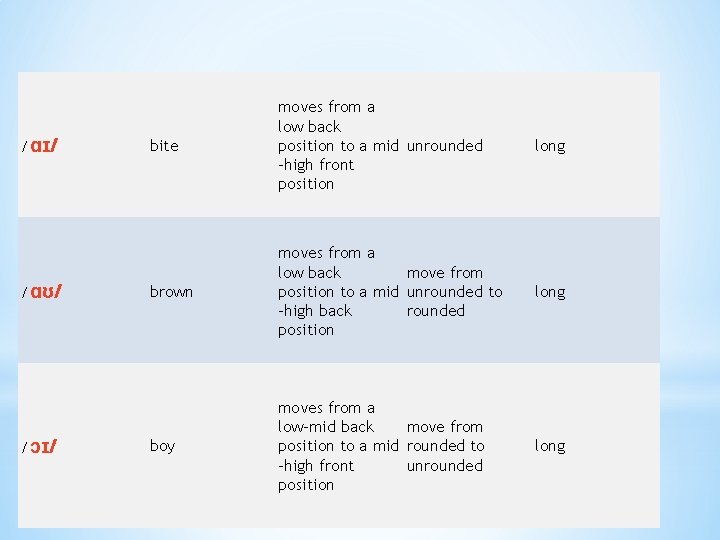
/ɑɪ/ /ɑʊ/ /ɔɪ/ bite moves from a low back position to a mid unrounded -high front position long brown moves from a move from low back position to a mid unrounded to -high back rounded position long boy moves from a move from low-mid back position to a mid rounded to -high front unrounded position long
Diphthongs (8 in number) *[ʊə] — as in poor /pʊə/ *[oʊ] — as in boast /boʊst/ *[aʊ] — as in arouse /ə’raʊz/ *[aɪ] — as in sprite /spraɪt/ *[eɪ] — as in jail /dʒeɪl/ *[ɔɪ] — as in soil /sɔɪl/ *[ɪə] — as in mere /mɪə/ *[eə] — as in spare /speə
*What is a Triphthong *ACCORDING TO Peter Roach, the most complex English sounds of the vowel type are the triphthongs. They can be rather difficult to pronounce, and very difficult to recognise.
*A triphthong is a glide from one vowel to another and then to a third, all produced rapidly and without interruption. For example, a careful pronunciation of the word ‘hour’ begins with a vowel quality similar to cu, goes on to a ghde towards the back close rounded area (for which we use the symbol u), then ends with a mid-central vowel (schwa, э).
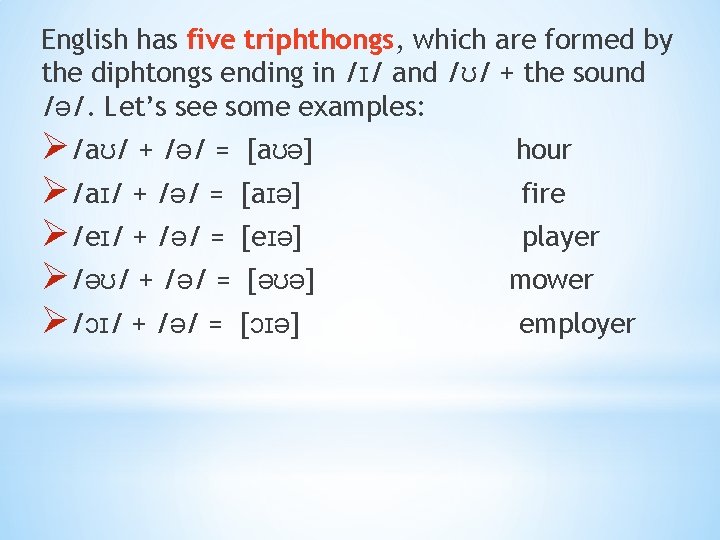
English has five triphthongs, which are formed by the diphtongs ending in /ɪ/ and /ʊ/ + the sound /ə/. Let’s see some examples: Ø/aʊ/ + /ə/ = [aʊə] hour Ø/aɪ/ + /ə/ = [aɪə] fire Ø/eɪ/ + /ə/ = [eɪə] player Ø/əʊ/ + /ə/ = [əʊə] mower Ø/ɔɪ/ + /ə/ = [ɔɪə] employer
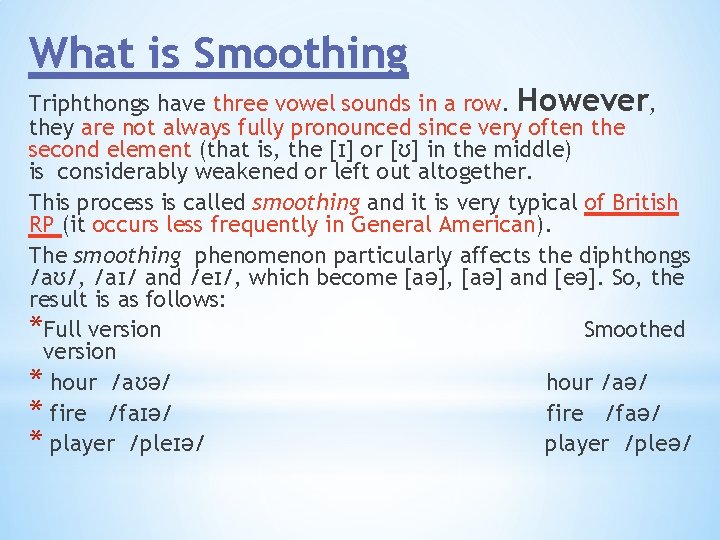
What is Smoothing Triphthongs have three vowel sounds in a row. However, they are not always fully pronounced since very often the second element (that is, the [ɪ] or [ʊ] in the middle) is considerably weakened or left out altogether. This process is called smoothing and it is very typical of British RP (it occurs less frequently in General American). The smoothing phenomenon particularly affects the diphthongs /aʊ/, /aɪ/ and /eɪ/, which become [aə], [aə] and [eə]. So, the result is as follows: *Full version Smoothed version * hour /aʊə/ hour /aə/ * fire /faɪə/ fire /faə/ * player /pleɪə/ player /pleə/
The triphthong [aʊə] is often pronounced just as /ɑː/, especially in some words like the possessive our. Notice how clearly this happens in the following examples: Ø A seal’s flippers resemble our hands (A. S. Byatt, BBC 4). Ø Somewhere our lives matter (Malorie Blackman, on BBC 4). Ø Thank you for downloading this episode of In Our Time. For more details about In Our Time and for our terms of use… (Melvyn Bragg, BBC 4).
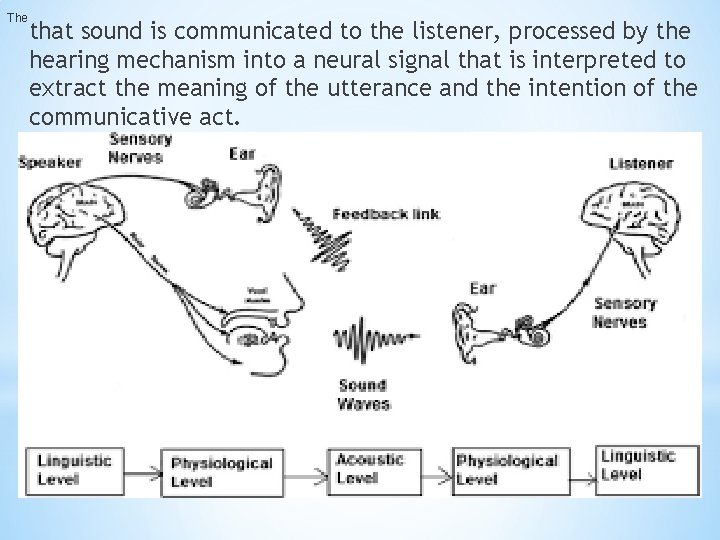
Speech chain
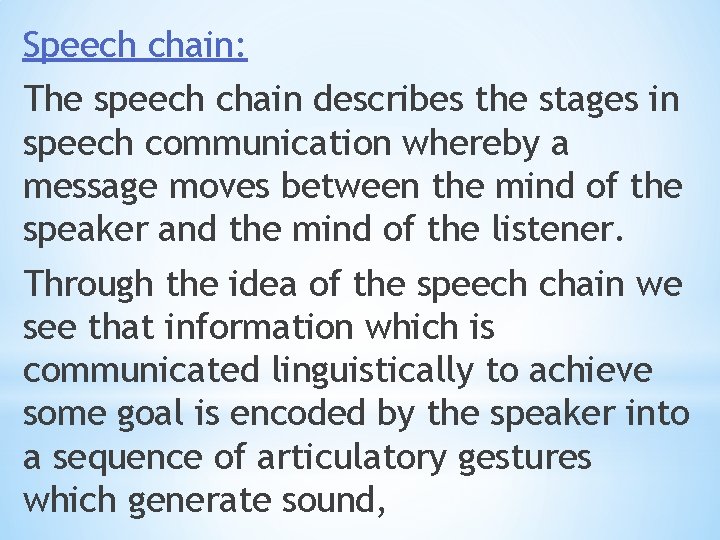
Speech chain: The speech chain describes the stages in speech communication whereby a message moves between the mind of the speaker and the mind of the listener. Through the idea of the speech chain we see that information which is communicated linguistically to achieve some goal is encoded by the speaker into a sequence of articulatory gestures which generate sound,
The that sound is communicated to the listener, processed by the hearing mechanism into a neural signal that is interpreted to extract the meaning of the utterance and the intention of the communicative act.
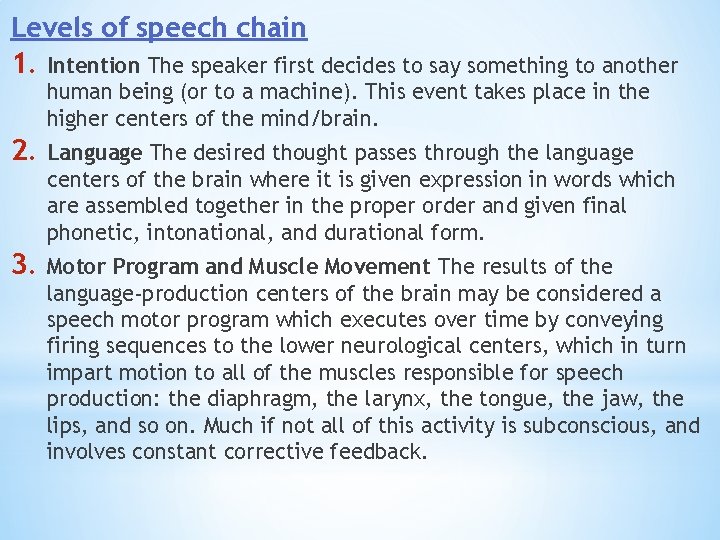
Levels of speech chain 1. Intention The speaker first decides to say something to another human being (or to a machine). This event takes place in the higher centers of the mind/brain. 2. Language The desired thought passes through the language centers of the brain where it is given expression in words which are assembled together in the proper order and given final phonetic, intonational, and durational form. 3. Motor Program and Muscle Movement The results of the language-production centers of the brain may be considered a speech motor program which executes over time by conveying firing sequences to the lower neurological centers, which in turn impart motion to all of the muscles responsible for speech production: the diaphragm, the larynx, the tongue, the jaw, the lips, and so on. Much if not all of this activity is subconscious, and involves constant corrective feedback.
*5. Airstream in the Vocal Tract As a result of the muscle movements, a stream of air emerges from the lungs, passes through the vocal cords where a phonation type (e. g. normal voicing, whispering, aspiration, creaky voice, or no shaping whatsoever) is developed, and receives its final shape in the vocal tract before emerging from the mouth and the nose and through the tissues of the face. 6. Sound Wave in Air The vibrations caused by the vocal apparatus of the speaker radiate through the air as a sound wave. 7. Electronic Transduction The sound wave may be converted to analog or digital form for storage or transmission, and in the form of electric waves may be transported thousands of miles to its destination, where the information in the electric waves is converted back to the form of sound. It is in the form of an electronic copy of the original sound wave that automatic speech recognition by computer gains access to speech data.
7. Hearing The sound wave, which may have passed through electronic coding and decoding, eventually strikes the eardrums of another human being, where it is first converted to waves on the surface of the tympanum membranes, next to mechanical motion via the ossicles of the middle ear, then to fluid pressure waves in the medium bathing the basiliar membrane of the inner ear, and finally to firings in the 30, 000 neural fibers which combine to form the auditory nerve. 8. Auditory and Language Processing The lower centers of the brainstem, the thalamus, the auditory cortex, and the language centers of the brain all cooperate in the recognition of the phonemes which convey meaning, the intonational and durational contours which provide additional information, and the vocal quality which allows the listener to recognize who is speaking and to gain insight into the speaker's health, emotional state, and intention in speaking
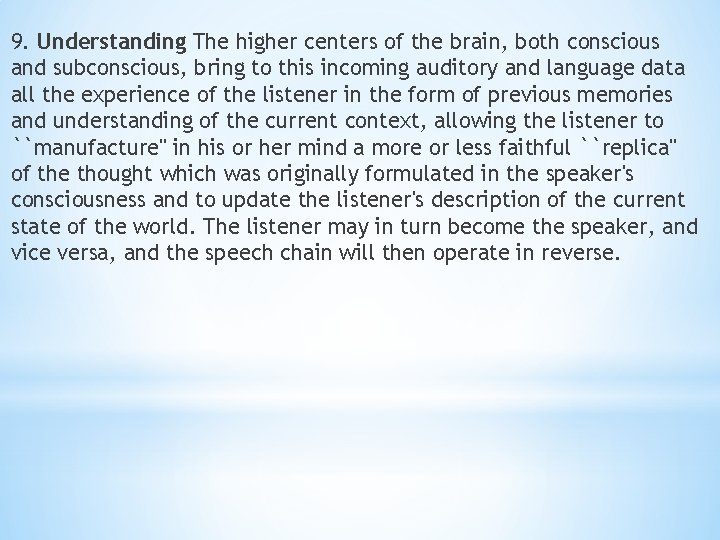
9. Understanding The higher centers of the brain, both conscious and subconscious, bring to this incoming auditory and language data all the experience of the listener in the form of previous memories and understanding of the current context, allowing the listener to ``manufacture" in his or her mind a more or less faithful ``replica" of the thought which was originally formulated in the speaker's consciousness and to update the listener's description of the current state of the world. The listener may in turn become the speaker, and vice versa, and the speech chain will then operate in reverse.
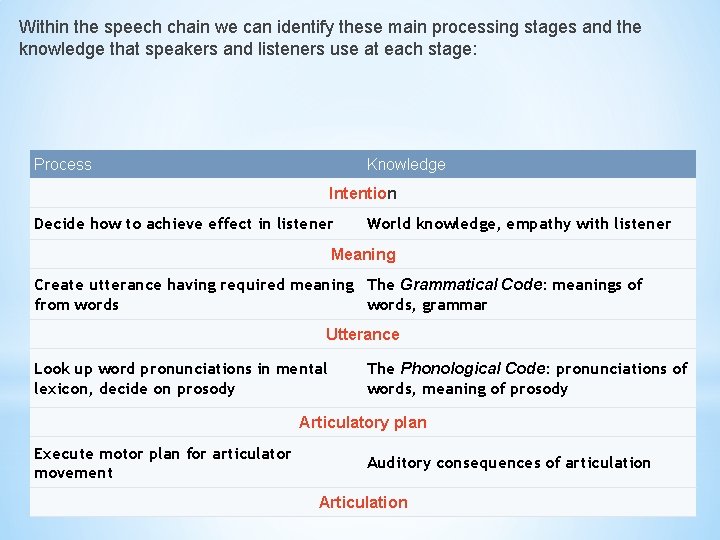
Within the speech chain we can identify these main processing stages and the knowledge that speakers and listeners use at each stage: Process Knowledge Intention Decide how to achieve effect in listener World knowledge, empathy with listener Meaning Create utterance having required meaning The Grammatical Code: meanings of from words, grammar Utterance Look up word pronunciations in mental lexicon, decide on prosody The Phonological Code: pronunciations of words, meaning of prosody Articulatory plan Execute motor plan for articulator movement Auditory consequences of articulation Articulation
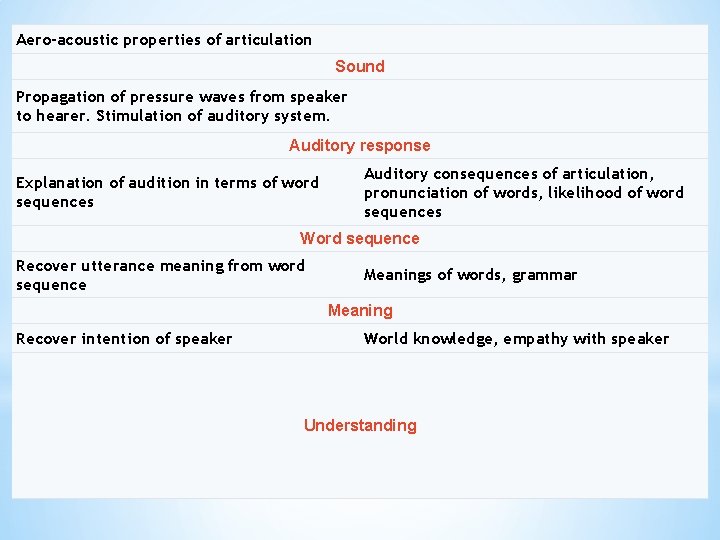
Aero-acoustic properties of articulation Sound Propagation of pressure waves from speaker to hearer. Stimulation of auditory system. Auditory response Explanation of audition in terms of word sequences Auditory consequences of articulation, pronunciation of words, likelihood of word sequences Word sequence Recover utterance meaning from word sequence Meanings of words, grammar Meaning Recover intention of speaker World knowledge, empathy with speaker Understanding
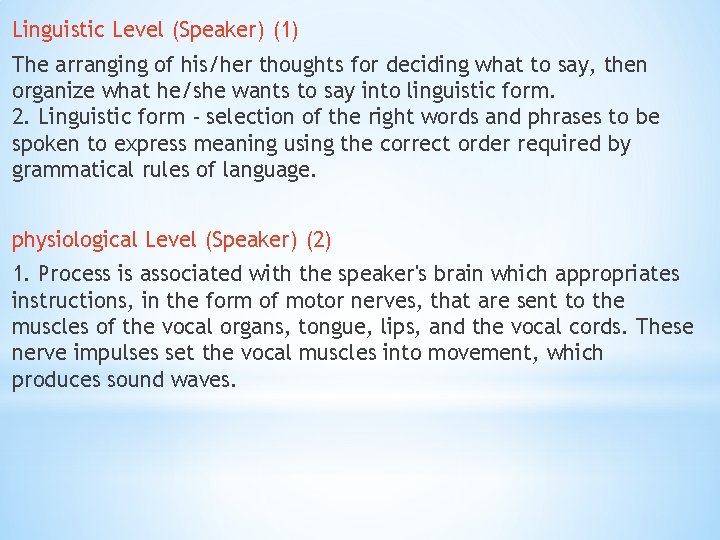
Linguistic Level (Speaker) (1) The arranging of his/her thoughts for deciding what to say, then organize what he/she wants to say into linguistic form. 2. Linguistic form - selection of the right words and phrases to be spoken to express meaning using the correct order required by grammatical rules of language. physiological Level (Speaker) (2) 1. Process is associated with the speaker's brain which appropriates instructions, in the form of motor nerves, that are sent to the muscles of the vocal organs, tongue, lips, and the vocal cords. These nerve impulses set the vocal muscles into movement, which produces sound waves.
3. Acoustic Level (3) The movements of the vocal folds generate speech sounds that travel through the air between the speaker and the listener. 4. Physiological Level (Listener) (4) Pressure changes at the ear activate the listener's auditory mechanism and produce nerve impulses that travel along the acoustic nerve to the listener's brain. Linguistic Level (Listener) (5) 1. The already considerable amount of nerve activity in the listener's brain is modified further by the nerve impulses arriving from the organ of hearing. This modification of brain activity brings about recognition of the speaker's message.
Ashby, Michael and John Maidment (2005) Introducing Phonetic Science. Cambridge University Press. Clark, John and Colin Yallop (1995) An Introduction to Phonetics and Phonology, 2 nd edition, pp. 42 -44. Blackwell Publishers. Crystal, David (1997) A Dictionary of Linguistics and Phonetics, 4 th edition, pp. 232. Blackwell Publishers. Davenport, Mike and S. J. Hannahs (2005) Introducing Phonetics and Phonology, 2 nd edition. New York: Hodder Arnold Publication. Ladefoged, Peter (2001) A Course in Phonetics, 4 th edition. Fort Worth: Harcourt College Publishers. Odden, David (2005) Introducing Phonology. Cambridge University Press. Roach, Peter (2000) English Phonetics and Phonology: A Practical Course, 3 rd edition. Cambridge University Press. Wee, Lian-Hee, Frederick Chew, Alfred Low and Lin Ma (2005) Tickle Your Tongue: An Introductory Reference to Learning Phonetics [software]. CDTL, National University of Singapore.
Homework 1. Draw peter Roach chart of English consonants phonemes. 2. do exercises provided in Echorouk library.
Thank you for your attention