
Second Trimester Inhibin A and New Approaches in
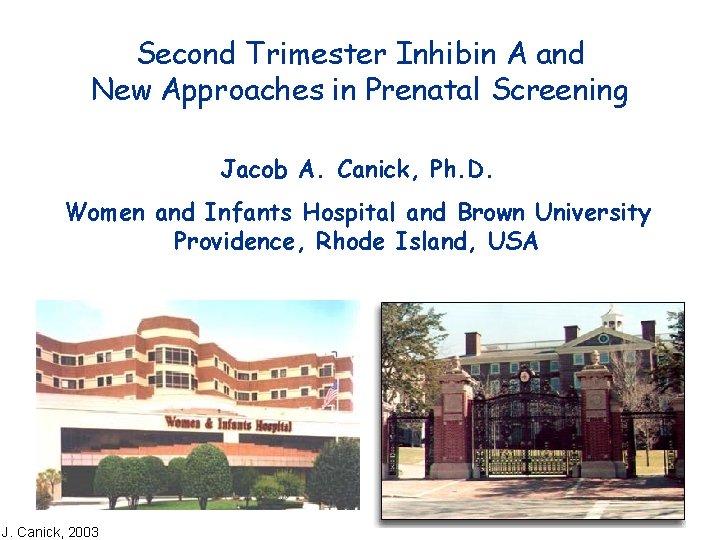
Second Trimester Inhibin A and New Approaches in Prenatal Screening Jacob A. Canick, Ph. D. Women and Infants Hospital and Brown University Providence, Rhode Island, USA J. Canick, 2003
Second Trimester Inhibin A and New Approaches in Prenatal Screening • Goals in prenatal screening • Where are we now? • New approaches: Addition of inhibin A • New approaches: The Integrated Test • New approaches: Fetal cells and DNA J. Canick, 2003
Goals in Prenatal Screening • Improved test performance (make screening safer) • Optimal timing of test • Offer the best, safest diagnostic test • Make screening available to the largest number of women J. Canick, 2003
Improving Screening Performance The challenge in screening is to have a test that has a high detection rate and low false positive rate. detection rate percentage of affecteds called screen positive by the test The higher the better! false positive rate percentage of unaffecteds called screen positive by the test The lower the better! J. Canick, 2003
Optimal Timing of Screening Test • The earlier the better – only if it is also a better test! • How early do most women present for prenatal care? • What diagnostic test will be offered if a woman is screen positive? • Safer options if a serious fetal abnormality is identified J. Canick, 2003
Offer the best, safest diagnostic test • For prenatal chromosome analysis, the choices are CVS or amniocentesis. • CVS is done no earlier than 10. 5 weeks and usually not later than 13 -14 weeks. • Amniocentesis is usually done no earlier than 14 -15 weeks. • Is CVS easily available in your geographic area? • Which procedure is safer? • Which procedure has more errors? J. Canick, 2003
Make prenatal screening available to the largest number of women • Ability to pay for test (government, insurance, self-pay? ) • Geographic dispersion (in city, suburban area, rural area)? • Availability of quality laboratory services? • Availability of quality obstetrical ultrasound? • Availability of genetic counseling? • Availability of appropriate follow-up diagnostic procedures and tests? J. Canick, 2003

Where are we now? J. Canick, 2003
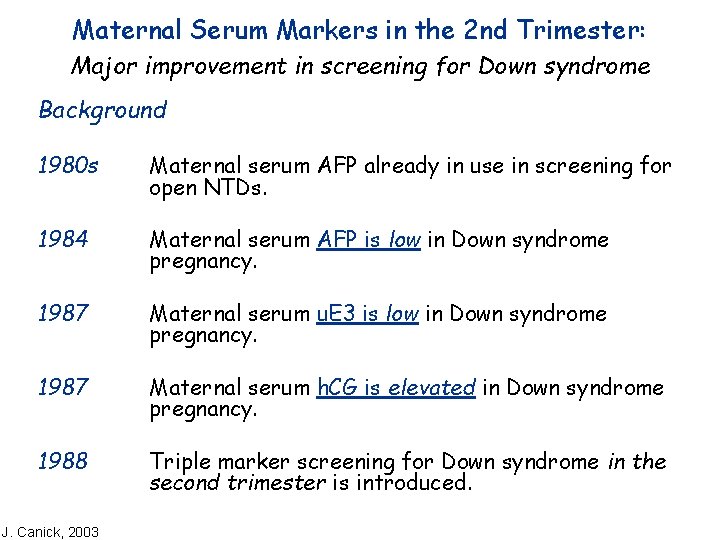
Maternal Serum Markers in the 2 nd Trimester: Major improvement in screening for Down syndrome Background 1980 s Maternal serum AFP already in use in screening for open NTDs. 1984 Maternal serum AFP is low in Down syndrome pregnancy. 1987 Maternal serum u. E 3 is low in Down syndrome pregnancy. 1987 Maternal serum h. CG is elevated in Down syndrome pregnancy. 1988 Triple marker screening for Down syndrome in the second trimester is introduced. J. Canick, 2003
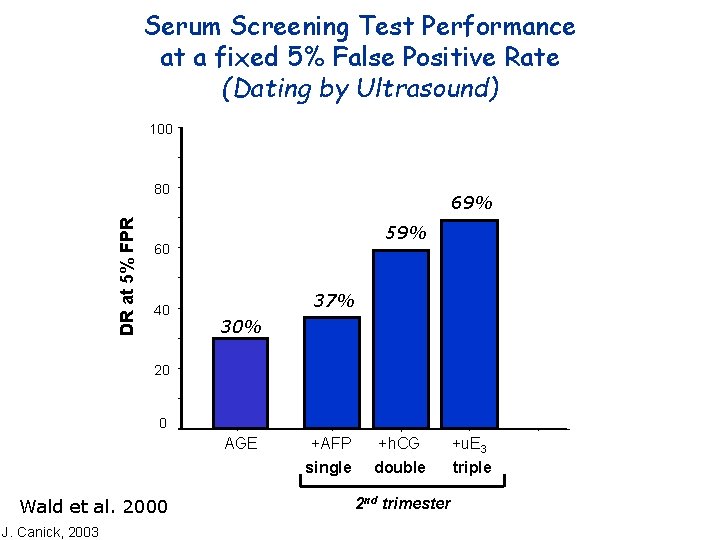
Serum Screening Test Performance at a fixed 5% False Positive Rate (Dating by Ultrasound) 100 DR at 5% FPR 80 69% 59% 60 40 37% 30% 20 0 AGE Wald et al. 2000 J. Canick, 2003 +AFP +h. CG +u. E 3 single double triple 2 nd trimester

New Approaches: Addition of Inhibin A J. Canick, 2003
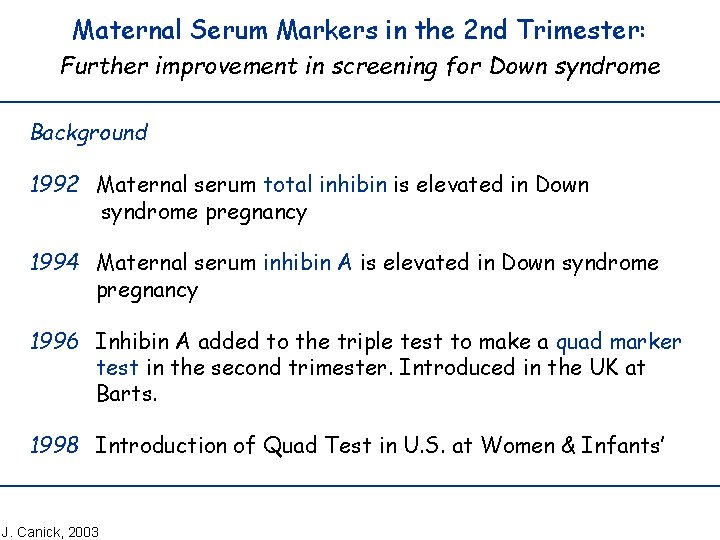
Maternal Serum Markers in the 2 nd Trimester: Further improvement in screening for Down syndrome Background 1992 Maternal serum total inhibin is elevated in Down syndrome pregnancy 1994 Maternal serum inhibin A is elevated in Down syndrome pregnancy 1996 Inhibin A added to the triple test to make a quad marker test in the second trimester. Introduced in the UK at Barts. 1998 Introduction of Quad Test in U. S. at Women & Infants’ J. Canick, 2003
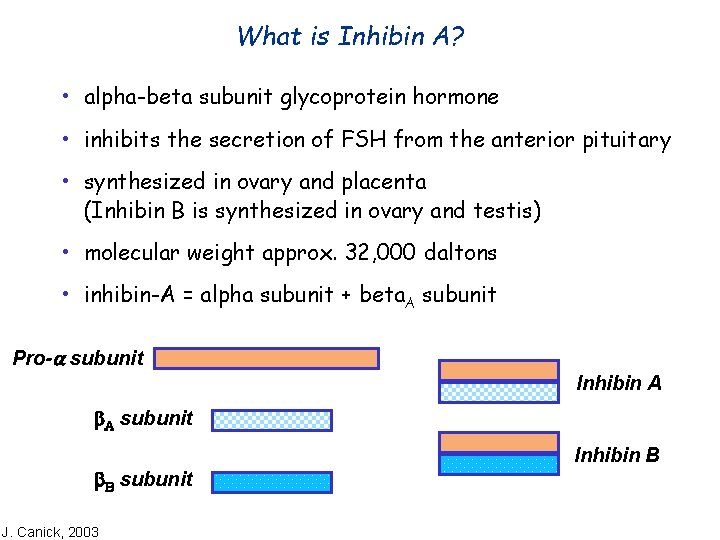
What is Inhibin A? • alpha-beta subunit glycoprotein hormone • inhibits the secretion of FSH from the anterior pituitary • synthesized in ovary and placenta (Inhibin B is synthesized in ovary and testis) • molecular weight approx. 32, 000 daltons • inhibin-A = alpha subunit + beta. A subunit Pro-a subunit Inhibin A b. A subunit b. B subunit J. Canick, 2003 Inhibin B

Maternal Serum Inhibin A: Like h. CG, it is, on average, about two times higher in Down syndrome than in unaffected pregnancies. Wald NJ et al, J Med Screen, 1997 J. Canick, 2003

Similarity of h. CG and inh. A distributions in Down syndrome and unaffected pregnancy J. Canick, 2003
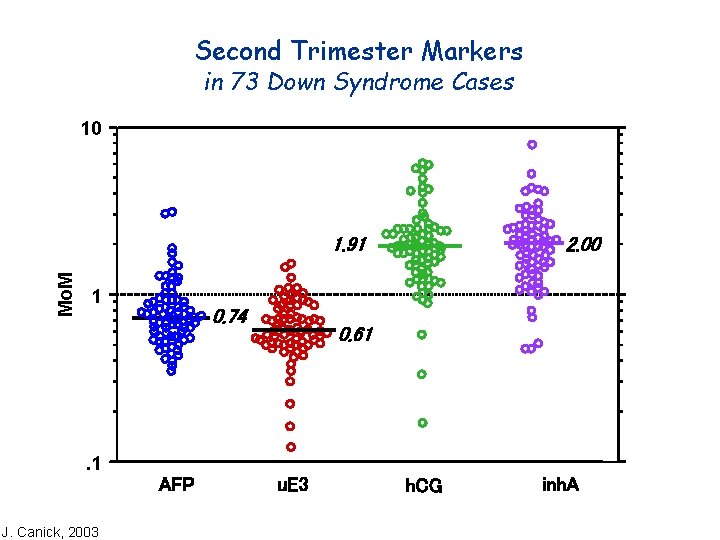
Second Trimester Markers in 73 Down Syndrome Cases 10 Mo. M 1. 91 1 . 1 J. Canick, 2003 0. 74 AFP 2. 00 0. 61 u. E 3 h. CG inh. A
Prenatal Screening Performance with Inhibin A J. Canick, 2003

Serum Screening Test Performance at a fixed 5% False Positive Rate (Dating by Ultrasound) 100 76% DR at 5% FPR 80 69% 59% 60 40 30% 37% 20 0 AGE Wald et al. 2000 J. Canick, 2003 +AFP +h. CG +u. E 3 single double triple 2 nd trimester +Inh. A quadruple
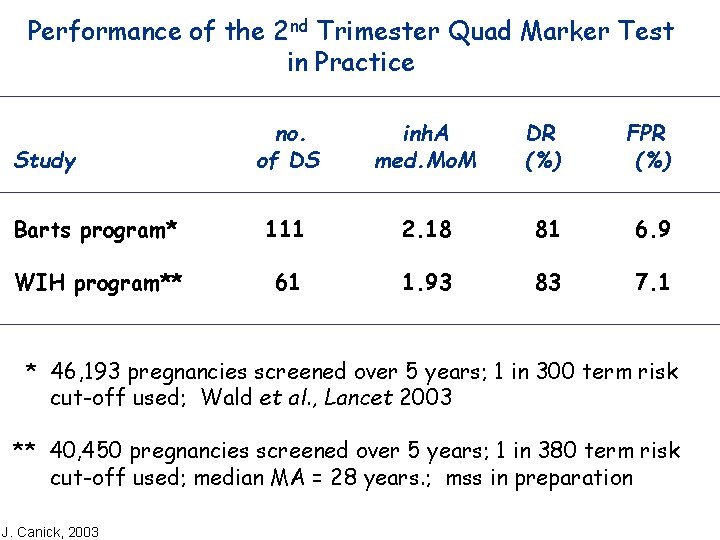
Performance of the 2 nd Trimester Quad Marker Test in Practice no. of DS inh. A med. Mo. M DR (%) FPR (%) Barts program* 111 2. 18 81 6. 9 WIH program** 61 1. 93 83 7. 1 Study * 46, 193 pregnancies screened over 5 years; 1 in 300 term risk cut-off used; Wald et al. , Lancet 2003 ** 40, 450 pregnancies screened over 5 years; 1 in 380 term risk cut-off used; median MA = 28 years. ; mss in preparation J. Canick, 2003
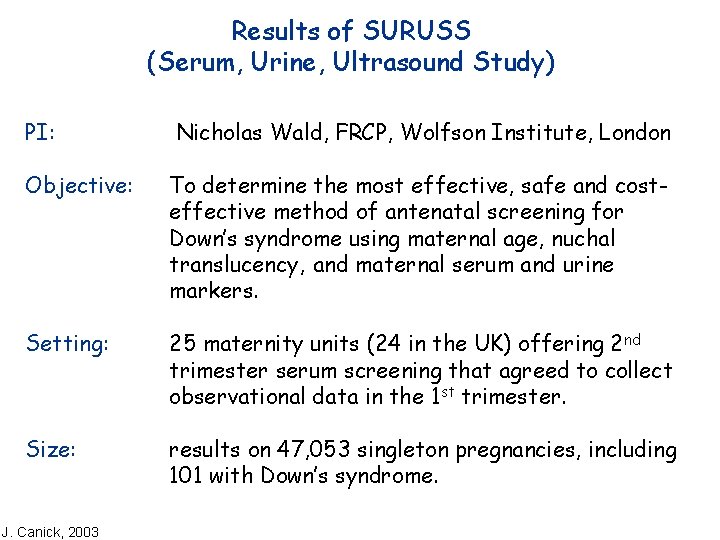
Results of SURUSS (Serum, Urine, Ultrasound Study) PI: Nicholas Wald, FRCP, Wolfson Institute, London Objective: To determine the most effective, safe and costeffective method of antenatal screening for Down’s syndrome using maternal age, nuchal translucency, and maternal serum and urine markers. Setting: 25 maternity units (24 in the UK) offering 2 nd trimester serum screening that agreed to collect observational data in the 1 st trimester. Size: results on 47, 053 singleton pregnancies, including 101 with Down’s syndrome. J. Canick, 2003
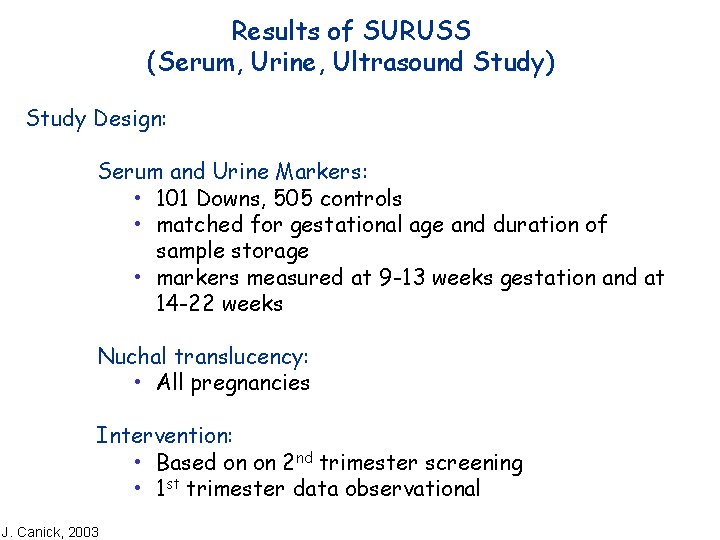
Results of SURUSS (Serum, Urine, Ultrasound Study) Study Design: Serum and Urine Markers: • 101 Downs, 505 controls • matched for gestational age and duration of sample storage • markers measured at 9 -13 weeks gestation and at 14 -22 weeks Nuchal translucency: • All pregnancies Intervention: • Based on on 2 nd trimester screening • 1 st trimester data observational J. Canick, 2003
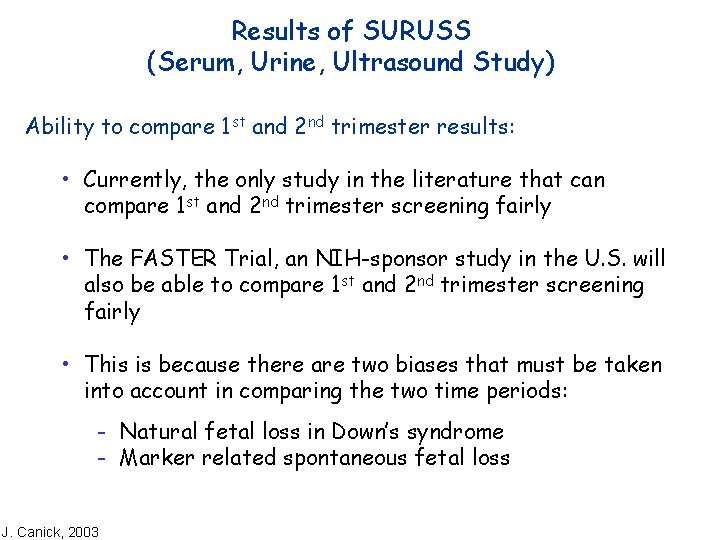
Results of SURUSS (Serum, Urine, Ultrasound Study) Ability to compare 1 st and 2 nd trimester results: • Currently, the only study in the literature that can compare 1 st and 2 nd trimester screening fairly • The FASTER Trial, an NIH-sponsor study in the U. S. will also be able to compare 1 st and 2 nd trimester screening fairly • This is because there are two biases that must be taken into account in comparing the two time periods: - Natural fetal loss in Down’s syndrome - Marker related spontaneous fetal loss J. Canick, 2003
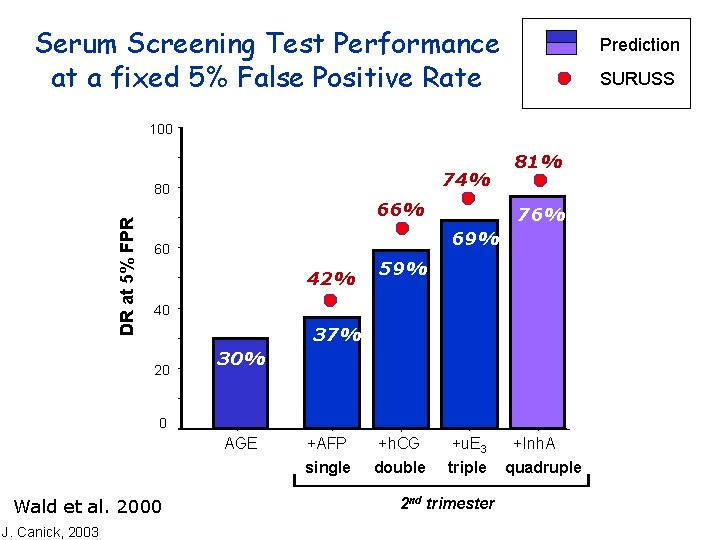
Serum Screening Test Performance at a fixed 5% False Positive Rate Prediction SURUSS 100 74% DR at 5% FPR 80 66% 81% 76% 69% 60 42% 59% 40 37% 20 30% 0 AGE Wald et al. 2000 J. Canick, 2003 +AFP +h. CG +u. E 3 single double triple 2 nd trimester +Inh. A quadruple
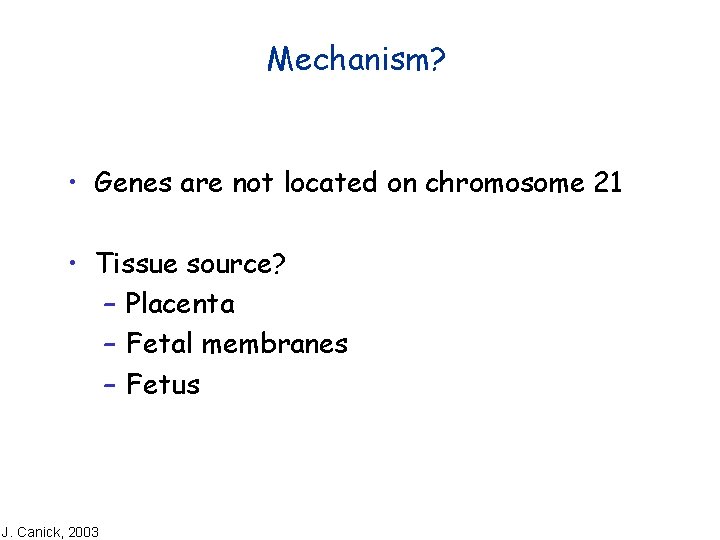
Mechanism? • Genes are not located on chromosome 21 • Tissue source? – Placenta – Fetal membranes – Fetus J. Canick, 2003

Chromosome 21: Not the source of genes for serum markers identified so far. Marker chromosome AFP h. CG a h. CG b inhibin a inhibin b. A J. Canick, 2003 4 q 6 q 19 q 2 q 7 p Chromosome 21 • 300 genes • 130 known human genes • Down syndrome critical region is 2 -20 Mb in q 22. • Likely that Down syndrome is a contiguous gene syndrome; unlikely that a single gene region is responsible. • Transcription factors, GF receptors, SOD 1 on 21.

Down Syndrome Pregnancy Fetal Underproduction / Placental overproduction ? Fetal origin: AFP DHEAS 16 a. OHDHEAS Fetoplacental origin: estriol (unconj) estriol (conj) J. Canick, 2003 Placental origin: h. CG free a-subunit of h. CG free b-subunit of h. CG h. PL SP 1 inhibin-A (also total inhibin) progesterone PLGF placental GH pro-MBP NAP (neutrophil alk phos) PAPP-A

Alpha : GAPDH Beta A : GAPDH Placental Inhibin A Subunit m. RNA Levels Alpha Lambert-Messerlian et al. , 1998 J. Canick, 2003 Beta A Control Down syndrome

New Approaches: The Integrated Test J. Canick, 2003
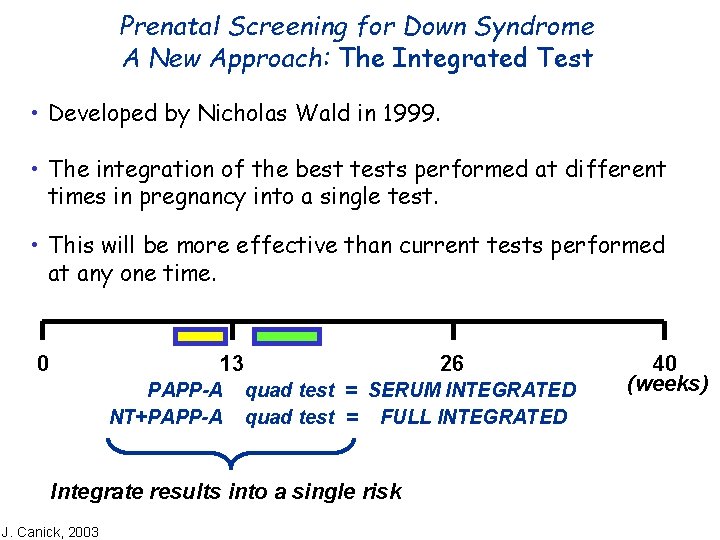
Prenatal Screening for Down Syndrome A New Approach: The Integrated Test • Developed by Nicholas Wald in 1999. • The integration of the best tests performed at different times in pregnancy into a single test. • This will be more effective than current tests performed at any one time. 0 13 PAPP-A NT+PAPP-A 26 quad test = SERUM INTEGRATED quad test = FULL INTEGRATED Integrate results into a single risk J. Canick, 2003 40 (weeks)
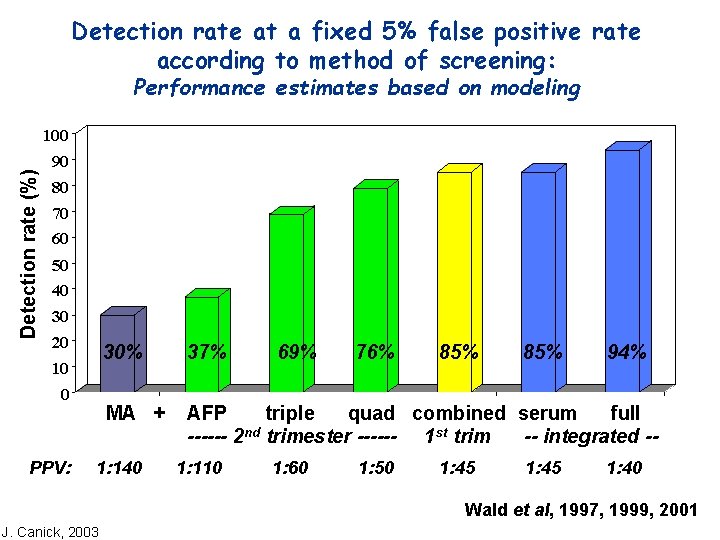
Detection rate at a fixed 5% false positive rate according to method of screening: Performance estimates based on modeling Detection rate (%) 100 90 80 70 60 50 40 30 20 10 0 PPV: 30% 37% MA + AFP triple quad combined serum full ------ 2 nd trimester ------ 1 st trim -- integrated -- 1: 140 1: 110 69% 1: 60 76% 1: 50 85% 1: 45 94% 1: 40 Wald et al, 1997, 1999, 2001 J. Canick, 2003
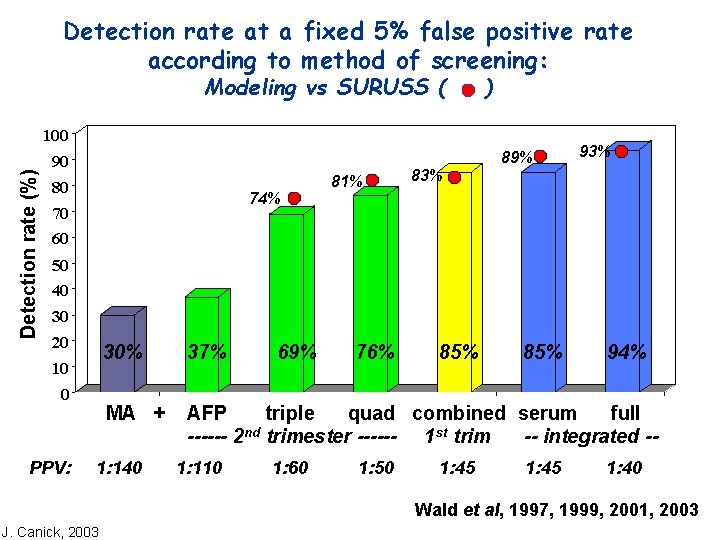
Detection rate at a fixed 5% false positive rate according to method of screening: Modeling vs SURUSS ( ) Detection rate (%) 100 89% 90 80 74% 70 60 81% 93% 83% 50 40 30 20 10 0 PPV: 30% 37% MA + AFP triple quad combined serum full ------ 2 nd trimester ------ 1 st trim -- integrated -- 1: 140 1: 110 69% 1: 60 76% 1: 50 85% 1: 45 94% 1: 40 Wald et al, 1997, 1999, 2001, 2003 J. Canick, 2003
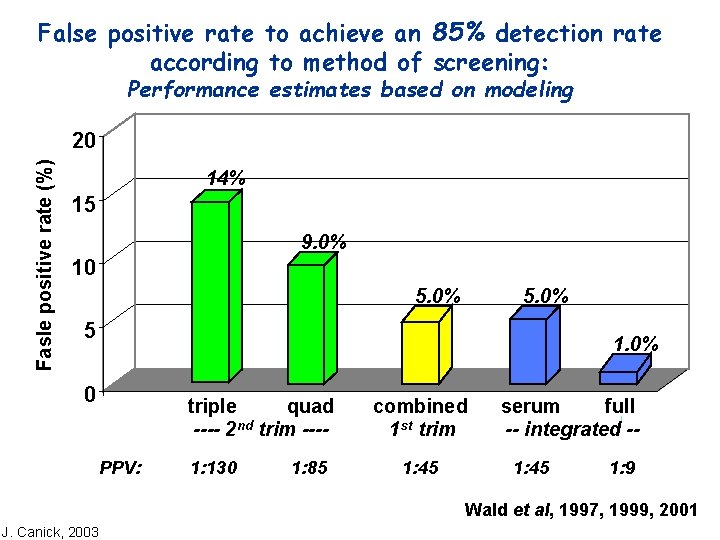
False positive rate to achieve an 85% detection rate according to method of screening: Performance estimates based on modeling Fasle positive rate (%) 20 14% 15 9. 0% 10 5. 0% 5 1. 0% 0 triple quad ---- 2 nd trim ---PPV: 1: 130 1: 85 combined 1 st trim 1: 45 serum full -- integrated -1: 45 1: 9 Wald et al, 1997, 1999, 2001 J. Canick, 2003
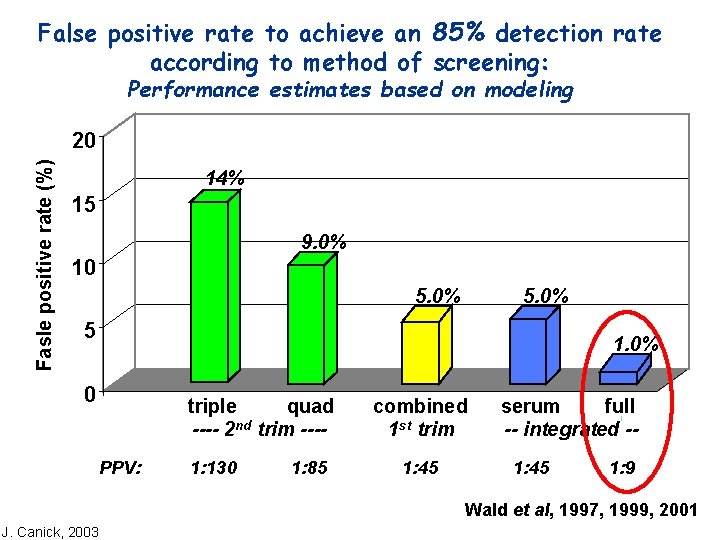
False positive rate to achieve an 85% detection rate according to method of screening: Performance estimates based on modeling Fasle positive rate (%) 20 14% 15 9. 0% 10 5. 0% 5 1. 0% 0 triple quad ---- 2 nd trim ---PPV: 1: 130 1: 85 combined 1 st trim 1: 45 serum full -- integrated -1: 45 1: 9 Wald et al, 1997, 1999, 2001 J. Canick, 2003
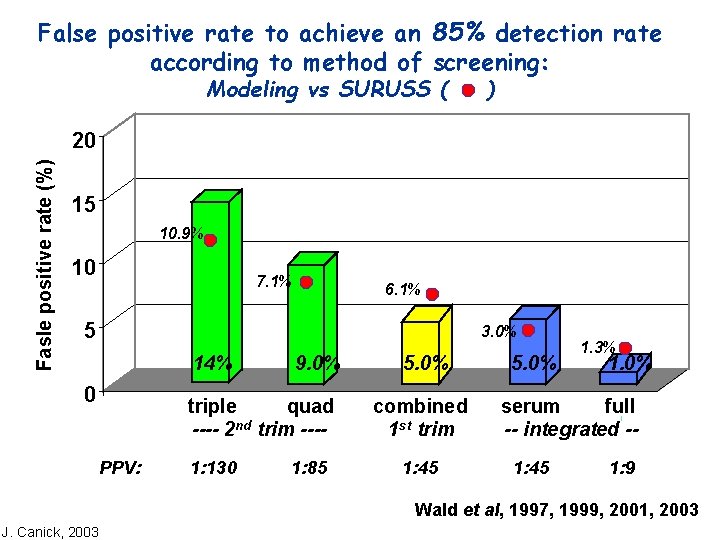
False positive rate to achieve an 85% detection rate according to method of screening: Modeling vs SURUSS ( ) Fasle positive rate (%) 20 15 10. 9% 10 7. 1% 6. 1% 5 3. 0% 14% 0 9. 0% triple quad ---- 2 nd trim ---PPV: 1: 130 1: 85 5. 0% combined 1 st trim 1: 45 5. 0% 1. 3% 1. 0% serum full -- integrated -1: 45 1: 9 Wald et al, 1997, 1999, 2001, 2003 J. Canick, 2003
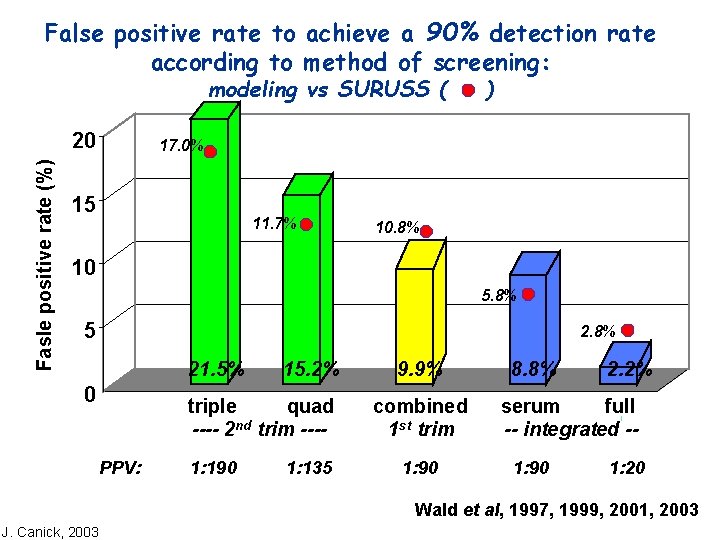
False positive rate to achieve a 90% detection rate according to method of screening: modeling vs SURUSS ( Fasle positive rate (%) 20 ) 17. 0% 15 11. 7% 10. 8% 10 5. 8% 5 2. 8% 21. 5% 0 15. 2% triple quad ---- 2 nd trim ---PPV: 1: 190 1: 135 9. 9% combined 1 st trim 1: 90 8. 8% 2. 2% serum full -- integrated -1: 90 1: 20 Wald et al, 1997, 1999, 2001, 2003 J. Canick, 2003
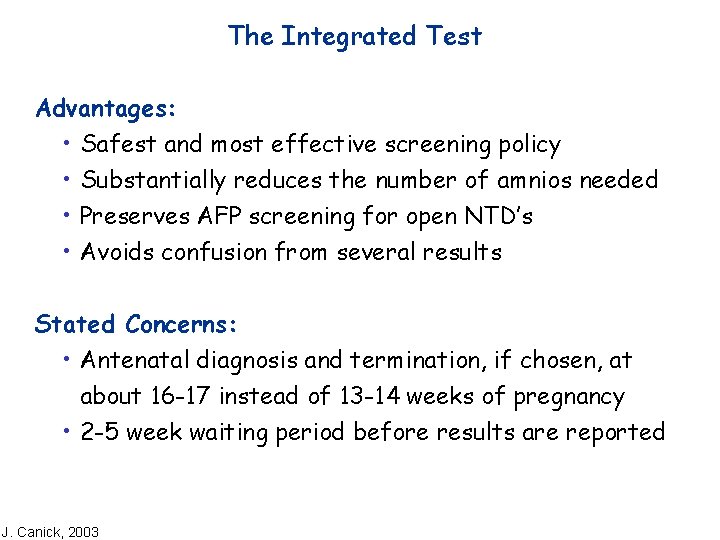
The Integrated Test Advantages: • Safest and most effective screening policy • Substantially reduces the number of amnios needed • Preserves AFP screening for open NTD’s • Avoids confusion from several results Stated Concerns: • Antenatal diagnosis and termination, if chosen, at about 16 -17 instead of 13 -14 weeks of pregnancy • 2 -5 week waiting period before results are reported J. Canick, 2003
New Approaches: Fetal Cells and Fetal DNA in the Maternal Circulation: Are They Useful in Prenatal Screening for Down Syndrome? J. Canick, 2003
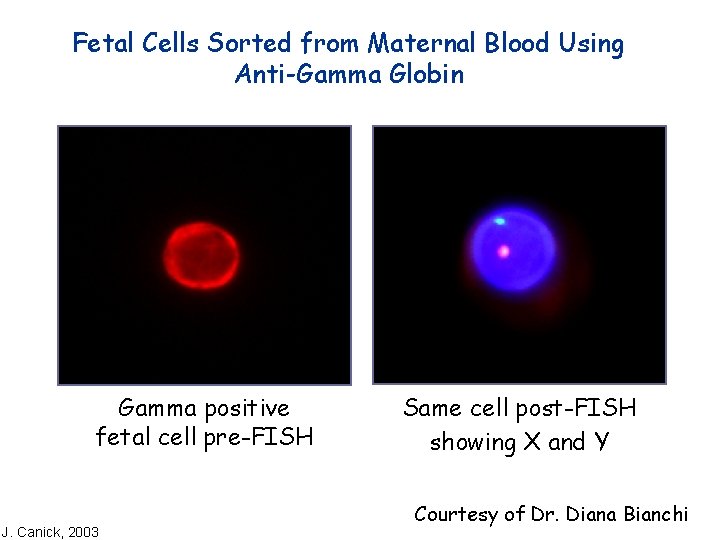
Fetal Cells Sorted from Maternal Blood Using Anti-Gamma Globin Gamma positive fetal cell pre-FISH J. Canick, 2003 Same cell post-FISH showing X and Y Courtesy of Dr. Diana Bianchi
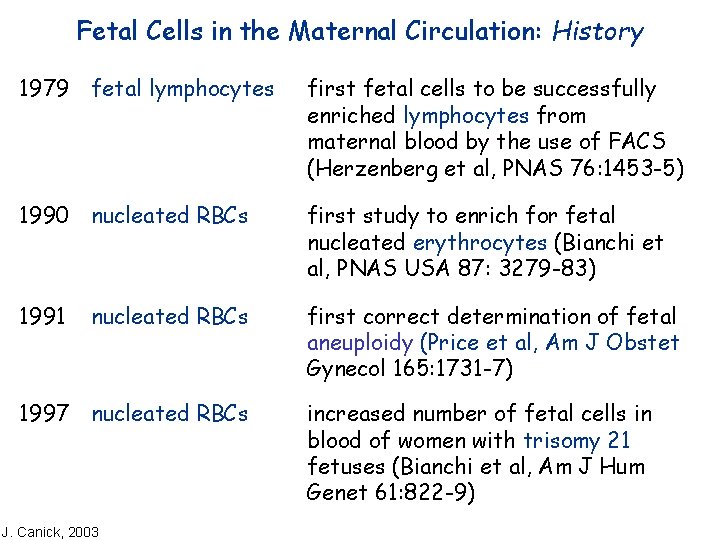
Fetal Cells in the Maternal Circulation: History 1979 fetal lymphocytes first fetal cells to be successfully enriched lymphocytes from maternal blood by the use of FACS (Herzenberg et al, PNAS 76: 1453 -5) 1990 nucleated RBCs first study to enrich for fetal nucleated erythrocytes (Bianchi et al, PNAS USA 87: 3279 -83) 1991 first correct determination of fetal aneuploidy (Price et al, Am J Obstet Gynecol 165: 1731 -7) nucleated RBCs 1997 nucleated RBCs J. Canick, 2003 increased number of fetal cells in blood of women with trisomy 21 fetuses (Bianchi et al, Am J Hum Genet 61: 822 -9)
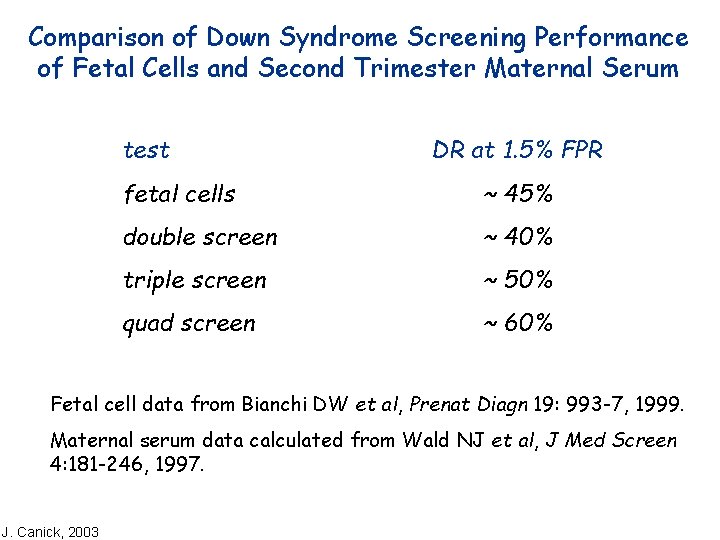
Comparison of Down Syndrome Screening Performance of Fetal Cells and Second Trimester Maternal Serum test DR at 1. 5% FPR fetal cells ~ 45% double screen ~ 40% triple screen ~ 50% quad screen ~ 60% Fetal cell data from Bianchi DW et al, Prenat Diagn 19: 993 -7, 1999. Maternal serum data calculated from Wald NJ et al, J Med Screen 4: 181 -246, 1997. J. Canick, 2003
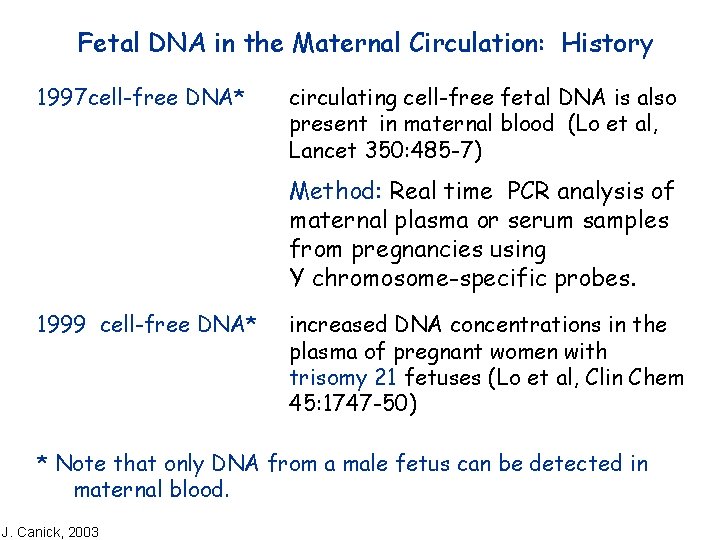
Fetal DNA in the Maternal Circulation: History 1997 cell-free DNA* circulating cell-free fetal DNA is also present in maternal blood (Lo et al, Lancet 350: 485 -7) Method: Real time PCR analysis of maternal plasma or serum samples from pregnancies using Y chromosome-specific probes. 1999 cell-free DNA* increased DNA concentrations in the plasma of pregnant women with trisomy 21 fetuses (Lo et al, Clin Chem 45: 1747 -50) * Note that only DNA from a male fetus can be detected in maternal blood. J. Canick, 2003
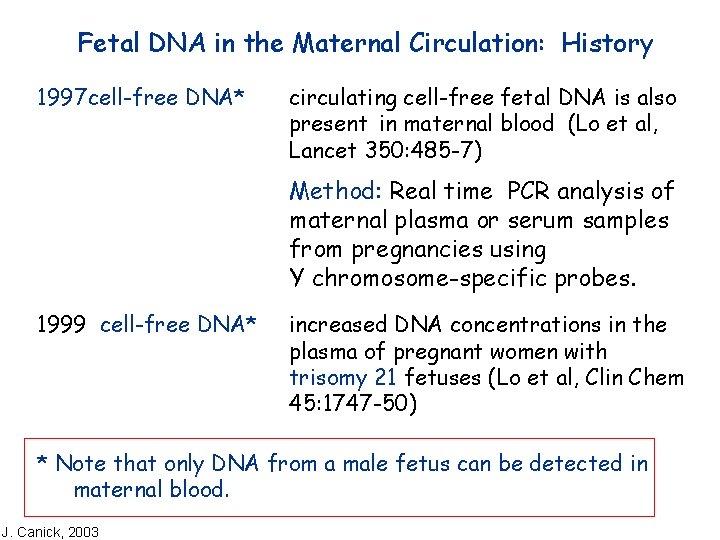
Fetal DNA in the Maternal Circulation: History 1997 cell-free DNA* circulating cell-free fetal DNA is also present in maternal blood (Lo et al, Lancet 350: 485 -7) Method: Real time PCR analysis of maternal plasma or serum samples from pregnancies using Y chromosome-specific probes. 1999 cell-free DNA* increased DNA concentrations in the plasma of pregnant women with trisomy 21 fetuses (Lo et al, Clin Chem 45: 1747 -50) * Note that only DNA from a male fetus can be detected in maternal blood. J. Canick, 2003
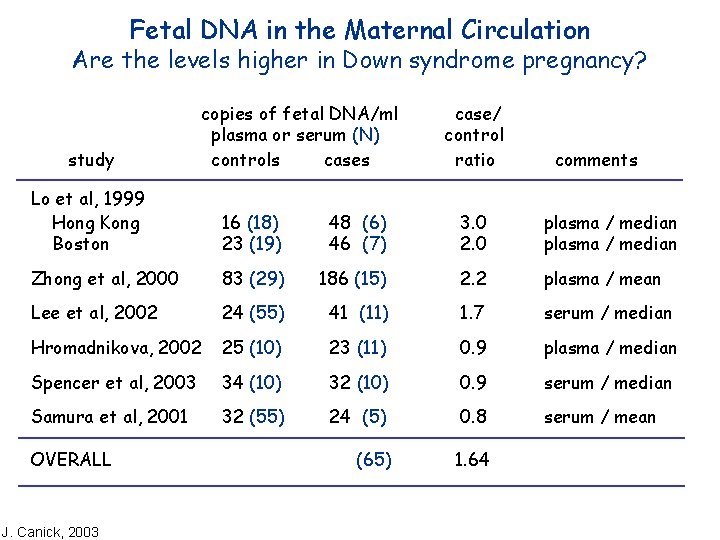
Fetal DNA in the Maternal Circulation Are the levels higher in Down syndrome pregnancy? study copies of fetal DNA/ml plasma or serum (N) controls case/ control ratio comments Lo et al, 1999 Hong Kong Boston 16 (18) 23 (19) 48 (6) 46 (7) 3. 0 2. 0 plasma / median Zhong et al, 2000 83 (29) 186 (15) 2. 2 plasma / mean Lee et al, 2002 24 (55) 41 (11) 1. 7 serum / median Hromadnikova, 2002 25 (10) 23 (11) 0. 9 plasma / median Spencer et al, 2003 34 (10) 32 (10) 0. 9 serum / median Samura et al, 2001 32 (55) 24 (5) 0. 8 serum / mean (65) 1. 64 OVERALL J. Canick, 2003
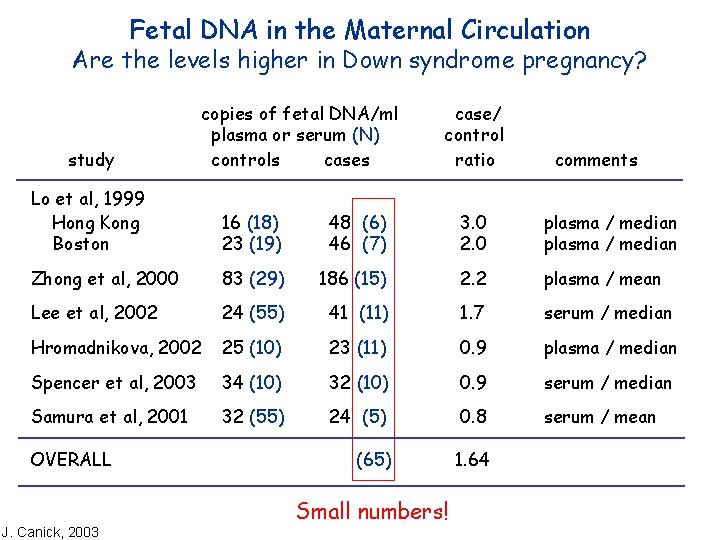
Fetal DNA in the Maternal Circulation Are the levels higher in Down syndrome pregnancy? study copies of fetal DNA/ml plasma or serum (N) controls case/ control ratio comments Lo et al, 1999 Hong Kong Boston 16 (18) 23 (19) 48 (6) 46 (7) 3. 0 2. 0 plasma / median Zhong et al, 2000 83 (29) 186 (15) 2. 2 plasma / mean Lee et al, 2002 24 (55) 41 (11) 1. 7 serum / median Hromadnikova, 2002 25 (10) 23 (11) 0. 9 plasma / median Spencer et al, 2003 34 (10) 32 (10) 0. 9 serum / median Samura et al, 2001 32 (55) 24 (5) 0. 8 serum / mean (65) 1. 64 OVERALL J. Canick, 2003 Small numbers!
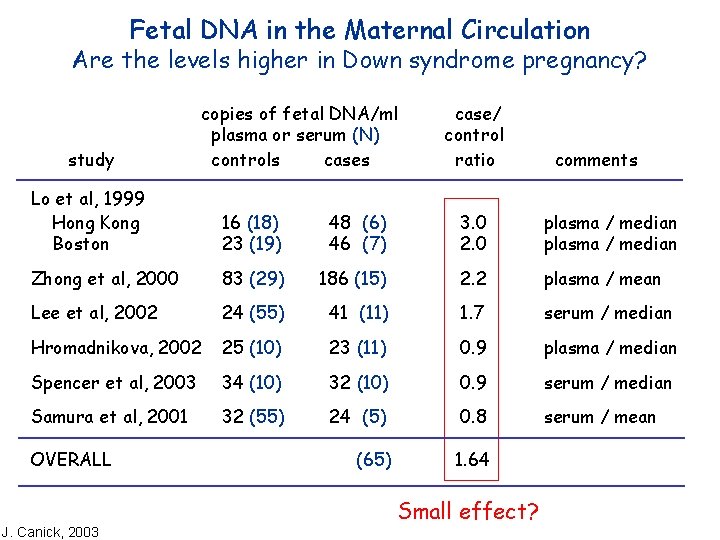
Fetal DNA in the Maternal Circulation Are the levels higher in Down syndrome pregnancy? study copies of fetal DNA/ml plasma or serum (N) controls case/ control ratio comments Lo et al, 1999 Hong Kong Boston 16 (18) 23 (19) 48 (6) 46 (7) 3. 0 2. 0 plasma / median Zhong et al, 2000 83 (29) 186 (15) 2. 2 plasma / mean Lee et al, 2002 24 (55) 41 (11) 1. 7 serum / median Hromadnikova, 2002 25 (10) 23 (11) 0. 9 plasma / median Spencer et al, 2003 34 (10) 32 (10) 0. 9 serum / median Samura et al, 2001 32 (55) 24 (5) 0. 8 serum / mean (65) 1. 64 OVERALL J. Canick, 2003 Small effect?
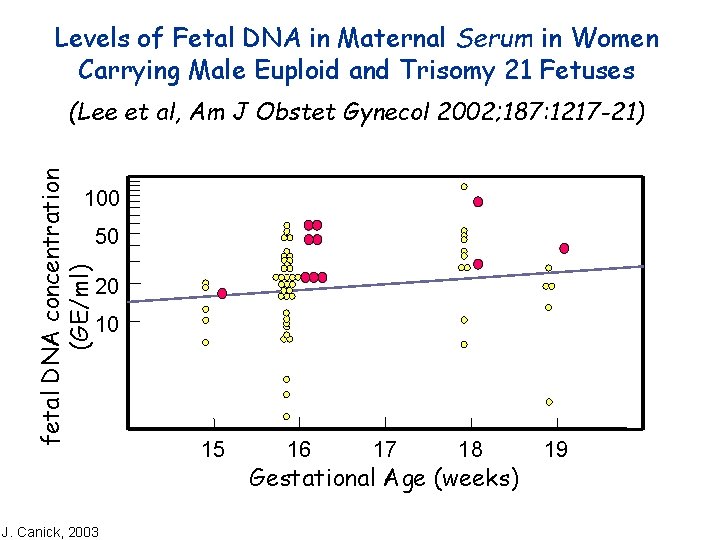
Levels of Fetal DNA in Maternal Serum in Women Carrying Male Euploid and Trisomy 21 Fetuses fetal DNA concentration (GE/ml) (Lee et al, Am J Obstet Gynecol 2002; 187: 1217 -21) 100 50 20 10 J. Canick, 2003 15 16 17 18 Gestational Age (weeks) 19
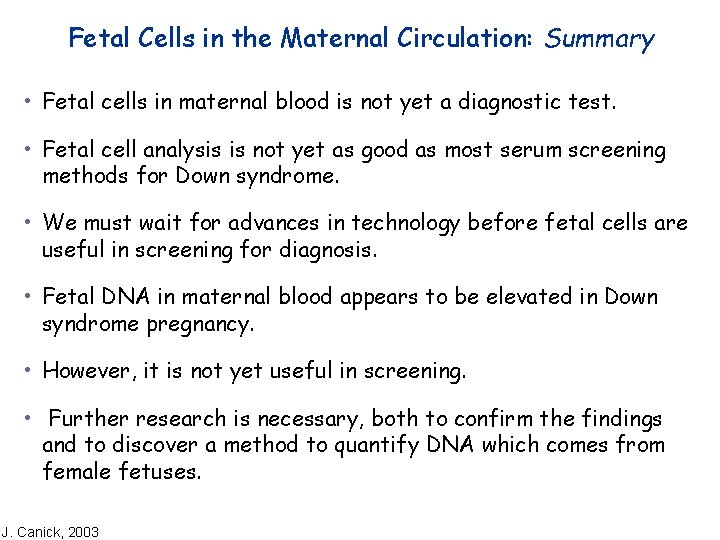
Fetal Cells in the Maternal Circulation: Summary • Fetal cells in maternal blood is not yet a diagnostic test. • Fetal cell analysis is not yet as good as most serum screening methods for Down syndrome. • We must wait for advances in technology before fetal cells are useful in screening for diagnosis. • Fetal DNA in maternal blood appears to be elevated in Down syndrome pregnancy. • However, it is not yet useful in screening. • Further research is necessary, both to confirm the findings and to discover a method to quantify DNA which comes from female fetuses. J. Canick, 2003
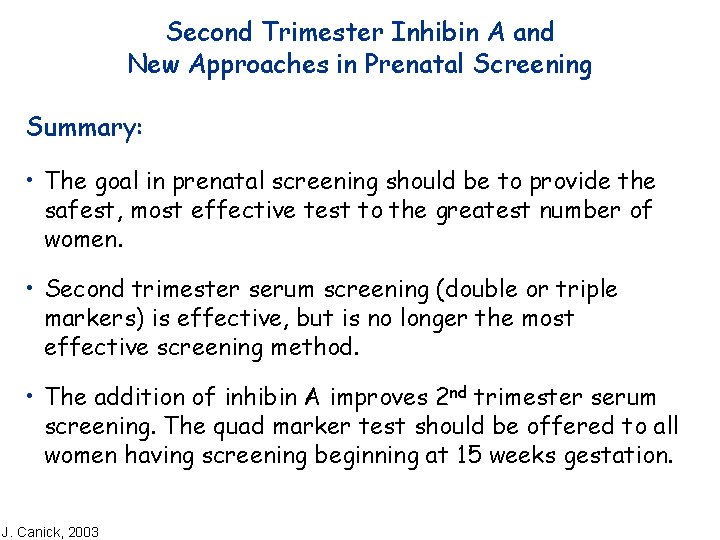
Second Trimester Inhibin A and New Approaches in Prenatal Screening Summary: • The goal in prenatal screening should be to provide the safest, most effective test to the greatest number of women. • Second trimester serum screening (double or triple markers) is effective, but is no longer the most effective screening method. • The addition of inhibin A improves 2 nd trimester serum screening. The quad marker test should be offered to all women having screening beginning at 15 weeks gestation. J. Canick, 2003
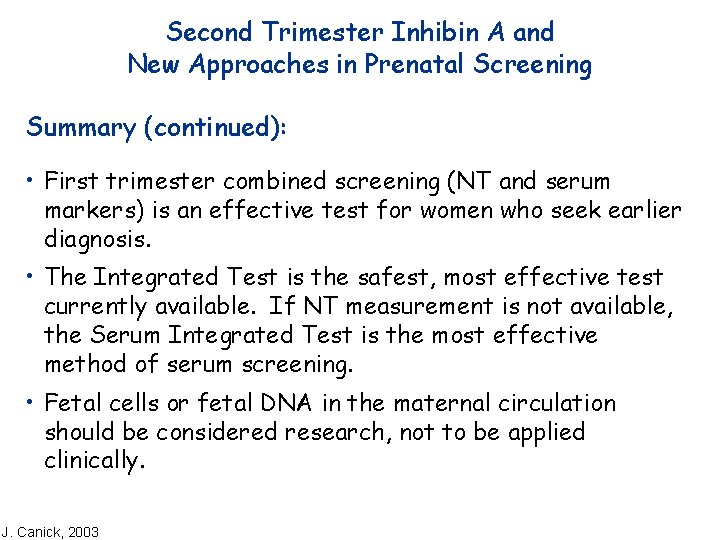
Second Trimester Inhibin A and New Approaches in Prenatal Screening Summary (continued): • First trimester combined screening (NT and serum markers) is an effective test for women who seek earlier diagnosis. • The Integrated Test is the safest, most effective test currently available. If NT measurement is not available, the Serum Integrated Test is the most effective method of serum screening. • Fetal cells or fetal DNA in the maternal circulation should be considered research, not to be applied clinically. J. Canick, 2003

. . . llginize tesekkur ederim. . . Beni guzel ulkenize davet. . ettiginiz icin tesekkur ederim. J. Canick, 2003
- Slides: 50