
Second OrderPartial Differential Equations P M V Subbarao
Second Order-Partial Differential Equations P M V Subbarao Professor Mechanical Engineering Department I I T Delhi Important and Unavoiable Thermofluid Applications Geneted SO-PDEs…. .
Introductory Remarks • There is no general theory known for solving all partial differential equations …. . • Abstract mathematicians never realized this branch of mathematics. • As the variety of phenomena modelled by such equations, research focuses on particular PDEs that are important for theory or applications. • Mathematicians only studied those PDEs which are catergorized according to application.
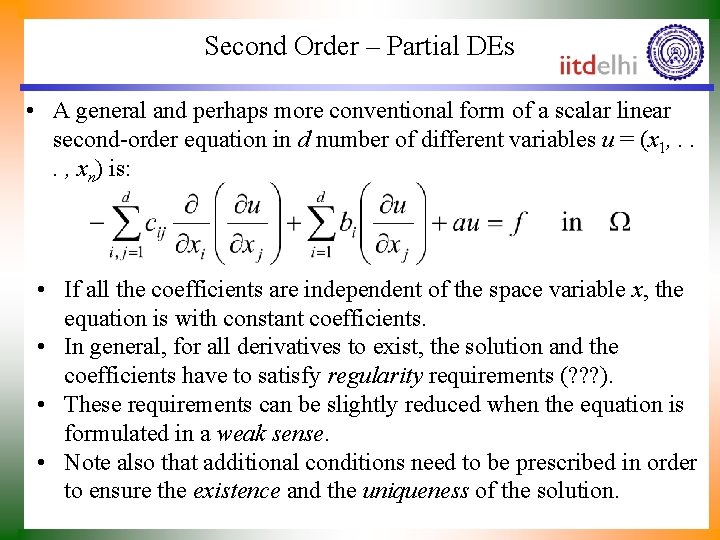
Second Order – Partial DEs • A general and perhaps more conventional form of a scalar linear second-order equation in d number of different variables u = (x 1, . . . , xn) is: • If all the coefficients are independent of the space variable x, the equation is with constant coefficients. • In general, for all derivatives to exist, the solution and the coefficients have to satisfy regularity requirements (? ? ? ). • These requirements can be slightly reduced when the equation is formulated in a weak sense. • Note also that additional conditions need to be prescribed in order to ensure the existence and the uniqueness of the solution.
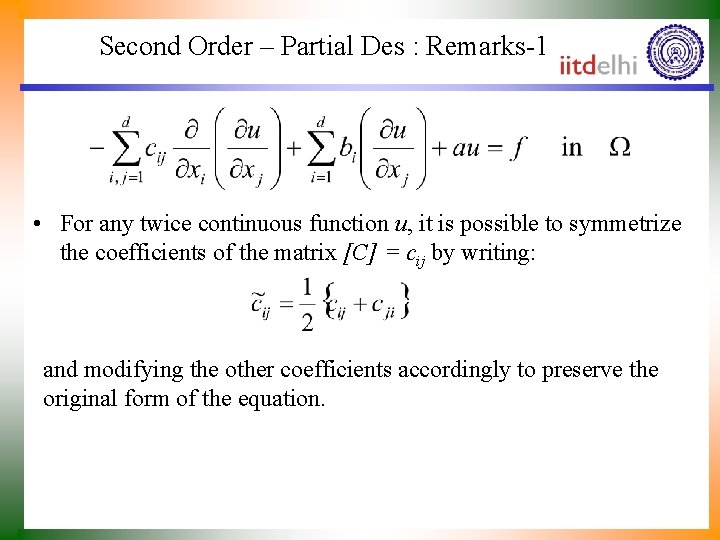
Second Order – Partial Des : Remarks-1 • For any twice continuous function u, it is possible to symmetrize the coefficients of the matrix [C] = cij by writing: and modifying the other coefficients accordingly to preserve the original form of the equation.

Second Order – Partial Des : Definition • Consider a second-order partial differential equation of above form with a symmetric coefficient matrix C(x); then the equation is said to be By extension, an equation will be called 1. elliptic at x , if C(x) is positive definite, i. e. , if for all v 0 elliptic, parabolic or hyperbolic in the d , vt. Cv > 0. 2. parabolic x , if C(x) semidefinite vt. Cv or 0, for all openat set if itisispositive elliptic, parabolic v 0 d andhyperbolic not positive definite and the rank C(x), everywhere in of . b(x), a(x) is equal to d. 3. hyperbolic at x , if C(x) has one negative and (n− 1) positive eigenvalues.
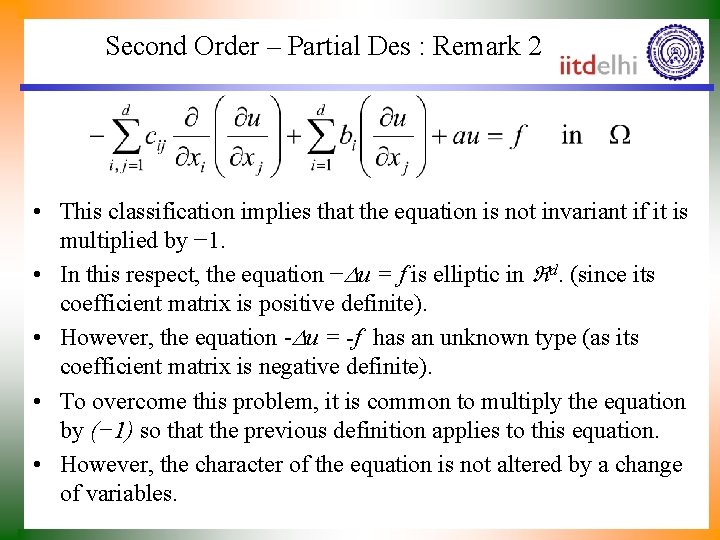
Second Order – Partial Des : Remark 2 • This classification implies that the equation is not invariant if it is multiplied by − 1. • In this respect, the equation − u = f is elliptic in d. (since its coefficient matrix is positive definite). • However, the equation - u = -f has an unknown type (as its coefficient matrix is negative definite). • To overcome this problem, it is common to multiply the equation by (− 1) so that the previous definition applies to this equation. • However, the character of the equation is not altered by a change of variables.
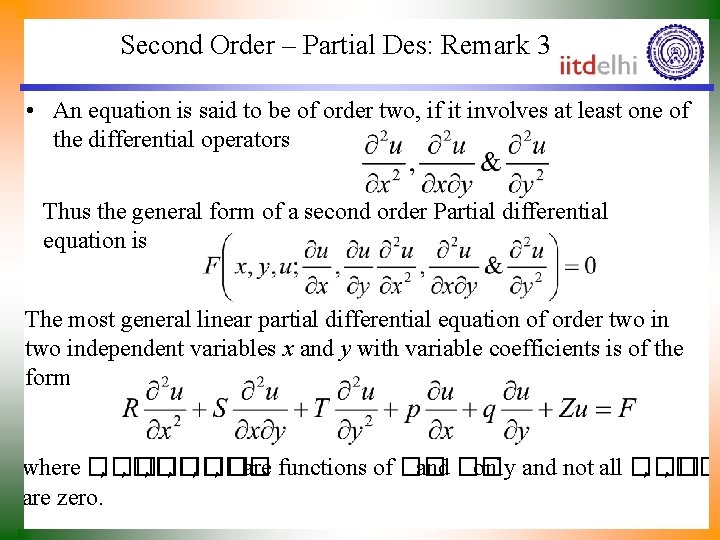
Second Order – Partial Des: Remark 3 • An equation is said to be of order two, if it involves at least one of the differential operators • Thus the general form of a second order Partial differential equation is The most general linear partial differential equation of order two independent variables x and y with variable coefficients is of the form where �� , �� , �� are functions of �� and �� only and not all �� , �� are zero.
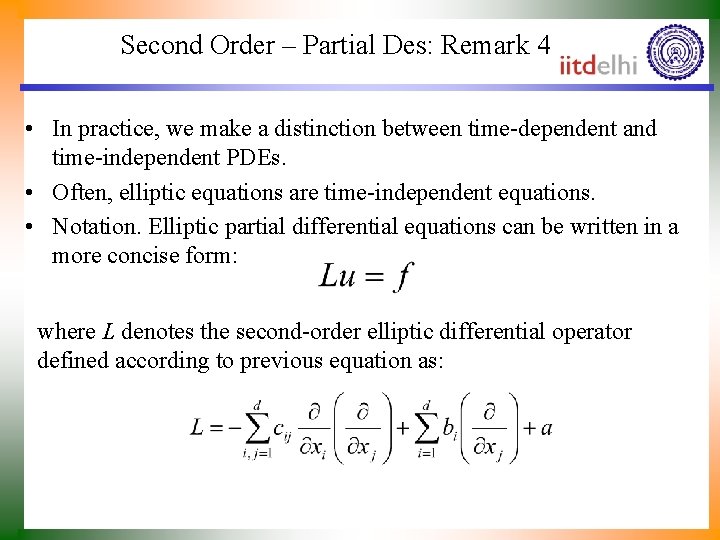
Second Order – Partial Des: Remark 4 • In practice, we make a distinction between time-dependent and time-independent PDEs. • Often, elliptic equations are time-independent equations. • Notation. Elliptic partial differential equations can be written in a more concise form: where L denotes the second-order elliptic differential operator defined according to previous equation as:
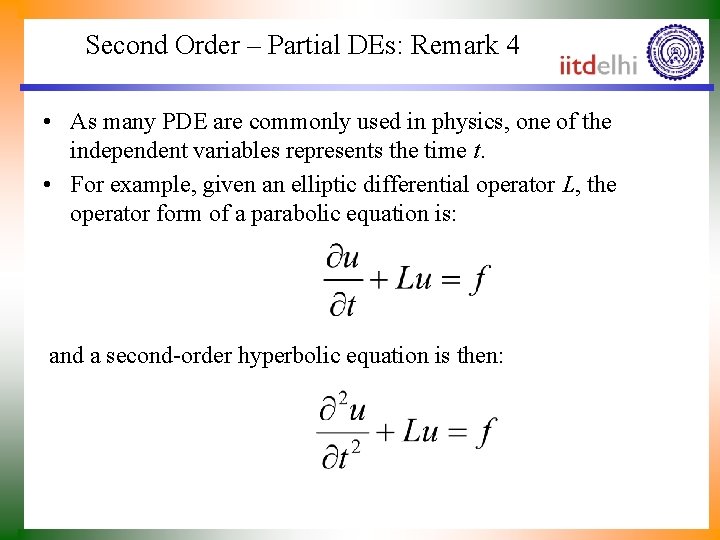
Second Order – Partial DEs: Remark 4 • As many PDE are commonly used in physics, one of the independent variables represents the time t. • For example, given an elliptic differential operator L, the operator form of a parabolic equation is: and a second-order hyperbolic equation is then:
Second Order – Partial DEs: Boundary Conditions • In general, in the mathematical models, additional information on the boundary of the domain are supplied with the PDE. • These information are known as initial or final conditions (with respect to the time dimension). • As boundary conditions (with respect to the space dimension). • Notice here the fundamental difference between ordinary differential equations (ODE) and partial differential equations. • The general solution of an ODE contains constants (values) while the general solution of a PDE contains arbitrary functions.
Second Order – Partial DEs: Boundary Conditions • As we will learn soon, the equation is not sufficient to ensure the unicity of the solution u. • Additional information is needed on the boundary or on a portion of the boundary of . • Such data is called a boundary condition. • Hence, the partial differential equation together with a set of additional restraints is called a boundary value problem.
Second Order – Partial DEs: Boundary Conditions • If the boundary condition gives a value to the domain: x , u(x) is fixed, then it is a Dirichlet boundary condition. • If the boundary condition gives a value to the normal derivative of the problem: x u(x)/ =( u ) is fixed, then it is a Neumann boundary condition. • Mixed boundary conditions indicate that different boundary conditions are used on different parts of the domain boundary. • Robin (Newton) boundary conditions is another frequently used type of boundary conditions. • It involves a (linear) combination of function values (Dirichlet) and normal derivatives (Neumann).
Hadamard concept of well-posed problem • The notion of well-posedness, due to J. Hadamard (1865 -1963), is related to the requirements that can be expected from solving a partial differential equation. • Definition (Hadamard’s well-posedness): • A given problem for a partial differential equation is said to be well-posed if: (1) a solution exists, (2) the solution is unique, (3) the solution depends continuously on the given data (in some reasonable topology). • Otherwise it is ill-posed.
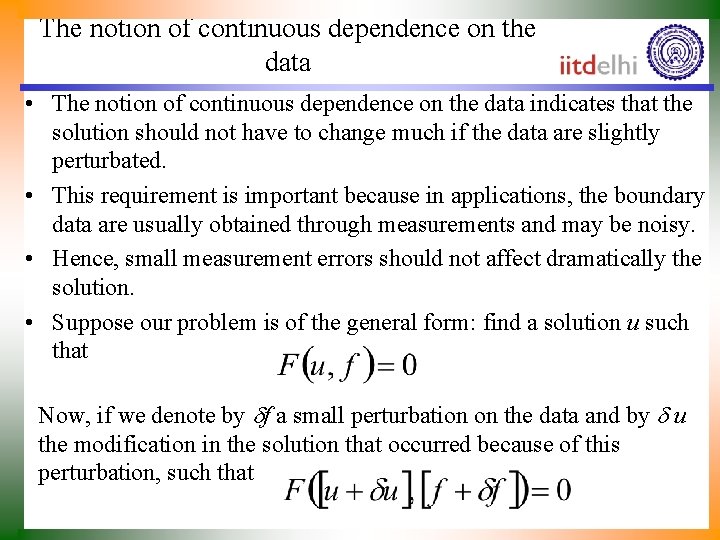
The notion of continuous dependence on the data • The notion of continuous dependence on the data indicates that the solution should not have to change much if the data are slightly perturbated. • This requirement is important because in applications, the boundary data are usually obtained through measurements and may be noisy. • Hence, small measurement errors should not affect dramatically the solution. • Suppose our problem is of the general form: find a solution u such that Now, if we denote by f a small perturbation on the data and by u the modification in the solution that occurred because of this perturbation, such that
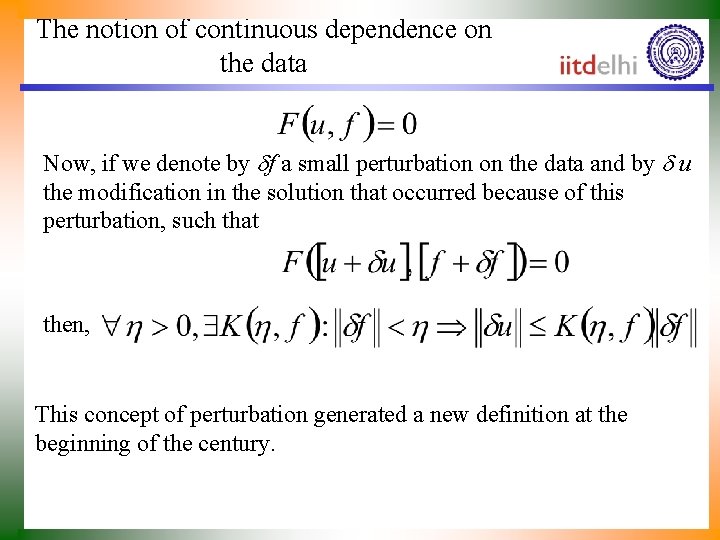
The notion of continuous dependence on the data Now, if we denote by f a small perturbation on the data and by u the modification in the solution that occurred because of this perturbation, such that then, This concept of perturbation generated a new definition at the beginning of the century.
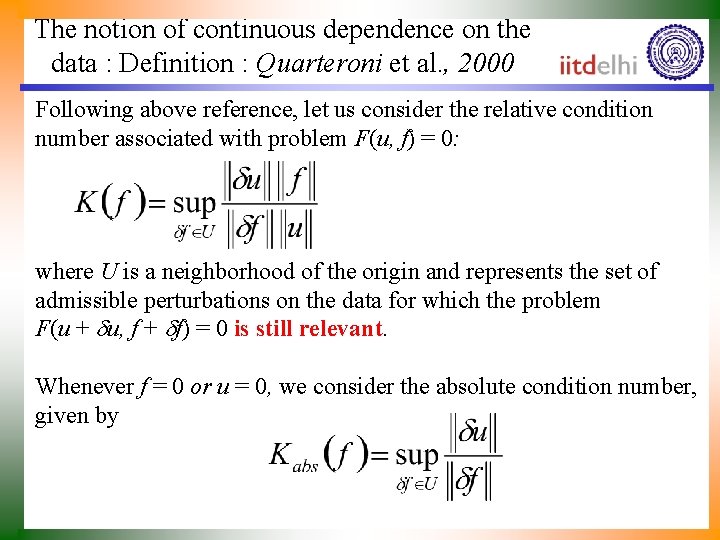
The notion of continuous dependence on the data : Definition : Quarteroni et al. , 2000 Following above reference, let us consider the relative condition number associated with problem F(u, f) = 0: where U is a neighborhood of the origin and represents the set of admissible perturbations on the data for which the problem F(u + u, f + f) = 0 is still relevant. Whenever f = 0 or u = 0, we consider the absolute condition number, given by
The ill-conditioned SO-PDE • Above problem is called ill-conditioned when K(f) is ”big” for any admissible given function f. • The meaning of big may change depending on the problem considered. • Remark: Notice that the notion of well-posedness of a problem and its property of being wellconditioned is independent from the numerical method used to solve it. • Even in the case where the condition number may be infinite, the problem may be well-posed. • Usually, it can be reformulated into an equivalent problem with a finite condition number.
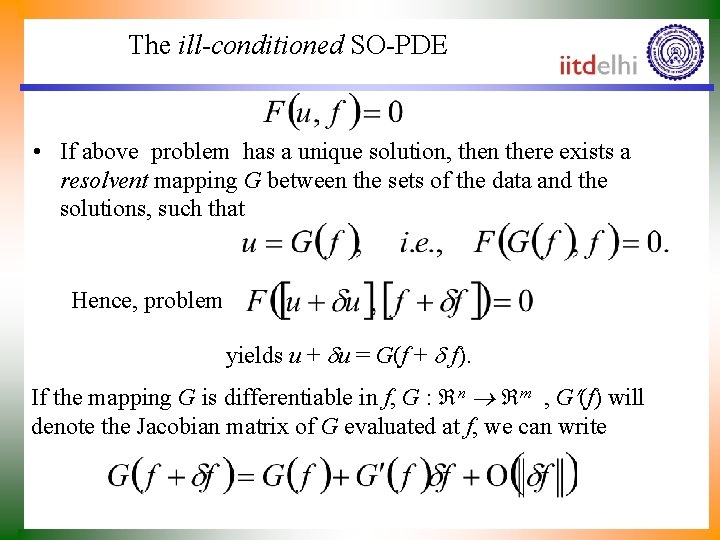
The ill-conditioned SO-PDE • If above problem has a unique solution, then there exists a resolvent mapping G between the sets of the data and the solutions, such that Hence, problem yields u + u = G(f + f). If the mapping G is differentiable in f, G : n m , G (f) will denote the Jacobian matrix of G evaluated at f, we can write
The Closure • The concept of well-posed problem is obviously of great importance is practical applications. • Indeed, if a problem is well-posed, it is reasonable to attempt to compute an accurate approximation of the exact solution (here unique) as long as the data are suitably approximated. • However, there are examples with incorrect boundary conditions may jeopardize the well-posedness nature of a problem.
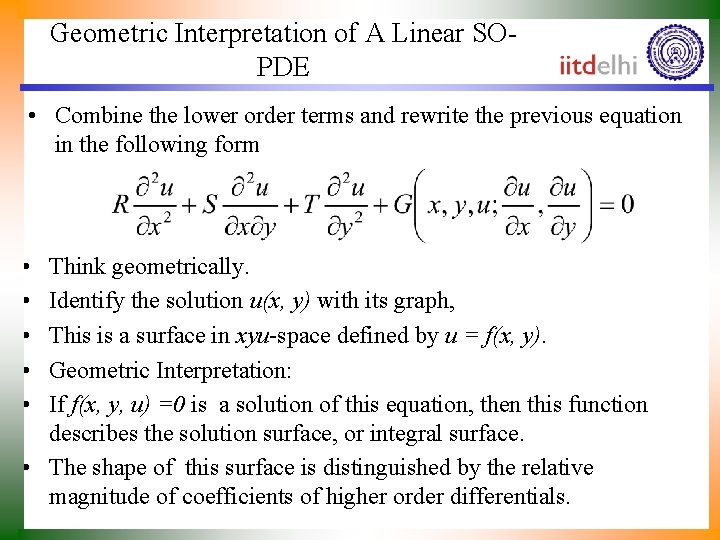
Geometric Interpretation of A Linear SOPDE • Combine the lower order terms and rewrite the previous equation in the following form • • • Think geometrically. Identify the solution u(x, y) with its graph, This is a surface in xyu-space defined by u = f(x, y). Geometric Interpretation: If f(x, y, u) =0 is a solution of this equation, then this function describes the solution surface, or integral surface. • The shape of this surface is distinguished by the relative magnitude of coefficients of higher order differentials.
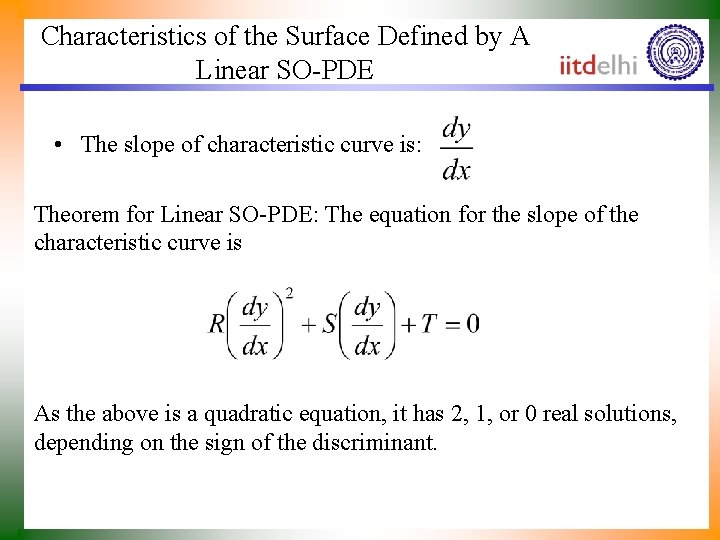
Characteristics of the Surface Defined by A Linear SO-PDE • The slope of characteristic curve is: Theorem for Linear SO-PDE: The equation for the slope of the characteristic curve is As the above is a quadratic equation, it has 2, 1, or 0 real solutions, depending on the sign of the discriminant.
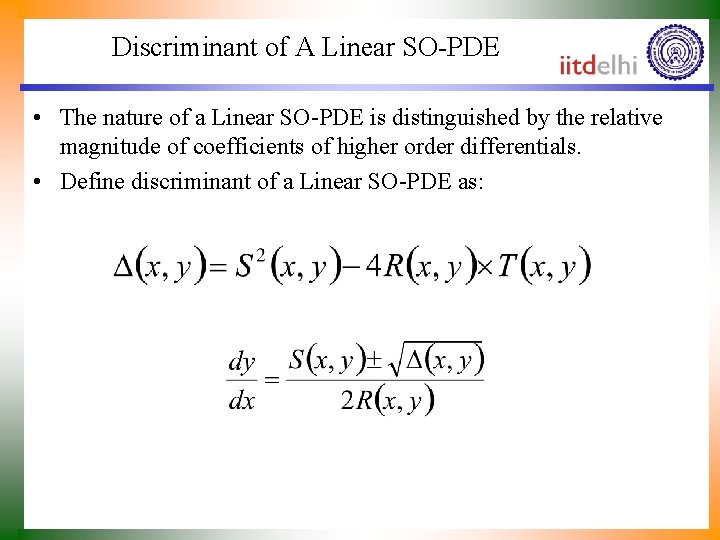
Discriminant of A Linear SO-PDE • The nature of a Linear SO-PDE is distinguished by the relative magnitude of coefficients of higher order differentials. • Define discriminant of a Linear SO-PDE as:
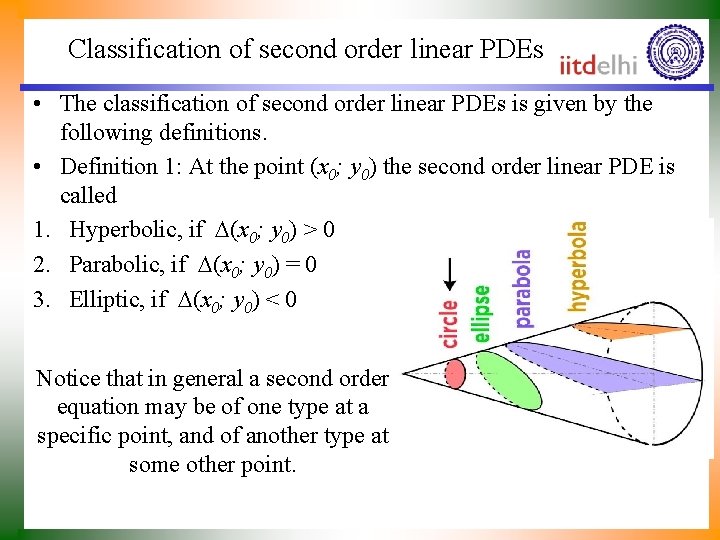
Classification of second order linear PDEs • The classification of second order linear PDEs is given by the following definitions. • Definition 1: At the point (x 0; y 0) the second order linear PDE is called 1. Hyperbolic, if (x 0; y 0) > 0 2. Parabolic, if (x 0; y 0) = 0 3. Elliptic, if (x 0; y 0) < 0 Notice that in general a second order equation may be of one type at a specific point, and of another type at some other point.
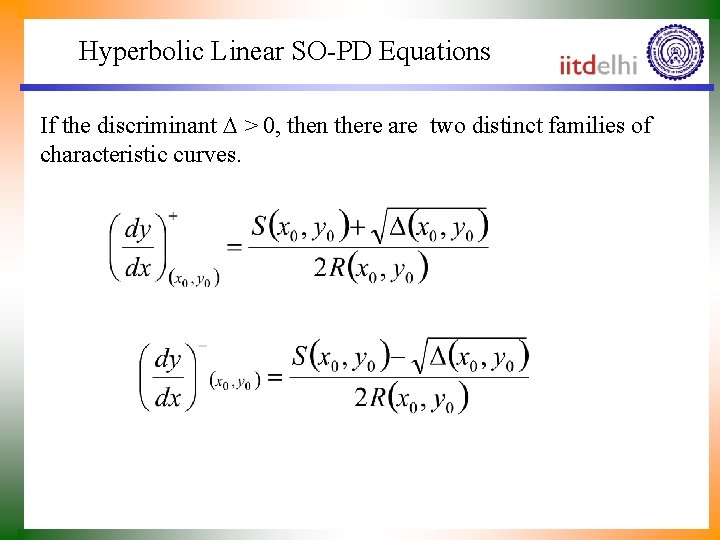
Hyperbolic Linear SO-PD Equations • If the discriminant > 0, then there are two distinct families of characteristic curves.
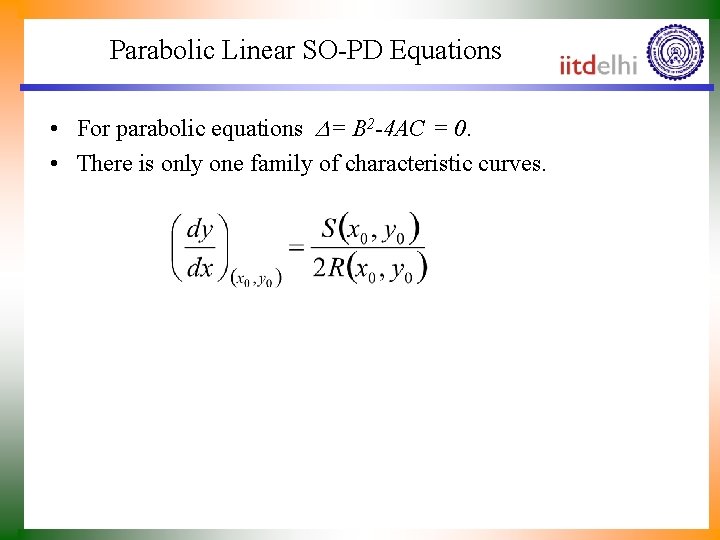
Parabolic Linear SO-PD Equations • For parabolic equations = B 2 -4 AC = 0. • There is only one family of characteristic curves.
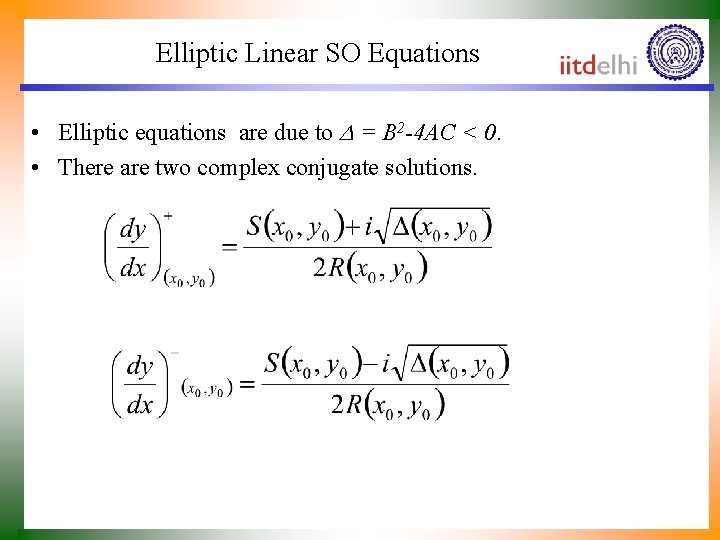
Elliptic Linear SO Equations • Elliptic equations are due to = B 2 -4 AC < 0. • There are two complex conjugate solutions.
Summary • All the three types of equations can be reduced to canonical forms. • The Hyperbolic equations reduce to wave equation. • The parabolic equations reduce to the heat equation. • The Laplace's equation models the canonical form of elliptic equations. • Thus, the wave, heat and Laplace's equations serve as canonical models for all second order constant coefficient PDEs. • We will spend the rest of this course studying the solutions to the Laplace, heat and wave equations.
- Slides: 27