
Second Language Development Teaching the ESOL Student in

- Slides: 42
Second Language Development Teaching the ESOL Student in the Mainstream Classroom Module 2
Contents: Language Development: l BICS vs. CALP l Stages of Language Development l Paralinguistic Communication
BICS vs. CALP
BICS vs. CALP Linguist Jim Cummins distinguishes between two types of language – Basic Interpersonal Communication Skills and Cognitive Academic Language Proficiency.
BICS vs. CALP Cummins developed the BICS and CALP Theory as a way to distinguish the time periods of language development. Without knowledge of BICS vs. CALP, teachers may have unrealistic expectations or remove educational support too early.
BICS vs. CALP Basic Interpersonal Communication Skills BICS refers to the first two years of language acquisition where children are acquiring conversational language. Children need active knowledge of approximately 3000 words to begin feeling comfortable with conversational English.
BICS vs. CALP Cognitive Academic Language Proficiency CALP refers to the stage when children are acquiring academic language. It takes about 5 -7 years to acquire the cognitive academic language necessary to be a successful student.
BICS vs. CALP Cognitive Academic Language Proficiency Children need active knowledge of approximately 6000 words to begin feeling comfortable with academic English.
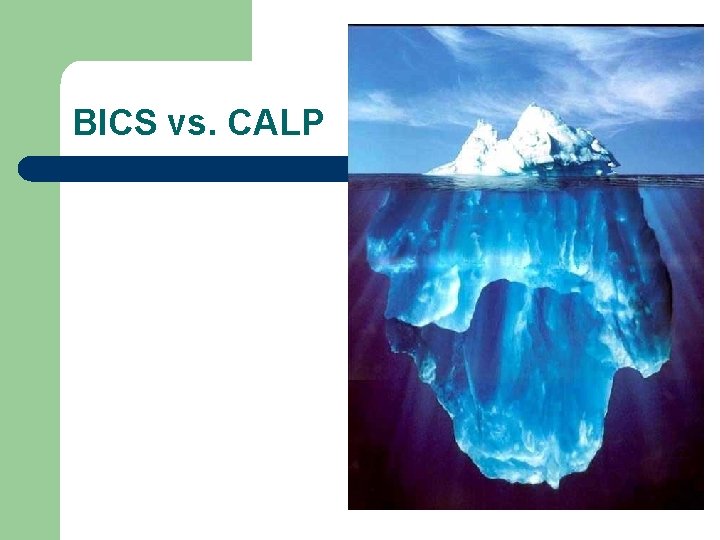
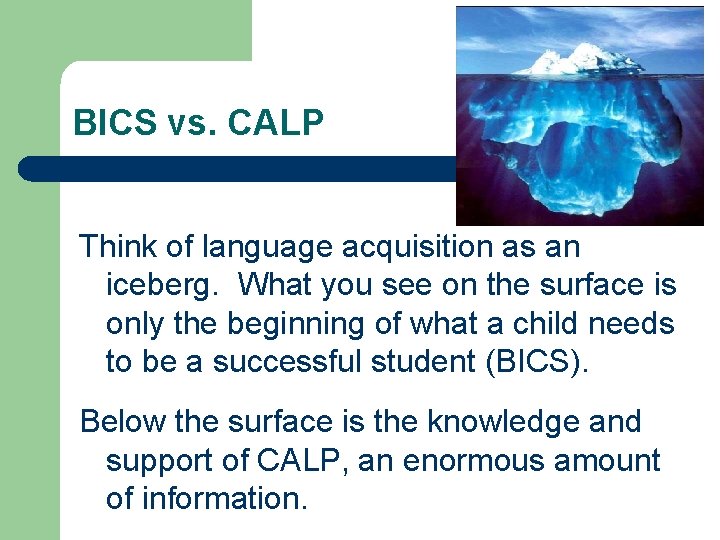
BICS vs. CALP Think of language acquisition as an iceberg. What you see on the surface is only the beginning of what a child needs to be a successful student (BICS). Below the surface is the knowledge and support of CALP, an enormous amount of information.
Stages of Language Development
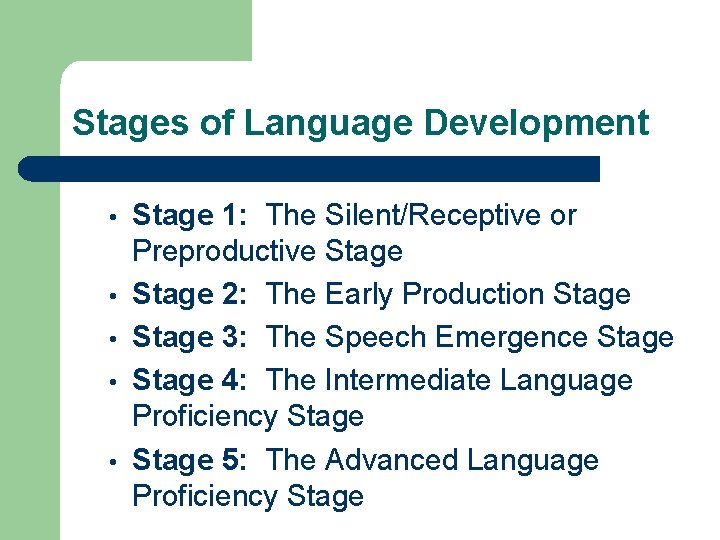
Stages of Language Development Language development follows predictable and sequential stages ranging from no knowledge of a language to proficiency similar to a native speaker. The time it takes a language learner to progress through the stages varies based on numerous factors.
Stages of Language Development There are five stages of language development:
Stages of Language Development • • • Stage 1: The Silent/Receptive or Preproductive Stage 2: The Early Production Stage 3: The Speech Emergence Stage 4: The Intermediate Language Proficiency Stage 5: The Advanced Language Proficiency Stage
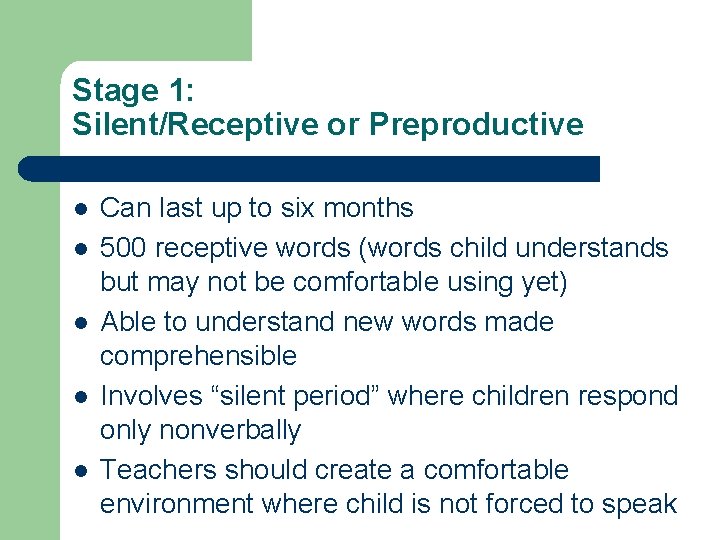
Stage 1: Silent/Receptive or Preproductive l l l Can last up to six months 500 receptive words (words child understands but may not be comfortable using yet) Able to understand new words made comprehensible Involves “silent period” where children respond only nonverbally Teachers should create a comfortable environment where child is not forced to speak
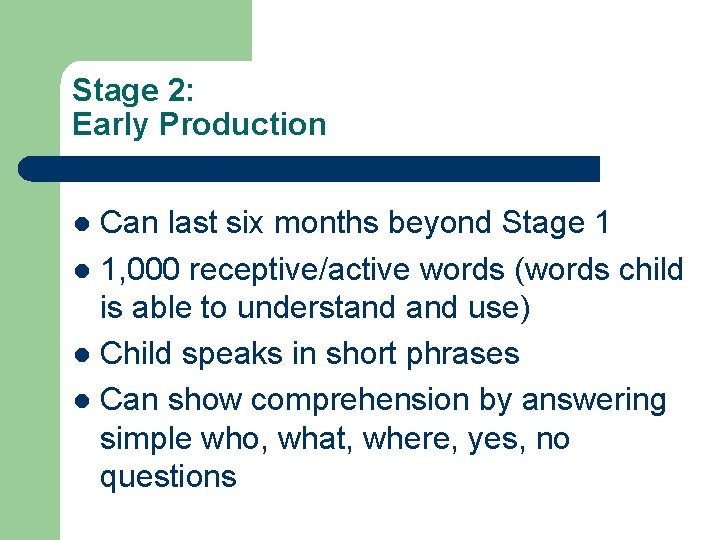
Stage 2: Early Production Can last six months beyond Stage 1 l 1, 000 receptive/active words (words child is able to understand use) l Child speaks in short phrases l Can show comprehension by answering simple who, what, where, yes, no questions l
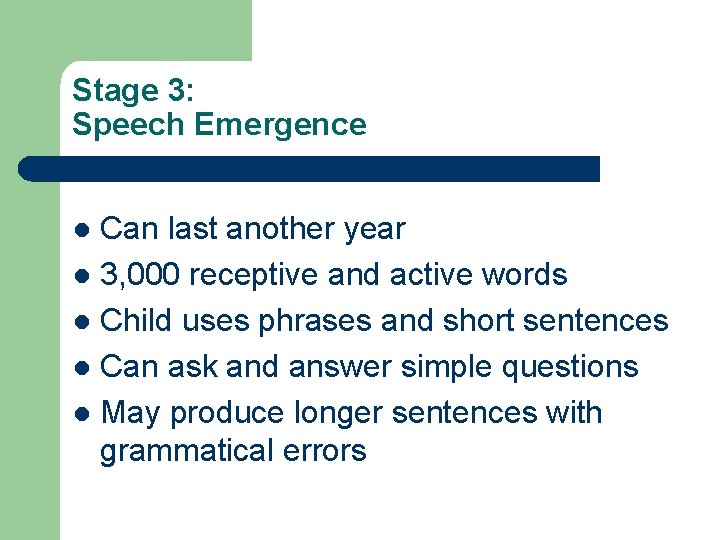
Stage 3: Speech Emergence Can last another year l 3, 000 receptive and active words l Child uses phrases and short sentences l Can ask and answer simple questions l May produce longer sentences with grammatical errors l
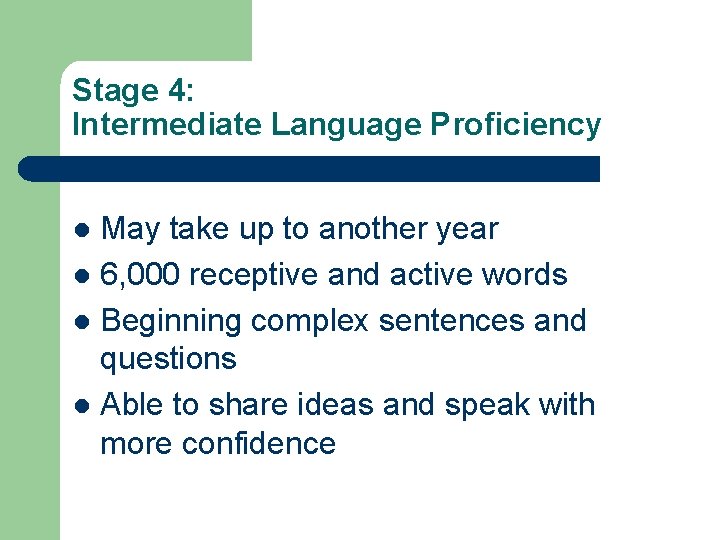
Stage 4: Intermediate Language Proficiency May take up to another year l 6, 000 receptive and active words l Beginning complex sentences and questions l Able to share ideas and speak with more confidence l
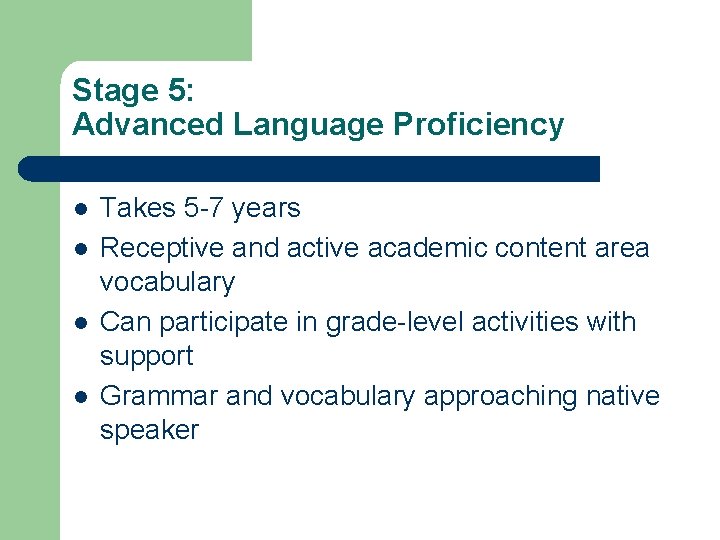
Stage 5: Advanced Language Proficiency l l Takes 5 -7 years Receptive and active academic content area vocabulary Can participate in grade-level activities with support Grammar and vocabulary approaching native speaker
Stages of Language Development The key to guiding children through the stages of language development is to remember Krashen’s i+1 Comprehensible Input.
Paralinguistic Communication
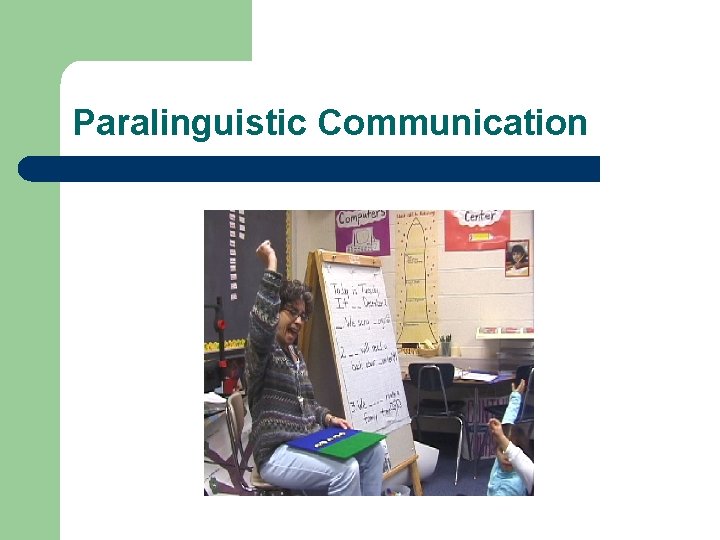
Paralinguistic Communication Paralinguistics is the part of communication outside of the words themselves – the volume, speed, intonation of a voice along with gestures and other non-verbal cues.
Paralinguistic Communication Whenever there is confusion or stereotyping in cross-cultural communication, paralinguistics is most often responsible.
Paralinguistic Communication Paralinguistics can be broken down into categories. The following are the most important for the classroom.
Paralinguistic Communication Paralinguistics can be broken down into categories. The following are the most important for the classroom. • • • Gestures Facial Expressions Eye Contact Kinesics - Body Language Proxemics
Paralinguistic Communication Gestures
Paralinguistic Communication • Gestures are commonly used in the classroom to help convey a message to second language learners. Be Careful! Gestures have different meanings in different cultures!
Paralinguistic Communication • Gestures are crucial to making language comprehensible. Gestures are easily misinterpreted.
Paralinguistic Communication Facial Expression
Paralinguistic Communication • Facial Expression Many facial expressions are universal. Japanese often refrain from showing emotion through facial expression – especially negative emotions. Eyebrow movement is very telling.
Paralinguistic Communication Eye Contact
Paralinguistic Communication • Eye Contact Eye contact provides necessary feedback for conversations to take place such as turn taking, beginning, and ending conversations. The amount of eye contact deemed appropriate is very culturally based – too much or too little can show boredom, intimidation, or disrespect.
Paralinguistic Communication Kinesics – Body Language
Paralinguistic Communication • Kinesics – Body Language Postures give quite a bit of information. Is the listener open or closed to the speaker? Is the speaker showing dominance by being at a higher level? Are other objects used as a comfort?
Paralinguistic Communication Proxemics
Paralinguistic Communication • Proxemics Each person in each culture has a need for personal space that can vary greatly. How far apart do you sit/stand when you talk? How do you feel when someone enters your personal space?
Paralinguistic Communication What are some common paralinguistic miscues?
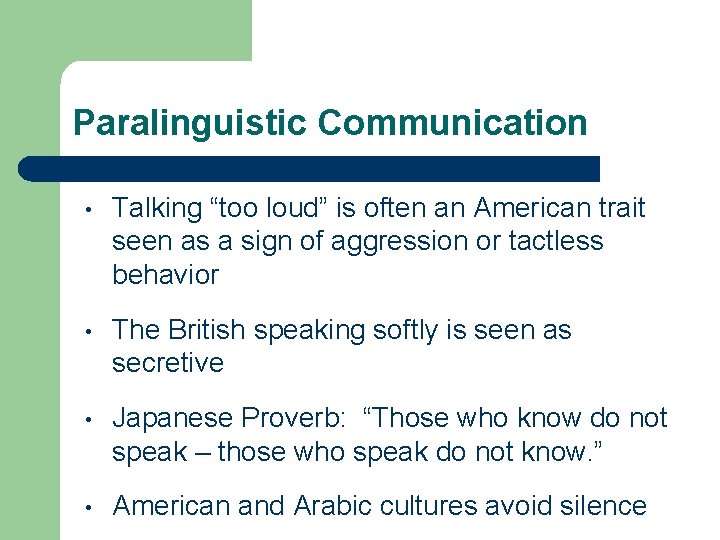
Paralinguistic Communication • Talking “too loud” is often an American trait seen as a sign of aggression or tactless behavior • The British speaking softly is seen as secretive • Japanese Proverb: “Those who know do not speak – those who speak do not know. ” • American and Arabic cultures avoid silence
Paralinguistic Communication What effect does this have on the classroom?
Bibliography Caper, Simon. (May 2000). Nonverbal Communication and the Second Language Learner: Some pedagogic considerations. The Language Teacher Online, 24. 05. Retrieved December 8, 2003 from http: //langue. hyper. chucu. ac. jp/jalt/pub/tlt/00/may/capper. html. Intermundo Glossary of Intercultural Terms. Retrieved December 8, 2003 from http: //intermundo. net/gossary_term. pl? mid=18 Center for Applied Linguistics. (2000). Enhancing English Language Learning in Elementary Classrooms. Delta Publishing Company. Cummins, J. BICS and CALP. Retrieved December 9, 2003 from http: //www. iteachilearn. com/cummins/bicscalp. html
Bibliography Mason, T. (unknown). Didactics 10 -Critique of Krashen VI. IUFM de Versailles. http: //perso. clubinternet. fr/tmason/Web. Pages/Lang. Teach/Licence/CM/Old. Lecture s/L 10_Monitor. htm. Online. Reed, B. & Railsback, J. (2003). Strategies and Resources for Mainstream Teachers of English Language Learners. Northwest Regional Educational Laboratory. http: //www. nwrel. org/request/2003 may/ell. pdf. Online. Schütz, Ricardo. (2002). Stephen Krashen's Theory of Second Language Acquisition. English Made in Brazil http: //www. sk. com. br/sk-krash. html. Online.
Bibliography Unknown. (2002). Noam Chomsky Biography. MIT Linguistics. http: //web. mit. edu/linguistics/www/biography/noambio. html. Online.
The End