
Second Language Acquisition Rod Ellis 2003 chapter 1




- Slides: 6
Second Language Acquisition (Rod Ellis, 2003) chapter 1 introduction: Describing and Explaining L 2 Acquisition By: Rudi Setiawan (2201407090) Second Language Acquisition (103 -104) ENGLISH DEPARTMENT STATE UNIVERSITY of SEMARANG
What is “Second Language Acquisition? ” The systematic study of how people acquire a second language (often referred to as an L 2) is a fairly recent phenomenon, belonging to the second half of the twentieth century “L 2 Acquisition” can be defined as the way in which people learn a language other than their mother tongue, inside or outside of classroom, and “Second Language Acquisition” (SLA) as the study of this. (Rod Ellis, 2003: 3)
What are the goals of SLA? One of the goals of SLA is the description of L 2 Acquisition. Another is explanation; identifying the external and internal factors that account for why learners acquire an L 2 in the way they do - One of the external factors is the social milieu in which learning take place. - Another external factor is the input that learners receive, that is, the samples of language to which a learner is exposed. Learners possess cognitive mechanism which enable them to extract information about L 2 from the input-to notice, for example, that the plularity in English. Final set of internal factors explain why learners vary in the rate they learn an L 2 and how successful they ultimate are. The goals of SLA, then, are to describe how L 2 Acquisition proceeds and to explain this process and why some learners seem to better at it than others. (Rod Ellis, 2003: 4 -6)
Issues in the description of learners language Learners make errors of different kinds L 2 learners acquire a large number of formula chunk, which they use to perform communicative functions that are important to them and which contribute to the fluency of their unplanned speech. Whether learners acquire the language systematically. (Rod Ellis, 2003: 12)
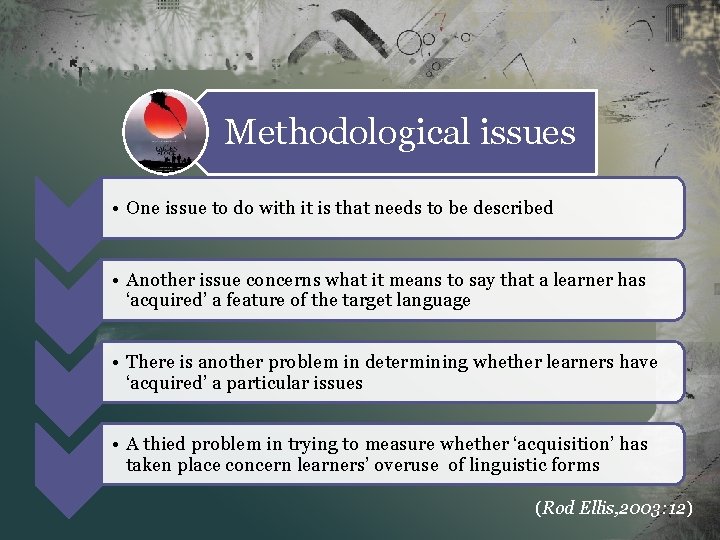
Methodological issues • One issue to do with it is that needs to be described • Another issue concerns what it means to say that a learner has ‘acquired’ a feature of the target language • There is another problem in determining whether learners have ‘acquired’ a particular issues • A thied problem in trying to measure whether ‘acquisition’ has taken place concern learners’ overuse of linguistic forms (Rod Ellis, 2003: 12)
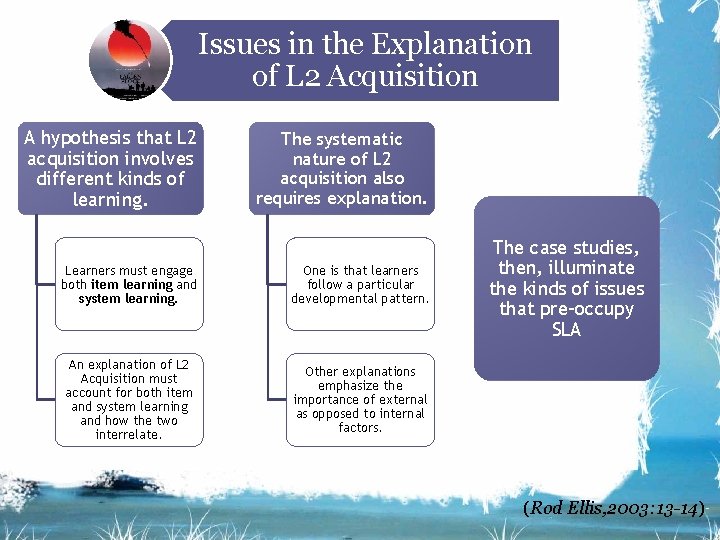
Issues in the Explanation of L 2 Acquisition A hypothesis that L 2 acquisition involves different kinds of learning. The systematic nature of L 2 acquisition also requires explanation. Learners must engage both item learning and system learning. One is that learners follow a particular developmental pattern. An explanation of L 2 Acquisition must account for both item and system learning and how the two interrelate. Other explanations emphasize the importance of external as opposed to internal factors. The case studies, then, illuminate the kinds of issues that pre-occupy SLA (Rod Ellis, 2003: 13 -14)