
Second Language Acquisition and the Critical Period Grant


















- Slides: 43
Second Language Acquisition and the Critical Period Grant Goodall Dept. of Linguistics
What we will do today • Introduction to second language acquisition • How age affects second language acquisition
Second language acquisition: a first look • Classroom learning not the best example of L 2 acquisition • L 2 acquisition is much like L 1 acquisition • Child L 2 acquisition is especially like L 1 acquisition • Adult L 2 acquisition diverges in certain ways from L 1 acquisition
Classroom learning not the best example of L 2 acquisition • Majority of humans speak an L 2; few of them learned it in classroom setting. • Classroom language instruction is a relatively recent phenomenon. • It usually involves just the beginning stages of acquisition.
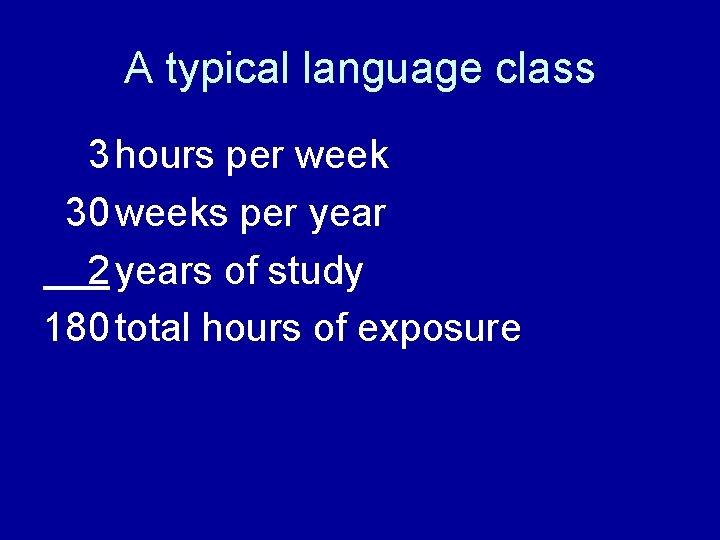
A typical language class 3 hours per week 30 weeks per year 2 years of study 180 total hours of exposure
What can you do in 180 hours? • If you learn 10 words per hour, you will learn 1, 800 words in 2 years. • Is this a lot? • No. Average 18 -year-old knows 60, 000 words. 5 -year-old knows 13, 000!
So…. . • Classroom language learning is worth studying (and worth doing!), • But it is just one piece of the larger picture of second language acquisition.
Second language acquisition: a first look • Classroom learning not the best example of L 2 acquisition • L 2 acquisition is much like L 1 acquisition • Child L 2 acquisition is especially like L 1 acquisition • Adult L 2 acquisition diverges in certain ways from L 1 acquisition
L 2 acquisition is much like L 1 acquisition • Have to learn words: dog, run, of … – Typical error: “Cover the turkey with aluminum paper. ” • Have to learn rules: SVO, “add –ed to make verb past tense” … – Typical error: “I taked test yesterday. ”
Second language acquisition: a first look • Classroom learning not the best example of L 2 acquisition • L 2 acquisition is much like L 1 acquisition • Child L 2 acquisition is especially like L 1 acquisition • Adult L 2 acquisition diverges in certain ways from L 1 acquisition
Child L 2 acquisition is especially like L 1 acquisition • After arriving in a new language environment, younger children will “catch up” within a year or two. • They then appear to be indistinguishable from L 1 acquirers of the language.
Second language acquisition: a first look • Classroom learning not the best example of L 2 acquisition • L 2 acquisition is much like L 1 acquisition • Child L 2 acquisition is especially like L 1 acquisition • Adult L 2 acquisition diverges in certain ways from L 1 acquisition
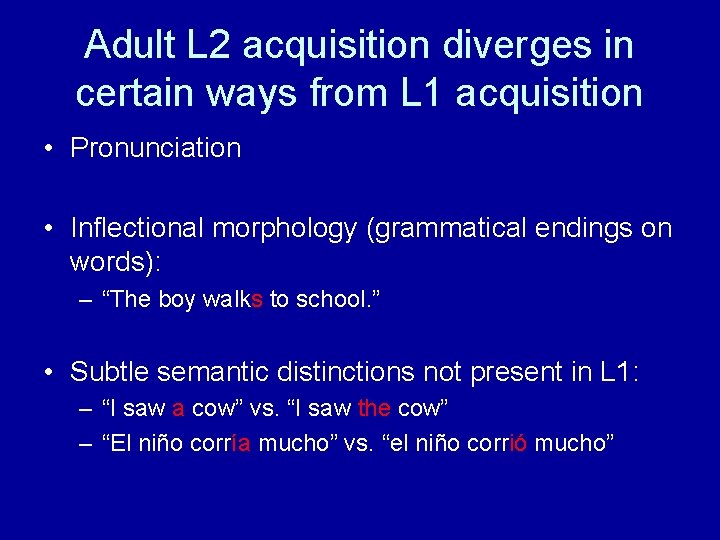
Adult L 2 acquisition diverges in certain ways from L 1 acquisition • Pronunciation • Inflectional morphology (grammatical endings on words): – “The boy walks to school. ” • Subtle semantic distinctions not present in L 1: – “I saw a cow” vs. “I saw the cow” – “El niño corría mucho” vs. “el niño corrió mucho”
…but you already knowed this facts!
But many other aspects of adult L 2 acquisition work just as you would expect…
Adults readily learn: • Words (vocabulary) • Word order and many other aspects of syntax: SVO, VSO, SOV, etc. Neko-ga nezumi-o toraeru. cat mouse catch
Second language acquisition: a first look • Classroom learning not the best example of L 2 acquisition • L 2 acquisition is much like L 1 acquisition • Child L 2 acquisition is especially like L 1 acquisition • Adult L 2 acquisition diverges in certain ways from L 1 acquisition
Effects of age on L 2 acquisition • Critical period for L 1 acquisition • What would a critical period for L 2 acquisition look like? • Do we actually find such a critical period? • Do late learners ever attain nativelikeness?
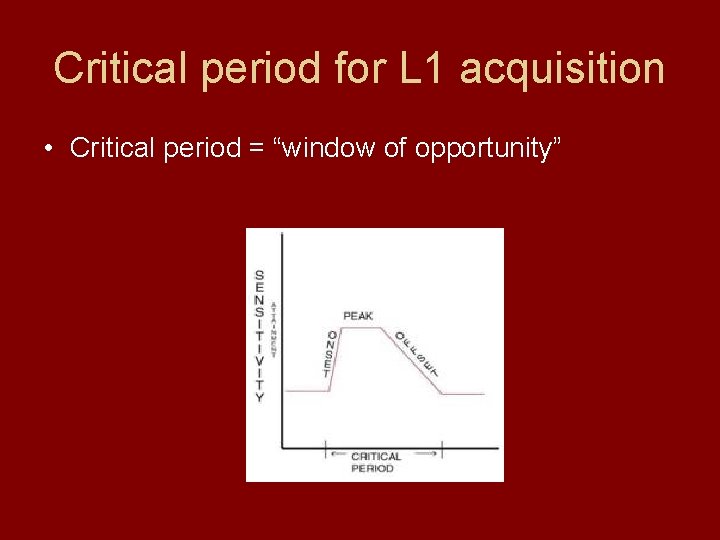
Critical period for L 1 acquisition • Critical period = “window of opportunity”
Standard evidence for critical period in L 1 • Young infants are “universal listeners”. Ability declines around age 1. • Delaying L 1 acquisition until after childhood leads to low levels of grammatical development (e. g. Genie).
Effects of age on L 2 acquisition • Critical period for L 1 acquisition • What would a critical period for L 2 acquisition look like? • Do we actually find such a critical period? • Do late learners ever attain nativelikeness?
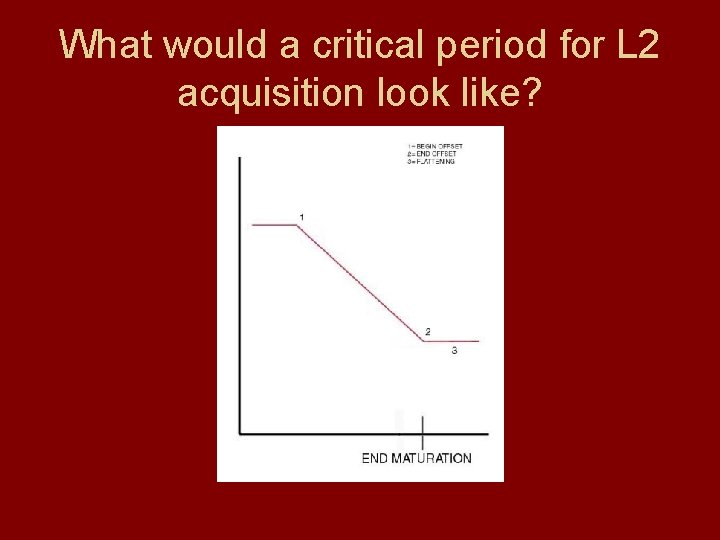
What would a critical period for L 2 acquisition look like?
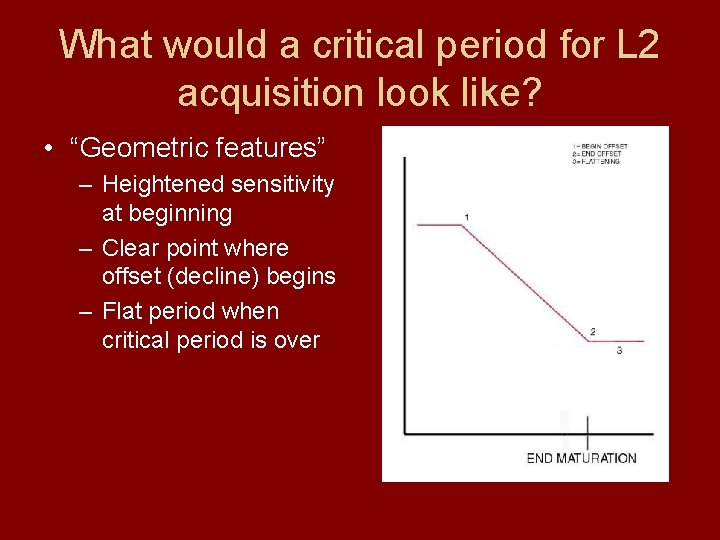
What would a critical period for L 2 acquisition look like? • “Geometric features” – Heightened sensitivity at beginning – Clear point where offset (decline) begins – Flat period when critical period is over
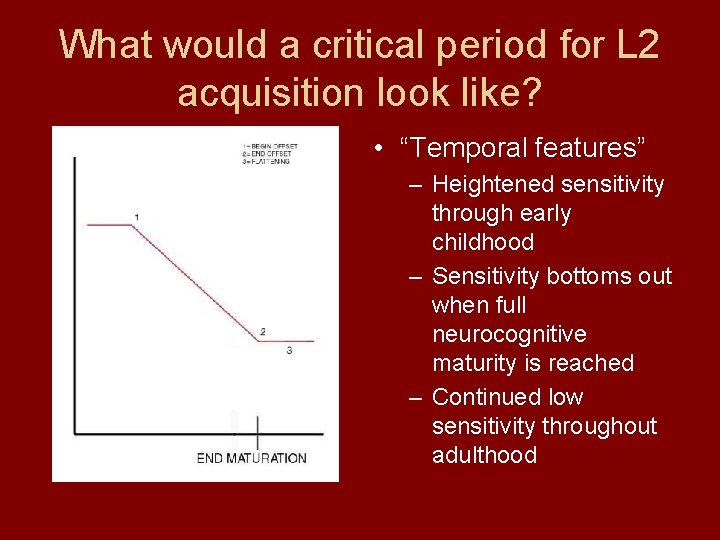
What would a critical period for L 2 acquisition look like? • “Temporal features” – Heightened sensitivity through early childhood – Sensitivity bottoms out when full neurocognitive maturity is reached – Continued low sensitivity throughout adulthood
Effects of age on L 2 acquisition • Critical period for L 1 acquisition • What would a critical period for L 2 acquisition look like? • Do we actually find such a critical period? • Do late learners ever attain nativelikeness?
Do we actually find such a critical period? • The “classic” study says yes. • Johnson & Newport (1989) compared English proficiency of Korean and Chinese immigrants to U. S. • Age of arrival ranged from 3 to 39 • Length of residence in U. S. at least 3 years • Subjects tested on variety of English structures
Results: • Clear and strong advantage for early arrivals over late arrivals • Age of arrival before puberty – Performance linearly related to age • Age of arrival after puberty – Performance low but highly variable – Performance unrelated to age
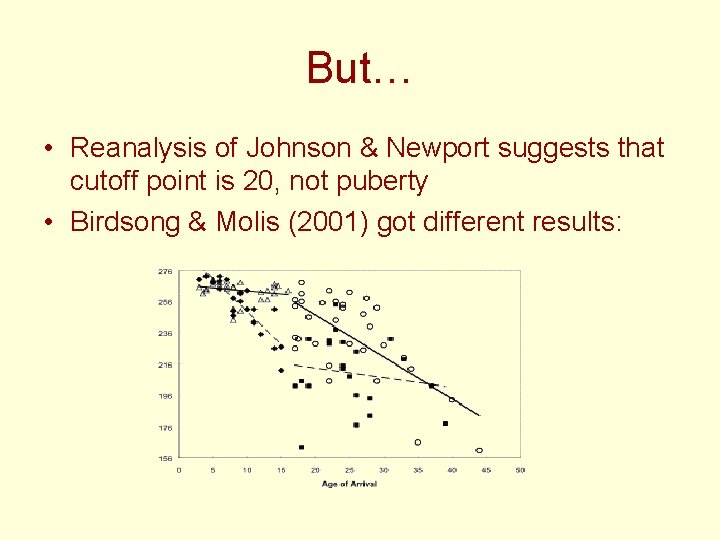
But… • Reanalysis of Johnson & Newport suggests that cutoff point is 20, not puberty • Birdsong & Molis (2001) got different results:
Other studies point to same conclusion: • Not clear there is sharp cutoff point • Slow decline in sensitivity throughout life (i. e. , no “flattening out”)
Flege (1999) • Pronunciation of Italian immigrants to Ontario, Canada • Length of residence ≥ 15 years • No cutoff point where decline begins • No flattening out in adulthood
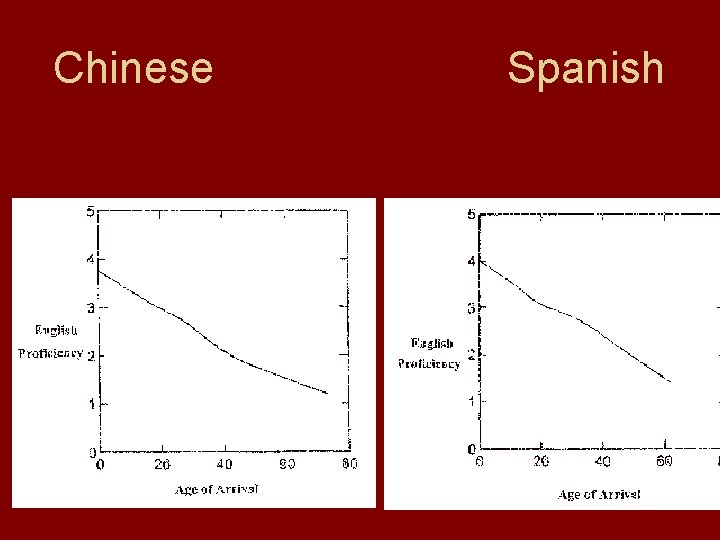
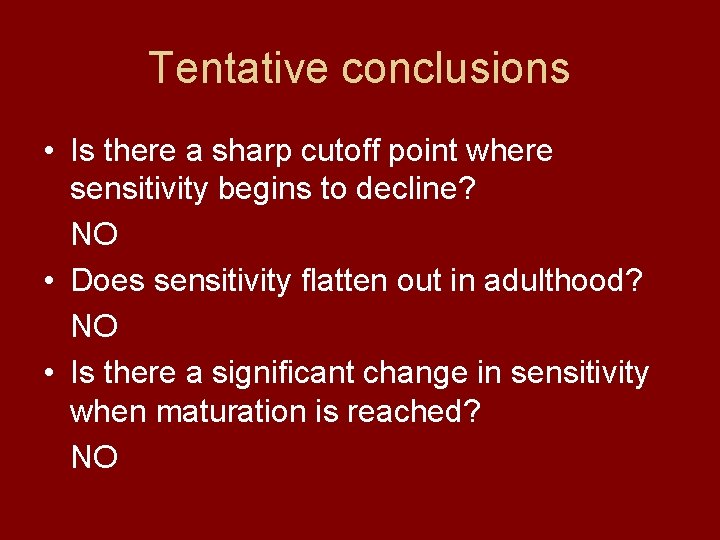
Hakuta, Bialystok & Wiley (2003) • Self-assessed oral proficiency ratings of Chinese- and Spanish-speaking immigrants to U. S. • Length of residence ≥ 10 years • No cutoff point where decline begins • No flattening out in adulthood
Chinese Spanish
Tentative conclusions • Is there a sharp cutoff point where sensitivity begins to decline? NO • Does sensitivity flatten out in adulthood? NO • Is there a significant change in sensitivity when maturation is reached? NO
• Is there a well-defined critical period for L 2 acquisition? NO • Does age affect L 2 acquisition? YES
Effects of age on L 2 acquisition • Critical period for L 1 acquisition • What would a critical period for L 2 acquisition look like? • Do we actually find such a critical period? • Do late learners ever attain nativelikeness?
Do late learners ever attain nativelikeness? • Previous assumed answer: Very rarely. • Is what we would expect if there is critical period. • Newer research reevaluates this, shows incidence of nativelikeness at 5% to 15%. • This is additional evidence against critical period.
Comments on nativelikeness • Not monolithic: one can be nativelike in pronunciation, but not syntax (or viceversa). • Have to consider the appropriate population: those who have had years of interaction with language
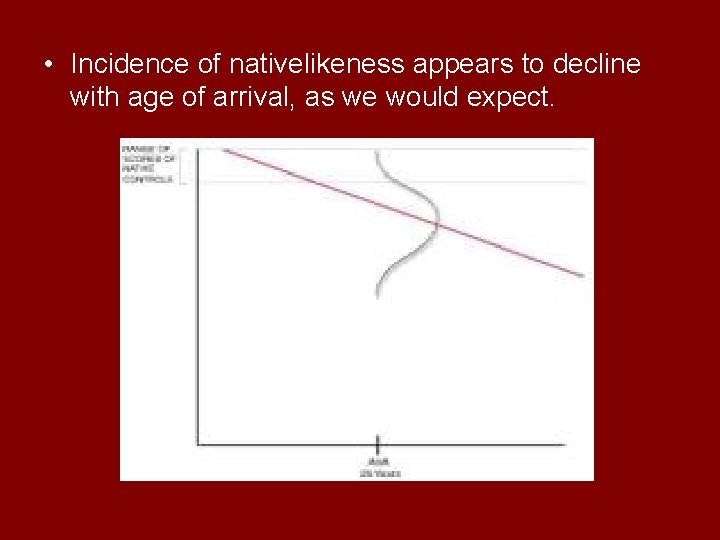
• Incidence of nativelikeness appears to decline with age of arrival, as we would expect.
Final considerations • Why does L 2 learning ability decline throughout life? – Biology – Environment
Biology • Age-related changes in cognitive processing. • For example, decreasing ability to: – Learn paired associates. – Encode new information. – Recall detail as opposed to gist. – Perform “control” processes (e. g. Simon task)
Biology • Also, general decline in: – Working memory capacity – Cognitive processing speed – Attention These changes in brain functioning may account for much of the decline in language learning ability. But also …
Environment • Lack of input that is good for learning. • Need to respond in socially appropriate way. • Insufficient time
Wanna learn another language? • Would have been easier 10 years ago. • But will be harder still 10 years from now. So do it now.