
SECOND INDUSTRIAL REVOLUTION LESSON 4 SECOND INDUSTRIAL REVOLUTION

- Slides: 20
SECOND INDUSTRIAL REVOLUTION LESSON #4
SECOND INDUSTRIAL REVOLUTION The Second Industrial Revolution, also known as the Technological Revolution, was a phase of the larger Industrial Revolution corresponding to the later half of the 19 th century until WWI Can be summarized into concepts: 1. Incorporation and mass production 2. Scientific research fuels new discoveries
SIGNIFICANT DEVELOPMENTS Creation of Steel Chemicals Electricity Transportation
STEEL VS IRON By 1850, the age of iron had become fully established. But for many uses, wrought iron was inferior to steel. The problem was not to make steel; the problem was to make cheap steel. Henry Bessemer in 1856 found an inexpensive way to covert Iron to Steel. This process is called Bessemer Process
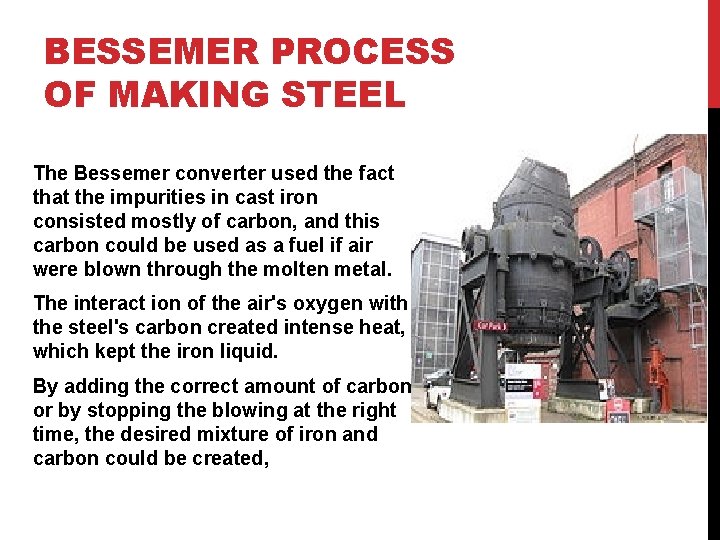
BESSEMER PROCESS OF MAKING STEEL The Bessemer converter used the fact that the impurities in cast iron consisted mostly of carbon, and this carbon could be used as a fuel if air were blown through the molten metal. The interact ion of the air's oxygen with the steel's carbon created intense heat, which kept the iron liquid. By adding the correct amount of carbon or by stopping the blowing at the right time, the desired mixture of iron and carbon could be created,
CHEMICALS Nitrogen fertilizers were produced from the caliche (natural sodium nitrate) mined in Chile. The famous Haber process to make ammonia, developed by Fritz Haber and BASF chemists Carl Bosch and Alwin Mittasch and the discovery of how to convert ammonia into nitric acid around 1908, made it possible for Germany to continue producing nitrates for fertilizers and explosives during World War I Chemistry also began its road toward the supply of new artificial materials. Charles Goodyear, the American tinkerer invented in 1839 the vulcanization process of rubber that made widespread industrial use of rubber possible. Another American, John Wesley Hyatt, succeeded in creating the first synthetic plastic in 1869,
ELECTRICITY Thomas Alva Edison The modern world is an electrified world. The light bulb, in particular, profoundly changed human existence by illuminating the night and making it hospitable to a wide range of human activity. The electric light, one of the everyday conveniences that most affects our lives Samuel Morse invested the first telegrpah allowing for ease of communication
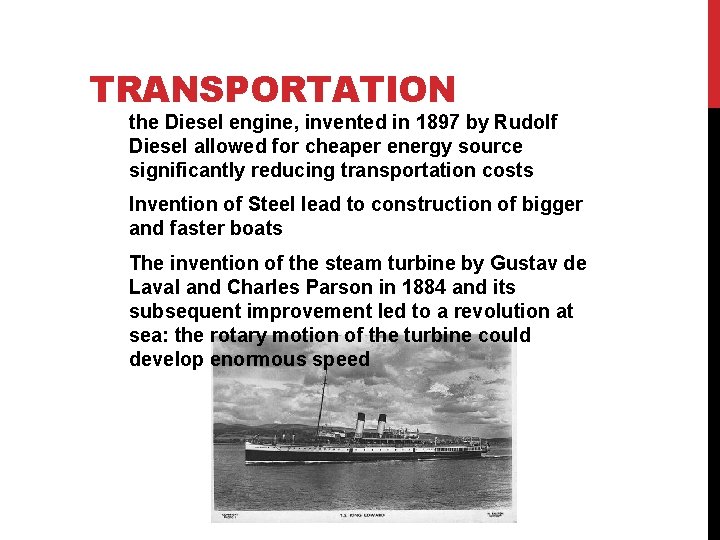
TRANSPORTATION the Diesel engine, invented in 1897 by Rudolf Diesel allowed for cheaper energy source significantly reducing transportation costs Invention of Steel lead to construction of bigger and faster boats The invention of the steam turbine by Gustav de Laval and Charles Parson in 1884 and its subsequent improvement led to a revolution at sea: the rotary motion of the turbine could develop enormous speed
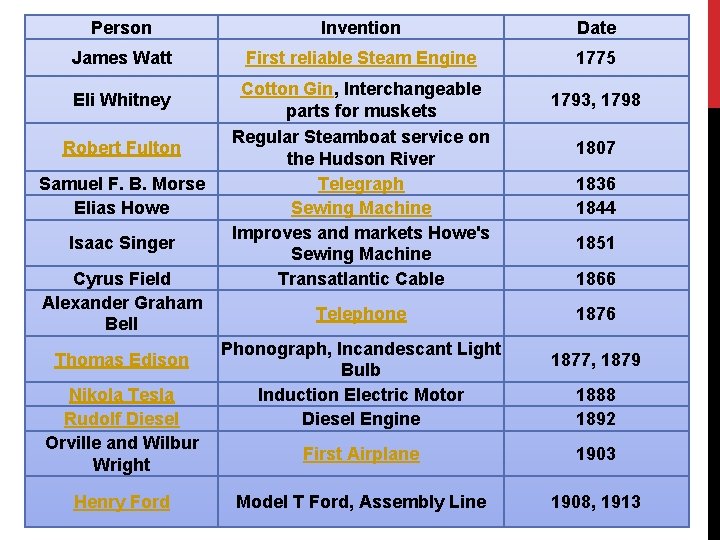
Person Invention Date James Watt First reliable Steam Engine 1775 Eli Whitney Robert Fulton Samuel F. B. Morse Elias Howe Isaac Singer Cyrus Field Alexander Graham Bell Thomas Edison Nikola Tesla Rudolf Diesel Orville and Wilbur Wright Henry Ford Cotton Gin, Interchangeable parts for muskets Regular Steamboat service on the Hudson River Telegraph Sewing Machine Improves and markets Howe's Sewing Machine Transatlantic Cable Telephone Phonograph, Incandescant Light Bulb Induction Electric Motor Diesel Engine 1793, 1798 1807 1836 1844 1851 1866 1877, 1879 1888 1892 First Airplane 1903 Model T Ford, Assembly Line 1908, 1913
THE GREAT DEPRESSION This is not the 1930’s famous great depression but a depression that happened during 1973 -1896. This depression is categorized by falling prices for agricultural products as a result farmers suffered the most during the industrial revolution. Farmers were unable to compete with the low prices and a lot of them could not longer farm as it was financially unbeneficial.
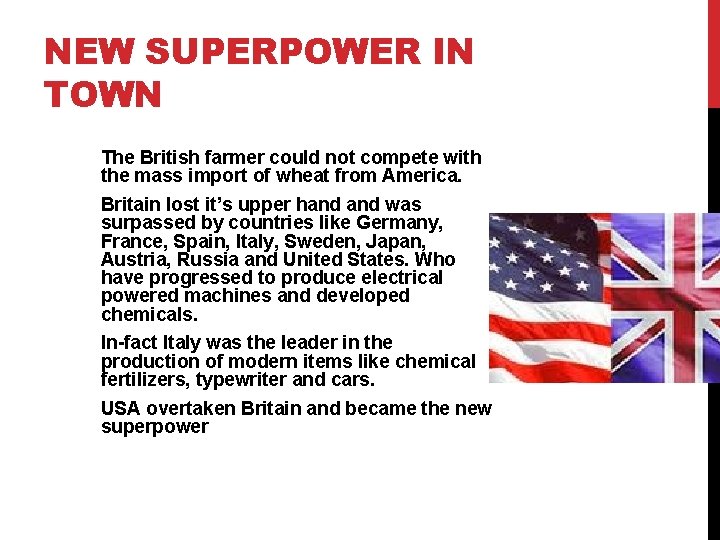
NEW SUPERPOWER IN TOWN The British farmer could not compete with the mass import of wheat from America. Britain lost it’s upper hand was surpassed by countries like Germany, France, Spain, Italy, Sweden, Japan, Austria, Russia and United States. Who have progressed to produce electrical powered machines and developed chemicals. In-fact Italy was the leader in the production of modern items like chemical fertilizers, typewriter and cars. USA overtaken Britain and became the new superpower
THE BIRTH OF CORPORATION AND STOCK TRADING Production were getting bigger and required more financing (more money). The concept of corporation was born. Under the law corporations were considered an entity distinct from the people who invested in it; if it went bankrupt, investors were not personally liable for it’s debts beyond their actual investment. The concept of Limited liability was born, which is still current today
HOW THE STOCK MARKET WORKS http: //www. youtube. com/watch? v=sjy. Wx. ERg. GJs&feature=rel ated – how the stock market works http: //www. youtube. com/watch? v=8 Su. Uzmq. Bewg&feature=re lated – what is a corporation
SKYSCRAPERS The skyscraper was born in Chicago but quickly become identified with New York City. Steel was used to build skyscraper Now Skyscraper are the imagine of a metropolitan city. Metropolitan city = represent a large city or urban area. A metropolis is usually a significant economic, political and cultural center for some country or region, and an important hub for regional or international connections and communications. Changed the physical appearance of our cities
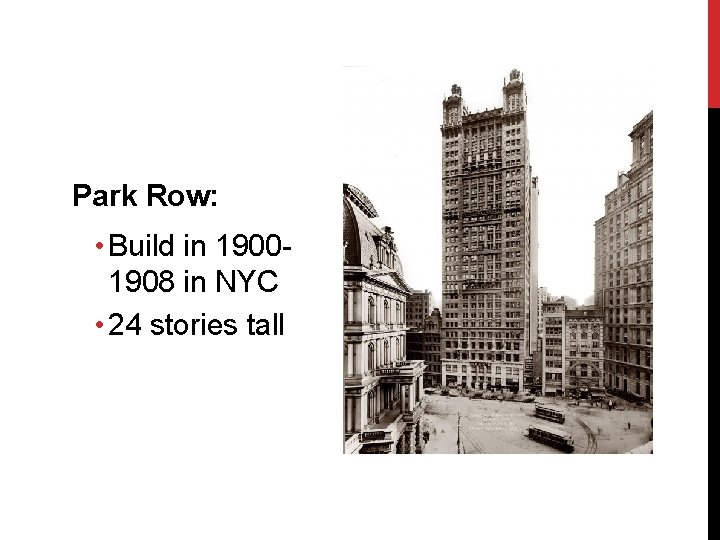
Park Row: • Build in 19001908 in NYC • 24 stories tall
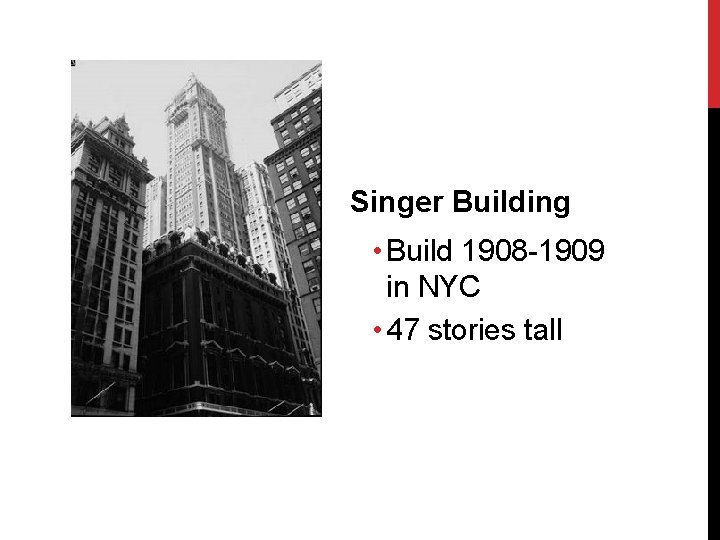
Singer Building • Build 1908 -1909 in NYC • 47 stories tall
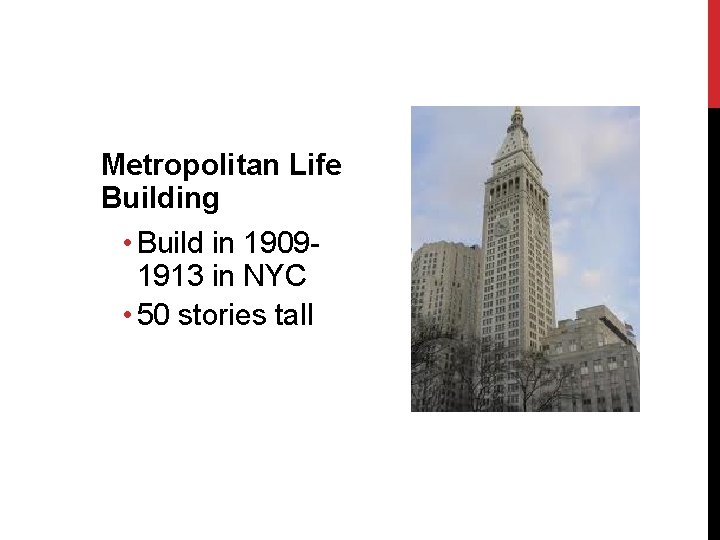
Metropolitan Life Building • Build in 19091913 in NYC • 50 stories tall
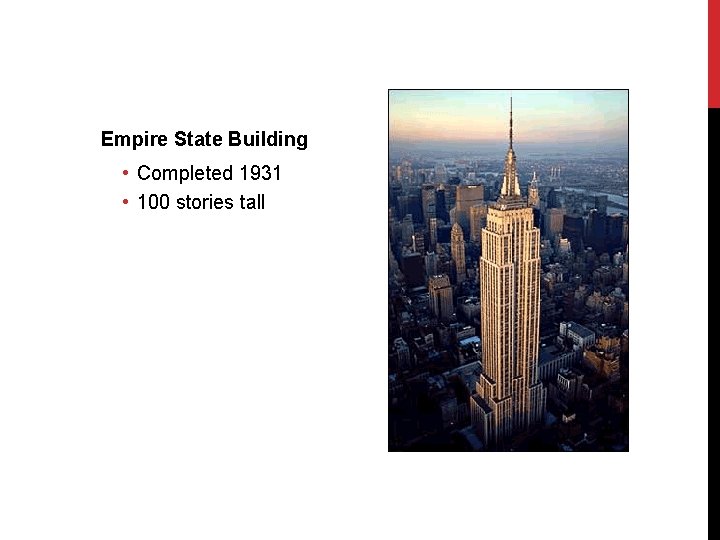
Empire State Building • Completed 1931 • 100 stories tall
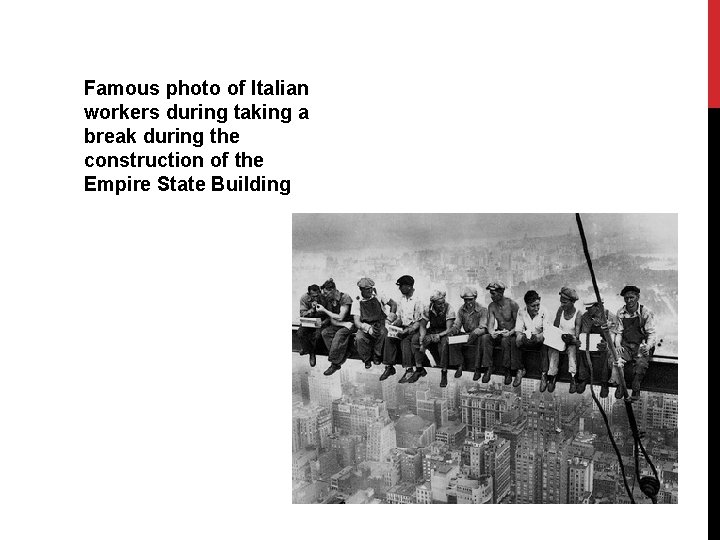
Famous photo of Italian workers during taking a break during the construction of the Empire State Building
STEAM POWER Continuation of James Watt invention of steam engine The steam cycle • is a cycle that converts heat into work. The heat is supplied externally to a closed loop, which in steam engines contains water and steam. This cycle generates about 80% of all electric power used throughout the world, including virtually all solar thermal, biomass, coal and nuclear power plants.