
SECME Generator Building Competition TOPICS Purpose Basic Theory
SECME Generator Building Competition

TOPICS • Purpose • Basic Theory of Electrical Generators • Competition • Generator Building Instructions 2
PURPOSE 3
Purpose The generator building competition will prepare students for other STEM programs by challenging them to understand the following: • Basic forms of energy, including electrical and mechanical • The basic magnetic theory • The relationship between magnetic and electric fields. • The flow of electrical circuits. • The law of electromagnetic induction (Faraday’s Law). 4

BASIC THEORY of ELECTRICAL GENERATORS 6
Basic Theory How does a Generator Work? • It’s a machine designed to convert Mechanical Energy to Electrical Energy. • Based on the principle of electromagnetic induction, which was introduced by Michael Faraday in 1831. Three things are required to build a generator: • A magnetic field • Current carrying conductor • Relative motion between the two. 7
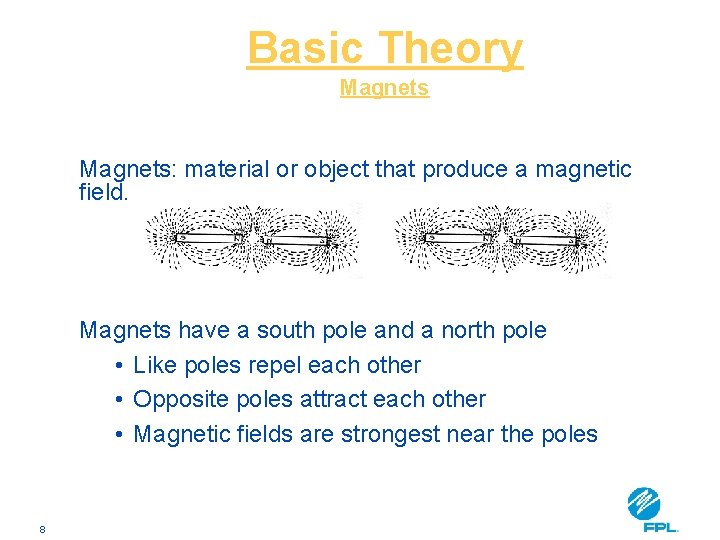
Basic Theory Magnets: material or object that produce a magnetic field. Magnets have a south pole and a north pole • Like poles repel each other • Opposite poles attract each other • Magnetic fields are strongest near the poles 8
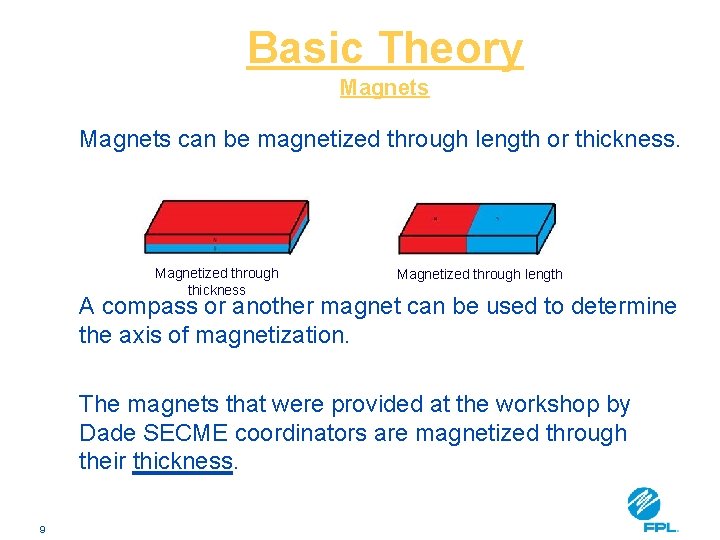
Basic Theory Magnets can be magnetized through length or thickness. Magnetized through thickness Magnetized through length A compass or another magnet can be used to determine the axis of magnetization. The magnets that were provided at the workshop by Dade SECME coordinators are magnetized through their thickness. 9
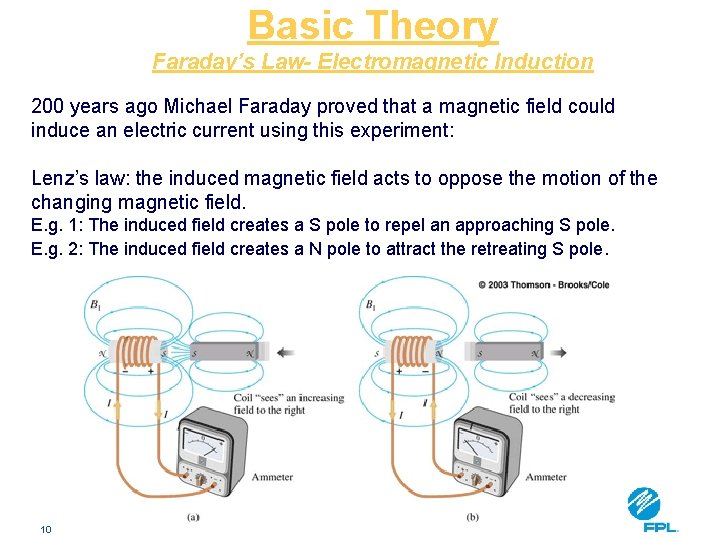
Basic Theory Faraday’s Law- Electromagnetic Induction 200 years ago Michael Faraday proved that a magnetic field could induce an electric current using this experiment: Lenz’s law: the induced magnetic field acts to oppose the motion of the changing magnetic field. E. g. 1: The induced field creates a S pole to repel an approaching S pole. E. g. 2: The induced field creates a N pole to attract the retreating S pole. 10
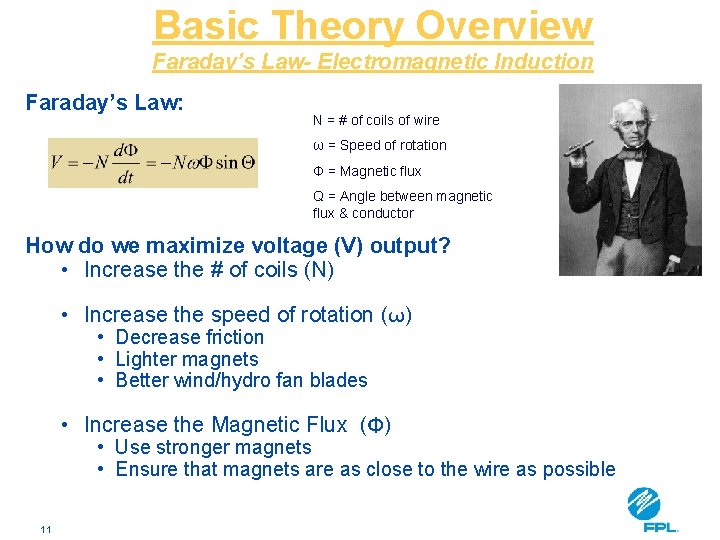
Basic Theory Overview Faraday’s Law- Electromagnetic Induction Faraday’s Law: N = # of coils of wire ω = Speed of rotation Ф = Magnetic flux Q = Angle between magnetic flux & conductor How do we maximize voltage (V) output? • Increase the # of coils (N) • Increase the speed of rotation (ω) • Decrease friction • Lighter magnets • Better wind/hydro fan blades • Increase the Magnetic Flux (Φ) • Use stronger magnets • Ensure that magnets are as close to the wire as possible 11
COMPETITION 12
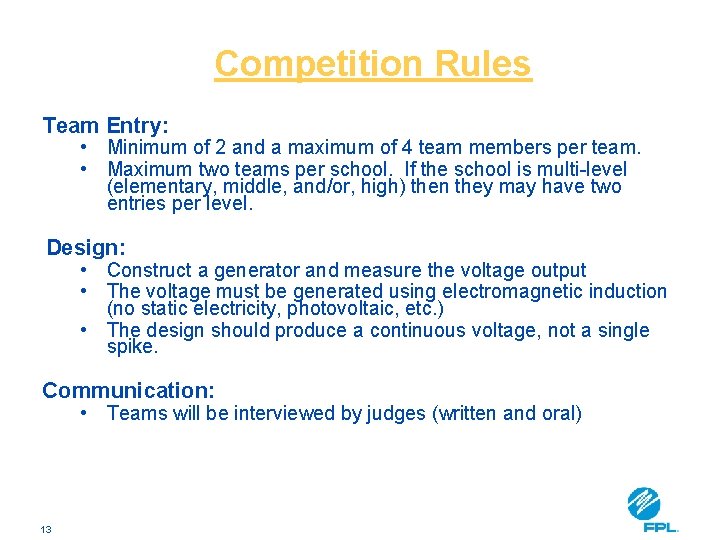
Competition Rules Team Entry: • Minimum of 2 and a maximum of 4 team members per team. • Maximum two teams per school. If the school is multi-level (elementary, middle, and/or, high) then they may have two entries per level. Design: • Construct a generator and measure the voltage output • The voltage must be generated using electromagnetic induction (no static electricity, photovoltaic, etc. ) • The design should produce a continuous voltage, not a single spike. Communication: • Teams will be interviewed by judges (written and oral) 13
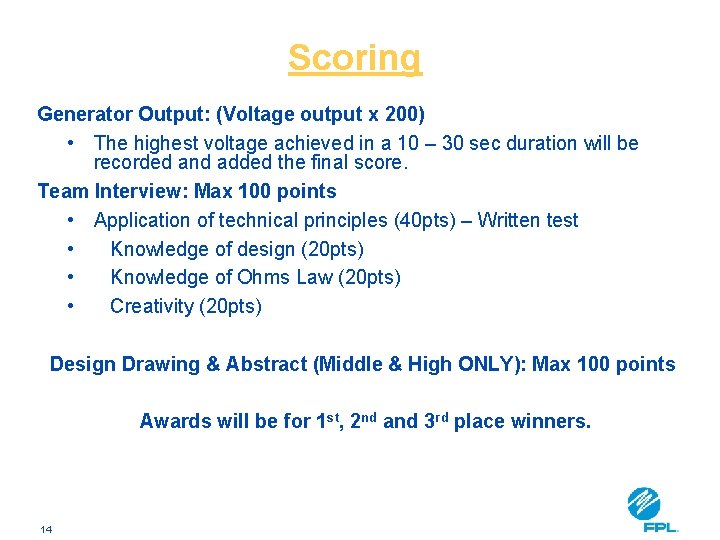
Scoring Generator Output: (Voltage output x 200) • The highest voltage achieved in a 10 – 30 sec duration will be recorded and added the final score. Team Interview: Max 100 points • Application of technical principles (40 pts) – Written test • Knowledge of design (20 pts) • Knowledge of Ohms Law (20 pts) • Creativity (20 pts) Design Drawing & Abstract (Middle & High ONLY): Max 100 points Awards will be for 1 st, 2 nd and 3 rd place winners. 14
Generator Requirements and Guidelines • Maximum Dimensions: 30 cm X 30 cm • No batteries, or external voltage source can be used. • No generator kits allowed • All items must be hand assembled • Generator must be able to run continuously for 30 sec. • Materials such as wood, cardboard, plastic, etc. can be used for the base of the generator. Long nails, screws, pencils, etc. can be used for the rotor. 15
Material List 500' Maximum of #28 AWG Magnetic Wire • Approximate cost: $10. 00 http: //www. amazon. com/Magnet-Plain-Enamel-Nylon. Insulated/dp/B 00 B 887 G 6 Y/ref=sr_1_10? s=industrial&ie=UTF 8&qid=1382704057&sr=1 -10&keywords=28+awg+magnet+wire Magnets: • Elementary and Middle school must use option (a) • High school may choose either (a) or (b) • These are strong magnets. Handle carefully to avoid pinching. They may lose their magnetism if chipped or damaged. • Keep magnets away from sensitive electronics and credit cards. (a) Maximum 4: Ceramic Bar Magnets (3/8” x 7/8 x 1 -7/8”) Cost: $5. 34 http: //www. homedepot. com/s/ceramic%2520 block%2520 magnets? NCNI-5 (b) Maximum 12: Neodymium Disc Magnets (3/16” x 1/4”) Cost: $5. 64 http: //www. kjmagnetics. com/proddetail. asp? prod=D 34 -N 52&cat=168 16
Elementary School: Rules & Scoring Safety First! Students should have an adult present to help with testing. Gloves & Safety Glasses are encouraged at ALL times. • Rotor will be turned by a standard electric drill at a set speed of approximately 200 rpm. • Judging will be based on the maximum peak voltage output for a duration of 10 seconds. • The rotor is to stick out at least 2 cm for the judges to attach the electric drill. 17
Middle School: Rules & Scoring Safety First! Students should have an adult present to help with testing. Gloves & Safety Glasses are encouraged at ALL times. • • 18 The students are to construct a generator powered by wind. Wind source used shall be from the blower portion of a shop/home vacuum. A 3 hp, 8 amp, 120 v vacuum will be used during competition. Students will operate the vacuum themselves. Judging will be based upon maximum peak voltage output for a duration of 30 seconds.
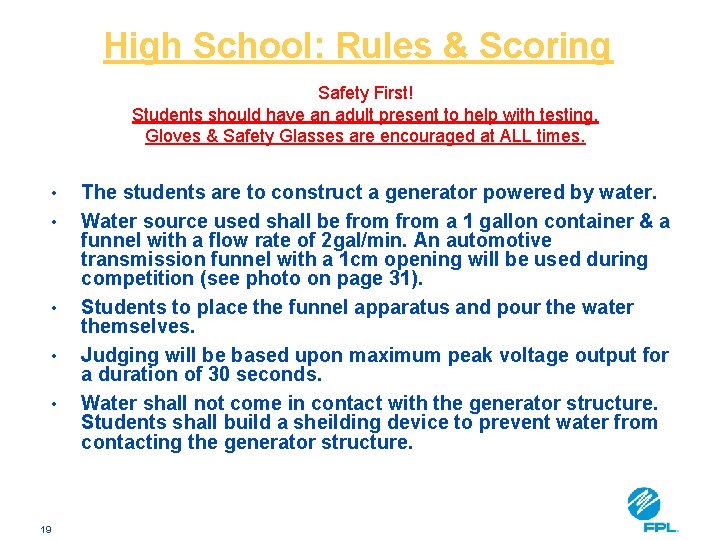
High School: Rules & Scoring Safety First! Students should have an adult present to help with testing. Gloves & Safety Glasses are encouraged at ALL times. • • • 19 The students are to construct a generator powered by water. Water source used shall be from a 1 gallon container & a funnel with a flow rate of 2 gal/min. An automotive transmission funnel with a 1 cm opening will be used during competition (see photo on page 31). Students to place the funnel apparatus and pour the water themselves. Judging will be based upon maximum peak voltage output for a duration of 30 seconds. Water shall not come in contact with the generator structure. Students shall build a sheilding device to prevent water from contacting the generator structure.
GENERATOR BUILDING INSTRUCTIONS 20
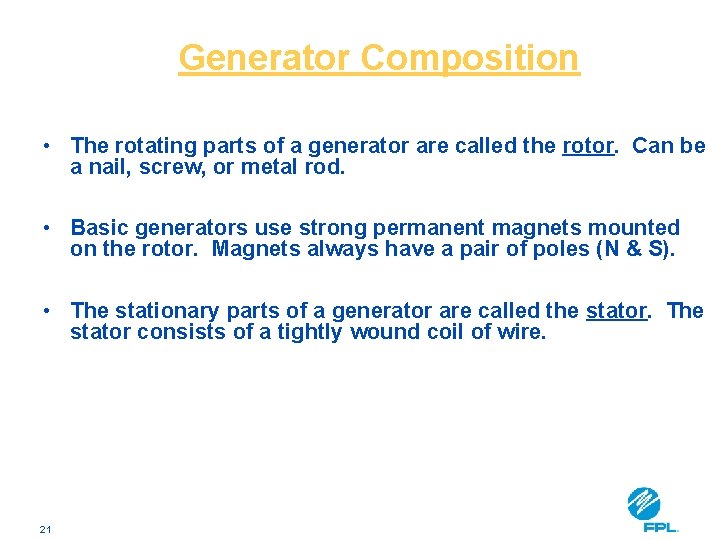
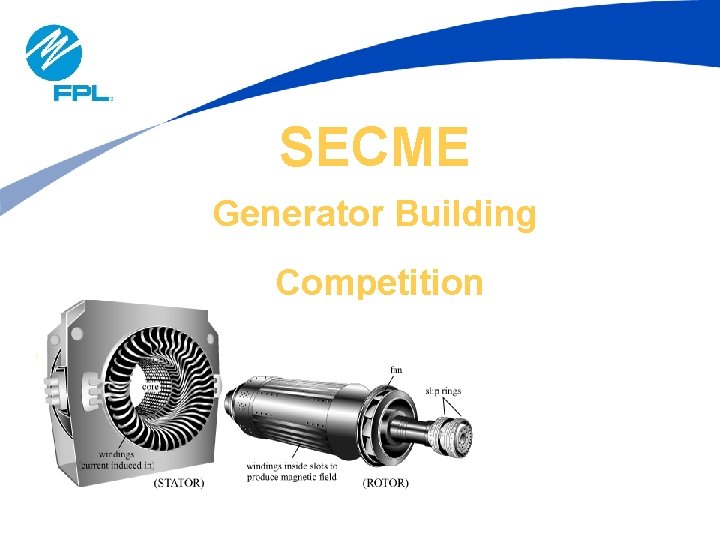
Generator Composition • The rotating parts of a generator are called the rotor. Can be a nail, screw, or metal rod. • Basic generators use strong permanent magnets mounted on the rotor. Magnets always have a pair of poles (N & S). • The stationary parts of a generator are called the stator. The stator consists of a tightly wound coil of wire. 21
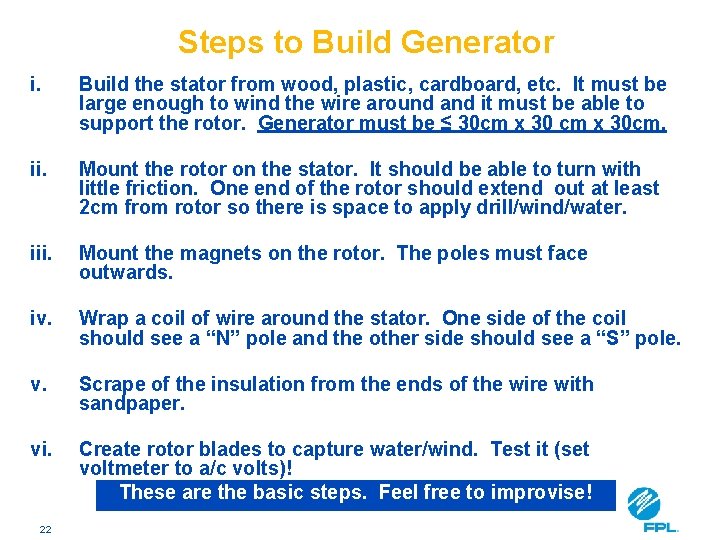
Steps to Build Generator i. Build the stator from wood, plastic, cardboard, etc. It must be large enough to wind the wire around and it must be able to support the rotor. Generator must be ≤ 30 cm x 30 cm. ii. Mount the rotor on the stator. It should be able to turn with little friction. One end of the rotor should extend out at least 2 cm from rotor so there is space to apply drill/wind/water. iii. Mount the magnets on the rotor. The poles must face outwards. iv. Wrap a coil of wire around the stator. One side of the coil should see a “N” pole and the other side should see a “S” pole. v. Scrape of the insulation from the ends of the wire with sandpaper. vi. Create rotor blades to capture water/wind. Test it (set voltmeter to a/c volts)! These are the basic steps. Feel free to improvise! 22
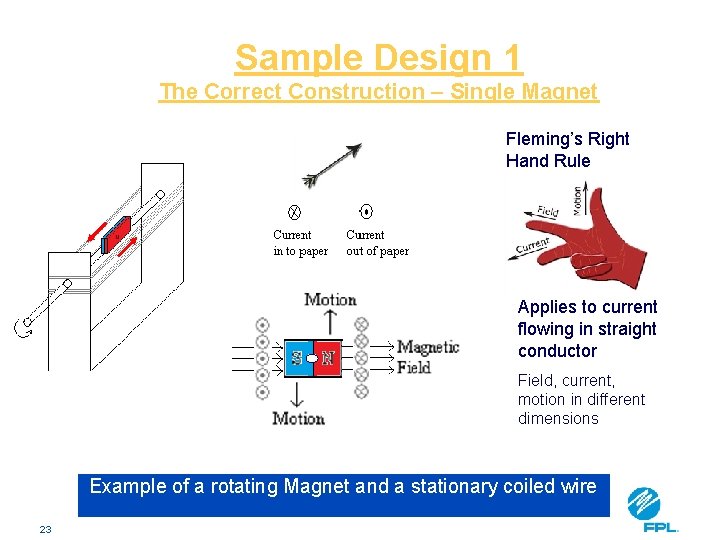
Sample Design 1 The Correct Construction – Single Magnet Fleming’s Right Hand Rule Direction of Current Rotor Applies to current flowing in straight conductor Field, current, motion in different dimensions Example of a rotating Magnet and a stationary coiled wire 23
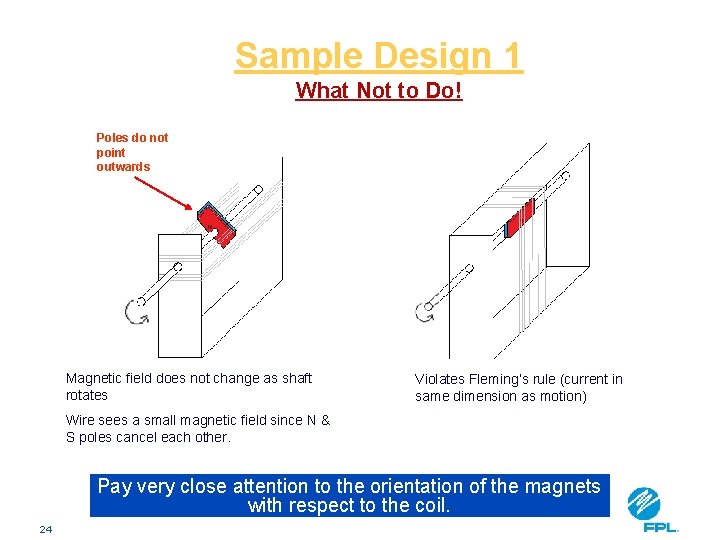
Sample Design 1 What Not to Do! Poles do not point outwards Magnetic field does not change as shaft rotates Violates Fleming’s rule (current in same dimension as motion) Wire sees a small magnetic field since N & S poles cancel each other. Pay very close attention to the orientation of the magnets with respect to the coil. 24
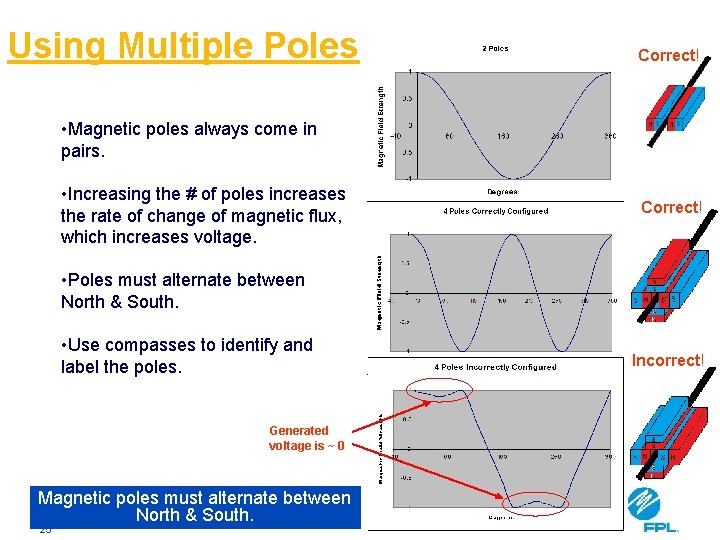
Using Multiple Poles Correct! • Magnetic poles always come in pairs. • Increasing the # of poles increases the rate of change of magnetic flux, which increases voltage. Correct! • Poles must alternate between North & South. • Use compasses to identify and label the poles. Generated voltage is ~ 0 Magnetic poles must alternate between North & South. 25 Incorrect!
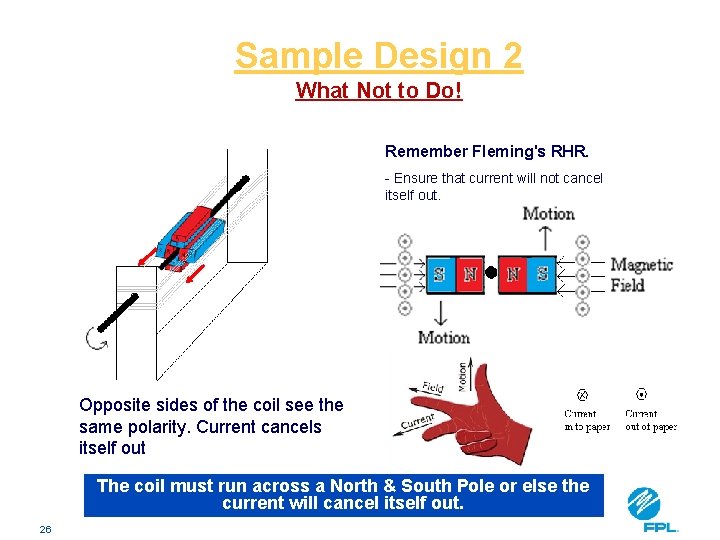
Sample Design 2 What Not to Do! Remember Fleming's RHR. Direction of Current - Ensure that current will not cancel itself out. Opposite sides of the coil see the same polarity. Current cancels itself out The coil must run across a North & South Pole or else the current will cancel itself out. 26
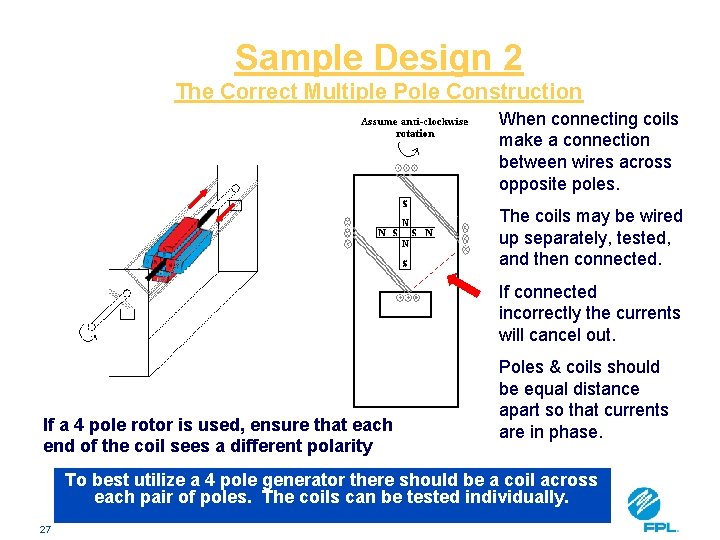
Sample Design 2 The Correct Multiple Pole Construction When connecting coils make a connection between wires across opposite poles. Direction of Current The coils may be wired up separately, tested, and then connected. Stator If a 4 pole rotor is used, ensure that each end of the coil sees a different polarity If connected incorrectly the currents will cancel out. Poles & coils should be equal distance apart so that currents are in phase. To best utilize a 4 pole generator there should be a coil across each pair of poles. The coils can be tested individually. 27
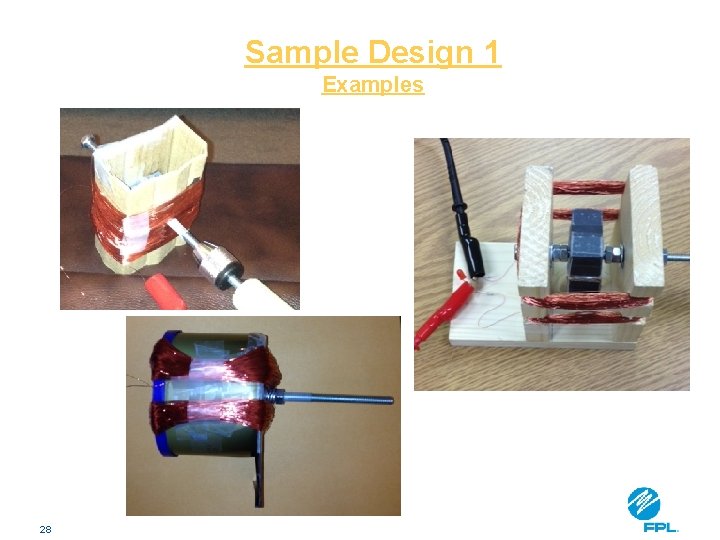
Sample Design 1 Examples 28
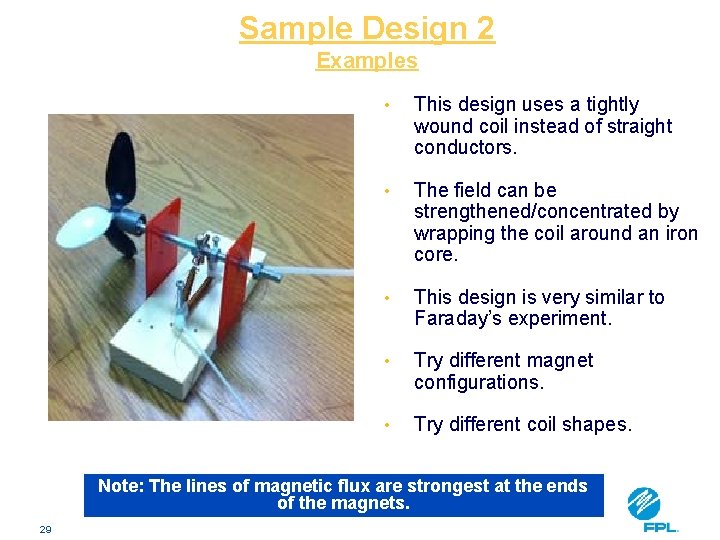
Sample Design 2 Examples • This design uses a tightly wound coil instead of straight conductors. • The field can be strengthened/concentrated by wrapping the coil around an iron core. • This design is very similar to Faraday’s experiment. • Try different magnet configurations. • Try different coil shapes. Note: The lines of magnetic flux are strongest at the ends of the magnets. 29
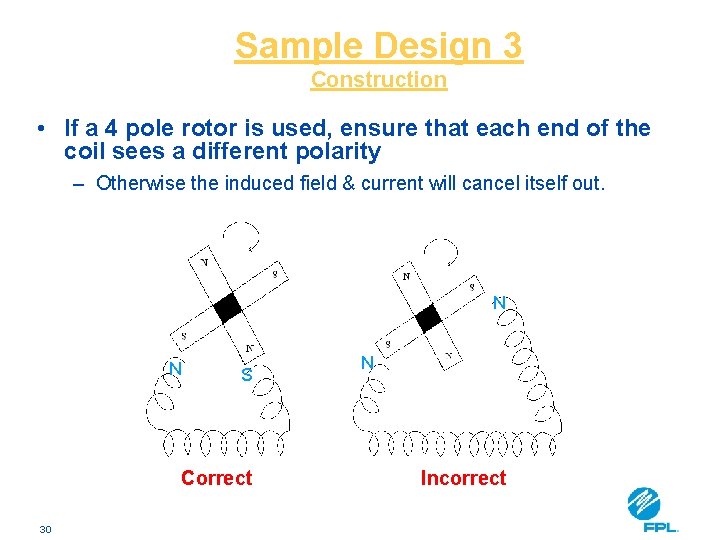
Sample Design 3 Construction • If a 4 pole rotor is used, ensure that each end of the coil sees a different polarity – Otherwise the induced field & current will cancel itself out. N N S Correct 30 N Incorrect
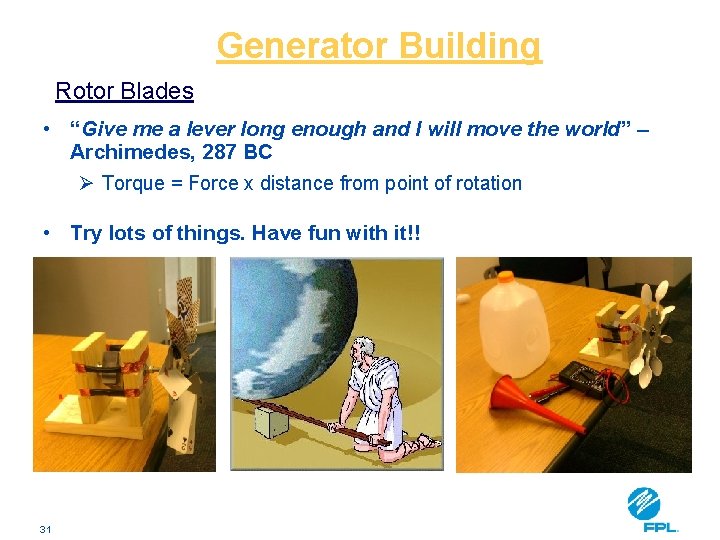
Generator Building Rotor Blades • “Give me a lever long enough and I will move the world” – Archimedes, 287 BC Ø Torque = Force x distance from point of rotation • Try lots of things. Have fun with it!! 31
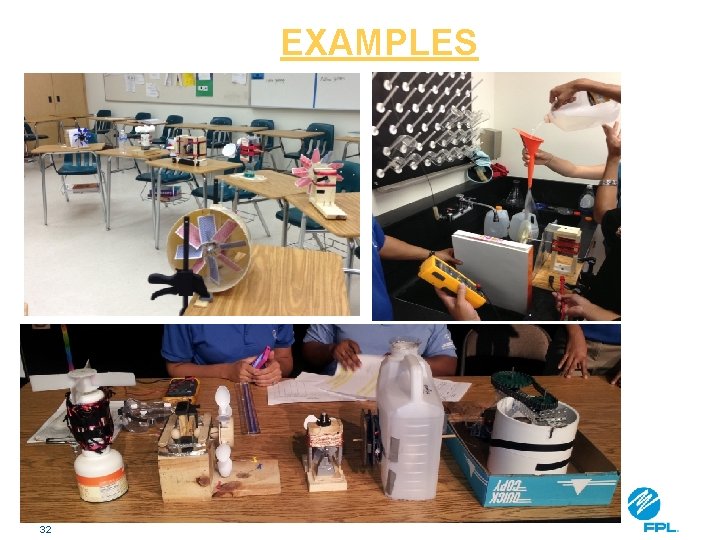
EXAMPLES 32
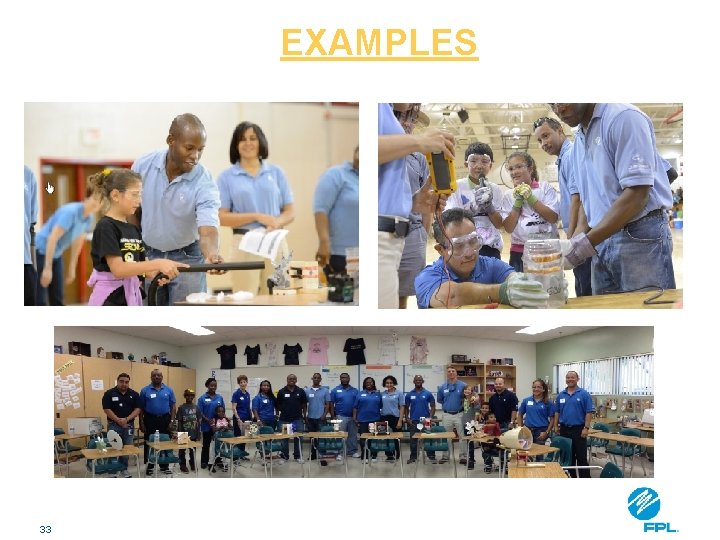
EXAMPLES 33
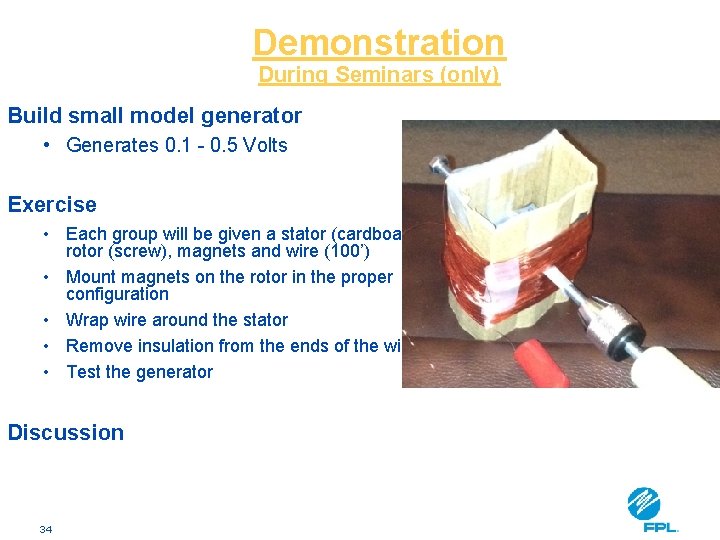
Demonstration During Seminars (only) Build small model generator • Generates 0. 1 - 0. 5 Volts Exercise • Each group will be given a stator (cardboard), rotor (screw), magnets and wire (100’) • Mount magnets on the rotor in the proper configuration • Wrap wire around the stator • Remove insulation from the ends of the wire • Test the generator Discussion 34
- Slides: 34