
SECE Sense Everything Control Everything Omer Boyaci Victoria
SECE: Sense Everything, Control Everything Omer Boyaci, Victoria Beltran and Henning Schulzrinne
SECE: Sense Everything, Control Everything SECE allows users to create services that combine communication calendaring location devices in the physical world SECE is an event-driven system that uses a high-level language to trigger action scripts, written in Tcl.
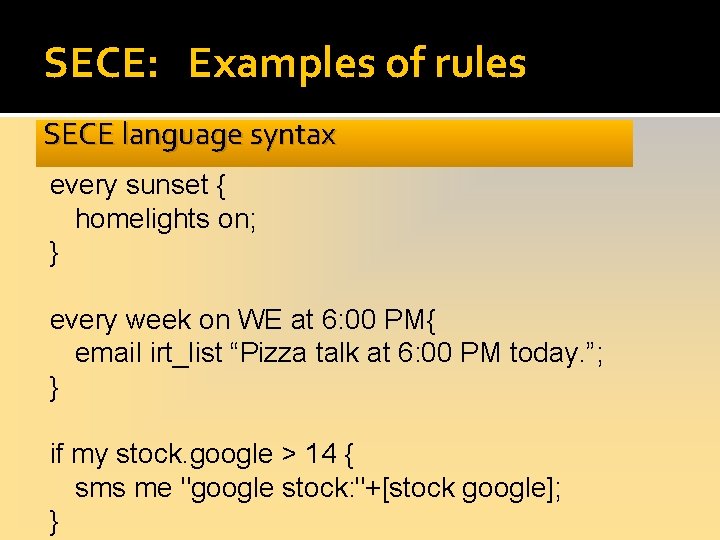
SECE: Examples of rules SECE language syntax every sunset { homelights on; } every week on WE at 6: 00 PM{ email irt_list “Pizza talk at 6: 00 PM today. ”; } if my stock. google > 14 { sms me "google stock: "+[stock google]; }
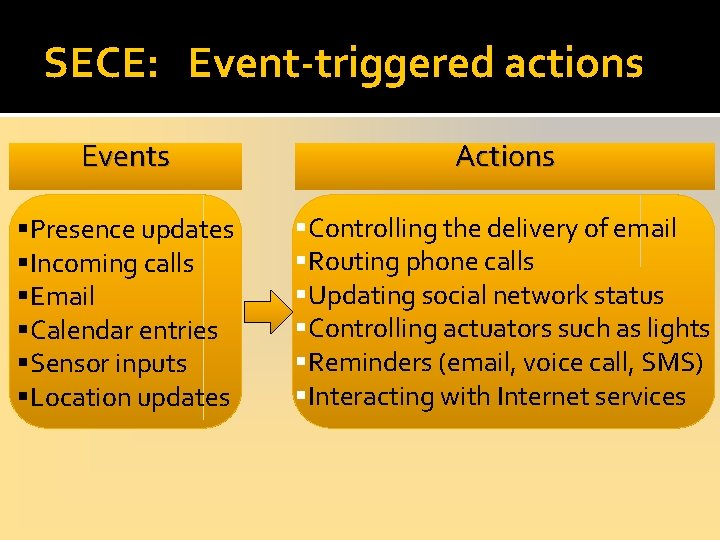
SECE: Event-triggered actions Events Actions Presence updates Incoming calls Email Calendar entries Sensor inputs Location updates Controlling the delivery of email Routing phone calls Updating social network status Controlling actuators such as lights Reminders (email, voice call, SMS) Interacting with Internet services
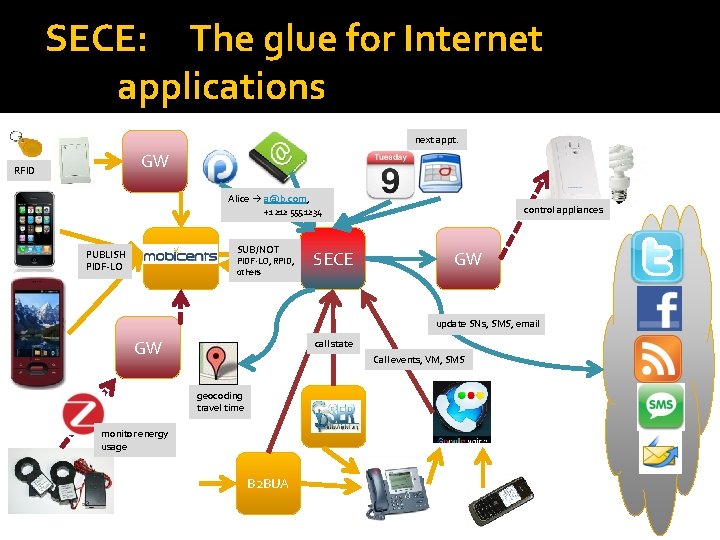
SECE: The glue for Internet applications next appt. GW RFID Alice a@b. com, control appliances +1 212 555 1234 SUB/NOT PUBLISH PIDF-LO, RPID, others SECE GW update SNs, SMS, email GW call state Call events, VM, SMS geocoding travel time monitor energy usage B 2 BUA
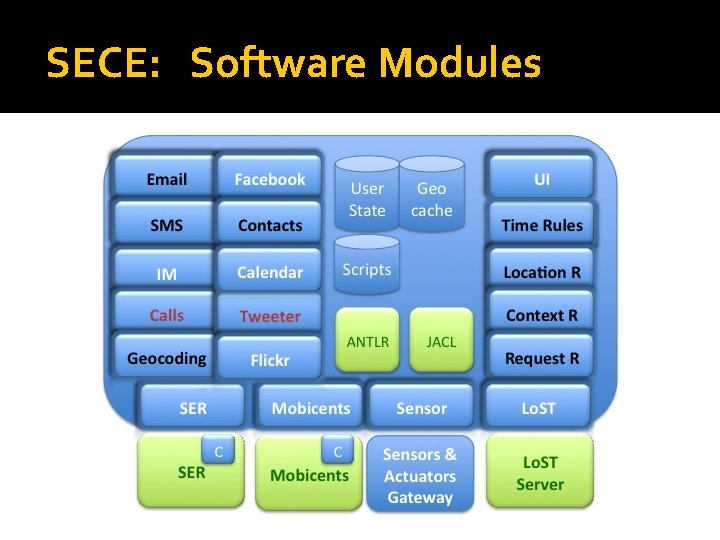
SECE: Software Modules
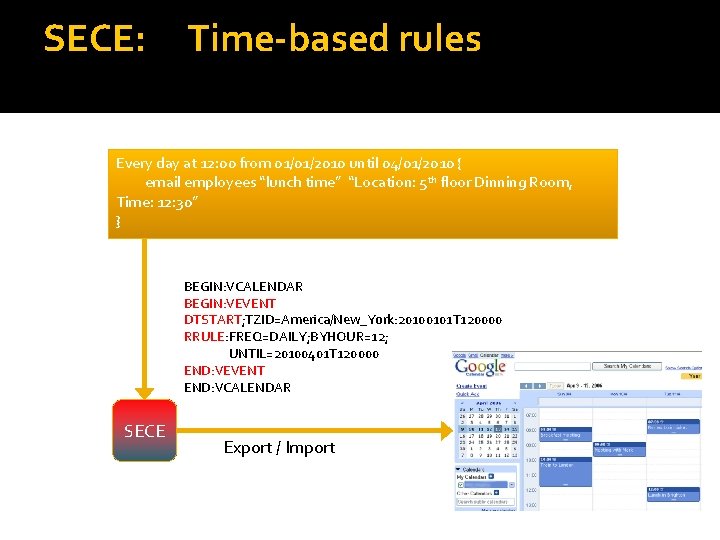
SECE: Time-based rules Every day at 12: 00 from 01/01/2010 until 04/01/2010 { email employees “lunch time” “Location: 5 th floor Dinning Room, Time: 12: 30” } BEGIN: VCALENDAR BEGIN: VEVENT DTSTART; TZID=America/New_York: 20100101 T 120000 RRULE: FREQ=DAILY; BYHOUR=12; UNTIL=20100401 T 120000 END: VEVENT END: VCALENDAR SECE Export / Import
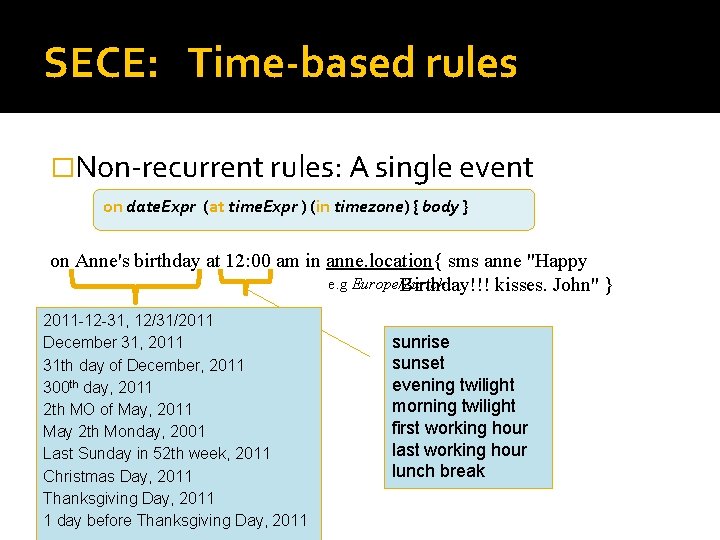
SECE: Time-based rules �Non-recurrent rules: A single event on date. Expr (at time. Expr ) (in timezone) { body } on Anne's birthday at 12: 00 am in anne. location{ sms anne "Happy e. g Europe/Zurich Birthday!!! kisses. John" } 2011 -12 -31, 12/31/2011 December 31, 2011 31 th day of December, 2011 300 th day, 2011 2 th MO of May, 2011 May 2 th Monday, 2001 Last Sunday in 52 th week, 2011 Christmas Day, 2011 Thanksgiving Day, 2011 1 day before Thanksgiving Day, 2011 sunrise sunset evening twilight morning twilight first working hour last working hour lunch break
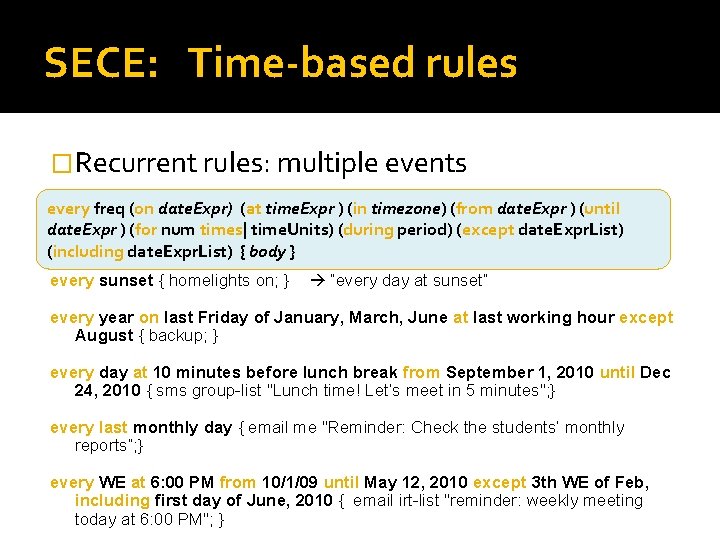
SECE: Time-based rules �Recurrent rules: multiple events every freq (on date. Expr) (at time. Expr ) (in timezone) (from date. Expr ) (until date. Expr ) (for num times| time. Units) (during period) (except date. Expr. List) (including date. Expr. List) { body } every sunset { homelights on; } “every day at sunset” every year on last Friday of January, March, June at last working hour except August { backup; } every day at 10 minutes before lunch break from September 1, 2010 until Dec 24, 2010 { sms group-list "Lunch time! Let’s meet in 5 minutes"; } every last monthly day { email me "Reminder: Check the students’ monthly reports”; } every WE at 6: 00 PM from 10/1/09 until May 12, 2010 except 3 th WE of Feb, including first day of June, 2010 { email irt-list "reminder: weekly meeting today at 6: 00 PM"; }
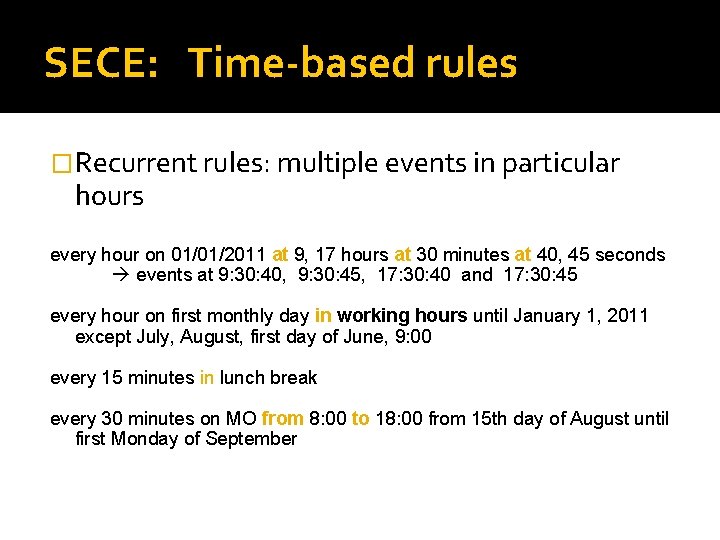
SECE: Time-based rules �Recurrent rules: multiple events in particular hours every hour on 01/01/2011 at 9, 17 hours at 30 minutes at 40, 45 seconds events at 9: 30: 40, 9: 30: 45, 17: 30: 40 and 17: 30: 45 every hour on first monthly day in working hours until January 1, 2011 except July, August, first day of June, 9: 00 every 15 minutes in lunch break every 30 minutes on MO from 8: 00 to 18: 00 from 15 th day of August until first Monday of September
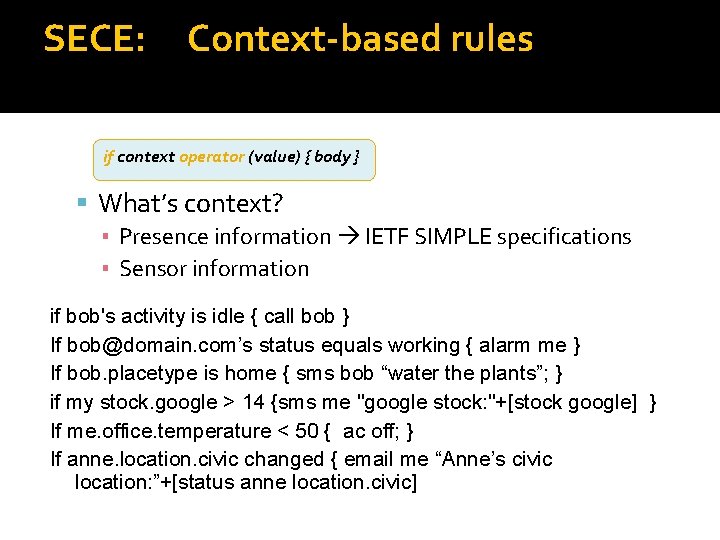
SECE: Context-based rules if context operator (value) { body } What’s context? ▪ Presence information IETF SIMPLE specifications ▪ Sensor information if bob's activity is idle { call bob } If bob@domain. com’s status equals working { alarm me } If bob. placetype is home { sms bob “water the plants”; } if my stock. google > 14 {sms me "google stock: "+[stock google] } If me. office. temperature < 50 { ac off; } If anne. location. civic changed { email me “Anne’s civic location: ”+[status anne location. civic]
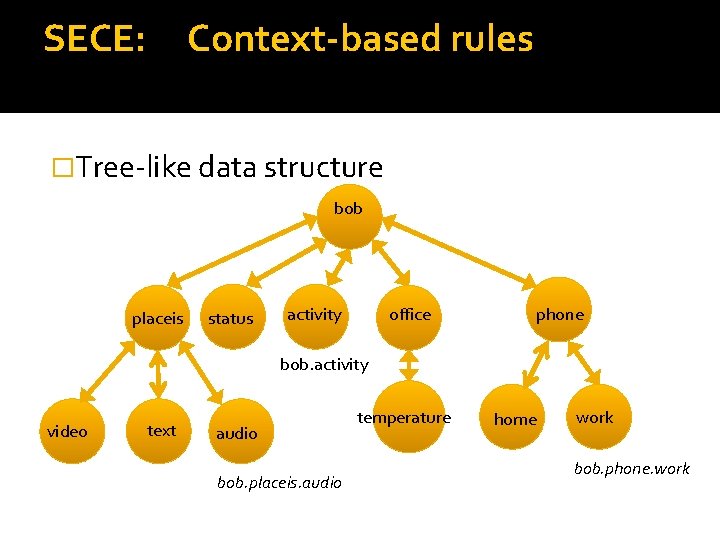
SECE: Context-based rules �Tree-like data structure bob placeis status activity office phone bob. activity video text audio bob. placeis. audio temperature home work bob. phone. work
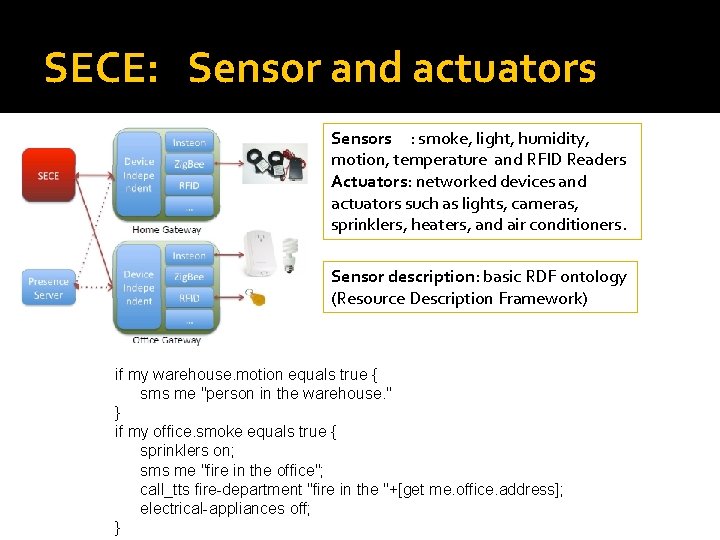
SECE: Sensor and actuators Sensors : smoke, light, humidity, motion, temperature and RFID Readers Actuators: networked devices and actuators such as lights, cameras, sprinklers, heaters, and air conditioners. Sensor description: basic RDF ontology (Resource Description Framework) if my warehouse. motion equals true { sms me "person in the warehouse. " } if my office. smoke equals true { sprinklers on; sms me "fire in the office"; call_tts fire-department "fire in the "+[get me. office. address]; electrical-appliances off; }
SECE: Location-based rules user operator location { body } bob near "Columbia University” me near 40. 807, -73. 963 tom within 5 miles of me me within 3 miles of ” 2960 Broadway, New York, 10027” tom in “Rockefeller center” Me outside of “Manhattan” bob moved 1. 5 miles • Place types and user-defined locations: me near a post office Anne in a museum me near my tennis club
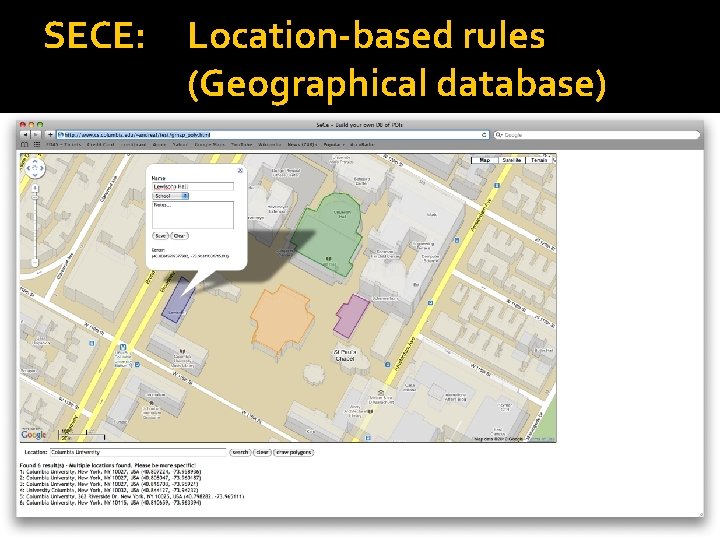
SECE: Location-based rules (Geographical database)
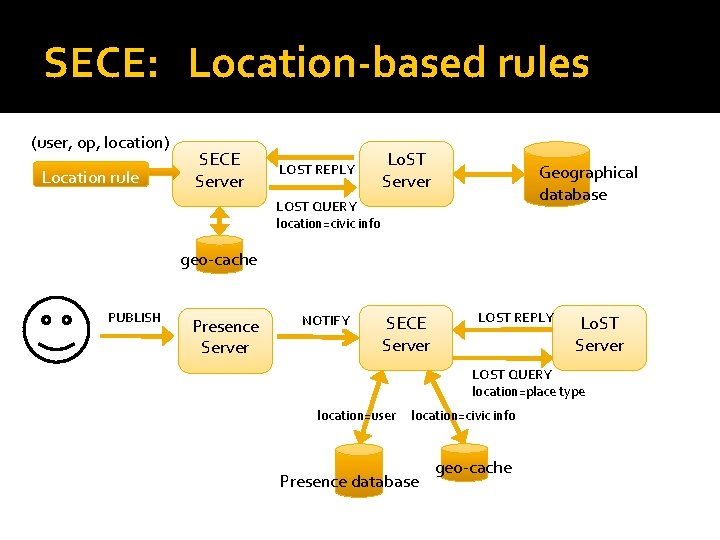
SECE: Location-based rules (user, op, location) Location rule SECE Server LOST REPLY Lo. ST Server Geographical database LOST QUERY location=civic info geo-cache PUBLISH Presence Server NOTIFY SECE Server LOST REPLY Lo. ST Server LOST QUERY location=place type location=user location=civic info Presence database geo-cache
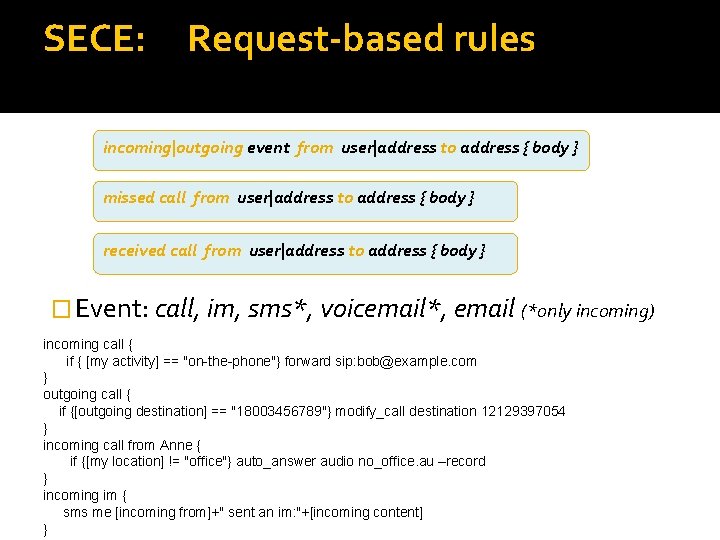
SECE: Request-based rules incoming|outgoing event from user|address to address { body } missed call from user|address to address { body } received call from user|address to address { body } � Event: call, im, sms*, voicemail*, email (*only incoming) incoming call { if { [my activity] == "on-the-phone"} forward sip: bob@example. com } outgoing call { if {[outgoing destination] == "18003456789"} modify_call destination 12129397054 } incoming call from Anne { if {[my location] != "office"} auto_answer audio no_office. au –record } incoming im { sms me [incoming from]+" sent an im: "+[incoming content] }
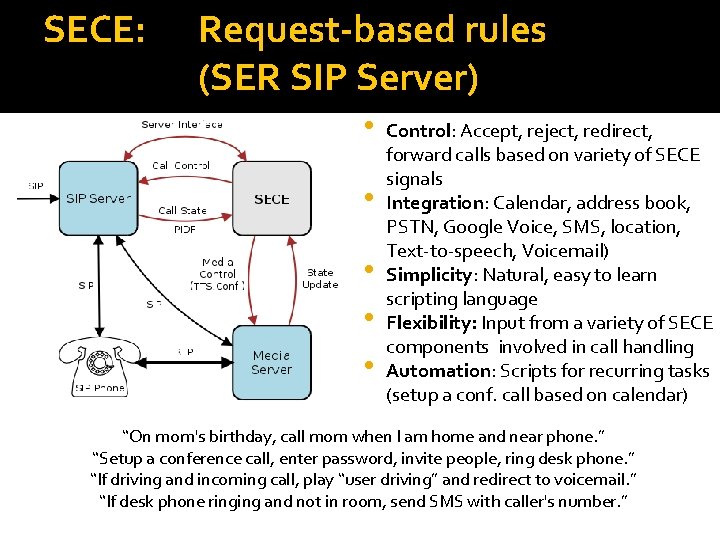
SECE: Request-based rules (SER SIP Server) • • • Control: Accept, reject, redirect, forward calls based on variety of SECE signals Integration: Calendar, address book, PSTN, Google Voice, SMS, location, Text-to-speech, Voicemail) Simplicity: Natural, easy to learn scripting language Flexibility: Input from a variety of SECE components involved in call handling Automation: Scripts for recurring tasks (setup a conf. call based on calendar) “On mom's birthday, call mom when I am home and near phone. ” “Setup a conference call, enter password, invite people, ring desk phone. ” “If driving and incoming call, play “user driving” and redirect to voicemail. ” “If desk phone ringing and not in room, send SMS with caller's number. ”
SECE: Next steps… � Integrate SER server � Integrate Lo. ST server and geodatabase � Finish Address Book functionality � Finish request-based incoming rules � Implement request-based outgoing rules � Calendar interface � Facebook interface
- Slides: 19