
Sec 5 5 LAW OF SINES Deriving the
- Slides: 21
Sec. 5. 5 LAW OF SINES
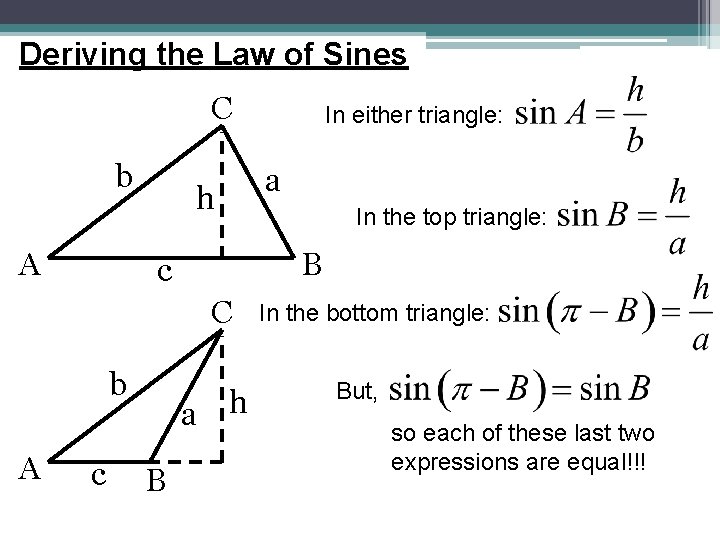
Deriving the Law of Sines C b A h C A c a h B a In the top triangle: B c b In either triangle: In the bottom triangle: But, so each of these last two expressions are equal!!!
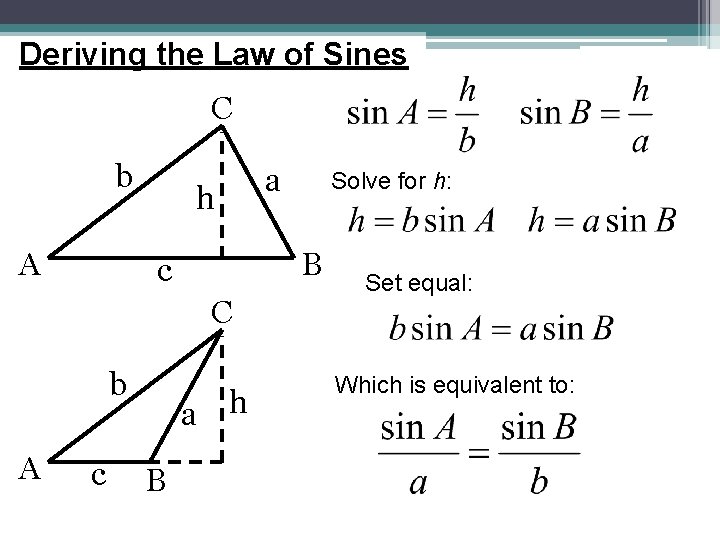
Deriving the Law of Sines C b A h C A c a h B Solve for h: B c b a Set equal: Which is equivalent to:
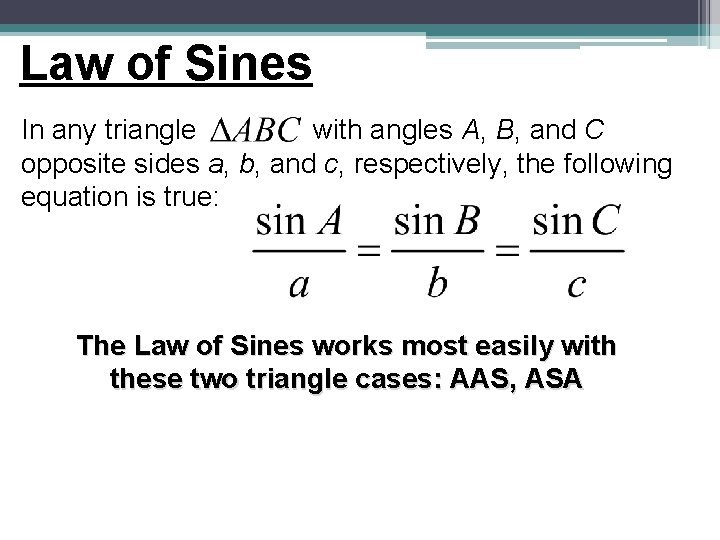
Law of Sines In any triangle with angles A, B, and C opposite sides a, b, and c, respectively, the following equation is true: The Law of Sines works most easily with these two triangle cases: AAS, ASA
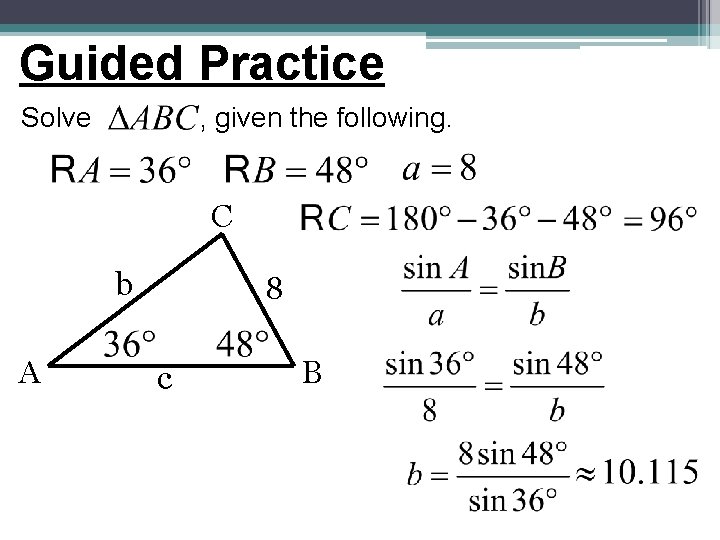
Guided Practice Solve , given the following. C b A 8 c B
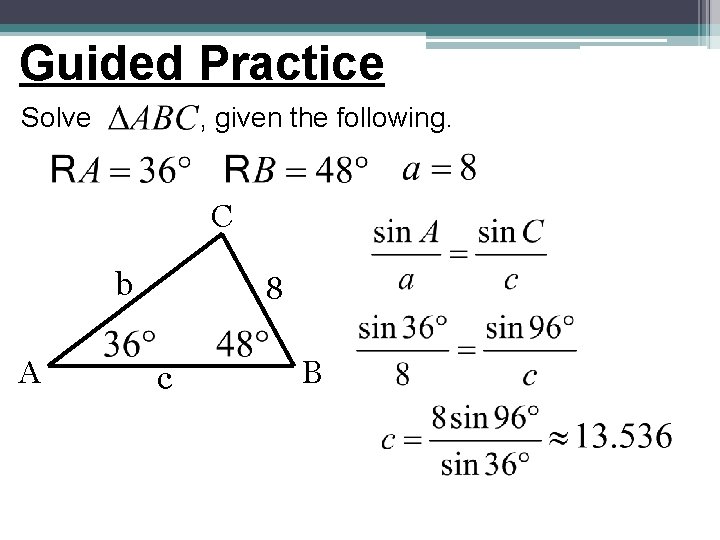
Guided Practice Solve , given the following. C b A 8 c B
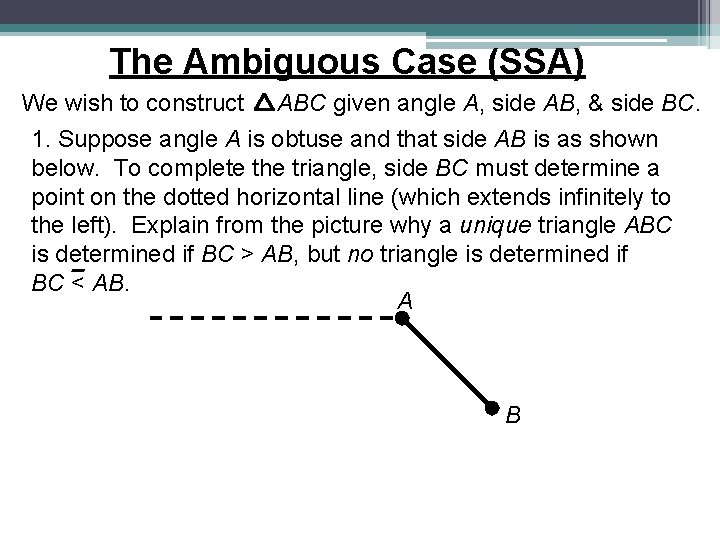
The Ambiguous Case (SSA) We wish to construct ABC given angle A, side AB, & side BC. 1. Suppose angle A is obtuse and that side AB is as shown below. To complete the triangle, side BC must determine a point on the dotted horizontal line (which extends infinitely to the left). Explain from the picture why a unique triangle ABC is determined if BC > AB, but no triangle is determined if BC < AB. A B
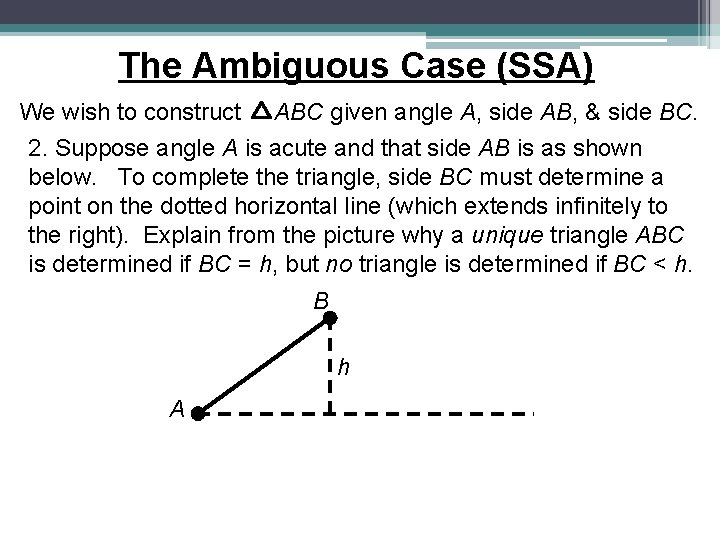
The Ambiguous Case (SSA) We wish to construct ABC given angle A, side AB, & side BC. 2. Suppose angle A is acute and that side AB is as shown below. To complete the triangle, side BC must determine a point on the dotted horizontal line (which extends infinitely to the right). Explain from the picture why a unique triangle ABC is determined if BC = h, but no triangle is determined if BC < h. B h A
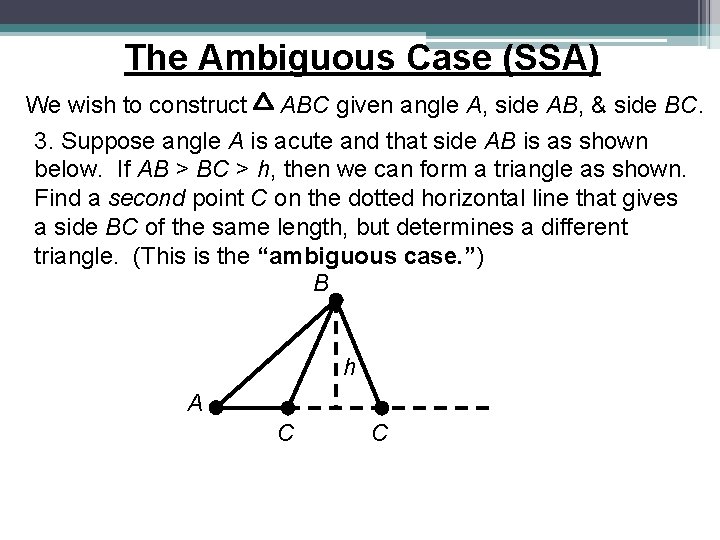
The Ambiguous Case (SSA) We wish to construct ABC given angle A, side AB, & side BC. 3. Suppose angle A is acute and that side AB is as shown below. If AB > BC > h, then we can form a triangle as shown. Find a second point C on the dotted horizontal line that gives a side BC of the same length, but determines a different triangle. (This is the “ambiguous case. ”) B h A C C
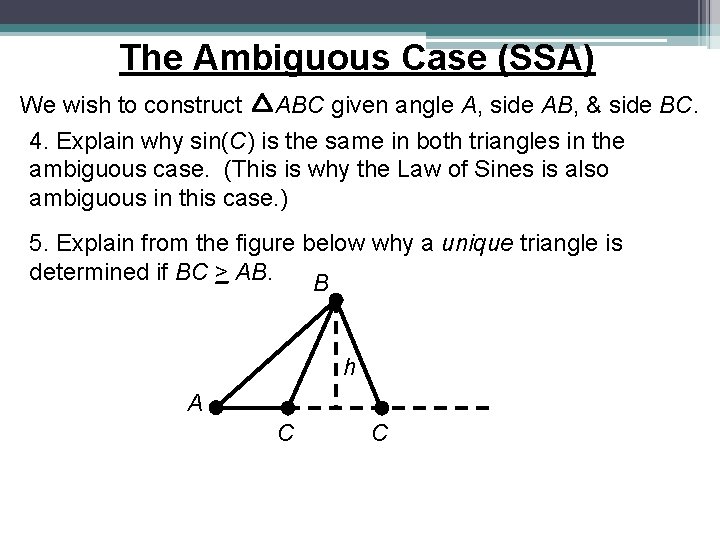
The Ambiguous Case (SSA) We wish to construct ABC given angle A, side AB, & side BC. 4. Explain why sin(C) is the same in both triangles in the ambiguous case. (This is why the Law of Sines is also ambiguous in this case. ) 5. Explain from the figure below why a unique triangle is determined if BC > AB. B h A C C
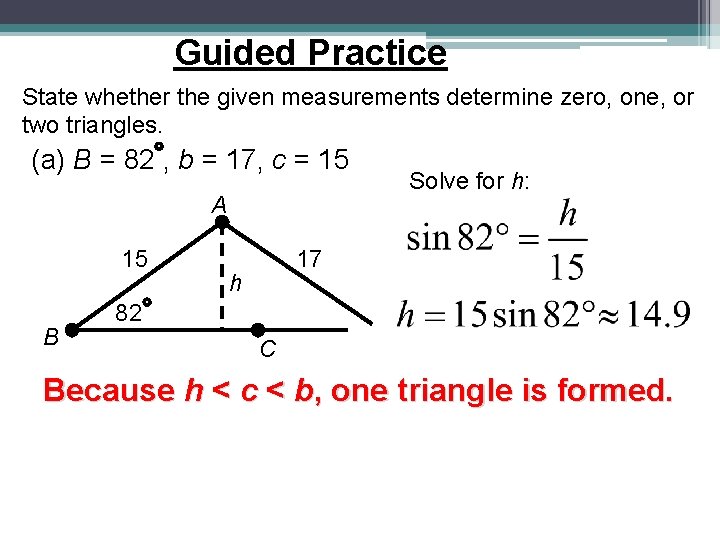
Guided Practice State whether the given measurements determine zero, one, or two triangles. (a) B = 82 , b = 17, c = 15 A 15 B Solve for h: 17 h 82 C Because h < c < b, one triangle is formed.
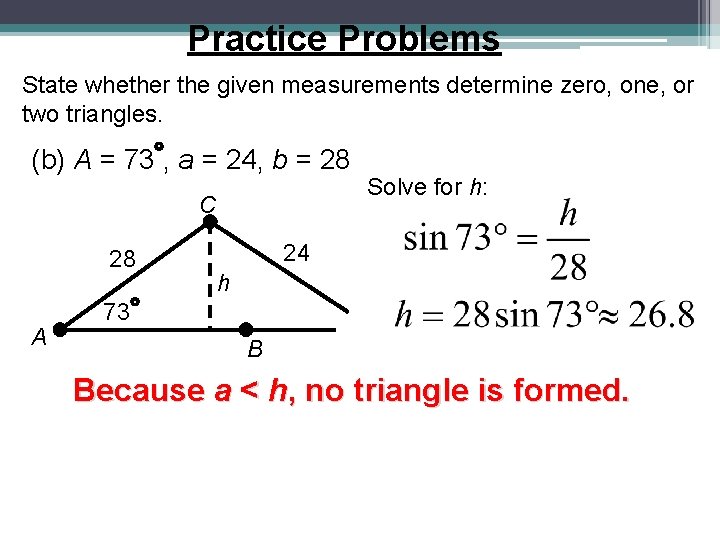
Practice Problems State whether the given measurements determine zero, one, or two triangles. (b) A = 73 , a = 24, b = 28 C 28 A Solve for h: 24 h 73 B Because a < h, no triangle is formed.
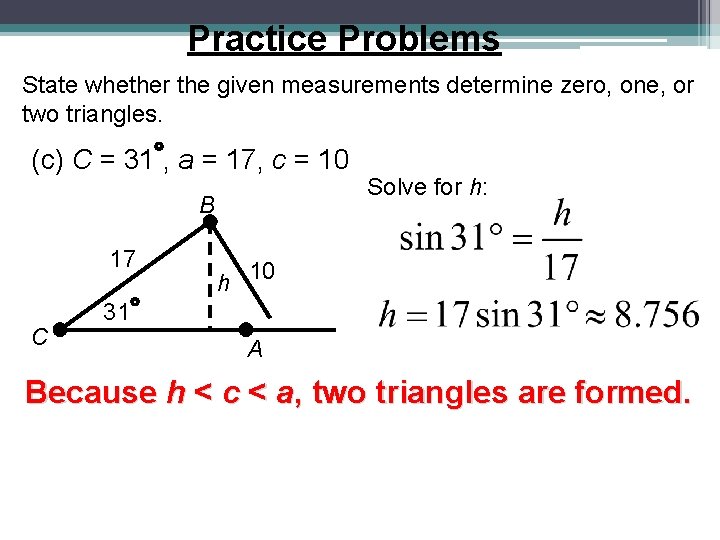
Practice Problems State whether the given measurements determine zero, one, or two triangles. (c) C = 31 , a = 17, c = 10 B 17 C Solve for h: h 10 31 A Because h < c < a, two triangles are formed.
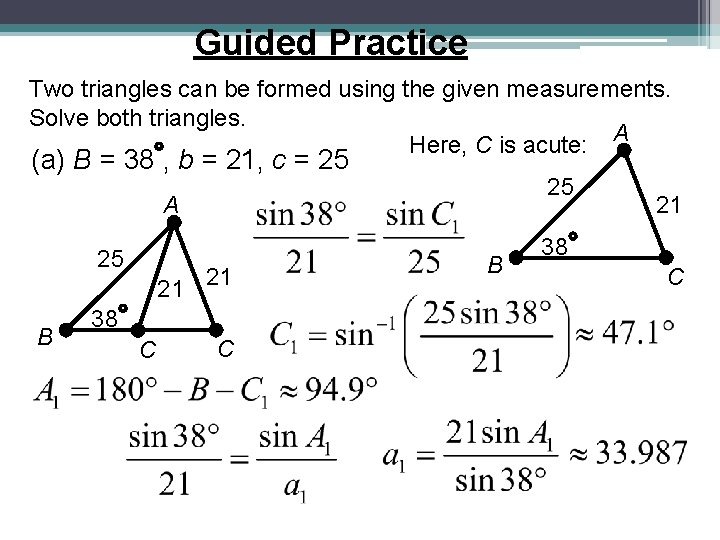
Guided Practice Two triangles can be formed using the given measurements. Solve both triangles. Here, C is acute: A (a) B = 38 , b = 21, c = 25 25 A 25 B 21 21 38 C C B 21 38 C
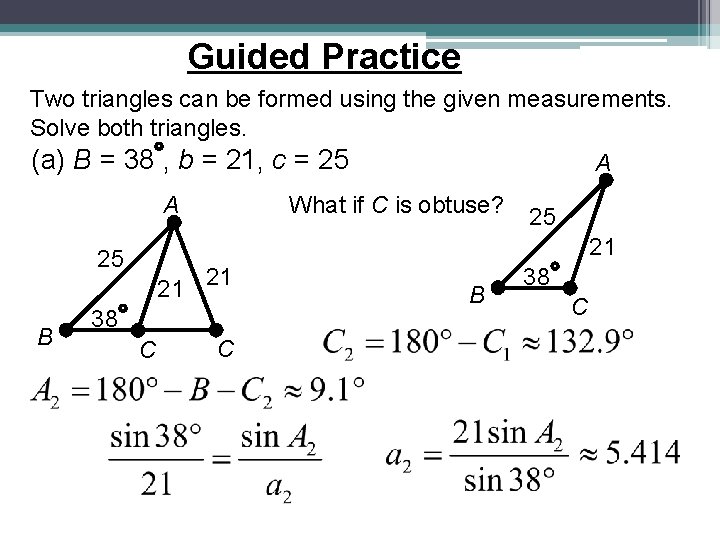
Guided Practice Two triangles can be formed using the given measurements. Solve both triangles. (a) B = 38 , b = 21, c = 25 A What if C is obtuse? A 21 25 B 25 21 21 38 C C B 38 C
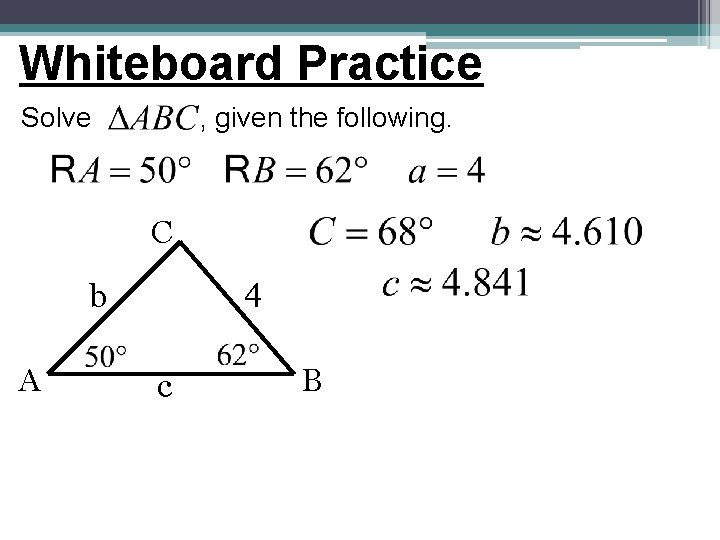
Whiteboard Practice Solve , given the following. C 4 b A c B
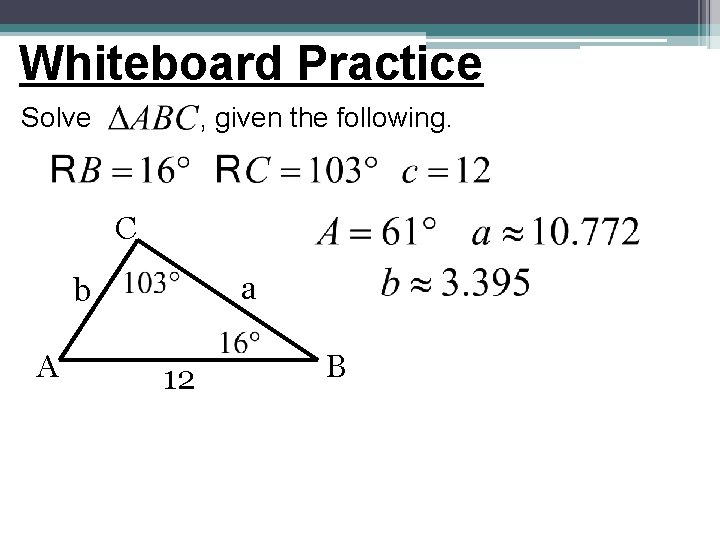
Whiteboard Practice Solve , given the following. C a b A 12 B
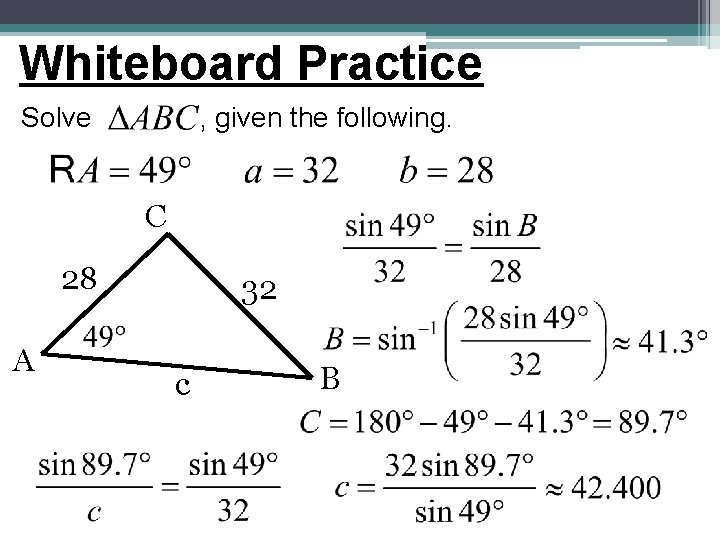
Whiteboard Practice Solve , given the following. C 28 A 32 c B
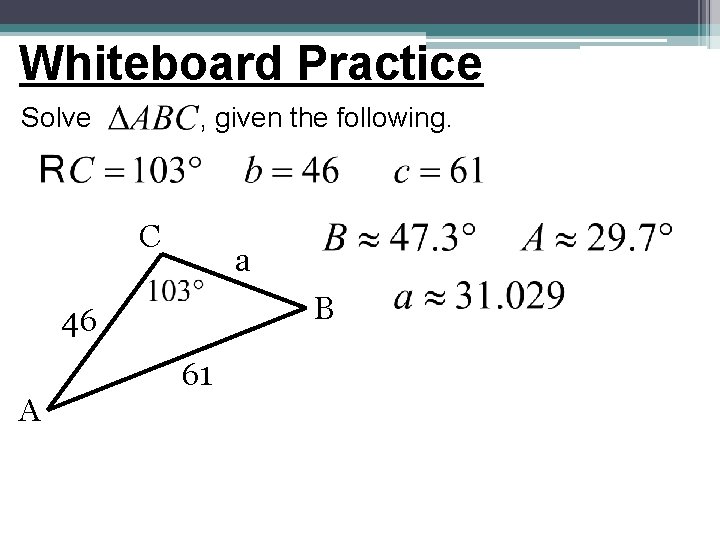
Whiteboard Practice Solve , given the following. C a B 46 A 61
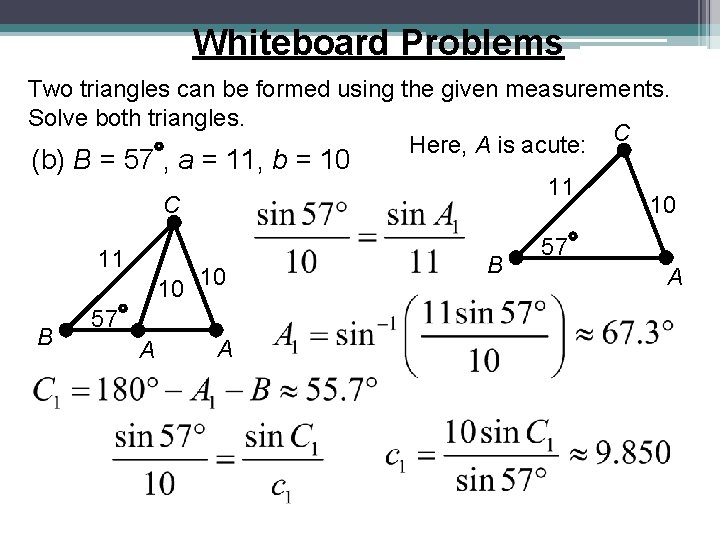
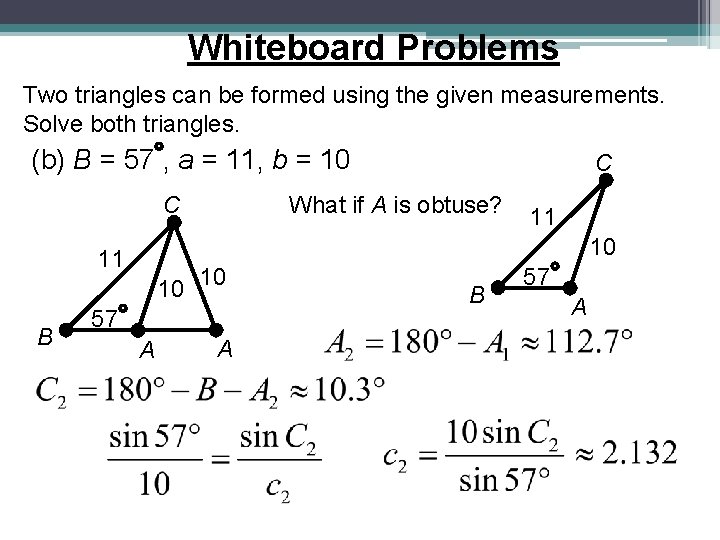
Whiteboard Problems Two triangles can be formed using the given measurements. Solve both triangles. Here, A is acute: C (b) B = 57 , a = 11, b = 10 11 C 11 B 10 10 57 A A B 10 57 A
Whiteboard Problems Two triangles can be formed using the given measurements. Solve both triangles. (b) B = 57 , a = 11, b = 10 What if A is obtuse? C 11 10 11 B C 10 10 57 A A B 57 A