
Sec 20 1 Oxidation and Reduction I Redox
- Slides: 4
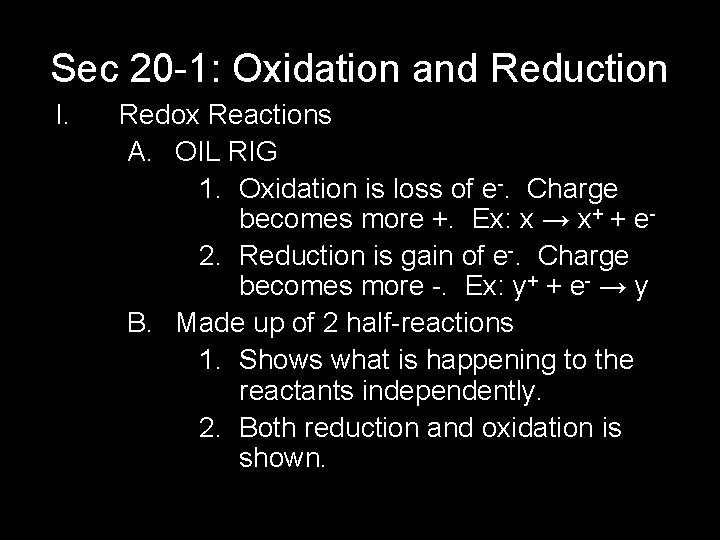
Sec 20 -1: Oxidation and Reduction I. Redox Reactions A. OIL RIG 1. Oxidation is loss of e-. Charge becomes more +. Ex: x → x+ + e 2. Reduction is gain of e-. Charge becomes more -. Ex: y+ + e- → y B. Made up of 2 half-reactions 1. Shows what is happening to the reactants independently. 2. Both reduction and oxidation is shown.
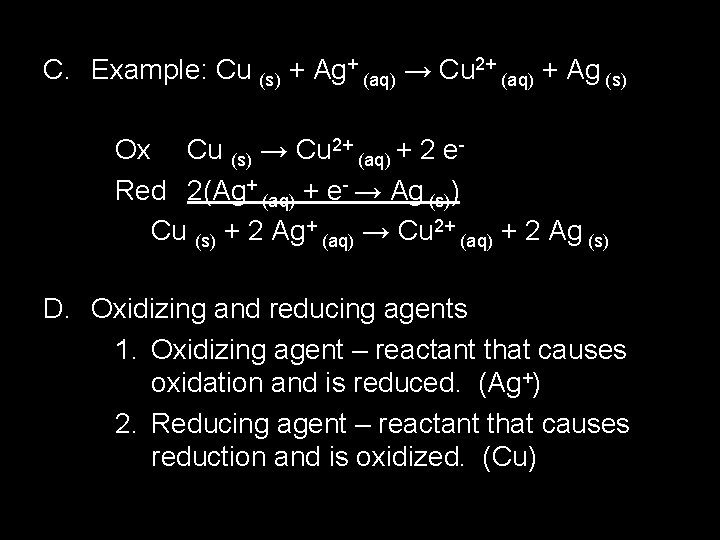
C. Example: Cu (s) + Ag+ (aq) → Cu 2+ (aq) + Ag (s) Ox Cu (s) → Cu 2+ (aq) + 2 e. Red 2(Ag+ (aq) + e- → Ag (s)) Cu (s) + 2 Ag+ (aq) → Cu 2+ (aq) + 2 Ag (s) D. Oxidizing and reducing agents 1. Oxidizing agent – reactant that causes oxidation and is reduced. (Ag+) 2. Reducing agent – reactant that causes reduction and is oxidized. (Cu)
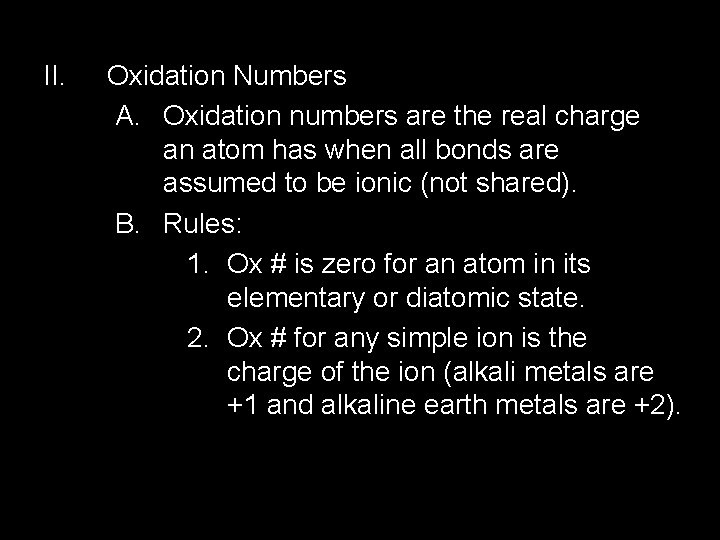
II. Oxidation Numbers A. Oxidation numbers are the real charge an atom has when all bonds are assumed to be ionic (not shared). B. Rules: 1. Ox # is zero for an atom in its elementary or diatomic state. 2. Ox # for any simple ion is the charge of the ion (alkali metals are +1 and alkaline earth metals are +2).
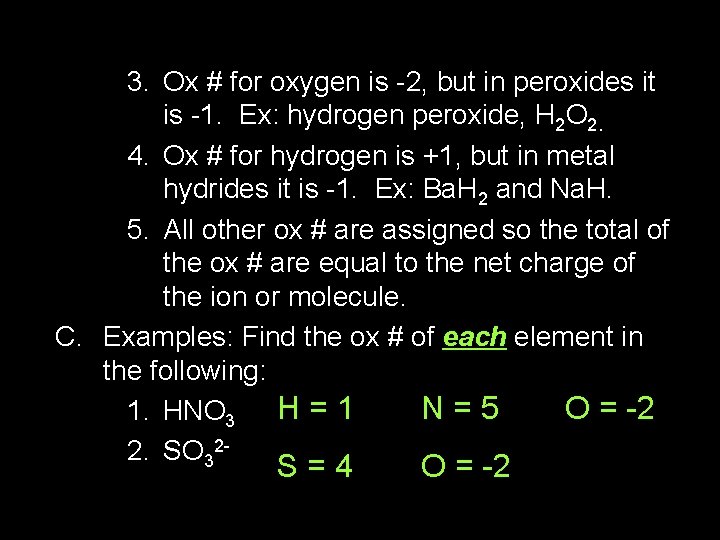
3. Ox # for oxygen is -2, but in peroxides it is -1. Ex: hydrogen peroxide, H 2 O 2. 4. Ox # for hydrogen is +1, but in metal hydrides it is -1. Ex: Ba. H 2 and Na. H. 5. All other ox # are assigned so the total of the ox # are equal to the net charge of the ion or molecule. C. Examples: Find the ox # of each element in the following: N=5 O = -2 1. HNO 3 H = 1 2. SO 32 - S=4 O = -2