
Sec 2 3 BurdenFaires Newtons Method and Its
Sec: 2. 3 (Burden&Faires) Newton’s Method and Its Extensions
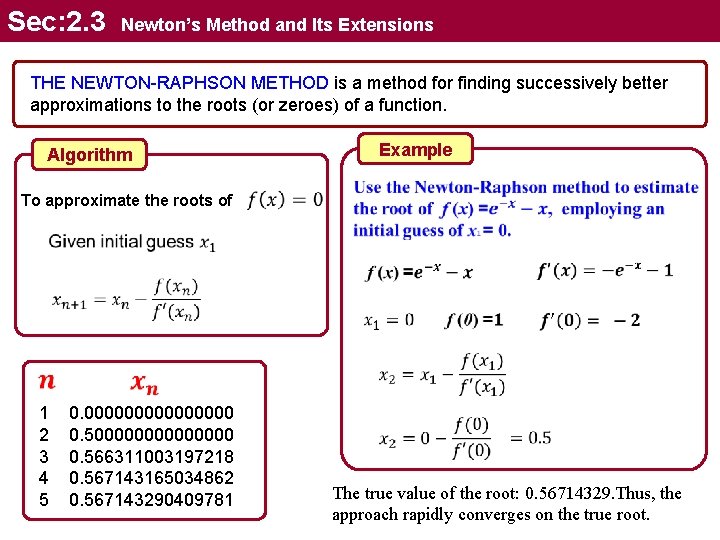
Sec: 2. 3 Newton’s Method and Its Extensions THE NEWTON-RAPHSON METHOD is a method for finding successively better approximations to the roots (or zeroes) of a function. Algorithm Example To approximate the roots of 1 2 3 4 5 0. 00000000 0. 50000000 0. 566311003197218 0. 567143165034862 0. 567143290409781 The true value of the root: 0. 56714329. Thus, the approach rapidly converges on the true root.
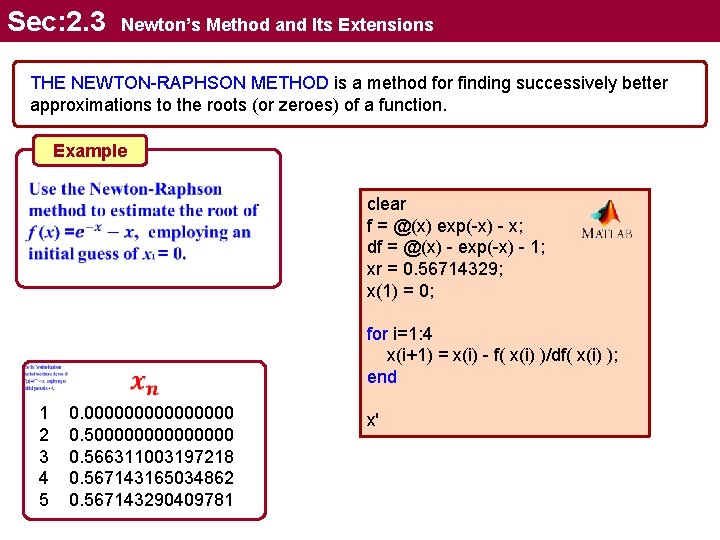
Sec: 2. 3 Newton’s Method and Its Extensions THE NEWTON-RAPHSON METHOD is a method for finding successively better approximations to the roots (or zeroes) of a function. Example clear f = @(x) exp(-x) - x; df = @(x) - exp(-x) - 1; xr = 0. 56714329; x(1) = 0; for i=1: 4 x(i+1) = x(i) - f( x(i) )/df( x(i) ); end 1 2 3 4 5 0. 00000000 0. 50000000 0. 566311003197218 0. 567143165034862 0. 567143290409781 x'
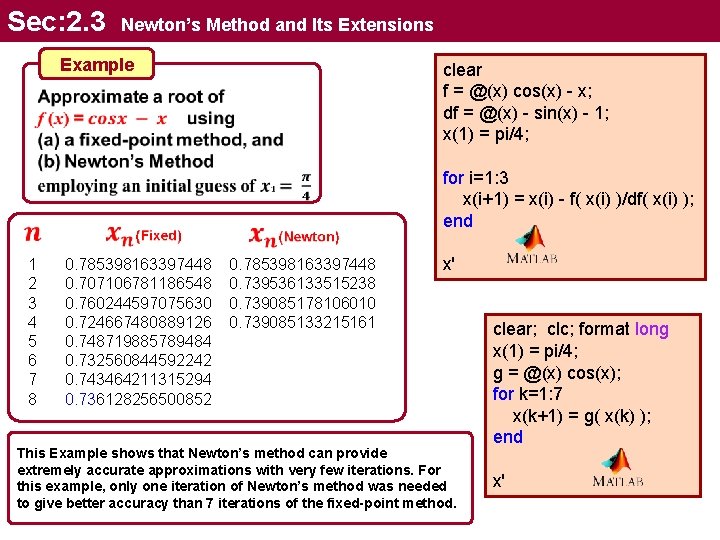
Sec: 2. 3 Newton’s Method and Its Extensions Example clear f = @(x) cos(x) - x; df = @(x) - sin(x) - 1; x(1) = pi/4; for i=1: 3 x(i+1) = x(i) - f( x(i) )/df( x(i) ); end 1 2 3 4 5 6 7 8 0. 785398163397448 0. 707106781186548 0. 760244597075630 0. 724667480889126 0. 748719885789484 0. 732560844592242 0. 743464211315294 0. 736128256500852 0. 785398163397448 0. 739536133515238 0. 739085178106010 0. 739085133215161 x' This Example shows that Newton’s method can provide extremely accurate approximations with very few iterations. For this example, only one iteration of Newton’s method was needed to give better accuracy than 7 iterations of the fixed-point method. clear; clc; format long x(1) = pi/4; g = @(x) cos(x); for k=1: 7 x(k+1) = g( x(k) ); end x'
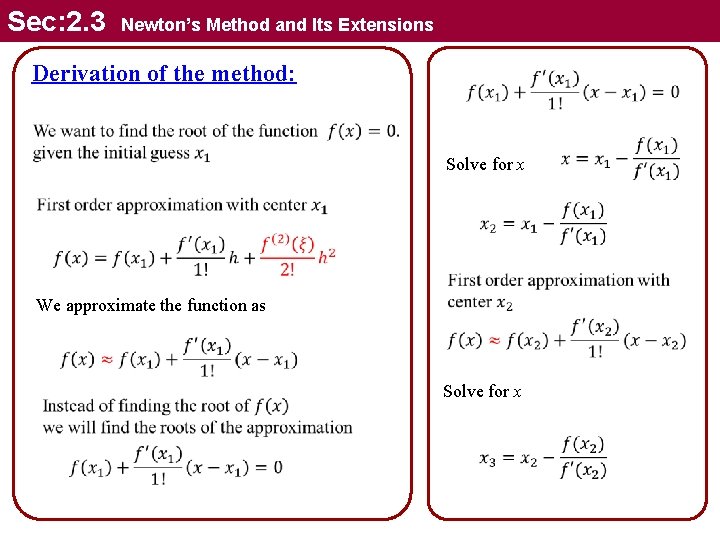
Sec: 2. 3 Newton’s Method and Its Extensions Derivation of the method: Solve for x We approximate the function as Solve for x
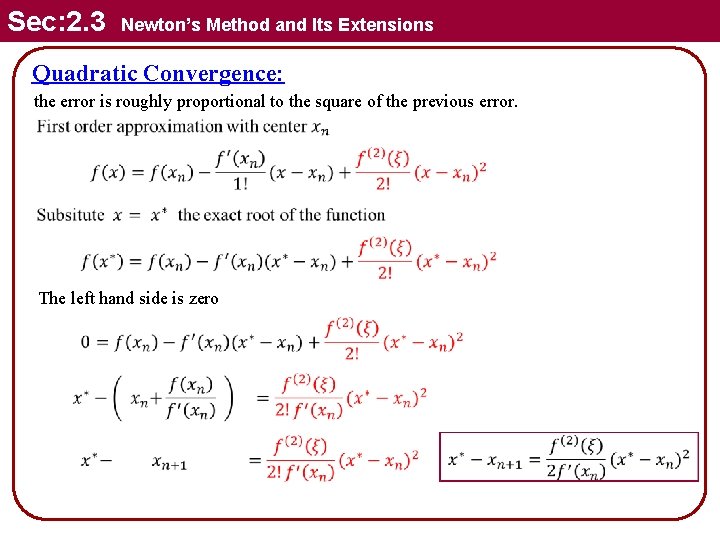
Sec: 2. 3 Newton’s Method and Its Extensions Quadratic Convergence: the error is roughly proportional to the square of the previous error. The left hand side is zero
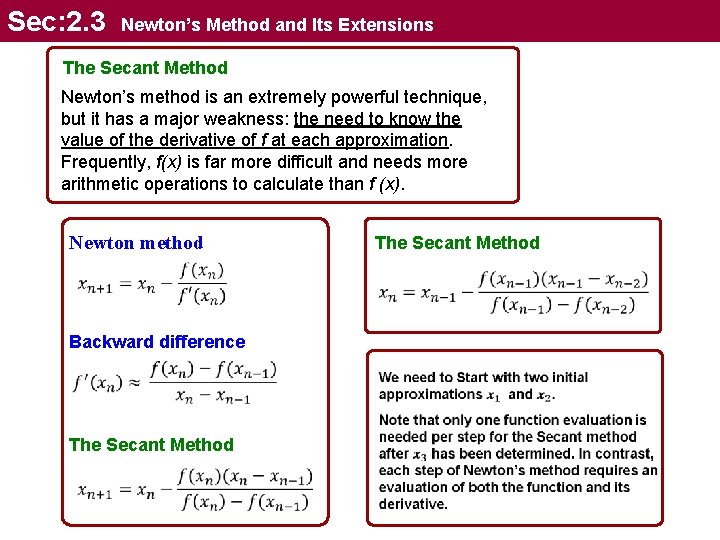
Sec: 2. 3 Newton’s Method and Its Extensions The Secant Method Newton’s method is an extremely powerful technique, but it has a major weakness: the need to know the value of the derivative of f at each approximation. Frequently, f(x) is far more difficult and needs more arithmetic operations to calculate than f (x). Newton method Backward difference The Secant Method
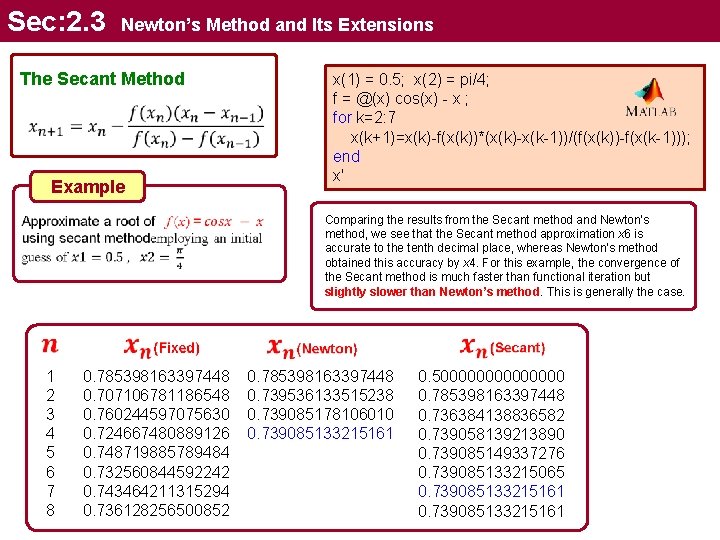
Sec: 2. 3 Newton’s Method and Its Extensions The Secant Method Example x(1) = 0. 5; x(2) = pi/4; f = @(x) cos(x) - x ; for k=2: 7 x(k+1)=x(k)-f(x(k))*(x(k)-x(k-1))/(f(x(k))-f(x(k-1))); end x' Comparing the results from the Secant method and Newton’s method, we see that the Secant method approximation x 6 is accurate to the tenth decimal place, whereas Newton’s method obtained this accuracy by x 4. For this example, the convergence of the Secant method is much faster than functional iteration but slightly slower than Newton’s method. This is generally the case. 1 2 3 4 5 6 7 8 0. 785398163397448 0. 707106781186548 0. 760244597075630 0. 724667480889126 0. 748719885789484 0. 732560844592242 0. 743464211315294 0. 736128256500852 0. 785398163397448 0. 739536133515238 0. 739085178106010 0. 739085133215161 0. 50000000 0. 785398163397448 0. 736384138836582 0. 739058139213890 0. 739085149337276 0. 739085133215065 0. 739085133215161
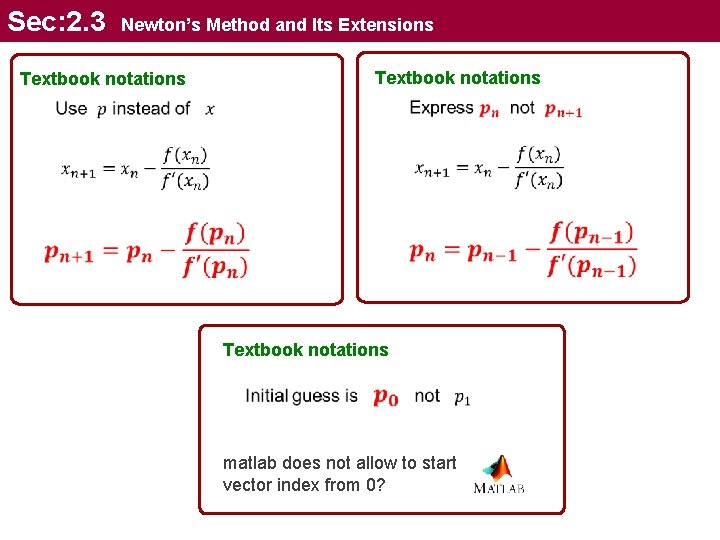
Sec: 2. 3 Newton’s Method and Its Extensions Textbook notations matlab does not allow to start vector index from 0?
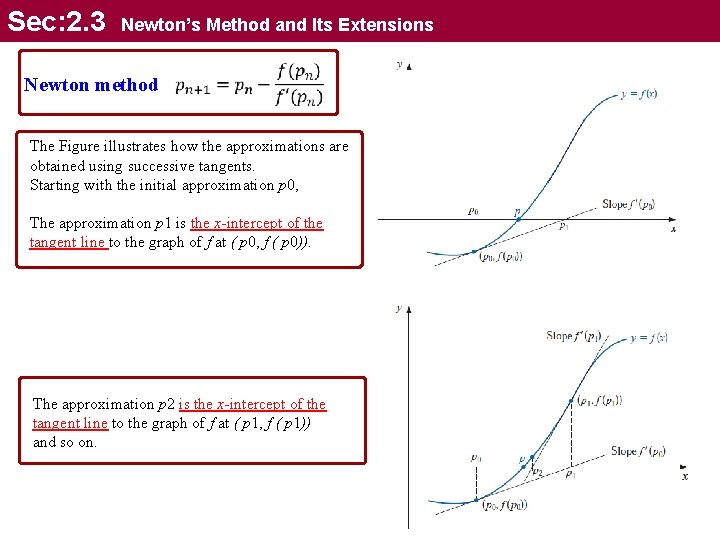
Sec: 2. 3 Newton’s Method and Its Extensions Newton method The Figure illustrates how the approximations are obtained using successive tangents. Starting with the initial approximation p 0, The approximation p 1 is the x-intercept of the tangent line to the graph of f at ( p 0, f ( p 0)). The approximation p 2 is the x-intercept of the tangent line to the graph of f at ( p 1, f ( p 1)) and so on.
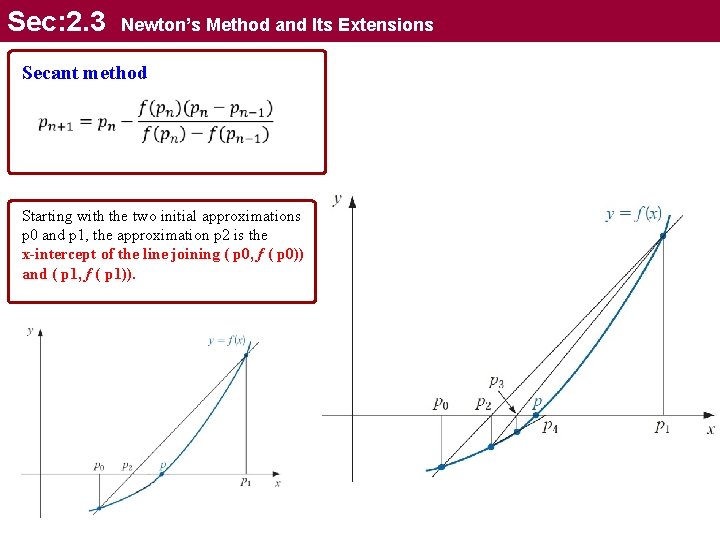
Sec: 2. 3 Newton’s Method and Its Extensions Secant method Starting with the two initial approximations p 0 and p 1, the approximation p 2 is the x-intercept of the line joining ( p 0, f ( p 0)) and ( p 1, f ( p 1)).
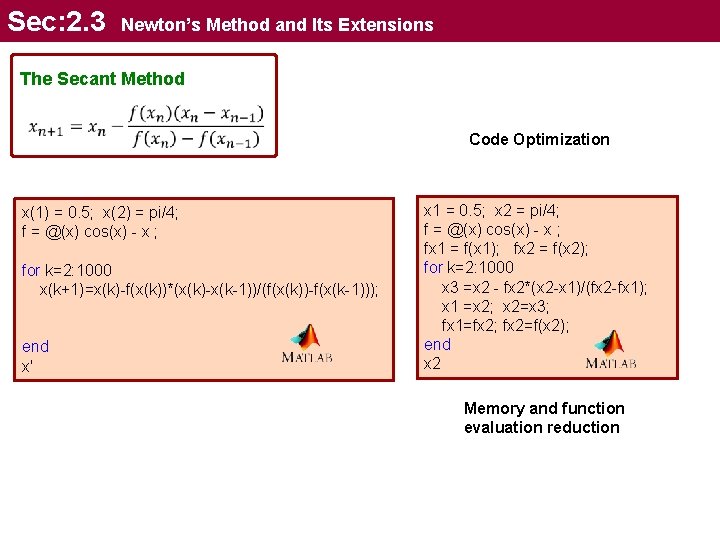
Sec: 2. 3 Newton’s Method and Its Extensions The Secant Method Code Optimization x(1) = 0. 5; x(2) = pi/4; f = @(x) cos(x) - x ; for k=2: 1000 x(k+1)=x(k)-f(x(k))*(x(k)-x(k-1))/(f(x(k))-f(x(k-1))); end x' x 1 = 0. 5; x 2 = pi/4; f = @(x) cos(x) - x ; fx 1 = f(x 1); fx 2 = f(x 2); for k=2: 1000 x 3 =x 2 - fx 2*(x 2 -x 1)/(fx 2 -fx 1); x 1 =x 2; x 2=x 3; fx 1=fx 2; fx 2=f(x 2); end x 2 Memory and function evaluation reduction
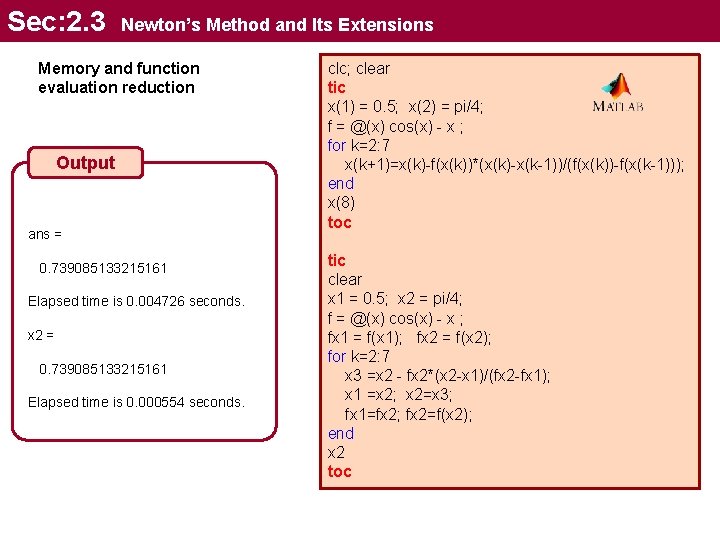
Sec: 2. 3 Newton’s Method and Its Extensions Memory and function evaluation reduction Output ans = 0. 739085133215161 Elapsed time is 0. 004726 seconds. x 2 = 0. 739085133215161 Elapsed time is 0. 000554 seconds. clc; clear tic x(1) = 0. 5; x(2) = pi/4; f = @(x) cos(x) - x ; for k=2: 7 x(k+1)=x(k)-f(x(k))*(x(k)-x(k-1))/(f(x(k))-f(x(k-1))); end x(8) toc tic clear x 1 = 0. 5; x 2 = pi/4; f = @(x) cos(x) - x ; fx 1 = f(x 1); fx 2 = f(x 2); for k=2: 7 x 3 =x 2 - fx 2*(x 2 -x 1)/(fx 2 -fx 1); x 1 =x 2; x 2=x 3; fx 1=fx 2; fx 2=f(x 2); end x 2 toc
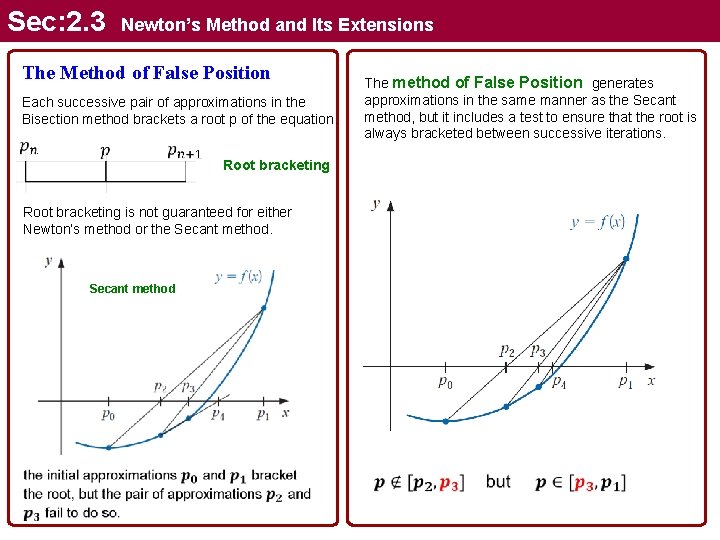
Sec: 2. 3 Newton’s Method and Its Extensions The Method of False Position Each successive pair of approximations in the Bisection method brackets a root p of the equation. Root bracketing is not guaranteed for either Newton’s method or the Secant method The method of False Position generates approximations in the same manner as the Secant method, but it includes a test to ensure that the root is always bracketed between successive iterations.
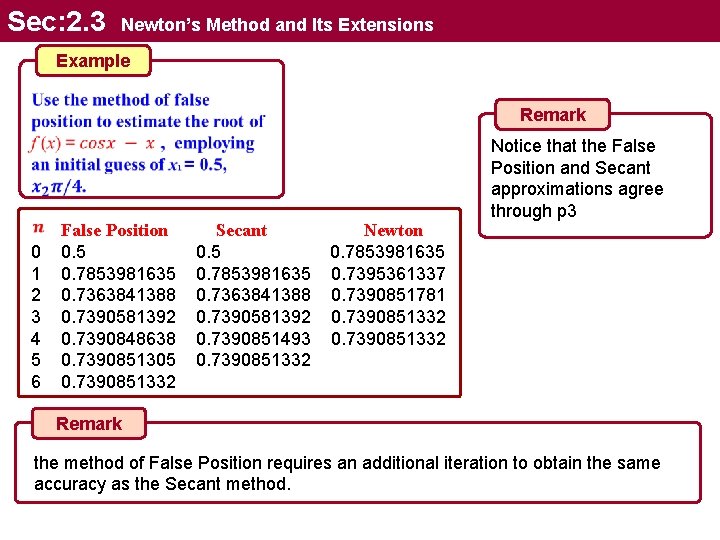
Sec: 2. 3 Newton’s Method and Its Extensions Example Remark 0 1 2 3 4 5 6 False Position 0. 5 0. 7853981635 0. 7363841388 0. 7390581392 0. 7390848638 0. 7390851305 0. 7390851332 Secant 0. 5 0. 7853981635 0. 7363841388 0. 7390581392 0. 7390851493 0. 7390851332 Newton 0. 7853981635 0. 7395361337 0. 7390851781 0. 7390851332 Notice that the False Position and Secant approximations agree through p 3 Remark the method of False Position requires an additional iteration to obtain the same accuracy as the Secant method.
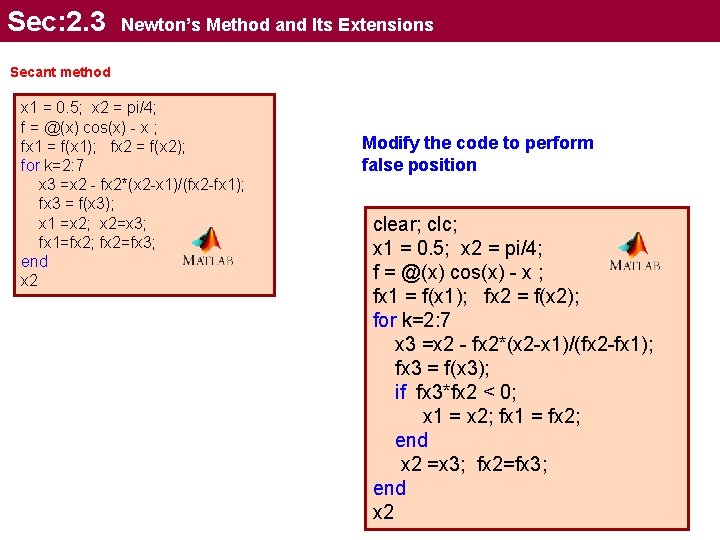
Sec: 2. 3 Newton’s Method and Its Extensions Secant method x 1 = 0. 5; x 2 = pi/4; f = @(x) cos(x) - x ; fx 1 = f(x 1); fx 2 = f(x 2); for k=2: 7 x 3 =x 2 - fx 2*(x 2 -x 1)/(fx 2 -fx 1); fx 3 = f(x 3); x 1 =x 2; x 2=x 3; fx 1=fx 2; fx 2=fx 3; end x 2 Modify the code to perform false position clear; clc; x 1 = 0. 5; x 2 = pi/4; f = @(x) cos(x) - x ; fx 1 = f(x 1); fx 2 = f(x 2); for k=2: 7 x 3 =x 2 - fx 2*(x 2 -x 1)/(fx 2 -fx 1); fx 3 = f(x 3); if fx 3*fx 2 < 0; x 1 = x 2; fx 1 = fx 2; end x 2 =x 3; fx 2=fx 3; end x 2
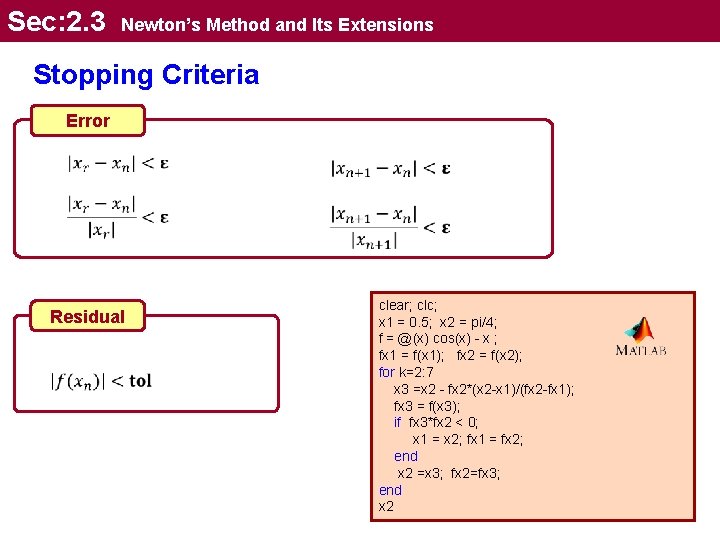
Sec: 2. 3 Newton’s Method and Its Extensions Stopping Criteria Error Residual clear; clc; x 1 = 0. 5; x 2 = pi/4; f = @(x) cos(x) - x ; fx 1 = f(x 1); fx 2 = f(x 2); for k=2: 7 x 3 =x 2 - fx 2*(x 2 -x 1)/(fx 2 -fx 1); fx 3 = f(x 3); if fx 3*fx 2 < 0; x 1 = x 2; fx 1 = fx 2; end x 2 =x 3; fx 2=fx 3; end x 2
- Slides: 17