
Sec 16 6 Triple Integrals Let f be
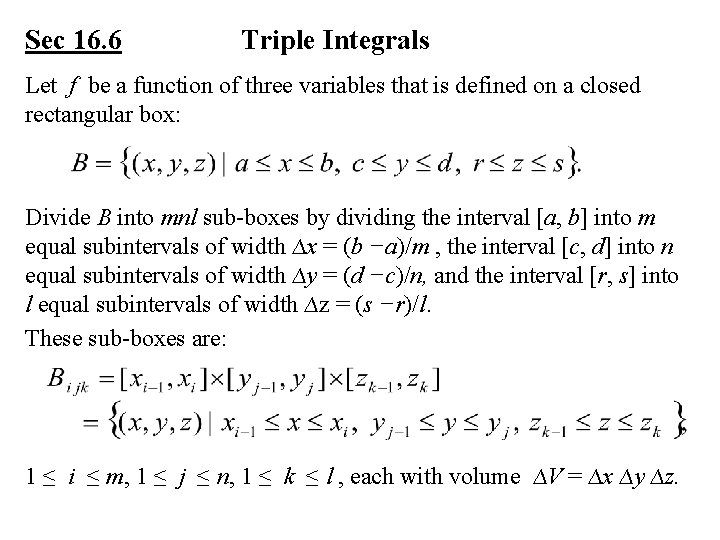
Sec 16. 6 Triple Integrals Let f be a function of three variables that is defined on a closed rectangular box: Divide B into mnl sub-boxes by dividing the interval [a, b] into m equal subintervals of width ∆x = (b −a)/m , the interval [c, d] into n equal subintervals of width ∆y = (d −c)/n, and the interval [r, s] into l equal subintervals of width ∆z = (s −r)/l. These sub-boxes are: 1 ≤ i ≤ m, 1 ≤ j ≤ n, 1 ≤ k ≤ l , each with volume ∆V = ∆x ∆y ∆z.
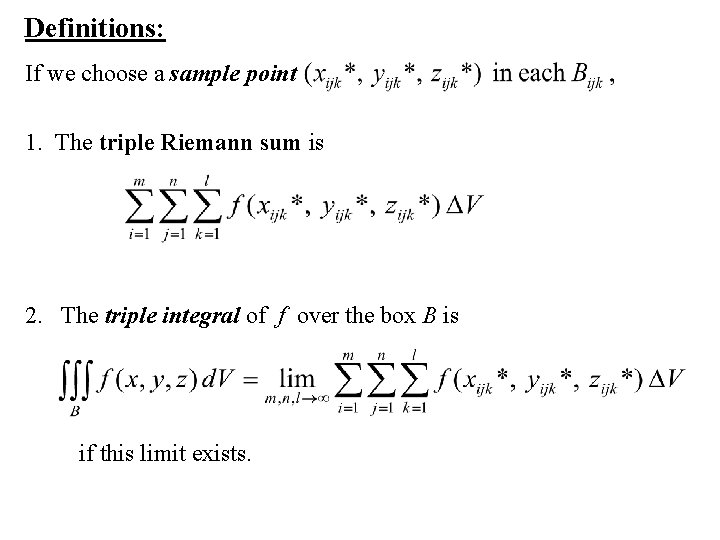
Definitions: If we choose a sample point 1. The triple Riemann sum is 2. The triple integral of f over the box B is if this limit exists.

Fubini’s Theorem for Triple Integrals: If f is continuous on the rectangular box B = [a, b] x [c, d] x [r, s] , then Note: This includes the five other orders in which we can integrate with respect to one variable, keeping the others fixed.
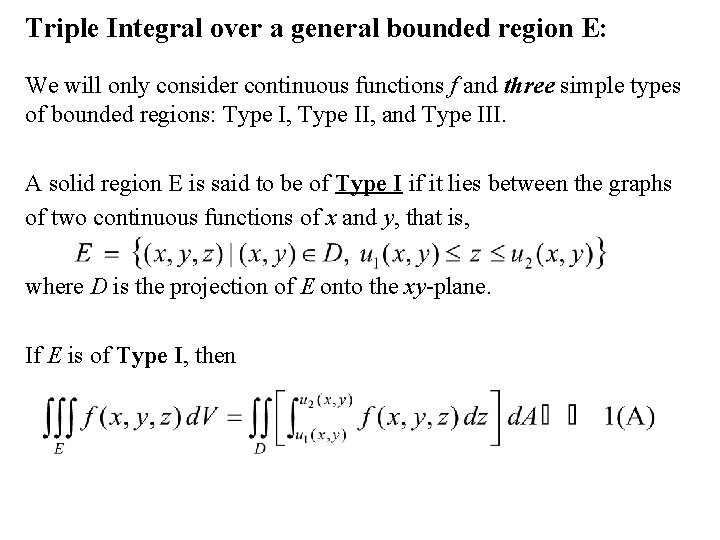
Triple Integral over a general bounded region E: We will only consider continuous functions f and three simple types of bounded regions: Type I, Type II, and Type III. A solid region E is said to be of Type I if it lies between the graphs of two continuous functions of x and y, that is, where D is the projection of E onto the xy-plane. If E is of Type I, then
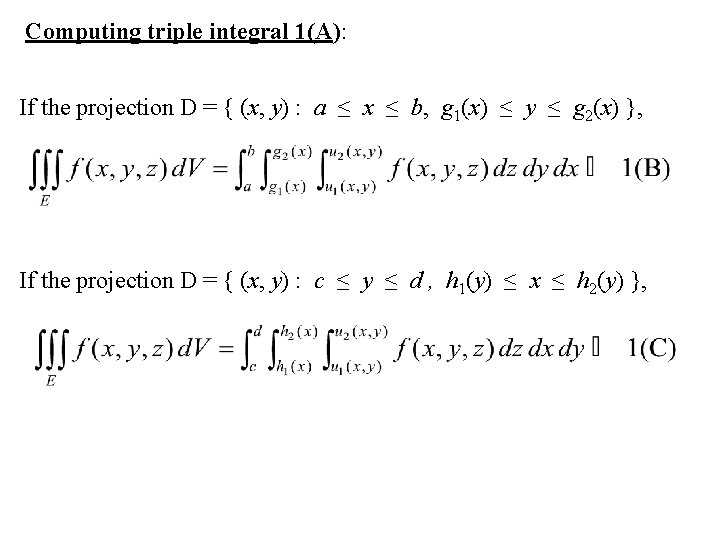
Computing triple integral 1(A): If the projection D = { (x, y) : a ≤ x ≤ b, g 1(x) ≤ y ≤ g 2(x) }, If the projection D = { (x, y) : c ≤ y ≤ d , h 1(y) ≤ x ≤ h 2(y) },
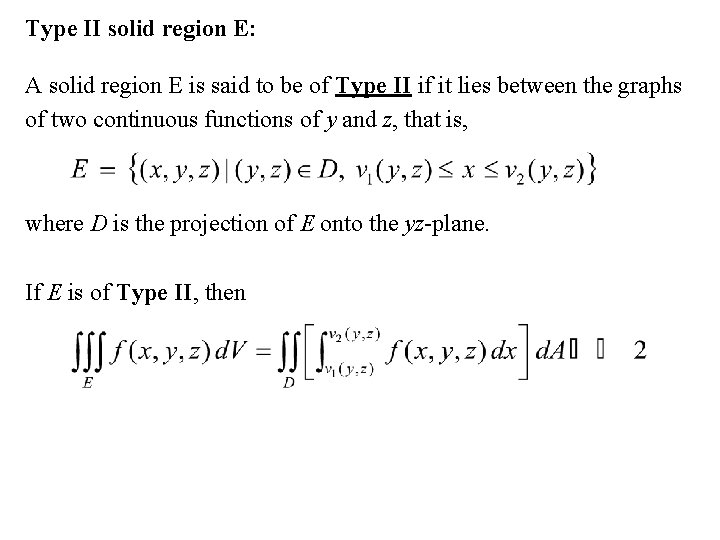
Type II solid region E: A solid region E is said to be of Type II if it lies between the graphs of two continuous functions of y and z, that is, where D is the projection of E onto the yz-plane. If E is of Type II, then
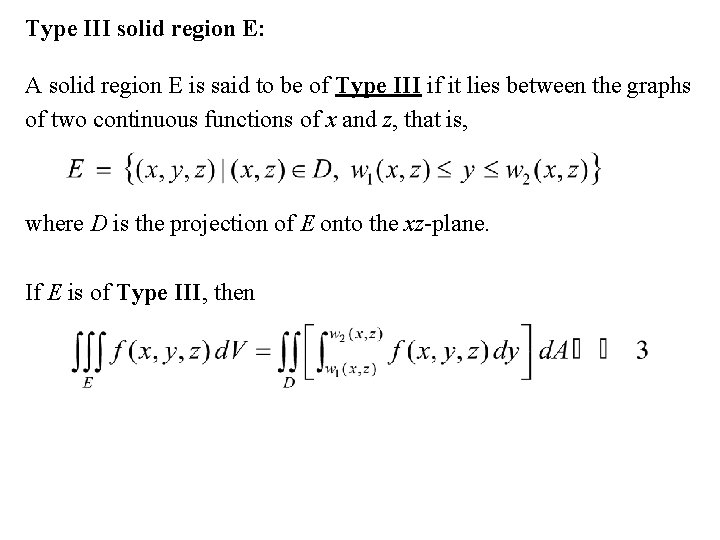
Type III solid region E: A solid region E is said to be of Type III if it lies between the graphs of two continuous functions of x and z, that is, where D is the projection of E onto the xz-plane. If E is of Type III, then
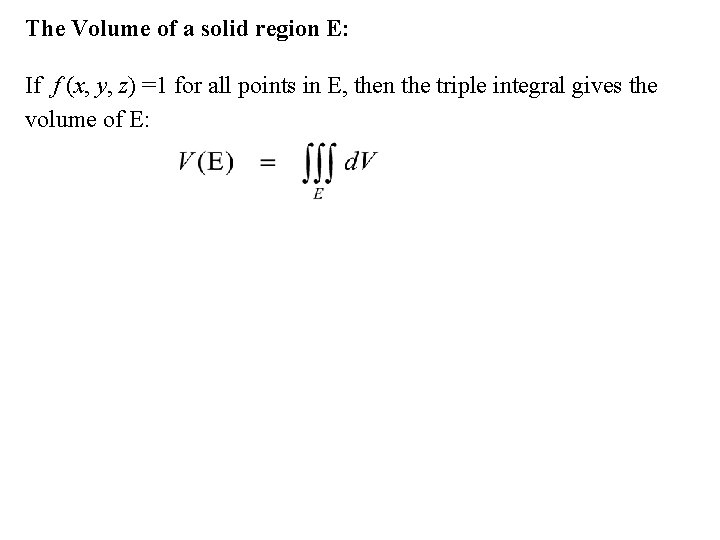
The Volume of a solid region E: If f (x, y, z) =1 for all points in E, then the triple integral gives the volume of E:
- Slides: 8