
Sec 1 1 Finding Limits Graphically and Numerically
- Slides: 17
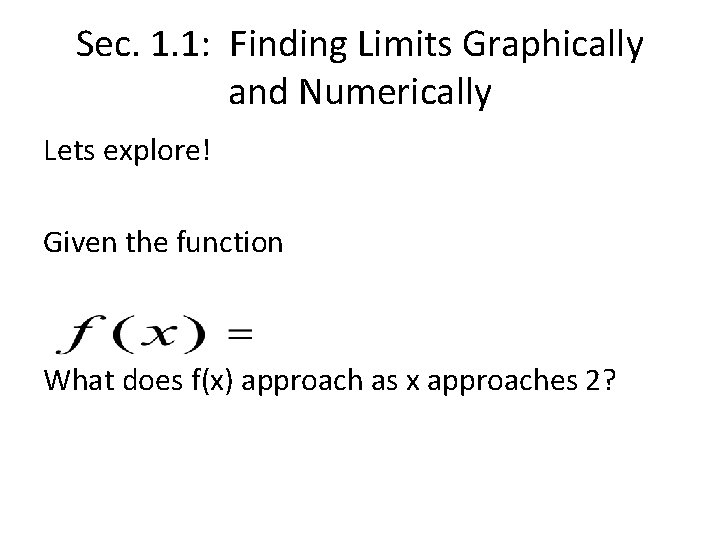
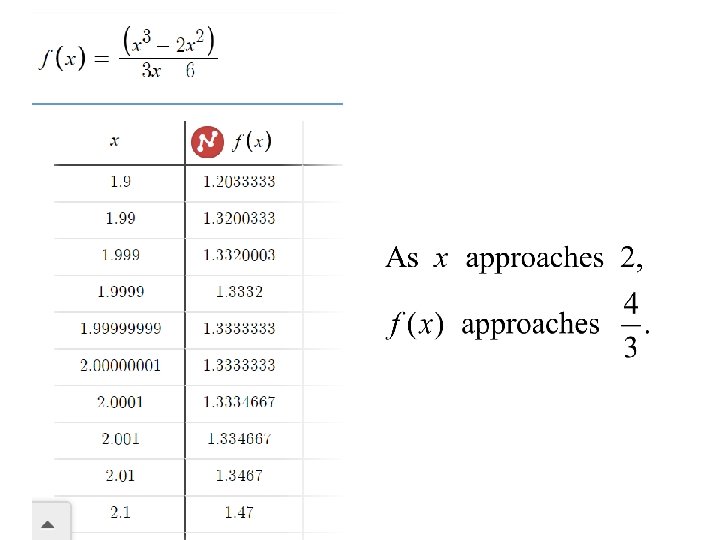
Sec. 1. 1: Finding Limits Graphically and Numerically Lets explore! Given the function What does f(x) approach as x approaches 2?
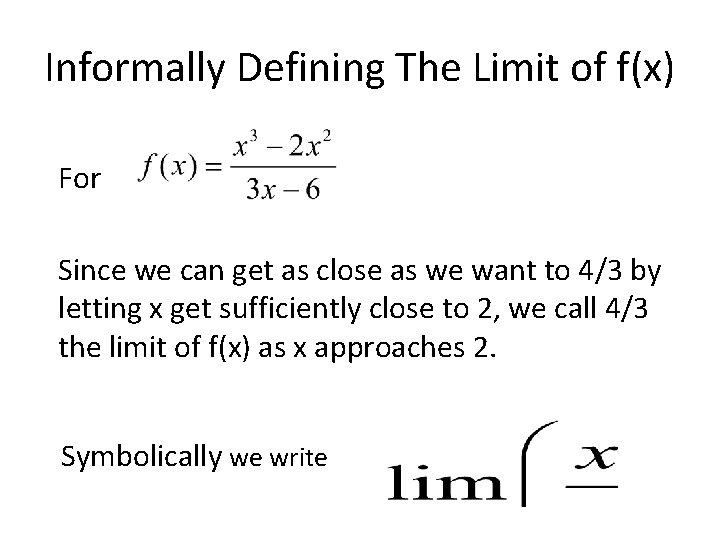
Informally Defining The Limit of f(x) For Since we can get as close as we want to 4/3 by letting x get sufficiently close to 2, we call 4/3 the limit of f(x) as x approaches 2. Symbolically we write
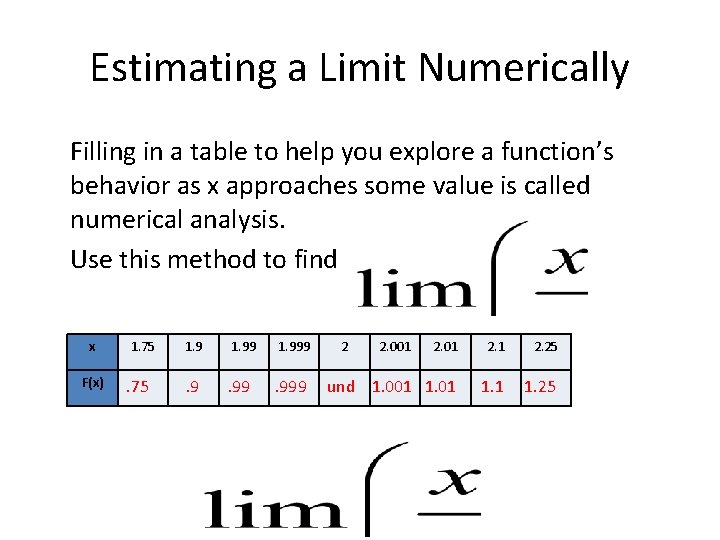
Estimating a Limit Numerically Filling in a table to help you explore a function’s behavior as x approaches some value is called numerical analysis. Use this method to find x F(x) 1. 75 1. 999 2 2. 001 2. 25 und 1. 001 1. 25
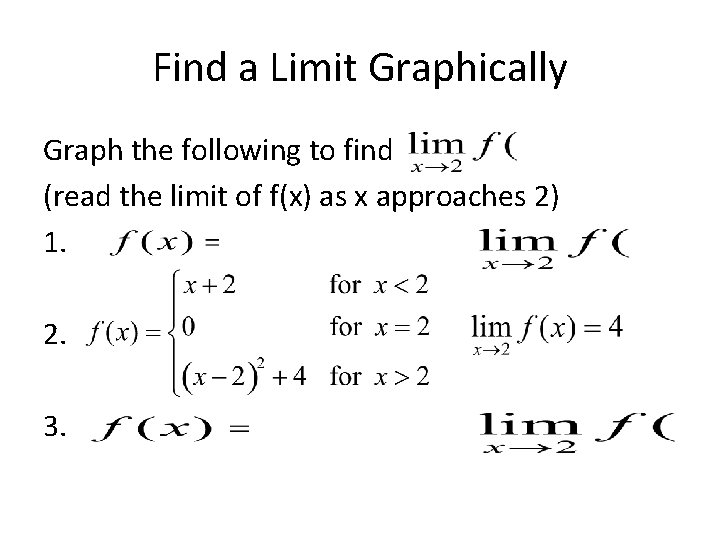
Find a Limit Graphically Graph the following to find (read the limit of f(x) as x approaches 2) 1. 2. 3.
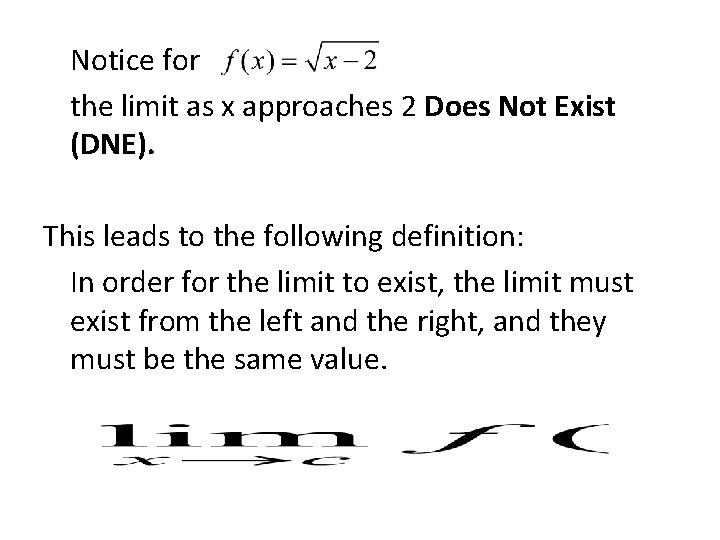
Notice for the limit as x approaches 2 Does Not Exist (DNE). This leads to the following definition: In order for the limit to exist, the limit must exist from the left and the right, and they must be the same value.
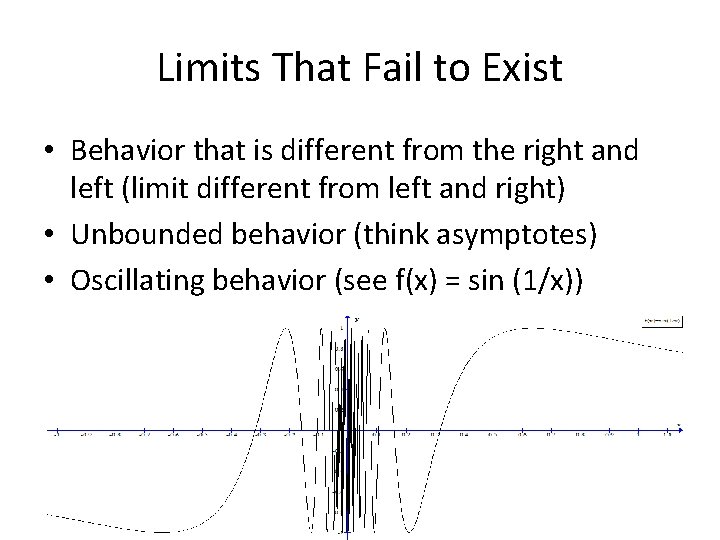
Limits That Fail to Exist • Behavior that is different from the right and left (limit different from left and right) • Unbounded behavior (think asymptotes) • Oscillating behavior (see f(x) = sin (1/x))
Sec. 1. 3: Evaluating Limits Analytically • The limit of f(x) as x approaches c does not depend on the value of f at c. i. e. The limit of f(x) as x approaches c may not be f(c). • Although, for those that are, we could have used direct substitution to evaluate the limit.
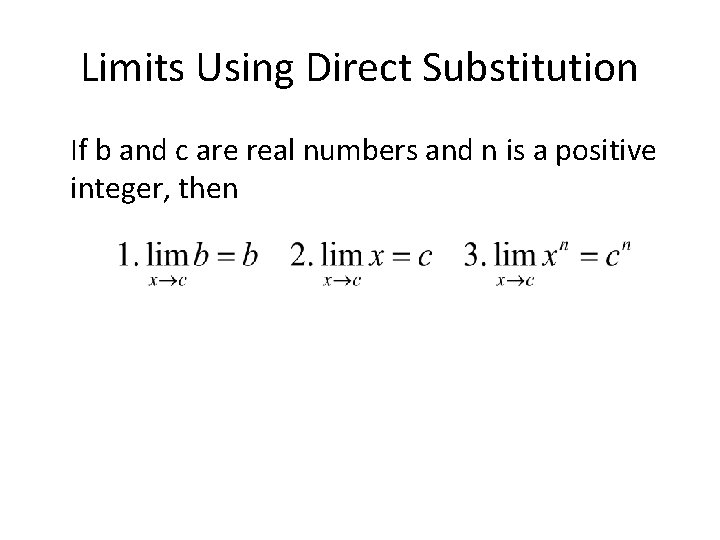
Limits Using Direct Substitution If b and c are real numbers and n is a positive integer, then
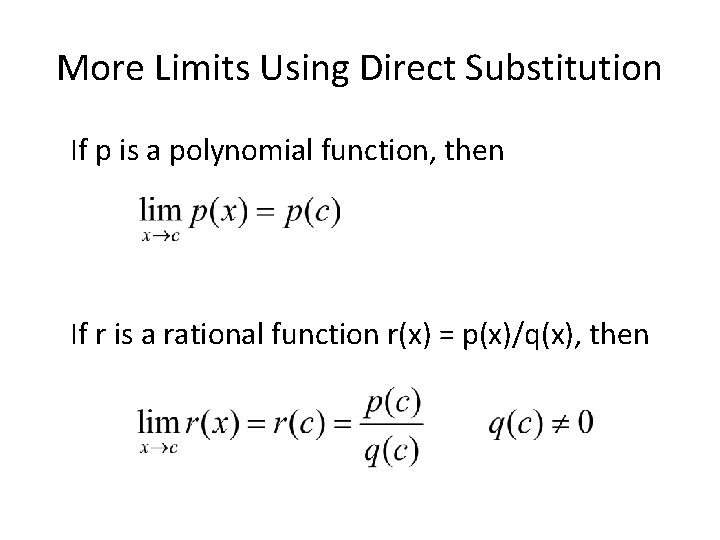
More Limits Using Direct Substitution If p is a polynomial function, then If r is a rational function r(x) = p(x)/q(x), then
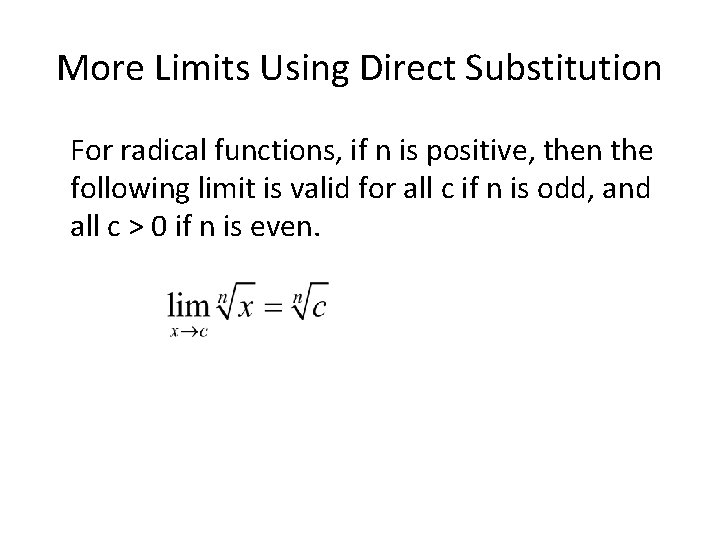
More Limits Using Direct Substitution For radical functions, if n is positive, then the following limit is valid for all c if n is odd, and all c > 0 if n is even.
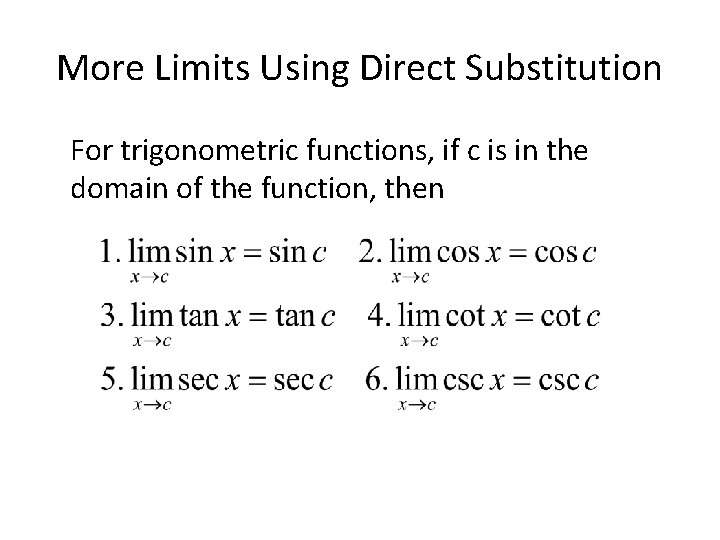
More Limits Using Direct Substitution For trigonometric functions, if c is in the domain of the function, then
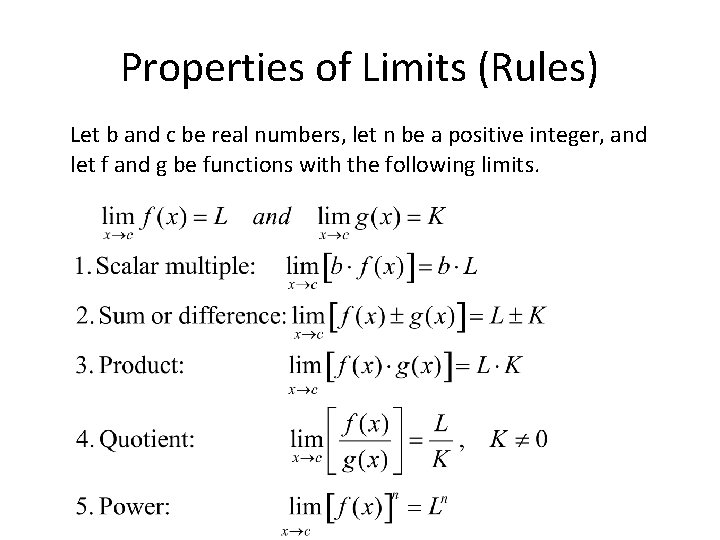
Properties of Limits (Rules) Let b and c be real numbers, let n be a positive integer, and let f and g be functions with the following limits.
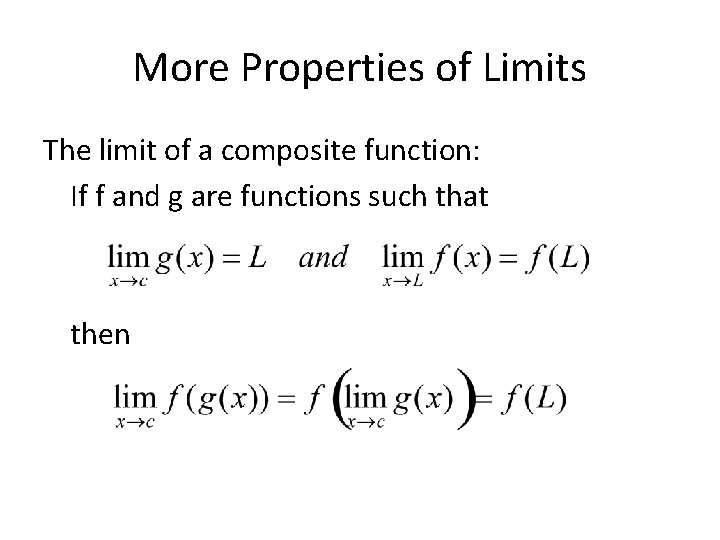
More Properties of Limits The limit of a composite function: If f and g are functions such that then
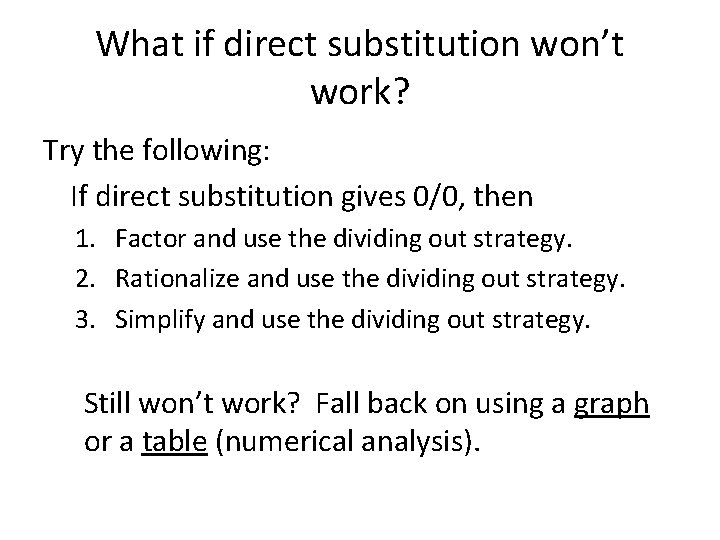
What if direct substitution won’t work? Try the following: If direct substitution gives 0/0, then 1. Factor and use the dividing out strategy. 2. Rationalize and use the dividing out strategy. 3. Simplify and use the dividing out strategy. Still won’t work? Fall back on using a graph or a table (numerical analysis).
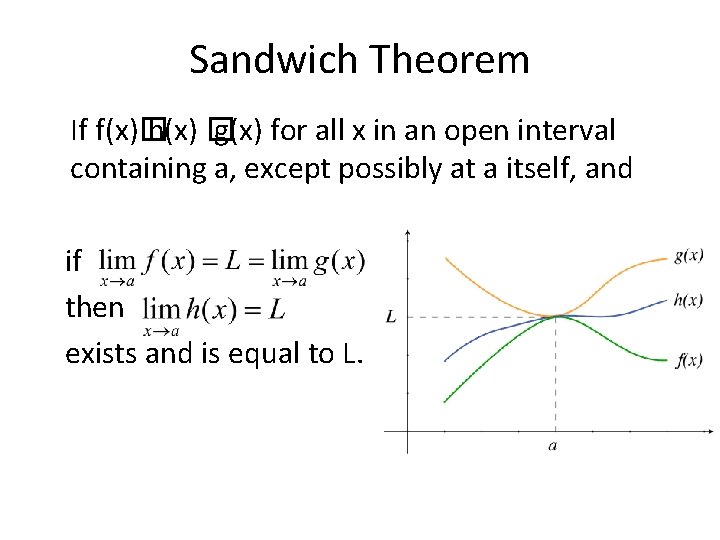
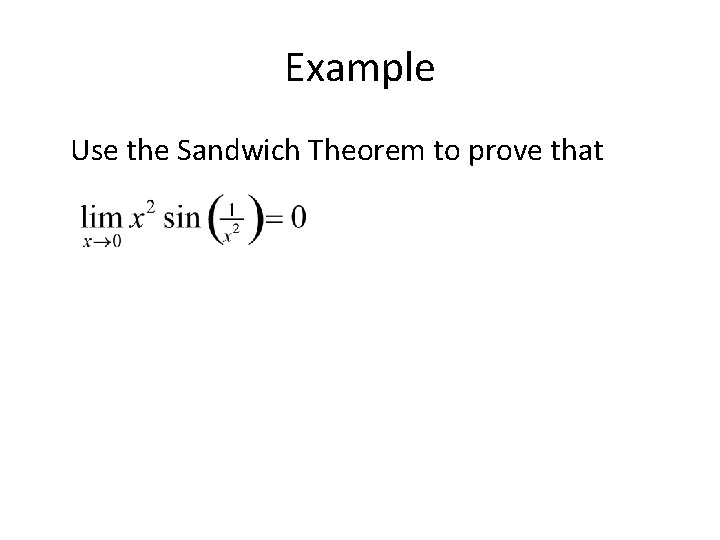
Sandwich Theorem If f(x)� h(x) � g(x) for all x in an open interval containing a, except possibly at a itself, and if then exists and is equal to L.
Example Use the Sandwich Theorem to prove that