
Seasonal Vegetation Coverage and its Impact on River
- Slides: 1
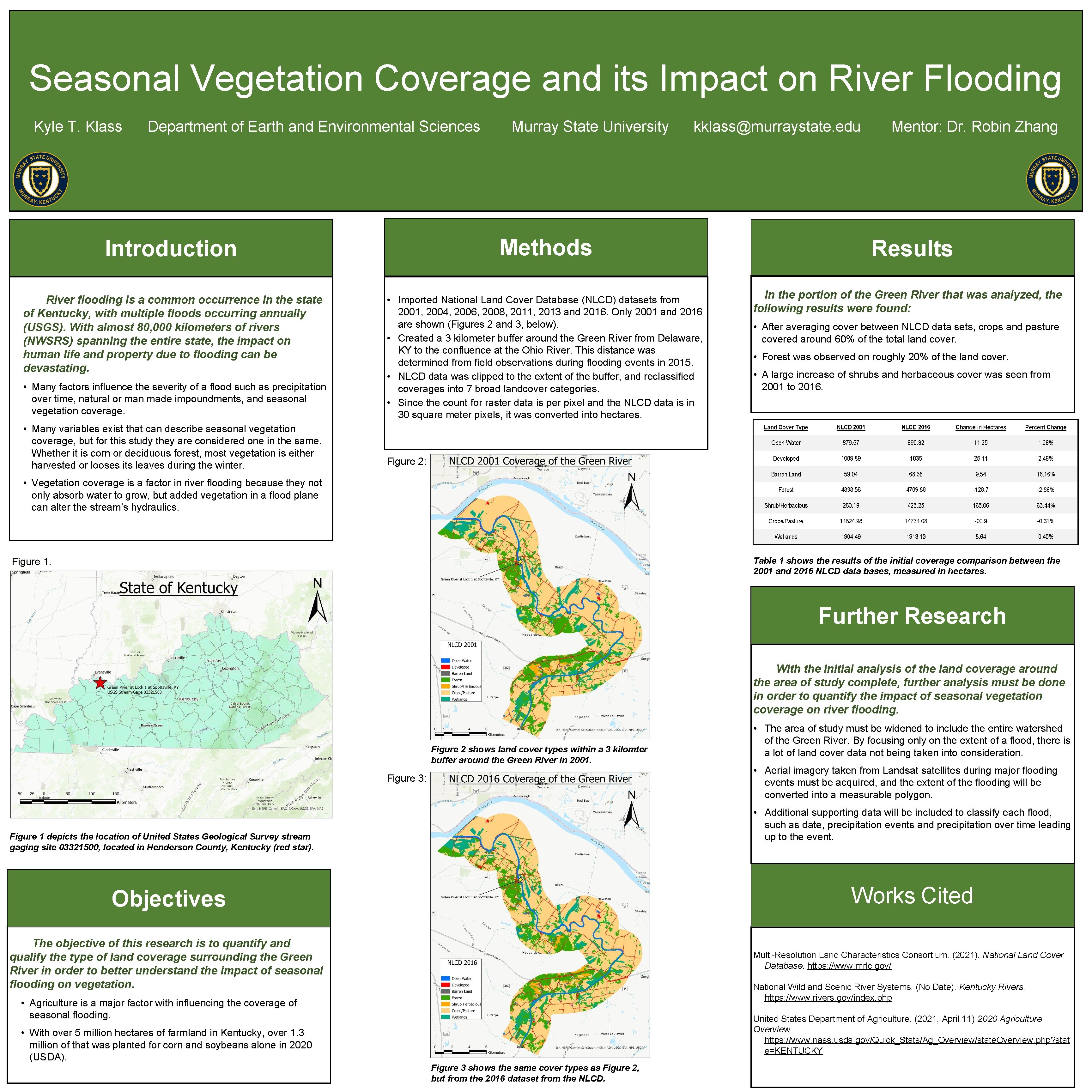
Seasonal Vegetation Coverage and its Impact on River Flooding Kyle T. Klass Department of Earth and Environmental Sciences Murray State University kklass@murraystate. edu Introduction Methods River flooding is a common occurrence in the state of Kentucky, with multiple floods occurring annually (USGS). With almost 80, 000 kilometers of rivers (NWSRS) spanning the entire state, the impact on human life and property due to flooding can be devastating. • Many factors influence the severity of a flood such as precipitation over time, natural or man made impoundments, and seasonal vegetation coverage. • Imported National Land Cover Database (NLCD) datasets from 2001, 2004, 2006, 2008, 2011, 2013 and 2016. Only 2001 and 2016 are shown (Figures 2 and 3, below). • Created a 3 kilometer buffer around the Green River from Delaware, KY to the confluence at the Ohio River. This distance was determined from field observations during flooding events in 2015. • NLCD data was clipped to the extent of the buffer, and reclassified coverages into 7 broad landcover categories. • Since the count for raster data is per pixel and the NLCD data is in 30 square meter pixels, it was converted into hectares. • Many variables exist that can describe seasonal vegetation coverage, but for this study they are considered one in the same. Whether it is corn or deciduous forest, most vegetation is either harvested or looses its leaves during the winter. Figure 2: Mentor: Dr. Robin Zhang Results In the portion of the Green River that was analyzed, the following results were found: • After averaging cover between NLCD data sets, crops and pasture covered around 60% of the total land cover. • Forest was observed on roughly 20% of the land cover. • A large increase of shrubs and herbaceous cover was seen from 2001 to 2016. • Vegetation coverage is a factor in river flooding because they not only absorb water to grow, but added vegetation in a flood plane can alter the stream’s hydraulics. Table 1 shows the results of the initial coverage comparison between the 2001 and 2016 NLCD data bases, measured in hectares. Figure 1. Further Research With the initial analysis of the land coverage around the area of study complete, further analysis must be done in order to quantify the impact of seasonal vegetation coverage on river flooding. Figure 2 shows land cover types within a 3 kilomter buffer around the Green River in 2001. Figure 3: • The area of study must be widened to include the entire watershed of the Green River. By focusing only on the extent of a flood, there is a lot of land cover data not being taken into consideration. • Aerial imagery taken from Landsat satellites during major flooding events must be acquired, and the extent of the flooding will be converted into a measurable polygon. • Additional supporting data will be included to classify each flood, such as date, precipitation events and precipitation over time leading up to the event. Figure 1 depicts the location of United States Geological Survey stream gaging site 03321500, located in Henderson County, Kentucky (red star). Works Cited Objectives The objective of this research is to quantify and qualify the type of land coverage surrounding the Green River in order to better understand the impact of seasonal flooding on vegetation. Multi-Resolution Land Characteristics Consortium. (2021). National Land Cover Database. https: //www. mrlc. gov/ National Wild and Scenic River Systems. (No Date). Kentucky Rivers. https: //www. rivers. gov/index. php • Agriculture is a major factor with influencing the coverage of seasonal flooding. United States Department of Agriculture. (2021, April 11) 2020 Agriculture Overview. https: //www. nass. usda. gov/Quick_Stats/Ag_Overview/state. Overview. php? stat e=KENTUCKY • With over 5 million hectares of farmland in Kentucky, over 1. 3 million of that was planted for corn and soybeans alone in 2020 (USDA). Figure 3 shows the same cover types as Figure 2, but from the 2016 dataset from the NLCD.