
Seasonal variations of Shamal wind in the Arabian
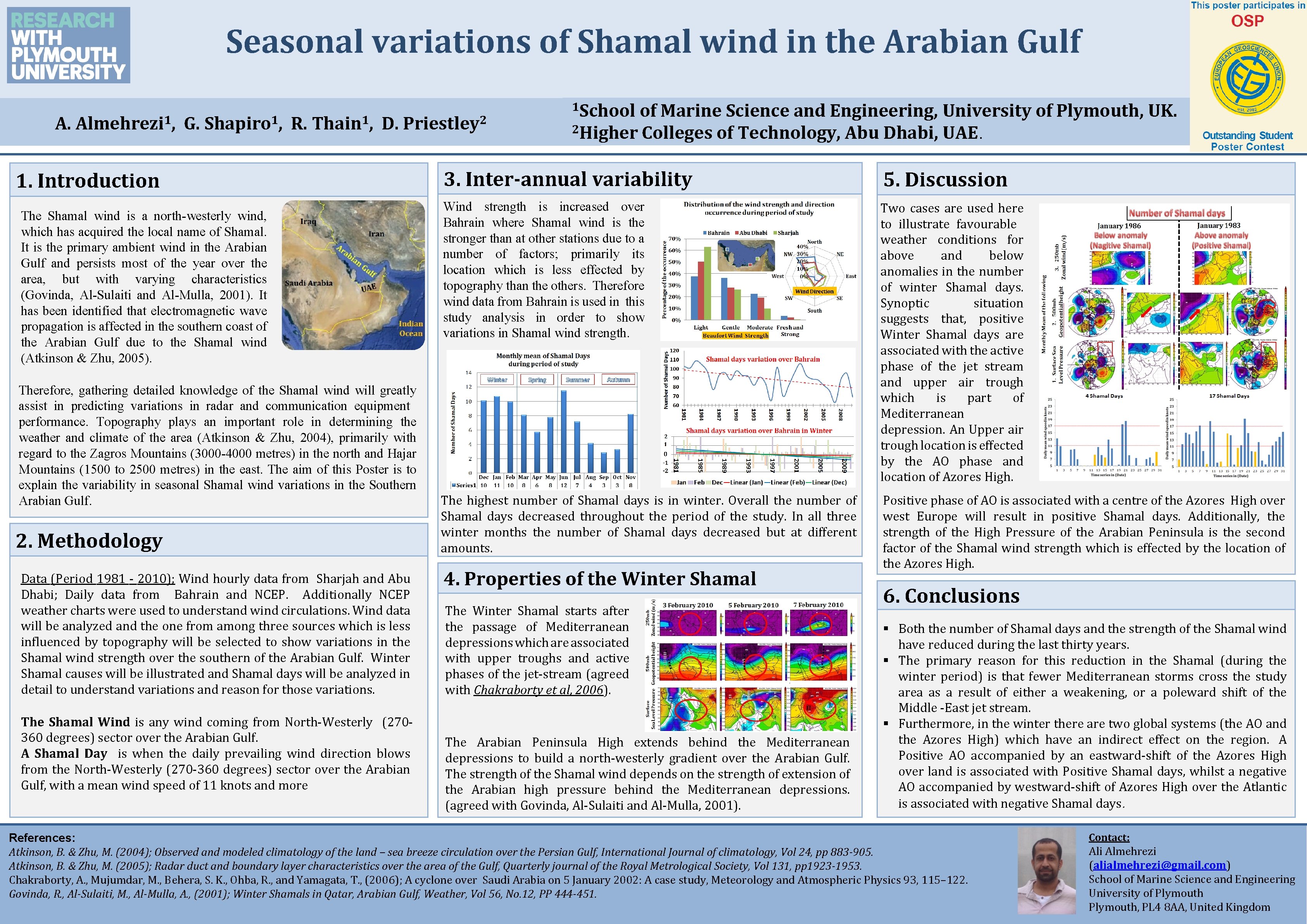
Seasonal variations of Shamal wind in the Arabian Gulf A. Almehrezi 1, G. Shapiro 1, R. Thain 1, D. Priestley 2 1. Introduction The Shamal wind is a north-westerly wind, which has acquired the local name of Shamal. It is the primary ambient wind in the Arabian Gulf and persists most of the year over the area, but with varying characteristics (Govinda, Al-Sulaiti and Al-Mulla, 2001). It has been identified that electromagnetic wave propagation is affected in the southern coast of the Arabian Gulf due to the Shamal wind (Atkinson & Zhu, 2005). Therefore, gathering detailed knowledge of the Shamal wind will greatly assist in predicting variations in radar and communication equipment performance. Topography plays an important role in determining the weather and climate of the area (Atkinson & Zhu, 2004), primarily with regard to the Zagros Mountains (3000 -4000 metres) in the north and Hajar Mountains (1500 to 2500 metres) in the east. The aim of this Poster is to explain the variability in seasonal Shamal wind variations in the Southern Arabian Gulf. 2. Methodology Data (Period 1981 - 2010); Wind hourly data from Sharjah and Abu Dhabi; Daily data from Bahrain and NCEP. Additionally NCEP weather charts were used to understand wind circulations. Wind data will be analyzed and the one from among three sources which is less influenced by topography will be selected to show variations in the Shamal wind strength over the southern of the Arabian Gulf. Winter Shamal causes will be illustrated and Shamal days will be analyzed in detail to understand variations and reason for those variations. The Shamal Wind is any wind coming from North-Westerly (270360 degrees) sector over the Arabian Gulf. A Shamal Day is when the daily prevailing wind direction blows from the North-Westerly (270 -360 degrees) sector over the Arabian Gulf, with a mean wind speed of 11 knots and more 1 School of Marine Science and Engineering, University of Plymouth, UK. 2 Higher Colleges of Technology, Abu Dhabi, UAE. 3. Inter-annual variability 5. Discussion Wind strength is increased over Bahrain where Shamal wind is the stronger than at other stations due to a number of factors; primarily its location which is less effected by topography than the others. Therefore wind data from Bahrain is used in this study analysis in order to show variations in Shamal wind strength. Two cases are used here to illustrate favourable weather conditions for above and below anomalies in the number of winter Shamal days. Synoptic situation suggests that, positive Winter Shamal days are associated with the active phase of the jet stream and upper air trough which is part of Mediterranean depression. An Upper air trough location is effected by the AO phase and location of Azores High. The highest number of Shamal days is in winter. Overall the number of Shamal days decreased throughout the period of the study. In all three winter months the number of Shamal days decreased but at different amounts. Positive phase of AO is associated with a centre of the Azores High over west Europe will result in positive Shamal days. Additionally, the strength of the High Pressure of the Arabian Peninsula is the second factor of the Shamal wind strength which is effected by the location of the Azores High. 4. Properties of the Winter Shamal The Winter Shamal starts after the passage of Mediterranean depressions which are associated with upper troughs and active phases of the jet-stream (agreed with Chakraborty et al, 2006). The Arabian Peninsula High extends behind the Mediterranean depressions to build a north-westerly gradient over the Arabian Gulf. The strength of the Shamal wind depends on the strength of extension of the Arabian high pressure behind the Mediterranean depressions. (agreed with Govinda, Al-Sulaiti and Al-Mulla, 2001). 6. Conclusions § Both the number of Shamal days and the strength of the Shamal wind have reduced during the last thirty years. § The primary reason for this reduction in the Shamal (during the winter period) is that fewer Mediterranean storms cross the study area as a result of either a weakening, or a poleward shift of the Middle -East jet stream. § Furthermore, in the winter there are two global systems (the AO and the Azores High) which have an indirect effect on the region. A Positive AO accompanied by an eastward-shift of the Azores High over land is associated with Positive Shamal days, whilst a negative AO accompanied by westward-shift of Azores High over the Atlantic is associated with negative Shamal days. References: Atkinson, B. & Zhu, M. (2004); Observed and modeled climatology of the land – sea breeze circulation over the Persian Gulf, International Journal of climatology, Vol 24, pp 883 -905. Atkinson, B. & Zhu, M. (2005); Radar duct and boundary layer characteristics over the area of the Gulf, Quarterly journal of the Royal Metrological Society, Vol 131, pp 1923 -1953. Chakraborty, A. , Mujumdar, M. , Behera, S. K. , Ohba, R. , and Yamagata, T. , (2006); A cyclone over Saudi Arabia on 5 January 2002: A case study, Meteorology and Atmospheric Physics 93, 115– 122. Govinda, R. , Al-Sulaiti, M. , Al-Mulla, A. , (2001); Winter Shamals in Qatar, Arabian Gulf, Weather, Vol 56, No. 12, PP 444 -451. Contact: Ali Almehrezi (alialmehrezi@gmail. com) School of Marine Science and Engineering University of Plymouth, PL 4 8 AA, United Kingdom
- Slides: 1