
Searching the dictionary ADT binary search trees 1
Searching • the dictionary ADT • binary search trees 1
The Dictionary ADT • A dictionary is an abstract model of a database – Like a priority queue, a dictionary stores key-element pairs – The main operation supported by a dictionary is searching by key • simple container methods: size() is. Empty() elements() • query methods: find. Element(k) find. All. Elements(k) • update methods: insert. Item(k, e) remove. Element(k) remove. All. Elements(k) • special element NO_SUCH_KEY, returned by an unsuccessful search 2
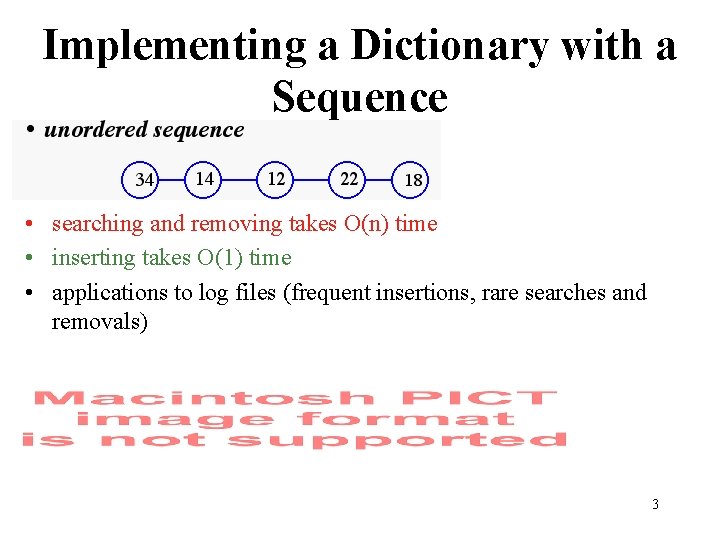
Implementing a Dictionary with a Sequence • searching and removing takes O(n) time • inserting takes O(1) time • applications to log files (frequent insertions, rare searches and removals) 3
Implementing a Dictionary with a Sequence • searching takes O(log n) time (binary search) • inserting and removing takes O(n) time • application to look-up tables (frequent searches, rare insertions and removals) 4
Binary Search • narrow down the search range in stages • “high-low” game • find. Element(22) 5
Pseudocode for Binary Search Algorithm Binary. Search(S, k, low, high) if low > high then return NO_SUCH_KEY else mid (low+high) / 2 if k = key(mid) then return key(mid) else if k < key(mid) then return Binary. Search(S, k, low, mid-1) else return Binary. Search(S, k, mid+1, high) 6

Running Time of Binary Search • The range of candidate items to be searched is halved after each comparison In the array-based implementation, access by rank takes O(1) time, 7 thus binary search runs in O(log n) time
Binary Search Trees • A binary search tree is a binary tree T such that – – each internal node stores an item (k, e) of a dictionary. keys stored at nodes in the left subtree of v are less than or equal to k. keys stored at nodes in the right subtree of v are greater than or equal to k. external nodes do not hold elements but serve as place holders. 8
Search • A binary search tree T is a decision tree, where the question asked at an internal node v is whether the search key k is less than, equal to, or greater than the key stored at v. • Pseudocode: Algorithm Tree. Search(k, v): Input: A search key k and a node v of a binary search tree T. Ouput: A node w of the subtree T(v) of T rooted at v, such that either w is an internal node storingkey k or w is the external node encountered in the inorder traversal of T(v) after all the internal nodes with keys smaller than k and before all the internal nodes with keys greater than k. if v is an external node then return v if k = key(v) then return v else if k < key(v) then return Tree. Search(k, T. left. Child(v)) else { k > key(v) } return Tree. Search(k, T. right. Child(v)) 9
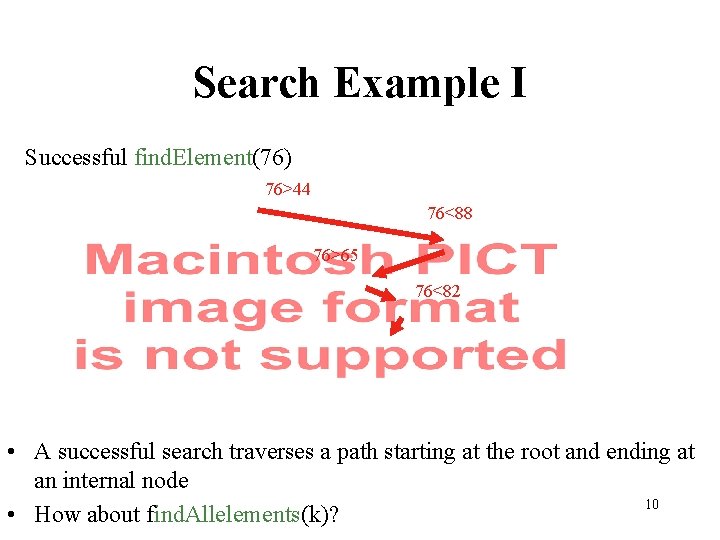
Search Example I Successful find. Element(76) 76>44 76<88 76>65 76<82 • A successful search traverses a path starting at the root and ending at an internal node 10 • How about find. Allelements(k)?
Search Example II Unsuccessful find. Element(25) 25<44 25>17 25<32 25<28 leaf node • An unsuccessful search traverses a path starting at the root and ending at an external node 11
Insertion • To perform insert. Item(k, e), let w be the node returned by Tree. Search(k, T. root()) • If w is external, we know that k is not stored in T. We call expand. External(w) on T and store (k, e) in w 12
Insertion II • If w is internal, we know another item with key k is stored at w. We call the algorithm recursively starting at T. right. Child(w) or T. left. Child(w) 13
Removal I • We locate the node w where the key is stored with algorithm Tree. Search • If w has an external child z, we remove w and z with remove. Above. External(z) 14
Removal II • If w has an no external children: – find the internal node y following w in inorder – move the item at y into w – perform remove. Above. External(x), where x is the left child of y (guaranteed to be external) 15
Time Complexity • A search, insertion, or removal, visits the nodes along a root-to leaf path, plus possibly the siblings of such nodes • Time O(1) is spent at each node • The running time of each operation is O(h), where h is the height of the tree • The height of binary serch tree is in n in the worst case, where a binary search tree looks like a sorted sequence • To achieve good running time, we need to keep the tree balanced, i. e. , with O(logn) height. • Various balancing schemes will be explored in the next lectures 16
- Slides: 16