
Searching For Qualitative Evidence Helen Buckley Woods Learning

Searching For Qualitative Evidence Helen Buckley Woods
Learning Outcomes • Describe the particular challenges inherent in identifying qualitative research • Apply question tools to identify the facets of your search strategy • Identify key terms to assist retrieval of qualitative research • Demonstrate an awareness of search filters for qualitative research
Today’s Session • A game of two halves: • Constructing a search strategy and sources of evidence Practical work on identifying qualitative keywords • Filters and other techniques Practical work on searching and study selection

Part One: Search strategies and sources
• What’s different about searching for qualitative research? • Using question tools to identify key concepts and plan your search • Sources of qualitative research • Case study: worked search example • Practical: sifting abstracts exercise
Qualitative Research • Qualitative research seeks to understand interpret personal experiences, behaviours, interactions, and social contexts to explain the phenomena of interest, such as the attitudes, beliefs, and perspectives of patients and clinicians; the interpersonal nature of caregiver and patient relationships; the illness experience; or the impact of human suffering. (Wong et al, 2004)
What do I need to consider? • Qualitative research is small part of the research literature • The indexing in databases is inconsistent and variable • Qualitative studies sometimes have creative titles or inadequate abstracts • Medline might not be your preferred resource. • If searching in limited databases try MEDLINE and CINAHL

Sources of Qualitative Research
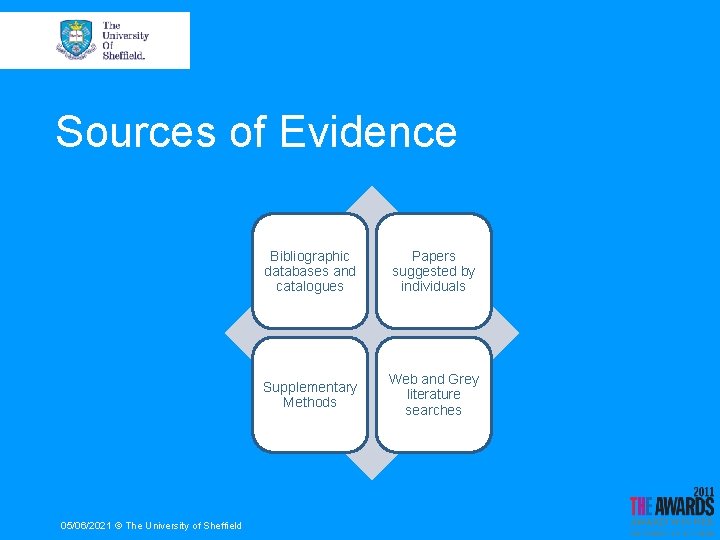
Sources of Evidence 05/06/2021 © The University of Sheffield Bibliographic databases and catalogues Papers suggested by individuals Supplementary Methods Web and Grey literature searches
Databases • Core health databases: CINAHL, Embase, Medline, Cochrane Library • Subject specific databases: ERIC, Scopus, Psych. INFO, ASSIA 05/06/2021 © The University of Sheffield

Dissertations and Books • Pro. Quest dissertations & theses database • Index to Theses (now part of the above from 2015) • British Library Catalogue • Copac (National, Academic and specialist library catalogues) • Specialist Library Collections
Grey Literature • Evidence which is unlikely to be found from bibliographic databases …can be defined as “materials not published commercially or indexed by major databases. ” (Giustini, 2011). • material not widely disseminated and that "Fugitive", hidden, invisible or literature in the deep web may be on government sites, deep in archives, institutional repositories, theses databases, conference sites, associations. (Giustini, 2011). • Useful to find additional papers or evidence on grass roots research which has not been published and indexed in journals databases • Interventions for the prevention of pre-diabetes in high risk groups: examples of current practice in relation to the UK evidence base. (Sc. HARR 2010) 05/06/2021 © The University of Sheffield
Grey literature/Web searching • HMIC, Social Policy & Practice • NHS Evidence • Open Grey, Open. DOAR • Specific topic related websites e. g. National obesity observatory, Campbell Collaboration, EPPI Centre • Google Scholar, bespoke search engines 05/06/2021 © The University of Sheffield
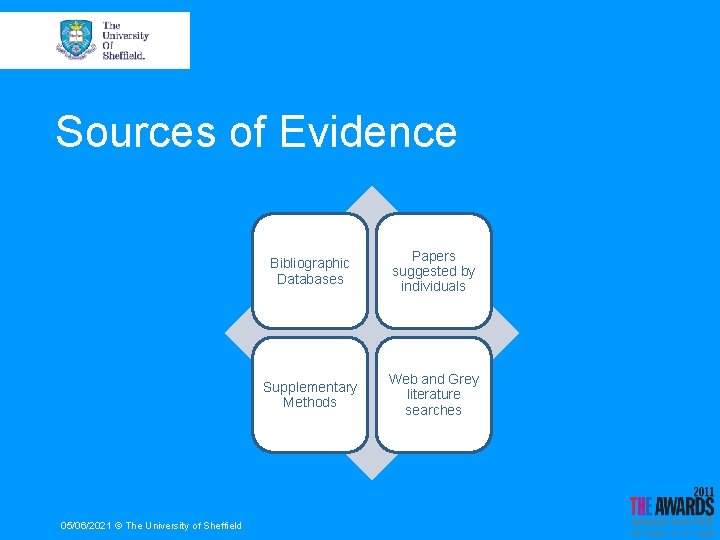
Sources of Evidence 05/06/2021 © The University of Sheffield Bibliographic Databases Papers suggested by individuals Supplementary Methods Web and Grey literature searches
So how does this work in practice? You are conducting a systematic review to examine the barriers to women using a health care facility to give birth in rural Kenya. The review commissioners want to answer “From the women’s perspective, what are the barriers to giving birth in health facilities in rural Kenya? ”
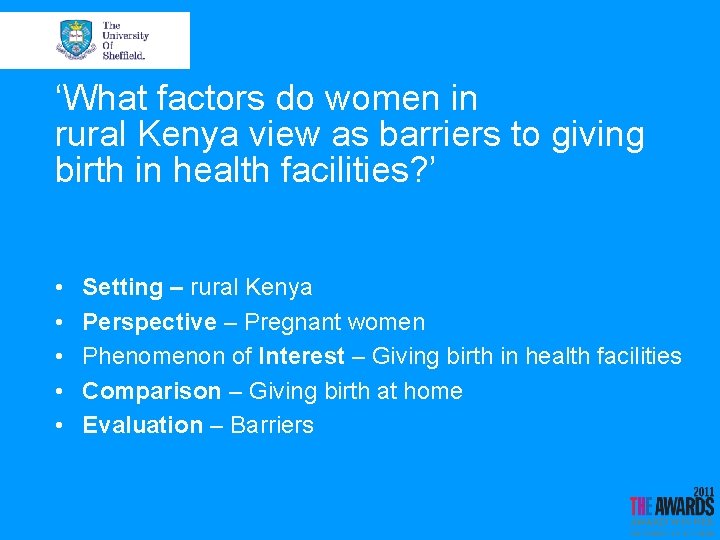
‘What factors do women in rural Kenya view as barriers to giving birth in health facilities? ’ • • • Setting – rural Kenya Perspective – Pregnant women Phenomenon of Interest – Giving birth in health facilities Comparison – Giving birth at home Evaluation – Barriers
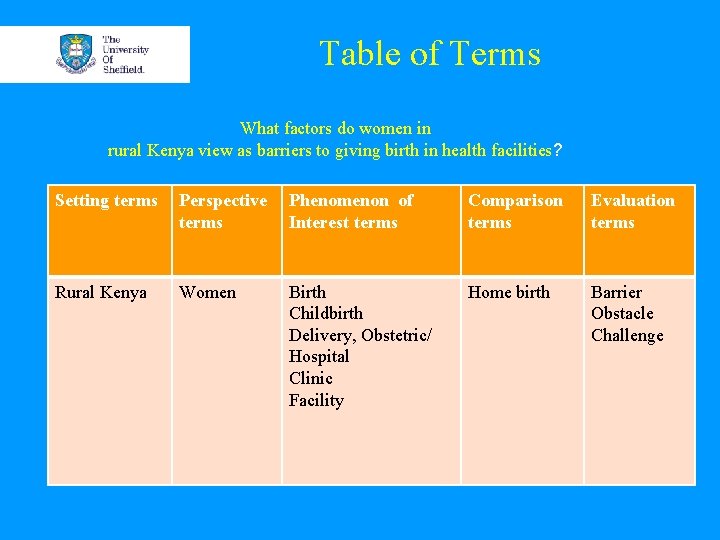
Table of Terms What factors do women in rural Kenya view as barriers to giving birth in health facilities? Setting terms Perspective terms Phenomenon of Interest terms Comparison terms Evaluation terms Rural Kenya Women Birth Childbirth Delivery, Obstetric/ Hospital Clinic Facility Home birth Barrier Obstacle Challenge
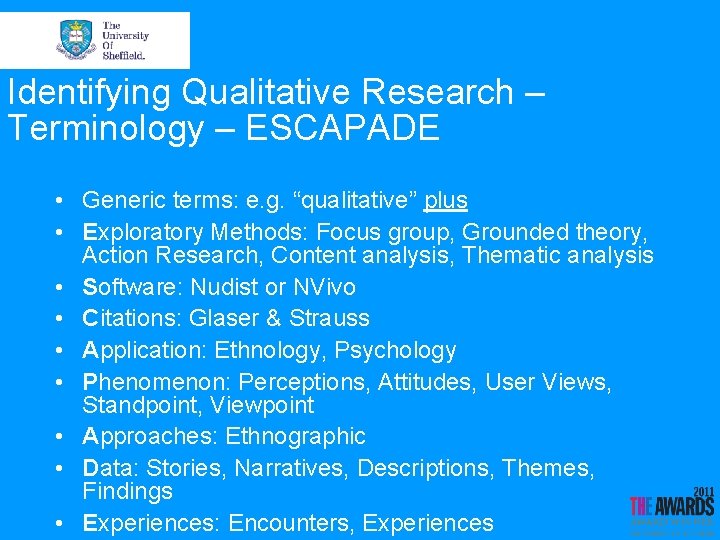
Identifying Qualitative Research – Terminology – ESCAPADE • Generic terms: e. g. “qualitative” plus • Exploratory Methods: Focus group, Grounded theory, Action Research, Content analysis, Thematic analysis • Software: Nudist or NVivo • Citations: Glaser & Strauss • Application: Ethnology, Psychology • Phenomenon: Perceptions, Attitudes, User Views, Standpoint, Viewpoint • Approaches: Ethnographic • Data: Stories, Narratives, Descriptions, Themes, Findings • Experiences: Encounters, Experiences
Exercise - Identifying Qualitative Research from Abstracts • Using the handout provided consider the list of references taken from CINAHL or Medline. • For each references mark all the words or phrases that identify the item as qualitative research.

Feedback from Exercise
Recap on the session so far • Challenges in searching for qualitative research • Sources • Using question tools to help design your search • Case Study • Keywords and subject headings to consider
Part Two: Search Filters and other search techniques
• “Supplementary” searching methods • Methodological filters
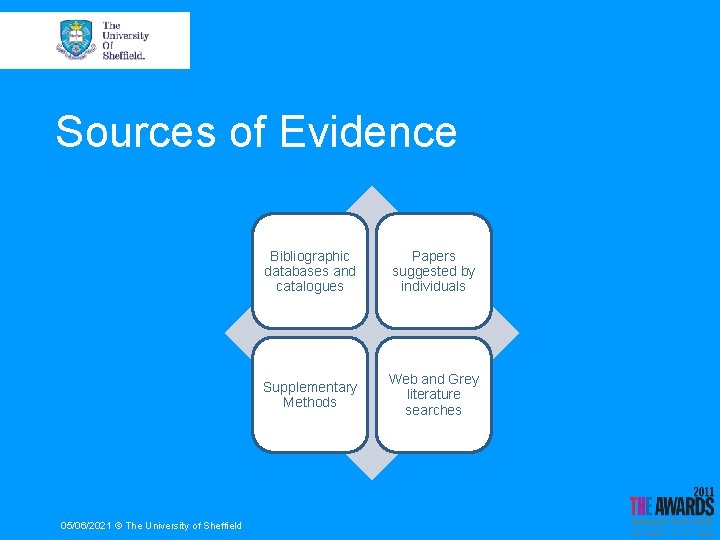
Sources of Evidence 05/06/2021 © The University of Sheffield Bibliographic databases and catalogues Papers suggested by individuals Supplementary Methods Web and Grey literature searches
“Supplementary” Methods • Citation searches – looking forward • Reference lists – looking back • Hand searching – in practice, review of electronic Tables of Contents (e. TOC) 05/06/2021 © The University of Sheffield
“Supplementary” Methods • “The conventional subject search identified 30 of 41 included references. . . References were missed by this method and a further 11 references were identified via citation searching, reference list checking and contact with experts. . . additional search techniques were essential and located further high quality references. ” (Papaioannou et al, 2010) • Systematic reviews of complex evidence cannot rely solely on protocol-driven search strategies. ” (Greenhalgh and Peacock, 2005) 05/06/2021 © The University of Sheffield
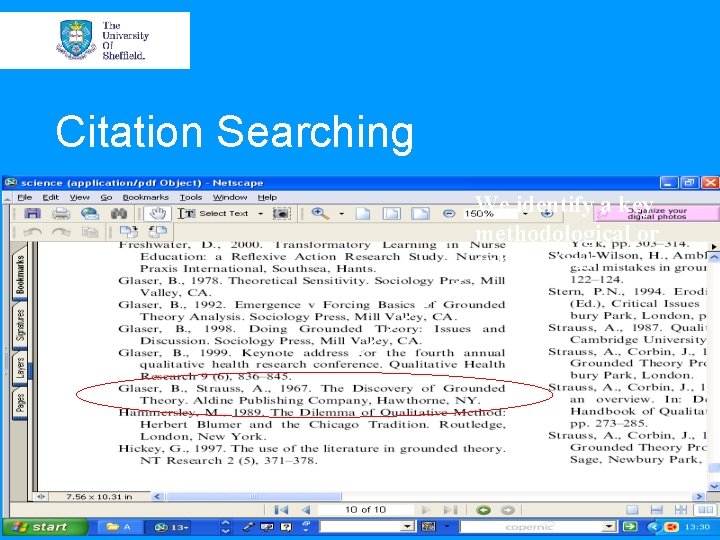
Citation Searching We identify a key methodological or subject text


What is a methodological filter? • “A hedge or filter is a standardised search strategy that is designed to be used in conjunction with a subject search to retrieve valid studies from the (primary) medical literature”. • Filters work in one of two ways: • by identifying particular publication types or study designs most likely to answer a question • by isolating subject or free-text terms most likely to be associated with high-quality studies
How do they work? • Filters come from 3 different sources: • Subject heading • Keyword • Publication type
How do I use a methodological filter? Step One: Carry out a subject search as usual using subject headings and/or free text Step Two: Apply methodological filter appropriate to question you are asking One-line filter Maximum sensitivity filter Maximum specificity filter Mid-range filter
Definitions • Sensitivity: the ability of a search strategy to identify relevant records • Specificity: the ability of a search strategy to exclude irrelevant records Spring M. (2008). Applying the principles of EBM to public health – searching for public health evidence – the experience at the National Institute for Health and Clinical Excellence (NICE). Eahil conference, Held on 23 -28 June, Helsinki, Finland.
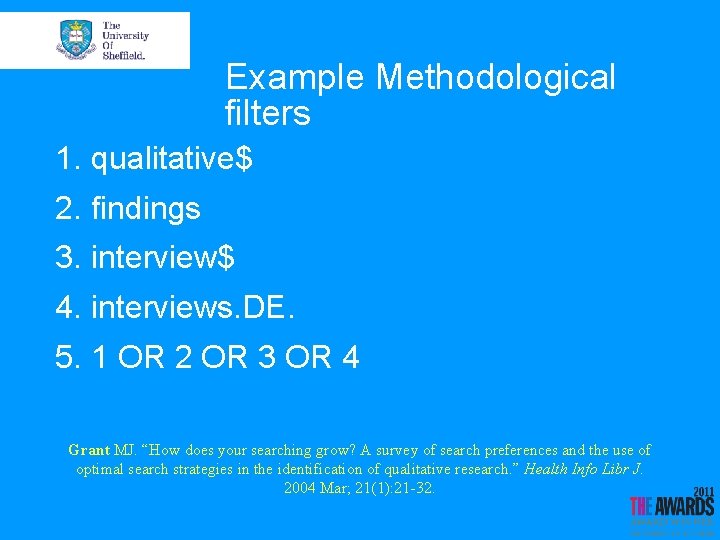
Example Methodological filters 1. qualitative$ 2. findings 3. interview$ 4. interviews. DE. 5. 1 OR 2 OR 3 OR 4 Grant MJ. “How does your searching grow? A survey of search preferences and the use of optimal search strategies in the identification of qualitative research. ” Health Info Libr J. 2004 Mar; 21(1): 21 -32.
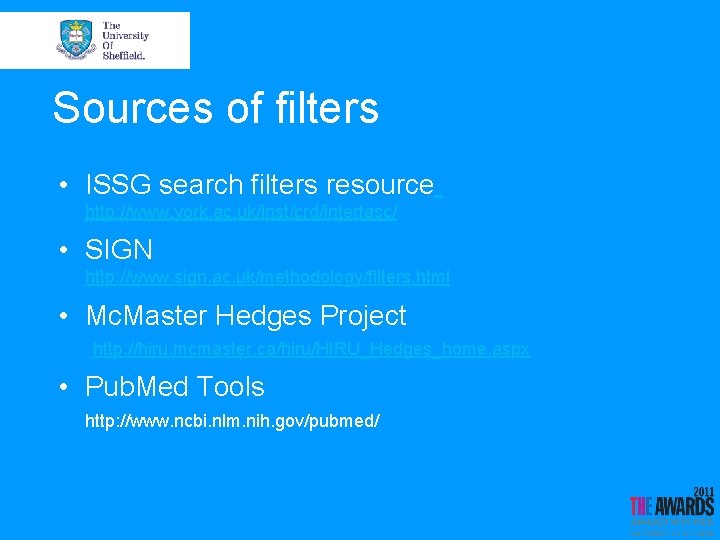
Sources of filters • ISSG search filters resource http: //www. york. ac. uk/inst/crd/intertasc/ • SIGN http: //www. sign. ac. uk/methodology/filters. html • Mc. Master Hedges Project http: //hiru. mcmaster. ca/hiru/HIRU_Hedges_home. aspx • Pub. Med Tools http: //www. ncbi. nlm. nih. gov/pubmed/

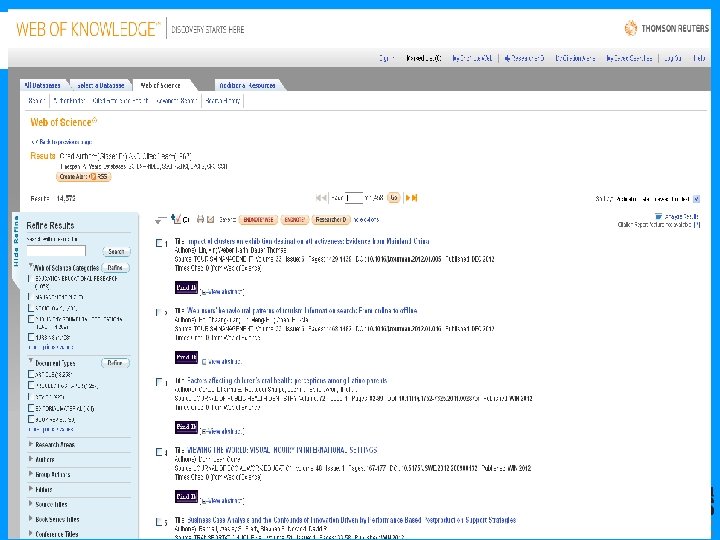
Demo of Pub. Med Health Services Research Special Queries http: //www. nlm. nih. gov/nichsr/hedges/search. html 05/06/2021 © The University of Sheffield
Practical • Practice some searching • Try out the HSR Pub. Med filter 05/06/2021 © The University of Sheffield
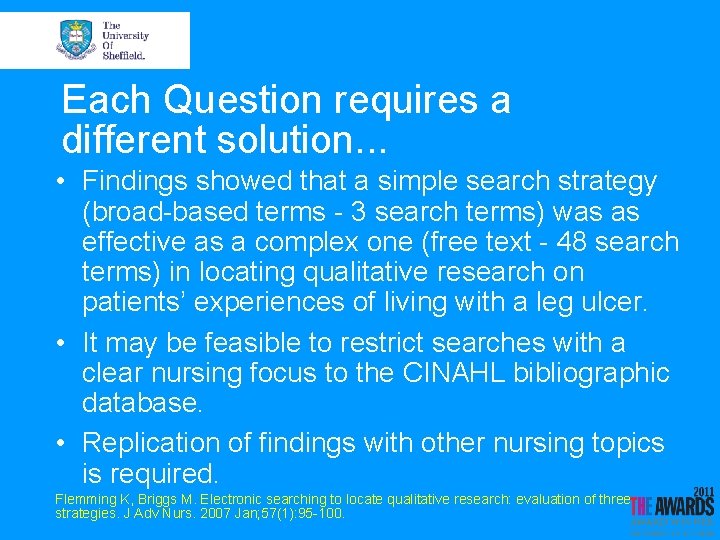
Each Question requires a different solution. . . • Findings showed that a simple search strategy (broad-based terms - 3 search terms) was as effective as a complex one (free text - 48 search terms) in locating qualitative research on patients’ experiences of living with a leg ulcer. • It may be feasible to restrict searches with a clear nursing focus to the CINAHL bibliographic database. • Replication of findings with other nursing topics is required. Flemming K, Briggs M. Electronic searching to locate qualitative research: evaluation of three strategies. J Adv Nurs. 2007 Jan; 57(1): 95 -100.
Study Selection “Sifting” exercise • Google Doc • Appraise the studies • Decide on whether to exclude, include, refer or access full text • Your anonymous decisions are recorded • Feedback after the break 05/06/2021 © The University of Sheffield
Learning Outcomes • Describe the particular challenges inherent in identifying qualitative research • Apply question tools to identify the facets of your search strategy • Identify key terms to assist retrieval of qualitative research • Demonstrate an awareness of search filters for qualitative research
![References - 1 • Bradley, P. Which search engine when? (n. d. ) [online].](http://slidetodoc.com/presentation_image_h2/53c5ea965a1b9fd100acca4e505583c3/image-43.jpg "References - 1 • Bradley, P. Which search engine when? (n. d. ) [online].")
References - 1 • Bradley, P. Which search engine when? (n. d. ) [online]. Phil Bradley’s website: making the internet, search and social media easy. Available from: http: //www. philb. com/whichengine. htm [Accessed 30 th August 2016] • Bronson, E. and Davis, T. S. (2012) Finding and Evaluating Evidence: Systematic Reviews and Evidence-Based Practice. Oxford, Oxford University Press • Flemming K, Briggs M. Electronic searching to locate qualitative research: evaluation of three strategies. J Adv Nurs. 2007 Jan; 57(1): 95 -100. • Giustini D. (2011) The Grey Zone UBC Health Library wiki [online]. British Columbia, University of British Columbia. Available from: http: //hlwiki. slais. ubc. ca/index. php/Grey_literature#The_. 22 Grey_Zone. 22 [Accessed 30 th August 2016]
References - 2 • Gorecki CA, Brown JM, Briggs M, Nixon J. Evaluation of five search strategies in retrieving qualitative patientreported electronic data on the impact of pressure ulcers on quality of life. J Adv Nurs. 2010 Mar; 66(3): 645 -52. • Grant MJ. How does your searching grow? A survey of search preferences and the use of optimal search strategies in the identification of qualitative research. Health Info Libr J. 2004 Mar; 21(1): 21 -32 • Greenhalgh and Peacock, (2005). Effectiveness and efficiency of search methods in systematic reviews of complex evidence: audit of primary sources, BMJ 2005; 331: 1064
References - 3 • Jones, R. et al. 2010. Interventions for the prevention of pre-diabetes in high risk groups: examples of current practice in relation to the UK evidence base. http: //www. nice. org. uk/nicemedia/live/12067/51588/5158 8. pdf • Marks S. Qualitative studies. In: Mc. Kibbon A, Eady A and Marks S. PDQ evidence-based principles and practice. Hamilton, Canada: BC Decker Inc. , 1999. • Papaioannou, D. , Sutton, A. , Carroll, C. , Booth, A. and Wong, R. (2010), Literature searching for social science systematic reviews: consideration of a range of search techniques. Health Information & Libraries Journal, 27: 114– 122. 05/06/2021 © The University of Sheffield
References - 4 • Pearson M. , Moxham, T. and Ashton, K. (2011), Exploring search strategies for identifying qualitative research about barriers and facilitators of programme delivery Evaluation & the Health Professions. 34 (3): 297 -308 • Spring M. (2008). Applying the principles of EBM to public health – searching for public health evidence – the experience at the National Institute for Health and Clinical Excellence (NICE). Eahil conference, Held on 23 -28 June, Helsinki, Finland • Wilczynski NL, Marks S, Haynes RB. Search strategies for identifying qualitative studies in CINAHL. Qual Health Res. 2007 May; 17(5): 705 -10. • Wong SSL, Wilczynski NL, Haynes RB. Developing optimal search strategies for detecting clinically relevant qualitative studies in Medline. Medinfo 2004; 311 -314. 05/06/2021 © The University of Sheffield
- Slides: 46