
Searching for microbes Part V Decontamination methods and
Searching for microbes Part V. Decontamination methods, and how to assess their effectivity Ondřej Zahradníček To practical for VLLM 0421 c Contacts to me: 777 031 969 zahradnicek@fnusa. cz ICQ 242 -234 -100
What we know already • We know how to use three diagnostic methods – microscopy as Wet mount, simple staining, Gram staining and capsular staining – culture of microbes on solid and liquid media (using solid media, we can get and strain) – biochemical (and other) identificathion methods for cultured strains • Today we will fight microbes using decontamination methods.
Tale • There was and king with three sons. He had an awful pyogene ulcus of his leg, and in the meantime he wanted to decide, who will be his ancestor on the thhone. So he decided, that the future king will be the prince, that will definitivelly destroy his ulcus.
What the first two princes have done • First prince sterilized the scalpel. He sterilized enough time, but at too low temperature. The scalpel was not sterile enough, and when the prince had cut the ulcus, it was reinfected soon. • Second prince sterilized the scalpel, too. He used sufficient temperature, but too short time. So the result was the same as in the case of the first prince.
What the third prince has done • He sterilized the scalpel for sufficient temperature and time. So he cut his father‘s ulcus, it was OK, he became king, he married and sexy princess, and if he have not died, he lives there, having and lot of children.
What to learn of it • When we try to kill microbes by physical or chemical factors, we have to use correct parameters. • These parameters are mutually related, i. e. the necessary value of one changes in relation with the other • Time is in majority of cases one of very important parameters
Decontamination methods • Those are physical and chemical approaches of destroying microbes, insects and rodents outside the organism. (Some hygienists put methods of destroying insects and rodents aside, as so named assanation methods) • Destroying microbes in organism, altough local (use of antiseptics), does not belong to decontamination methods. An antiseptic is a drug. A disinfectant is not a drug
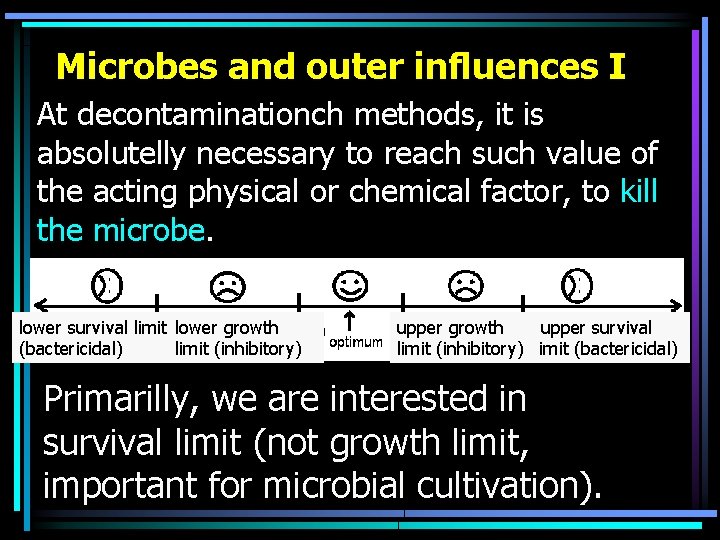
Microbes and outer influences I At decontaminationch methods, it is absolutelly necessary to reach such value of the acting physical or chemical factor, to kill the microbe. lower survival limit lower growth (bactericidal) limit (inhibitory) upper growth upper survival limit (inhibitory) limit (bactericidal) Primarilly, we are interested in survival limit (not growth limit, important for microbial cultivation).
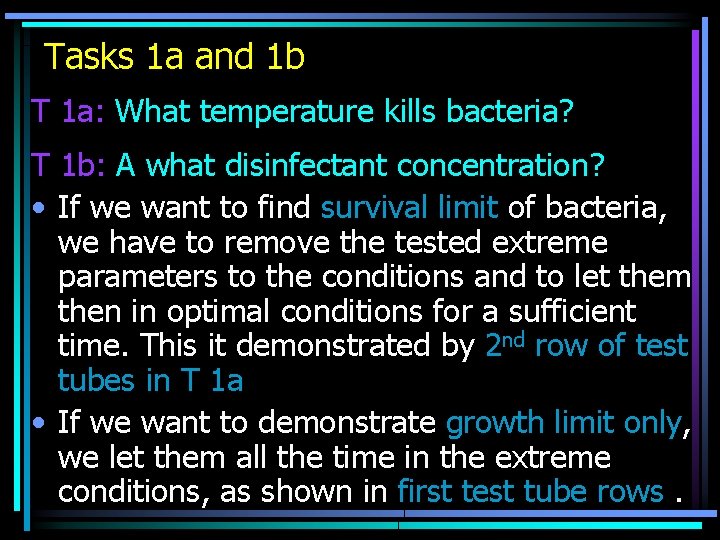
Tasks 1 a and 1 b T 1 a: What temperature kills bacteria? T 1 b: A what disinfectant concentration? • If we want to find survival limit of bacteria, we have to remove the tested extreme parameters to the conditions and to let them then in optimal conditions for a sufficient time. This it demonstrated by 2 nd row of test tubes in T 1 a • If we want to demonstrate growth limit only, we let them all the time in the extreme conditions, as shown in first test tube rows.
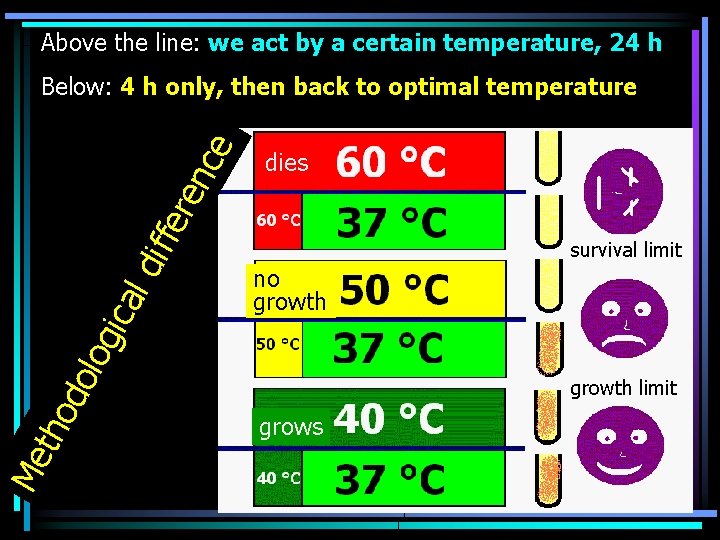
Above the line: we act by a certain temperature, 24 h dies survival limit no growth Me tho do log ica l di ffe ren ce Below: 4 h only, then back to optimal temperature growth limit grows
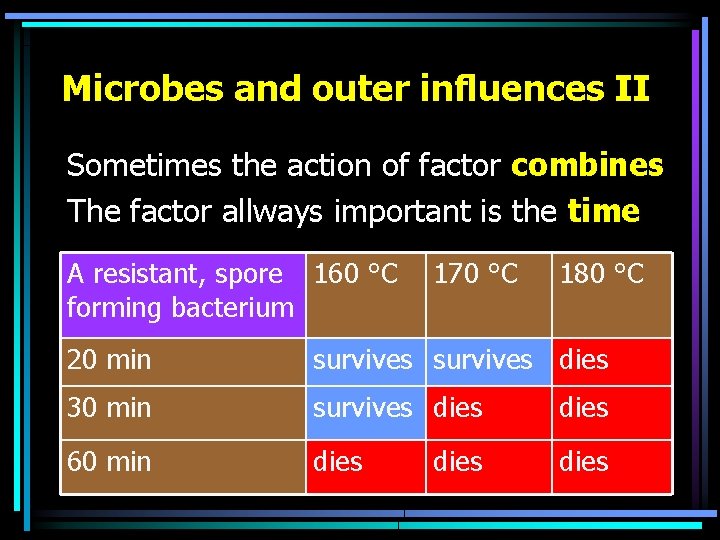
Microbes and outer influences II Sometimes the action of factor combines The factor allways important is the time A resistant, spore 160 °C forming bacterium 170 °C 180 °C 20 min survives dies 30 min survives dies 60 min dies
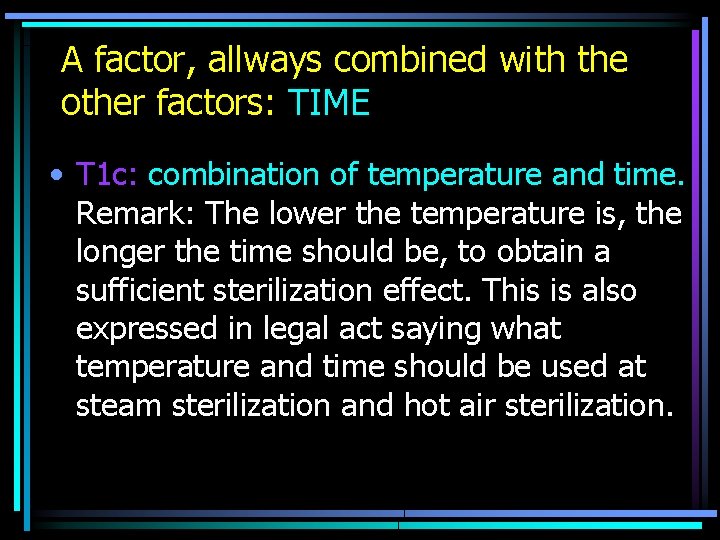
A factor, allways combined with the other factors: TIME • T 1 c: combination of temperature and time. Remark: The lower the temperature is, the longer the time should be, to obtain a sufficient sterilization effect. This is also expressed in legal act saying what temperature and time should be used at steam sterilization and hot air sterilization.
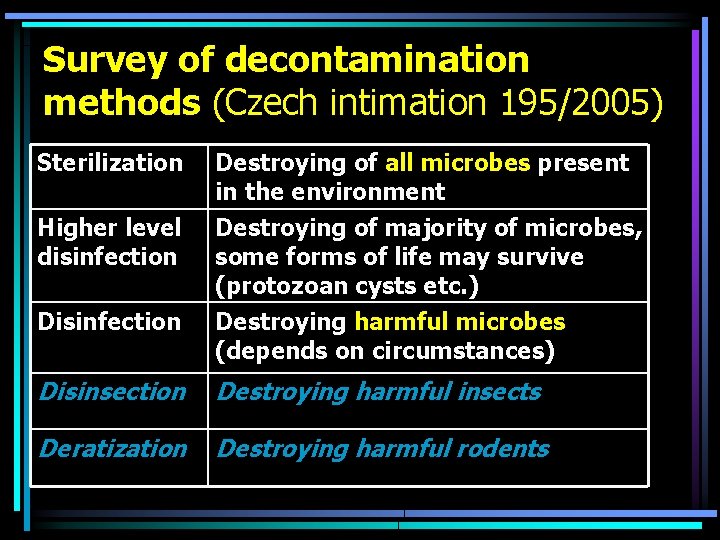
Survey of decontamination methods (Czech intimation 195/2005) Sterilization Destroying of all microbes present in the environment Higher level disinfection Destroying of majority of microbes, some forms of life may survive (protozoan cysts etc. ) Destroying harmful microbes (depends on circumstances) Disinfection Disinsection Destroying harmful insects Deratization Destroying harmful rodents
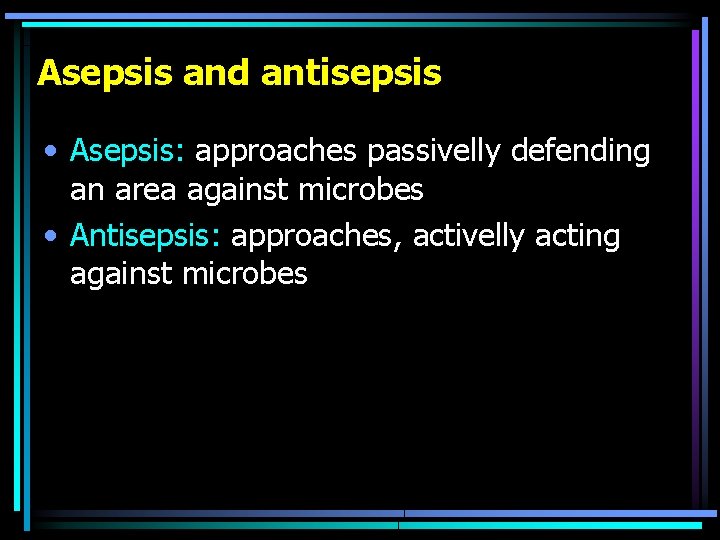
Asepsis and antisepsis • Asepsis: approaches passivelly defending an area against microbes • Antisepsis: approaches, activelly acting against microbes
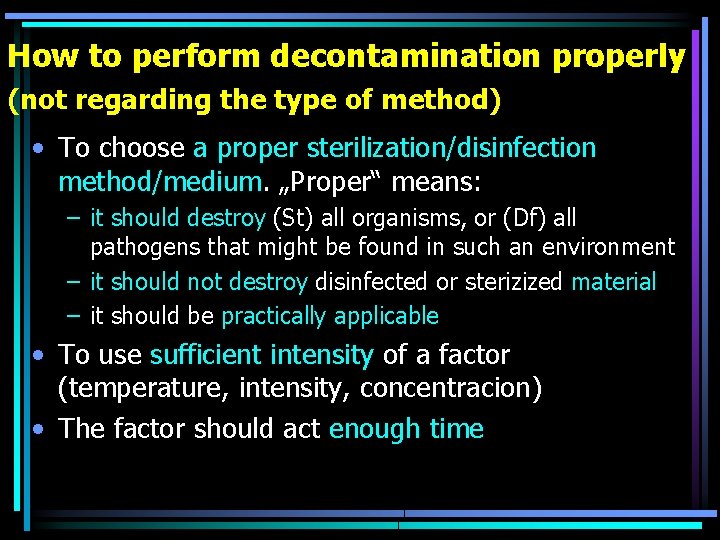
How to perform decontamination properly (not regarding the type of method) • To choose a proper sterilization/disinfection method/medium. „Proper“ means: – it should destroy (St) all organisms, or (Df) all pathogens that might be found in such an environment – it should not destroy disinfected or sterizized material – it should be practically applicable • To use sufficient intensity of a factor (temperature, intensity, concentracion) • The factor should act enough time
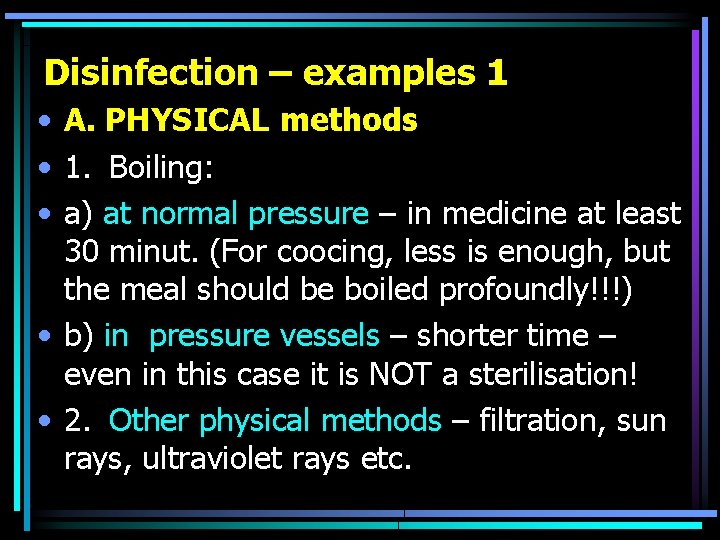
Disinfection – examples 1 • A. PHYSICAL methods • 1. Boiling: • a) at normal pressure – in medicine at least 30 minut. (For coocing, less is enough, but the meal should be boiled profoundly!!!) • b) in pressure vessels – shorter time – even in this case it is NOT a sterilisation! • 2. Other physical methods – filtration, sun rays, ultraviolet rays etc.
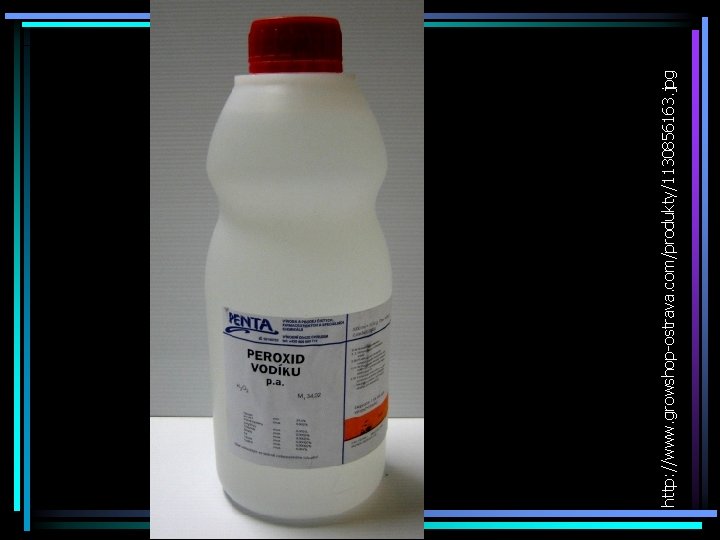
Disinfection – examples 2 • B. DISINFECTANTS • Oxidation reagents • 3. Peroxides: peracetic acid (CH 3 COOOH, in Czechia Persteril). For spores, fungi, and tuberculosis; 0, 5% solution = higher level disinfection. Disadvantage: agressivity, decoloration of textils, instability of solutions • 4. Hydrogen peroxide (H 2 O 2) – simillar, less agressive, but also less effective
http: //www. growshop-ostrava. com/produkty/1130856163. jpg
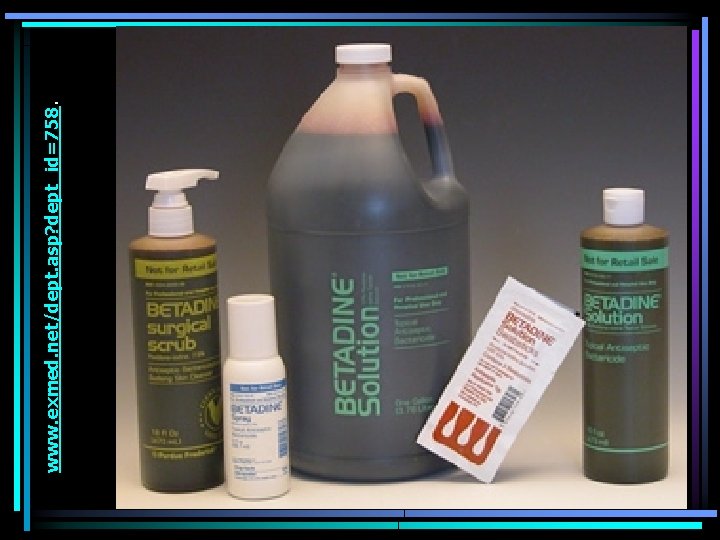
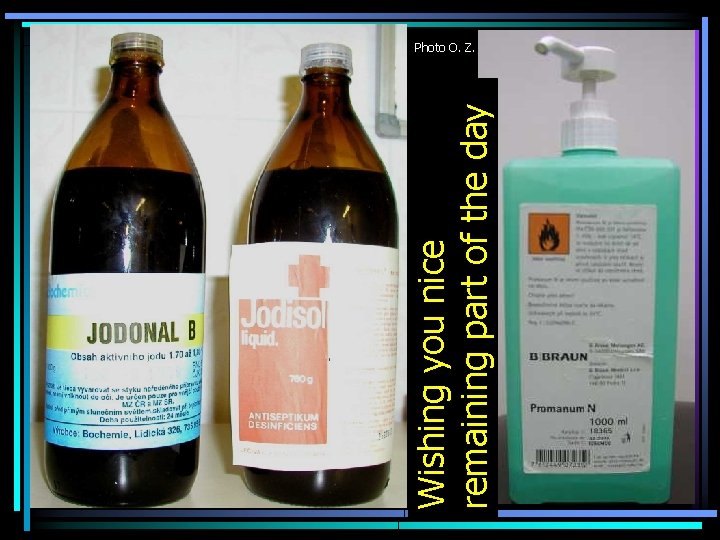
Disinfection – examples 3 • 5. Halogen preparations – hypochloates: – sodium hypochlorate (Na. OCl), u nás Savo – calcium hypochlorate (Ca(OCl)2 • 6. Chloramin (Chloramin B in Czechia). • 7. Iodine solutions (in Czechia mostly Jodonal B, Jodisol and Betadine). Unlike ancient iodine tincture, iodine is bound in a komplex. At non-alergic pacients iodine preparations should be used rather than detergents (Ajatin)
www. exmed. net/dept. asp? dept_id=758.
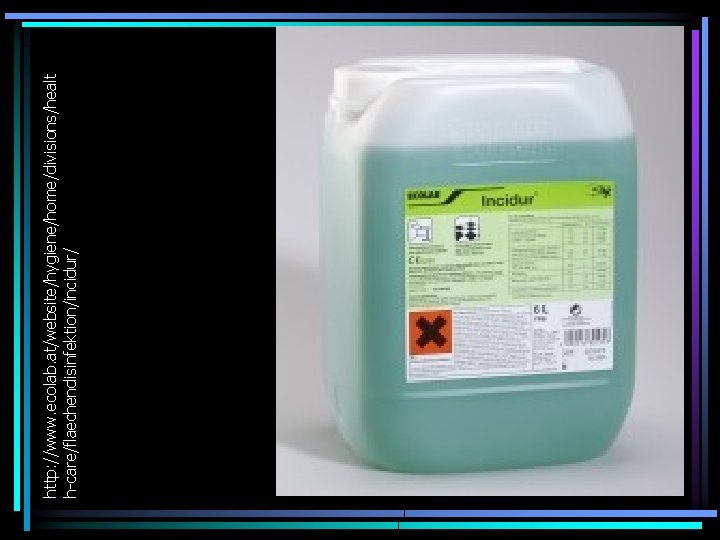
Disinfection – examples 4 • 8. Kalium permanganate has no more use. • 9. Formaldehyde – in mixtures • 10. Kresol (lysol) is effective, but for aggresivity and bad smell not used at all • 11. Ethylalcohol – in mixtures; alone not enough effectifity; the most effective is 70 % solution • 12. Detergents: Orthosan BF 12 • 13. Ajatin – for skin disinfection • 14. Septonex – rather an antiseptic. • 15. Anorganic acids and hydroxydes, heavy metals • 16. Combined agents, e. g. Incidur
http: //www. ecolab. at/website/hygiene/home/divisions/healt h-care/flaechendisinfektion/incidur/
Watch a nice video „Disinfection“! It is a litle bit ancient and in Czech, but nice!
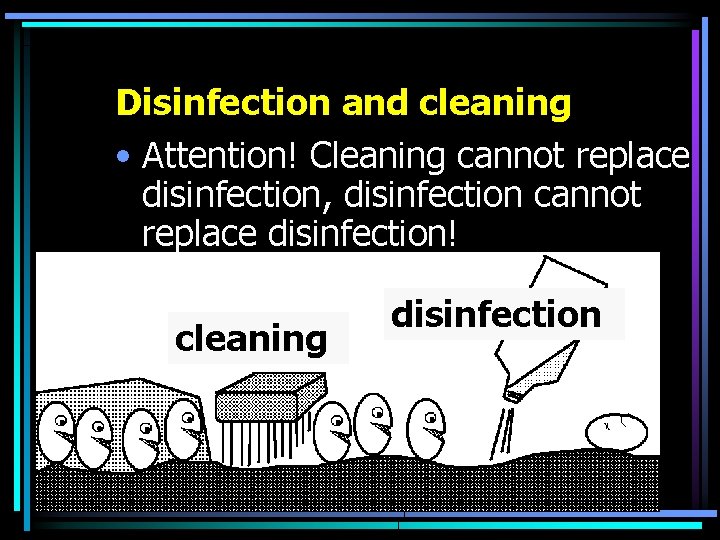
Disinfection and cleaning • Attention! Cleaning cannot replace disinfection, disinfection cannot replace disinfection! cleaning disinfection
Higher level disinfection • „Something between sterilization and disinfection“ • It is not sterilization, because protozoan cysts and helming eggs are not always destroyed. • Glutaraldehyde, Secusept or Persteril • Concentration always higher then for common disinfection • For flexible endoscopes, where no sterilization methods can be used.
Sterilization – examples I • 1. Hot steam sterilization under pressure. Steam should be just saturated. It is suitable for objects made of glass, metal, ceramics, china, textile, rubber and some plastics. Temperatures 121 – 134 °C. (No more 115 °C!) • 2. Hot air sterilization (in apparates with artificial air circulation 180 °C 20 min or 170 °C 30 min or 160 °C an hour). For metal, glass, china. • 3. Hot water sterilization under pressure – not used anymore
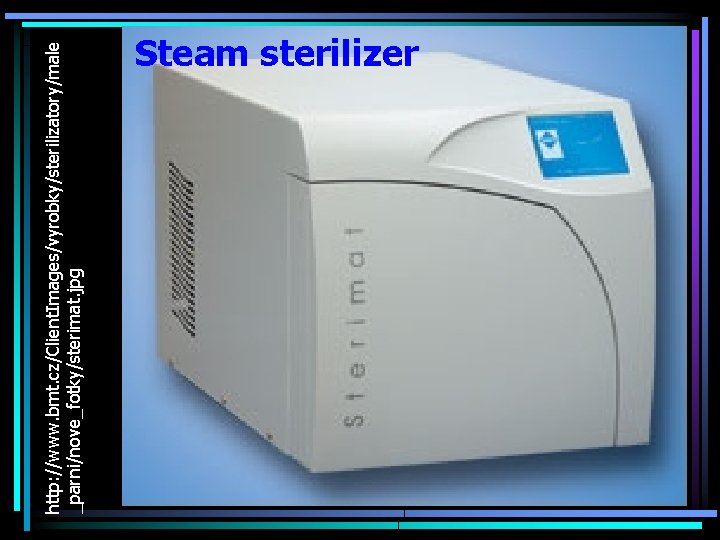
http: //www. bmt. cz/Client. Images/vyrobky/sterilizatory/male _parni/nove_fotky/sterimat. jpg Steam sterilizer
Sterilization – examples II • 4. Gamma ray sterilization: in industrial production, e. g. for single use gloves. • 5. Plasma sterilization in high-frequency electromagnetic field (a modern method) • 6. Chemical sterilization by vapors of formaldehyde or by ethylenoxide (the procedure should be peformed according to the shedule). In situations disabling use of physical methods.
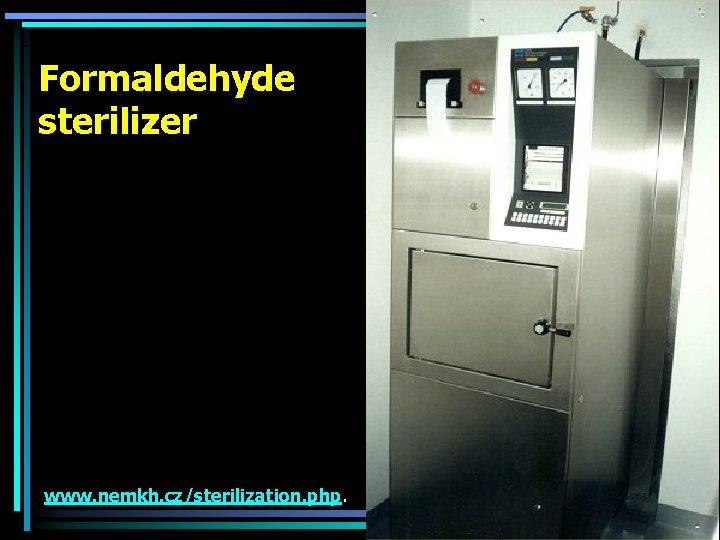
Formaldehyde sterilizer www. nemkh. cz/sterilization. php.
Sterilization – examples III (not in health care) • 7. Fire sterilization for microbiological loops only. Incineration for waste. • 8. Pascalisation is a pressure sterilization, used in alimentary industr • 9. Other methods: fractionated sterilization, solution filtration etc. , used exceptionally
Practical choice of a suitable method • When choosing suitable sterilization methods, you allways have to think about suitability of the methods is given by material resistance to various temperature, humidity, chemicals and other factors • In all methods, you have to asses the appropriate temperature (in °C), radiation dose (in units called „Gray“), and of course, always time!
Before and after decontamination • Before decontamination often preparation is necessary – mechanical cleaning, ensuring of a proper process. All the procedures take part in legal acts concerning decontamination methods • After decontamination often some steps should be done (e. g. let the remaining gases to flow out). It is necessary to keep rules for storage of decontaminated objects. • Storage of decontaminated objects (exspiration) is described in intimations, too.
Checing up, whether sterilisation was done, and its quality assessment • Orientation checking up – e. g. by typical smelling • Assessment of real concentration of disinfectants (chemically) • Chemical check up of sterilization uses indicators that change colour at a certain temperature • Biological way uses resistant strains of Bacillus genus. These absolve the whole cycle and then their survival is assessed.
Practical tasks – effectivity check up • Task 3 a: you have five disinfectants: – Peracetic acid – Ajatin – Jodonal B – Chloramin B – Promanum (alcohol disinfectants for hands) • Task 3 b, c: did the microbes survive a normal sterilization cycle, and did then grow when being put back to optimal conditions? • Task 3 d: what surfaces are sterile?
Wishing you nice remaining part of the day Photo O. Z.
- Slides: 35