
Searching And Sorting In this section of notes
![The Driver Class (2) if (args. length == 1) { if (args[0]. equals("-on")) {](https://slidetodoc.com/presentation_image_h2/b2edce5f06cf64fd3b75ca84a53abca6/image-10.jpg "The Driver Class (2) if (args. length == 1) { if (args[0]. equals(\"-on\")) {")
![Class Search public class Search { private int [] list; private Random generator; James](https://slidetodoc.com/presentation_image_h2/b2edce5f06cf64fd3b75ca84a53abca6/image-13.jpg "Class Search public class Search { private int [] list; private Random generator; James")
![An Example Binary Search: The Search Class public class Search { private int []](https://slidetodoc.com/presentation_image_h2/b2edce5f06cf64fd3b75ca84a53abca6/image-28.jpg "An Example Binary Search: The Search Class public class Search { private int []")
![An Example Binary Search: The Search Class (6) if (key == list[high]) return high;](https://slidetodoc.com/presentation_image_h2/b2edce5f06cf64fd3b75ca84a53abca6/image-32.jpg "An Example Binary Search: The Search Class (6) if (key == list[high]) return high;")
![The Search Class public class Search { private int [] list; private int size;](https://slidetodoc.com/presentation_image_h2/b2edce5f06cf64fd3b75ca84a53abca6/image-39.jpg "The Search Class public class Search { private int [] list; private int size;")
![The Search Class (3) if (key == list[low]) return low; else return -1; }](https://slidetodoc.com/presentation_image_h2/b2edce5f06cf64fd3b75ca84a53abca6/image-41.jpg "The Search Class (3) if (key == list[low]) return low; else return -1; }")
![An Example Of A Bubble Sort: Class Driver (4) else if (args[1]. equals("-a")) {](https://slidetodoc.com/presentation_image_h2/b2edce5f06cf64fd3b75ca84a53abca6/image-51.jpg "An Example Of A Bubble Sort: Class Driver (4) else if (args[1]. equals(\"-a\")) {")
![Class Sort public class Sort { private int [] list; public static final int](https://slidetodoc.com/presentation_image_h2/b2edce5f06cf64fd3b75ca84a53abca6/image-76.jpg "Class Sort public class Sort { private int [] list; public static final int")
![Class Sort (5) list[j] = item. To. Insert; } // if condition (elements out](https://slidetodoc.com/presentation_image_h2/b2edce5f06cf64fd3b75ca84a53abca6/image-80.jpg "Class Sort (5) list[j] = item. To. Insert; } // if condition (elements out")
![Class Sort public class Sort { private int [] list; public static final int](https://slidetodoc.com/presentation_image_h2/b2edce5f06cf64fd3b75ca84a53abca6/image-94.jpg "Class Sort public class Sort { private int [] list; public static final int")
![Class Sort (8) while (first 1 <= last 1) { temp[index] = list[first 1];](https://slidetodoc.com/presentation_image_h2/b2edce5f06cf64fd3b75ca84a53abca6/image-101.jpg "Class Sort (8) while (first 1 <= last 1) { temp[index] = list[first 1];")
![Class Sort public class Sort { private int [] list; public static final int](https://slidetodoc.com/presentation_image_h2/b2edce5f06cf64fd3b75ca84a53abca6/image-107.jpg "Class Sort public class Sort { private int [] list; public static final int")
![Class Sort (5) while (done == false) { while (list[index. From. Left] < pivot)](https://slidetodoc.com/presentation_image_h2/b2edce5f06cf64fd3b75ca84a53abca6/image-111.jpg "Class Sort (5) while (done == false) { while (list[index. From. Left] < pivot)")
- Slides: 115
Searching And Sorting • In this section of notes you will learn about different search and sort algorithms James Tam
How To Succeed In This Course • Practice things yourself. - Write programs (attempt all assignments) - Trace lots of code Leonardo da Vinci J. R. R. Tolkien Bruce Lee Amadeus Mozart Wayne Gretzky James Tam
Read Up The Material Ahead Of Time • Read through the relevant parts of the book • Trace through code examples James Tam
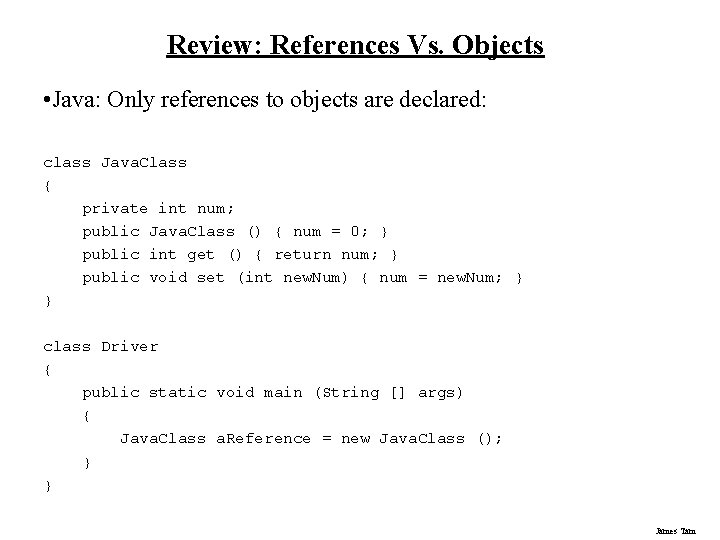
Review: References Vs. Objects • Java: Only references to objects are declared: class Java. Class { private int num; public Java. Class () { num = 0; } public int get () { return num; } public void set (int new. Num) { num = new. Num; } } class Driver { public static void main (String [] args) { Java. Class a. Reference = new Java. Class (); } } James Tam
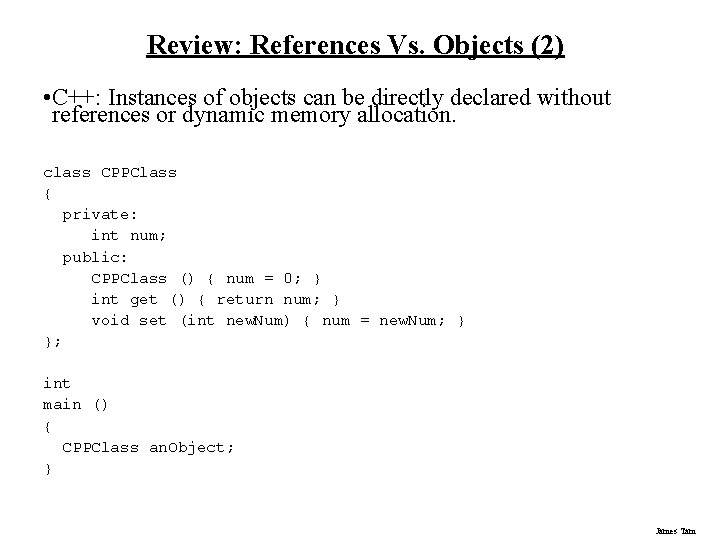
Review: References Vs. Objects (2) • C++: Instances of objects can be directly declared without references or dynamic memory allocation. class CPPClass { private: int num; public: CPPClass () { num = 0; } int get () { return num; } void set (int new. Num) { num = new. Num; } }; int main () { CPPClass an. Object; } James Tam
Typical Searching And Sorting Operations • Swaps • Moves • Compares James Tam
Search Algorithms 1. Sequential search 2. Binary search 3. Interpolation search James Tam
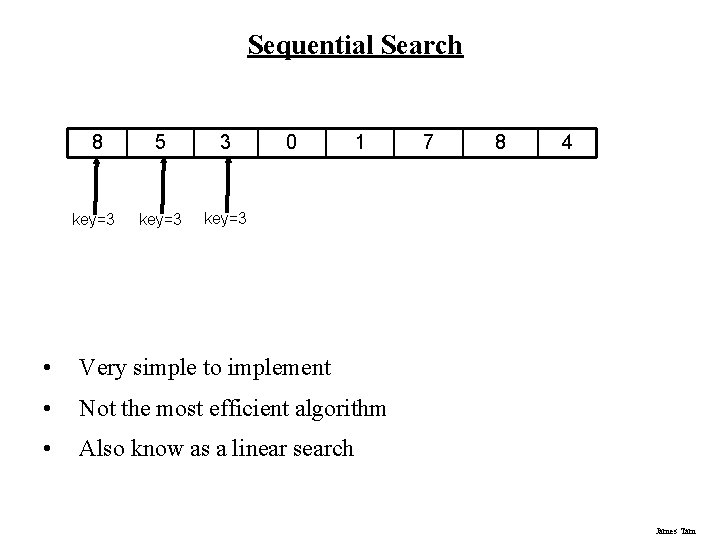
Sequential Search 8 5 3 key=3 0 1 • Very simple to implement • Not the most efficient algorithm • Also know as a linear search 7 8 4 James Tam
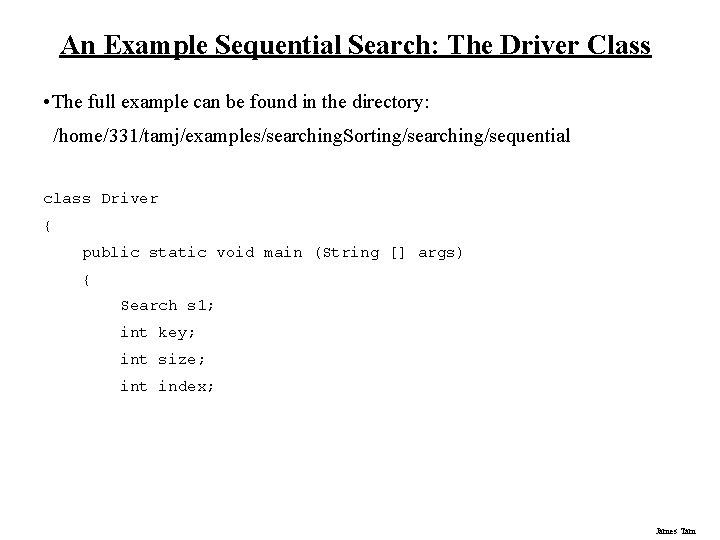
An Example Sequential Search: The Driver Class • The full example can be found in the directory: /home/331/tamj/examples/searching. Sorting/searching/sequential class Driver { public static void main (String [] args) { Search s 1; int key; int size; int index; James Tam
The Driver Class (2) if (args. length == 1) { if (args[0]. equals("-on")) { Debug. on = true; } else if (args[0]. equals("-off")) { Debug. on = false; } else { System. out. println("Usage: java Driver [-on/off]"); System. exit(-1); } } else if (args. length > 1) { System. out. println("Usage: java Driver [-on/-off]"); System. exit(-1); James Tam
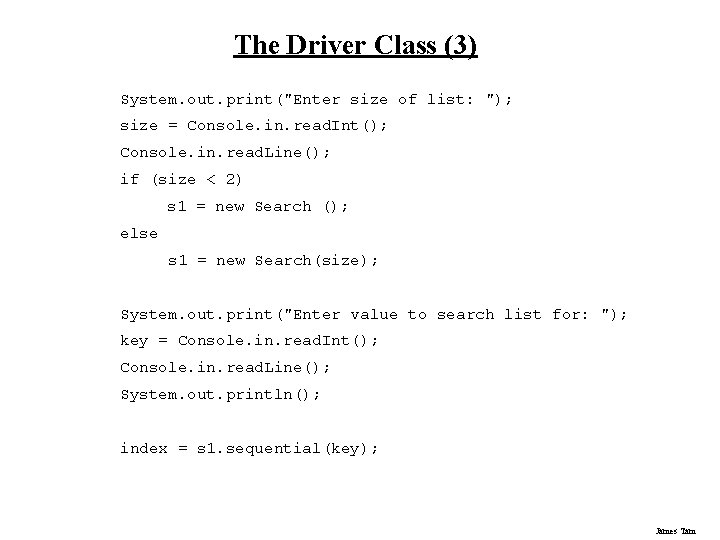
The Driver Class (3) System. out. print("Enter size of list: "); size = Console. in. read. Int(); Console. in. read. Line(); if (size < 2) s 1 = new Search (); else s 1 = new Search(size); System. out. print("Enter value to search list for: "); key = Console. in. read. Int(); Console. in. read. Line(); System. out. println(); index = s 1. sequential(key); James Tam
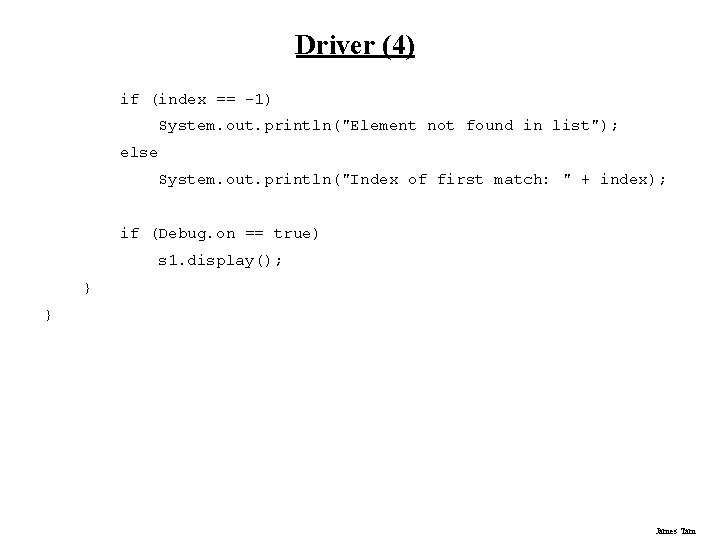
Driver (4) if (index == -1) System. out. println("Element not found in list"); else System. out. println("Index of first match: " + index); if (Debug. on == true) s 1. display(); } } James Tam
Class Search public class Search { private int [] list; private Random generator; James Tam
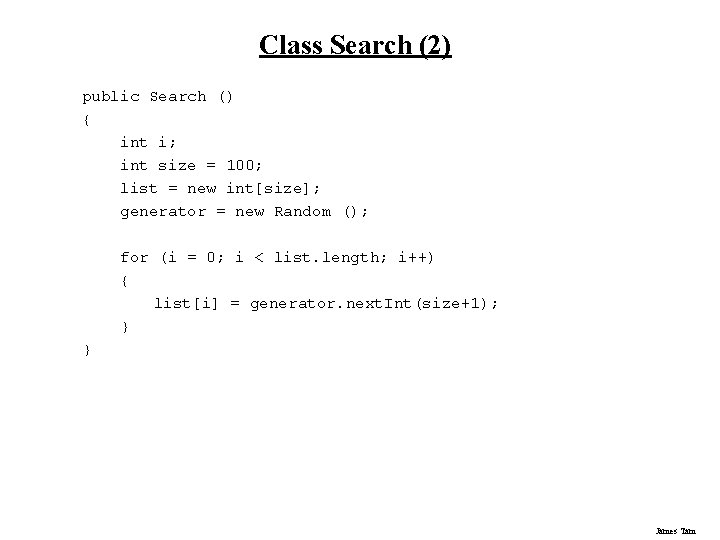
Class Search (2) public Search () { int i; int size = 100; list = new int[size]; generator = new Random (); for (i = 0; i < list. length; i++) { list[i] = generator. next. Int(size+1); } } James Tam
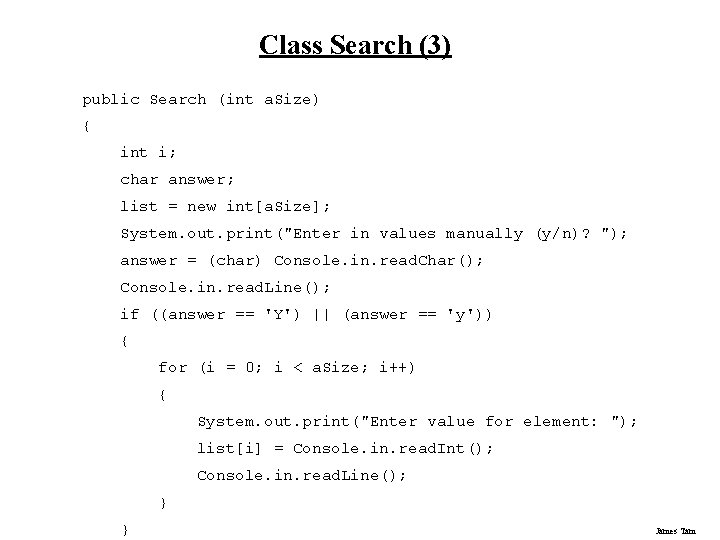
Class Search (3) public Search (int a. Size) { int i; char answer; list = new int[a. Size]; System. out. print("Enter in values manually (y/n)? "); answer = (char) Console. in. read. Char(); Console. in. read. Line(); if ((answer == 'Y') || (answer == 'y')) { for (i = 0; i < a. Size; i++) { System. out. print("Enter value for element: "); list[i] = Console. in. read. Int(); Console. in. read. Line(); } } James Tam
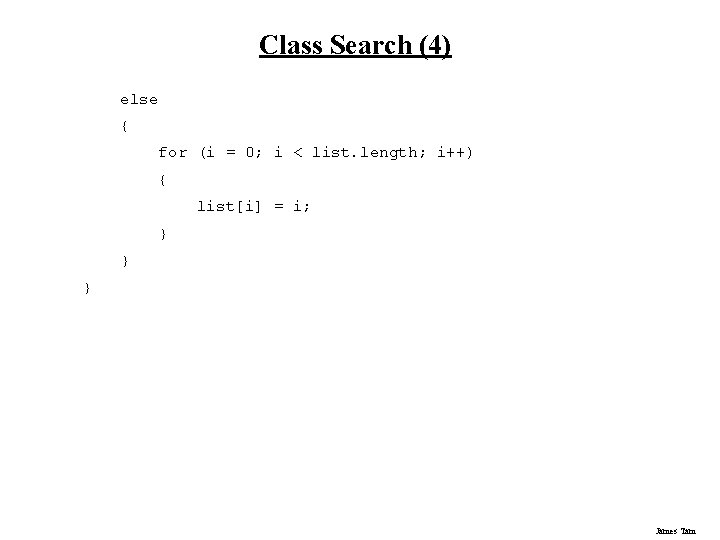
Class Search (4) else { for (i = 0; i < list. length; i++) { list[i] = i; } } } James Tam
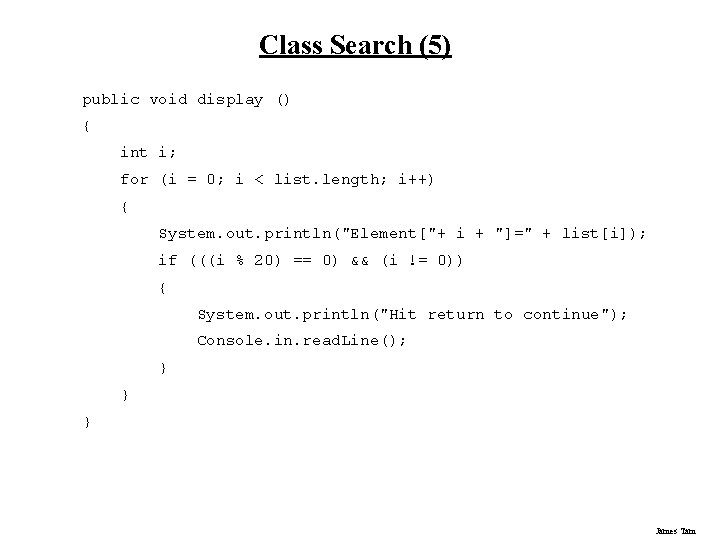
Class Search (5) public void display () { int i; for (i = 0; i < list. length; i++) { System. out. println("Element["+ i + "]=" + list[i]); if (((i % 20) == 0) && (i != 0)) { System. out. println("Hit return to continue"); Console. in. read. Line(); } } } James Tam
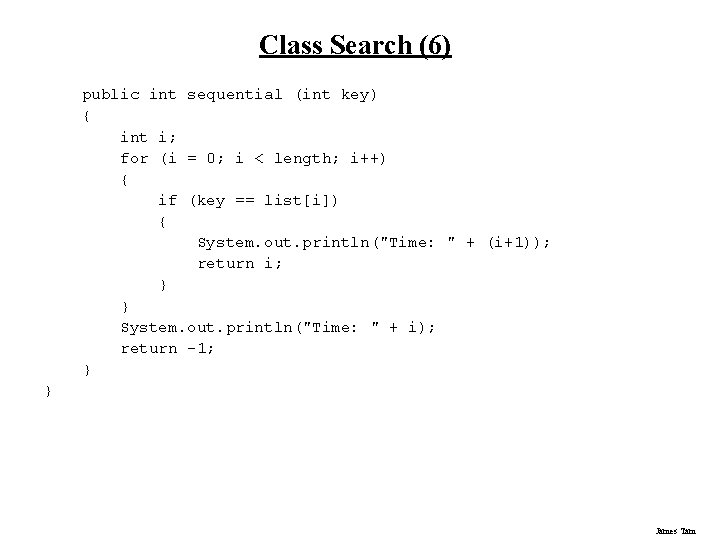
Class Search (6) public int sequential (int key) { int i; for (i = 0; i < length; i++) { if (key == list[i]) { System. out. println("Time: " + (i+1)); return i; } } System. out. println("Time: " + i); return -1; } } James Tam
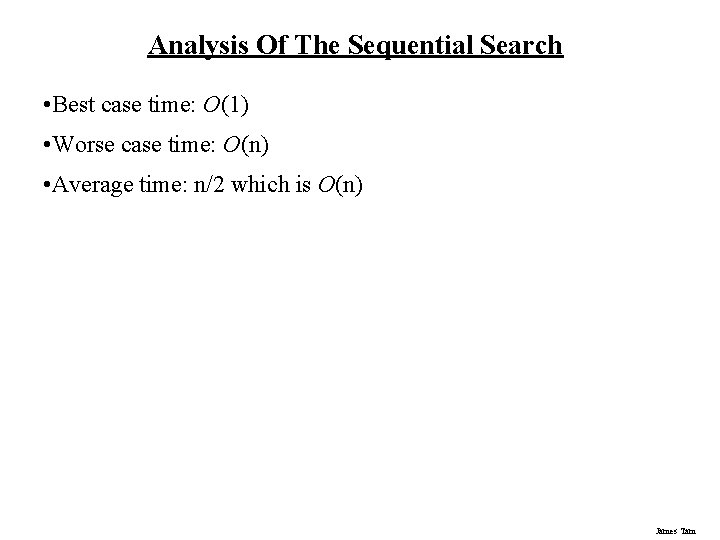
Analysis Of The Sequential Search • Best case time: O(1) • Worse case time: O(n) • Average time: n/2 which is O(n) James Tam
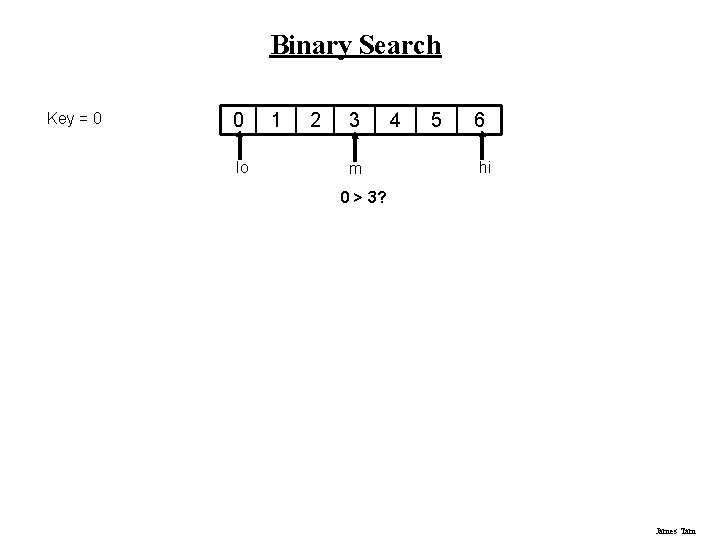
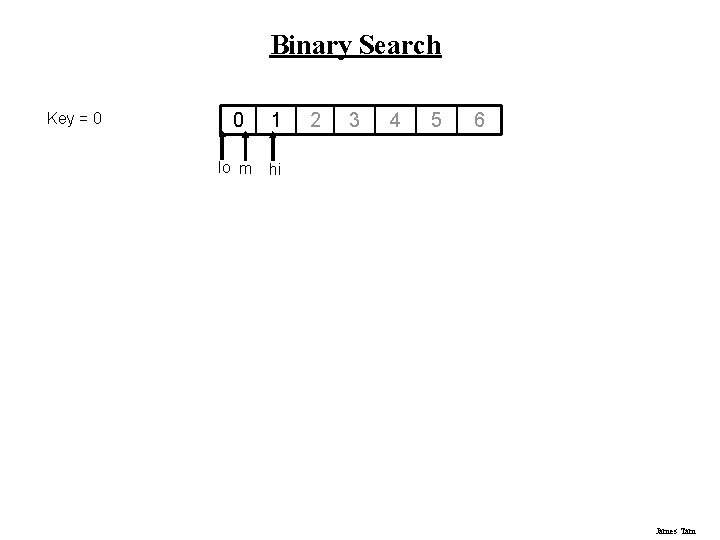
Binary Search Key = 0 0 lo 1 2 3 m 4 5 6 hi 0 > 3? James Tam
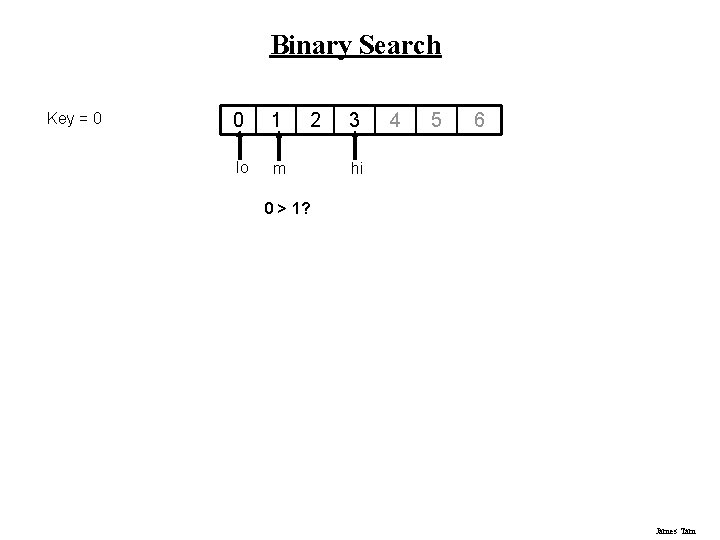
Binary Search Key = 0 0 1 lo m 2 3 4 5 6 hi 0 > 1? James Tam
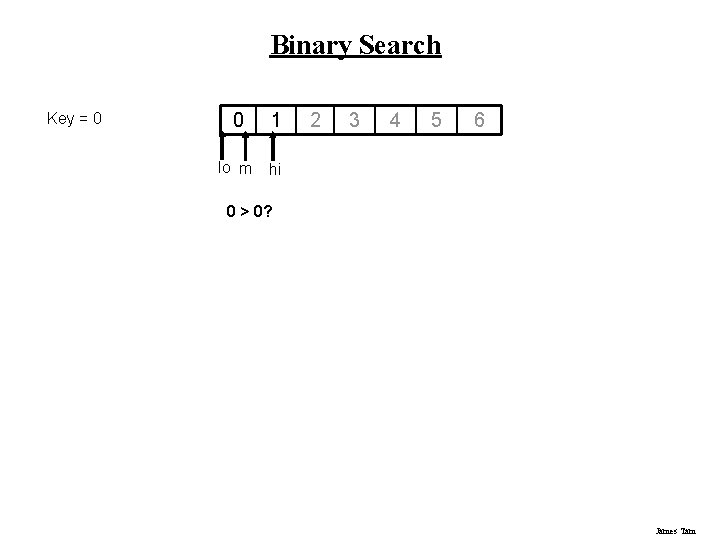
Binary Search Key = 0 0 1 lo m hi 2 3 4 5 6 0 > 0? James Tam
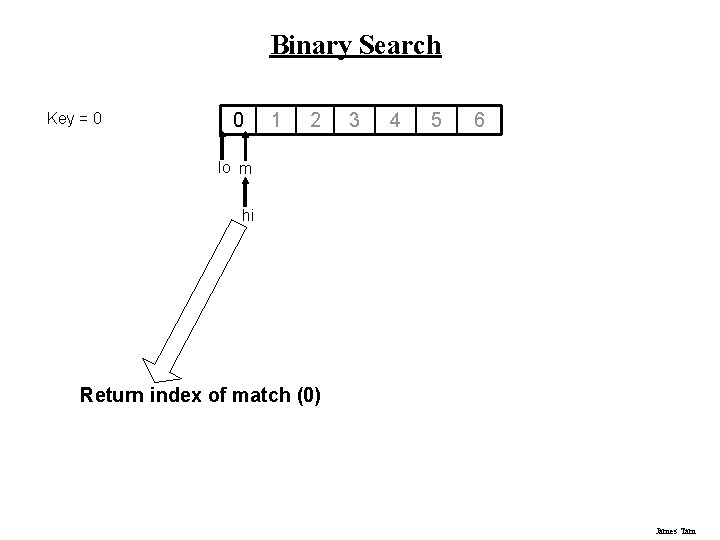
Binary Search Key = 0 0 1 lo m hi 2 3 4 5 6 James Tam
Binary Search Key = 0 0 1 2 3 4 5 6 lo m hi Return index of match (0) James Tam
Binary Search • A little tougher to implement than a sequential search • More efficient than a sequential search but the data must first be sorted. James Tam
An Example Binary Search: The Driver Class • The full example can be found in the directory: /home/331/tamj/examples/searching. Sorting/searching/binary class Driver { public static void main (String [] args) { Search s 1; int key; int size; int index; James Tam
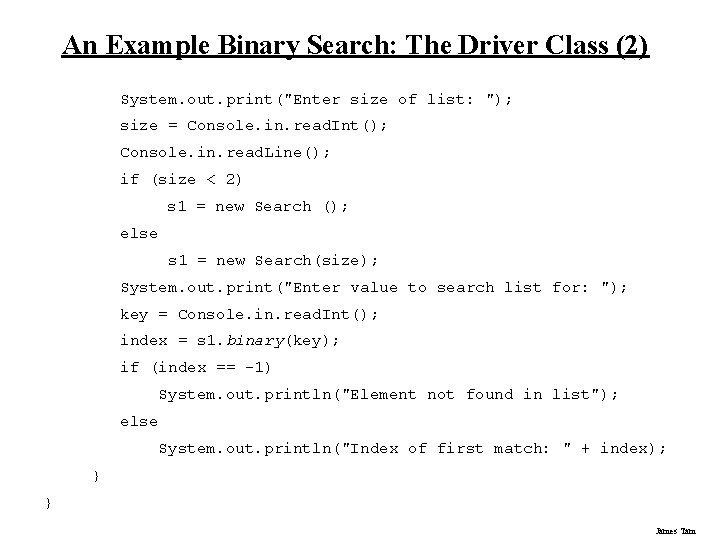
An Example Binary Search: The Driver Class (2) System. out. print("Enter size of list: "); size = Console. in. read. Int(); Console. in. read. Line(); if (size < 2) s 1 = new Search (); else s 1 = new Search(size); System. out. print("Enter value to search list for: "); key = Console. in. read. Int(); index = s 1. binary(key); if (index == -1) System. out. println("Element not found in list"); else System. out. println("Index of first match: " + index); } } James Tam
An Example Binary Search: The Search Class public class Search { private int [] list; private Random generator; public Search () { int i; int size = 100; list = new int[size]; for (i = 0; i < list. length; i++) { list[i] = i; } } James Tam
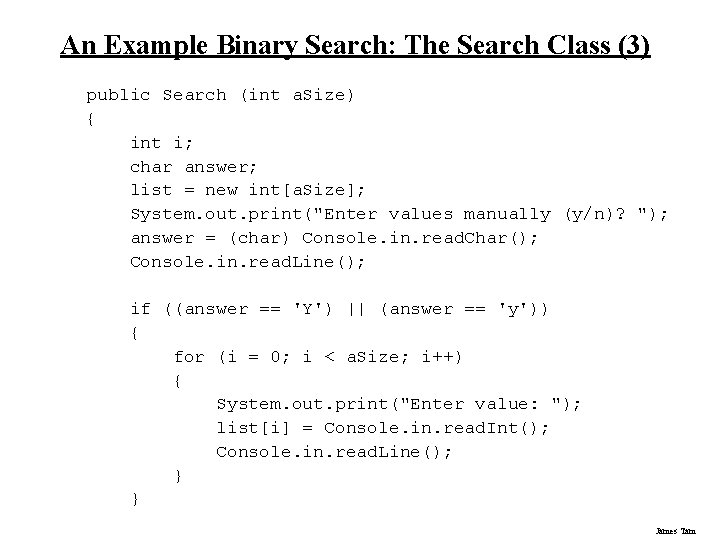
An Example Binary Search: The Search Class (3) public Search (int a. Size) { int i; char answer; list = new int[a. Size]; System. out. print("Enter values manually (y/n)? "); answer = (char) Console. in. read. Char(); Console. in. read. Line(); if ((answer == 'Y') || (answer == 'y')) { for (i = 0; i < a. Size; i++) { System. out. print("Enter value: "); list[i] = Console. in. read. Int(); Console. in. read. Line(); } } James Tam
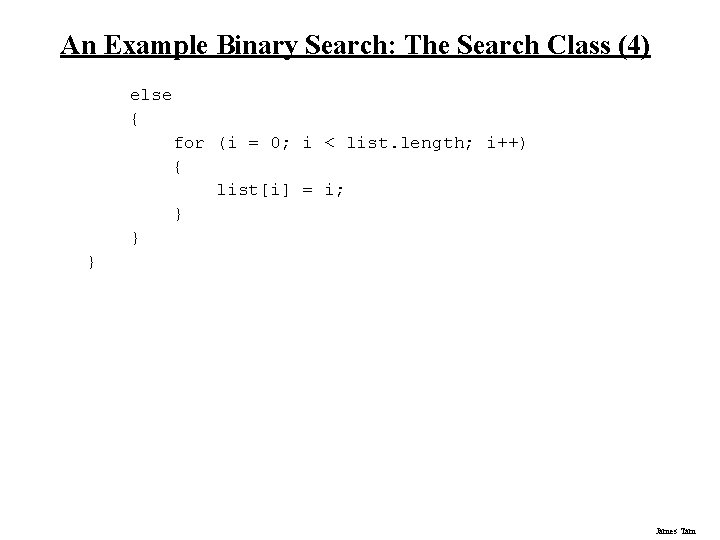
An Example Binary Search: The Search Class (4) else { for (i = 0; i < list. length; i++) { list[i] = i; } } } James Tam
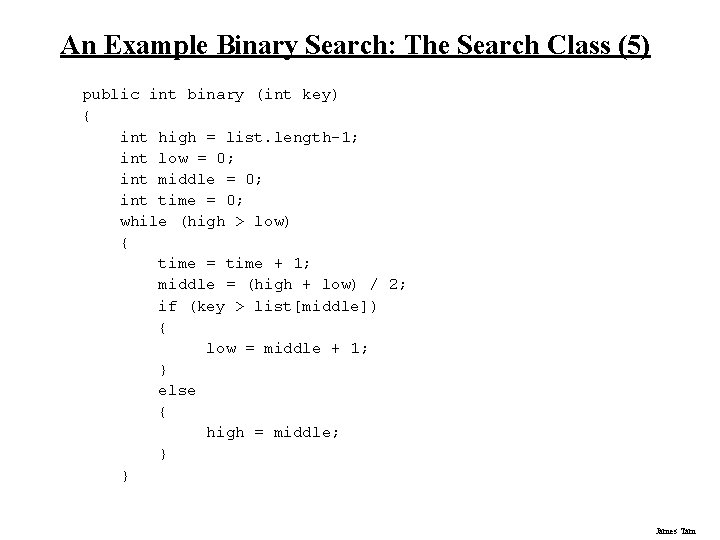
An Example Binary Search: The Search Class (5) public int binary (int key) { int high = list. length-1; int low = 0; int middle = 0; int time = 0; while (high > low) { time = time + 1; middle = (high + low) / 2; if (key > list[middle]) { low = middle + 1; } else { high = middle; } } James Tam
An Example Binary Search: The Search Class (6) if (key == list[high]) return high; else return -1; } } James Tam
Analysis Of The Binary Search • Best case time: O(log 2 n) • Worse case time: O(log 2 n) • Average time: which is O(log 2 n) • However a binary search requires that the list is already sorted. James Tam
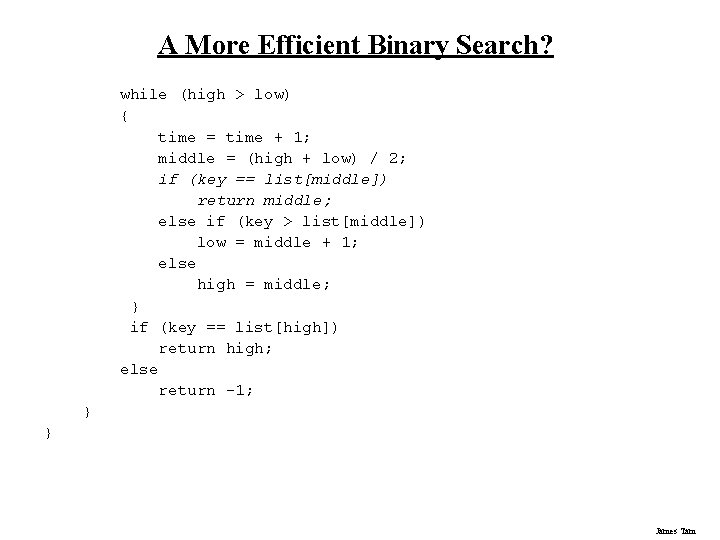
A More Efficient Binary Search? while (high > low) { time = time + 1; middle = (high + low) / 2; if (key == list[middle]) return middle; else if (key > list[middle]) low = middle + 1; else high = middle; } if (key == list[high]) return high; else return -1; } } James Tam
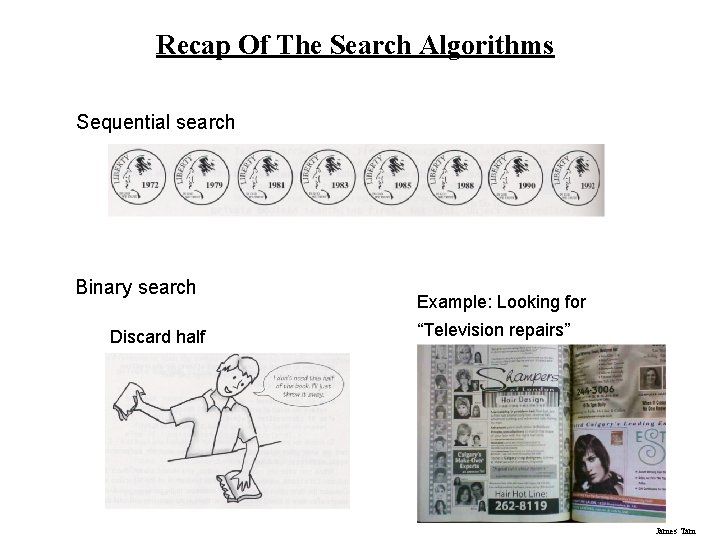
Recap Of The Search Algorithms Sequential search Binary search Discard half Example: Looking for “Television repairs” James Tam
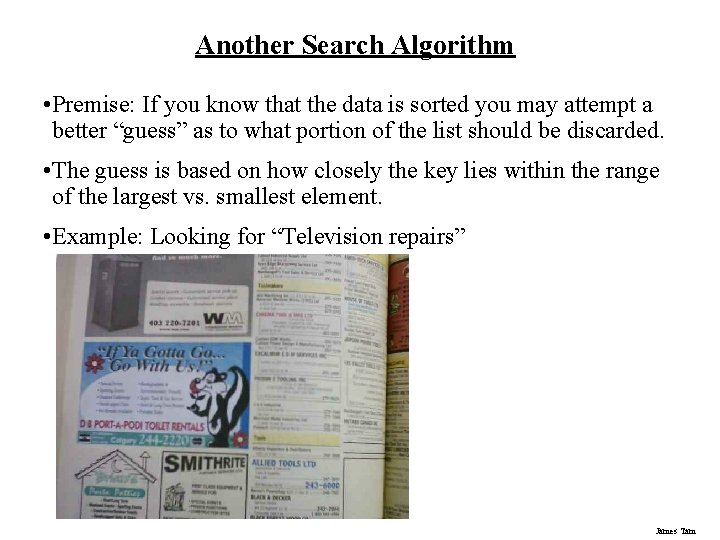
Another Search Algorithm • Premise: If you know that the data is sorted you may attempt a better “guess” as to what portion of the list should be discarded. • The guess is based on how closely the key lies within the range of the largest vs. smallest element. • Example: Looking for “Television repairs” James Tam
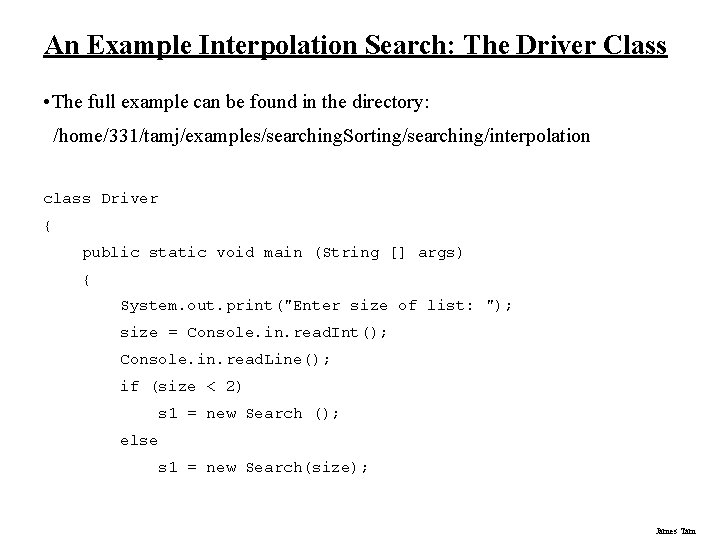
An Example Interpolation Search: The Driver Class • The full example can be found in the directory: /home/331/tamj/examples/searching. Sorting/searching/interpolation class Driver { public static void main (String [] args) { System. out. print("Enter size of list: "); size = Console. in. read. Int(); Console. in. read. Line(); if (size < 2) s 1 = new Search (); else s 1 = new Search(size); James Tam
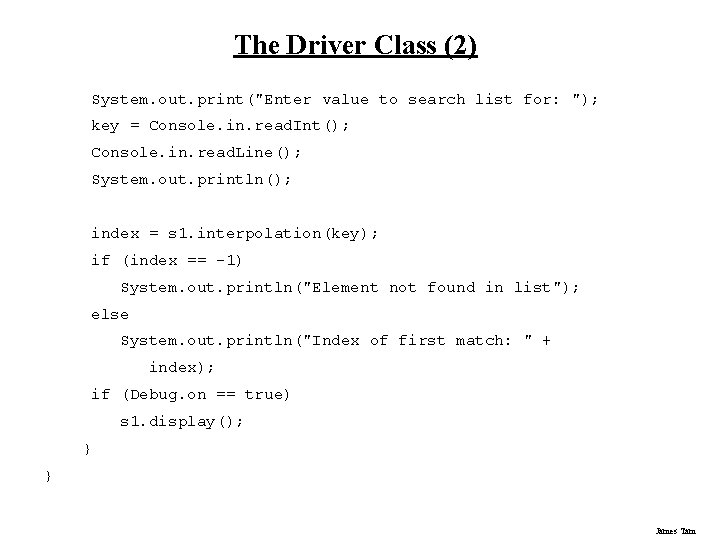
The Driver Class (2) System. out. print("Enter value to search list for: "); key = Console. in. read. Int(); Console. in. read. Line(); System. out. println(); index = s 1. interpolation(key); if (index == -1) System. out. println("Element not found in list"); else System. out. println("Index of first match: " + index); if (Debug. on == true) s 1. display(); } } James Tam
The Search Class public class Search { private int [] list; private int size; private Random generator; James Tam
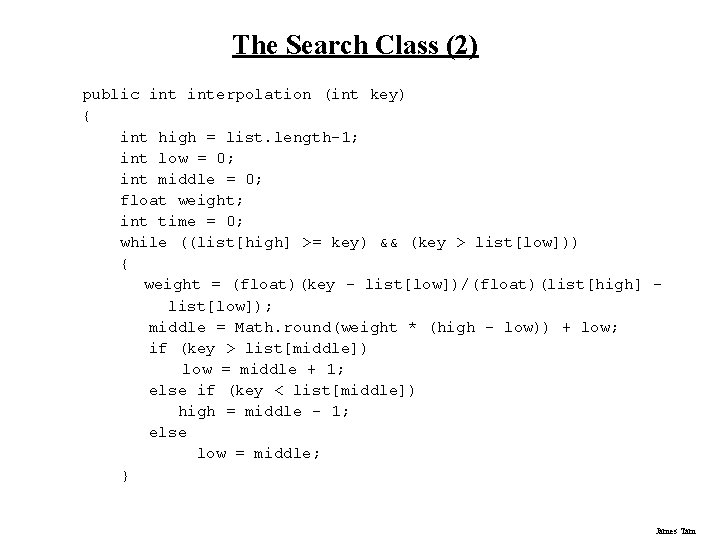
The Search Class (2) public interpolation (int key) { int high = list. length-1; int low = 0; int middle = 0; float weight; int time = 0; while ((list[high] >= key) && (key > list[low])) { weight = (float)(key - list[low])/(float)(list[high] list[low]); middle = Math. round(weight * (high - low)) + low; if (key > list[middle]) low = middle + 1; else if (key < list[middle]) high = middle - 1; else low = middle; } James Tam
The Search Class (3) if (key == list[low]) return low; else return -1; } } James Tam
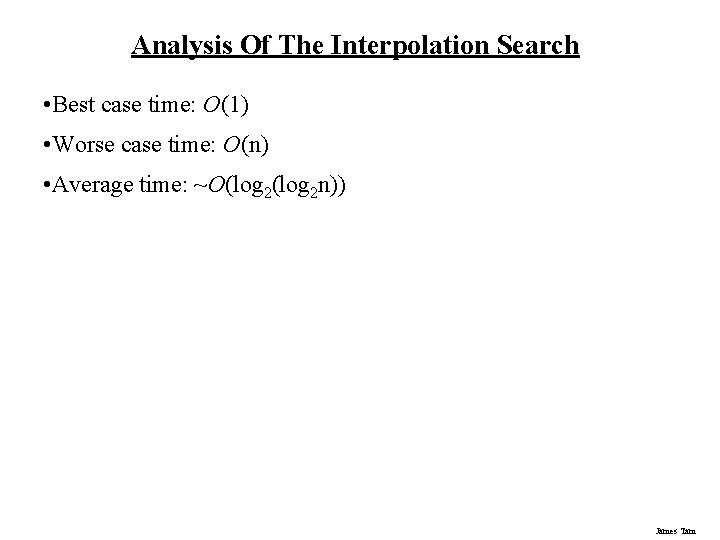
Analysis Of The Interpolation Search • Best case time: O(1) • Worse case time: O(n) • Average time: ~O(log 2 n)) James Tam
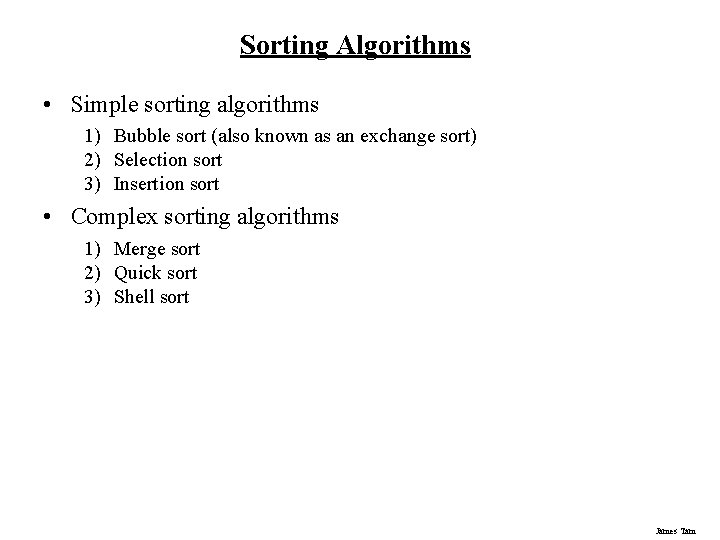
Sorting Algorithms • Simple sorting algorithms 1) Bubble sort (also known as an exchange sort) 2) Selection sort 3) Insertion sort • Complex sorting algorithms 1) Merge sort 2) Quick sort 3) Shell sort James Tam
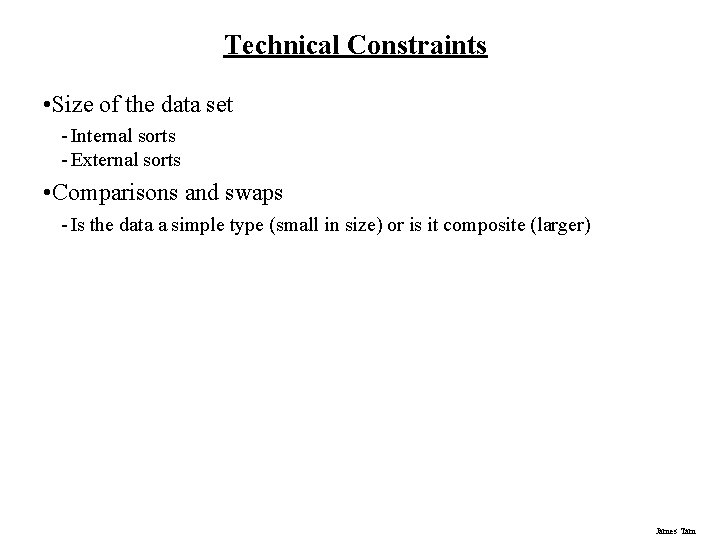
Technical Constraints • Size of the data set - Internal sorts - External sorts • Comparisons and swaps - Is the data a simple type (small in size) or is it composite (larger) James Tam
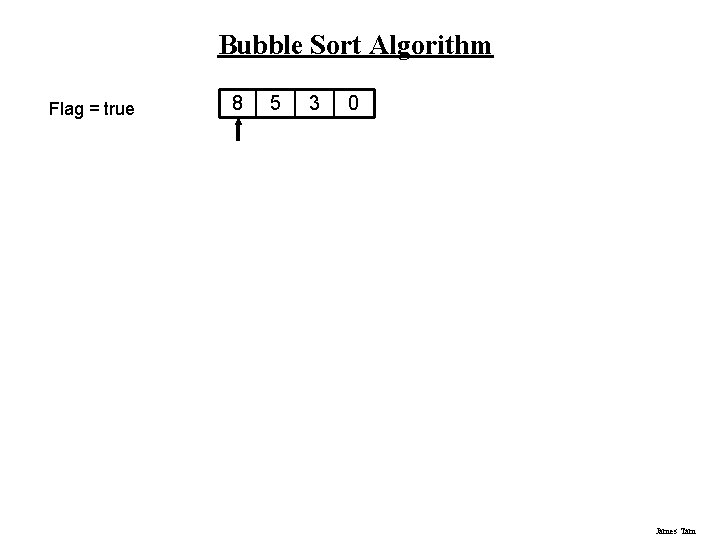
Bubble Sort Algorithm Flag = true 8 5 3 0 James Tam
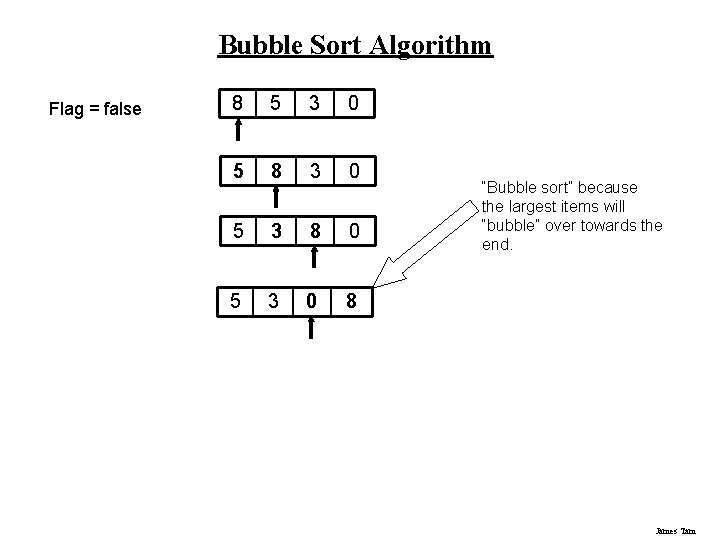
Bubble Sort Algorithm Flag = false 8 5 3 0 5 8 3 0 5 3 8 0 5 3 0 8 “Bubble sort” because the largest items will “bubble” over towards the end. James Tam
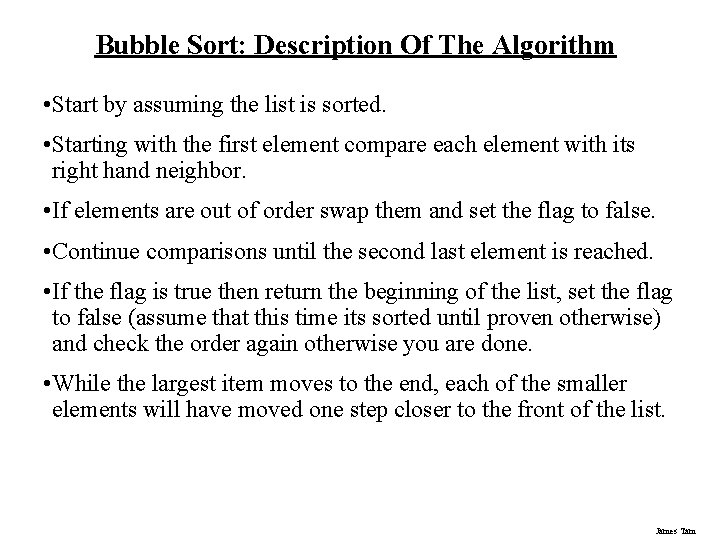
Bubble Sort: Description Of The Algorithm • Start by assuming the list is sorted. • Starting with the first element compare each element with its right hand neighbor. • If elements are out of order swap them and set the flag to false. • Continue comparisons until the second last element is reached. • If the flag is true then return the beginning of the list, set the flag to false (assume that this time its sorted until proven otherwise) and check the order again otherwise you are done. • While the largest item moves to the end, each of the smaller elements will have moved one step closer to the front of the list. James Tam
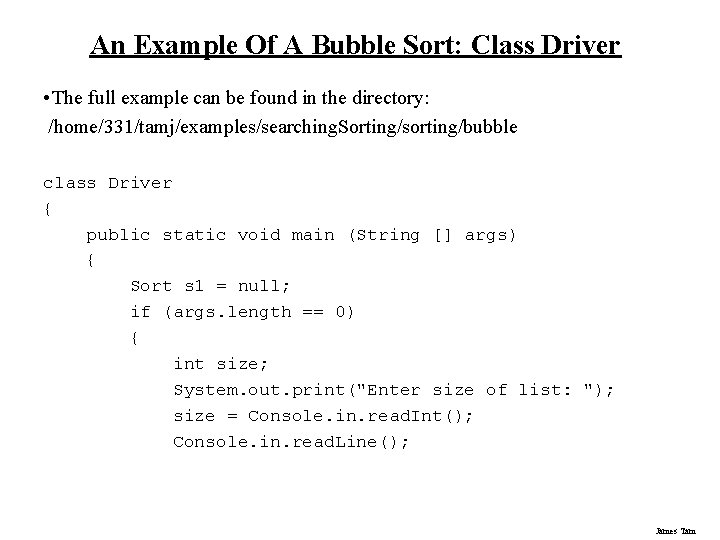
An Example Of A Bubble Sort: Class Driver • The full example can be found in the directory: /home/331/tamj/examples/searching. Sorting/sorting/bubble class Driver { public static void main (String [] args) { Sort s 1 = null; if (args. length == 0) { int size; System. out. print("Enter size of list: "); size = Console. in. read. Int(); Console. in. read. Line(); James Tam
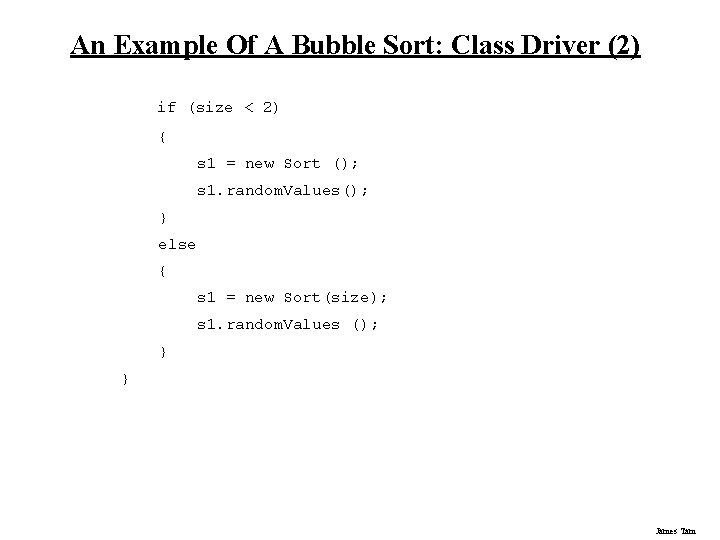
An Example Of A Bubble Sort: Class Driver (2) if (size < 2) { s 1 = new Sort (); s 1. random. Values(); } else { s 1 = new Sort(size); s 1. random. Values (); } } James Tam
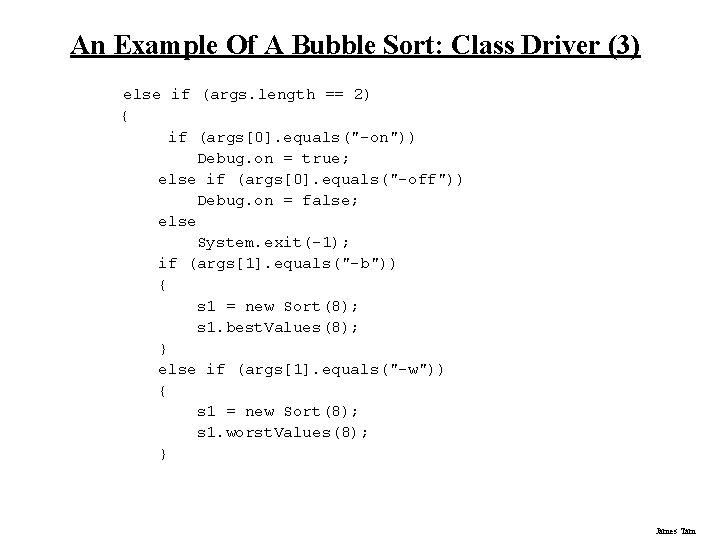
An Example Of A Bubble Sort: Class Driver (3) else if (args. length == 2) { if (args[0]. equals("-on")) Debug. on = true; else if (args[0]. equals("-off")) Debug. on = false; else System. exit(-1); if (args[1]. equals("-b")) { s 1 = new Sort(8); s 1. best. Values(8); } else if (args[1]. equals("-w")) { s 1 = new Sort(8); s 1. worst. Values(8); } James Tam
An Example Of A Bubble Sort: Class Driver (4) else if (args[1]. equals("-a")) { s 1 = new Sort (8); s 1. average. Values(8); } else { System. out. print("Second argument must be '-b', 'w'"); System. out. println("or '-a'"); System. exit(-1); } } else System. exit(-1); s 1. bubble(); s 1. display(); } } James Tam
An Example Of A Bubble Sort: Class Debug public class Debug { public static boolean on = false; } James Tam
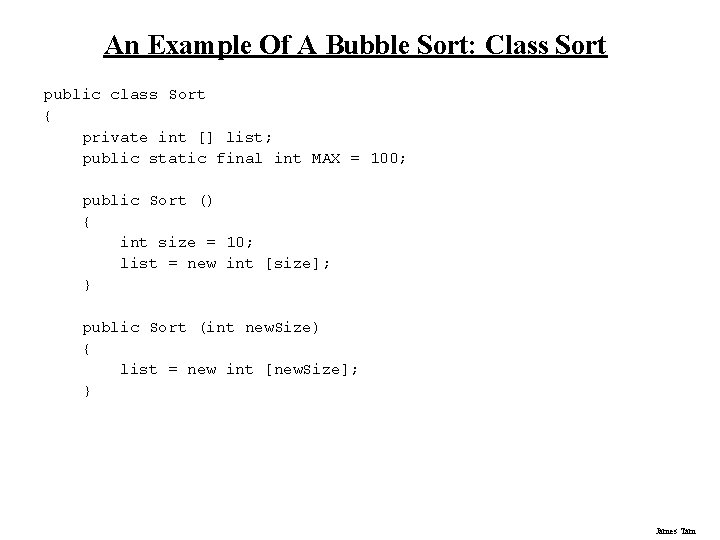
An Example Of A Bubble Sort: Class Sort public class Sort { private int [] list; public static final int MAX = 100; public Sort () { int size = 10; list = new int [size]; } public Sort (int new. Size) { list = new int [new. Size]; } James Tam
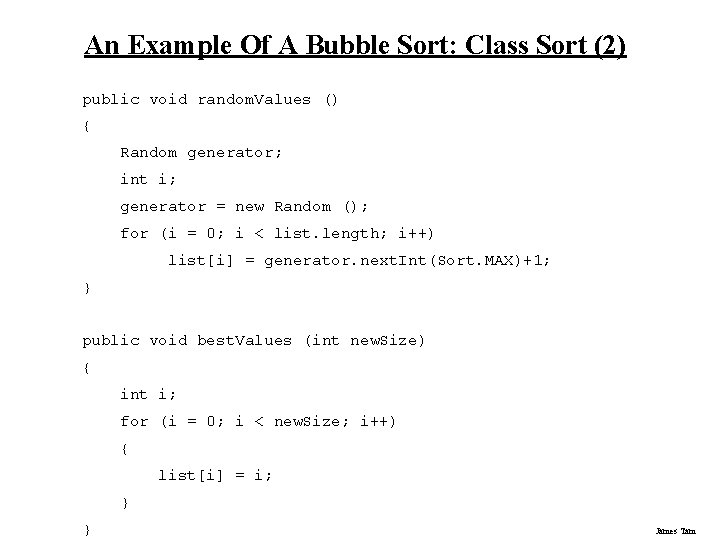
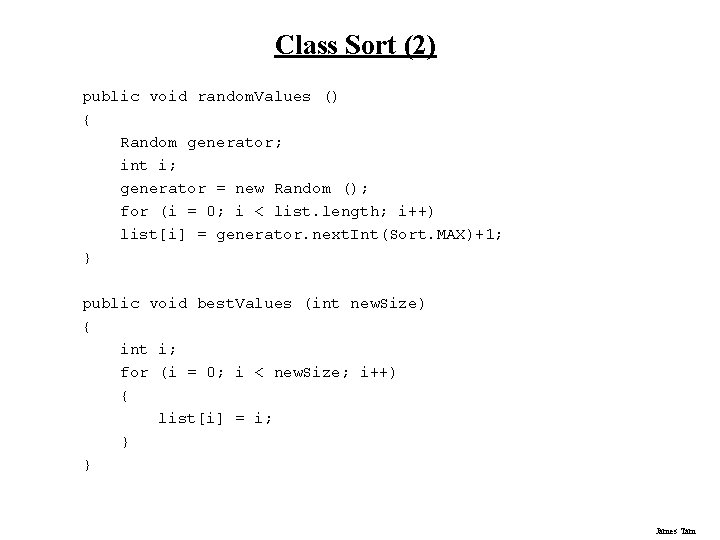
An Example Of A Bubble Sort: Class Sort (2) public void random. Values () { Random generator; int i; generator = new Random (); for (i = 0; i < list. length; i++) list[i] = generator. next. Int(Sort. MAX)+1; } public void best. Values (int new. Size) { int i; for (i = 0; i < new. Size; i++) { list[i] = i; } } James Tam
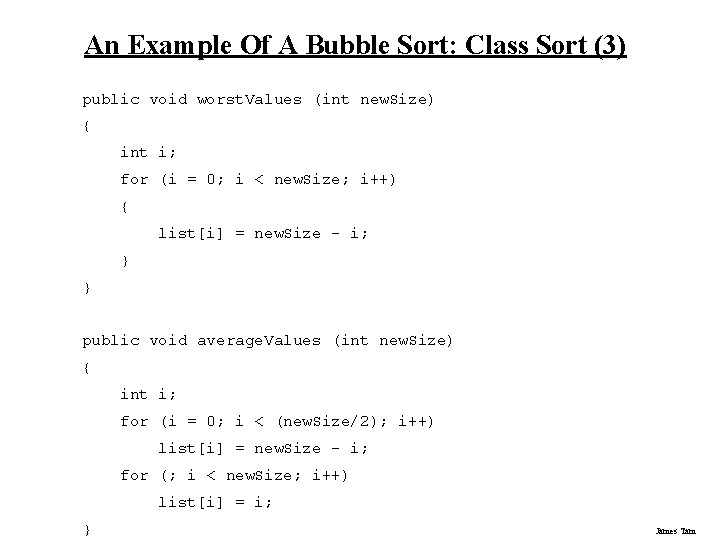
An Example Of A Bubble Sort: Class Sort (3) public void worst. Values (int new. Size) { int i; for (i = 0; i < new. Size; i++) { list[i] = new. Size - i; } } public void average. Values (int new. Size) { int i; for (i = 0; i < (new. Size/2); i++) list[i] = new. Size - i; for (; i < new. Size; i++) list[i] = i; } James Tam
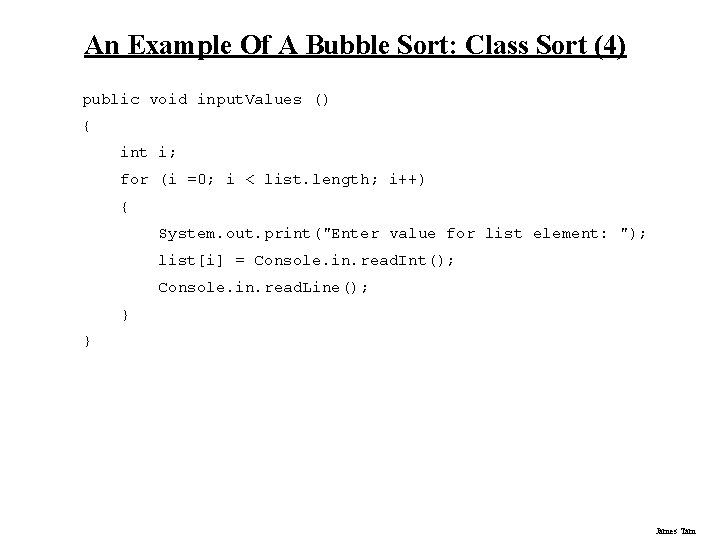
An Example Of A Bubble Sort: Class Sort (4) public void input. Values () { int i; for (i =0; i < list. length; i++) { System. out. print("Enter value for list element: "); list[i] = Console. in. read. Int(); Console. in. read. Line(); } } James Tam
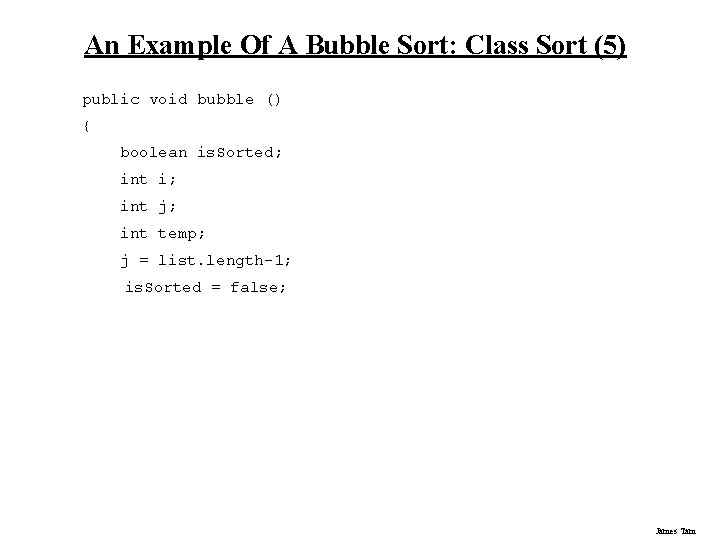
An Example Of A Bubble Sort: Class Sort (5) public void bubble () { boolean is. Sorted; int i; int j; int temp; j = list. length-1; is. Sorted = false; James Tam
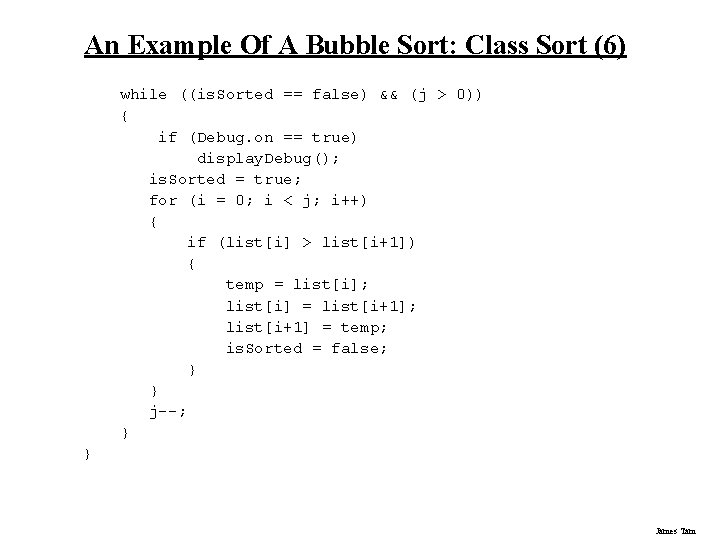
An Example Of A Bubble Sort: Class Sort (6) while ((is. Sorted == false) && (j > 0)) { if (Debug. on == true) display. Debug(); is. Sorted = true; for (i = 0; i < j; i++) { if (list[i] > list[i+1]) { temp = list[i]; list[i] = list[i+1]; list[i+1] = temp; is. Sorted = false; } } j--; } } James Tam
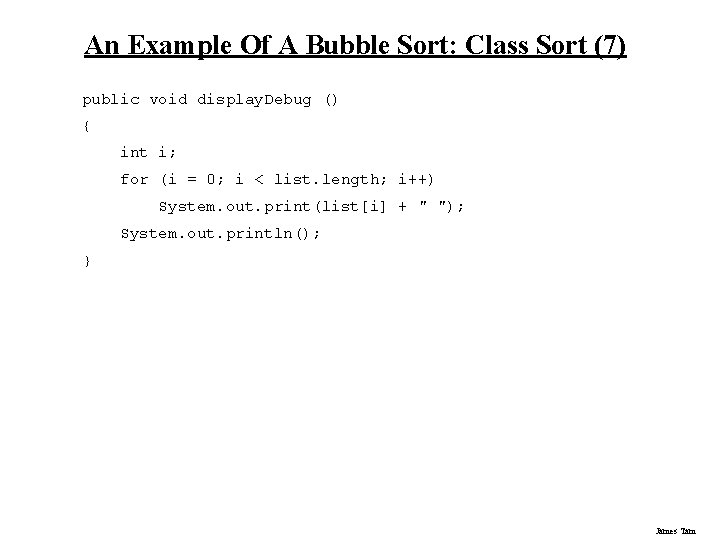
An Example Of A Bubble Sort: Class Sort (7) public void display. Debug () { int i; for (i = 0; i < list. length; i++) System. out. print(list[i] + " "); System. out. println(); } James Tam
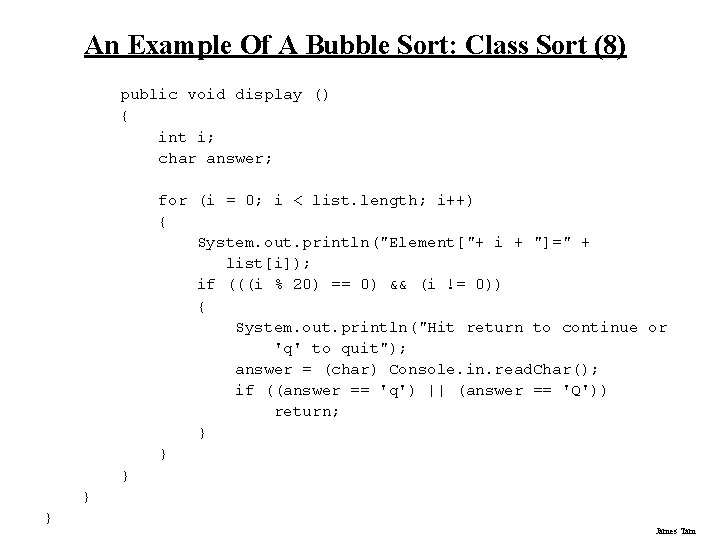
An Example Of A Bubble Sort: Class Sort (8) public void display () { int i; char answer; for (i = 0; i < list. length; i++) { System. out. println("Element["+ i + "]=" + list[i]); if (((i % 20) == 0) && (i != 0)) { System. out. println("Hit return to continue or 'q' to quit"); answer = (char) Console. in. read. Char(); if ((answer == 'q') || (answer == 'Q')) return; } } } James Tam
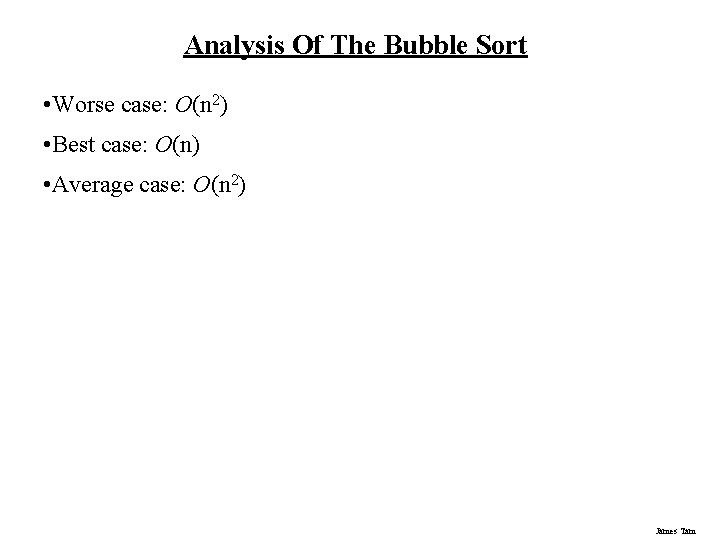
Analysis Of The Bubble Sort • Worse case: O(n 2) • Best case: O(n) • Average case: O(n 2) James Tam
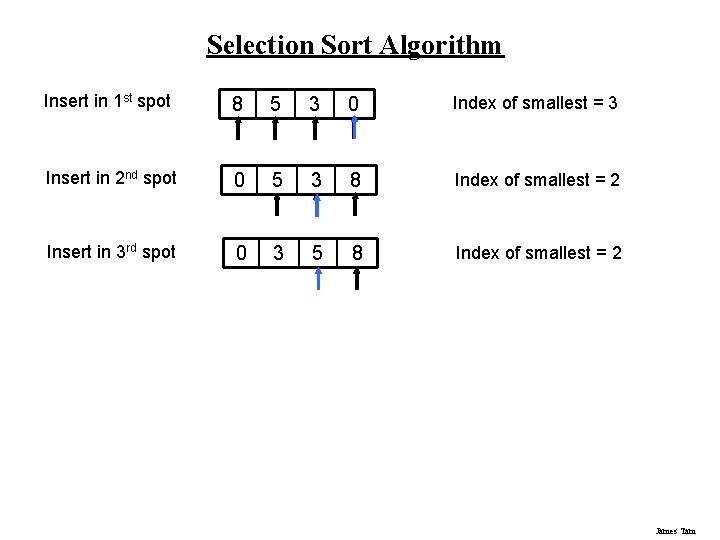
Selection Sort Algorithm Insert in 1 st spot 8 5 3 0 Index of smallest = 3 Insert in 2 nd spot 0 5 3 8 Index of smallest = 2 Insert in 3 rd spot 0 3 5 8 Index of smallest = 2 James Tam
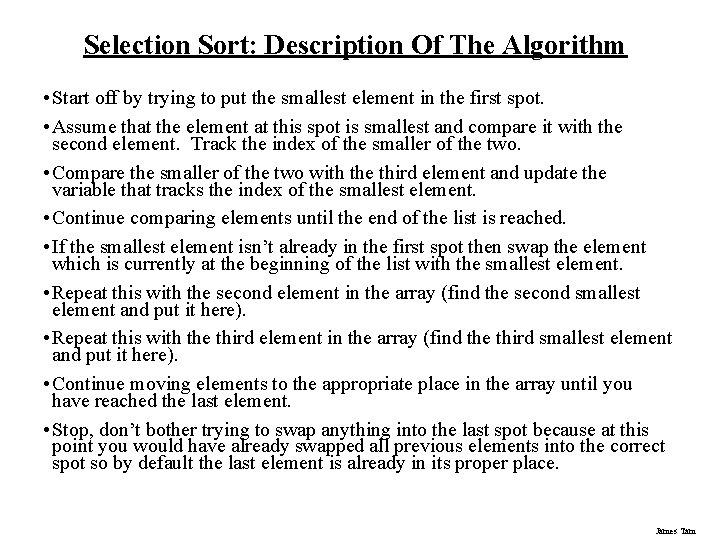
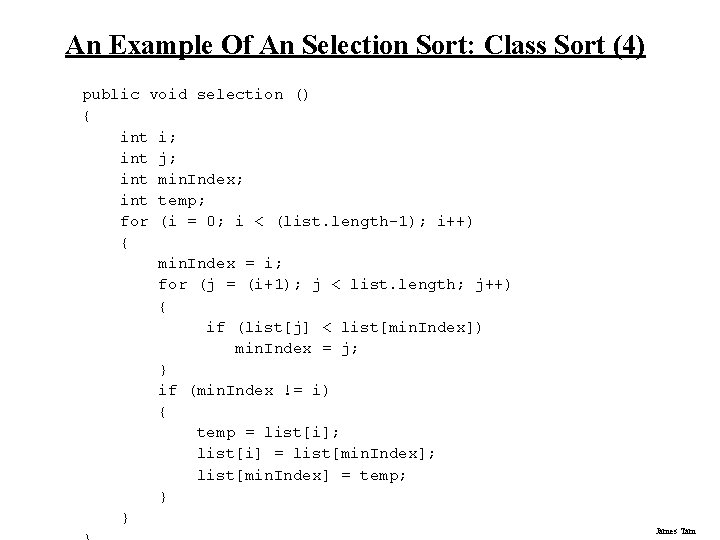
Selection Sort: Description Of The Algorithm • Start off by trying to put the smallest element in the first spot. • Assume that the element at this spot is smallest and compare it with the second element. Track the index of the smaller of the two. • Compare the smaller of the two with the third element and update the variable that tracks the index of the smallest element. • Continue comparing elements until the end of the list is reached. • If the smallest element isn’t already in the first spot then swap the element which is currently at the beginning of the list with the smallest element. • Repeat this with the second element in the array (find the second smallest element and put it here). • Repeat this with the third element in the array (find the third smallest element and put it here). • Continue moving elements to the appropriate place in the array until you have reached the last element. • Stop, don’t bother trying to swap anything into the last spot because at this point you would have already swapped all previous elements into the correct spot so by default the last element is already in its proper place. James Tam
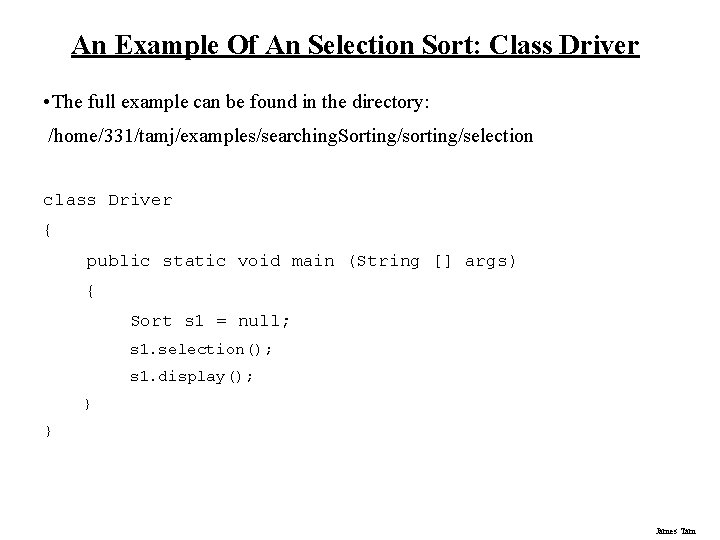
An Example Of An Selection Sort: Class Driver • The full example can be found in the directory: /home/331/tamj/examples/searching. Sorting/selection class Driver { public static void main (String [] args) { Sort s 1 = null; s 1. selection(); s 1. display(); } } James Tam
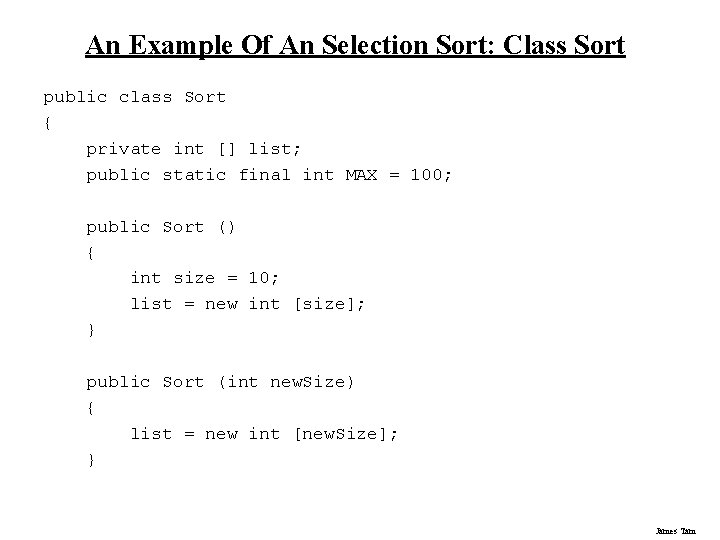
An Example Of An Selection Sort: Class Sort public class Sort { private int [] list; public static final int MAX = 100; public Sort () { int size = 10; list = new int [size]; } public Sort (int new. Size) { list = new int [new. Size]; } James Tam
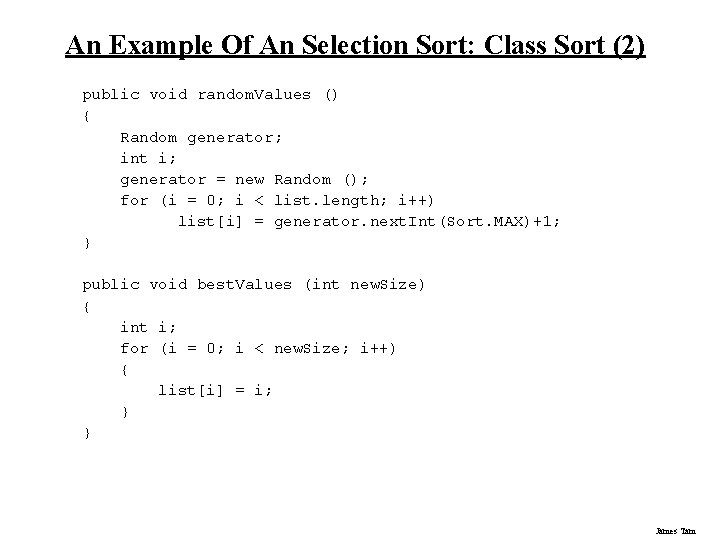
An Example Of An Selection Sort: Class Sort (2) public void random. Values () { Random generator; int i; generator = new Random (); for (i = 0; i < list. length; i++) list[i] = generator. next. Int(Sort. MAX)+1; } public void best. Values (int new. Size) { int i; for (i = 0; i < new. Size; i++) { list[i] = i; } } James Tam
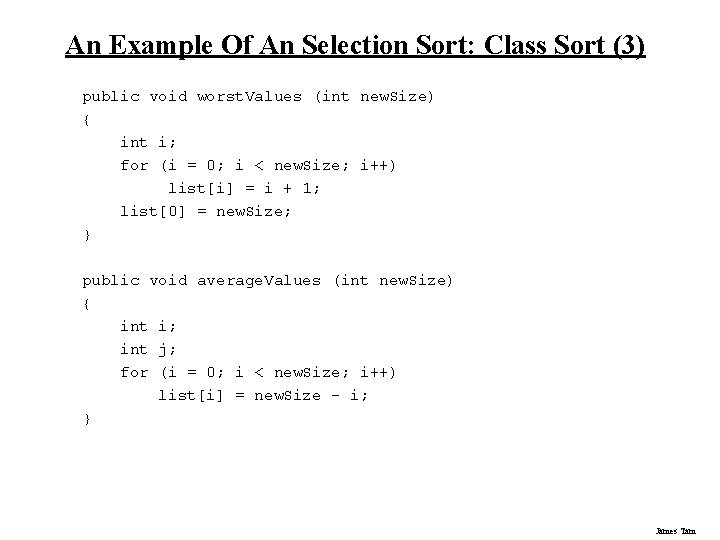
An Example Of An Selection Sort: Class Sort (3) public void worst. Values (int new. Size) { int i; for (i = 0; i < new. Size; i++) list[i] = i + 1; list[0] = new. Size; } public void average. Values (int new. Size) { int i; int j; for (i = 0; i < new. Size; i++) list[i] = new. Size - i; } James Tam
An Example Of An Selection Sort: Class Sort (4) public void selection () { int i; int j; int min. Index; int temp; for (i = 0; i < (list. length-1); i++) { min. Index = i; for (j = (i+1); j < list. length; j++) { if (list[j] < list[min. Index]) min. Index = j; } if (min. Index != i) { temp = list[i]; list[i] = list[min. Index]; list[min. Index] = temp; } } James Tam
Analysis Of The Selection Sort • All cases: O(n 2) James Tam
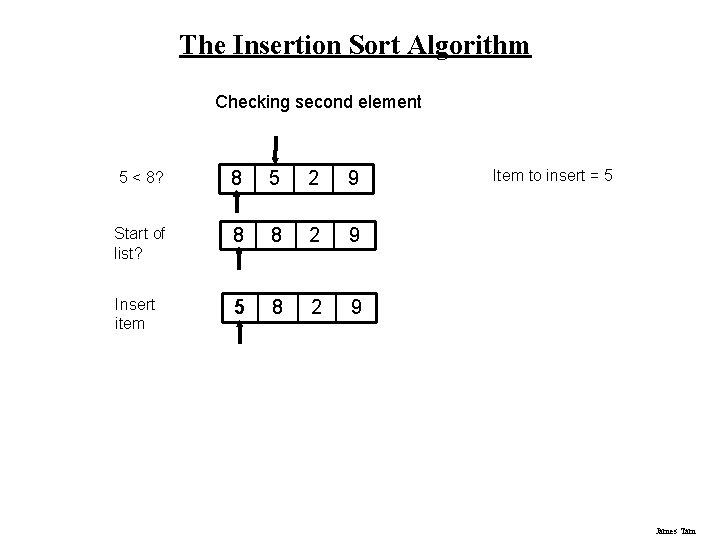
The Insertion Sort Algorithm Checking second element 5 < 8? 8 5 2 9 Start of list? 8 8 2 9 Insert item 5 8 2 9 Item to insert = 5 James Tam
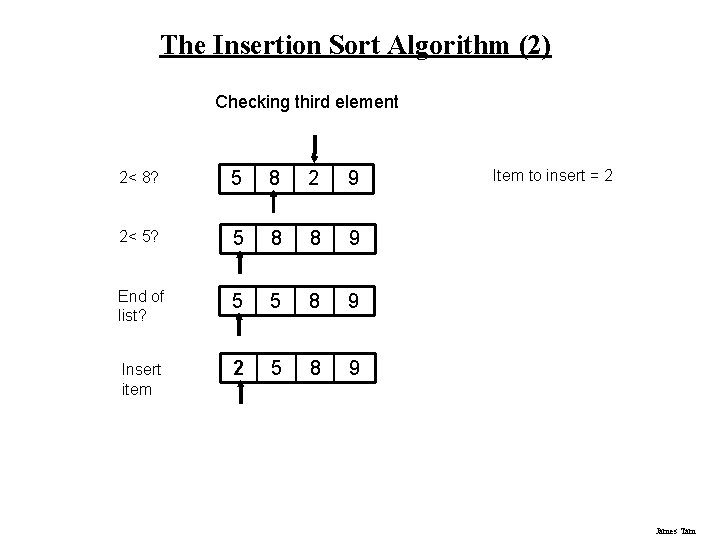
The Insertion Sort Algorithm (2) Checking third element 2< 8? 5 8 2 9 2< 5? 5 8 8 9 End of list? 5 5 8 9 Insert item 2 5 8 9 Item to insert = 2 James Tam
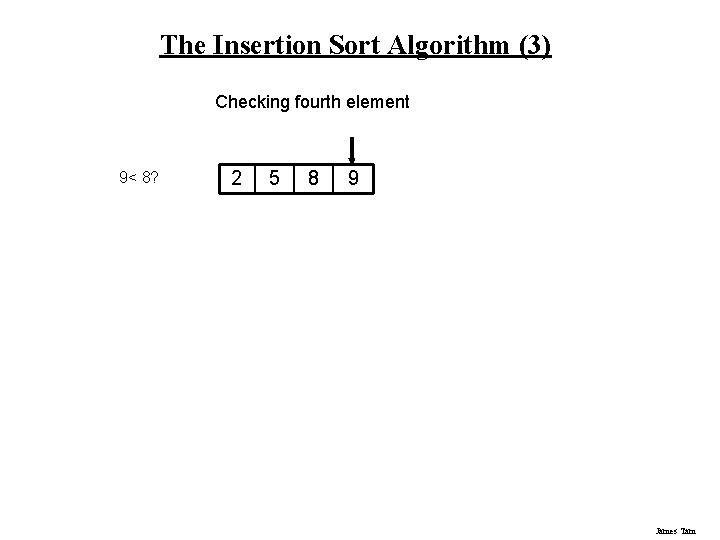
The Insertion Sort Algorithm (3) Checking fourth element 9< 8? 2 5 8 9 James Tam
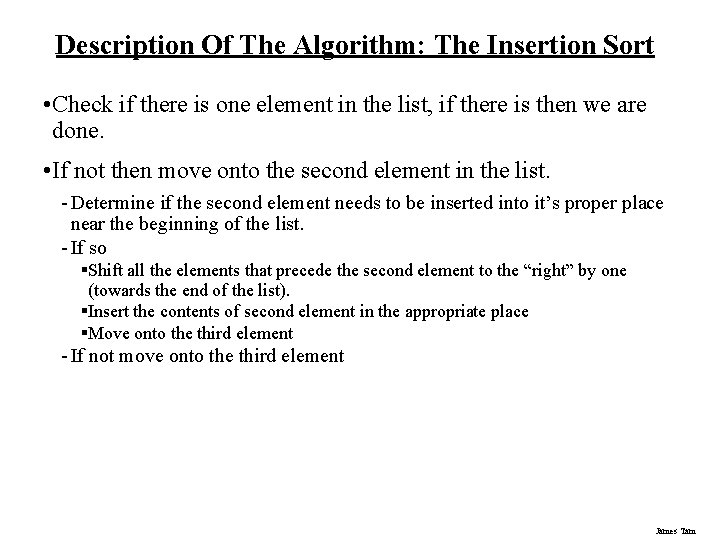
Description Of The Algorithm: The Insertion Sort • Check if there is one element in the list, if there is then we are done. • If not then move onto the second element in the list. - Determine if the second element needs to be inserted into it’s proper place near the beginning of the list. - If so §Shift all the elements that precede the second element to the “right” by one (towards the end of the list). §Insert the contents of second element in the appropriate place §Move onto the third element - If not move onto the third element James Tam
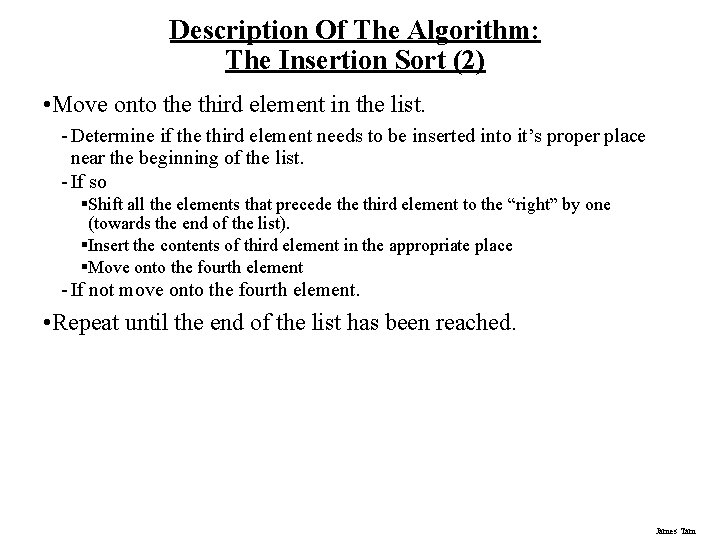
Description Of The Algorithm: The Insertion Sort (2) • Move onto the third element in the list. - Determine if the third element needs to be inserted into it’s proper place near the beginning of the list. - If so §Shift all the elements that precede third element to the “right” by one (towards the end of the list). §Insert the contents of third element in the appropriate place §Move onto the fourth element - If not move onto the fourth element. • Repeat until the end of the list has been reached. James Tam
An Example Of An Selection Sort: Class Driver • The full example can be found in the directory: /home/331/tamj/examples/searching. Sorting/sorting/insertion class Driver { public static void main (String [] args) { Sort s 1 = null; s 1. insertion(); s 1. display(); } } James Tam
Class Sort public class Sort { private int [] list; public static final int MAX = 100; public Sort () { int size = 10; list = new int [size]; } public Sort (int new. Size) { list = new int [new. Size]; } James Tam
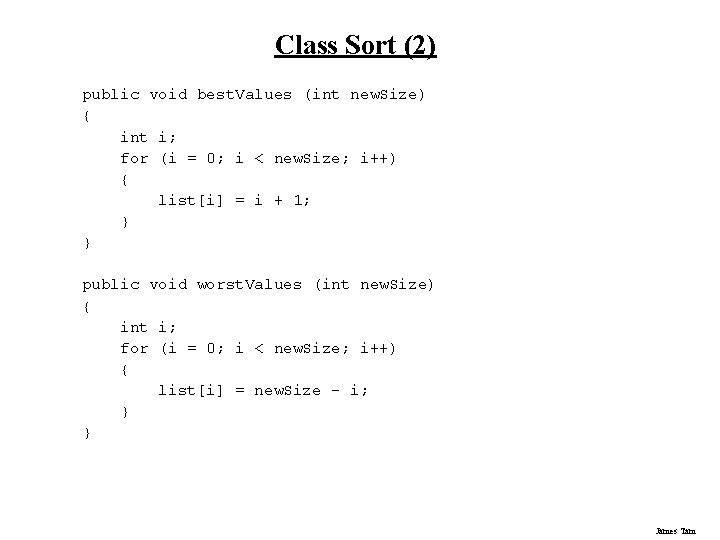
Class Sort (2) public void best. Values (int new. Size) { int i; for (i = 0; i < new. Size; i++) { list[i] = i + 1; } } public void worst. Values (int new. Size) { int i; for (i = 0; i < new. Size; i++) { list[i] = new. Size - i; } } James Tam
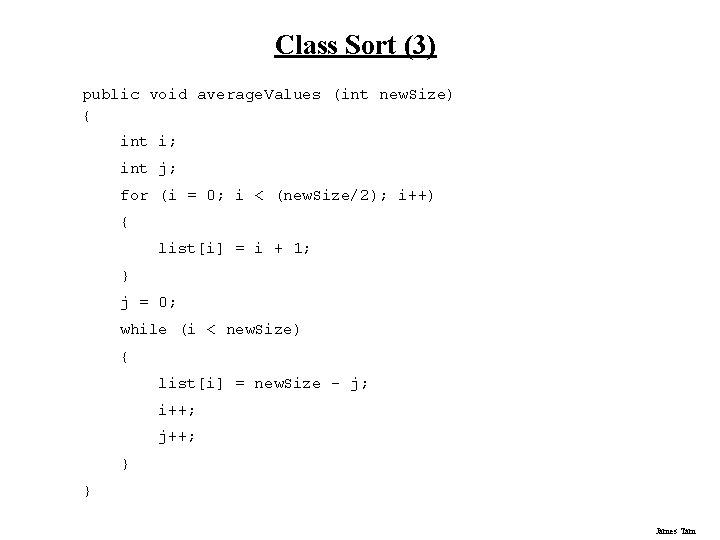
Class Sort (3) public void average. Values (int new. Size) { int i; int j; for (i = 0; i < (new. Size/2); i++) { list[i] = i + 1; } j = 0; while (i < new. Size) { list[i] = new. Size - j; i++; j++; } } James Tam
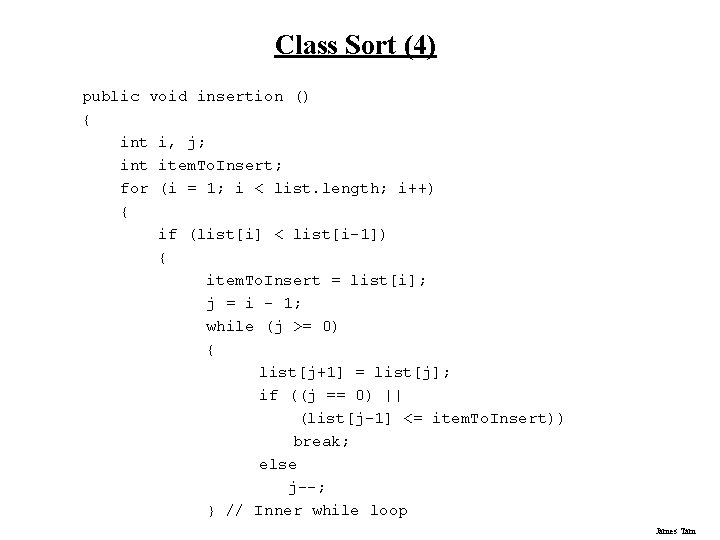
Class Sort (4) public void insertion () { int i, j; int item. To. Insert; for (i = 1; i < list. length; i++) { if (list[i] < list[i-1]) { item. To. Insert = list[i]; j = i - 1; while (j >= 0) { list[j+1] = list[j]; if ((j == 0) || (list[j-1] <= item. To. Insert)) break; else j--; } // Inner while loop James Tam
Class Sort (5) list[j] = item. To. Insert; } // if condition (elements out of order) } // outer for loop } // end of method James Tam
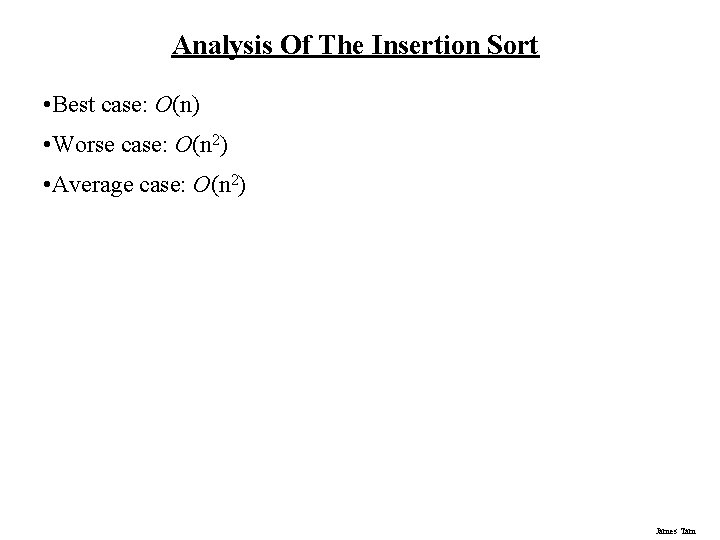
Analysis Of The Insertion Sort • Best case: O(n) • Worse case: O(n 2) • Average case: O(n 2) James Tam
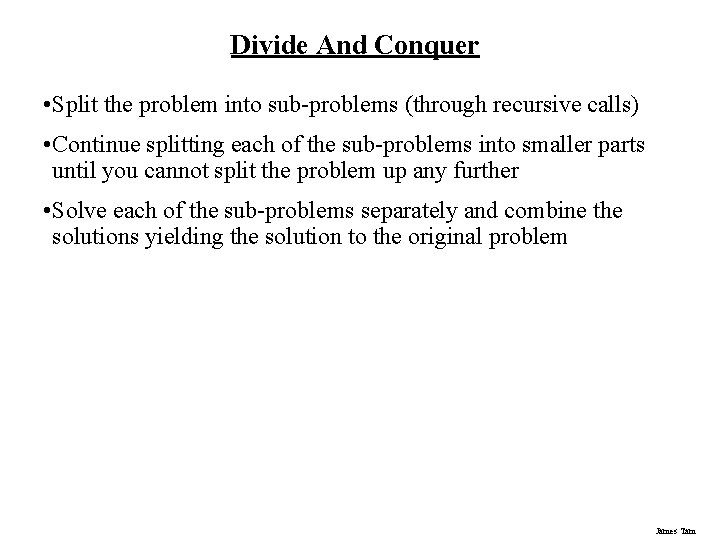
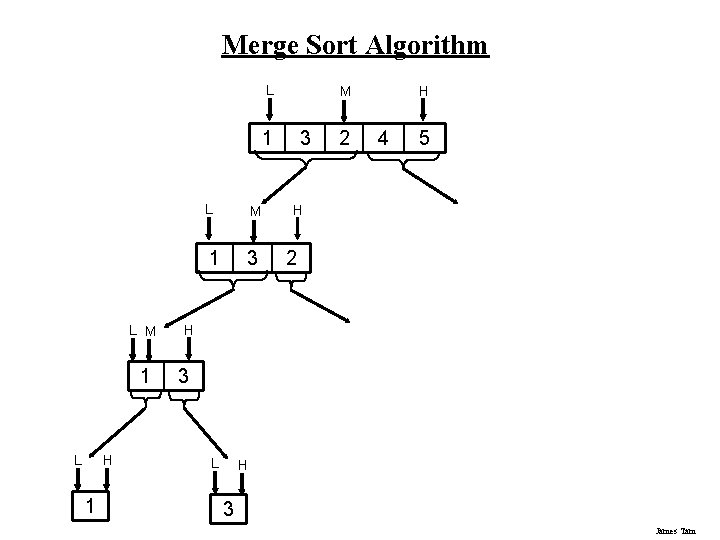
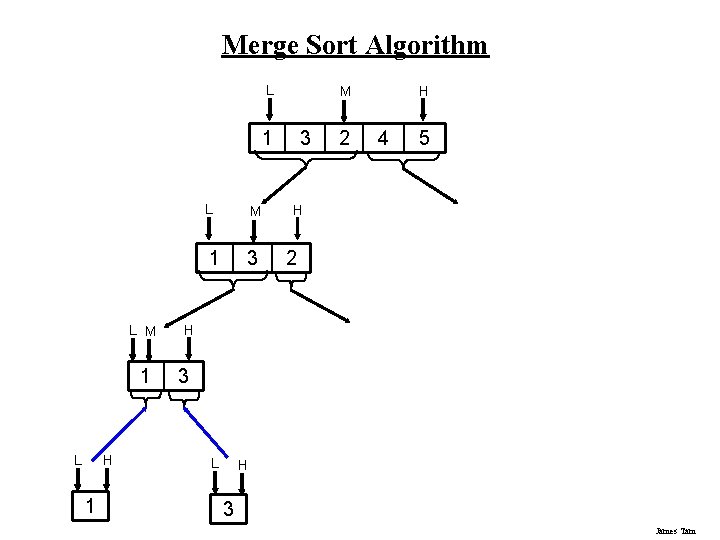
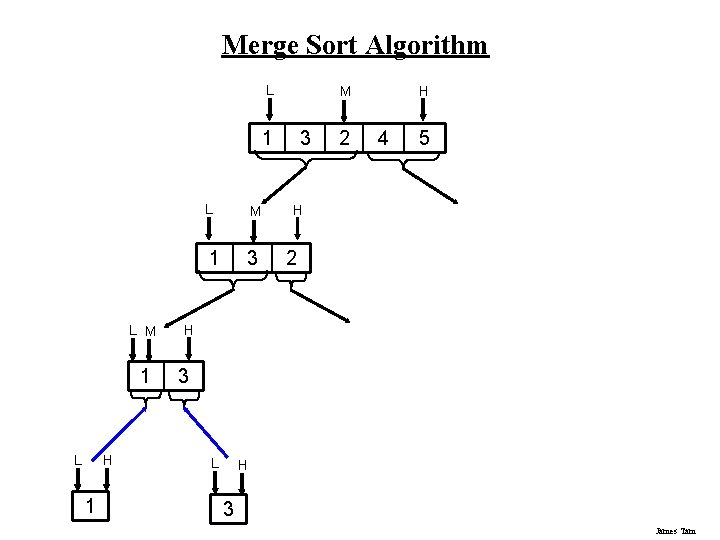
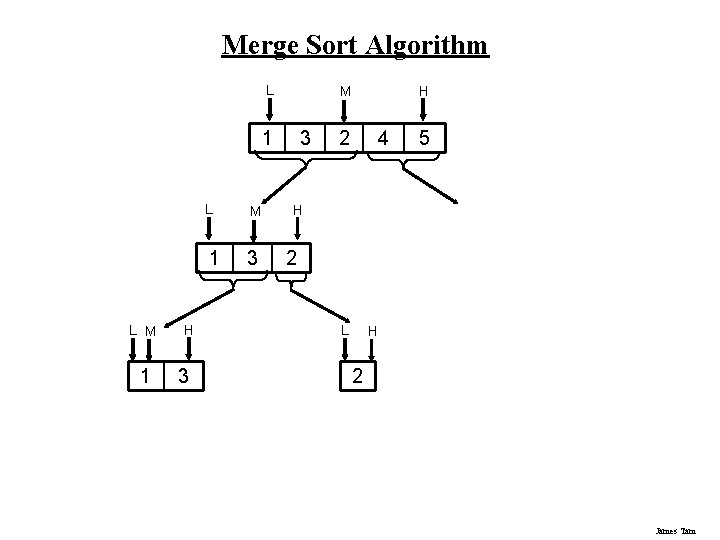
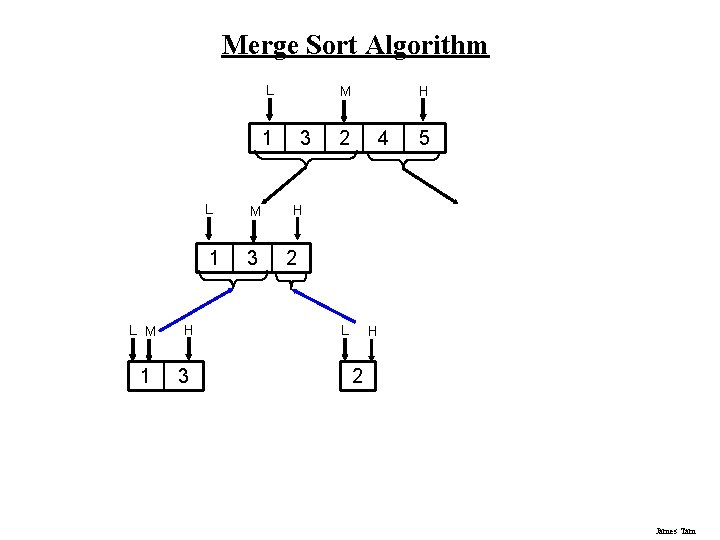
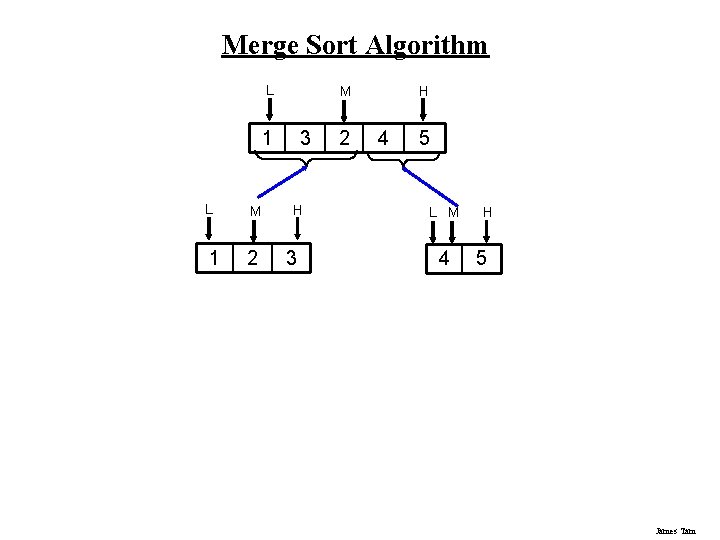
Divide And Conquer • Split the problem into sub-problems (through recursive calls) • Continue splitting each of the sub-problems into smaller parts until you cannot split the problem up any further • Solve each of the sub-problems separately and combine the solutions yielding the solution to the original problem James Tam
Merge Sort Algorithm L 1 L M 1 L H 1 L M 1 3 H M 3 2 4 5 H 2 H 3 L H 3 James Tam
Merge Sort Algorithm L 1 L M 1 L H 1 L M 1 3 H M 3 2 4 5 H 2 H 3 L H 3 James Tam
Merge Sort Algorithm L 1 L M 1 L H 1 L M 1 3 H M 3 2 4 5 H 2 H 3 L H 3 James Tam
Merge Sort Algorithm L 1 L M 1 H 3 L M 1 3 H M 3 2 4 5 H 2 L H 2 James Tam
Merge Sort Algorithm L 1 L M 1 H 3 L M 1 3 H M 3 2 4 5 H 2 L H 2 James Tam
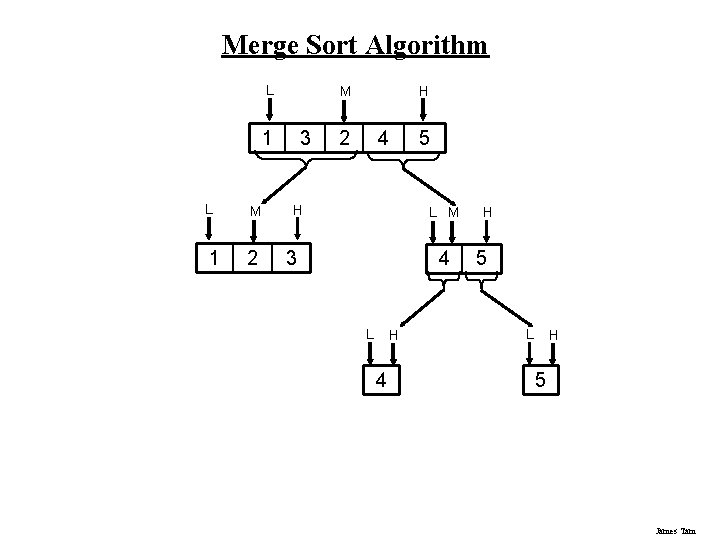
Merge Sort Algorithm L 1 L M 1 2 H M 3 2 4 5 H L M 3 4 L H 4 H 5 L H 5 James Tam
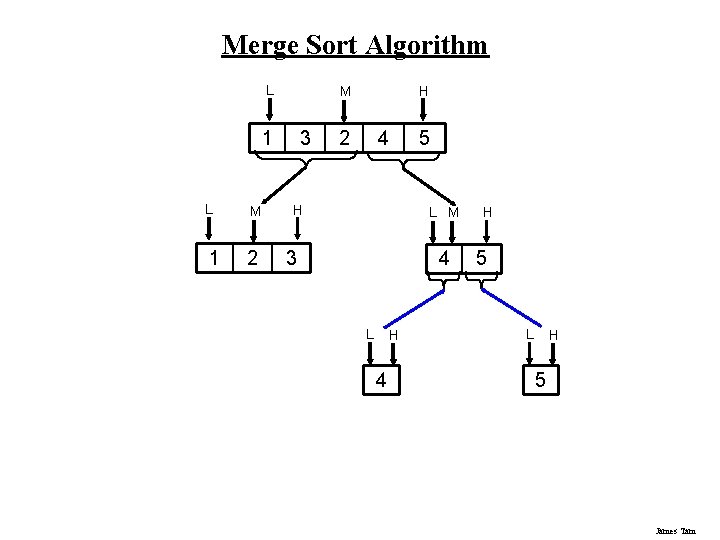
Merge Sort Algorithm L 1 L M 1 2 H M 3 2 4 5 H L M 3 4 L H 4 H 5 L H 5 James Tam
Merge Sort Algorithm L 1 L M 1 2 H M 3 H 3 2 4 5 L M 4 H 5 James Tam
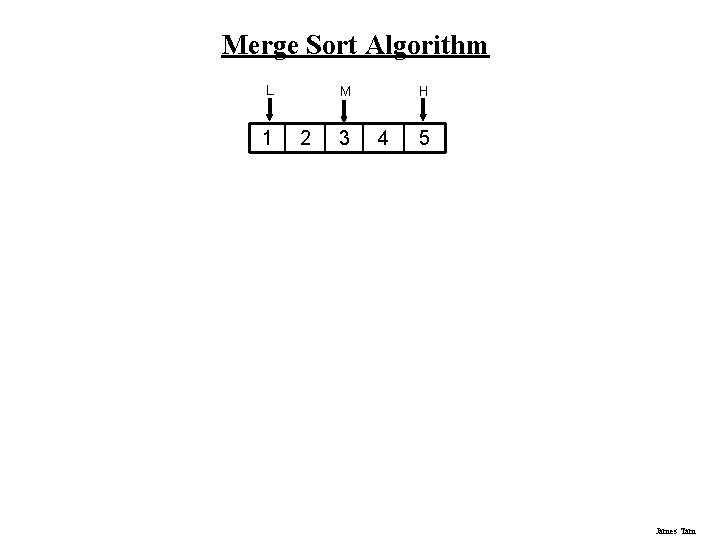
Merge Sort Algorithm L 1 H M 2 3 4 5 James Tam
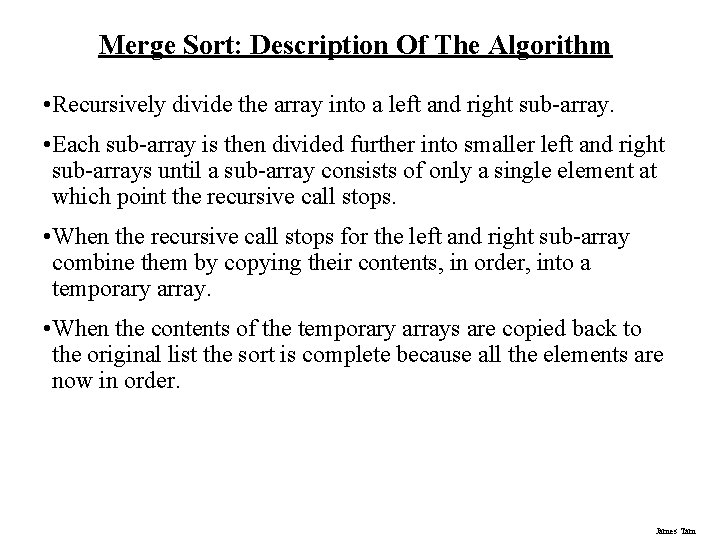
Merge Sort: Description Of The Algorithm • Recursively divide the array into a left and right sub-array. • Each sub-array is then divided further into smaller left and right sub-arrays until a sub-array consists of only a single element at which point the recursive call stops. • When the recursive call stops for the left and right sub-array combine them by copying their contents, in order, into a temporary array. • When the contents of the temporary arrays are copied back to the original list the sort is complete because all the elements are now in order. James Tam
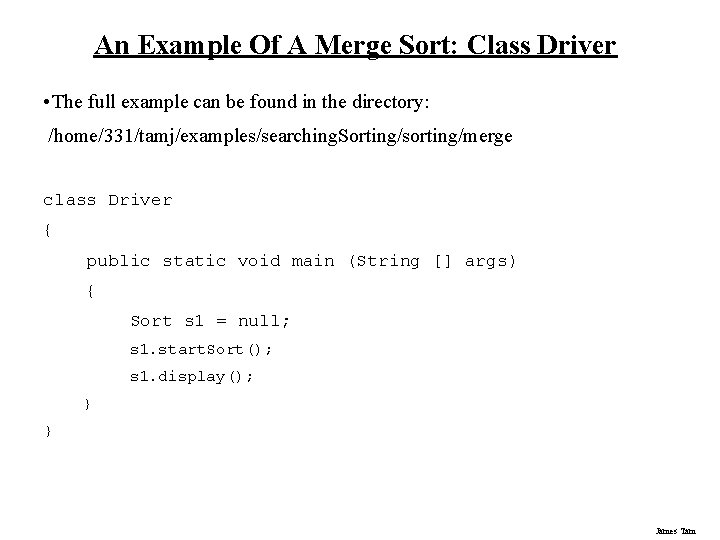
An Example Of A Merge Sort: Class Driver • The full example can be found in the directory: /home/331/tamj/examples/searching. Sorting/sorting/merge class Driver { public static void main (String [] args) { Sort s 1 = null; s 1. start. Sort(); s 1. display(); } } James Tam
Class Sort public class Sort { private int [] list; public static final int MAX = 100; private int time = 0; public Sort () { int size = 10; list = new int [size]; } public Sort (int new. Size) { list = new int [new. Size]; } James Tam
Class Sort (2) public void random. Values () { Random generator; int i; generator = new Random (); for (i = 0; i < list. length; i++) list[i] = generator. next. Int(Sort. MAX)+1; } public void best. Values (int new. Size) { int i; for (i = 0; i < new. Size; i++) { list[i] = i; } } James Tam
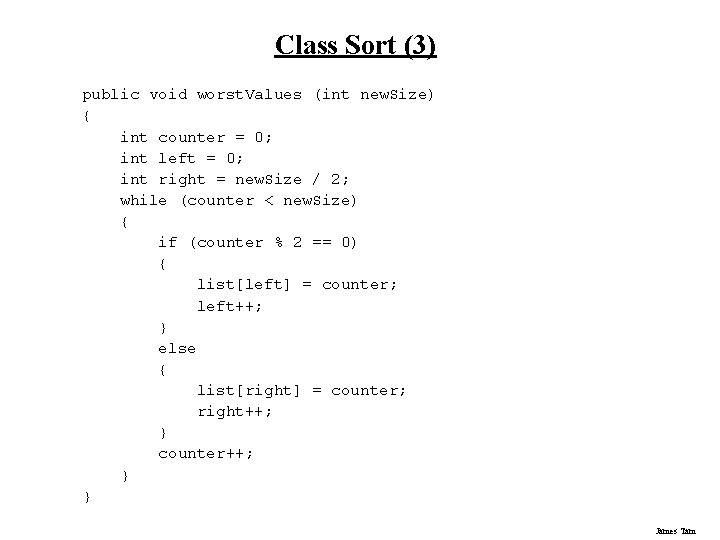
Class Sort (3) public void worst. Values (int new. Size) { int counter = 0; int left = 0; int right = new. Size / 2; while (counter < new. Size) { if (counter % 2 == 0) { list[left] = counter; left++; } else { list[right] = counter; right++; } counter++; } } James Tam
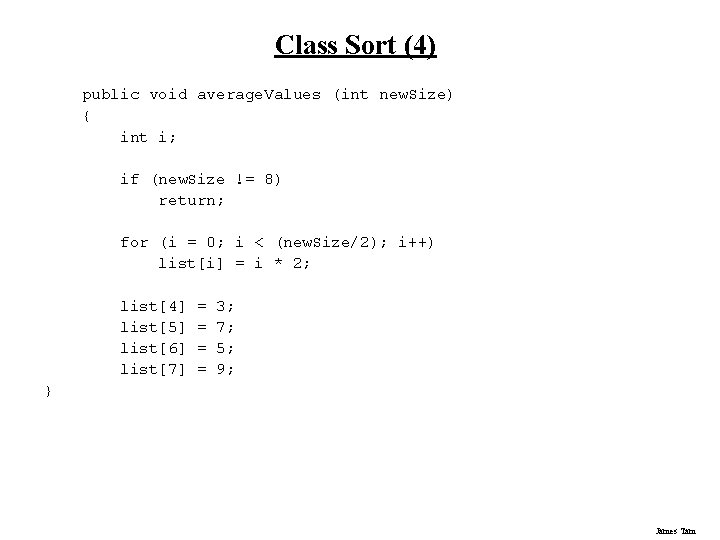
Class Sort (4) public void average. Values (int new. Size) { int i; if (new. Size != 8) return; for (i = 0; i < (new. Size/2); i++) list[i] = i * 2; list[4] list[5] list[6] list[7] = = 3; 7; 5; 9; } James Tam
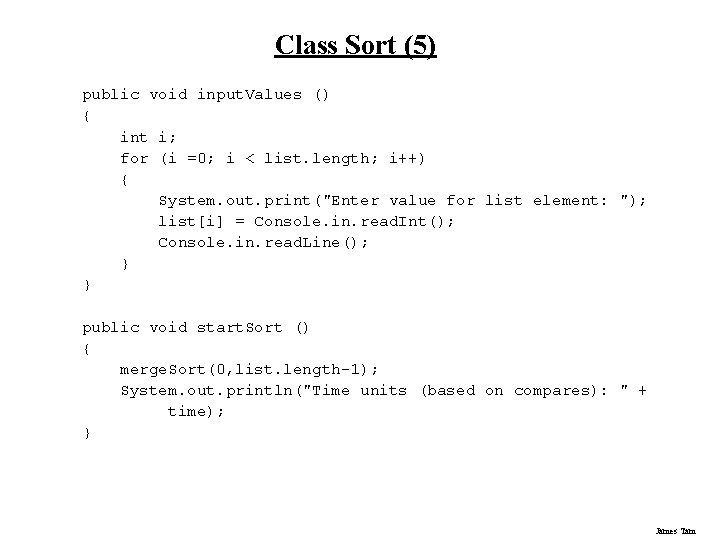
Class Sort (5) public void input. Values () { int i; for (i =0; i < list. length; i++) { System. out. print("Enter value for list element: "); list[i] = Console. in. read. Int(); Console. in. read. Line(); } } public void start. Sort () { merge. Sort(0, list. length-1); System. out. println("Time units (based on compares): " + time); } James Tam
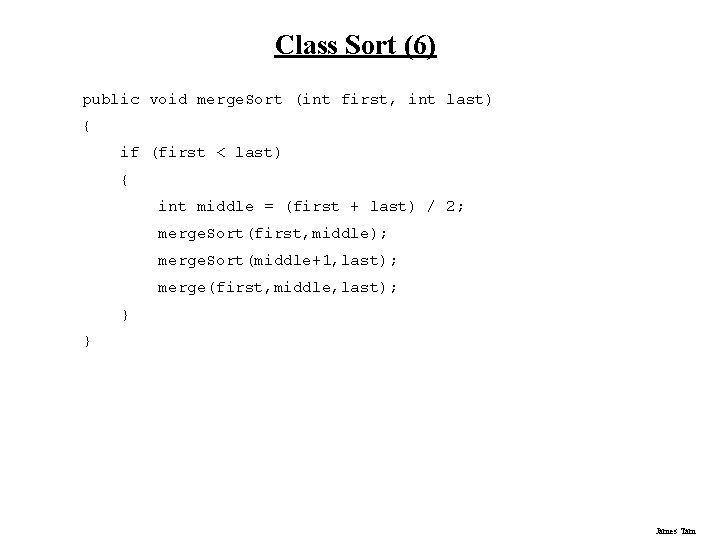
Class Sort (6) public void merge. Sort (int first, int last) { if (first < last) { int middle = (first + last) / 2; merge. Sort(first, middle); merge. Sort(middle+1, last); merge(first, middle, last); } } James Tam
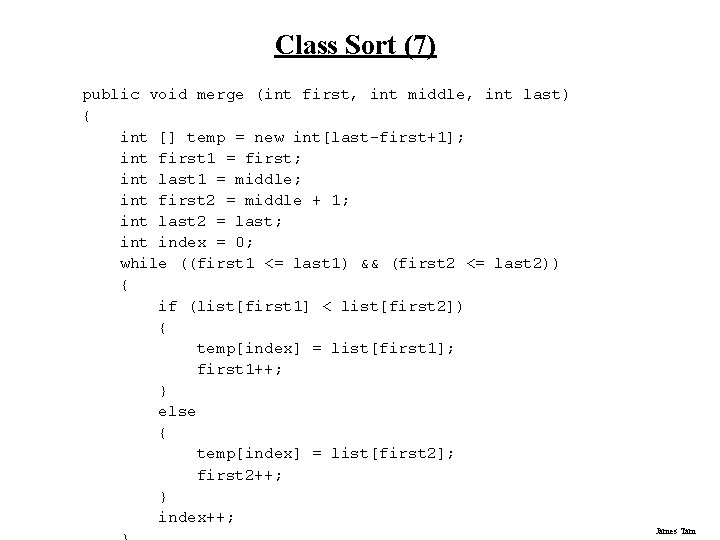
Class Sort (7) public void merge (int first, int middle, int last) { int [] temp = new int[last-first+1]; int first 1 = first; int last 1 = middle; int first 2 = middle + 1; int last 2 = last; int index = 0; while ((first 1 <= last 1) && (first 2 <= last 2)) { if (list[first 1] < list[first 2]) { temp[index] = list[first 1]; first 1++; } else { temp[index] = list[first 2]; first 2++; } index++; James Tam
Class Sort (8) while (first 1 <= last 1) { temp[index] = list[first 1]; first 1++; index++; } while (first 2 <= last 2) { temp[index] = list[first 2]; first 2++; index++; } int list. Index = first; for (index = 0; index < temp. length; index++) { list[list. Index] = temp[index]; list. Index++; } } James Tam
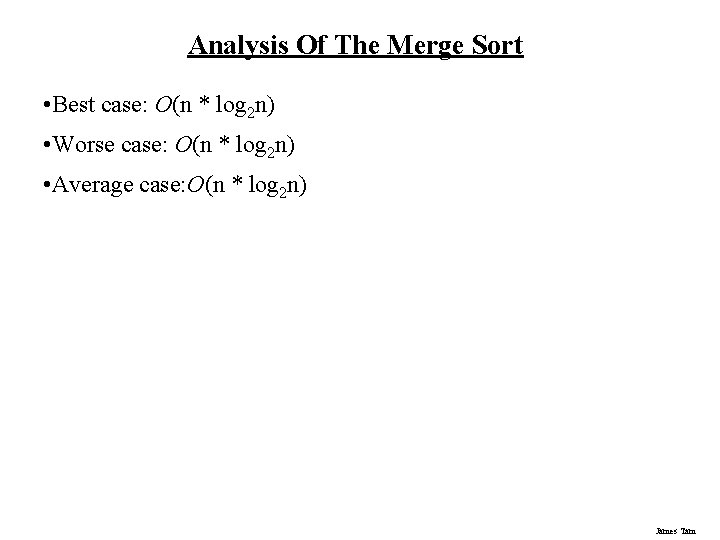
Analysis Of The Merge Sort • Best case: O(n * log 2 n) • Worse case: O(n * log 2 n) • Average case: O(n * log 2 n) James Tam
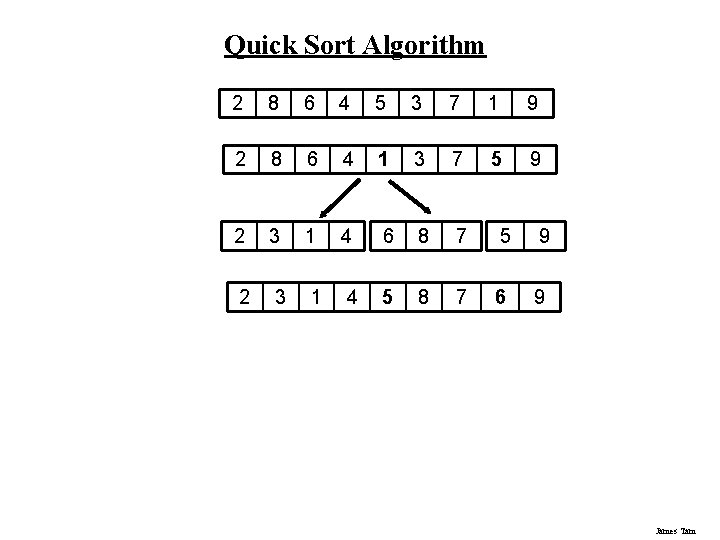
Quick Sort Algorithm 2 8 6 4 5 3 7 1 9 2 8 6 4 1 3 7 5 9 2 3 1 4 6 8 7 5 9 2 3 1 4 5 8 7 6 9 James Tam
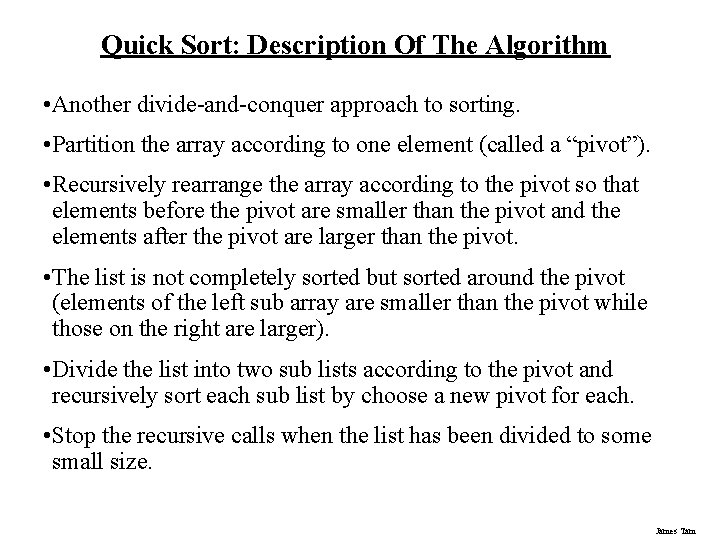
Quick Sort: Description Of The Algorithm • Another divide-and-conquer approach to sorting. • Partition the array according to one element (called a “pivot”). • Recursively rearrange the array according to the pivot so that elements before the pivot are smaller than the pivot and the elements after the pivot are larger than the pivot. • The list is not completely sorted but sorted around the pivot (elements of the left sub array are smaller than the pivot while those on the right are larger). • Divide the list into two sub lists according to the pivot and recursively sort each sub list by choose a new pivot for each. • Stop the recursive calls when the list has been divided to some small size. James Tam
Choosing A Pivot 1. First element/last element 2. Median of three James Tam
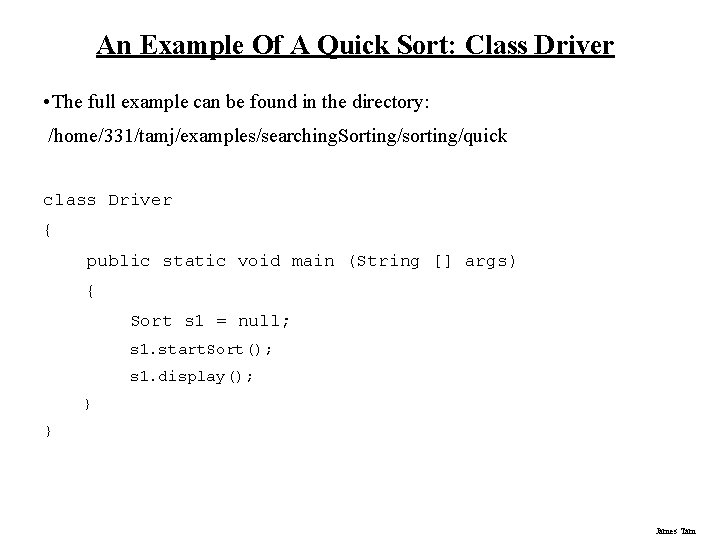
An Example Of A Quick Sort: Class Driver • The full example can be found in the directory: /home/331/tamj/examples/searching. Sorting/sorting/quick class Driver { public static void main (String [] args) { Sort s 1 = null; s 1. start. Sort(); s 1. display(); } } James Tam
Class Sort public class Sort { private int [] list; public static final int MAX = 100; James Tam
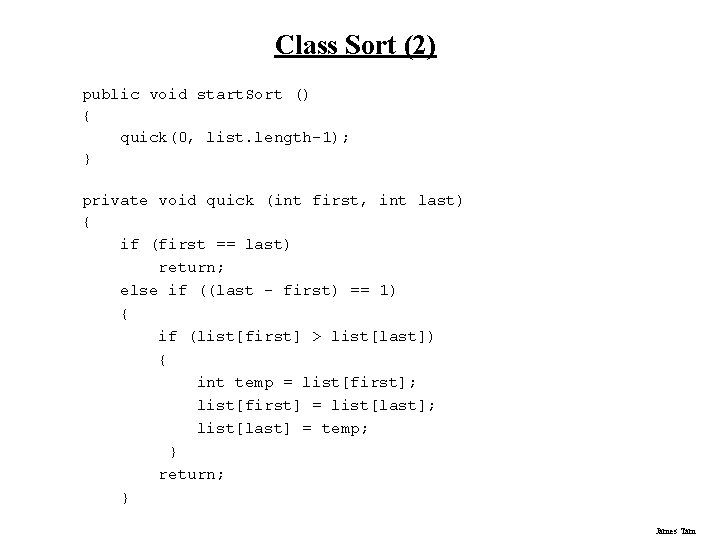
Class Sort (2) public void start. Sort () { quick(0, list. length-1); } private void quick (int first, int last) { if (first == last) return; else if ((last - first) == 1) { if (list[first] > list[last]) { int temp = list[first]; list[first] = list[last]; list[last] = temp; } return; } James Tam
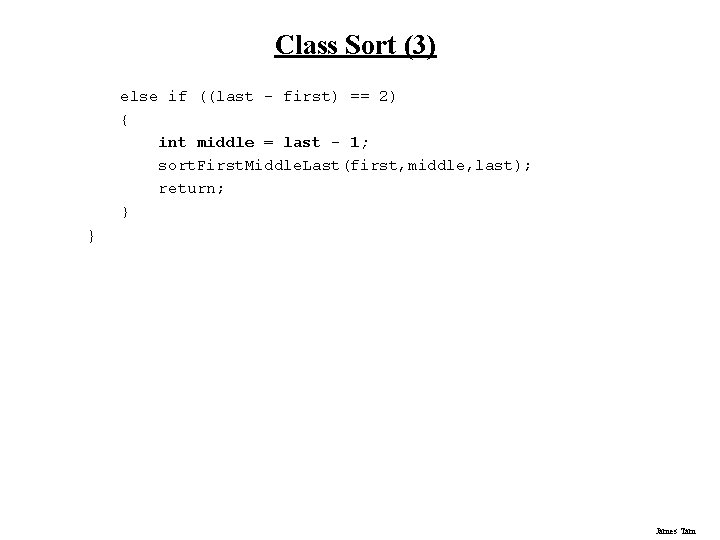
Class Sort (3) else if ((last - first) == 2) { int middle = last - 1; sort. First. Middle. Last(first, middle, last); return; } } James Tam
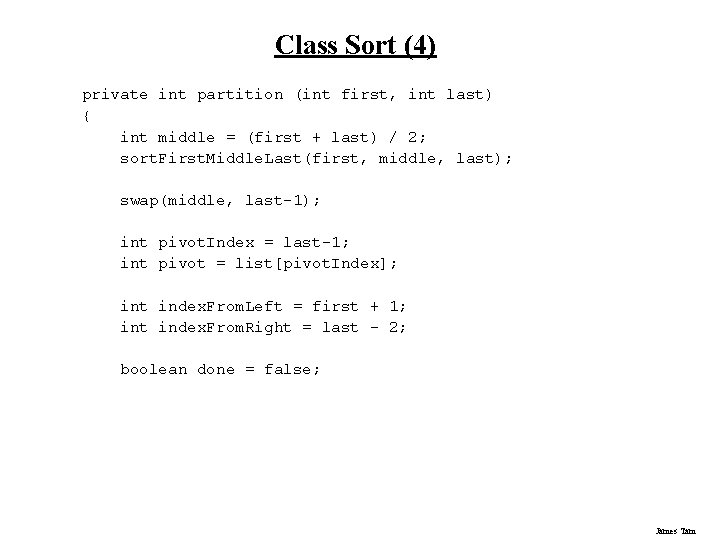
Class Sort (4) private int partition (int first, int last) { int middle = (first + last) / 2; sort. First. Middle. Last(first, middle, last); swap(middle, last-1); int pivot. Index = last-1; int pivot = list[pivot. Index]; int index. From. Left = first + 1; int index. From. Right = last - 2; boolean done = false; James Tam
Class Sort (5) while (done == false) { while (list[index. From. Left] < pivot) index. From. Left++; while (list[index. From. Right] > pivot) index. From. Right--; if (index. From. Left < index. From. Right) { swap(index. From. Left, index. From. Right); index. From. Left++; index. From. Right--; } else { done = true; } } swap(pivot. Index, index. From. Left); pivot. Index = index. From. Left; return pivot. Index; } James Tam
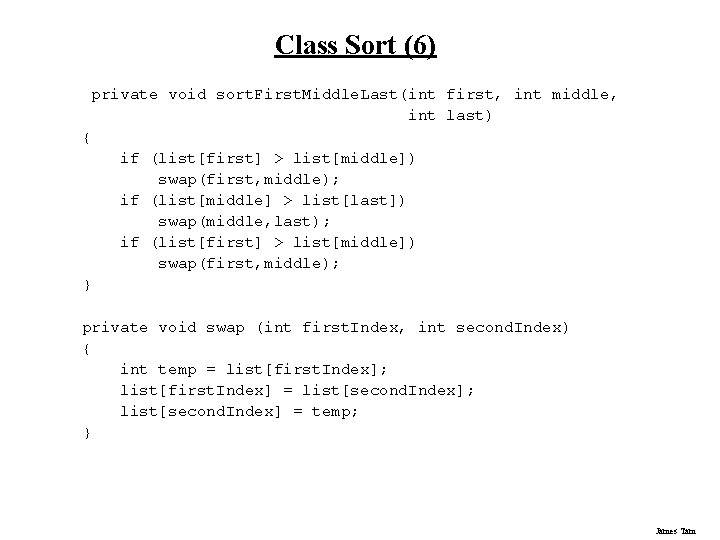
Class Sort (6) private void sort. First. Middle. Last(int first, int middle, int last) { if (list[first] > list[middle]) swap(first, middle); if (list[middle] > list[last]) swap(middle, last); if (list[first] > list[middle]) swap(first, middle); } private void swap (int first. Index, int second. Index) { int temp = list[first. Index]; list[first. Index] = list[second. Index]; list[second. Index] = temp; } James Tam
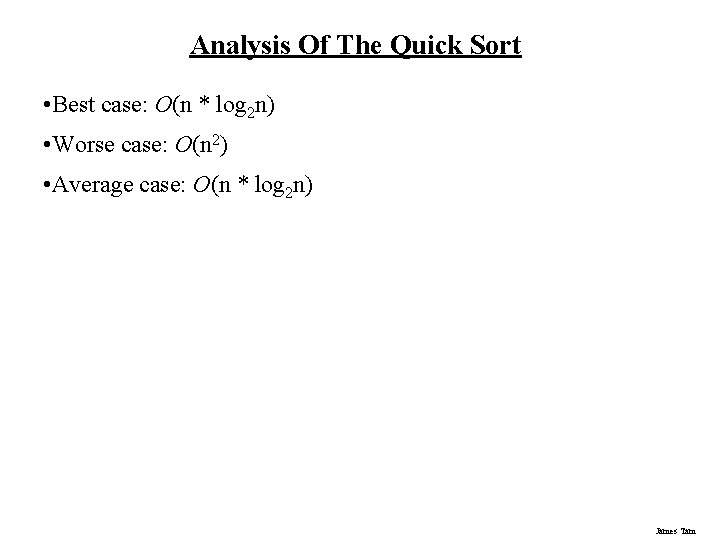
Analysis Of The Quick Sort • Best case: O(n * log 2 n) • Worse case: O(n 2) • Average case: O(n * log 2 n) James Tam
You Should Now Know • Common searching algorithms and their strengths and limitations • Sorting algorithms - How are they implemented? - What are the best, worse and average cases? - What is their best, worst and average case speeds? - Strengths and weaknesses that go beyond algorithm analysis (i. e. , considerations other than just Big-O). James Tam
Sources Of Material • Java: A Framework for Program Design and Data Structures (2 nd edition) by Kenneth A. Lambert and Martin Osborne • Data Structures and Abstractions with Java by Frank M. Carrano and Walter Savitch. • CPSC 331 course notes by Marina L. Gavrilova http: //pages. cpsc. ucalgary. ca/~marina/331/ James Tam