
Search for mAu eAu conversion with SINDRUM II
- Slides: 21
Search for m-Au → e-Au conversion with SINDRUM II Collaboration (2000): RWTH Aachen (1) PSI (Paul Scherrer Institut) (2) University Zurich (3) Authors: W. Bertl (2) R. Engfer (3) E. A. Hermes (3) T. Kozlowski (2+3) G. Kurz (3) J. Kuth (1) G. Otter (1) F. Rosenbaum (2+3) N. M. Ryskulov (2) A. van der Schaaf (3) P. Wintz (3) I. Zychor (3) …and earlier members of the SINDRUM II collaboration: ETH Zurich Tbilisi State University “Flavour in the era of the LHC” 3 rd Workshop CERN, May 2006 A. Badertscher, J. Bagaturia, M. Begalli, C. Dohmen, W. Dzhordzhadze, J. Egger, S. Eggli, Ch. Findeisen, D. Gaewiler, M. Grossmann. Handschin, K. D. Groth, H. Haan, P. Hawelka, B. Heer, W. Herold, J. Hofmann, W. Honecker, D. Junker, D. Kampmann, J. Kaulard, B. Krause, N. Lordong, G. Melitauri, A. Mtchedlishvili, F. Muheim, U. Mueller, C. B. Niebuhr, S. Playfer, H. S. Pruys, D. Renker, L. Ricken, M. Rutsche, M. Salzmann, R. Seeliger, L. Simons, B. Steinruecken, M. Starlinger, O. Szavits, D. Vermeulen, H. K. Walter, W. Bertl, PSI
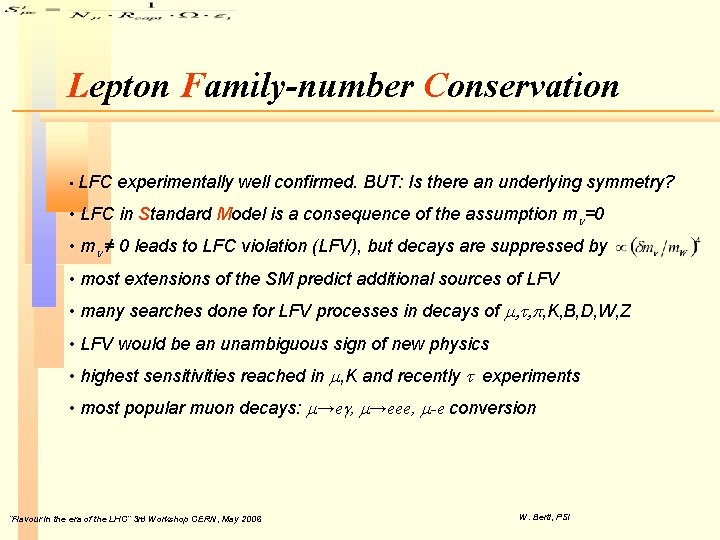
Lepton Family-number Conservation • LFC experimentally well confirmed. BUT: Is there an underlying symmetry? • LFC in Standard Model is a consequence of the assumption mn=0 • mn ≠ 0 leads to LFC violation (LFV), but decays are suppressed by • most extensions of the SM predict additional sources of LFV • many searches done for LFV processes in decays of m, t, p, K, B, D, W, Z • LFV would be an unambiguous sign of new physics • highest sensitivities reached in m, K and recently t experiments • most popular muon decays: m→eg, m→eee, m-e conversion “Flavour in the era of the LHC” 3 rd Workshop CERN, May 2006 W. Bertl, PSI
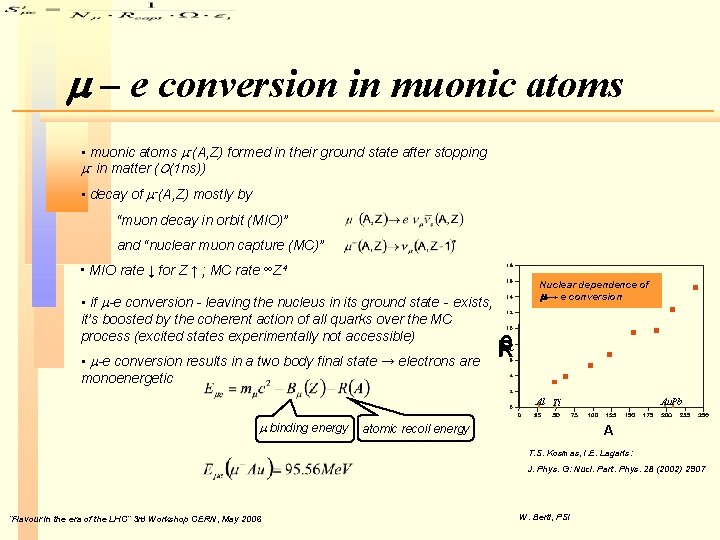
m – e conversion in muonic atoms • muonic atoms m-(A, Z) formed in their ground state after stopping m- in matter (O(1 ns)) • decay of m-(A, Z) mostly by “muon decay in orbit (MIO)” and “nuclear muon capture (MC)” • MIO rate ↓ for Z ↑ ; MC rate ∞Z 4 • if m-e conversion - leaving the nucleus in its ground state - exists, it’s boosted by the coherent action of all quarks over the MC process (excited states experimentally not accessible) • m-e conversion results in a two body final state → electrons are monoenergetic Nuclear dependence of m → e conversion e m R Al Ti m binding energy atomic recoil energy Au. Pb A T. S. Kosmas, I. E. Lagaris: J. Phys. G: Nucl. Part. Phys. 28 (2002) 2907 “Flavour in the era of the LHC” 3 rd Workshop CERN, May 2006 W. Bertl, PSI
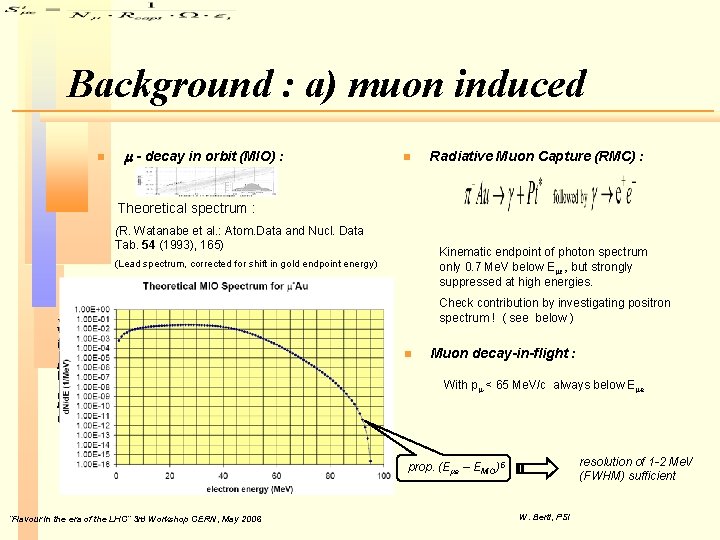
Background : a) muon induced n m - decay in orbit (MIO) : n Radiative Muon Capture (RMC) : Theoretical spectrum : (R. Watanabe et al. : Atom. Data and Nucl. Data Tab. 54 (1993), 165) Kinematic endpoint of photon spectrum only 0. 7 Me. V below Eme , but strongly suppressed at high energies. (Lead spectrum, corrected for shift in gold endpoint energy) )V e M /1 (E d /N d Check contribution by investigating positron spectrum ! ( see below ) n Muon decay-in-flight : With pm < 65 Me. V/c always below Eme resolution of 1 -2 Me. V (FWHM) sufficient prop. (E (Eme – EMIO)5 “Flavour in the era of the LHC” 3 rd Workshop CERN, May 2006 W. Bertl, PSI
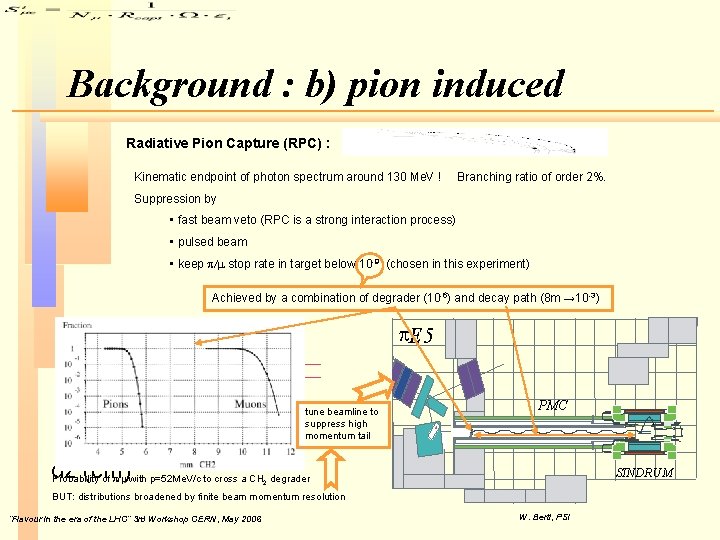
Background : b) pion induced Radiative Pion Capture (RPC) : Kinematic endpoint of photon spectrum around 130 Me. V ! Branching ratio of order 2%. Suppression by • fast beam veto (RPC is a strong interaction process) • pulsed beam • keep p/m stop rate in target below 10 -9 (chosen in this experiment) Achieved by a combination of degrader (10 -6) and decay path (8 m → 10 -3) p. E 5 tune beamline to suppress high momentum tail PMC dz (cm) Probability of p/m with p=52 Me. V/c to cross a CH degrader SINDRUM 2 BUT: distributions broadened by finite beam momentum resolution “Flavour in the era of the LHC” 3 rd Workshop CERN, May 2006 W. Bertl, PSI
Background: c) electron induced Electrons in the beam may scatter from the target Suppression by • beam momentum much below 90 Me. V/c However, electrons from pion decays in flight before the degrader and from RPC in the degrader may have higher momenta and represent a serious background source. Suppression achieved by using their time relation with the proton beam’s rf-structure together with a reduction in phase space (see below) “Flavour in the era of the LHC” 3 rd Workshop CERN, May 2006 W. Bertl, PSI
Background: d) cosmic induced Cosmic radiation produce e- which may fake a me event. Suppression: • Most of them identified by hits not belonging to main track (see below). • g→e+e- pair production in the target : § use passive shielding § veto counter systems § small target mass “Flavour in the era of the LHC” 3 rd Workshop CERN, May 2006 W. Bertl, PSI
Experimental Set-up Proton beam: 590 Me. V, time structure: bursts 0. 3 ns wide every 19. 75 n p. E 5 -beam line: 52 or 53 Me. V/c with ± 2% FWHM (limiting high momentum tail) Transport solenoid PMC: 1. 1 T, lead collimator with 60 mm hole followed by a 8 mm CH 2 degrader “Flavour in the era of the LHC” 3 rd Workshop CERN, May 2006 W. Bertl, PSI
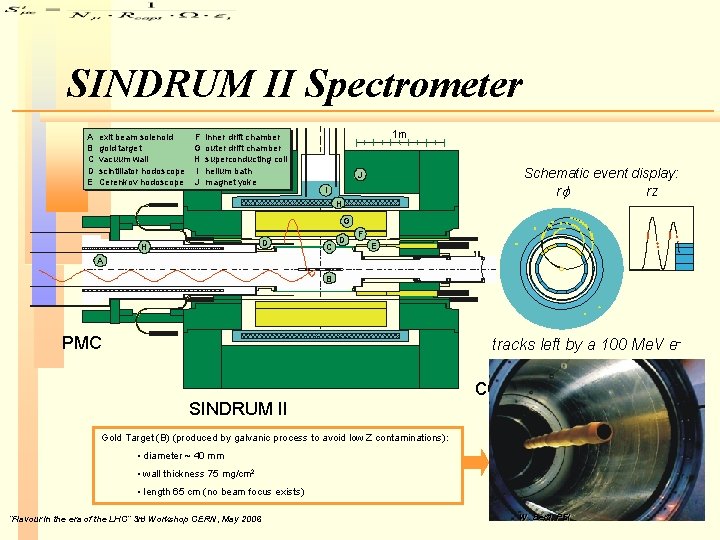
SINDRUM II Spectrometer A B C D E exit beam solenoid F inner drift chamber gold target G outer drift chamber vacuum wall H superconducting coil scintillator hodoscope I helium bath Cerenkov hodoscope J magnet yoke 1 m Schematic event display: rf rz J I H G D H C D F E A B PMC tracks left by a 100 Me. V e- SINDRUM II configuration 2000 Gold Target (B) (produced by galvanic process to avoid low Z contaminations): • diameter ~ 40 mm • wall thickness 75 mg/cm 2 • length 65 cm (no beam focus exists) “Flavour in the era of the LHC” 3 rd Workshop CERN, May 2006 W. Bertl, PSI
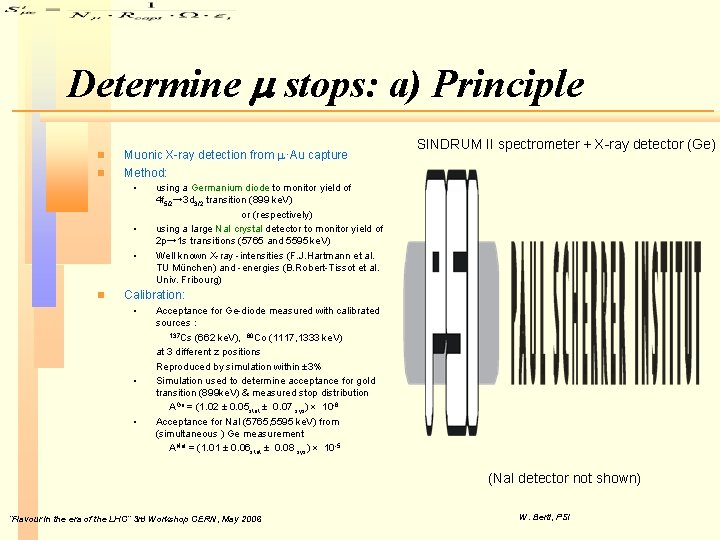
Determine m stops: a) Principle n n Muonic X-ray detection from m -Au capture Method: • • • n SINDRUM II spectrometer + X-ray detector (Ge) using a Germanium diode to monitor yield of 4 f 5/2→ 3 d 3/2 transition (899 ke. V) or (respectively) using a large Na. I crystal detector to monitor yield of 2 p→ 1 s transitions (5765 and 5595 ke. V) Well known X-ray -intensities (F. J. Hartmann et al. TU München) and -energies (B. Robert-Tissot et al. Univ. Fribourg) Calibration: • • • Acceptance for Ge-diode measured with calibrated sources : 137 Cs (662 ke. V), 60 Co (1117, 1333 ke. V) at 3 different z positions Reproduced by simulation within ± 3% Simulation used to determine acceptance for gold transition (899 ke. V) & measured stop distribution AGe = (1. 02 ± 0. 05 stat ± 0. 07 sys) 10 -6 Acceptance for Na. I (5765, 5595 ke. V) from (simultaneous ) Ge measurement ANa. I = (1. 01 ± 0. 06 stat ± 0. 08 sys) 10 -5 (Na. I detector not shown) “Flavour in the era of the LHC” 3 rd Workshop CERN, May 2006 W. Bertl, PSI
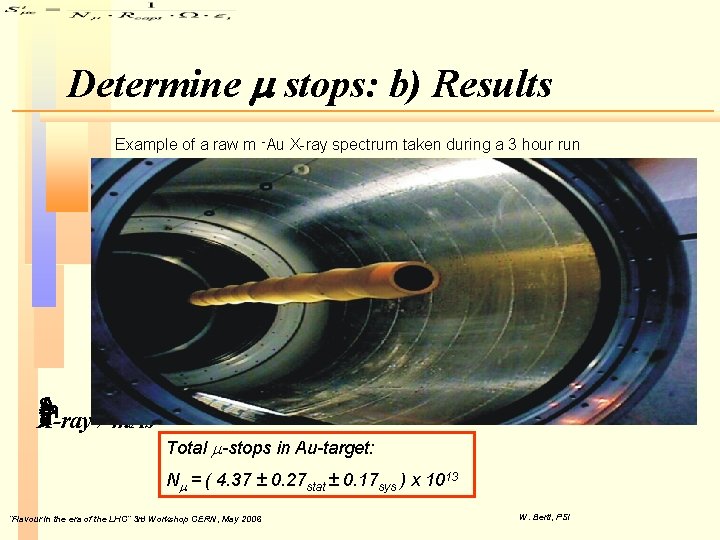
Determine m stops: b) Results Example of a raw m -Au X-ray spectrum taken during a 3 hour run s A m / y ra X-ray / m. As Total m-stops in Au-target: Nm = ( 4. 37 ± 0. 27 stat ± 0. 17 sys ) x 1013 “Flavour in the era of the LHC” 3 rd Workshop CERN, May 2006 W. Bertl, PSI
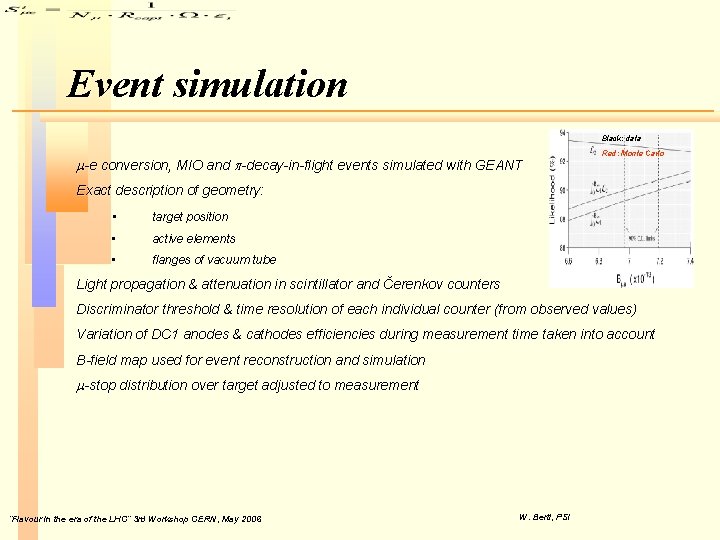
Event simulation Black: data m-e conversion, MIO and p-decay-in-flight events simulated with GEANT Red: Monte Carlo Exact description of geometry: • target position • active elements • flanges of vacuum tube Light propagation & attenuation in scintillator and Čerenkov counters Discriminator threshold & time resolution of each individual counter (from observed values) Variation of DC 1 anodes & cathodes efficiencies during measurement time taken into account B-field map used for event reconstruction and simulation m-stop distribution over target adjusted to measurement “Flavour in the era of the LHC” 3 rd Workshop CERN, May 2006 W. Bertl, PSI
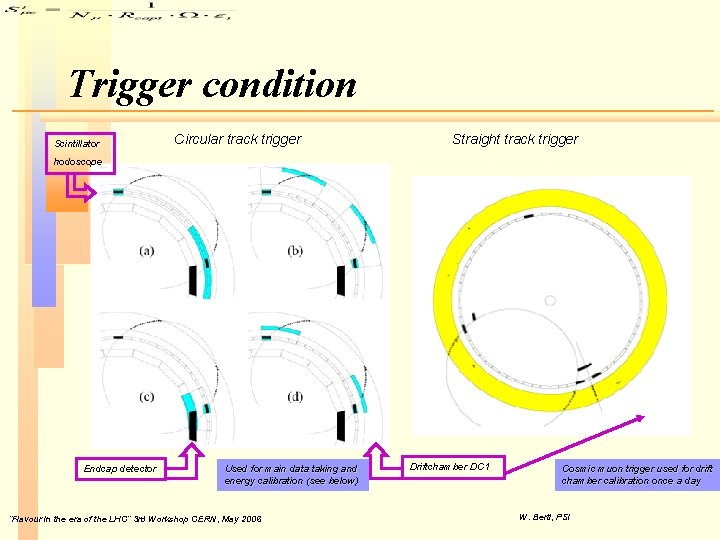
Trigger condition Scintillator Circular track trigger Straight track trigger hodoscope Endcap detector Used for main data taking and energy calibration (see below) “Flavour in the era of the LHC” 3 rd Workshop CERN, May 2006 Driftchamber DC 1 Cosmic muon trigger used for drift chamber calibration once a day W. Bertl, PSI
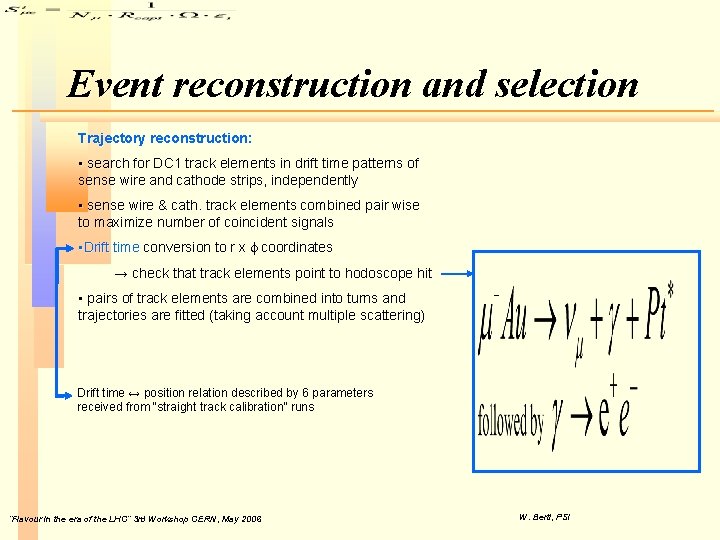
Event reconstruction and selection Trajectory reconstruction: • search for DC 1 track elements in drift time patterns of sense wire and cathode strips, independently • sense wire & cath. track elements combined pair wise to maximize number of coincident signals • Drift time conversion to r x f coordinates → check that track elements point to hodoscope hit • pairs of track elements are combined into turns and trajectories are fitted (taking account multiple scattering) Drift time ↔ position relation described by 6 parameters received from “straight track calibration” runs “Flavour in the era of the LHC” 3 rd Workshop CERN, May 2006 W. Bertl, PSI
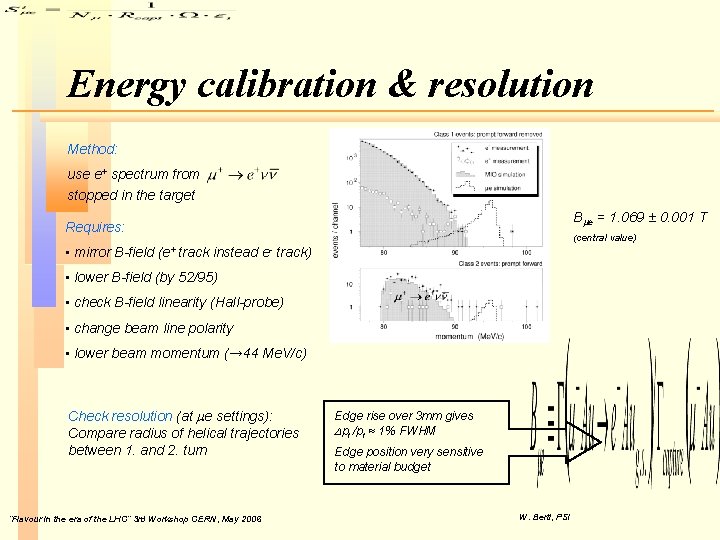
Energy calibration & resolution Method: use e+ spectrum from stopped in the target Bme = 1. 069 ± 0. 001 T Requires: • mirror B-field (central value) (e+ track instead e- track) • lower B-field (by 52/95) • check B-field linearity (Hall-probe) • change beam line polarity • lower beam momentum (→ 44 Me. V/c) Check resolution (at me settings): Compare radius of helical trajectories between 1. and 2. turn “Flavour in the era of the LHC” 3 rd Workshop CERN, May 2006 Edge rise over 3 mm gives Dpt /pt ≈ 1% FWHM Edge position very sensitive to material budget W. Bertl, PSI
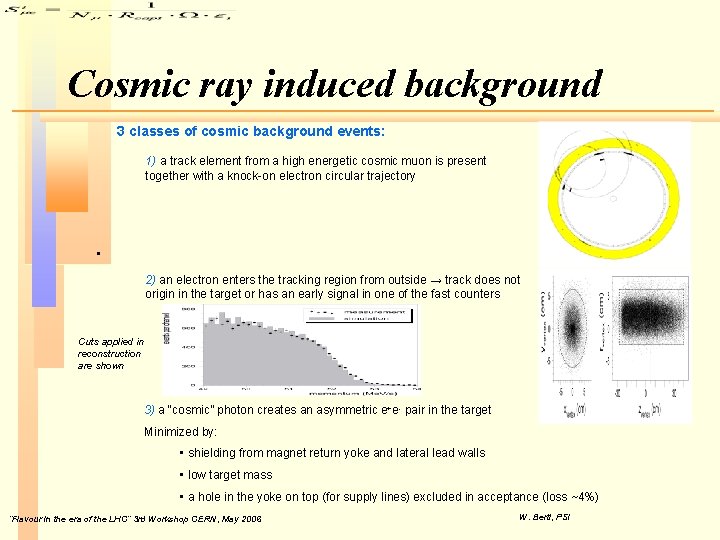
Cosmic ray induced background 3 classes of cosmic background events: 1) a track element from a high energetic cosmic muon is present together with a knock-on electron circular trajectory • 2) an electron enters the tracking region from outside → track does not origin in the target or has an early signal in one of the fast counters Cuts applied in reconstruction are shown 3) a “cosmic” photon creates an asymmetric e+e- pair in the target Minimized by: • shielding from magnet return yoke and lateral lead walls • low target mass • a hole in the yoke on top (for supply lines) excluded in acceptance (loss ~4%) “Flavour in the era of the LHC” 3 rd Workshop CERN, May 2006 W. Bertl, PSI
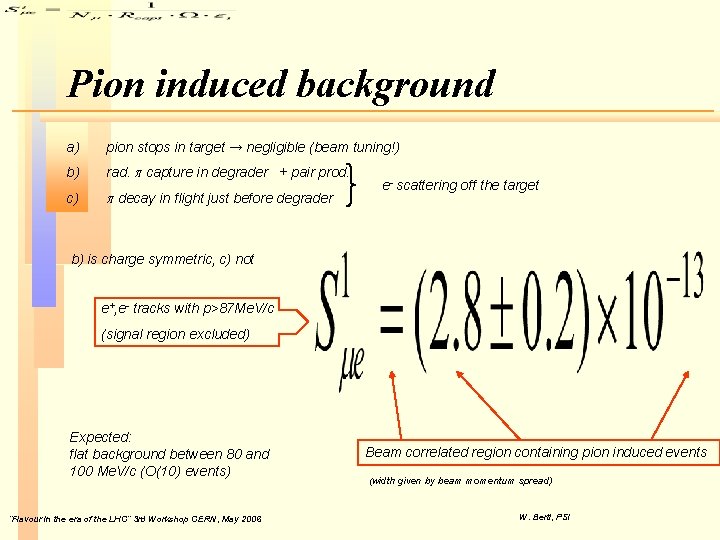
Pion induced background a) pion stops in target → negligible (beam tuning!) b) rad. p capture in degrader + pair prod. c) p decay in flight just before degrader e- scattering off the target b) is charge symmetric, c) not e+, e- tracks with p>87 Me. V/c (signal region excluded) Expected: flat background between 80 and 100 Me. V/c (O(10) events) “Flavour in the era of the LHC” 3 rd Workshop CERN, May 2006 Beam correlated region containing pion induced events (width given by beam momentum spread) W. Bertl, PSI
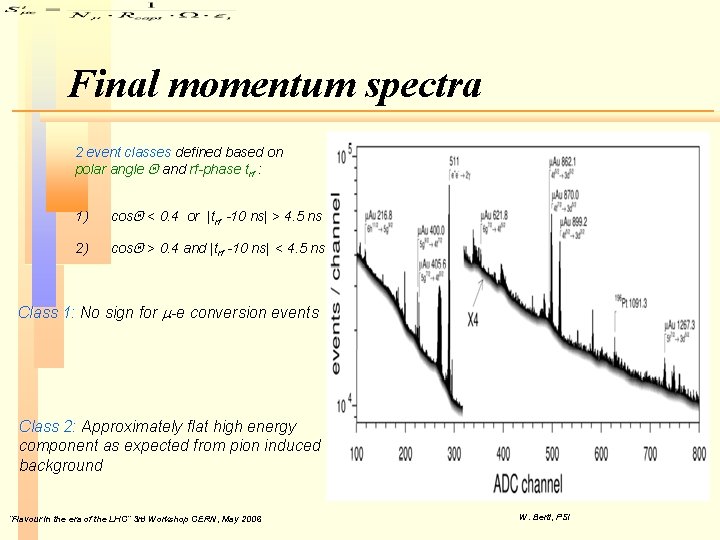
Final momentum spectra 2 event classes defined based on polar angle Q and rf-phase trf : 1) cos. Q < 0. 4 or |trf -10 ns| > 4. 5 ns 2) cos. Q > 0. 4 and |trf -10 ns| < 4. 5 ns Class 1: No sign for m-e conversion events Class 2: Approximately flat high energy component as expected from pion induced background “Flavour in the era of the LHC” 3 rd Workshop CERN, May 2006 W. Bertl, PSI
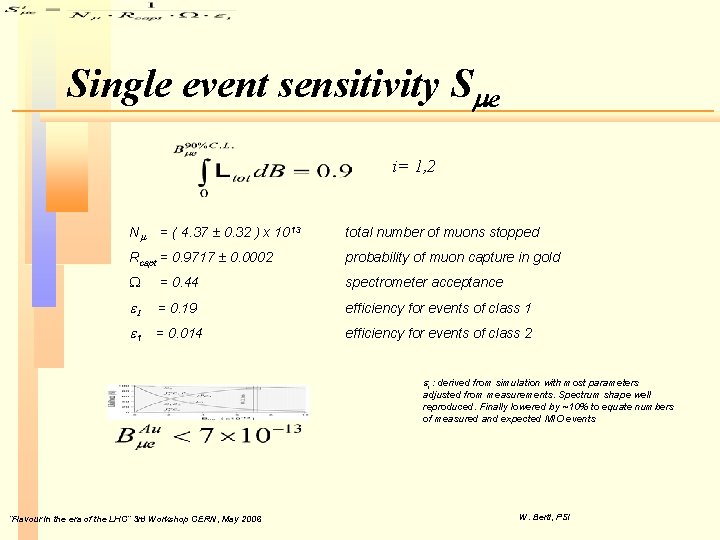
Single event sensitivity Sme i= 1, 2 Nm = ( 4. 37 ± 0. 32 ) x 1013 total number of muons stopped Rcapt = 0. 9717 ± 0. 0002 probability of muon capture in gold W = 0. 44 spectrometer acceptance e 1 = 0. 19 efficiency for events of class 1 e 1 = 0. 014 efficiency for events of class 2 ei : derived from simulation with most parameters adjusted from measurements. Spectrum shape well reproduced. Finally lowered by ~10% to equate numbers of measured and expected MIO events “Flavour in the era of the LHC” 3 rd Workshop CERN, May 2006 W. Bertl, PSI
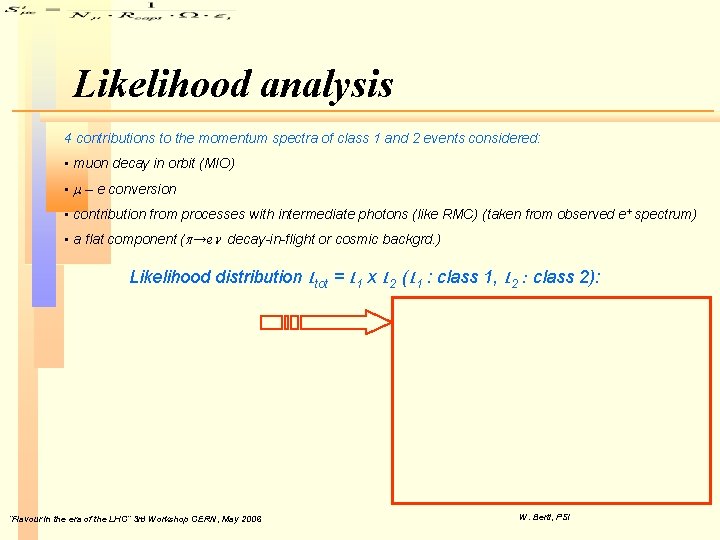
Likelihood analysis 4 contributions to the momentum spectra of class 1 and 2 events considered: • muon decay in orbit (MIO) • m – e conversion • contribution from processes with intermediate photons (like RMC) (taken from observed e+ spectrum) • a flat component (p→en decay-in-flight or cosmic backgrd. ) Likelihood distribution Ltot = L 1 x L 2 (L 1 : class 1, L 2 : class 2): “Flavour in the era of the LHC” 3 rd Workshop CERN, May 2006 W. Bertl, PSI
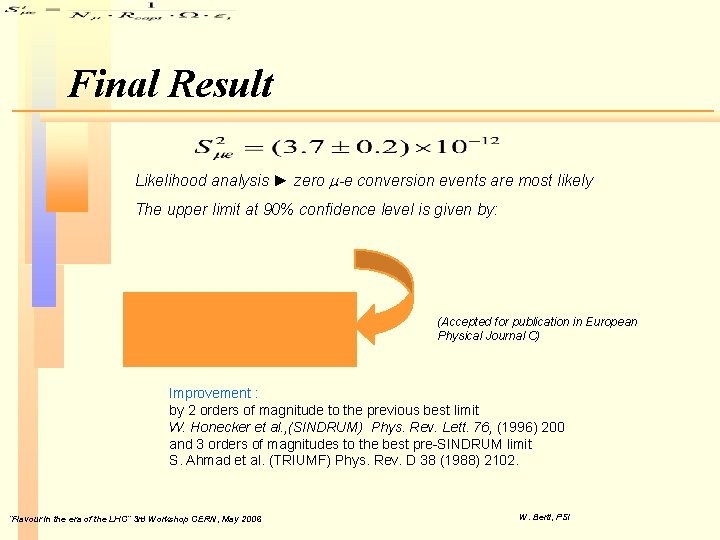
Final Result Likelihood analysis ► zero m-e conversion events are most likely The upper limit at 90% confidence level is given by: (Accepted for publication in European Physical Journal C) Improvement : by 2 orders of magnitude to the previous best limit W. Honecker et al. , (SINDRUM) Phys. Rev. Lett. 76, (1996) 200 and 3 orders of magnitudes to the best pre-SINDRUM limit S. Ahmad et al. (TRIUMF) Phys. Rev. D 38 (1988) 2102. “Flavour in the era of the LHC” 3 rd Workshop CERN, May 2006 W. Bertl, PSI