
Search for Kaonic nuclei at SPring 8LEPS Atsushi
- Slides: 18
Search for Kaonic nuclei at SPring 8/LEPS Atsushi Tokiyasu (for LEPS collaboration) Experimental Nuclear and Hadronic Physics Laboratry, Department of Physics, Kyoto University GCOE Symposium 12 th – 14 th. Feb. 2013 @ Kyoto University
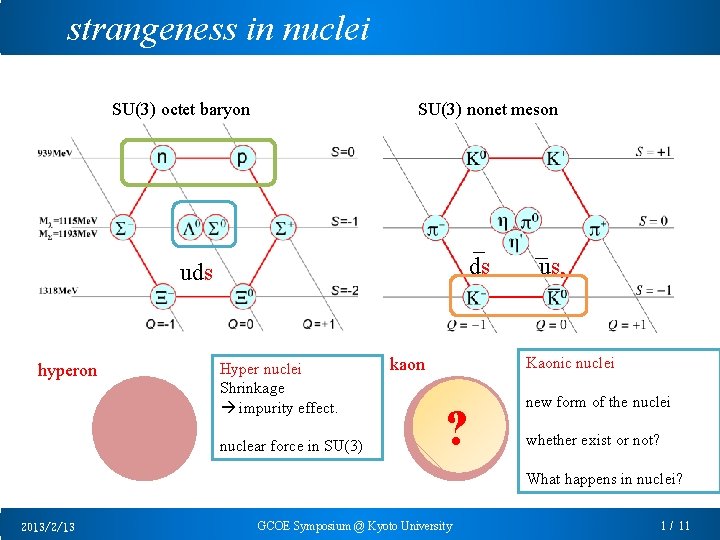
strangeness in nuclei SU(3) octet baryon SU(3) nonet meson ds uds hyperon Hyper nuclei Shrinkage impurity effect. L nuclear force in SU(3) kaon us, Kaonic nuclei ? new form of the nuclei K whether exist or not? What happens in nuclei? 2013/2/13 GCOE Symposium @ Kyoto University 1 / 11
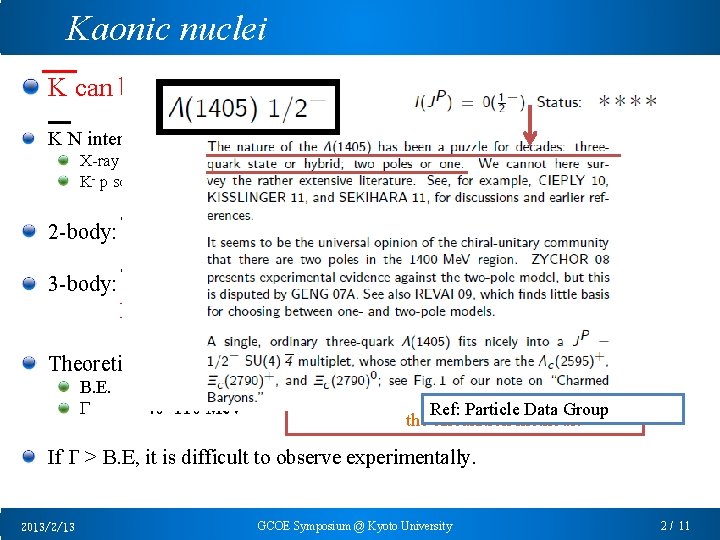
Kaonic nuclei K can be bound in the nuclei by strong interaction. K N interaction (I=0) is strongly attractive ! X-ray shift of Kaonic Hydrogen K- p scattering data 2 -body: KN Formation of Cold (T=0) and Dense (r > 2 r 0) nuclei. : L(1405) ? 3 -body: KNN : lightest nucleus. K-pp the strongest bound state in 3 -body systems Theoretical prediction (All theory support the existence) B. E. = 20 -100 Me. V G = 40 - 110 Me. V dependent on the models of KN interaction Ref: Particle Data Group the calculation methods. If G > B. E, it is difficult to observe experimentally. 2013/2/13 GCOE Symposium @ Kyoto University 2 / 11
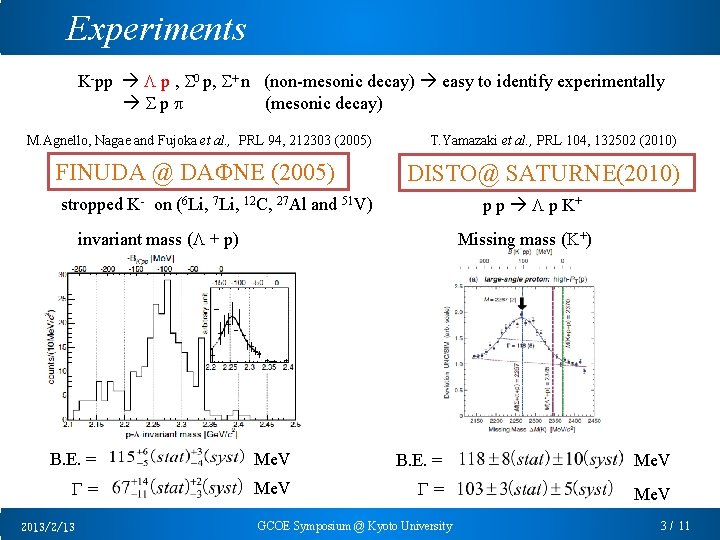
Experiments K-pp L p , S 0 p, S+ n (non-mesonic decay) easy to identify experimentally Spp (mesonic decay) M. Agnello, Nagae and Fujoka et al. , PRL 94, 212303 (2005) FINUDA @ DAFNE (2005) T. Yamazaki et al. , PRL 104, 132502 (2010) DISTO@ SATURNE(2010) p p L p K+ stropped K- on (6 Li, 7 Li, 12 C, 27 Al and 51 V) Missing mass (K+) invariant mass (L + p) B. E. = Me. V G= Me. V 2013/2/13 GCOE Symposium @ Kyoto University 3 / 11
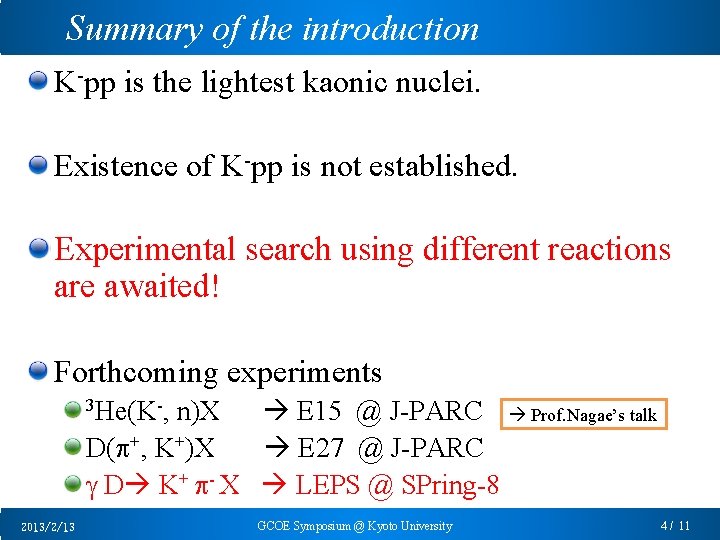
Summary of the introduction K-pp is the lightest kaonic nuclei. Existence of K-pp is not established. Experimental search using different reactions are awaited! Forthcoming experiments n)X E 15 @ J-PARC D(p+, K+)X E 27 @ J-PARC g D K+ p- X LEPS @ SPring-8 3 He(K-, 2013/2/13 GCOE Symposium @ Kyoto University Prof. Nagae’s talk 4 / 11
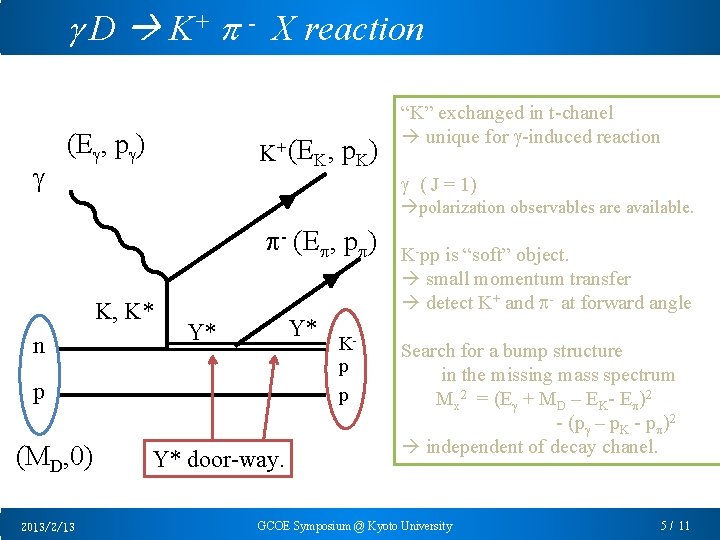
g D K+ p - X reaction g (Eg, pg) K+ (EK, p. K) “K” exchanged in t-chanel unique for g-induced reaction g ( J = 1) polarization observables are available. p- (Ep, pp) K, K* n Y* Y* p (MD, 0) 2013/2/13 Y* door-way. Kp p K-pp is “soft” object. small momentum transfer detect K+ and p- at forward angle Search for a bump structure in the missing mass spectrum Mx 2 = (Eg + MD – EK- Ep)2 - (pg – p. K - pp)2 independent of decay chanel. GCOE Symposium @ Kyoto University 5 / 11
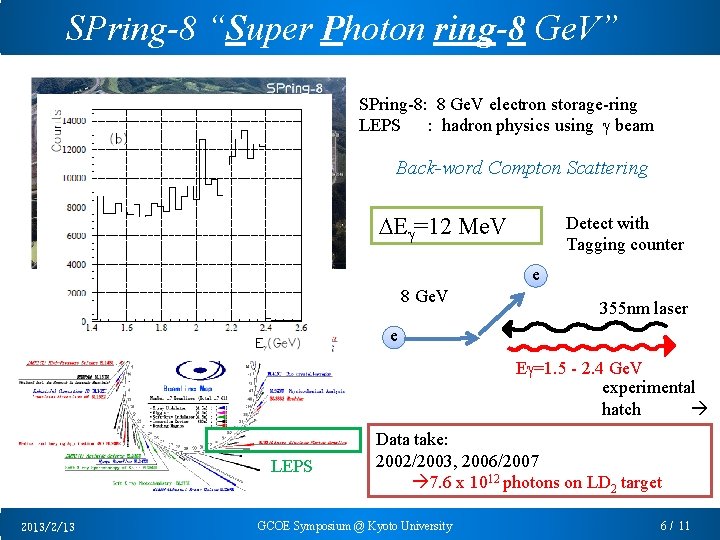
SPring-8 “Super Photon ring-8 Ge. V” SPring-8: 8 Ge. V electron storage-ring LEPS : hadron physics using g beam Back-word Compton Scattering DEg=12 Me. V Detect with Tagging counter e 8 Ge. V 355 nm laser e Eg=1. 5 - 2. 4 Ge. V experimental hatch LEPS 2013/2/13 Data take: 2002/2003, 2006/2007 7. 6 x 10¹² photons on LD 2 target GCOE Symposium @ Kyoto University 6 / 11
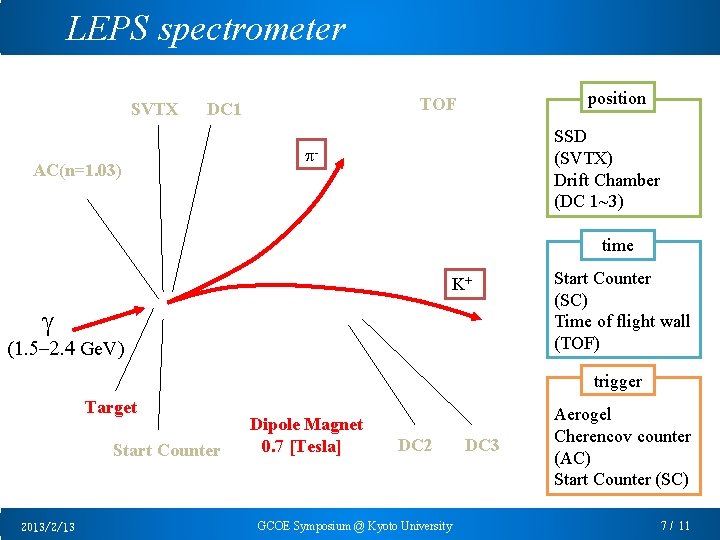
LEPS spectrometer SVTX AC(n=1. 03) position TOF DC 1 SSD (SVTX) Drift Chamber (DC 1~3) p- time K+ g (1. 5 -2. 4 Ge. V) Start Counter (SC) Time of flight wall (TOF) trigger Target Start Counter 2013/2/13 Dipole Magnet 0. 7 [Tesla] DC 2 GCOE Symposium @ Kyoto University DC 3 Aerogel Cherencov counter (AC) Start Counter (SC) 7 / 11
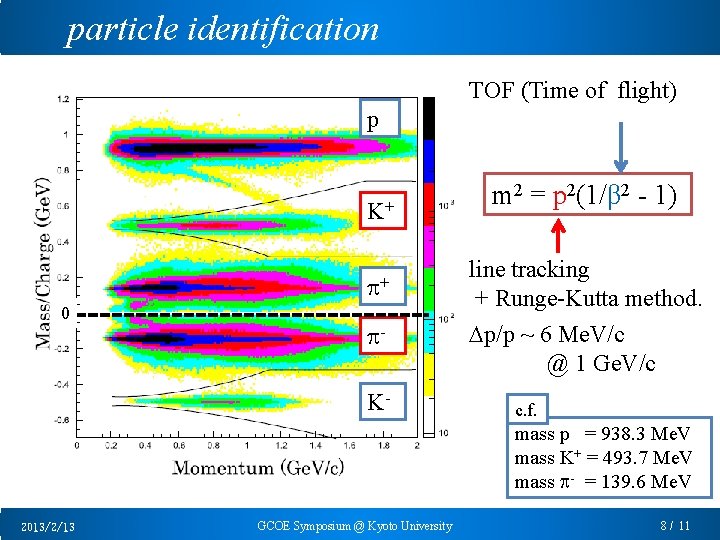
particle identification TOF (Time of flight) p K+ p+ 0 p. K- m 2 = p 2(1/β 2 - 1) line tracking + Runge-Kutta method. Dp/p ~ 6 Me. V/c @ 1 Ge. V/c c. f. mass p = 938. 3 Me. V mass K+ = 493. 7 Me. V mass p- = 139. 6 Me. V 2013/2/13 GCOE Symposium @ Kyoto University 8 / 11
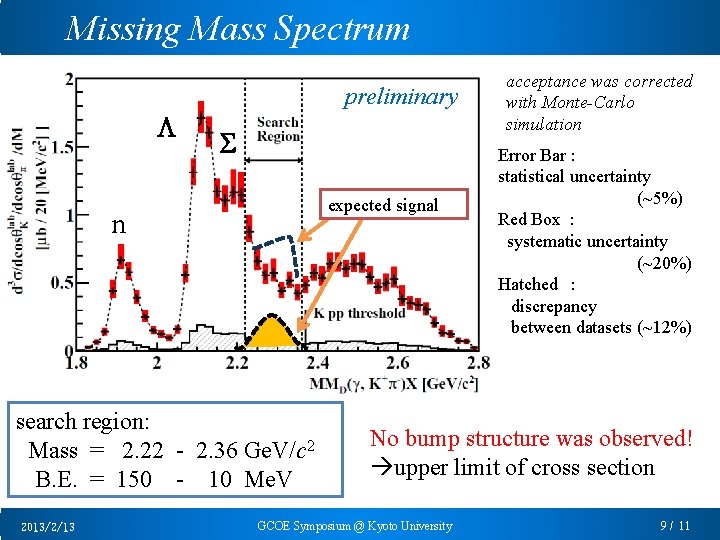
Missing Mass Spectrum L preliminary S expected signal n search region: Mass = 2. 22 - 2. 36 Ge. V/c 2 B. E. = 150 - 10 Me. V 2013/2/13 acceptance was corrected with Monte-Carlo simulation Error Bar : statistical uncertainty (~5%) Red Box : systematic uncertainty (~20%) Hatched : discrepancy between datasets (~12%) No bump structure was observed! upper limit of cross section GCOE Symposium @ Kyoto University 9 / 11
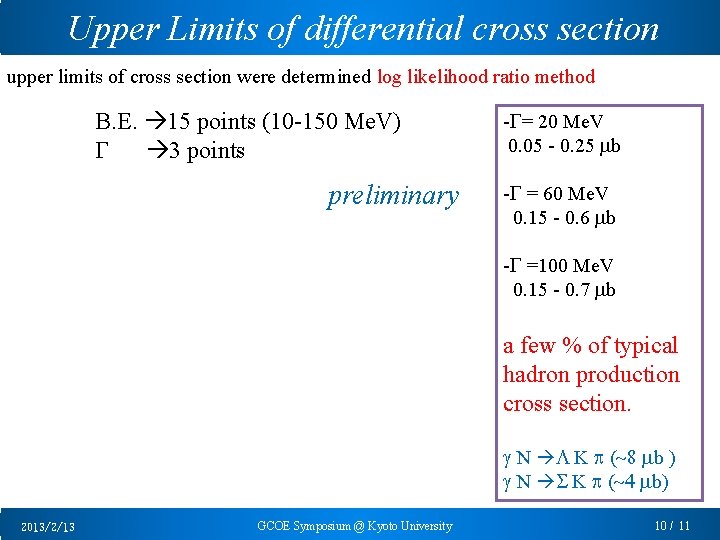
Upper Limits of differential cross section upper limits of cross section were determined log likelihood ratio method B. E. 15 points (10 -150 Me. V) G 3 points preliminary -G= 20 Me. V 0. 05 - 0. 25 mb -G = 60 Me. V 0. 15 - 0. 6 mb -G =100 Me. V 0. 15 - 0. 7 mb a few % of typical hadron production cross section. g N L K p (~8 mb ) g N S K p (~4 mb) 2013/2/13 GCOE Symposium @ Kyoto University 10 / 11
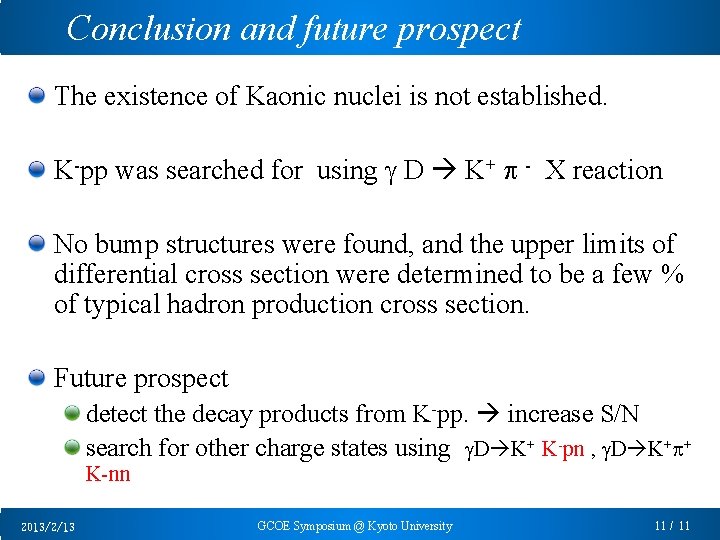
Conclusion and future prospect The existence of Kaonic nuclei is not established. K-pp was searched for using g D K+ p - X reaction No bump structures were found, and the upper limits of differential cross section were determined to be a few % of typical hadron production cross section. Future prospect detect the decay products from K-pp. increase S/N search for other charge states using g. D K+ K-pn , g. D K+p+ K-nn 2013/2/13 GCOE Symposium @ Kyoto University 11 / 11
Collaborators 2013/2/13 GCOE Symposium @ Kyoto University 12 / 15
Appendix 2013/2/13 GCOE Symposium @ Kyoto University 13 / 15
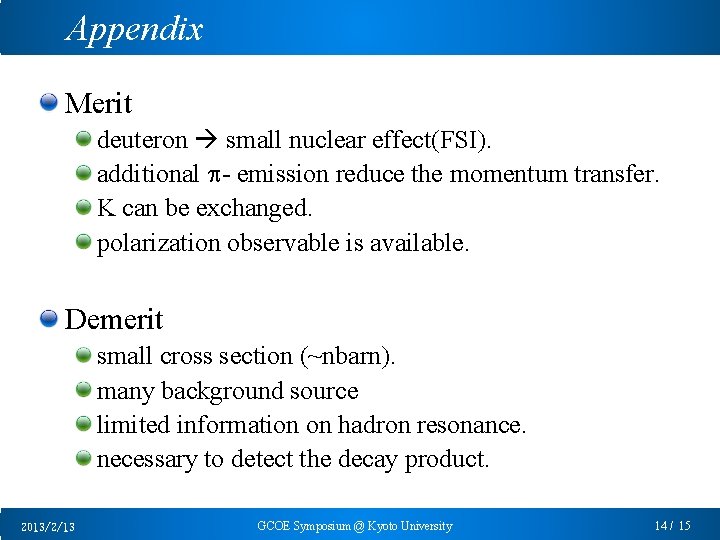
Appendix Merit deuteron small nuclear effect(FSI). additional p- emission reduce the momentum transfer. K can be exchanged. polarization observable is available. Demerit small cross section (~nbarn). many background source limited information on hadron resonance. necessary to detect the decay product. 2013/2/13 GCOE Symposium @ Kyoto University 14 / 15
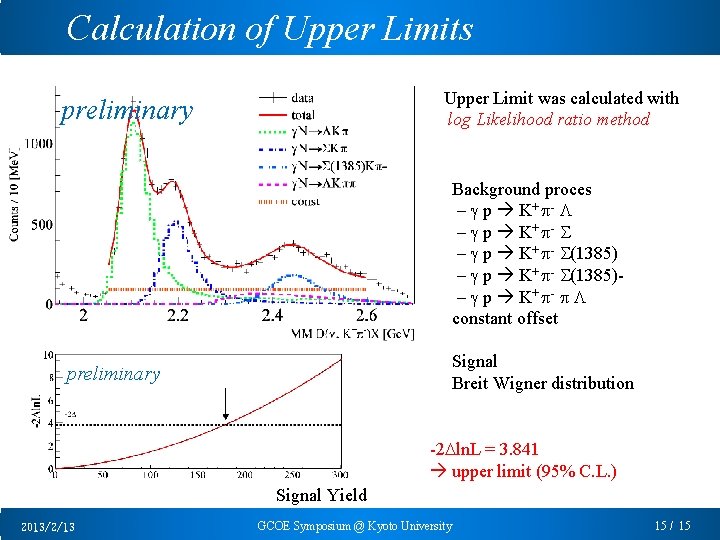
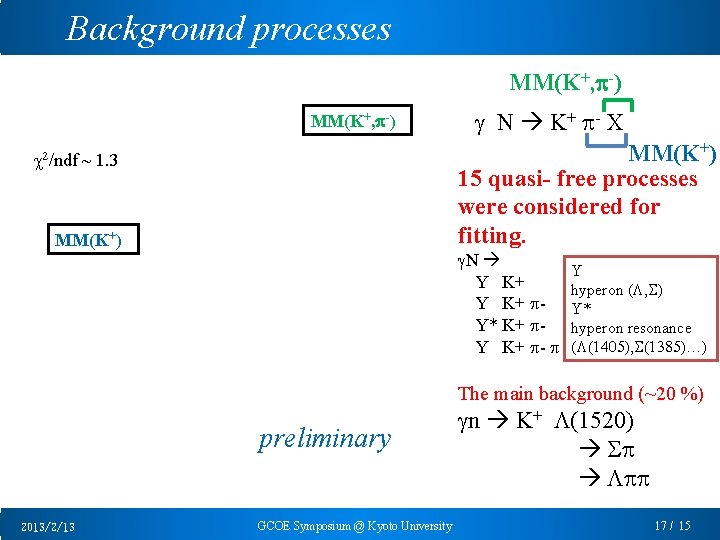
Calculation of Upper Limits Upper Limit was calculated with log Likelihood ratio method preliminary Background proces - g p K+ p - L - g p K+ p - S - g p K+ p- S(1385)- g p K+ p - p L constant offset Signal Breit Wigner distribution preliminary -2 Dln. L = 3. 841 upper limit (95% C. L. ) Signal Yield 2013/2/13 GCOE Symposium @ Kyoto University 15 / 15
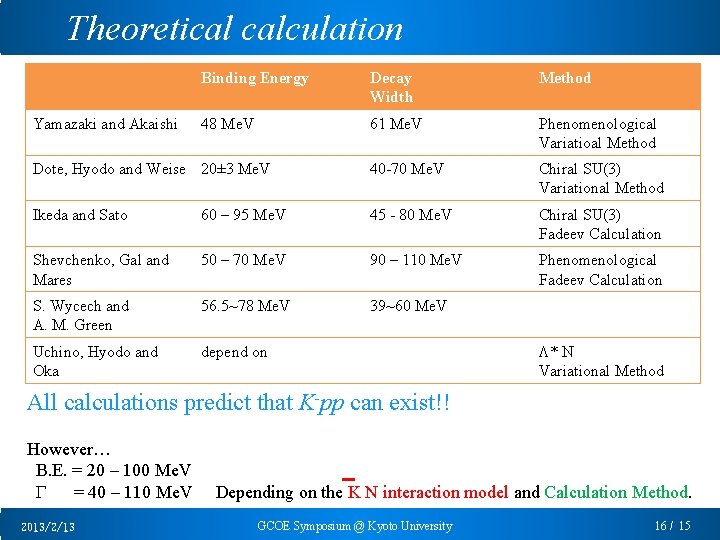
Theoretical calculation Binding Energy Decay Width Method 48 Me. V 61 Me. V Phenomenological Variatioal Method Dote, Hyodo and Weise 20± 3 Me. V 40 -70 Me. V Chiral SU(3) Variational Method Ikeda and Sato 60 – 95 Me. V 45 - 80 Me. V Chiral SU(3) Fadeev Calculation Shevchenko, Gal and Mares 50 – 70 Me. V 90 – 110 Me. V Phenomenological Fadeev Calculation S. Wycech and A. M. Green 56. 5~78 Me. V 39~60 Me. V Uchino, Hyodo and Oka depend on Yamazaki and Akaishi L* N Variational Method All calculations predict that K-pp can exist!! However… B. E. = 20 – 100 Me. V G = 40 – 110 Me. V 2013/2/13 Depending on the K N interaction model and Calculation Method. GCOE Symposium @ Kyoto University 16 / 15
Background processes MM(K+, p-) g N K+ p - X MM(K+) 15 quasi- free processes were considered for fitting. c 2/ndf ~ 1. 3 MM(K+) g. N Y K+ p. Y* K+ p. Y K+ p- p Y hyperon (L, S) Y* hyperon resonance (L(1405), S(1385)…) The main background (~20 %) preliminary 2013/2/13 GCOE Symposium @ Kyoto University gn K+ L(1520) Sp Lpp 17 / 15