
Search for a Possible QCD Critical Point using
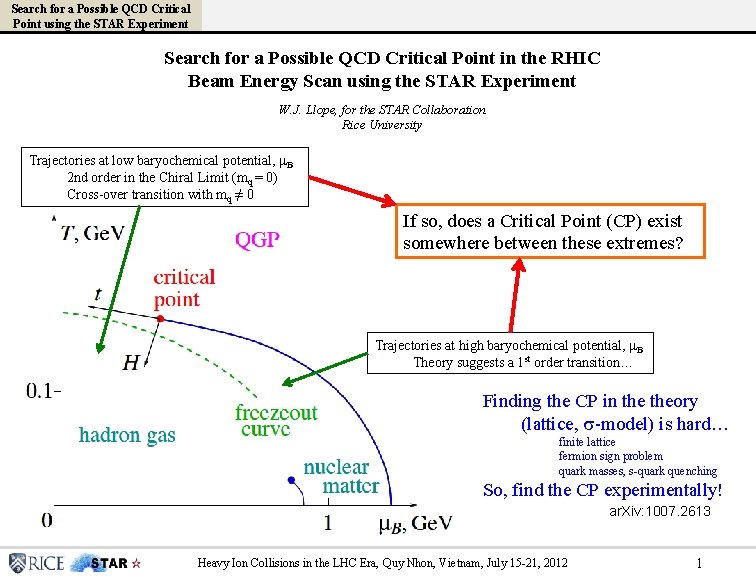
Search for a Possible QCD Critical Point using the STAR Experiment Click to edit Master subtitle style Search for a Possible QCD Critical Point in the RHIC Beam Energy Scan using the STAR Experiment W. J. Llope, for the STAR Collaboration Rice University Trajectories at low baryochemical potential, m. B 2 nd order in the Chiral Limit (mq = 0) Cross-over transition with mq ≠ 0 If so, does a Critical Point (CP) exist somewhere between these extremes? Trajectories at high baryochemical potential, m. B Theory suggests a 1 st order transition… Finding the CP in theory (lattice, s-model) is hard… finite lattice fermion sign problem quark masses, s-quark quenching So, find the CP experimentally! ar. Xiv: 1007. 2613 Heavy Ion Collisions in the LHC Era, Quy Nhon, Vietnam, July 15 -21, 2012 1
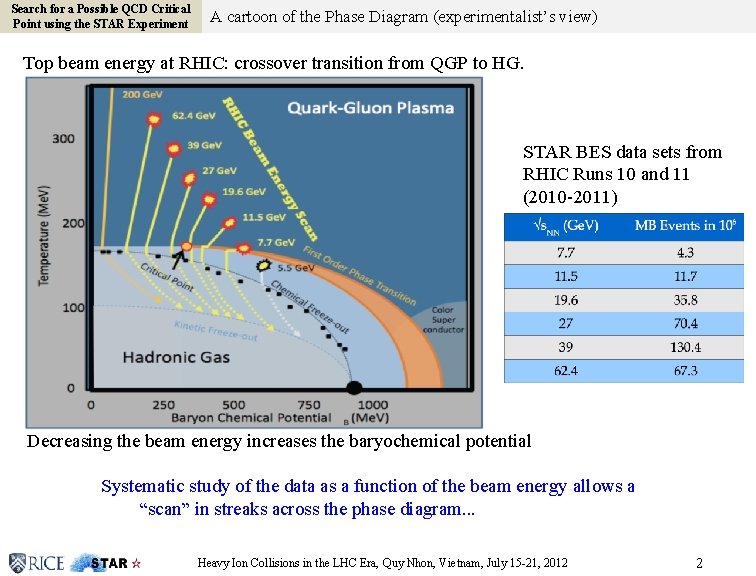
Search for a Possible QCD Critical Point using the STAR Experiment A cartoon of the Phase Diagram (experimentalist’s view) Click to edit Master subtitle style Top beam energy at RHIC: crossover transition from QGP to HG. STAR BES data sets from RHIC Runs 10 and 11 (2010 -2011) Decreasing the beam energy increases the baryochemical potential Systematic study of the data as a function of the beam energy allows a “scan” in streaks across the phase diagram. . . Heavy Ion Collisions in the LHC Era, Quy Nhon, Vietnam, July 15 -21, 2012 2
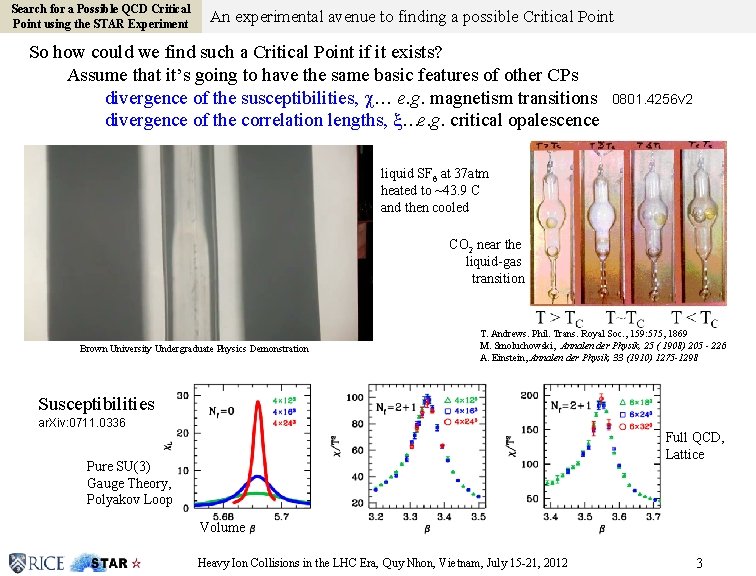
Search for a Possible QCD Critical Point using the STAR Experiment An experimental avenue to finding a possible Critical Point Click to edit Master subtitle style So how could we find such a Critical Point if it exists? Assume that it’s going to have the same basic features of other CPs divergence of the susceptibilities, c… e. g. magnetism transitions divergence of the correlation lengths, x…e. g. critical opalescence 0801. 4256 v 2 liquid SF 6 at 37 atm heated to ~43. 9 C and then cooled CO 2 near the liquid-gas transition Brown University Undergraduate Physics Demonstration T. Andrews. Phil. Trans. Royal Soc. , 159: 575, 1869 M. Smoluchowski, Annalen der Physik, 25 ( 1908) 205 - 226 A. Einstein, Annalen der Physik, 33 (1910) 1275 -1298 Susceptibilities ar. Xiv: 0711. 0336 Full QCD, Lattice Pure SU(3) Gauge Theory, Polyakov Loop Volume Heavy Ion Collisions in the LHC Era, Quy Nhon, Vietnam, July 15 -21, 2012 3
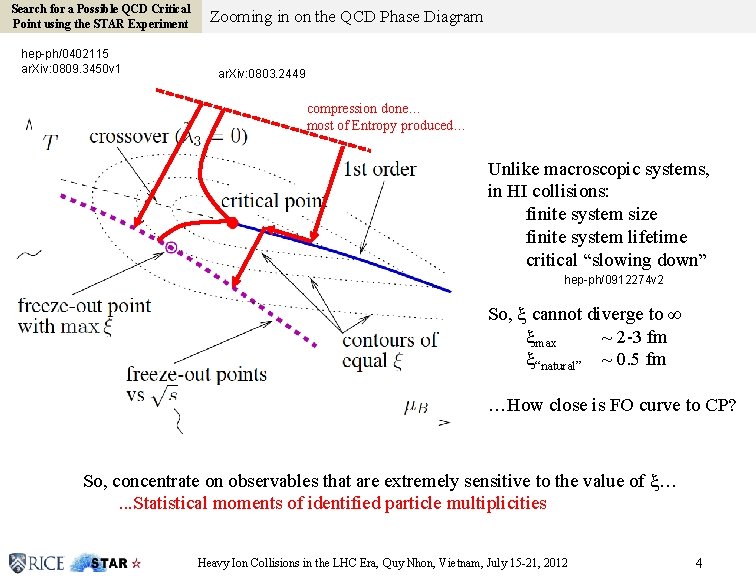
Search for a Possible QCD Critical Point using the STAR Experiment hep-ph/0402115 ar. Xiv: 0809. 3450 v 1 Zooming in on the QCD Phase Diagram Click to edit Master subtitle style ar. Xiv: 0803. 2449 compression done… most of Entropy produced… Unlike macroscopic systems, in HI collisions: finite system size finite system lifetime critical “slowing down” hep-ph/0912274 v 2 So, x cannot diverge to ∞ xmax ~ 2 -3 fm x“natural” ~ 0. 5 fm …How close is FO curve to CP? So, concentrate on observables that are extremely sensitive to the value of x…. . . Statistical moments of identified particle multiplicities Heavy Ion Collisions in the LHC Era, Quy Nhon, Vietnam, July 15 -21, 2012 4
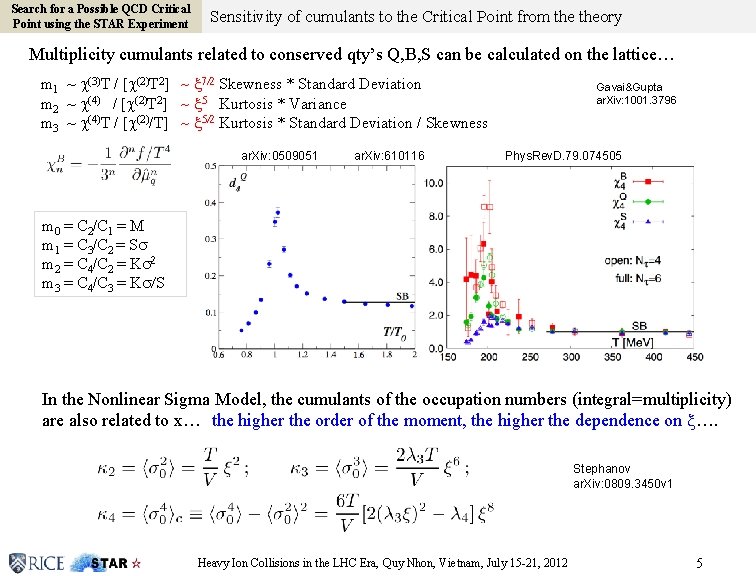
Search for a Possible QCD Critical Point using the STAR Experiment Sensitivity of cumulants to the Critical Point from theory Click to edit Master subtitle style Multiplicity cumulants related to conserved qty’s Q, B, S can be calculated on the lattice… m 1 ~ c(3)T / [c(2)T 2] ~ x 7/2 Skewness * Standard Deviation m 2 ~ c(4) / [c(2)T 2] ~ x 5 Kurtosis * Variance m 3 ~ c(4)T / [c(2)/T] ~ x 5/2 Kurtosis * Standard Deviation / Skewness ar. Xiv: 0509051 ar. Xiv: 610116 Gavai&Gupta ar. Xiv: 1001. 3796 Phys. Rev. D. 79. 074505 m 0 = C 2/C 1 = M m 1 = C 3/C 2 = Ss m 2 = C 4/C 2 = Ks 2 m 3 = C 4/C 3 = Ks/S In the Nonlinear Sigma Model, the cumulants of the occupation numbers (integral=multiplicity) are also related to x… the higher the order of the moment, the higher the dependence on x…. Stephanov ar. Xiv: 0809. 3450 v 1 Heavy Ion Collisions in the LHC Era, Quy Nhon, Vietnam, July 15 -21, 2012 5
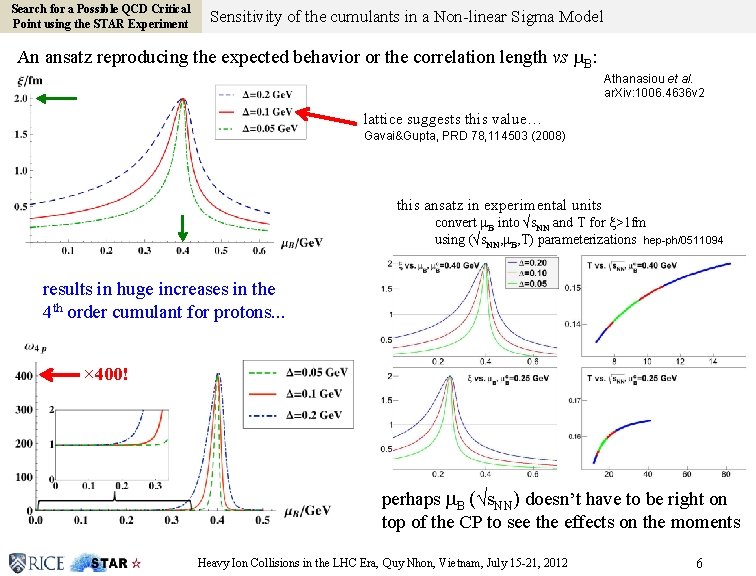
Search for a Possible QCD Critical Point using the STAR Experiment Sensitivity of the cumulants in a Non-linear Sigma Model Click to edit Master subtitle style An ansatz reproducing the expected behavior or the correlation length vs m. B: Athanasiou et al. ar. Xiv: 1006. 4636 v 2 lattice suggests this value… Gavai&Gupta, PRD 78, 114503 (2008) this ansatz in experimental units convert m. B into √s. NN and T for x>1 fm using (√s. NN, m. B, T) parameterizations hep-ph/0511094 results in huge increases in the 4 th order cumulant for protons. . . × 400! perhaps m. B (√s. NN) doesn’t have to be right on top of the CP to see the effects on the moments Heavy Ion Collisions in the LHC Era, Quy Nhon, Vietnam, July 15 -21, 2012 6
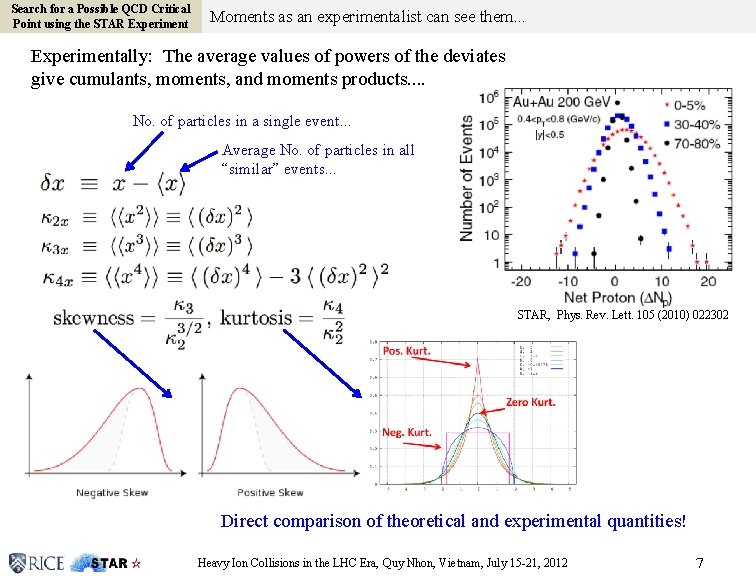
Search for a Possible QCD Critical Point using the STAR Experiment Moments as an experimentalist can see them. . . Click to edit Master subtitle style Experimentally: The average values of powers of the deviates give cumulants, moments, and moments products. . No. of particles in a single event. . . Average No. of particles in all “similar” events. . . STAR, Phys. Rev. Lett. 105 (2010) 022302 Direct comparison of theoretical and experimental quantities! Heavy Ion Collisions in the LHC Era, Quy Nhon, Vietnam, July 15 -21, 2012 7
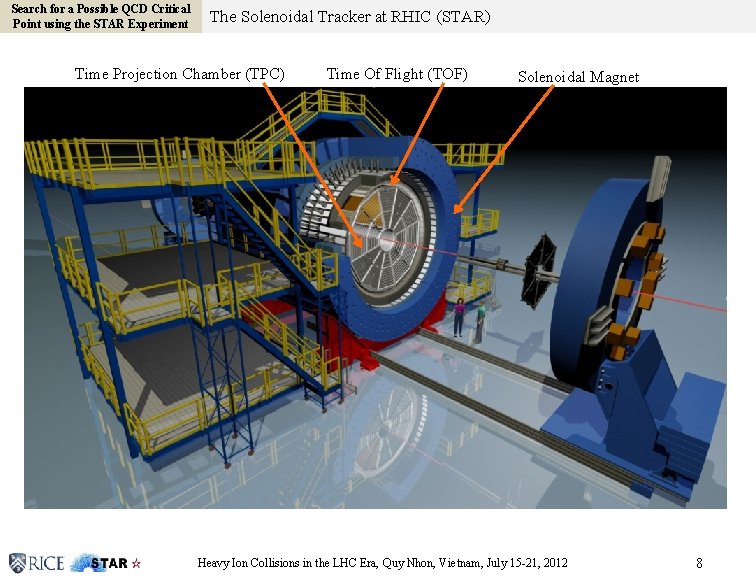
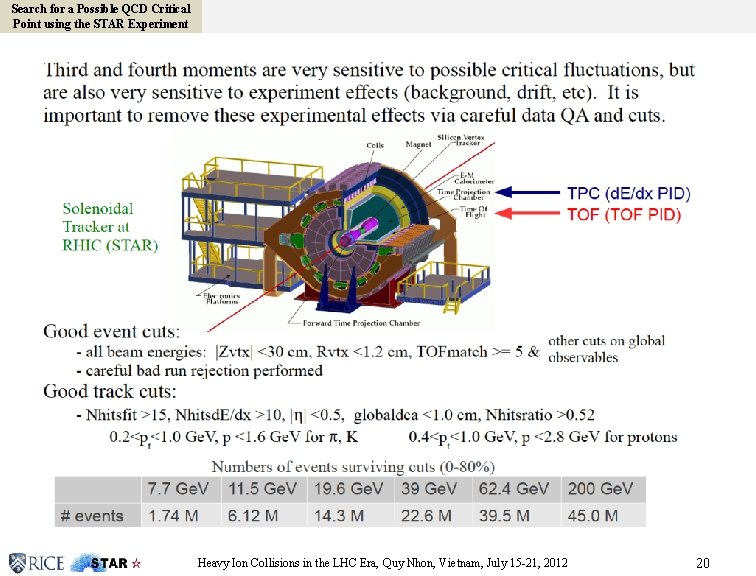
Search for a Possible QCD Critical Point using the STAR Experiment The Solenoidal Tracker at RHIC (STAR) Click to edit Master subtitle style Time Projection Chamber (TPC) Time Of Flight (TOF) Solenoidal Magnet Heavy Ion Collisions in the LHC Era, Quy Nhon, Vietnam, July 15 -21, 2012 8
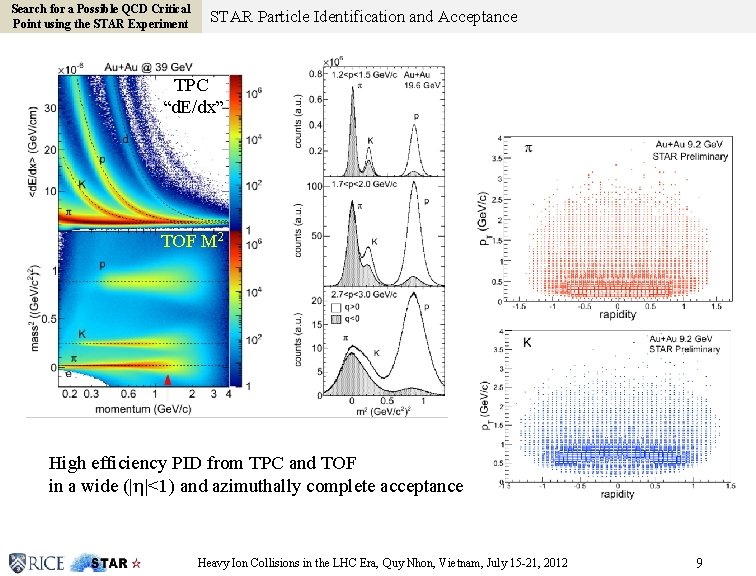
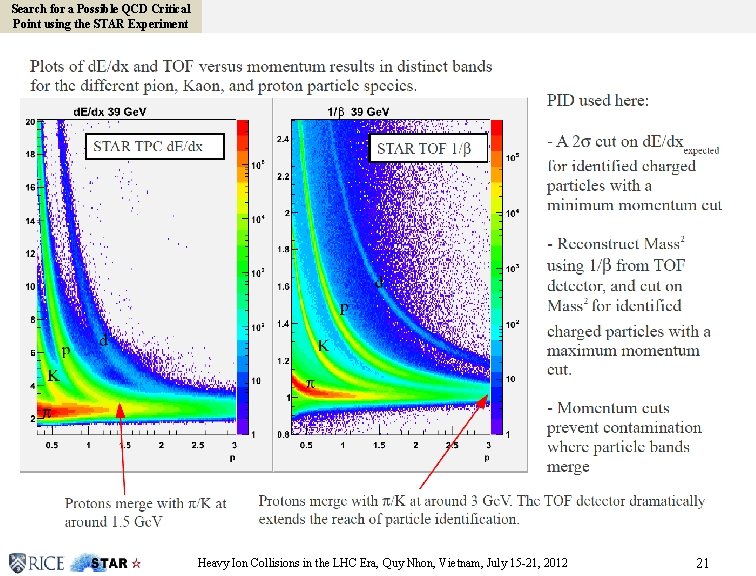
Search for a Possible QCD Critical Point using the STAR Experiment STAR Particle Identification and Acceptance Click to edit Master subtitle style TPC “d. E/dx” TOF M 2 High efficiency PID from TPC and TOF in a wide (|h|<1) and azimuthally complete acceptance Heavy Ion Collisions in the LHC Era, Quy Nhon, Vietnam, July 15 -21, 2012 9
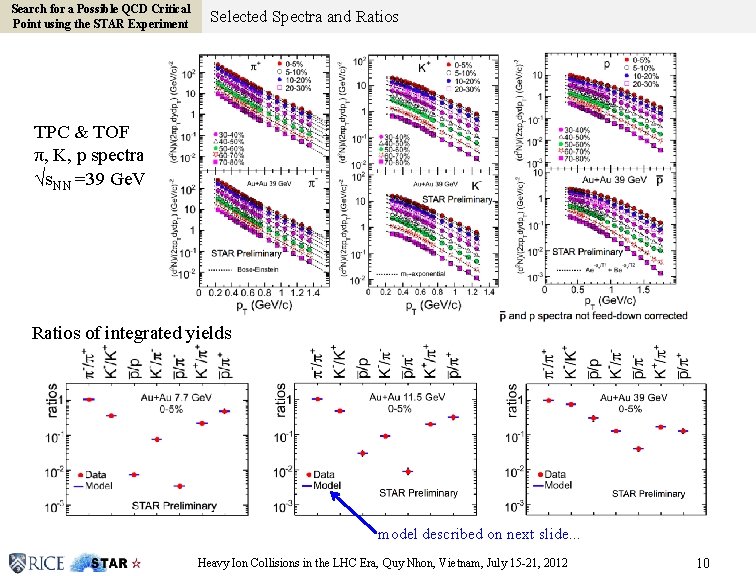
Search for a Possible QCD Critical Point using the STAR Experiment Selected Spectra and Ratios Click to edit Master subtitle style TPC & TOF π, K, p spectra √s. NN =39 Ge. V Ratios of integrated yields model described on next slide. . . Heavy Ion Collisions in the LHC Era, Quy Nhon, Vietnam, July 15 -21, 2012 10
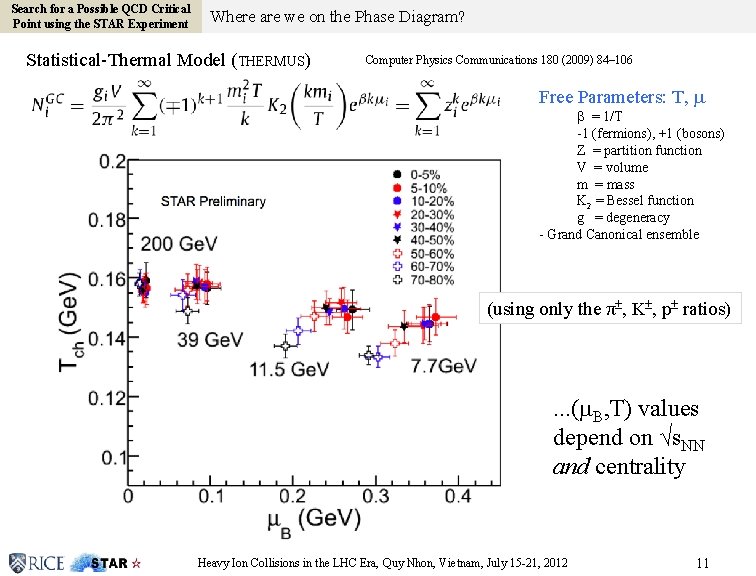
Search for a Possible QCD Critical Point using the STAR Experiment Where are we on the Phase Diagram? Click to edit Master subtitle style Statistical-Thermal Model (THERMUS) Computer Physics Communications 180 (2009) 84– 106 Free Parameters: T, m b = 1/T -1 (fermions), +1 (bosons) Z = partition function V = volume m = mass K 2 = Bessel function g = degeneracy - Grand Canonical ensemble (using only the π±, K±, p± ratios) . . . (m. B, T) values depend on √s. NN and centrality Heavy Ion Collisions in the LHC Era, Quy Nhon, Vietnam, July 15 -21, 2012 11
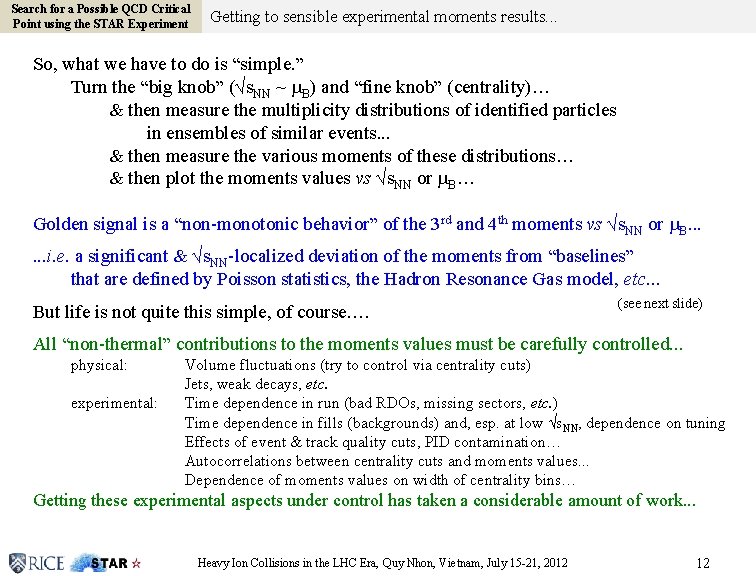
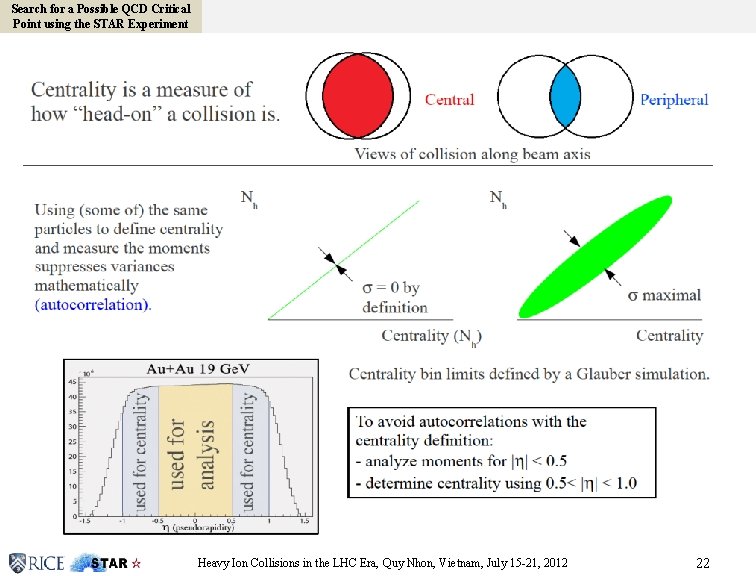
Search for a Possible QCD Critical Point using the STAR Experiment Getting to sensible experimental moments results. . . Click to edit Master subtitle style So, what we have to do is “simple. ” Turn the “big knob” (√s. NN ~ m. B) and “fine knob” (centrality)… & then measure the multiplicity distributions of identified particles in ensembles of similar events. . . & then measure the various moments of these distributions… & then plot the moments values vs √s. NN or m. B… Golden signal is a “non-monotonic behavior” of the 3 rd and 4 th moments vs √s. NN or m. B. . . i. e. a significant & √s. NN-localized deviation of the moments from “baselines” that are defined by Poisson statistics, the Hadron Resonance Gas model, etc. . . But life is not quite this simple, of course…. (see next slide) All “non-thermal” contributions to the moments values must be carefully controlled. . . physical: experimental: Volume fluctuations (try to control via centrality cuts) Jets, weak decays, etc. Time dependence in run (bad RDOs, missing sectors, etc. ) Time dependence in fills (backgrounds) and, esp. at low √s. NN, dependence on tuning Effects of event & track quality cuts, PID contamination… Autocorrelations between centrality cuts and moments values. . . Dependence of moments values on width of centrality bins… Getting these experimental aspects under control has taken a considerable amount of work. . . Heavy Ion Collisions in the LHC Era, Quy Nhon, Vietnam, July 15 -21, 2012 12
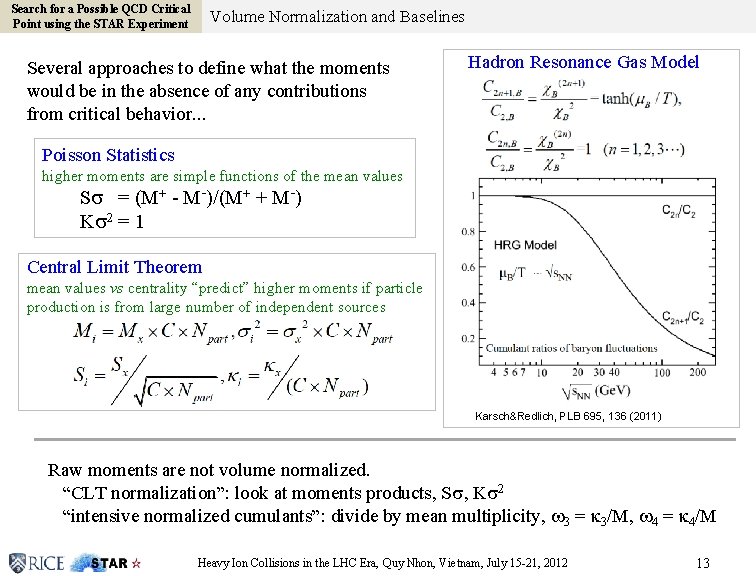
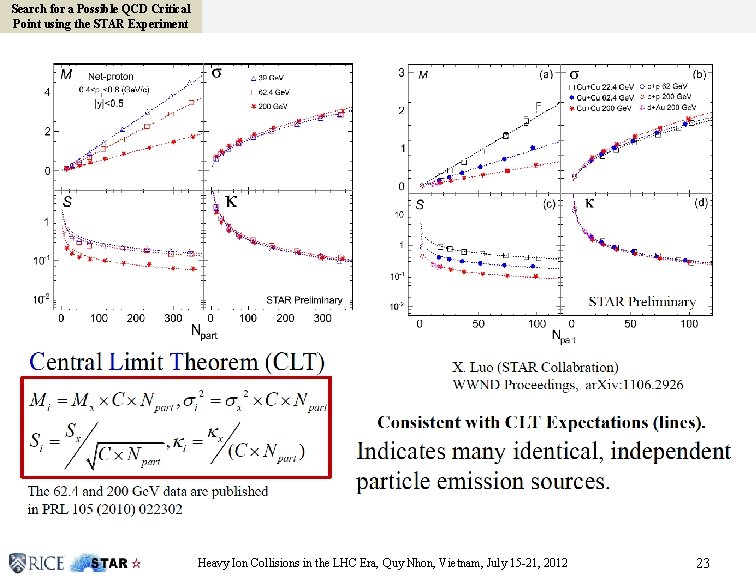
Search for a Possible QCD Critical Point using the STAR Experiment Volume Normalization and Baselines Click to edit Master subtitle style Several approaches to define what the moments would be in the absence of any contributions from critical behavior. . . Hadron Resonance Gas Model Poisson Statistics higher moments are simple functions of the mean values Ss = (M+ - M-)/(M+ + M-) Ks 2 = 1 Central Limit Theorem mean values vs centrality “predict” higher moments if particle production is from large number of independent sources Karsch&Redlich, PLB 695, 136 (2011) Raw moments are not volume normalized. “CLT normalization”: look at moments products, Ss, Ks 2 “intensive normalized cumulants”: divide by mean multiplicity, w 3 = k 3/M, w 4 = k 4/M Heavy Ion Collisions in the LHC Era, Quy Nhon, Vietnam, July 15 -21, 2012 13
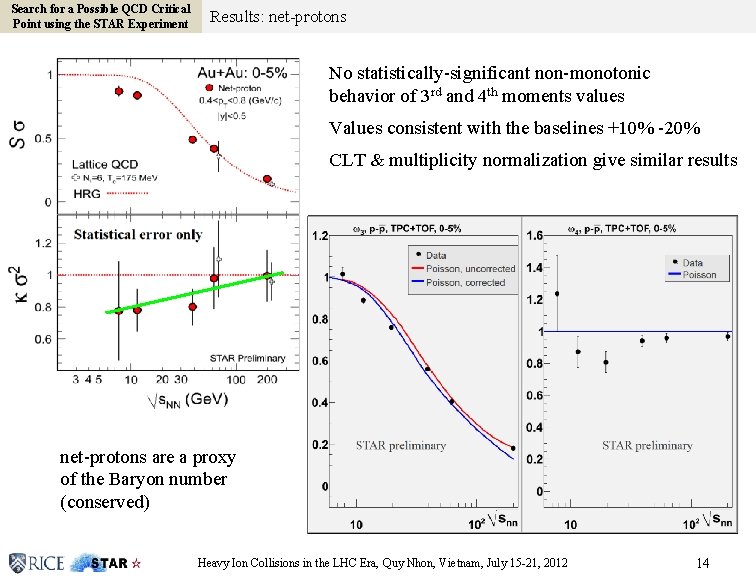
Search for a Possible QCD Critical Point using the STAR Experiment Results: net-protons Click to edit Master subtitle style No statistically-significant non-monotonic behavior of 3 rd and 4 th moments values Values consistent with the baselines +10% -20% CLT & multiplicity normalization give similar results net-protons are a proxy of the Baryon number (conserved) Heavy Ion Collisions in the LHC Era, Quy Nhon, Vietnam, July 15 -21, 2012 14
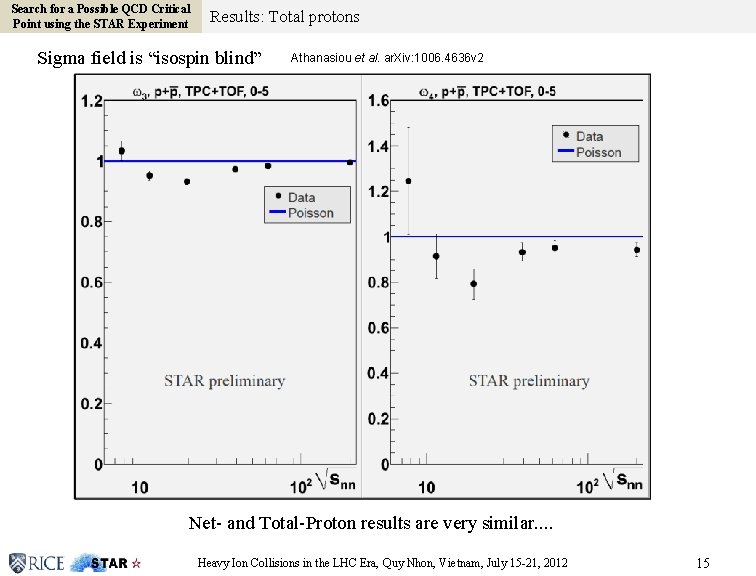
Search for a Possible QCD Critical Point using the STAR Experiment Results: Total protons Sigma field is “isospin blind” Click to edit Master subtitle style Athanasiou et al. ar. Xiv: 1006. 4636 v 2 Net- and Total-Proton results are very similar. . Heavy Ion Collisions in the LHC Era, Quy Nhon, Vietnam, July 15 -21, 2012 15
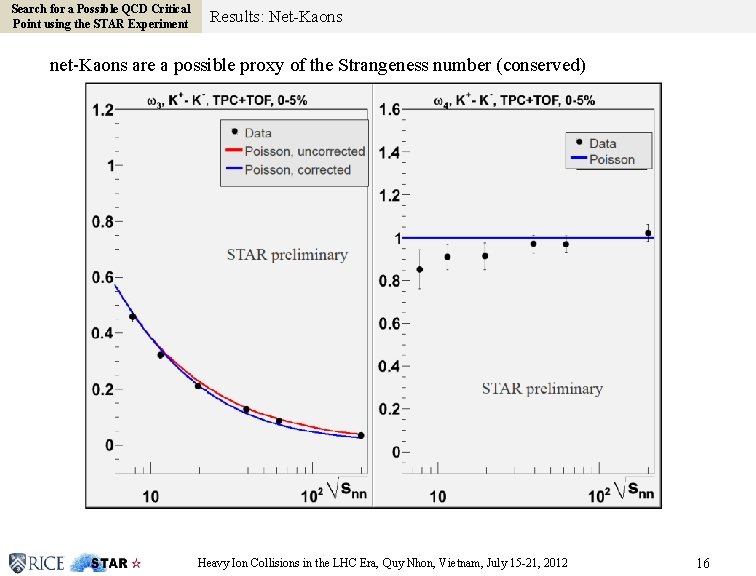
Search for a Possible QCD Critical Point using the STAR Experiment Results: Net-Kaons Click to edit Master subtitle style net-Kaons are a possible proxy of the Strangeness number (conserved) Heavy Ion Collisions in the LHC Era, Quy Nhon, Vietnam, July 15 -21, 2012 16
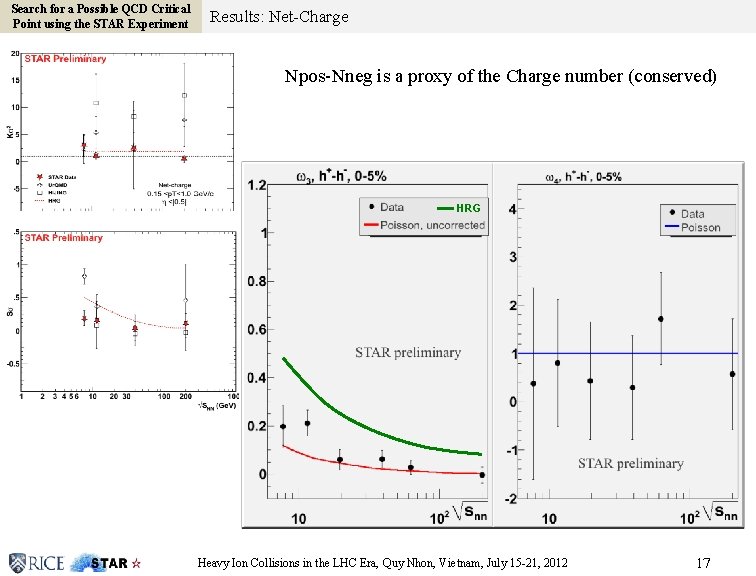
Search for a Possible QCD Critical Point using the STAR Experiment Results: Net-Charge Click to edit Master subtitle style Npos-Nneg is a proxy of the Charge number (conserved) HRG Heavy Ion Collisions in the LHC Era, Quy Nhon, Vietnam, July 15 -21, 2012 17
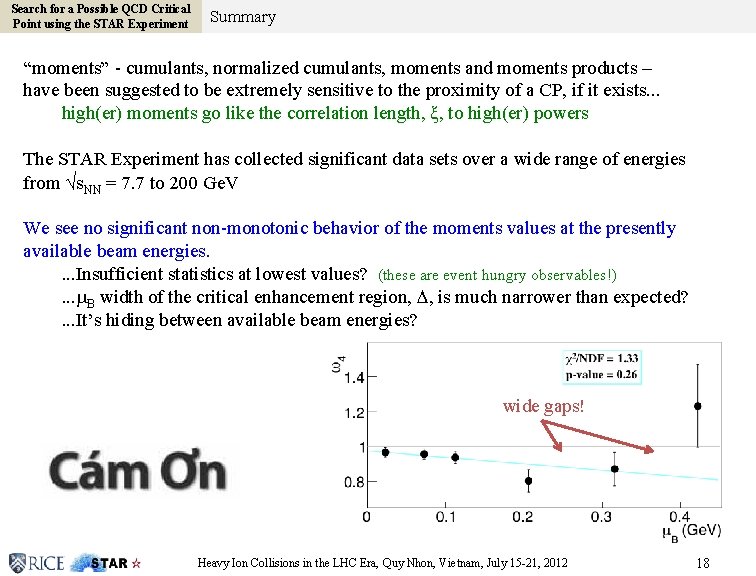
Search for a Possible QCD Critical Point using the STAR Experiment Summary Click to edit Master subtitle style “moments” - cumulants, normalized cumulants, moments and moments products – have been suggested to be extremely sensitive to the proximity of a CP, if it exists. . . high(er) moments go like the correlation length, ξ, to high(er) powers The STAR Experiment has collected significant data sets over a wide range of energies from √s. NN = 7. 7 to 200 Ge. V We see no significant non-monotonic behavior of the moments values at the presently available beam energies. . Insufficient statistics at lowest values? (these are event hungry observables!). . . m. B width of the critical enhancement region, D, is much narrower than expected? . . . It’s hiding between available beam energies? wide gaps! Heavy Ion Collisions in the LHC Era, Quy Nhon, Vietnam, July 15 -21, 2012 18
Search for a Possible QCD Critical Point using the STAR Experiment Click to edit Master subtitle style BACKUP Heavy Ion Collisions in the LHC Era, Quy Nhon, Vietnam, July 15 -21, 2012 19
Search for a Possible QCD Critical Point using the STAR Experiment Click to edit Master subtitle style Heavy Ion Collisions in the LHC Era, Quy Nhon, Vietnam, July 15 -21, 2012 20
Search for a Possible QCD Critical Point using the STAR Experiment Click to edit Master subtitle style Heavy Ion Collisions in the LHC Era, Quy Nhon, Vietnam, July 15 -21, 2012 21
Search for a Possible QCD Critical Point using the STAR Experiment Click to edit Master subtitle style Heavy Ion Collisions in the LHC Era, Quy Nhon, Vietnam, July 15 -21, 2012 22
Search for a Possible QCD Critical Point using the STAR Experiment Click to edit Master subtitle style Heavy Ion Collisions in the LHC Era, Quy Nhon, Vietnam, July 15 -21, 2012 23
- Slides: 23