
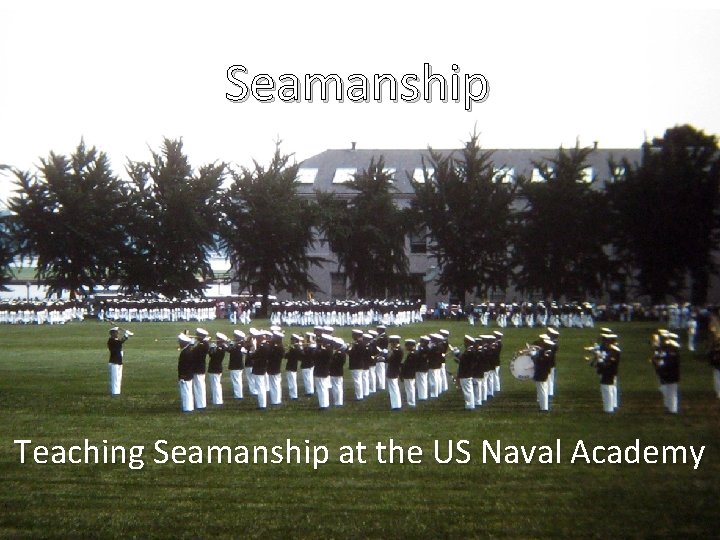
Seamanship Teaching Seamanship at the US Naval Academy
- Slides: 26
Seamanship Teaching Seamanship at the US Naval Academy
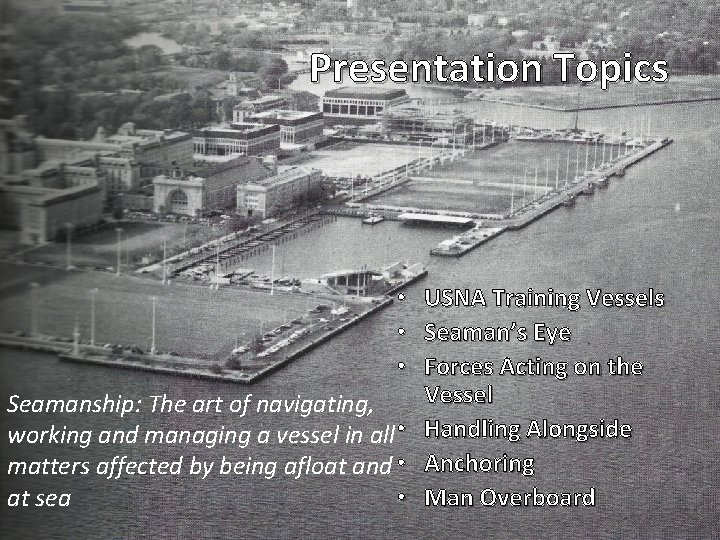
Presentation Topics • USNA Training Vessels • Seaman’s Eye • Forces Acting on the Vessel Seamanship: The art of navigating, working and managing a vessel in all • Handling Alongside matters affected by being afloat and • Anchoring • Man Overboard at sea
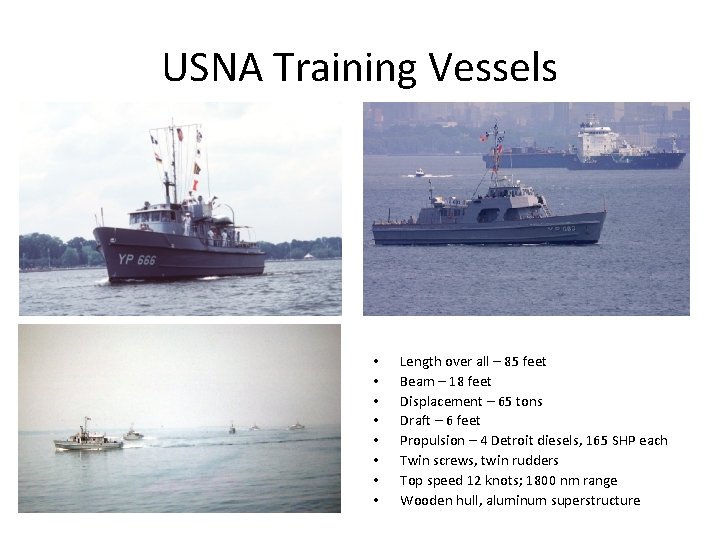
USNA Training Vessels • • Length over all – 85 feet Beam – 18 feet Displacement – 65 tons Draft – 6 feet Propulsion – 4 Detroit diesels, 165 SHP each Twin screws, twin rudders Top speed 12 knots; 1800 nm range Wooden hull, aluminum superstructure
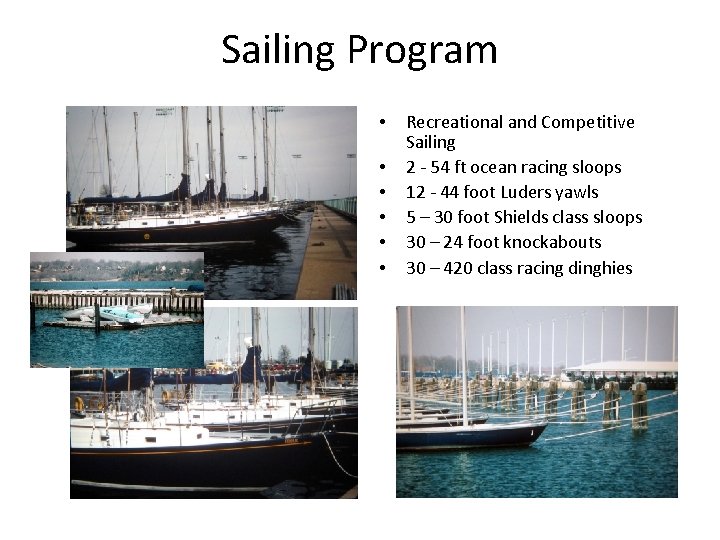
Sailing Program • • • Recreational and Competitive Sailing 2 - 54 ft ocean racing sloops 12 - 44 foot Luders yawls 5 – 30 foot Shields class sloops 30 – 24 foot knockabouts 30 – 420 class racing dinghies
Presentation Topics • USNA Training Vessels • Seaman’s Eye • Forces Acting on the Vessel Seamanship: The art of navigating, working and managing a vessel in all • Handling Alongside matters affected by being afloat and • Anchoring • Man Overboard at sea
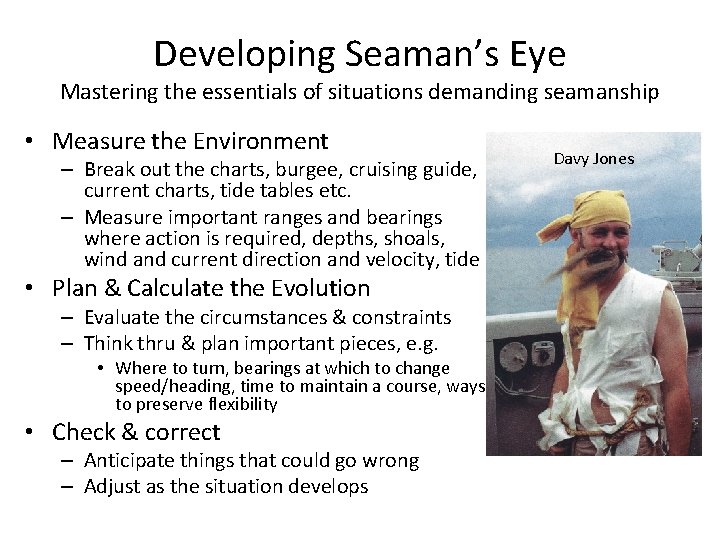
Developing Seaman’s Eye Mastering the essentials of situations demanding seamanship • Measure the Environment – Break out the charts, burgee, cruising guide, current charts, tide tables etc. – Measure important ranges and bearings where action is required, depths, shoals, wind and current direction and velocity, tide • Plan & Calculate the Evolution – Evaluate the circumstances & constraints – Think thru & plan important pieces, e. g. • Where to turn, bearings at which to change speed/heading, time to maintain a course, ways to preserve flexibility • Check & correct – Anticipate things that could go wrong – Adjust as the situation develops Davy Jones
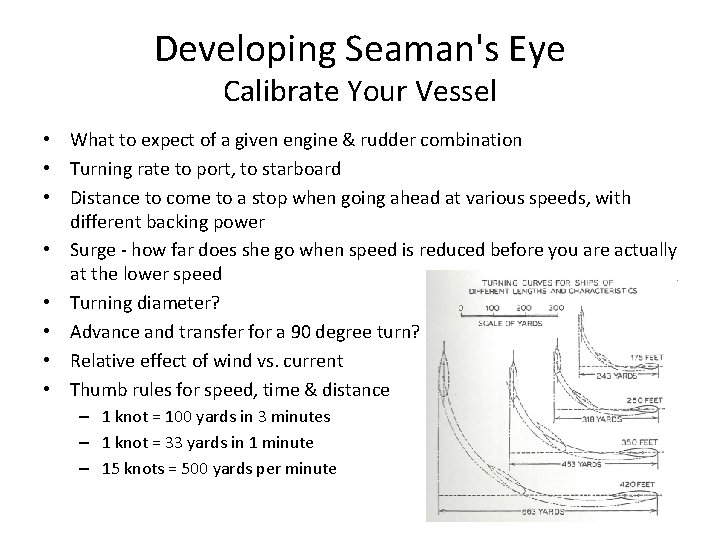
Developing Seaman's Eye Calibrate Your Vessel • What to expect of a given engine & rudder combination • Turning rate to port, to starboard • Distance to come to a stop when going ahead at various speeds, with different backing power • Surge - how far does she go when speed is reduced before you are actually at the lower speed • Turning diameter? • Advance and transfer for a 90 degree turn? • Relative effect of wind vs. current • Thumb rules for speed, time & distance – 1 knot = 100 yards in 3 minutes – 1 knot = 33 yards in 1 minute – 15 knots = 500 yards per minute
Presentation Topics • USNA Training Vessels • Seaman’s Eye • Forces Acting on the Vessel Seamanship: The art of navigating, working and managing a vessel in all • Handling Alongside matters affected by being afloat and • Anchoring • Man Overboard at sea
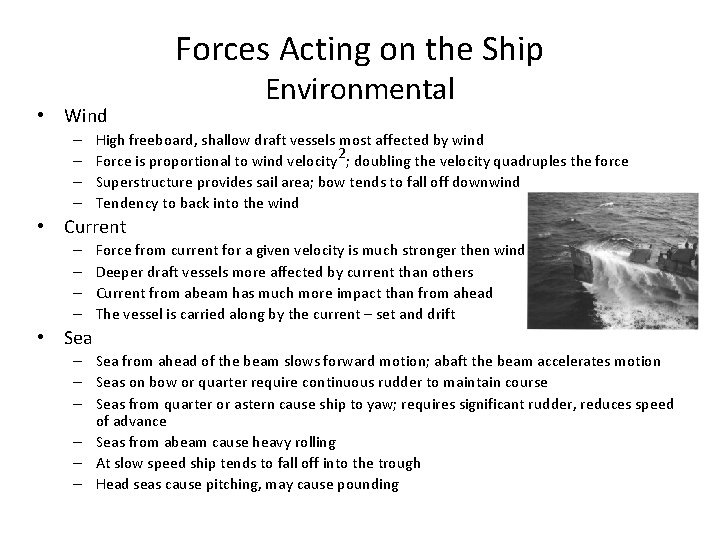
Forces Acting on the Ship • Wind – – Environmental High freeboard, shallow draft vessels most affected by wind Force is proportional to wind velocity 2; doubling the velocity quadruples the force Superstructure provides sail area; bow tends to fall off downwind Tendency to back into the wind • Current – – Force from current for a given velocity is much stronger then wind Deeper draft vessels more affected by current than others Current from abeam has much more impact than from ahead The vessel is carried along by the current – set and drift • Sea – Sea from ahead of the beam slows forward motion; abaft the beam accelerates motion – Seas on bow or quarter require continuous rudder to maintain course – Seas from quarter or astern cause ship to yaw; requires significant rudder, reduces speed of advance – Seas from abeam cause heavy rolling – At slow speed ship tends to fall off into the trough – Head seas cause pitching, may cause pounding
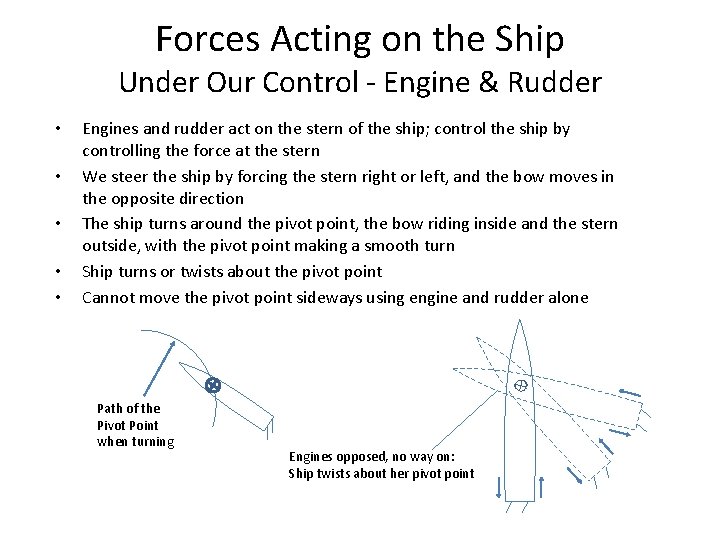
Forces Acting on the Ship Under Our Control - Engine & Rudder • • • Engines and rudder act on the stern of the ship; control the ship by controlling the force at the stern We steer the ship by forcing the stern right or left, and the bow moves in the opposite direction The ship turns around the pivot point, the bow riding inside and the stern outside, with the pivot point making a smooth turn Ship turns or twists about the pivot point Cannot move the pivot point sideways using engine and rudder alone Path of the Pivot Point when turning Engines opposed, no way on: Ship twists about her pivot point
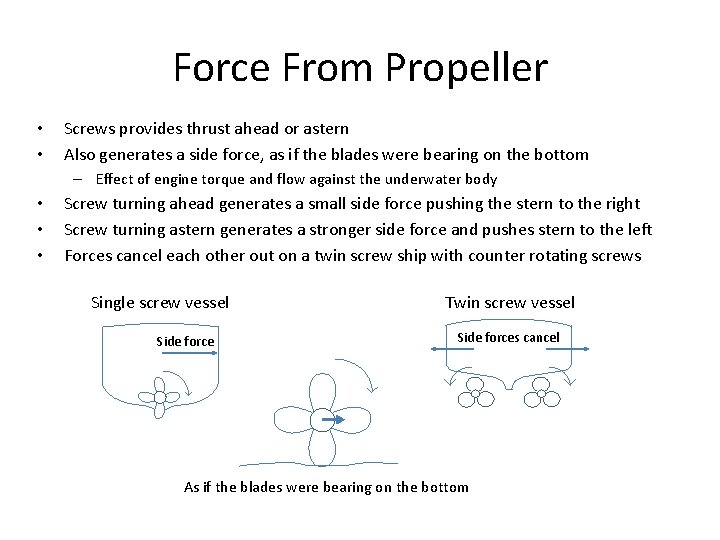
Force From Propeller • • Screws provides thrust ahead or astern Also generates a side force, as if the blades were bearing on the bottom – Effect of engine torque and flow against the underwater body • • • Screw turning ahead generates a small side force pushing the stern to the right Screw turning astern generates a stronger side force and pushes stern to the left Forces cancel each other out on a twin screw ship with counter rotating screws Single screw vessel Side force Twin screw vessel Side forces cancel As if the blades were bearing on the bottom
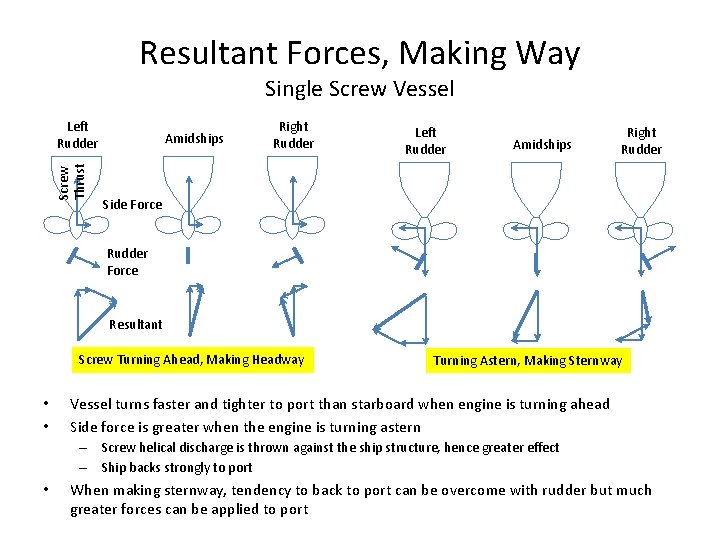
Resultant Forces, Making Way Single Screw Vessel Screw Thrust Left Rudder Amidships Right Rudder Side Force Rudder Force Resultant Screw Turning Ahead, Making Headway • • Turning Astern, Making Sternway Vessel turns faster and tighter to port than starboard when engine is turning ahead Side force is greater when the engine is turning astern – Screw helical discharge is thrown against the ship structure, hence greater effect – Ship backs strongly to port • When making sternway, tendency to back to port can be overcome with rudder but much greater forces can be applied to port
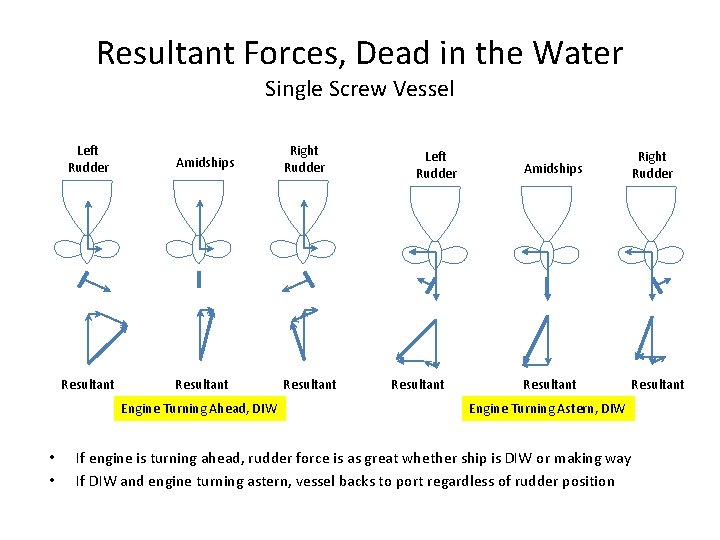
Resultant Forces, Dead in the Water Single Screw Vessel Left Rudder Amidships Right Rudder Resultant Engine Turning Ahead, DIW • • Left Rudder Resultant Amidships Right Rudder Resultant Engine Turning Astern, DIW If engine is turning ahead, rudder force is as great whether ship is DIW or making way If DIW and engine turning astern, vessel backs to port regardless of rudder position
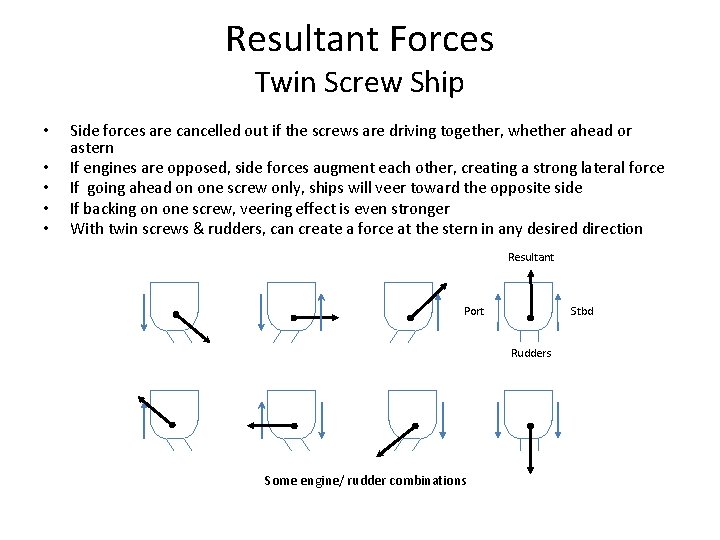
Resultant Forces Twin Screw Ship • • • Side forces are cancelled out if the screws are driving together, whether ahead or astern If engines are opposed, side forces augment each other, creating a strong lateral force If going ahead on one screw only, ships will veer toward the opposite side If backing on one screw, veering effect is even stronger With twin screws & rudders, can create a force at the stern in any desired direction Resultant Port Stbd Rudders Some engine/ rudder combinations
Presentation Topics • USNA Training Vessels • Seaman’s Eye • Forces Acting on the Vessel Seamanship: The art of navigating, working and managing a vessel in all • Handling Alongside matters affected by being afloat and • Anchoring • Man Overboard at sea
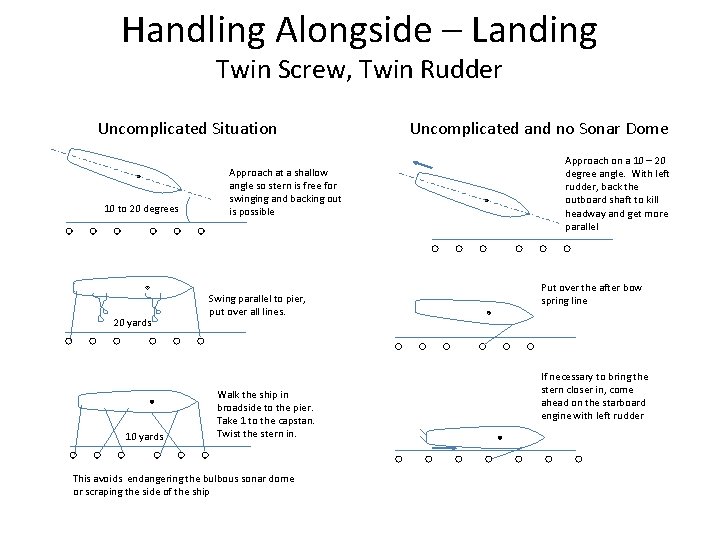
Handling Alongside – Landing Twin Screw, Twin Rudder Uncomplicated Situation 10 to 20 degrees 20 yards 10 yards Approach at a shallow angle so stern is free for swinging and backing out is possible Swing parallel to pier, put over all lines. Walk the ship in broadside to the pier. Take 1 to the capstan. Twist the stern in. This avoids endangering the bulbous sonar dome or scraping the side of the ship Uncomplicated and no Sonar Dome Approach on a 10 – 20 degree angle. With left rudder, back the outboard shaft to kill headway and get more parallel Put over the after bow spring line If necessary to bring the stern closer in, come ahead on the starboard engine with left rudder
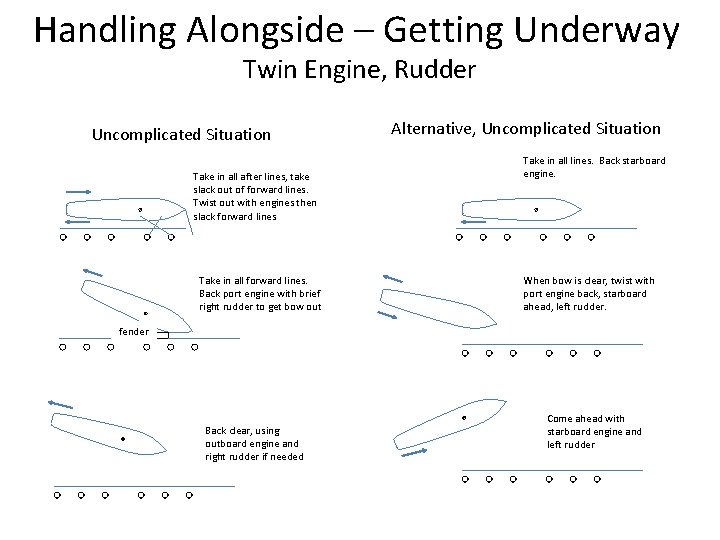
Handling Alongside – Getting Underway Twin Engine, Rudder Uncomplicated Situation Take in all after lines, take slack out of forward lines. Twist out with engines then slack forward lines Take in all forward lines. Back port engine with brief right rudder to get bow out Alternative, Uncomplicated Situation Take in all lines. Back starboard engine. When bow is clear, twist with port engine back, starboard ahead, left rudder. fender Back clear, using outboard engine and right rudder if needed Come ahead with starboard engine and left rudder
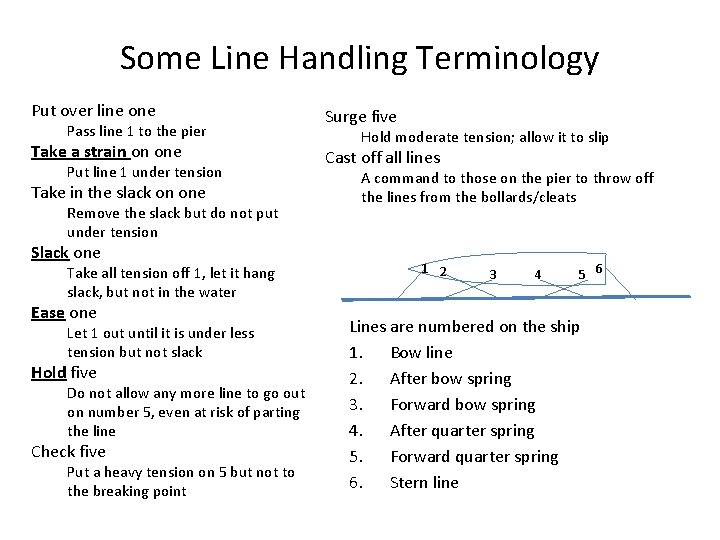
Some Line Handling Terminology Put over line one Pass line 1 to the pier Take a strain on one Put line 1 under tension Take in the slack on one Remove the slack but do not put under tension Slack one Take all tension off 1, let it hang slack, but not in the water Ease one Let 1 out until it is under less tension but not slack Hold five Do not allow any more line to go out on number 5, even at risk of parting the line Check five Put a heavy tension on 5 but not to the breaking point Surge five Hold moderate tension; allow it to slip Cast off all lines A command to those on the pier to throw off the lines from the bollards/cleats 1 2 3 4 5 6 Lines are numbered on the ship 1. Bow line 2. After bow spring 3. Forward bow spring 4. After quarter spring 5. Forward quarter spring 6. Stern line
Presentation Topics • • Seamanship: The art of navigating, • working and managing a vessel in all • matters affected by being afloat and • at sea USNA Training Vessels Seaman’s Eye Forces Acting on the Vessel Line Handling Alongside Anchoring Man Overboard
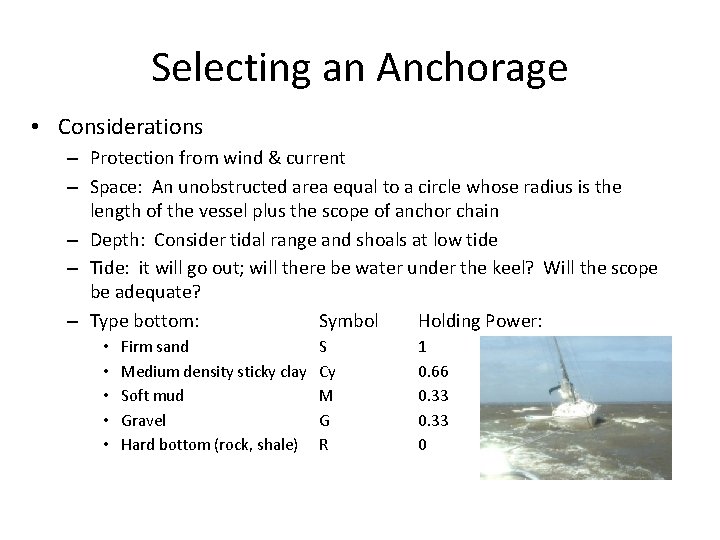
Selecting an Anchorage • Considerations – Protection from wind & current – Space: An unobstructed area equal to a circle whose radius is the length of the vessel plus the scope of anchor chain – Depth: Consider tidal range and shoals at low tide – Tide: it will go out; will there be water under the keel? Will the scope be adequate? – Type bottom: Symbol Holding Power: • • • Firm sand Medium density sticky clay Soft mud Gravel Hard bottom (rock, shale) S Cy M G R 1 0. 66 0. 33 0
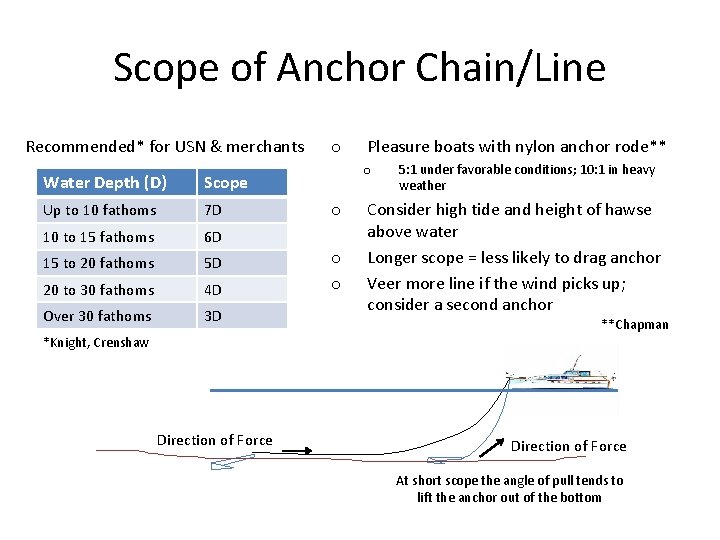
Scope of Anchor Chain/Line Recommended* for USN & merchants Water Depth (D) Scope Up to 10 fathoms 7 D 10 to 15 fathoms 6 D 15 to 20 fathoms 5 D 20 to 30 fathoms 4 D Over 30 fathoms 3 D o Pleasure boats with nylon anchor rode** o o 5: 1 under favorable conditions; 10: 1 in heavy weather Consider high tide and height of hawse above water Longer scope = less likely to drag anchor Veer more line if the wind picks up; consider a second anchor **Chapman *Knight, Crenshaw Direction of Force At short scope the angle of pull tends to lift the anchor out of the bottom
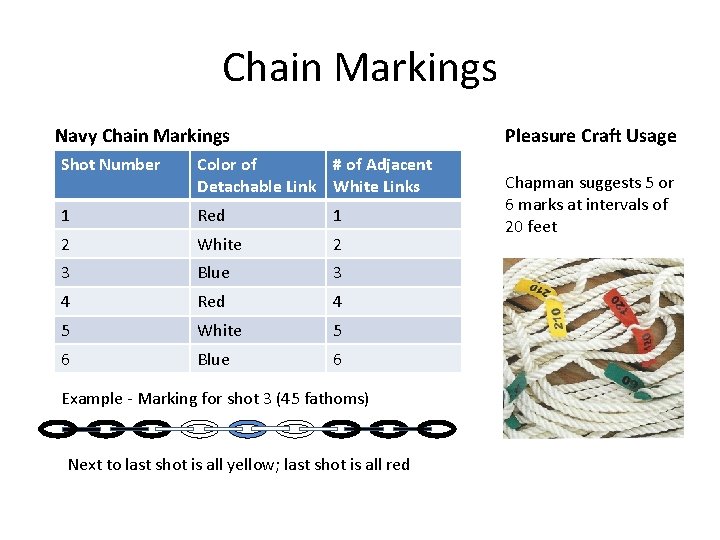
Chain Markings Navy Chain Markings Pleasure Craft Usage Shot Number Color of # of Adjacent Detachable Link White Links 1 Red 1 2 White 2 3 Blue 3 4 Red 4 5 White 5 6 Blue 6 Example - Marking for shot 3 (45 fathoms) Next to last shot is all yellow; last shot is all red Chapman suggests 5 or 6 marks at intervals of 20 feet
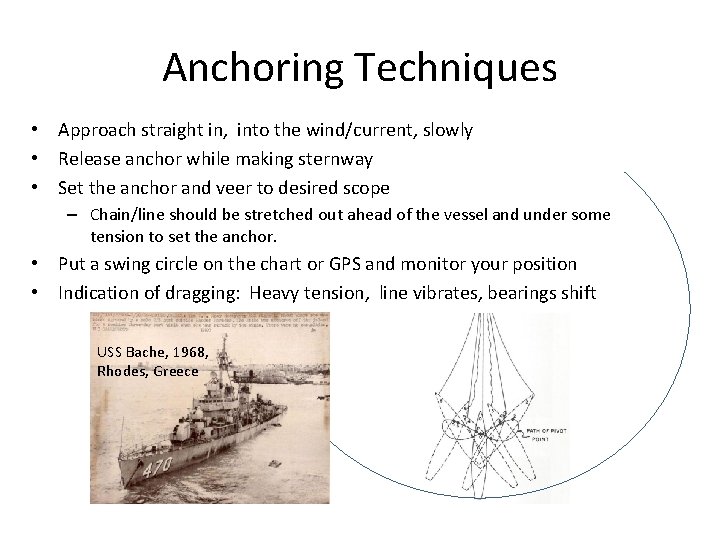
Anchoring Techniques • Approach straight in, into the wind/current, slowly • Release anchor while making sternway • Set the anchor and veer to desired scope – Chain/line should be stretched out ahead of the vessel and under some tension to set the anchor. • Put a swing circle on the chart or GPS and monitor your position • Indication of dragging: Heavy tension, line vibrates, bearings shift USS Bache, 1968, Rhodes, Greece
Presentation Topics • • Seamanship: The art of navigating, • working and managing a vessel in all • matters affected by being afloat and • at sea USNA Training Vessels Seaman’s Eye Forces Acting on the Vessel Line Handling Alongside Anchoring Man Overboard
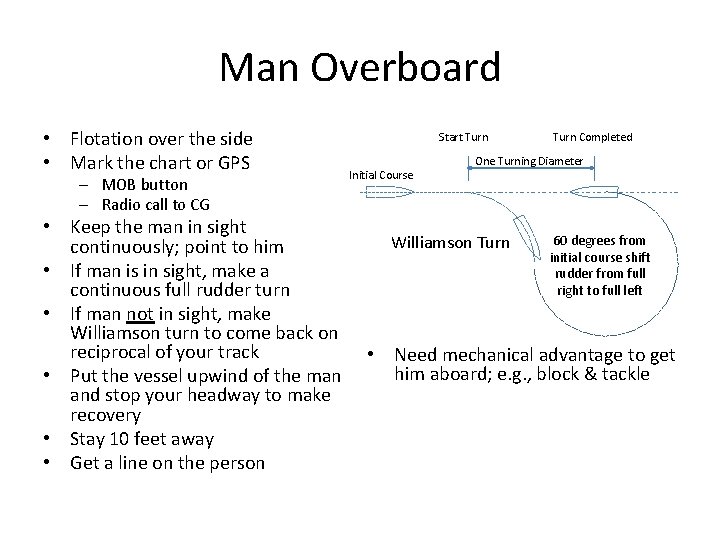
Man Overboard • Flotation over the side • Mark the chart or GPS – MOB button – Radio call to CG • Keep the man in sight continuously; point to him • If man is in sight, make a continuous full rudder turn • If man not in sight, make Williamson turn to come back on reciprocal of your track • Put the vessel upwind of the man and stop your headway to make recovery • Stay 10 feet away • Get a line on the person Start Turn Initial Course Turn Completed One Turning Diameter Williamson Turn 60 degrees from initial course shift rudder from full right to full left • Need mechanical advantage to get him aboard; e. g. , block & tackle
Questions?