
Seamanship Chapter 8 Marlinespike Learning Objectives Marlinespike seamanship
® Seamanship Chapter 8 Marlinespike
® Learning Objectives § Marlinespike seamanship § encompasses the art and science of working with rope and line. With the completion of this material the recreational boater should understand knots, bends, hitches and splices. It also includes the selection and use of line and the proper care of line. USPS® Seamanship Slide 2 of 35
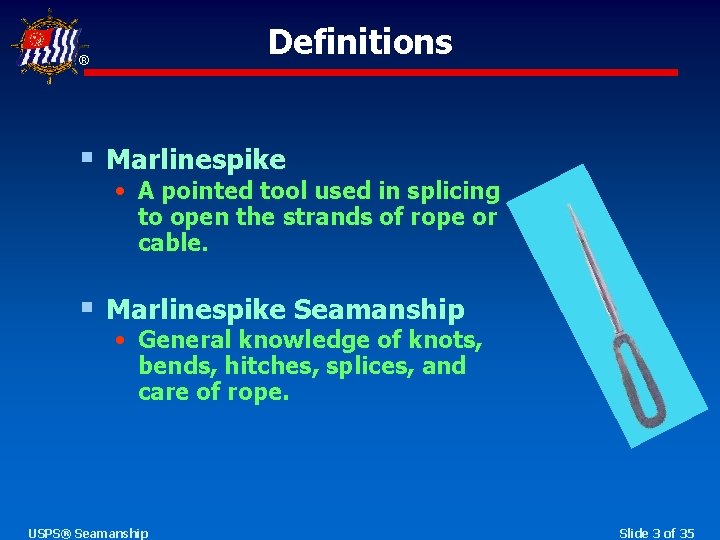
Definitions ® § Marlinespike • A pointed tool used in splicing to open the strands of rope or cable. § Marlinespike Seamanship • General knowledge of knots, bends, hitches, splices, and care of rope. USPS® Seamanship Slide 3 of 35
Definitions ® § Rope • Cordage made of natural or synthetic fibers, also can be made of steel wire. § Line • Name given rope aboard a boat. Each line is given a specific name, such as: anchor line, halyard, main sheet, spring line or dock line. A few are still called rope, as in bell rope. USPS® Seamanship Slide 4 of 35
Definitions ® § Working Part • Section of line used in forming a knot § Standing Part • The part of a line that is made fast • The portion of the line not used in forming a knot • The part of the line around which the knot may be tied • In use, normally under strain. USPS® Seamanship Slide 5 of 35
Definitions ® § Bitter End • Inboard end of a line, chain or cable • The end made fast to the boat § Working End • Attached to an anchor or cleat, etc. USPS® Seamanship Slide 6 of 35
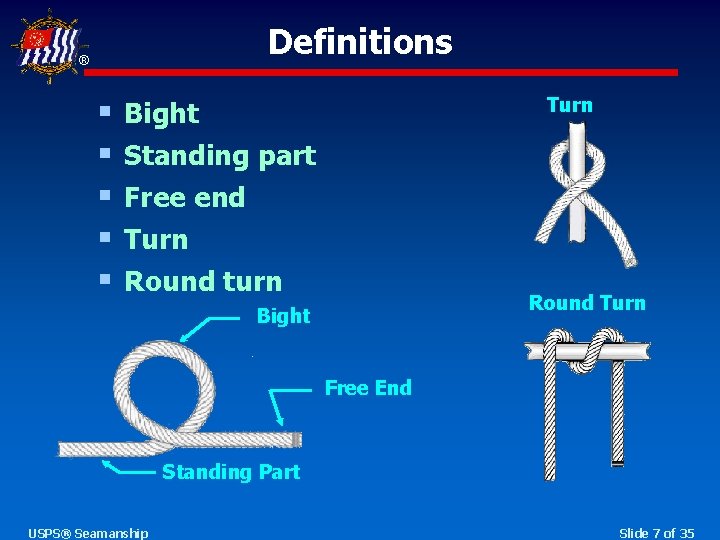
Definitions ® § § § Turn Bight Standing part Free end Turn Round turn Round Turn Bight Free End Standing Part USPS® Seamanship Slide 7 of 35
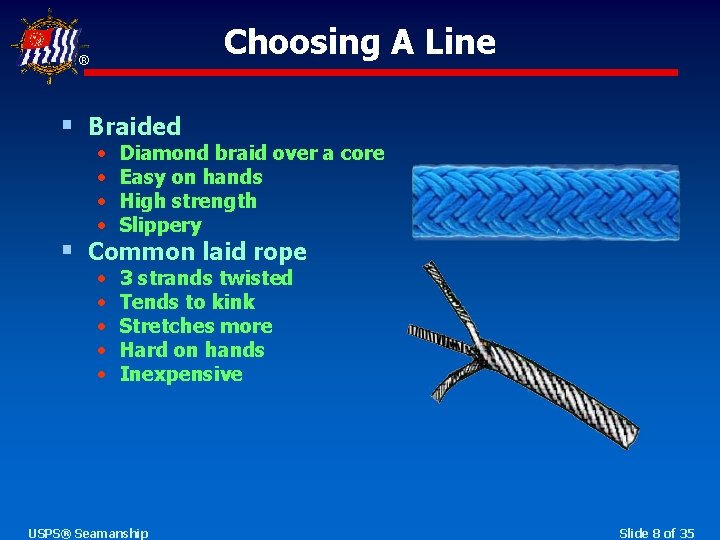
Choosing A Line ® § Braided • • Diamond braid over a core Easy on hands High strength Slippery • • • 3 strands twisted Tends to kink Stretches more Hard on hands Inexpensive § Common laid rope USPS® Seamanship Slide 8 of 35
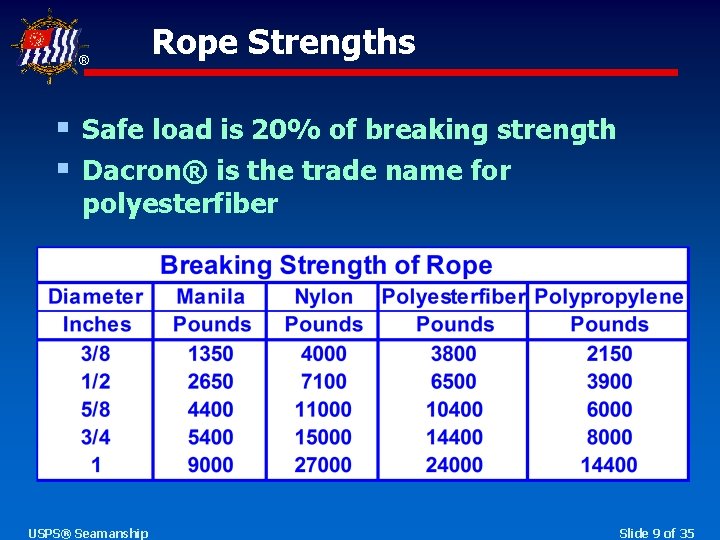
® Rope Strengths § Safe load is 20% of breaking strength § Dacron® is the trade name for polyesterfiber USPS® Seamanship Slide 9 of 35
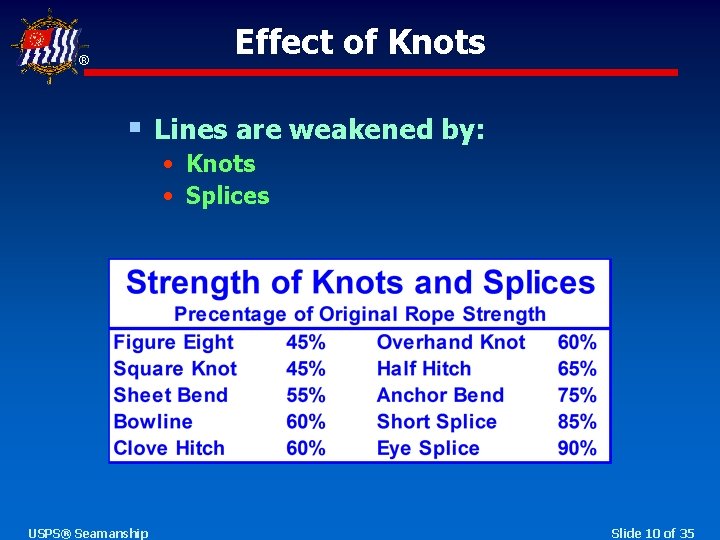
Effect of Knots ® § Lines are weakened by: • Knots • Splices USPS® Seamanship Slide 10 of 35
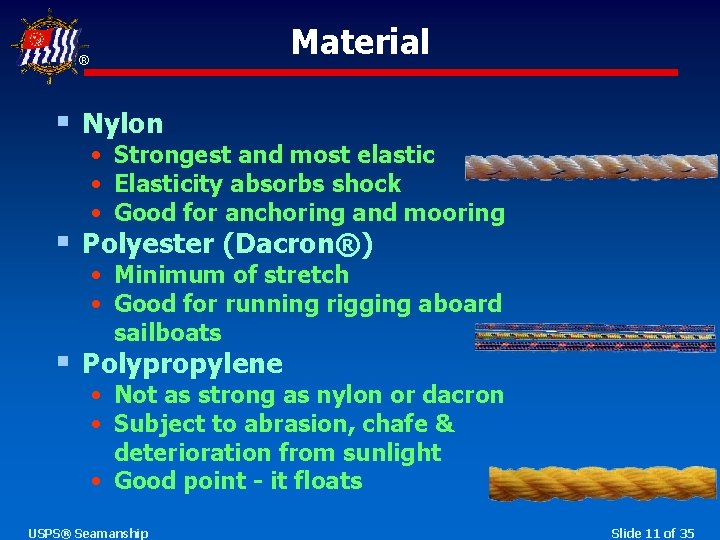
Material ® § Nylon • Strongest and most elastic • Elasticity absorbs shock • Good for anchoring and mooring § Polyester (Dacron®) • Minimum of stretch • Good for running rigging aboard sailboats § Polypropylene • Not as strong as nylon or dacron • Subject to abrasion, chafe & deterioration from sunlight • Good point - it floats USPS® Seamanship Slide 11 of 35

Chafing Gear ® § Protects line from § § chafing on chocks and hawse Pipes Commercially available Home made using old Water hose USPS® Seamanship Slide 12 of 35

® Coiling a Line § Start by lacing line 1 over your hand 2 3 4 § Form generous loops until line is coiled § Make two turns around coil § Feed working end through coil USPS® Seamanship Slide 13 of 35
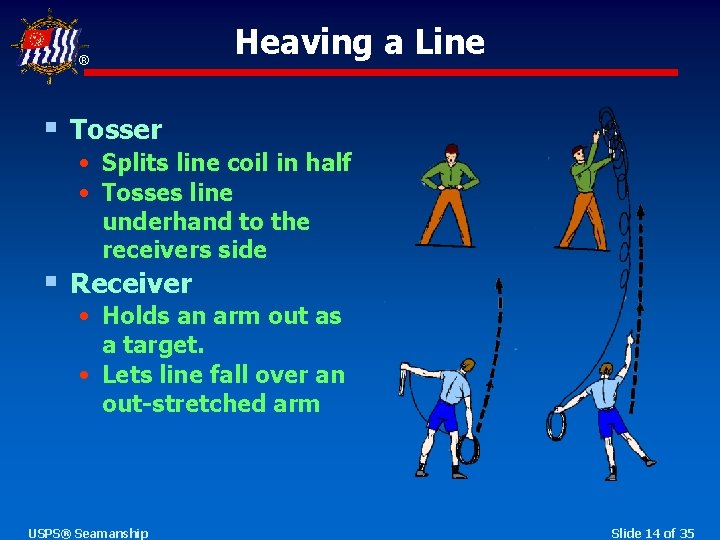
® Heaving a Line § Tosser • Splits line coil in half • Tosses line underhand to the receivers side § Receiver • Holds an arm out as a target. • Lets line fall over an out-stretched arm USPS® Seamanship Slide 14 of 35
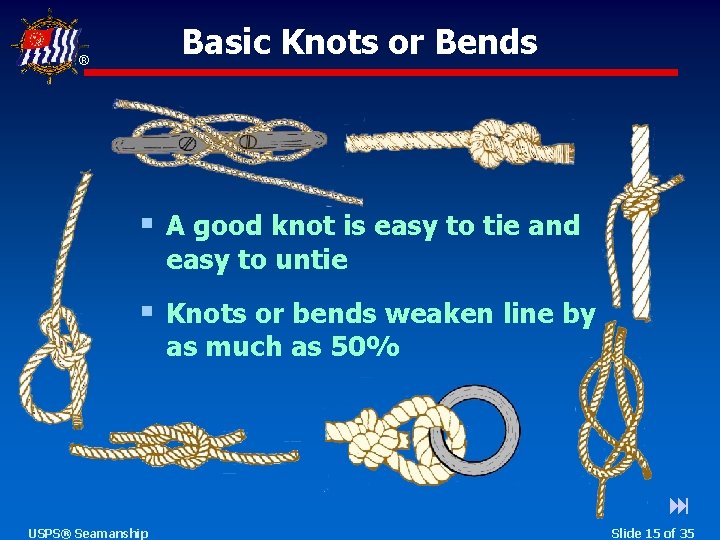
Basic Knots or Bends ® § A good knot is easy to tie and easy to untie § Knots or bends weaken line by as much as 50% USPS® Seamanship Slide 15 of 35
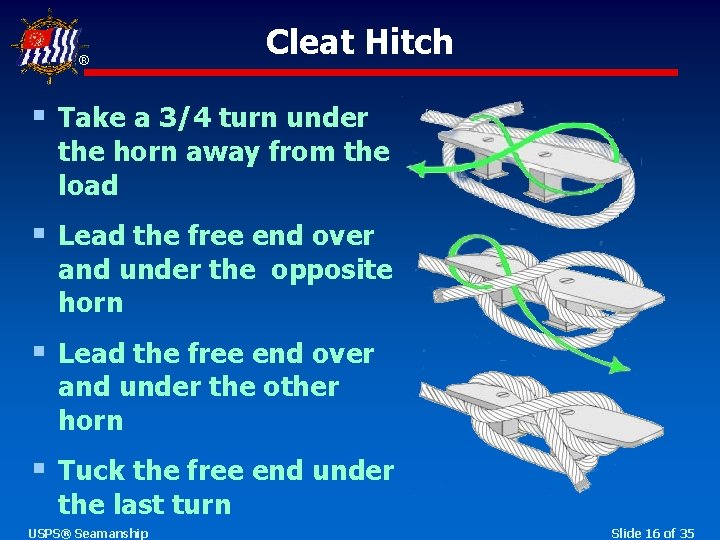
® Cleat Hitch § Take a 3/4 turn under the horn away from the load § Lead the free end over and under the opposite horn § Lead the free end over and under the other horn § Tuck the free end under the last turn USPS® Seamanship Slide 16 of 35
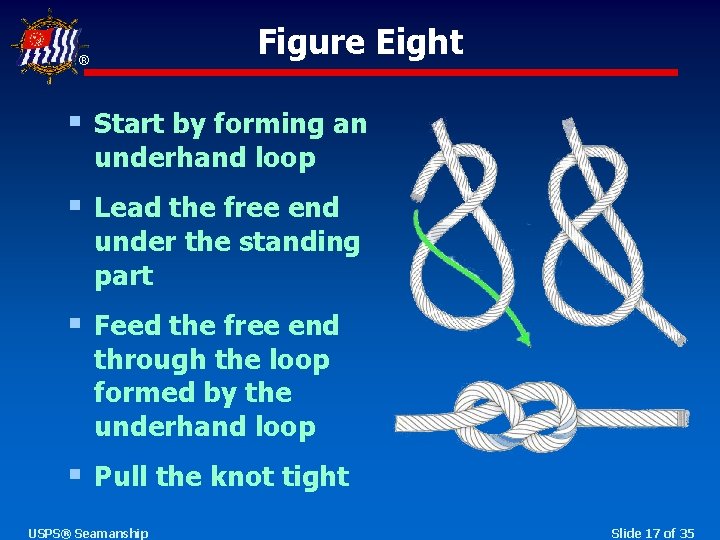
Figure Eight ® § Start by forming an underhand loop § Lead the free end under the standing part § Feed the free end through the loop formed by the underhand loop § Pull the knot tight USPS® Seamanship Slide 17 of 35
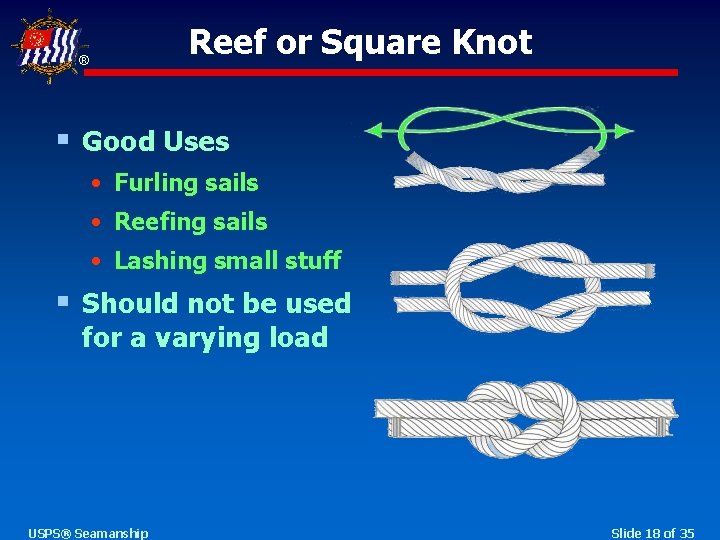
Reef or Square Knot ® § Good Uses • Furling sails • Reefing sails • Lashing small stuff § Should not be used for a varying load USPS® Seamanship Slide 18 of 35
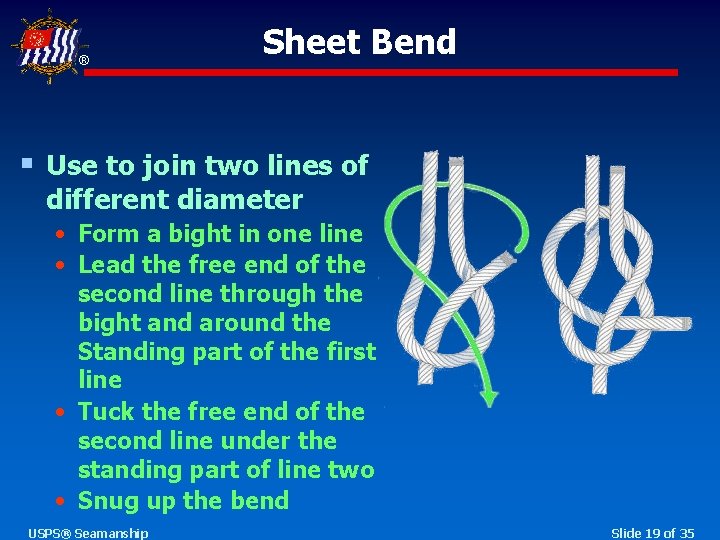
® Sheet Bend § Use to join two lines of different diameter • Form a bight in one line • Lead the free end of the second line through the bight and around the Standing part of the first line • Tuck the free end of the second line under the standing part of line two • Snug up the bend USPS® Seamanship Slide 19 of 35
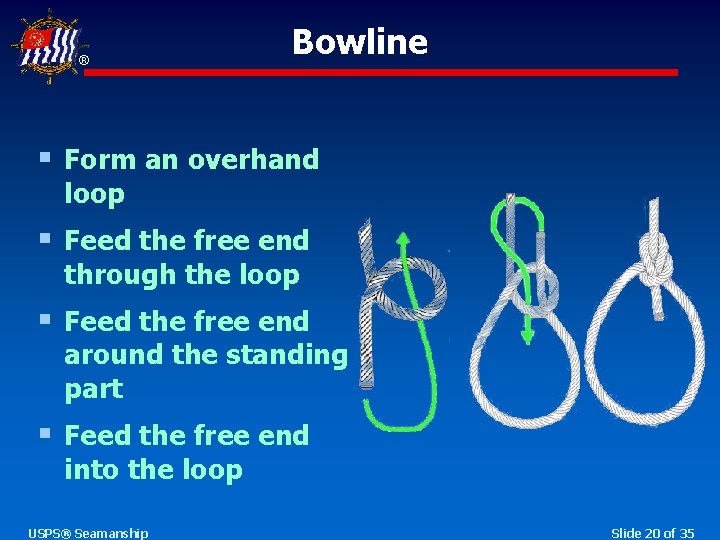
® Bowline § Form an overhand loop § Feed the free end through the loop § Feed the free end around the standing part § Feed the free end into the loop USPS® Seamanship Slide 20 of 35
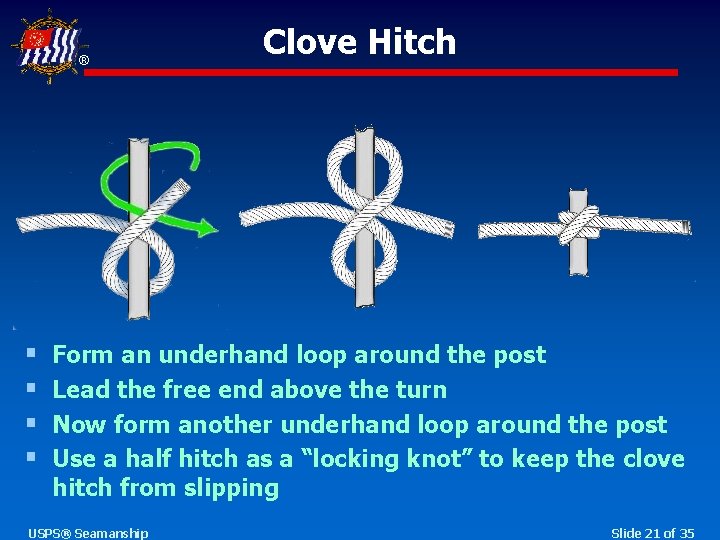
® § § Clove Hitch Form an underhand loop around the post Lead the free end above the turn Now form another underhand loop around the post Use a half hitch as a “locking knot” to keep the clove hitch from slipping USPS® Seamanship Slide 21 of 35
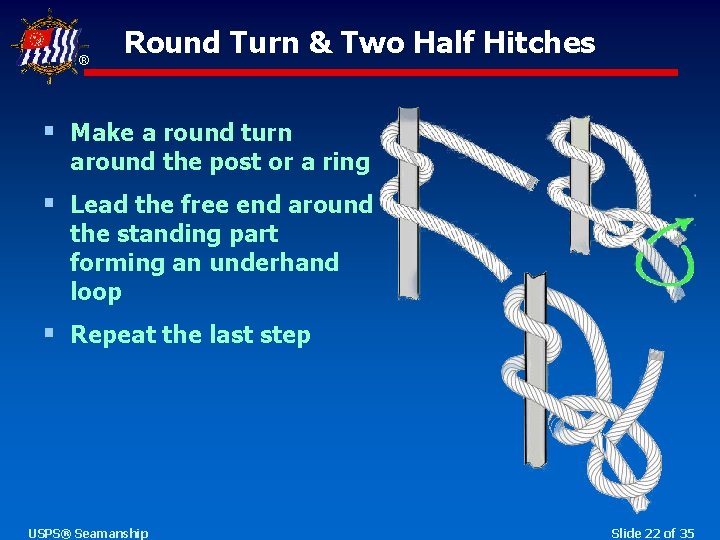
® Round Turn & Two Half Hitches § Make a round turn around the post or a ring § Lead the free end around the standing part forming an underhand loop § Repeat the last step USPS® Seamanship Slide 22 of 35
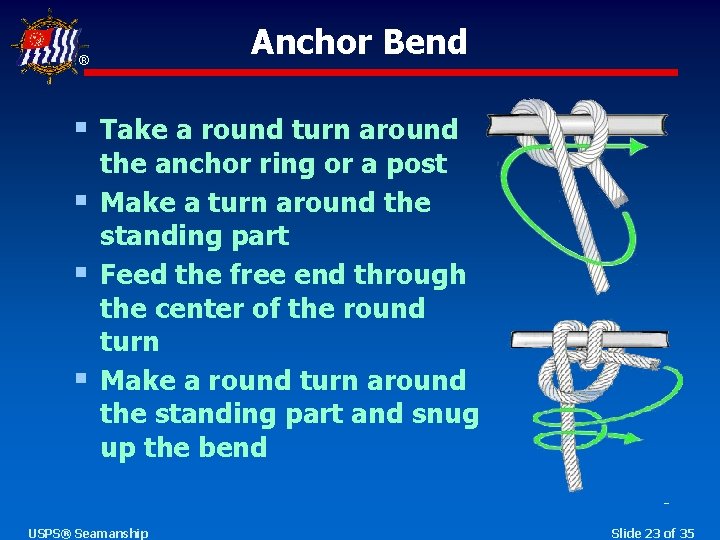
Anchor Bend ® § Take a round turn around § § § the anchor ring or a post Make a turn around the standing part Feed the free end through the center of the round turn Make a round turn around the standing part and snug up the bend USPS® Seamanship Slide 23 of 35
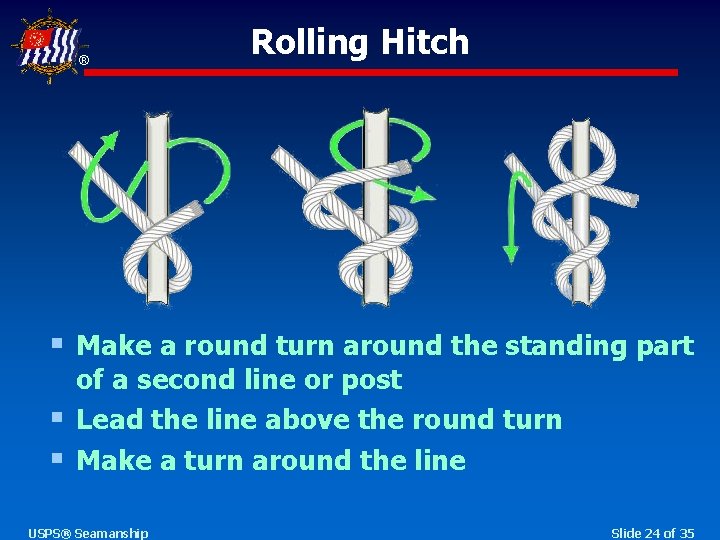
® Rolling Hitch § Make a round turn around the standing part § § of a second line or post Lead the line above the round turn Make a turn around the line USPS® Seamanship Slide 24 of 35
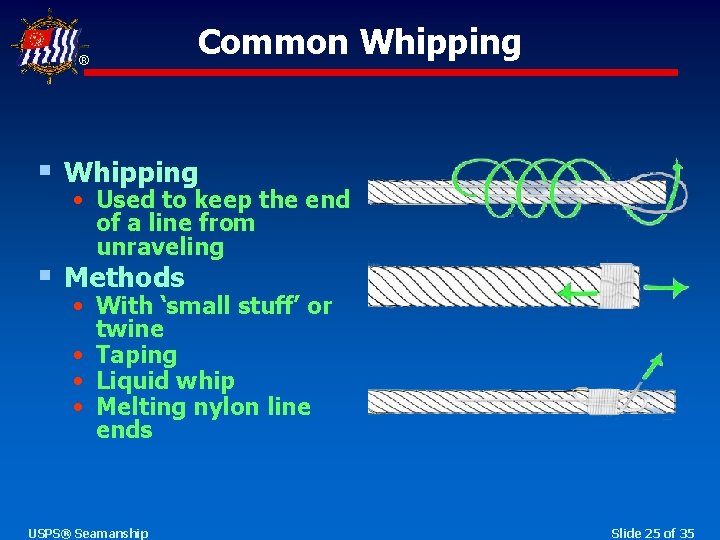
® Common Whipping § Whipping • Used to keep the end of a line from unraveling § Methods • With ‘small stuff’ or twine • Taping • Liquid whip • Melting nylon line ends USPS® Seamanship Slide 25 of 35
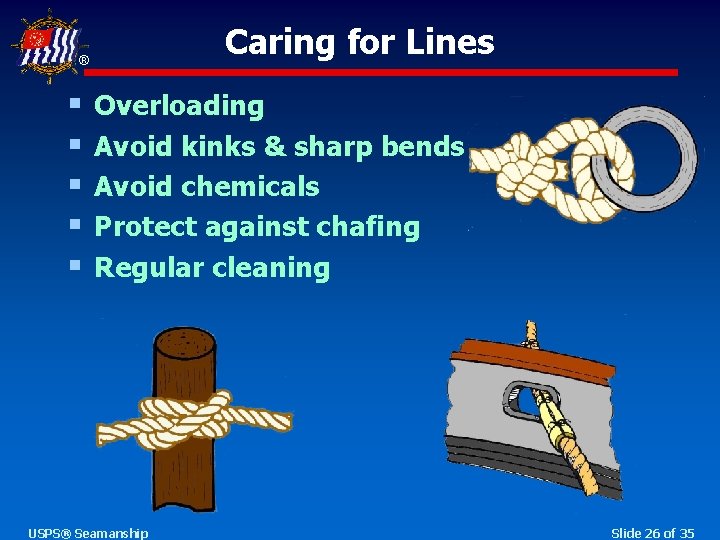
Caring for Lines ® § § § Overloading Avoid kinks & sharp bends Avoid chemicals Protect against chafing Regular cleaning USPS® Seamanship Slide 26 of 35
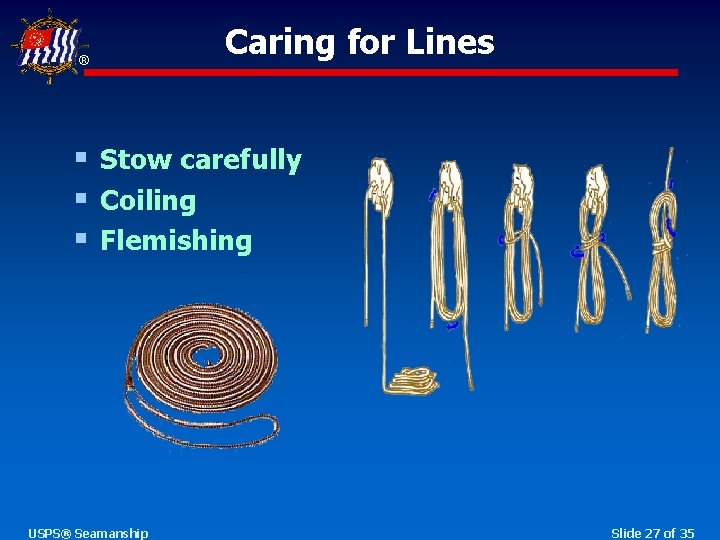
® Caring for Lines § Stow carefully § Coiling § Flemishing USPS® Seamanship Slide 27 of 35
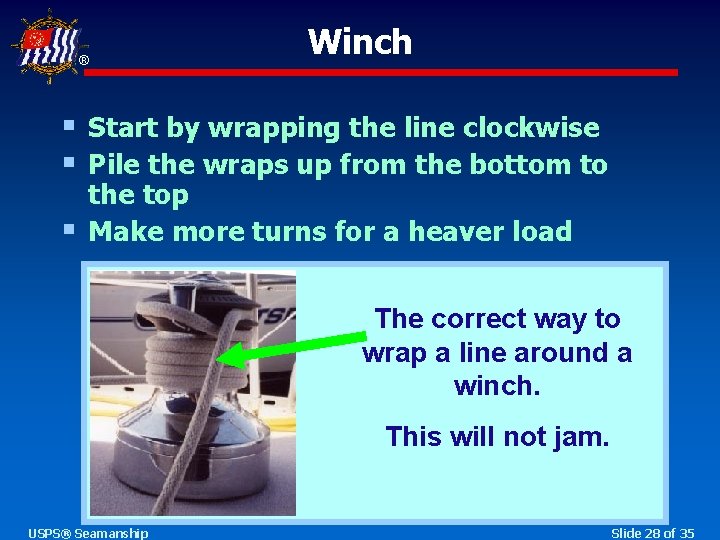
® Winch § Start by wrapping the line clockwise § Pile the wraps up from the bottom to § the top Make more turns for a heaver load The correct way to wrap a line around a winch. This will not jam. USPS® Seamanship Slide 28 of 35
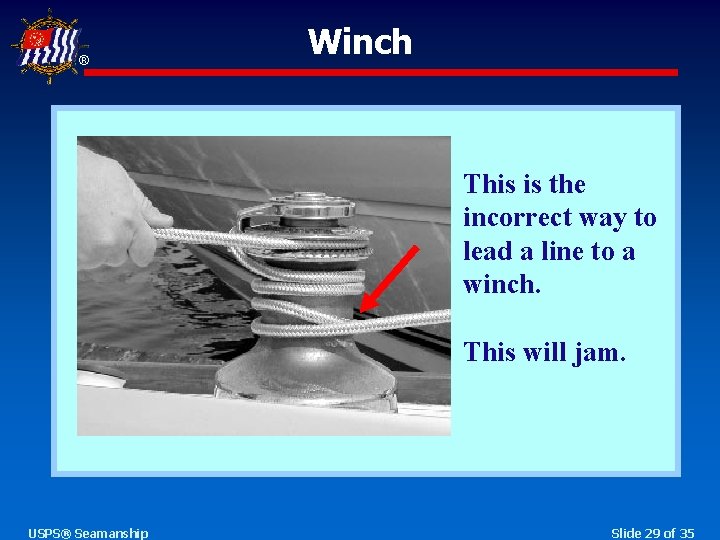
® Winch This is the incorrect way to lead a line to a winch. This will jam. USPS® Seamanship Slide 29 of 35
Blocks and Tackle ® § Block • A nautical name for a pulley § Sheave • Roller in a block over which a line passes as it goes through the block § Tackle • Arrangement of line and blocks used to provide increased mechanical advantage § Winch • Geared drum turned by a handle and used to pull lines such as sheets and halyards USPS® Seamanship Slide 30 of 35
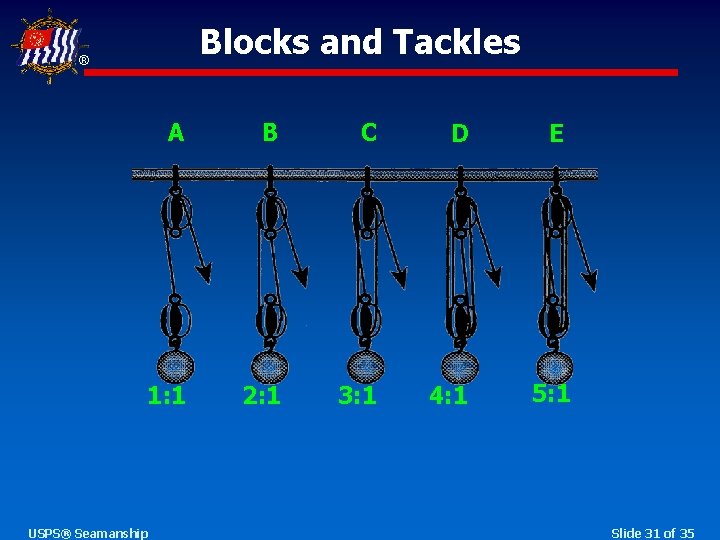
Blocks and Tackles ® A B C D 1: 1 2: 1 3: 1 4: 1 USPS® Seamanship E 5: 1 Slide 31 of 35
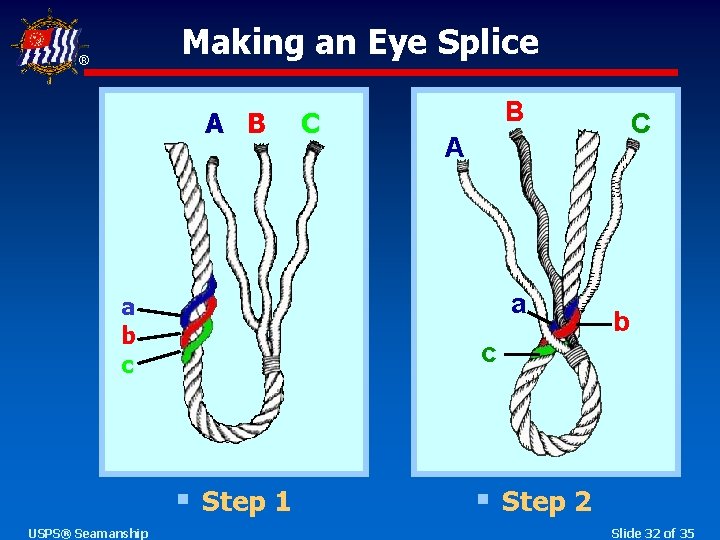
Making an Eye Splice ® A B B c § Step 1 C A a a b c USPS® Seamanship C b § Step 2 Slide 32 of 35
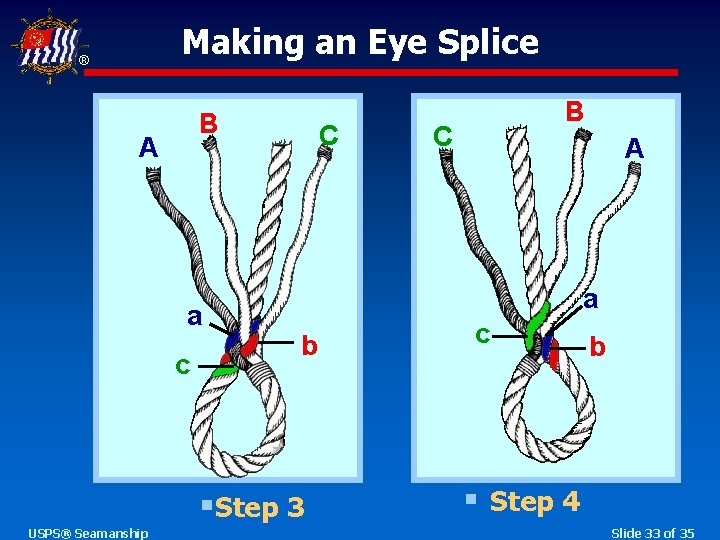
Making an Eye Splice ® B A a c C C A a b §Step 3 USPS® Seamanship B c b § Step 4 Slide 33 of 35
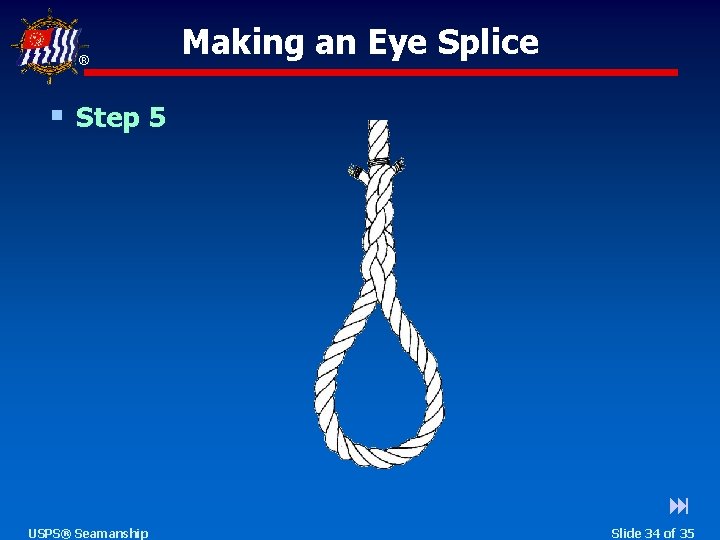
® Making an Eye Splice § Step 5 USPS® Seamanship Slide 34 of 35
® Chapter 8 USPS® Seamanship Slide 35 of 35
- Slides: 35