
SEAL Stages of Early Arithmetical Learning SEAL Stages
- Slides: 9
SEAL Stages of Early Arithmetical Learning
SEAL: Stages of Early Arithmetical Learning • Children develop and use a range of methods to solve number problems • The strategies they use increase in sophistication as children gain experience and develop better ways of problem solving • Progression needs to take into account the number range that a child can solve problems within and the sophistication of the strategies used • The Stages of Early Arithmetical Learning (SEAL) classifies the various strategies used by children into stages
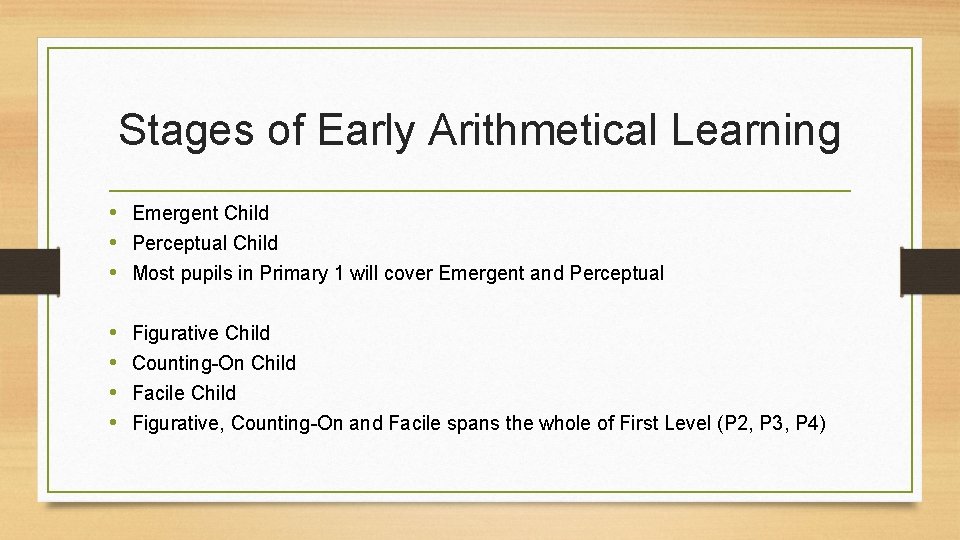
Stages of Early Arithmetical Learning • Emergent Child • Perceptual Child • Most pupils in Primary 1 will cover Emergent and Perceptual • • Figurative Child Counting-On Child Facile Child Figurative, Counting-On and Facile spans the whole of First Level (P 2, P 3, P 4)
• As children progress through these stages they move towards having a secure early number knowledge • With this knowledge they will be able to choose the most efficient strategy when dealing with number problems
For example if you ask the child what is 24+3 • We want them to know that they should start at 24 and count on by 3 to find the answer • Some children will start at 0 and count up to 24 first then add on the 3 which is time consuming and also allows for more errors to be made
For example if you ask them what is 7+5? • We want them to know that 7+3 = 10 then add 2 more to find the answer • Rather than starting at 7 and counting 5 more to get to the answer
Teaching Structure • • • Forward number word sequences Backward number word sequences Counting visible items Spatial patterns Finger patterns Temporal patterns and temporal sequences
• Children need to develop an understanding of how a number looks, sounds and feels in order to fully understand what it means • We can use our fingers to make the same number in different ways
Ideas for Home • • • Counting forwards and backwards from different starting points Tell me the number before/after Show me… Which number is bigger/smaller Counting out concrete items