
SEAL Maths What does it look like in

- Slides: 15
+ SEAL Maths What does it look like in Currie Nursery?
+ Background of SEAL n SEAL (Stages of Early Arithmetical Learning) n An authority priority in City of Edinburgh (and other local authorities across Scotland) with training and support materials for teachers n n Whole school training for all teachers to build confidence and knowledge across the school Focused training for specific stages (started with P 1 in 2013/14 , and since P 2, P 3 and P 4) n Pedagogy (way of teaching) based on years of international research n Initially used as an intervention “Maths Recovery” n Focus on understanding, strategies and mental agility n My experience – used as Support for Learning tool with P 4 and P 5, used it in P 1 for 3 years and now in Nursery.
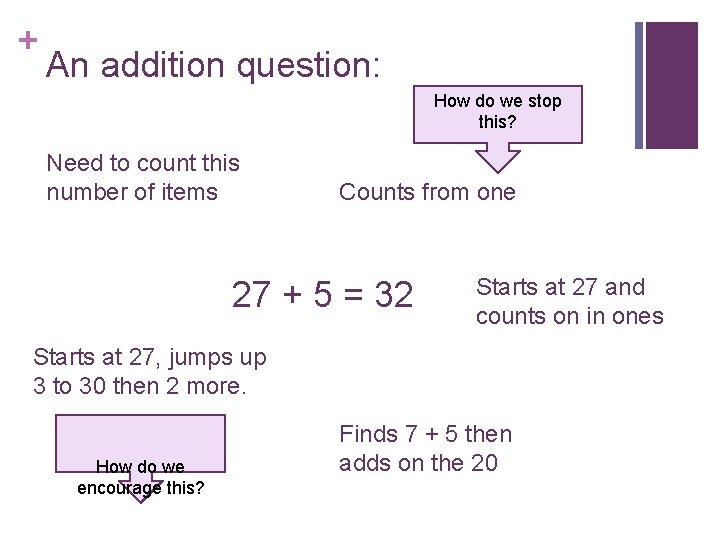
+ An addition question: How do we stop this? Need to count this number of items Counts from one 27 + 5 = 32 Starts at 27 and counts on in ones Starts at 27, jumps up 3 to 30 then 2 more. How do we encourage this? Finds 7 + 5 then adds on the 20
+ SEAL (Stages of Early Arithmetical Learning) n. Stage 1 - Emergent n. Stage 2 - Perceptual n. Stage 3 - Figurative n. Stage 4 - Counting-on n. Stage 5 - Facile
+ Stage 1 - Emergent n Saying Forward/Backwards Number Word Sequence (FNWS/BNWS) to 20 n Sequencing, recognising and identifying Numerals to 10 n Engaging with concrete items (counters, rows of dots) n Feeling, seeing, hearing items as they count n Opportunities to count items in one and two collections n Lots of practise organising n Finger patterns 1 -5, seen and unseen and double finger patterns 1 -5
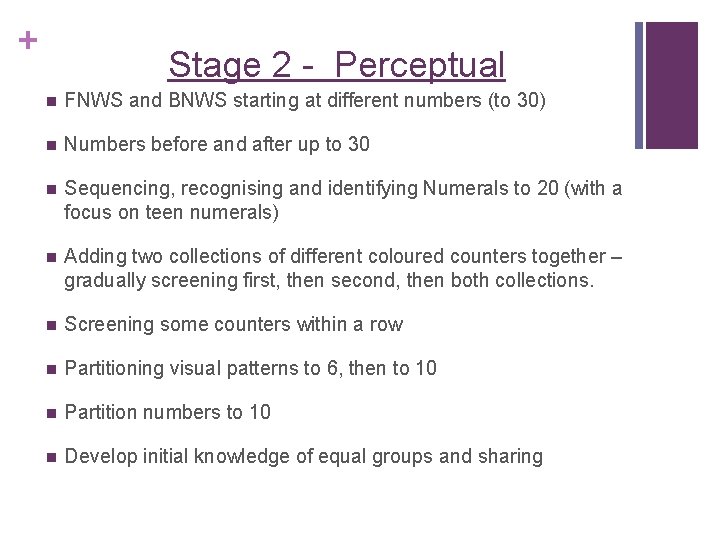
+ Stage 2 - Perceptual n FNWS and BNWS starting at different numbers (to 30) n Numbers before and after up to 30 n Sequencing, recognising and identifying Numerals to 20 (with a focus on teen numerals) n Adding two collections of different coloured counters together – gradually screening first, then second, then both collections. n Screening some counters within a row n Partitioning visual patterns to 6, then to 10 n Partition numbers to 10 n Develop initial knowledge of equal groups and sharing
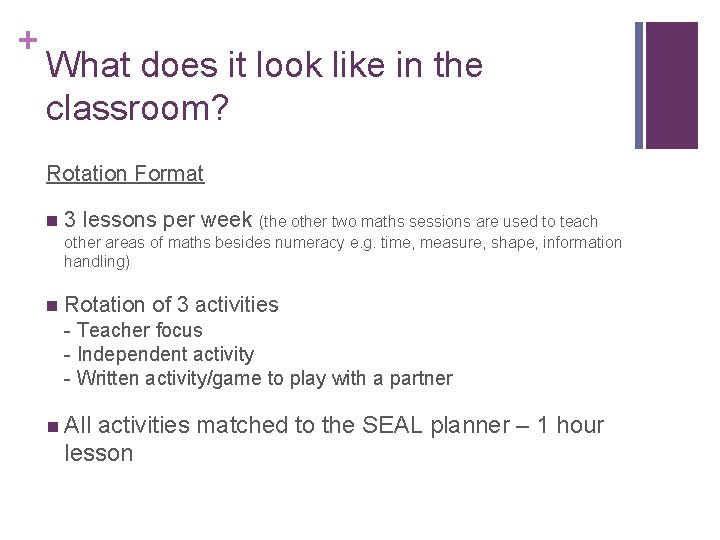
+ What does it look like in the classroom? Rotation Format n 3 lessons per week (the other two maths sessions are used to teach other areas of maths besides numeracy e. g. time, measure, shape, information handling) n Rotation of 3 activities - Teacher focus - Independent activity - Written activity/game to play with a partner n All activities matched to the SEAL planner – 1 hour lesson
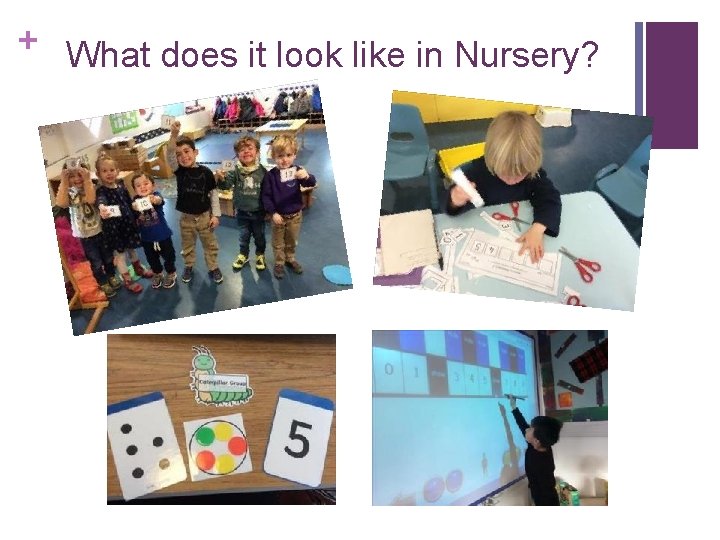
+ What does it look like in Nursery?
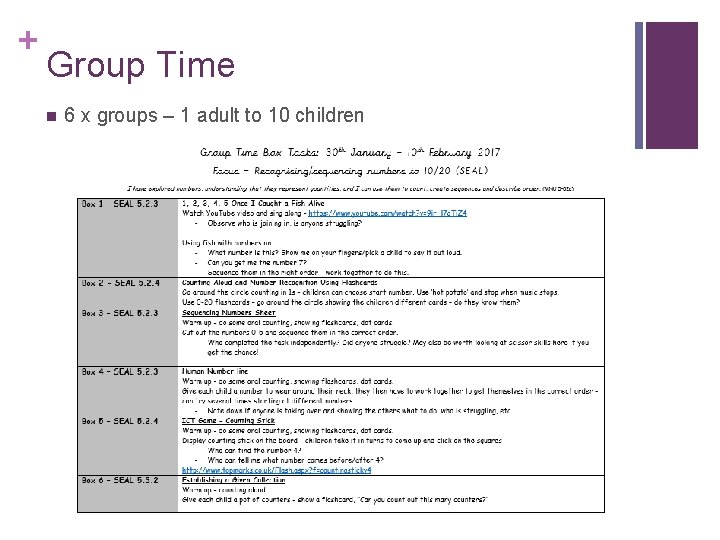
+ Group Time n 6 x groups – 1 adult to 10 children
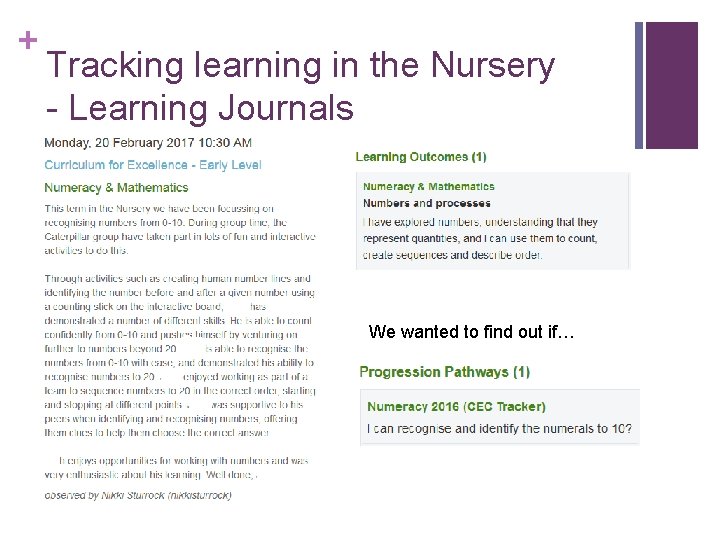
+ Tracking learning in the Nursery - Learning Journals We wanted to find out if…
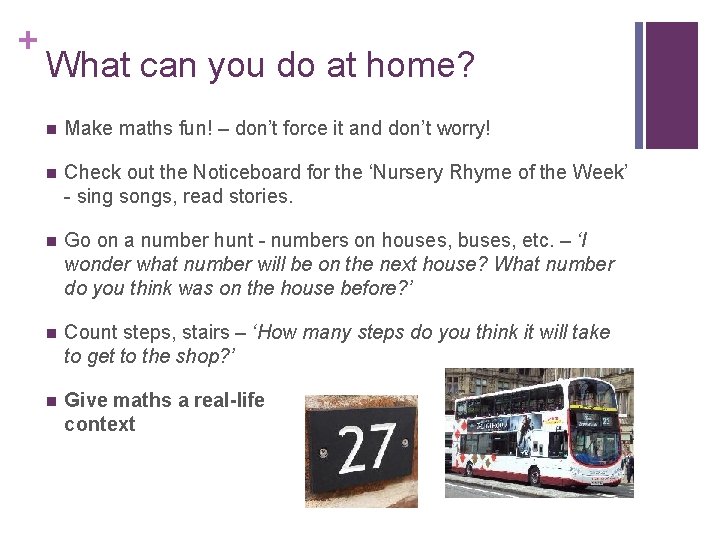
+ What can you do at home? n Make maths fun! – don’t force it and don’t worry! n Check out the Noticeboard for the ‘Nursery Rhyme of the Week’ - sing songs, read stories. n Go on a number hunt - numbers on houses, buses, etc. – ‘I wonder what number will be on the next house? What number do you think was on the house before? ’ n Count steps, stairs – ‘How many steps do you think it will take to get to the shop? ’ n Give maths a real-life context
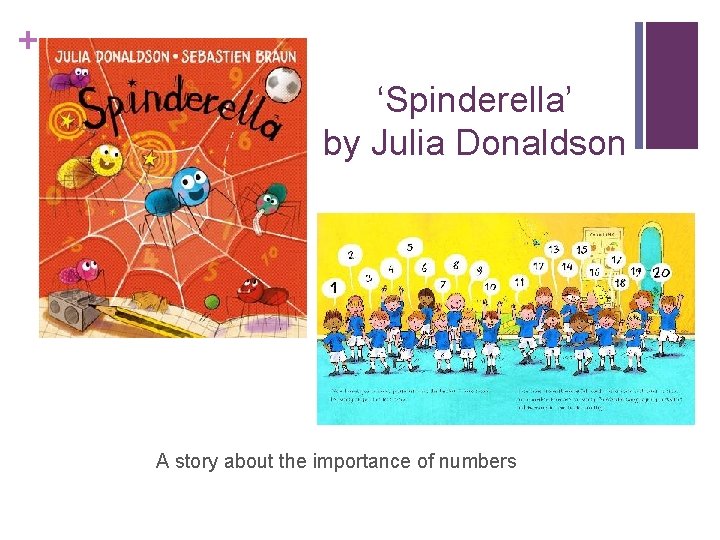
+ ‘Spinderella’ by Julia Donaldson A story about the importance of numbers
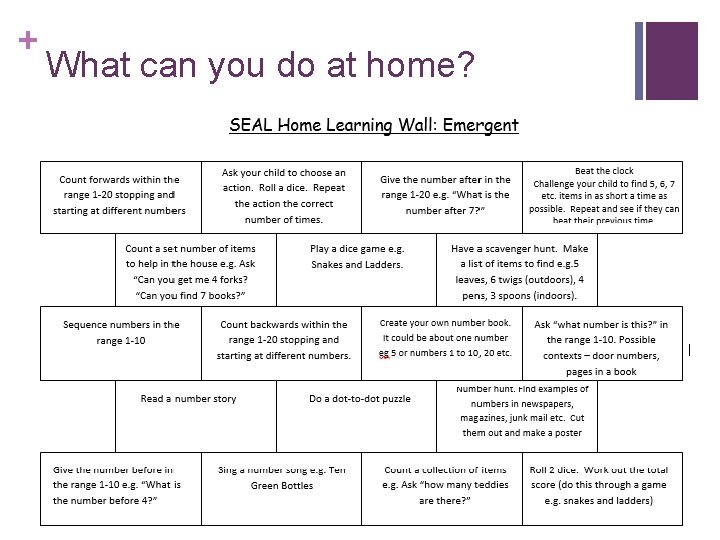
+ What can you do at home?
+ How do we know it is working ? n Teacher evidence in learning journals n Standardised Tests Results n SEAL assessments n Pupil Focus groups n The pupil’s ability to talk about their learning
+ Thank you for coming! Any questions?