
Sea Turtle Notes General Characteristics Large streamlined shell
- Slides: 10
Sea Turtle Notes
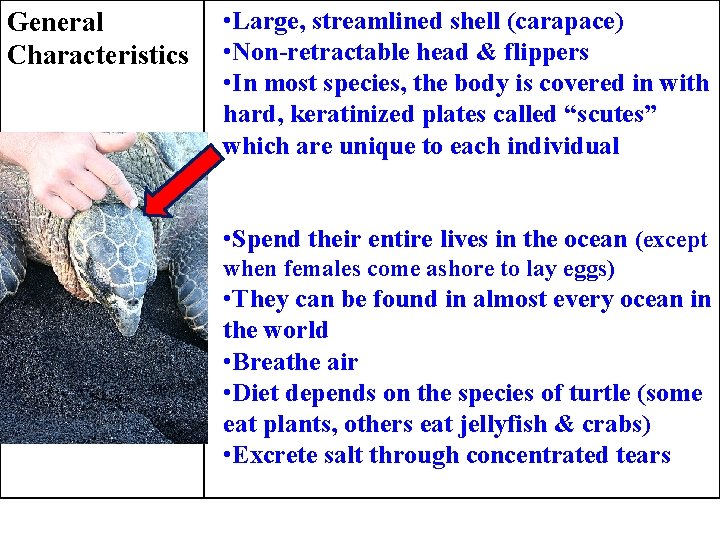
General Characteristics • Large, streamlined shell (carapace) • Non-retractable head & flippers • In most species, the body is covered in with hard, keratinized plates called “scutes” which are unique to each individual • Spend their entire lives in the ocean (except when females come ashore to lay eggs) • They can be found in almost every ocean in the world • Breathe air • Diet depends on the species of turtle (some eat plants, others eat jellyfish & crabs) • Excrete salt through concentrated tears
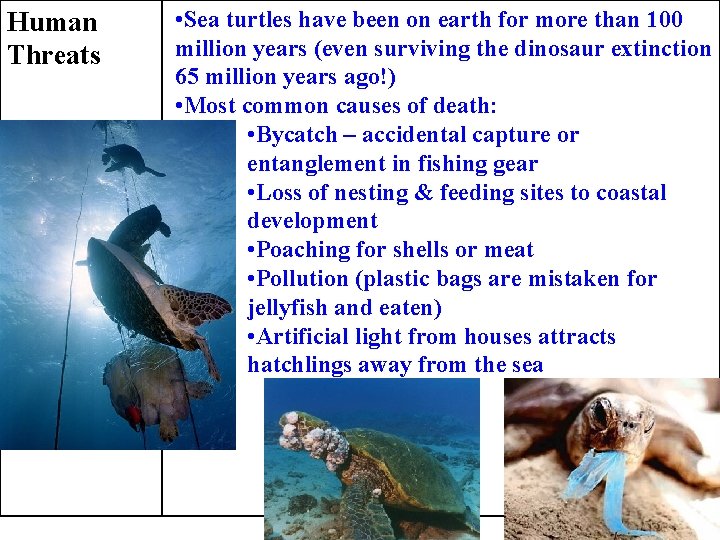
Human Threats • Sea turtles have been on earth for more than 100 million years (even surviving the dinosaur extinction 65 million years ago!) • Most common causes of death: • Bycatch – accidental capture or entanglement in fishing gear • Loss of nesting & feeding sites to coastal development • Poaching for shells or meat • Pollution (plastic bags are mistaken for jellyfish and eaten) • Artificial light from houses attracts hatchlings away from the sea
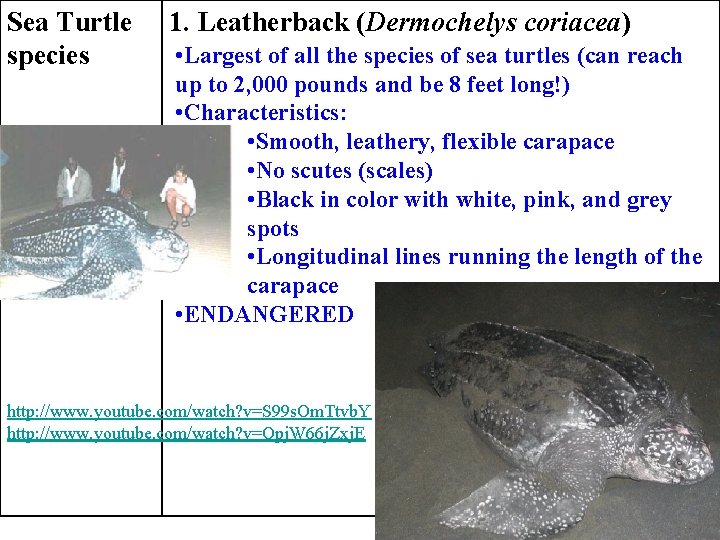
Sea Turtle species 1. Leatherback (Dermochelys coriacea) • Largest of all the species of sea turtles (can reach up to 2, 000 pounds and be 8 feet long!) • Characteristics: • Smooth, leathery, flexible carapace • No scutes (scales) • Black in color with white, pink, and grey spots • Longitudinal lines running the length of the carapace • ENDANGERED http: //www. youtube. com/watch? v=S 99 s. Om. Ttvb. Y http: //www. youtube. com/watch? v=Qpj. W 66 j. Zxj. E
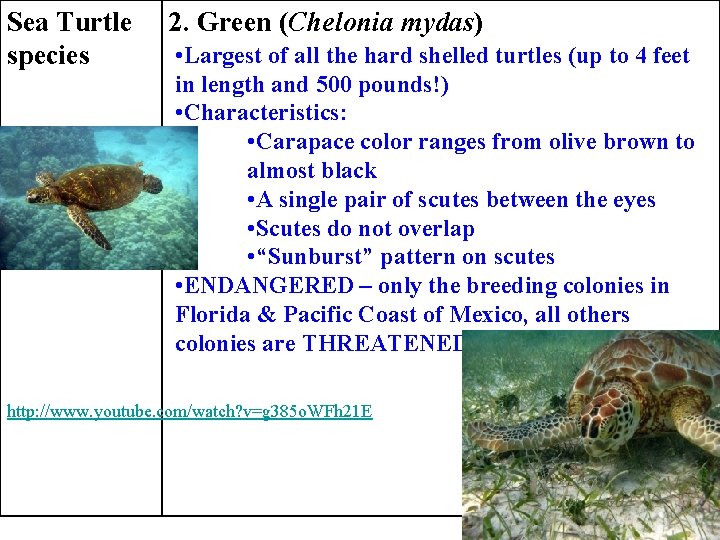
Sea Turtle species 2. Green (Chelonia mydas) • Largest of all the hard shelled turtles (up to 4 feet in length and 500 pounds!) • Characteristics: • Carapace color ranges from olive brown to almost black • A single pair of scutes between the eyes • Scutes do not overlap • “Sunburst” pattern on scutes • ENDANGERED – only the breeding colonies in Florida & Pacific Coast of Mexico, all others colonies are THREATENED http: //www. youtube. com/watch? v=g 385 o. WFh 21 E
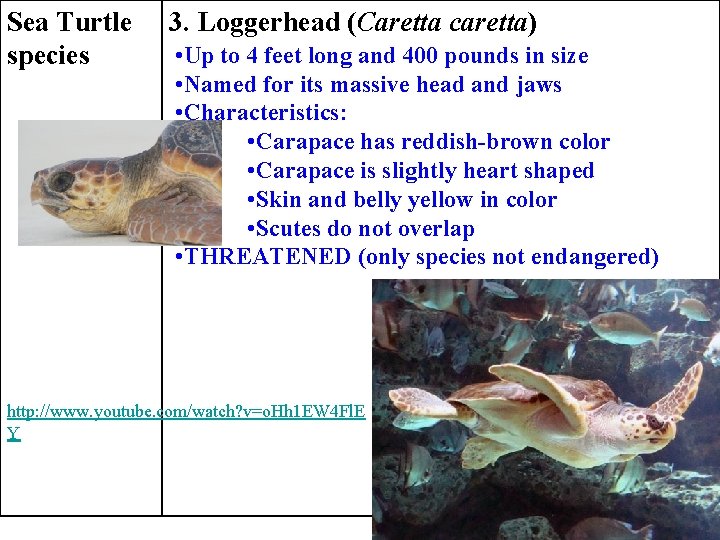
Sea Turtle species 3. Loggerhead (Caretta caretta) • Up to 4 feet long and 400 pounds in size • Named for its massive head and jaws • Characteristics: • Carapace has reddish-brown color • Carapace is slightly heart shaped • Skin and belly yellow in color • Scutes do not overlap • THREATENED (only species not endangered) http: //www. youtube. com/watch? v=o. Hh 1 EW 4 Fl. E Y
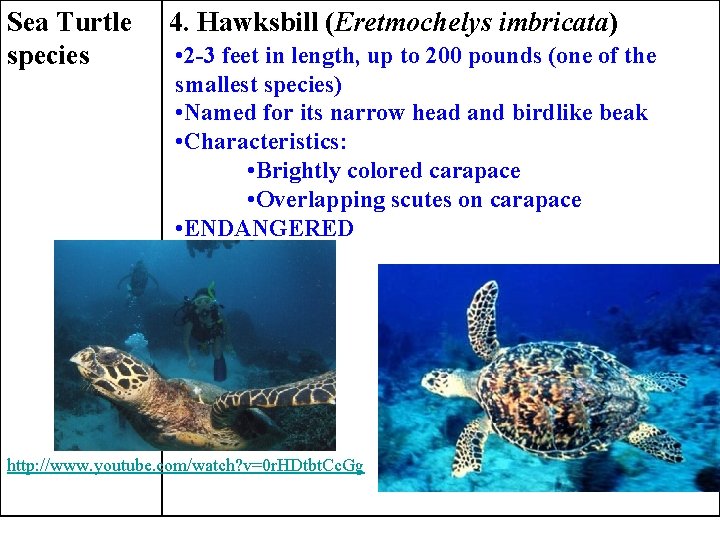
Sea Turtle species 4. Hawksbill (Eretmochelys imbricata) • 2 -3 feet in length, up to 200 pounds (one of the smallest species) • Named for its narrow head and birdlike beak • Characteristics: • Brightly colored carapace • Overlapping scutes on carapace • ENDANGERED http: //www. youtube. com/watch? v=0 r. HDtbt. Cc. Gg
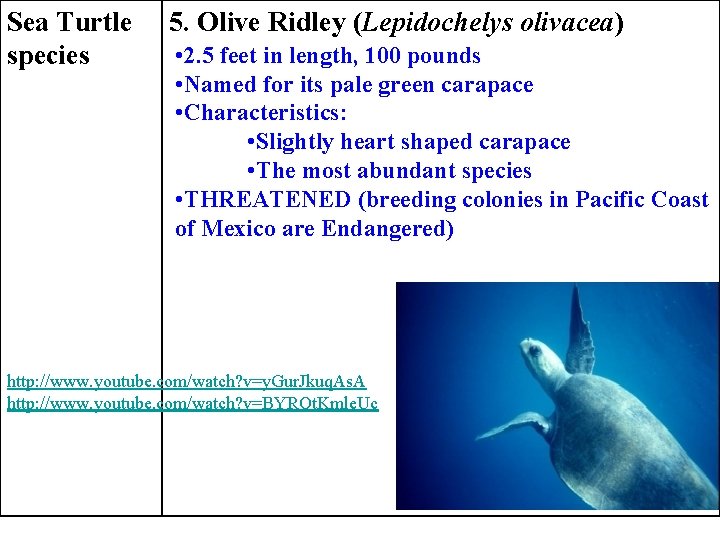
Sea Turtle species 5. Olive Ridley (Lepidochelys olivacea) • 2. 5 feet in length, 100 pounds • Named for its pale green carapace • Characteristics: • Slightly heart shaped carapace • The most abundant species • THREATENED (breeding colonies in Pacific Coast of Mexico are Endangered) http: //www. youtube. com/watch? v=y. Gur. Jkuq. As. A http: //www. youtube. com/watch? v=BYROt. Kmle. Uc
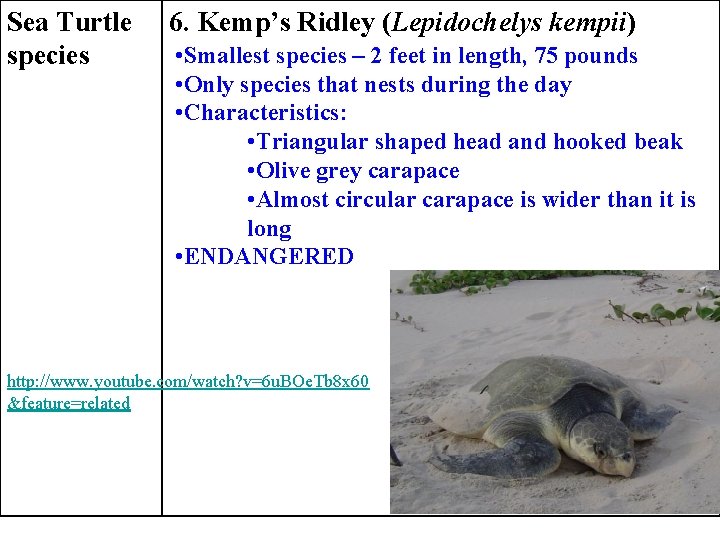
Sea Turtle species 6. Kemp’s Ridley (Lepidochelys kempii) • Smallest species – 2 feet in length, 75 pounds • Only species that nests during the day • Characteristics: • Triangular shaped head and hooked beak • Olive grey carapace • Almost circular carapace is wider than it is long • ENDANGERED http: //www. youtube. com/watch? v=6 u. BOe. Tb 8 x 60 &feature=related
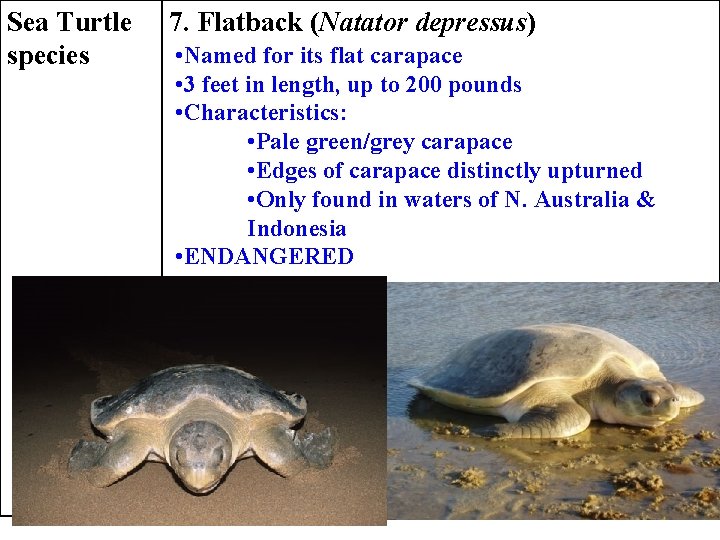
Sea Turtle species 7. Flatback (Natator depressus) • Named for its flat carapace • 3 feet in length, up to 200 pounds • Characteristics: • Pale green/grey carapace • Edges of carapace distinctly upturned • Only found in waters of N. Australia & Indonesia • ENDANGERED