
Sea Level Rise and Shifting Maritime Jurisdictional Limits
- Slides: 13
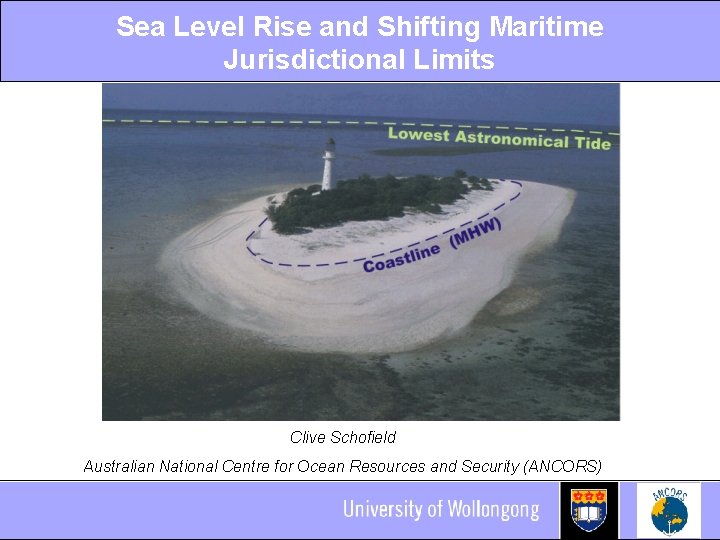
Sea Level Rise and Shifting Maritime Jurisdictional Limits Clive Schofield Australian National Centre for Ocean Resources and Security (ANCORS)
Sea Level Rise • IPCC’s estimated range of sea level rise: 0. 380. 59 m by the end of the century? • Growing consensus that this estimate is overly conservative • Great uncertainty over the critical questions of how much and how quickly?
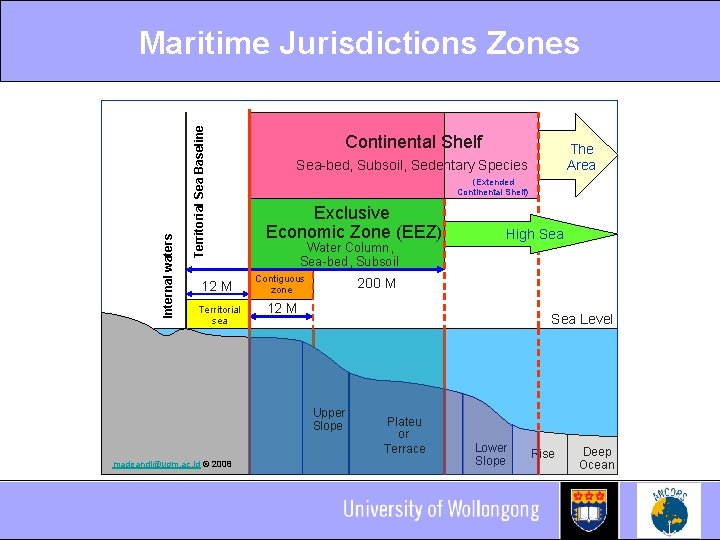
Territorial Sea Baseline Internal waters Maritime Jurisdictions Zones Continental Shelf The Area Sea-bed, Subsoil, Sedentary Species (Extended Continental Shelf) Exclusive Economic Zone (EEZ) Water Column, Sea-bed, Subsoil 12 M Contiguous zone Territorial sea Shelf madeandi@ugm. ac. id © 2008 High Sea 200 M 12 M Sea Level Upper Slope Plateu or Terrace Lower Slope Rise Deep Ocean
Migrating Baselines = Shifting Limits • Maritime jurisdictional limits measured from baselines: § Predominantly normal baselines, low-water line baselines • Traditional interpretation: ambulatory baselines and consequently shifting limits § Coastlines dynamic – low water line susceptible to change § As normal baselines move, the limits drawn from them also shift • Not a new phenomenon • As sea level rises so the low-water line migrates inland • Dramatic horizontal shifts to normal baselines possible from slight changes to sea level vertically
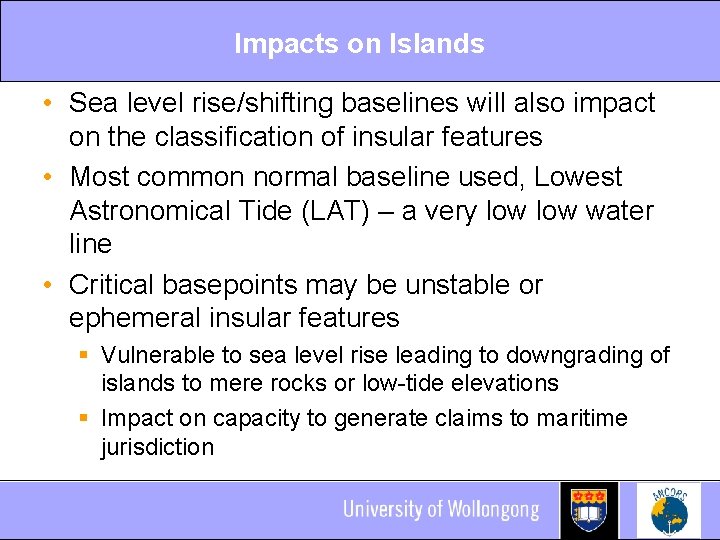
Impacts on Islands • Sea level rise/shifting baselines will also impact on the classification of insular features • Most common normal baseline used, Lowest Astronomical Tide (LAT) – a very low water line • Critical basepoints may be unstable or ephemeral insular features § Vulnerable to sea level rise leading to downgrading of islands to mere rocks or low-tide elevations § Impact on capacity to generate claims to maritime jurisdiction
Implications • Implications for: § Extent and limits of maritime claims § Enforcement issues § Delimitation of maritime boundaries • Loss of jurisdiction over vital marine resources • Jurisdictional uncertainty • Potential for conflict
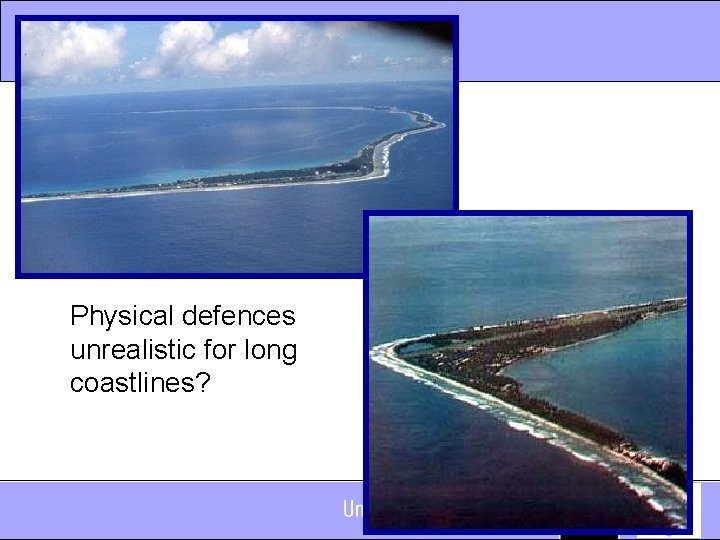
Potential Responses • Fix normal baselines physically § Can key basepoints be preserved through sea defences, ‘building-up’ and/or reclamation? § Long tradition and an option for critical basepoints but unrealistic for long coastlines? • Fix normal baselines legally • Fix the limits of maritime zones
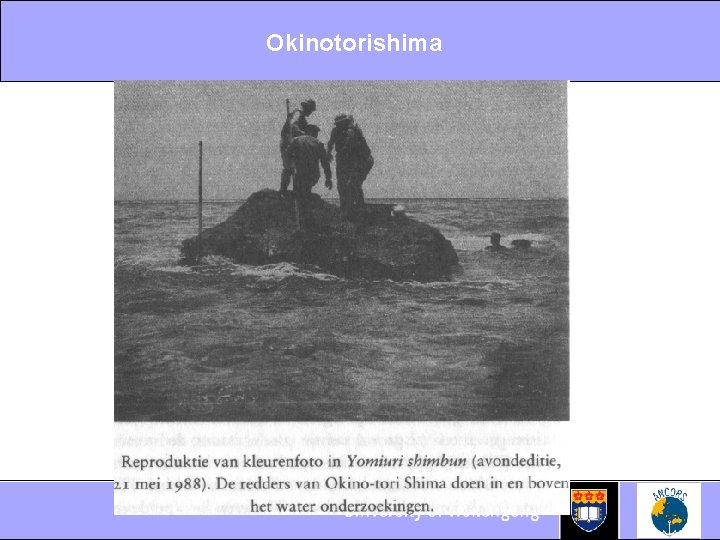
Okinotorishima: Maritime Claims
Okinotorishima
Okinotorishima
Physical defences unrealistic for long coastlines?
Fix Normal Baselines Legally • Choice of chart depicting normal baseline left up to the coastal State (LOSC, Article 5) • Chart the legal document • Can a coastal State therefore choose a chart that is advantageous to it? § What if there is a difference between the low water line shown on the chart and reality? • The drafters of the Convention did not anticipate sea level rise • BUT: Ambulatory baselines may be fixed with straight baselines on unstable coasts § Connection to the low water line still required
Fixing Limits and Boundaries • Once agreed maritime boundaries remain fixed even though the baselines used to construct them may regress § What if the territory in question disappears entirely? • The outer limits of the continental shelf may also be fixed as “final and binding” • Fix (declare) maritime limits § Provides the advantage of certainty and the preservation of existing maritime claims § BUT: Increasing tension between fixed limit and receding or disappearing normal baseline it is measured from