
Sea Hunter and Maritime Autonomy This research was
- Slides: 10
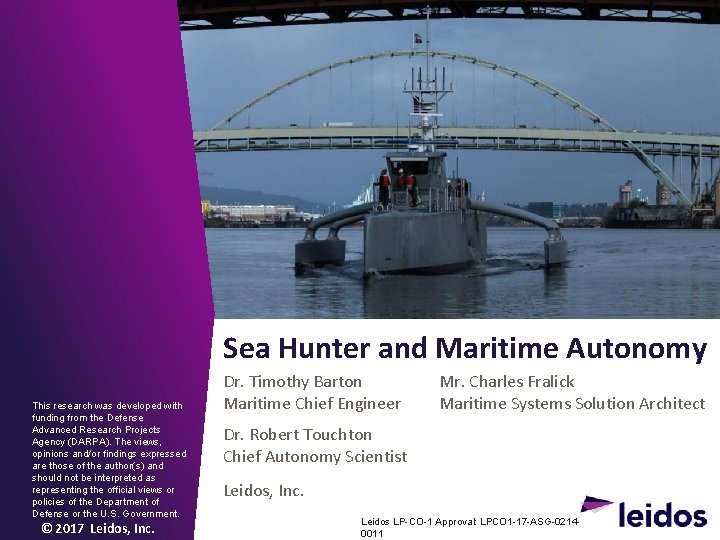
Sea Hunter and Maritime Autonomy This research was developed with funding from the Defense Advanced Research Projects Agency (DARPA). The views, opinions and/or findings expressed are those of the author(s) and should not be interpreted as representing the official views or policies of the Department of Defense or the U. S. Government. © 2017 Leidos, Inc. Dr. Timothy Barton Maritime Chief Engineer Mr. Charles Fralick Maritime Systems Solution Architect Dr. Robert Touchton Chief Autonomy Scientist Leidos, Inc. Leidos LP-CO-1 Approval: LPCO 1 -17 -ASG-02140011
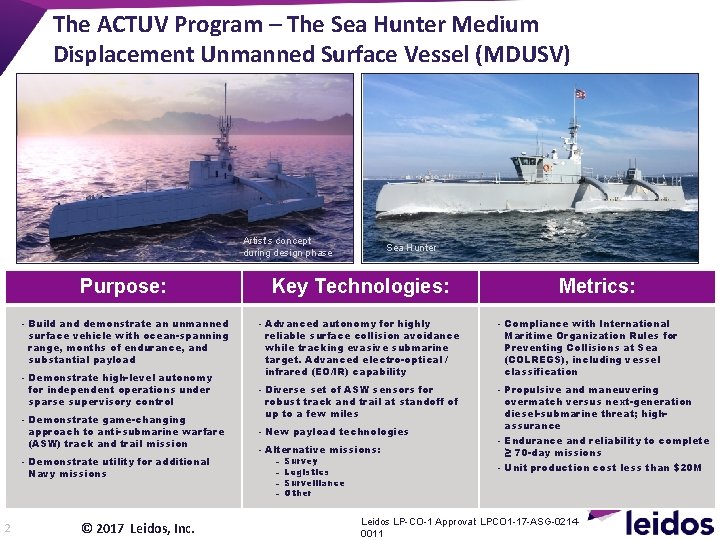
The ACTUV Program – The Sea Hunter Medium Displacement Unmanned Surface Vessel (MDUSV) Early testing of COLREGS autonomy on surrogate vessel - Pathfinder Artist’s concept during design phase Purpose: • Build and demonstrate an unmanned surface vehicle with ocean-spanning range, months of endurance, and substantial payload • Demonstrate high-level autonomy for independent operations under sparse supervisory control • Demonstrate game-changing approach to anti-submarine warfare (ASW) track and trail mission • Demonstrate utility for additional Navy missions 2 © 2017 Leidos, Inc. Sea Hunter Key Technologies: Metrics: • Advanced autonomy for highly • Compliance with International • Diverse set of ASW sensors for • Propulsive and maneuvering reliable surface collision avoidance while tracking evasive submarine target. Advanced electro-optical / infrared (EO/IR) capability robust track and trail at standoff of up to a few miles • New payload technologies • Alternative missions: – – Survey Logistics Surveillance Other Maritime Organization Rules for Preventing Collisions at Sea (COLREGS), including vessel classification overmatch versus next-generation diesel-submarine threat; highassurance • Endurance and reliability to complete ≥ 70 -day missions • Unit production cost less than $20 M Leidos LP-CO-1 Approval: LPCO 1 -17 -ASG-02140011
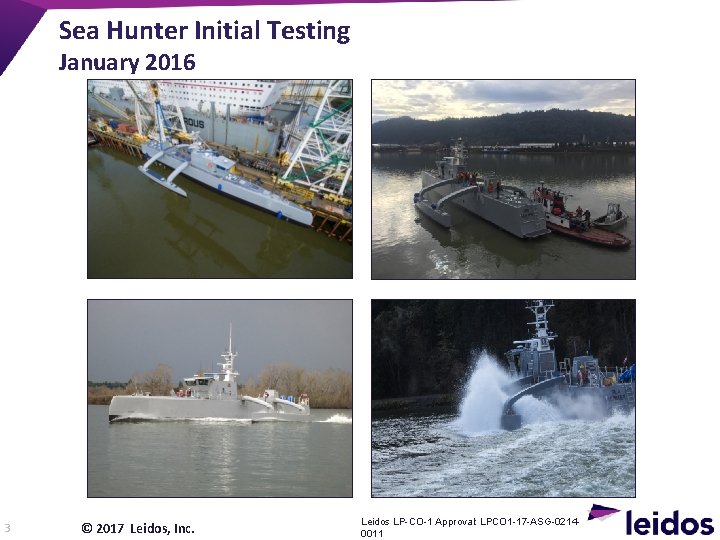
Sea Hunter Initial Testing January 2016 3 © 2017 Leidos, Inc. Leidos LP-CO-1 Approval: LPCO 1 -17 -ASG-02140011
Sea Hunter Initial Testing January 2016 • Please see: http: //www. darpa. mil/work-with-us/actuv-christening-mediakit • ACTUV Speed & Maneuverability Tests 4 © 2017 Leidos, Inc. Leidos LP-CO-1 Approval: LPCO 1 -17 -ASG-02140011
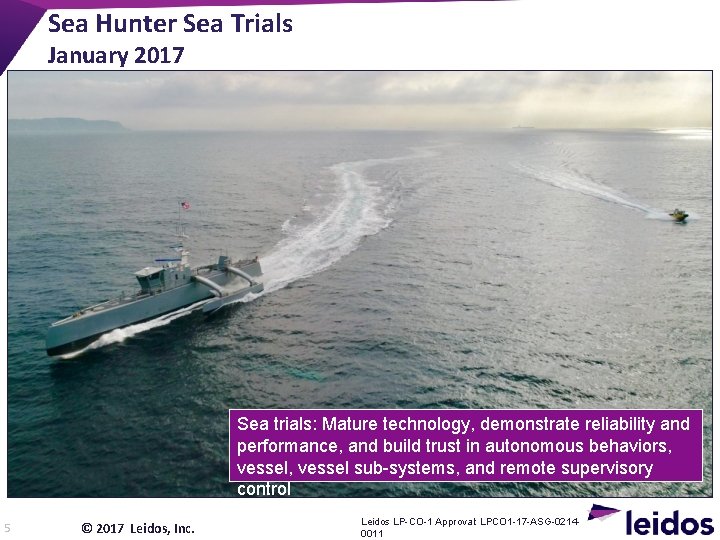
Sea Hunter Sea Trials January 2017 Sea trials: Mature technology, demonstrate reliability and performance, and build trust in autonomous behaviors, vessel sub-systems, and remote supervisory control 5 © 2017 Leidos, Inc. Leidos LP-CO-1 Approval: LPCO 1 -17 -ASG-02140011
General Autonomy Implementation • Many Government and commercial organizations have autonomy implementations on un-manned systems and platforms – The logic and autonomy behaviors are typically straight-forward – it is how they are implemented within the system context that is important – Typically complex and centralized – makes fault tolerance difficult – Hard to manage organizational intellectual property (IP) – Typically does not adhere to standards for interfaces and services – difficult and not cost effective to upgrade, improve, or to include “best of breed” solutions – vendor lock – Typically include information assurance (IA) and anti-tamper (AT) measures as after thoughts; difficult and not cost effective to integrate and modify as risks and threats change • Desire autonomy implementations that reduce cost, risk, and schedule: – Open systems architecture (OSA) and standards compliance – Distributed hierarchical autonomy (DHA) § Modular and distributed functionality – centralized supervisory autonomy, sub-system autonomy is § § specialized Supports fault tolerance Supports strong IA/AT features and multi-level security applications Supports safety critical implementations Supports IP management for Government and Industry – Reuse proven capabilities instead of custom solutions 6 © 2017 Leidos, Inc. Leidos LP-CO-1 Approval: LPCO 1 -17 -ASG-02140011
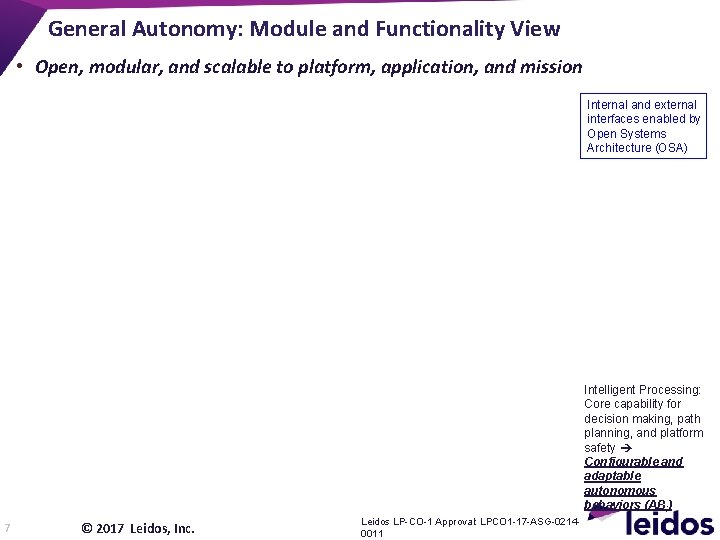
General Autonomy: Module and Functionality View • Open, modular, and scalable to platform, application, and mission Internal and external interfaces enabled by Open Systems Architecture (OSA) Intelligent Processing: Core capability for decision making, path planning, and platform safety Configurable and adaptable autonomous behaviors (ABi) 7 © 2017 Leidos, Inc. Leidos LP-CO-1 Approval: LPCO 1 -17 -ASG-02140011
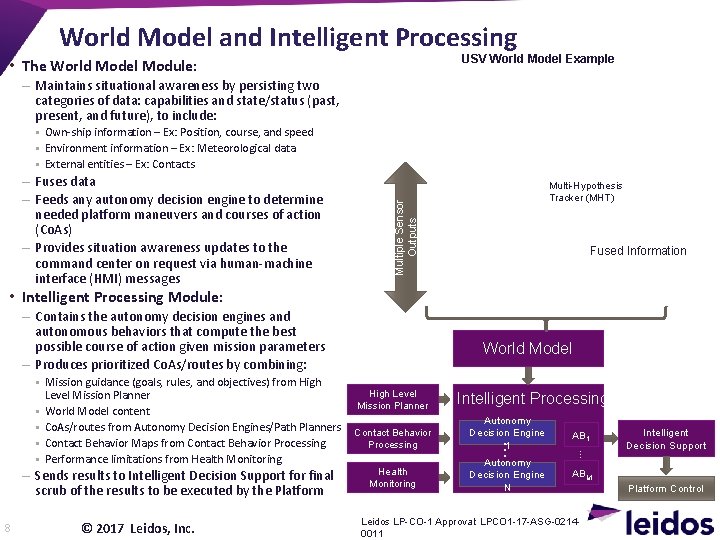
World Model and Intelligent Processing USV World Model Example • The World Model Module: – Maintains situational awareness by persisting two categories of data: capabilities and state/status (past, present, and future), to include: § Own-ship information – Ex: Position, course, and speed § Environment information – Ex: Meteorological data § External entities – Ex: Contacts Multi-Hypothesis Tracker (MHT) Multiple Sensor Outputs – Fuses data – Feeds any autonomy decision engine to determine needed platform maneuvers and courses of action (Co. As) – Provides situation awareness updates to the command center on request via human-machine interface (HMI) messages Fused Information • Intelligent Processing Module: – Contains the autonomy decision engines and autonomous behaviors that compute the best possible course of action given mission parameters – Produces prioritized Co. As/routes by combining: § § § – Sends results to Intelligent Decision Support for final scrub of the results to be executed by the Platform 8 © 2017 Leidos, Inc. High Level Mission Planner Intelligent Processing Contact Behavior Processing Autonomy Decision Engine 1 AB 1 Health Monitoring Autonomy Decision Engine N ABM … § Level Mission Planner World Model content Co. As/routes from Autonomy Decision Engines/Path Planners Contact Behavior Maps from Contact Behavior Processing Performance limitations from Health Monitoring … § Mission guidance (goals, rules, and objectives) from High World Model Leidos LP-CO-1 Approval: LPCO 1 -17 -ASG-02140011 Intelligent Decision Support Platform Control
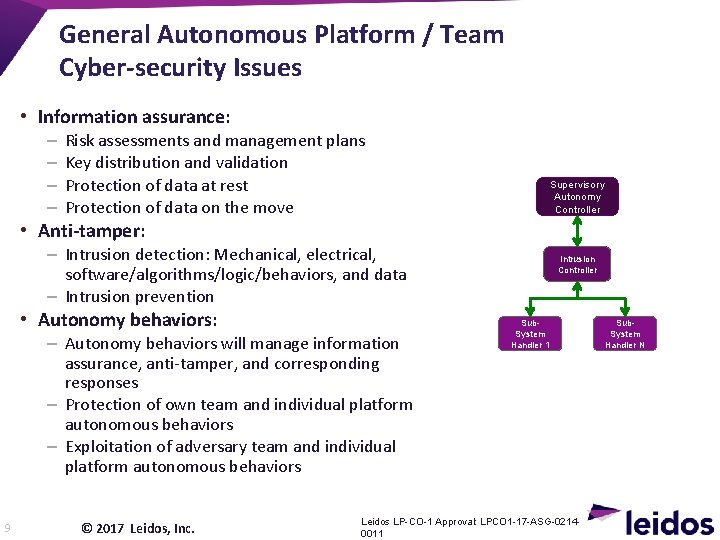
General Autonomous Platform / Team Cyber-security Issues • Information assurance: – – Risk assessments and management plans Key distribution and validation Protection of data at rest Protection of data on the move Supervisory Autonomy Controller • Anti-tamper: – Intrusion detection: Mechanical, electrical, software/algorithms/logic/behaviors, and data – Intrusion prevention • Autonomy behaviors: – Autonomy behaviors will manage information assurance, anti-tamper, and corresponding responses – Protection of own team and individual platform autonomous behaviors – Exploitation of adversary team and individual platform autonomous behaviors 9 © 2017 Leidos, Inc. Intrusion Controller Sub. System Handler 1 Leidos LP-CO-1 Approval: LPCO 1 -17 -ASG-02140011 Sub. System Handler N
Summary • The DARPA ACTUV Program has produced the first long-range, long-endurance MDUSV – COLREGs, obstacle avoidance, and mission autonomy behaviors § Autonomy is installed and being tested – Rigorous test program to mature technology, demonstrate reliability, and to build trust – Currently undergoing sea trials – Alternative missions being explored • Leidos maritime platform and collaborative team autonomy: – Open systems architecture (OSA) and standards compliance § Allows cost-effective and timely improvements in capability, and avoids vendor-lock – Distributed hierarchical autonomy (DHA) – modular and distributed functionality Supports fault tolerance § Supports strong IA/AT features and multi-level security applications § Supports safety critical implementations § Supports IP management for Government and Industry § • Robust communications and cyber-security are key to effective and successful autonomous platform and collaborative team mission performance • Autonomous platforms and collaborative teams of manned and unmanned autonomous platforms can execute current missions at a lower cost and risk profile – and they can enable new missions 10 © 2017 Leidos, Inc. Leidos LP-CO-1 Approval: LPCO 1 -17 -ASG-02140011