
Se di m en ta ry Ig ne


- Slides: 44
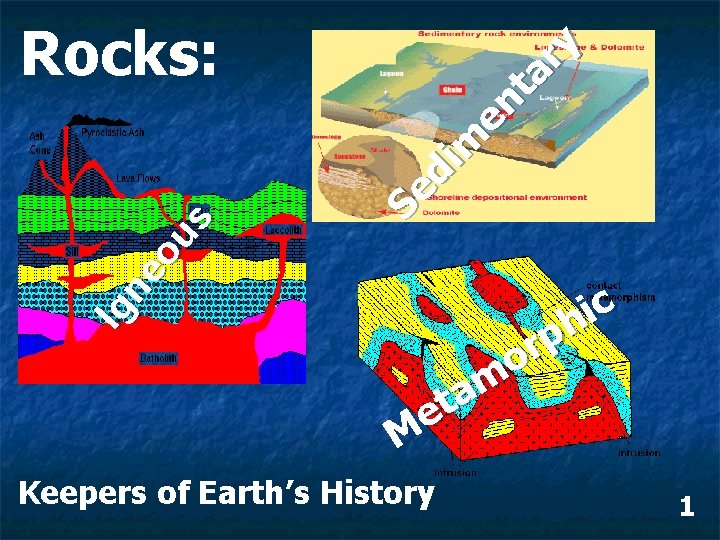
Se di m en ta ry Ig ne ou s Rocks: c i h p r o m a t e M Keepers of Earth’s History 1
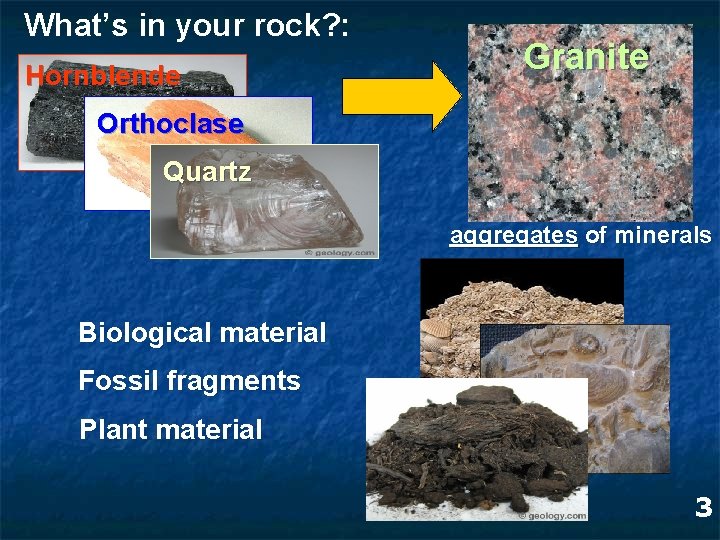
What’s in your rock? : Hornblende Granite Orthoclase Quartz aggregates of minerals Biological material Fossil fragments Plant material 3
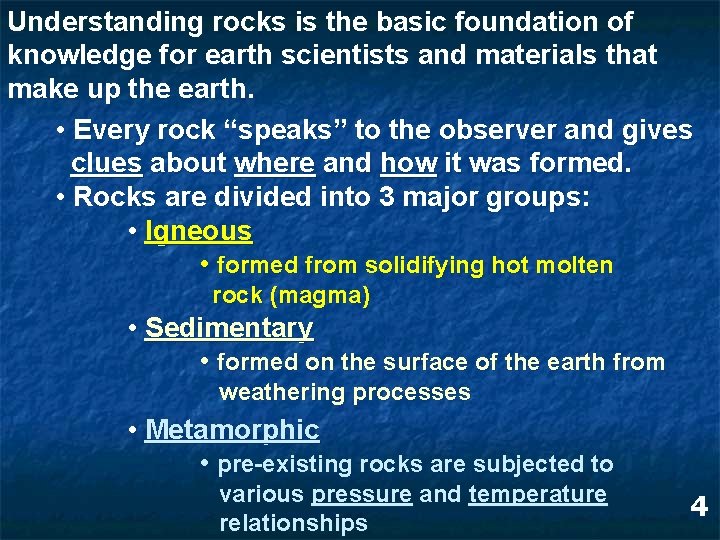
Understanding rocks is the basic foundation of knowledge for earth scientists and materials that make up the earth. • Every rock “speaks” to the observer and gives clues about where and how it was formed. • Rocks are divided into 3 major groups: • Igneous • formed from solidifying hot molten rock (magma) • Sedimentary • formed on the surface of the earth from weathering processes • Metamorphic • pre-existing rocks are subjected to various pressure and temperature relationships 4
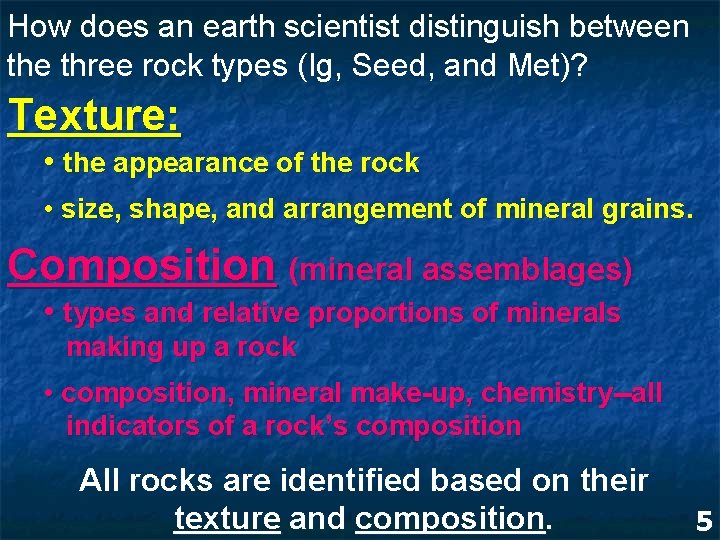
How does an earth scientist distinguish between the three rock types (Ig, Seed, and Met)? Texture: • the appearance of the rock • size, shape, and arrangement of mineral grains. Composition (mineral assemblages) • types and relative proportions of minerals making up a rock • composition, mineral make-up, chemistry--all indicators of a rock’s composition All rocks are identified based on their texture and composition. 5
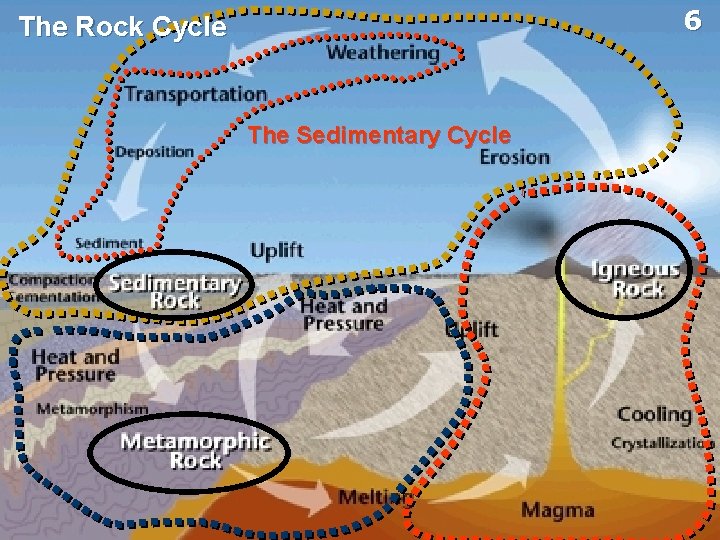
6 The Rock Cycle The Sedimentary Cycle
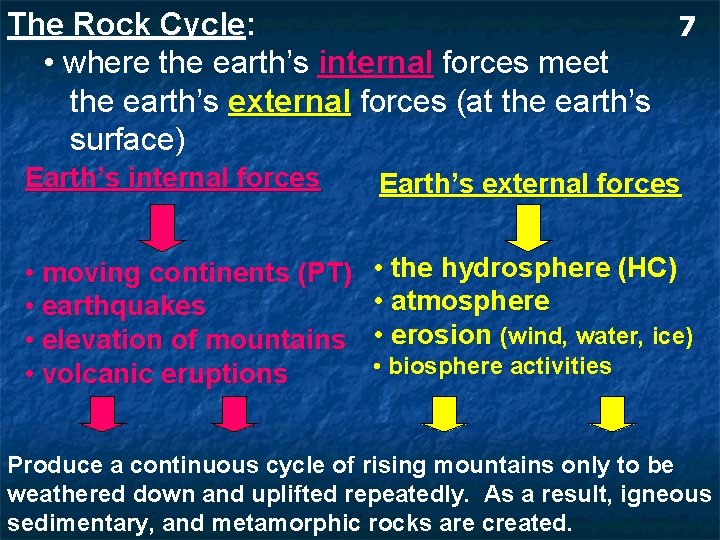
The Rock Cycle: 7 • where the earth’s internal forces meet the earth’s external forces (at the earth’s surface) Earth’s internal forces Earth’s external forces • moving continents (PT) • earthquakes • elevation of mountains • volcanic eruptions • the hydrosphere (HC) • atmosphere • erosion (wind, water, ice) • biosphere activities Produce a continuous cycle of rising mountains only to be weathered down and uplifted repeatedly. As a result, igneous sedimentary, and metamorphic rocks are created.
8 I Earth Science, especially the rock cycle !!!!!!! Discuss with a friend: 1. Briefly identify each rock group and its geologic environment. 2. Draw the rock cycle, and explain how the rock cycle works to your neighbor. 3. Why is the rock cycle a “cycle”? ? ? I will get an A on my exams and quizzes.
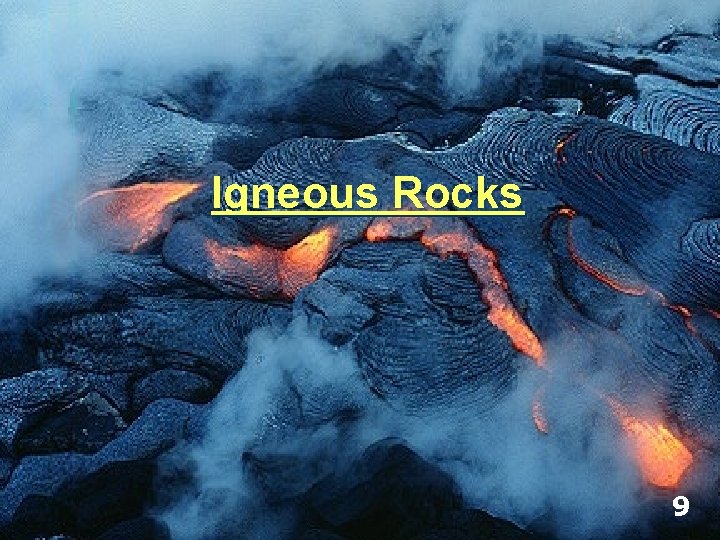
Geology – Chapter 3 – Igneous Rocks 9
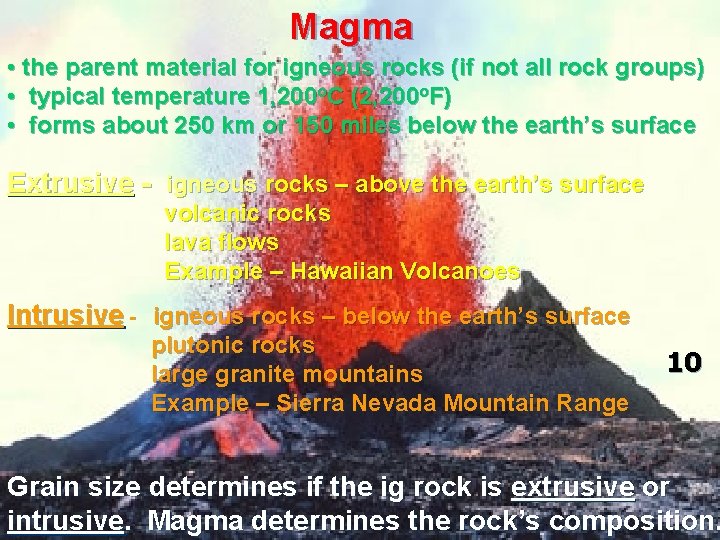
Magma • the parent material for igneous rocks (if not all rock groups) • typical temperature 1, 200 o. C (2, 200 o. F) • forms about 250 km or 150 miles below the earth’s surface Extrusive - igneous rocks – above the earth’s surface volcanic rocks lava flows Example – Hawaiian Volcanoes Intrusive - igneous rocks – below the earth’s surface plutonic rocks large granite mountains Example – Sierra Nevada Mountain Range 10 Grain size determines if the ig rock is extrusive or intrusive. Magma determines the rock’s composition.
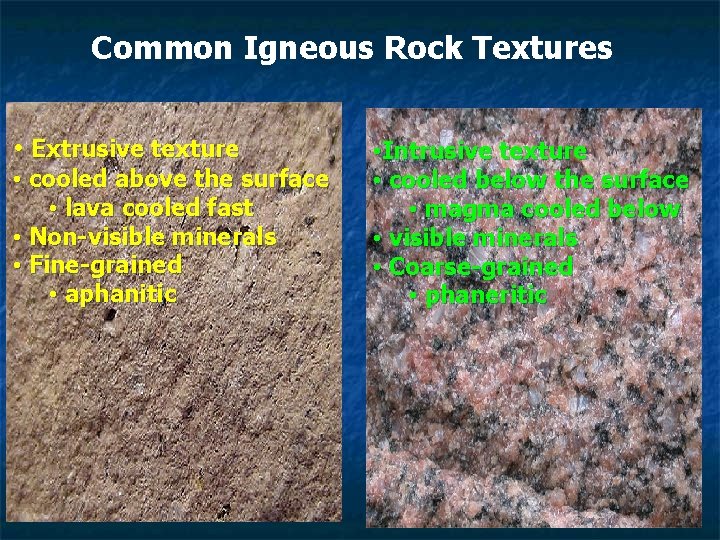
Common Igneous Rock Textures • Extrusive texture • cooled above the surface • lava cooled fast • Non-visible minerals • Fine-grained • aphanitic • Intrusive texture • cooled below the surface • magma cooled below • visible minerals • Coarse-grained • phaneritic
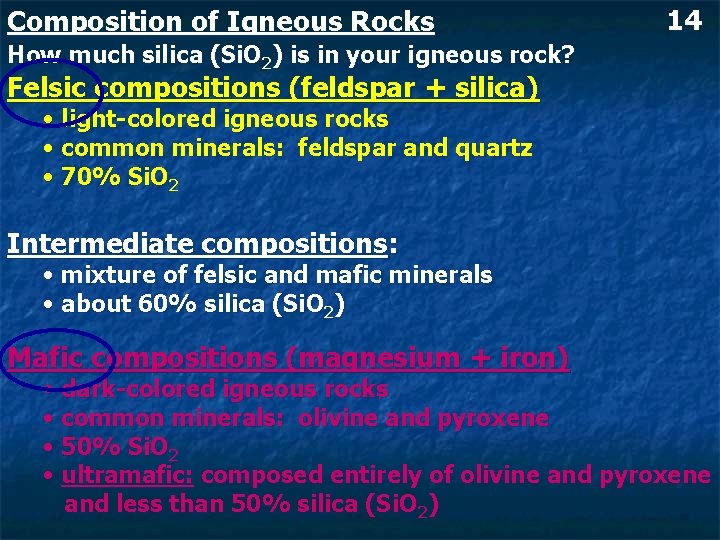
Composition of Igneous Rocks 14 How much silica (Si. O 2) is in your igneous rock? Felsic compositions (feldspar + silica) • light-colored igneous rocks • common minerals: feldspar and quartz • 70% Si. O 2 Intermediate compositions: • mixture of felsic and mafic minerals • about 60% silica (Si. O 2) Mafic compositions (magnesium + iron) • dark-colored igneous rocks • common minerals: olivine and pyroxene • 50% Si. O 2 • ultramafic: composed entirely of olivine and pyroxene and less than 50% silica (Si. O 2)
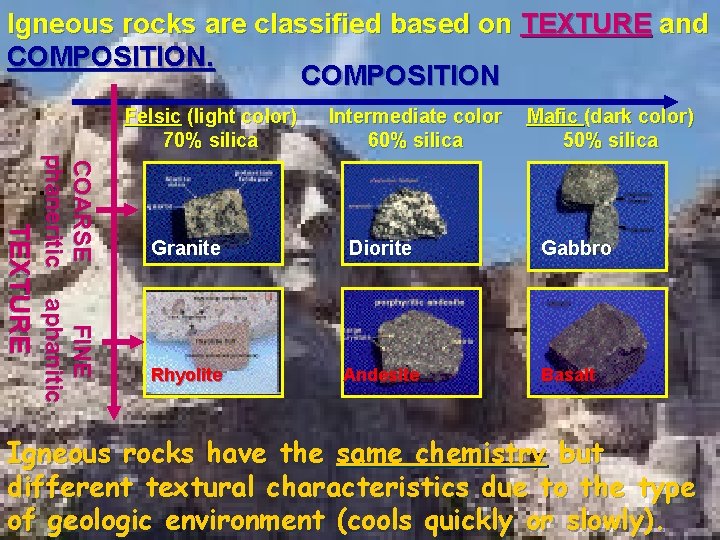
Igneous rocks arerocks classified based on TEXTURE and How are igneous classified? COMPOSITION. • Using their TEXTURE and COMPOSITION Felsic (light color) 70% silica Intermediate color 60% silica COARSE phaneritic FINE aphanitic TEXTURE Granite Diorite Rhyolite Andesite Mafic (dark color) 50% silica Gabbro Basalt Igneous rocks have the same chemistry but different textural characteristics due to the type of geologic environment (cools quickly or slowly).
I Earth Science, especially igneous rocks. 4. What is the difference between extrusive and intrusive igneous rocks? 5. How can one tell the difference between an extrusive and intrusive rock texture? 6. The composition of a mafic ig rock is…. The composition of a felsic ig rock is …. 7. A fine-grained, light-colored ig rock is called a …………………. I will get an A on my exams and quizzes. 17
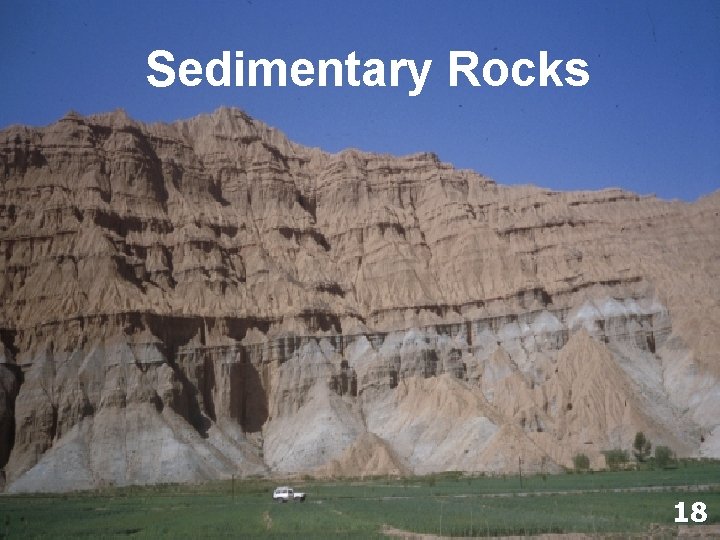
Sedimentary Rocks 18
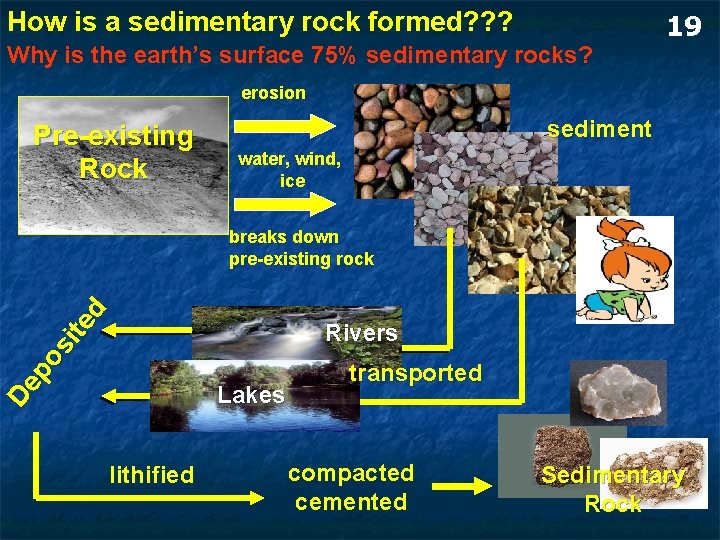
How is a sedimentary rock formed? ? ? Why is the earth’s surface 75% sedimentary rocks? 19 erosion Pre-existing Rock sediment water, wind, ice De po si te d breaks down pre-existing rock Rivers Lakes lithified transported compacted cemented Sedimentary Rock
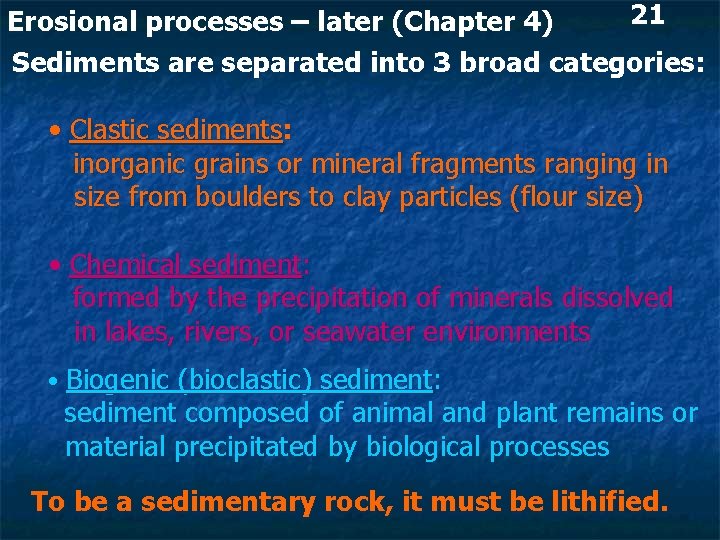
21 Erosional processes – later (Chapter 4) Sediments are separated into 3 broad categories: • Clastic sediments: inorganic grains or mineral fragments ranging in size from boulders to clay particles (flour size) • Chemical sediment: formed by the precipitation of minerals dissolved in lakes, rivers, or seawater environments • Biogenic (bioclastic) sediment: sediment composed of animal and plant remains or material precipitated by biological processes To be a sedimentary rock, it must be lithified.
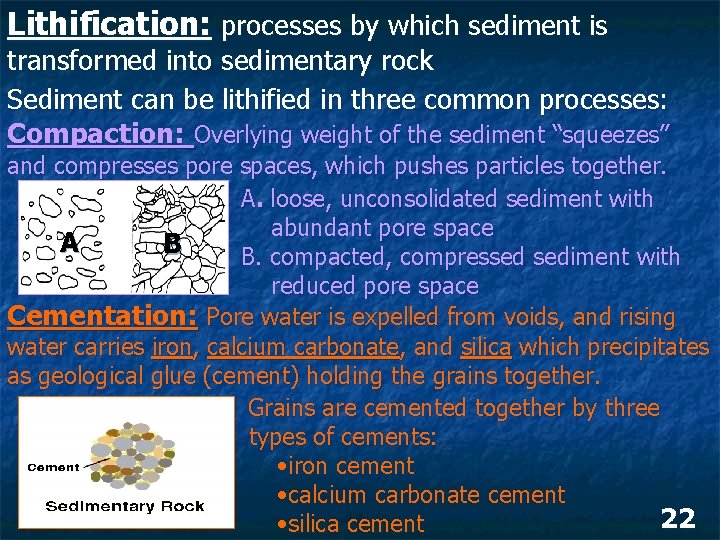
Lithification: processes by which sediment is transformed into sedimentary rock Sediment can be lithified in three common processes: Compaction: Overlying weight of the sediment “squeezes” and compresses pore spaces, which pushes particles together. A. loose, unconsolidated sediment with abundant pore space A B B. compacted, compressed sediment with reduced pore space Cementation: Pore water is expelled from voids, and rising water carries iron, calcium carbonate, and silica which precipitates as geological glue (cement) holding the grains together. Grains are cemented together by three types of cements: • iron cement • calcium carbonate cement 22 • silica cement
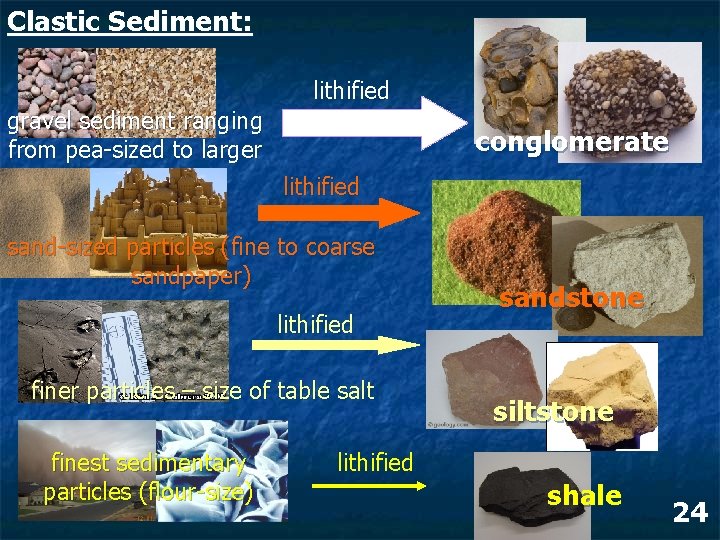
Clastic Sediment: lithified gravel sediment ranging from pea-sized to larger conglomerate lithified sand-sized particles (fine to coarse sandpaper) lithified finer particles – size of table salt finest sedimentary particles (flour-size) sandstone siltstone lithified shale 24
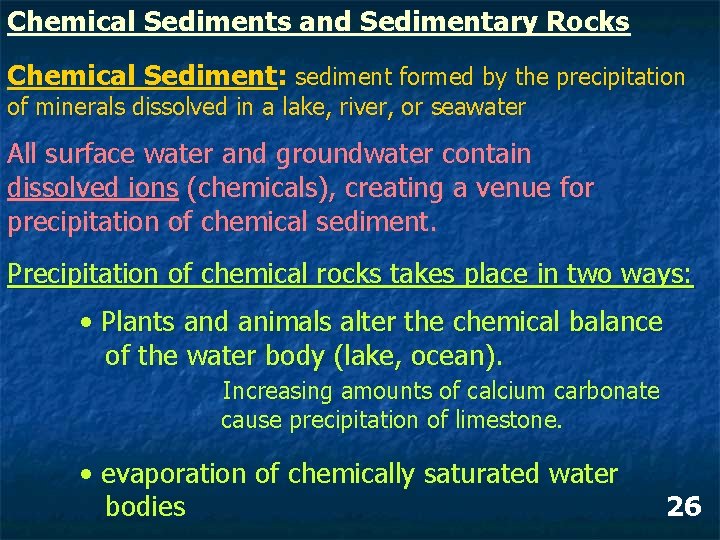
Chemical Sediments and Sedimentary Rocks Chemical Sediment: sediment formed by the precipitation of minerals dissolved in a lake, river, or seawater All surface water and groundwater contain dissolved ions (chemicals), creating a venue for precipitation of chemical sediment. Precipitation of chemical rocks takes place in two ways: • Plants and animals alter the chemical balance of the water body (lake, ocean). Increasing amounts of calcium carbonate cause precipitation of limestone. • evaporation of chemically saturated water bodies 26
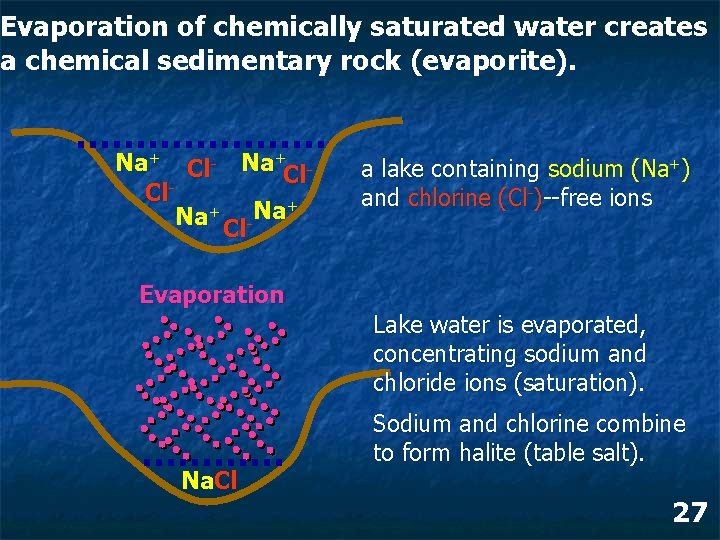
Evaporation of chemically saturated water creates a chemical sedimentary rock (evaporite). Na+ Cl- Na+Cl. Cl+ Na+ Cl-Na a lake containing sodium (Na+) and chlorine (Cl-)--free ions Evaporation Lake water is evaporated, concentrating sodium and chloride ions (saturation). Na. Cl Sodium and chlorine combine to form halite (table salt). 27
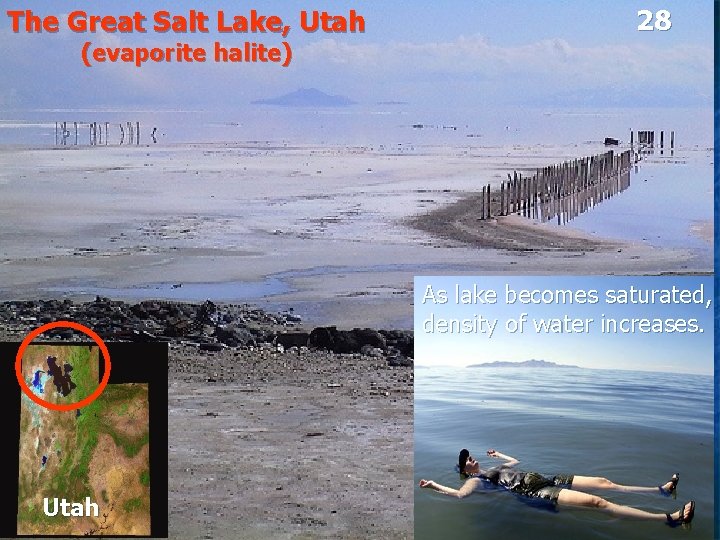
The Great Salt Lake, Utah 28 (evaporite halite) As lake becomes saturated, density of water increases. Utah
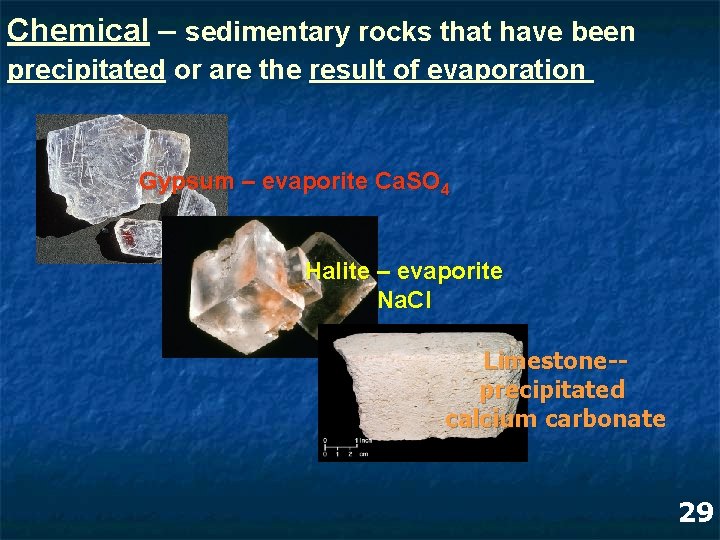
Chemical – sedimentary rocks that have been precipitated or are the result of evaporation Gypsum – evaporite Ca. SO 4 Halite – evaporite Na. Cl Limestone-precipitated calcium carbonate 29
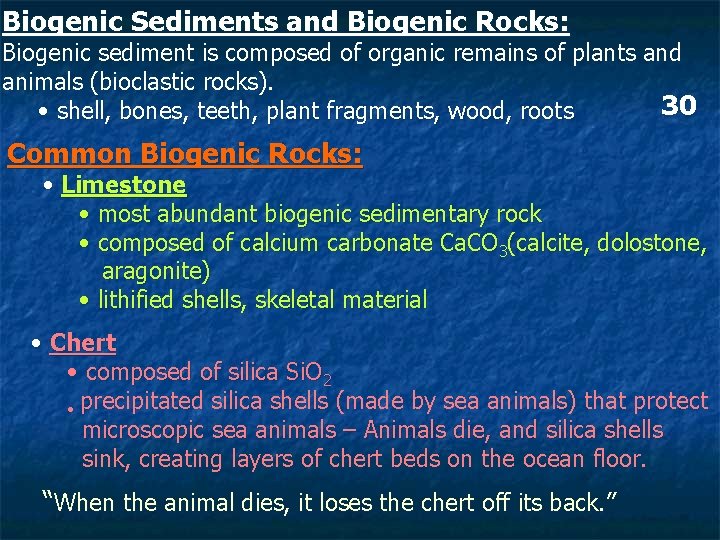
Biogenic Sediments and Biogenic Rocks: Biogenic sediment is composed of organic remains of plants and animals (bioclastic rocks). 30 • shell, bones, teeth, plant fragments, wood, roots Common Biogenic Rocks: • Limestone • most abundant biogenic sedimentary rock • composed of calcium carbonate Ca. CO 3(calcite, dolostone, aragonite) • lithified shells, skeletal material • Chert • composed of silica Si. O 2 • precipitated silica shells (made by sea animals) that protect microscopic sea animals – Animals die, and silica shells sink, creating layers of chert beds on the ocean floor. “When the animal dies, it loses the chert off its back. ”
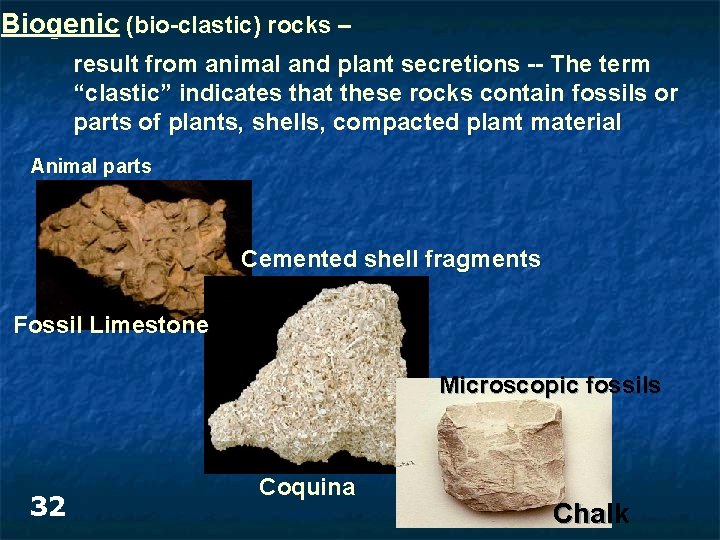
Biogenic (bio-clastic) rocks – result from animal and plant secretions -- The term “clastic” indicates that these rocks contain fossils or parts of plants, shells, compacted plant material Animal parts Cemented shell fragments Fossil Limestone Microscopic fossils 32 Coquina Chalk
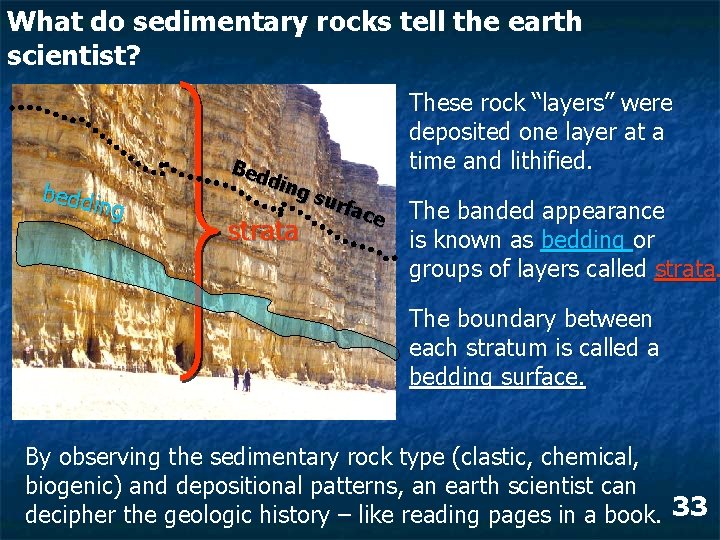
What do sedimentary rocks tell the earth scientist? beddi ng Bed din g su rfac e strata These rock “layers” were deposited one layer at a time and lithified. The banded appearance is known as bedding or groups of layers called strata. The boundary between each stratum is called a bedding surface. By observing the sedimentary rock type (clastic, chemical, biogenic) and depositional patterns, an earth scientist can decipher the geologic history – like reading pages in a book. 33
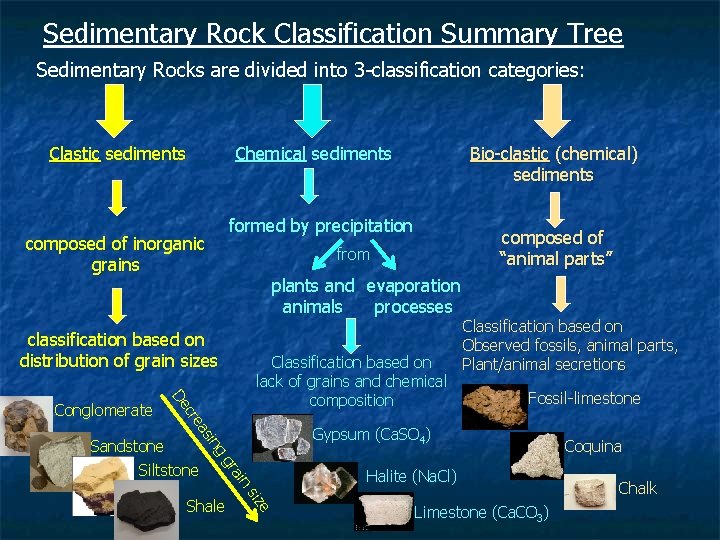
Sedimentary Rock Classification Summary Tree Sedimentary Rocks are divided into 3 -classification categories: Clastic sediments Chemical sediments formed by precipitation composed of inorganic grains plants and evaporation animals processes Classification based on lack of grains and chemical composition g sin ea cr De e siz Shale Classification based on Observed fossils, animal parts, Plant/animal secretions Fossil-limestone Gypsum (Ca. SO 4) ain gr Sandstone Siltstone composed of “animal parts” from classification based on distribution of grain sizes Conglomerate Bio-clastic (chemical) sediments Halite (Na. Cl) Limestone (Ca. CO 3) Coquina Chalk
36 I sedimentary rock classification. Discuss with a friend: 8. Describe at least 2 characteristics of each sedimentary rock classification (clastic, biogenic, chemical). 9. Give a rock example for each classification. I will get an A on my exams and quizzes.
37
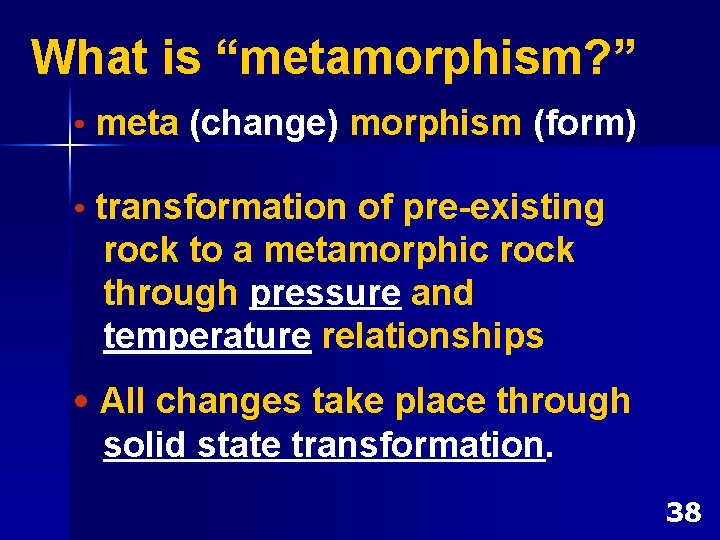
What is “metamorphism? ” • meta (change) morphism (form) • transformation of pre-existing rock to a metamorphic rock through pressure and temperature relationships • All changes take place through solid state transformation. 38
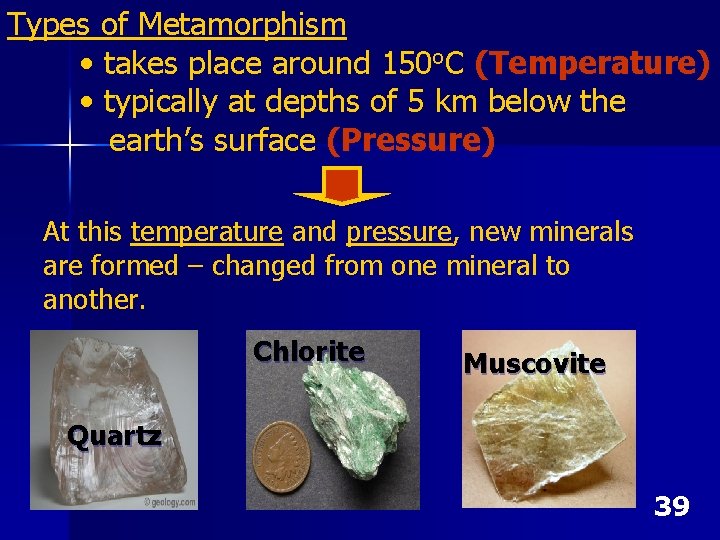
Types of Metamorphism • takes place around 150 o. C (Temperature) • typically at depths of 5 km below the earth’s surface (Pressure) At this temperature and pressure, new minerals are formed – changed from one mineral to another. Chlorite Muscovite Quartz 39
I metamorphic rocks. Discuss with a friend: 10. How do you define metamorphism? – Be specific. 11. What two major factors are necessary for pre-existing rocks to become metamorphosed? 12. Where does metamorphism typically take place within the earth? I will get an A on my exams and quizzes. 40
2 Common types of metamorphism • contact metamorphism • regional metamorphism 44
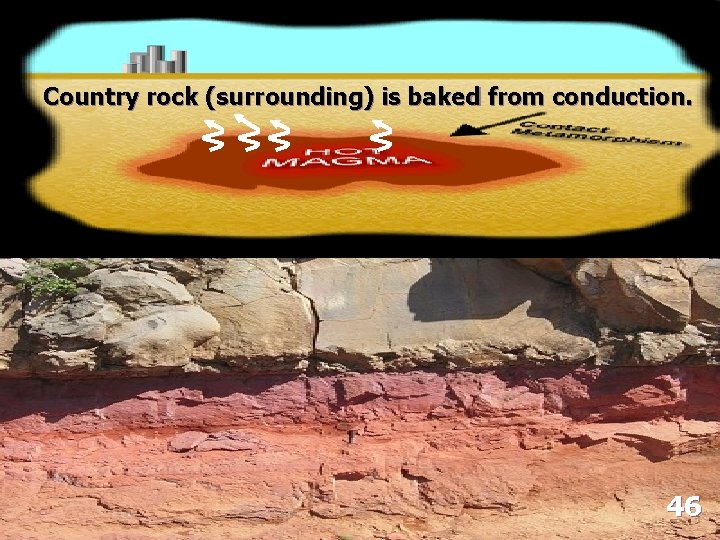
What is contact metamorphism? • Contact metamorphism: magma “contacts” solid rock – heat is transferred into overlying rocks through conduction – changing the pre-existing rock it intruded • high heat/low pressure • localized metamorphism • “fast-acting, ” like touching a hot frying pan 45
Country rock (surrounding) is baked from conduction. 46
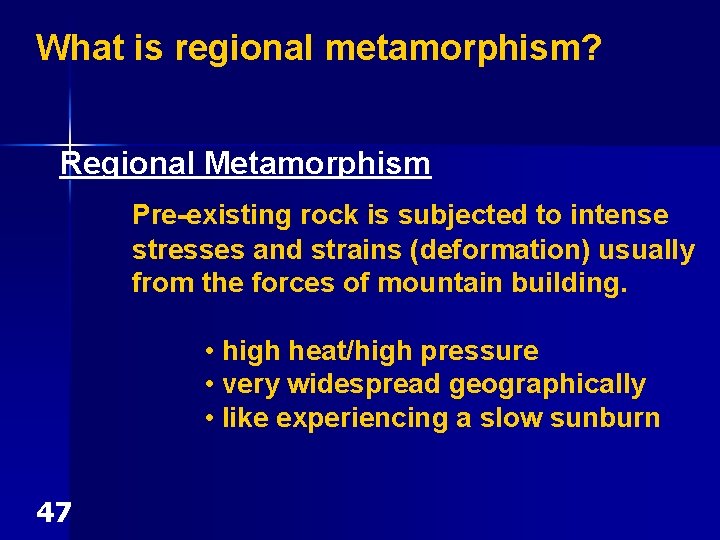
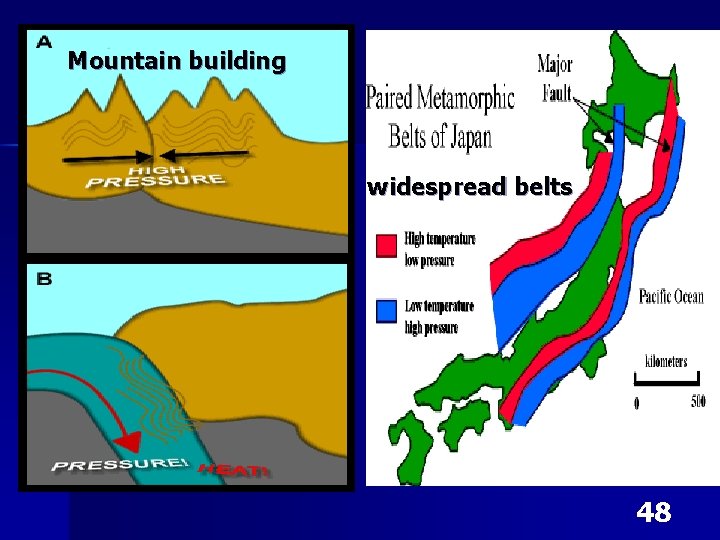
What is regional metamorphism? Regional Metamorphism Pre-existing rock is subjected to intense stresses and strains (deformation) usually from the forces of mountain building. • high heat/high pressure • very widespread geographically • like experiencing a slow sunburn 47
Mountain building widespread belts 48
I the different ways to create Metamorphism. Discuss with a friend: 13. Describe the conditions necessary for each type of metamorphism: • contact metamorphism • regional metamorphism I will get an A on my exams and quizzes. 49
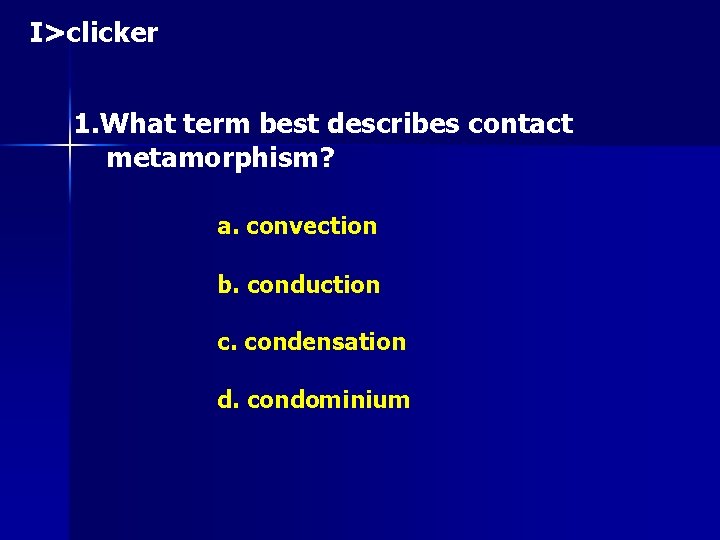
I>clicker 1. What term best describes contact metamorphism? a. convection b. conduction c. condensation d. condominium
Metamorphic heat sources: Heat sources: contact with hot magma – heat penetrates overlying rocks (conduction) geothermal gradient – heat increases with depth – rocks are hotter when buried 50
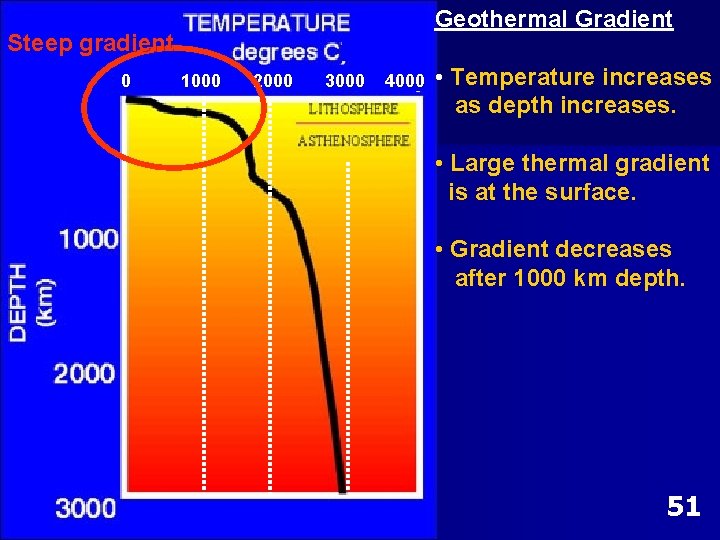
Geothermal Gradient Steep gradient 0 1000 2000 3000 4000 • Temperature increases as depth increases. • Large thermal gradient is at the surface. • Gradient decreases after 1000 km depth. 51
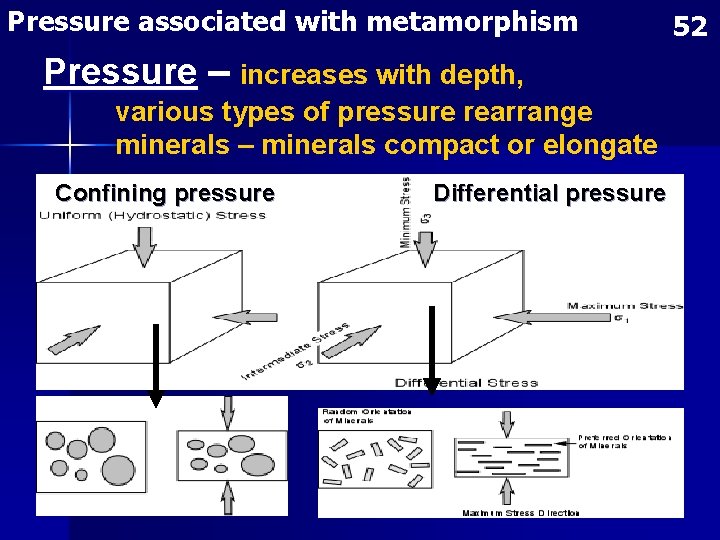
Pressure associated with metamorphism Pressure – increases with depth, various types of pressure rearrange minerals – minerals compact or elongate Confining pressure Differential pressure 52
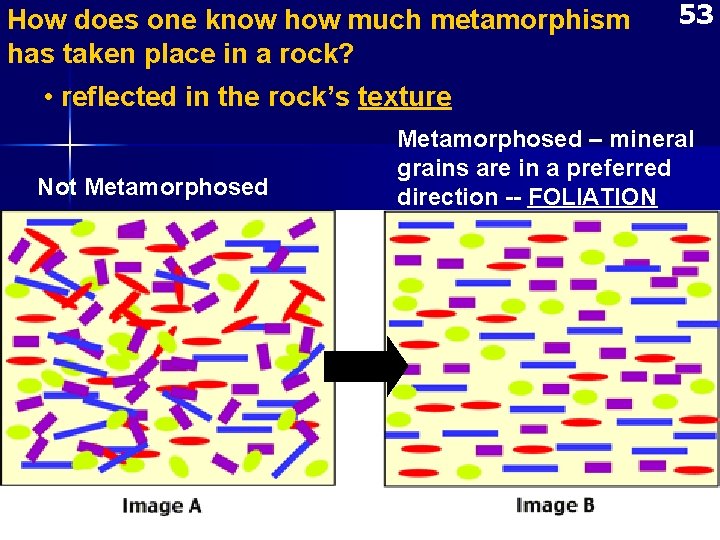
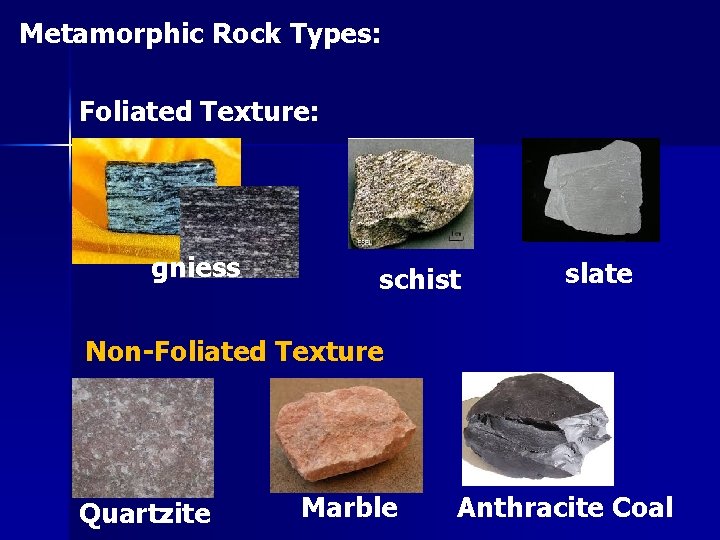
How does one know how much metamorphism has taken place in a rock? 53 • reflected in the rock’s texture Not Metamorphosed – mineral grains are in a preferred direction -- FOLIATION
Metamorphic Rock Types: Foliated Texture: gniess schist slate Non-Foliated Texture Quartzite Marble Anthracite Coal
54 I to metamorphose. Discuss with a friend: 14. Describe two heat sources associated with metamorphism. 15. Define the differences between confining and differential pressures. 16. Draw a diagram that shows mineral orientation due to confining and differential type pressures. I will get an A on my exams and quizzes.