
SDOH Screening in a Pediatric Inpatient Setting Laura
- Slides: 1
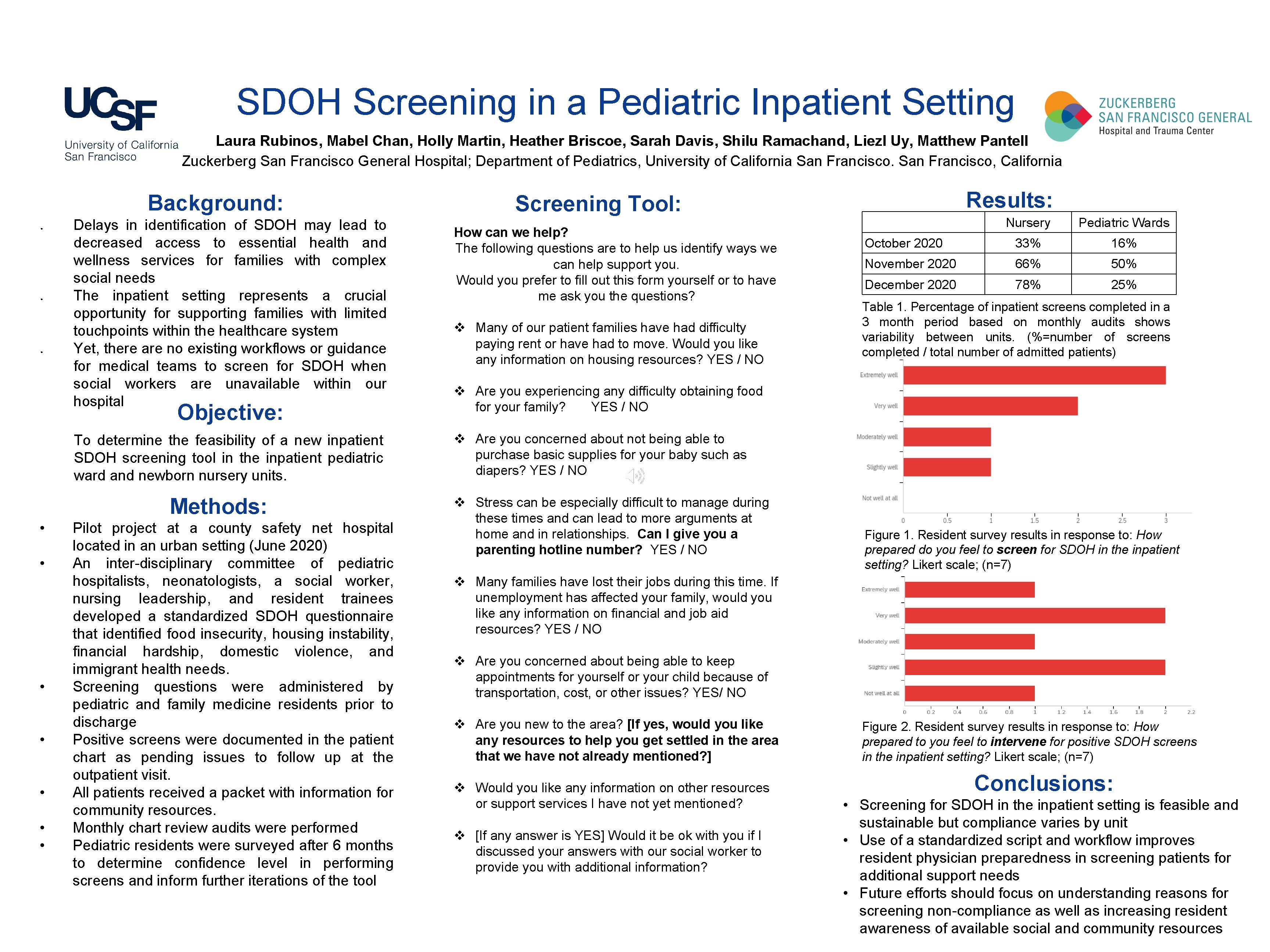
SDOH Screening in a Pediatric Inpatient Setting Laura Rubinos, Mabel Chan, Holly Martin, Heather Briscoe, Sarah Davis, Shilu Ramachand, Liezl Uy, Matthew Pantell Zuckerberg San Francisco General Hospital; Department of Pediatrics, University of California San Francisco, California Background: ● ● ● Delays in identification of SDOH may lead to decreased access to essential health and wellness services for families with complex social needs The inpatient setting represents a crucial opportunity for supporting families with limited touchpoints within the healthcare system Yet, there are no existing workflows or guidance for medical teams to screen for SDOH when social workers are unavailable within our hospital Objective: To determine the feasibility of a new inpatient SDOH screening tool in the inpatient pediatric ward and newborn nursery units. Methods: • • Pilot project at a county safety net hospital located in an urban setting (June 2020) An inter-disciplinary committee of pediatric hospitalists, neonatologists, a social worker, nursing leadership, and resident trainees developed a standardized SDOH questionnaire that identified food insecurity, housing instability, financial hardship, domestic violence, and immigrant health needs. Screening questions were administered by pediatric and family medicine residents prior to discharge Positive screens were documented in the patient chart as pending issues to follow up at the outpatient visit. All patients received a packet with information for community resources. Monthly chart review audits were performed Pediatric residents were surveyed after 6 months to determine confidence level in performing screens and inform further iterations of the tool Results: Screening Tool: How can we help? The following questions are to help us identify ways we can help support you. Would you prefer to fill out this form yourself or to have me ask you the questions? v Many of our patient families have had difficulty paying rent or have had to move. Would you like any information on housing resources? YES / NO Nursery Pediatric Wards October 2020 33% 16% November 2020 66% 50% December 2020 78% 25% Table 1. Percentage of inpatient screens completed in a 3 month period based on monthly audits shows variability between units. (%=number of screens completed / total number of admitted patients) v Are you experiencing any difficulty obtaining food for your family? YES / NO v Are you concerned about not being able to purchase basic supplies for your baby such as diapers? YES / NO v Stress can be especially difficult to manage during these times and can lead to more arguments at home and in relationships. Can I give you a parenting hotline number? YES / NO Figure 1. Resident survey results in response to: How prepared do you feel to screen for SDOH in the inpatient setting? Likert scale; (n=7) v Many families have lost their jobs during this time. If unemployment has affected your family, would you like any information on financial and job aid resources? YES / NO v Are you concerned about being able to keep appointments for yourself or your child because of transportation, cost, or other issues? YES/ NO v Are you new to the area? [If yes, would you like any resources to help you get settled in the area that we have not already mentioned? ] v Would you like any information on other resources or support services I have not yet mentioned? v [If any answer is YES] Would it be ok with you if I discussed your answers with our social worker to provide you with additional information? Figure 2. Resident survey results in response to: How prepared to you feel to intervene for positive SDOH screens in the inpatient setting? Likert scale; (n=7) Conclusions: • Screening for SDOH in the inpatient setting is feasible and sustainable but compliance varies by unit • Use of a standardized script and workflow improves resident physician preparedness in screening patients for additional support needs • Future efforts should focus on understanding reasons for screening non-compliance as well as increasing resident awareness of available social and community resources