
SDOAIA science plan prioritization and implementation Five Objectives
SDO/AIA science plan: prioritization and implementation: Five Objectives in 10 steps I: C 4/C 6/M 8: Coronal Energy Inputs Chair(s): Tom Metcalf, Karel Schrijver Status: draft III (2006/01/11) With comments from Eric Priest, Pascal Demoulin, Aad van Ballegooijen, Tom Metcalf & Karel Schrijver C 4/C 6/M 8 HMI/AIA science teams meeting; Monterey; Feb. 2006 1
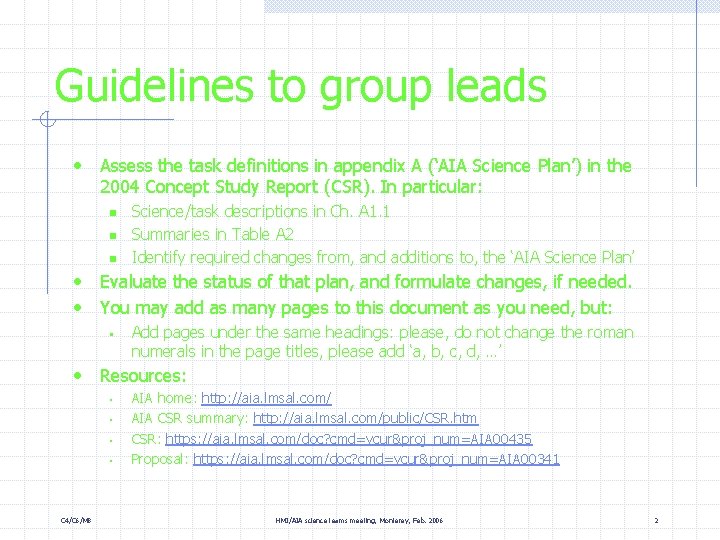
Guidelines to group leads • Assess the task definitions in appendix A (‘AIA Science Plan’) in the 2004 Concept Study Report (CSR). In particular: n n n Science/task descriptions in Ch. A 1. 1 Summaries in Table A 2 Identify required changes from, and additions to, the ‘AIA Science Plan’ • Evaluate the status of that plan, and formulate changes, if needed. • You may add as many pages to this document as you need, but: • Add pages under the same headings: please, do not change the roman numerals in the page titles, please add ‘a, b, c, d, …’ • Resources: • • C 4/C 6/M 8 AIA home: http: //aia. lmsal. com/ AIA CSR summary: http: //aia. lmsal. com/public/CSR. htm CSR: https: //aia. lmsal. com/doc? cmd=vcur&proj_num=AIA 00435 Proposal: https: //aia. lmsal. com/doc? cmd=vcur&proj_num=AIA 00341 HMI/AIA science teams meeting; Monterey; Feb. 2006 2
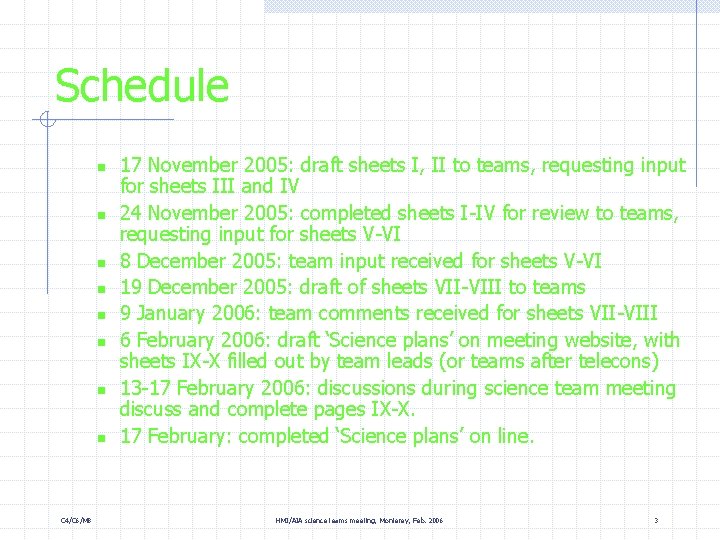
Schedule n n n n C 4/C 6/M 8 17 November 2005: draft sheets I, II to teams, requesting input for sheets III and IV 24 November 2005: completed sheets I-IV for review to teams, requesting input for sheets V-VI 8 December 2005: team input received for sheets V-VI 19 December 2005: draft of sheets VII-VIII to teams 9 January 2006: team comments received for sheets VII-VIII 6 February 2006: draft ‘Science plans’ on meeting website, with sheets IX-X filled out by team leads (or teams after telecons) 13 -17 February 2006: discussions during science team meeting discuss and complete pages IX-X. 17 February: completed ‘Science plans’ on line. HMI/AIA science teams meeting; Monterey; Feb. 2006 3
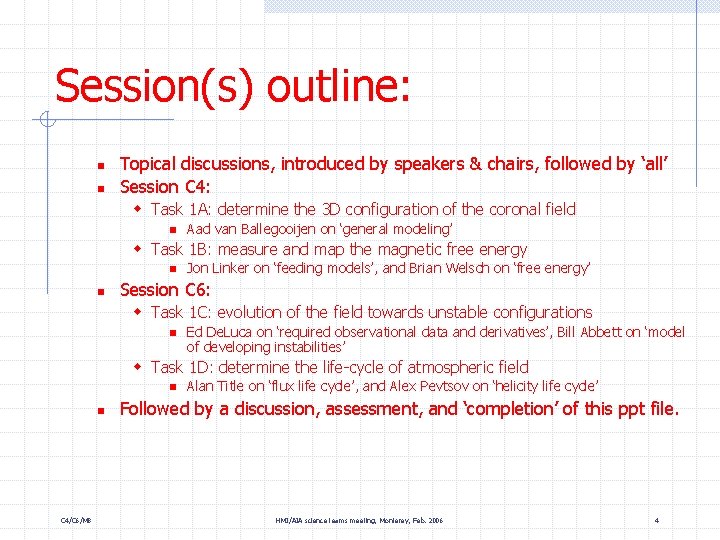
Session(s) outline: n n Topical discussions, introduced by speakers & chairs, followed by ‘all’ Session C 4: w Task 1 A: determine the 3 D configuration of the coronal field n Aad van Ballegooijen on ‘general modeling’ w Task 1 B: measure and map the magnetic free energy n n Jon Linker on ‘feeding models’, and Brian Welsch on ‘free energy’ Session C 6: w Task 1 C: evolution of the field towards unstable configurations n Ed De. Luca on ‘required observational data and derivatives’, Bill Abbett on ‘model of developing instabilities’ w Task 1 D: determine the life-cycle of atmospheric field n n C 4/C 6/M 8 Alan Title on ‘flux life cycle’, and Alex Pevtsov on ‘helicity life cycle’ Followed by a discussion, assessment, and ‘completion’ of this ppt file. HMI/AIA science teams meeting; Monterey; Feb. 2006 4
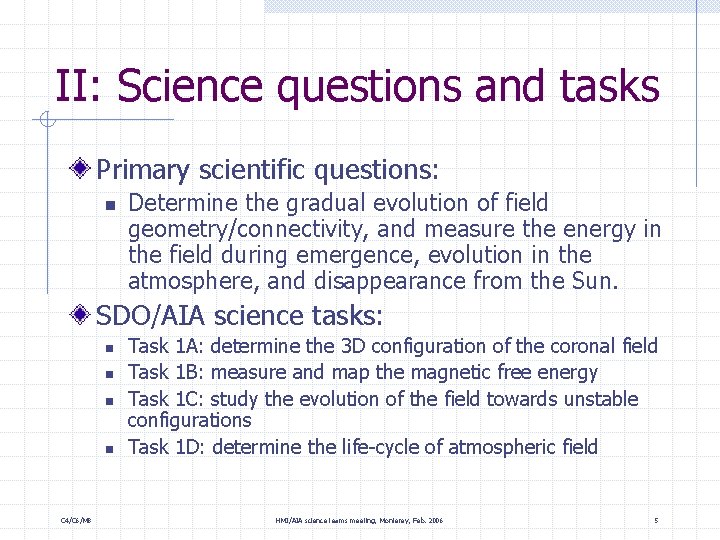
II: Science questions and tasks Primary scientific questions: n Determine the gradual evolution of field geometry/connectivity, and measure the energy in the field during emergence, evolution in the atmosphere, and disappearance from the Sun. SDO/AIA science tasks: n n C 4/C 6/M 8 Task 1 A: determine the 3 D configuration of the coronal field Task 1 B: measure and map the magnetic free energy Task 1 C: study the evolution of the field towards unstable configurations Task 1 D: determine the life-cycle of atmospheric field HMI/AIA science teams meeting; Monterey; Feb. 2006 5
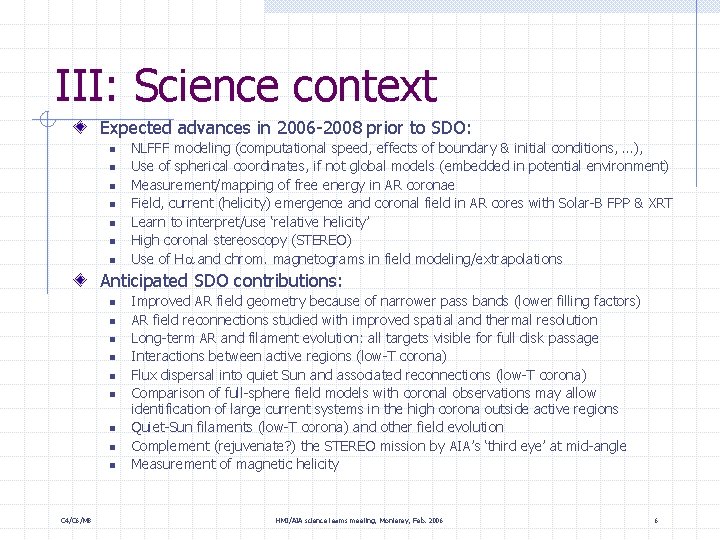
III: Science context Expected advances in 2006 -2008 prior to SDO: n n n n NLFFF modeling (computational speed, effects of boundary & initial conditions, …), Use of spherical coordinates, if not global models (embedded in potential environment) Measurement/mapping of free energy in AR coronae Field, current (helicity) emergence and coronal field in AR cores with Solar-B FPP & XRT Learn to interpret/use ‘relative helicity’ High coronal stereoscopy (STEREO) Use of H and chrom. magnetograms in field modeling/extrapolations Anticipated SDO contributions: n n n n n C 4/C 6/M 8 Improved AR field geometry because of narrower pass bands (lower filling factors) AR field reconnections studied with improved spatial and thermal resolution Long-term AR and filament evolution: all targets visible for full disk passage Interactions between active regions (low-T corona) Flux dispersal into quiet Sun and associated reconnections (low-T corona) Comparison of full-sphere field models with coronal observations may allow identification of large current systems in the high corona outside active regions Quiet-Sun filaments (low-T corona) and other field evolution Complement (rejuvenate? ) the STEREO mission by AIA’s ‘third eye’ at mid-angle Measurement of magnetic helicity HMI/AIA science teams meeting; Monterey; Feb. 2006 6
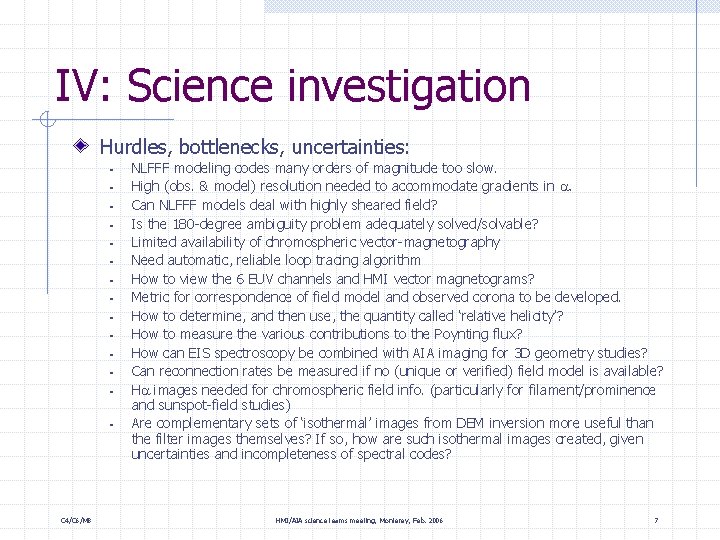
IV: Science investigation Hurdles, bottlenecks, uncertainties: § § § § C 4/C 6/M 8 NLFFF modeling codes many orders of magnitude too slow. High (obs. & model) resolution needed to accommodate gradients in . Can NLFFF models deal with highly sheared field? Is the 180 -degree ambiguity problem adequately solved/solvable? Limited availability of chromospheric vector-magnetography Need automatic, reliable loop tracing algorithm How to view the 6 EUV channels and HMI vector magnetograms? Metric for correspondence of field model and observed corona to be developed. How to determine, and then use, the quantity called ‘relative helicity’? How to measure the various contributions to the Poynting flux? How can EIS spectroscopy be combined with AIA imaging for 3 D geometry studies? Can reconnection rates be measured if no (unique or verified) field model is available? H images needed for chromospheric field info. (particularly for filament/prominence and sunspot-field studies) Are complementary sets of ‘isothermal’ images from DEM inversion more useful than the filter images themselves? If so, how are such isothermal images created, given uncertainties and incompleteness of spectral codes? HMI/AIA science teams meeting; Monterey; Feb. 2006 7
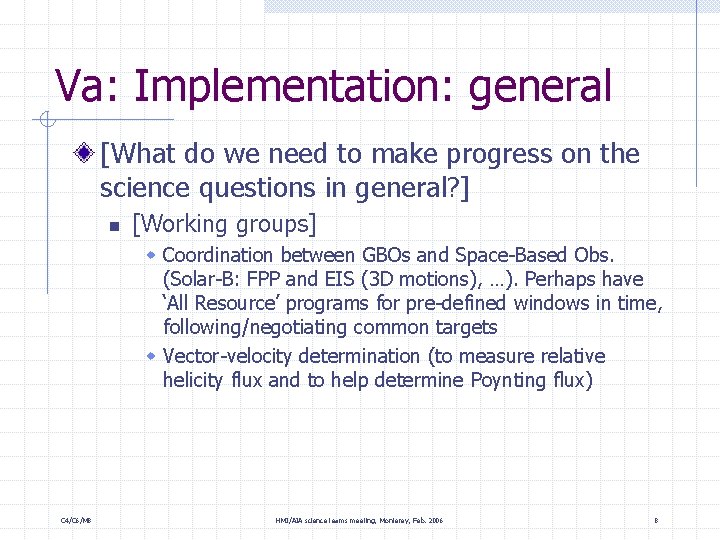
Va: Implementation: general [What do we need to make progress on the science questions in general? ] n [Working groups] w Coordination between GBOs and Space-Based Obs. (Solar-B: FPP and EIS (3 D motions), …). Perhaps have ‘All Resource’ programs for pre-defined windows in time, following/negotiating common targets w Vector-velocity determination (to measure relative helicity flux and to help determine Poynting flux) C 4/C 6/M 8 HMI/AIA science teams meeting; Monterey; Feb. 2006 8

Vb: Implementation: general [What do we need to make progress on the science questions in general? ] n [Science stimuli, funding, …] w NLFFF code speed and resolution: high resolution is essential to accommodate strong shear; large number of pixels is needed to model multi-AR interacting fields or large-scale filaments. w 180 -degree ambiguity resolution: algorithm speed; options to start from a previous vector-magnetogram. w Funding for (one or more? ): n n C 4/C 6/M 8 GBO chromospheric vector magnetograms Solar-B and/or GBO H HMI/AIA science teams meeting; Monterey; Feb. 2006 9

Vc: Implementation: general [What do we need to make progress on the science questions in general? ] n n [SR&T/TR&T/…] [observables, models, codes, resources, people …] w NLFFF model tests on synthetic data w Chromospheric field information ([vector]B, Halpha, …) w Solar-B EIS data for 3 D flow determination n C 4/C 6/M 8 … HMI/AIA science teams meeting; Monterey; Feb. 2006 10
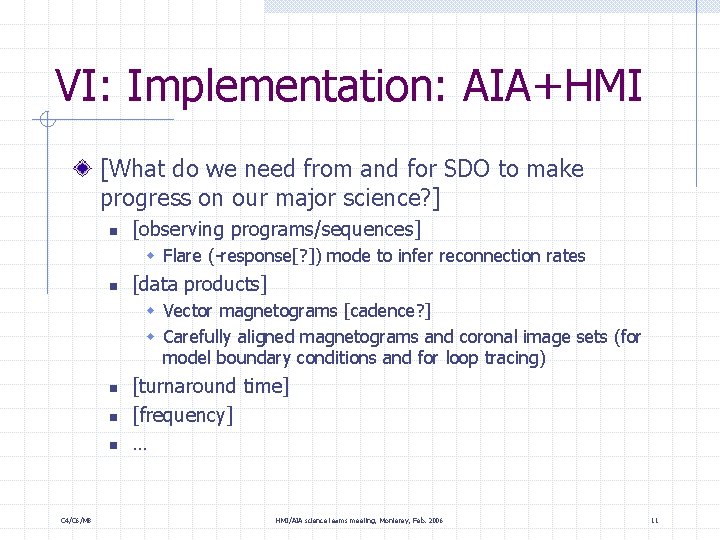
VI: Implementation: AIA+HMI [What do we need from and for SDO to make progress on our major science? ] n [observing programs/sequences] w Flare (-response[? ]) mode to infer reconnection rates n [data products] w Vector magnetograms [cadence? ] w Carefully aligned magnetograms and coronal image sets (for model boundary conditions and for loop tracing) n n n C 4/C 6/M 8 [turnaround time] [frequency] … HMI/AIA science teams meeting; Monterey; Feb. 2006 11
![VII: AIA (+HMI+EVE) data products [list data products; differentiate ‘critical’, ‘desirable’, ‘useful’] n SDO](http://slidetodoc.com/presentation_image/d825cdfd3ced7b8f614c85d95e486dc9/image-12.jpg "VII: AIA (+HMI+EVE) data products [list data products; differentiate ‘critical’, ‘desirable’, ‘useful’] n SDO")
VII: AIA (+HMI+EVE) data products [list data products; differentiate ‘critical’, ‘desirable’, ‘useful’] n SDO data: w NLFFF model result or tool? Global or local? Frequency? w… n Supporting data from other observatories: w… C 4/C 6/M 8 HMI/AIA science teams meeting; Monterey; Feb. 2006 12
![VIIIa: AIA (+HMI+EVE) data production Assessment of required resources/codes/etc: n [pipeline software] w 3](http://slidetodoc.com/presentation_image/d825cdfd3ced7b8f614c85d95e486dc9/image-13.jpg "VIIIa: AIA (+HMI+EVE) data production Assessment of required resources/codes/etc: n [pipeline software] w 3")
VIIIa: AIA (+HMI+EVE) data production Assessment of required resources/codes/etc: n [pipeline software] w 3 D NLFFF products - or provide ‘supporting software’? w Loop coordinates - or loop-tracing algorithm? w Image alignment for HMI int. and (vector-)B and all AIA channels n n [analysis software/studies] [supporting software/models] w 3 D NLFFF model software - or provide data products? w Loop-tracking algorithm - or data product? C 4/C 6/M 8 HMI/AIA science teams meeting; Monterey; Feb. 2006 13
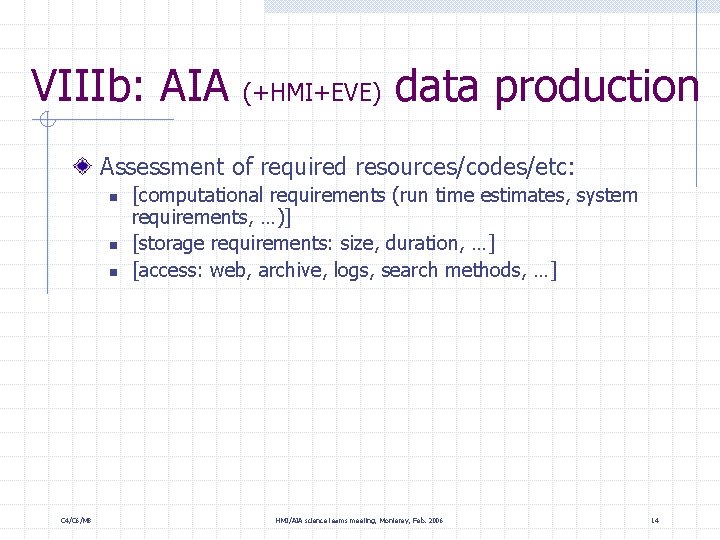
VIIIb: AIA (+HMI+EVE) data production Assessment of required resources/codes/etc: n n n C 4/C 6/M 8 [computational requirements (run time estimates, system requirements, …)] [storage requirements: size, duration, …] [access: web, archive, logs, search methods, …] HMI/AIA science teams meeting; Monterey; Feb. 2006 14
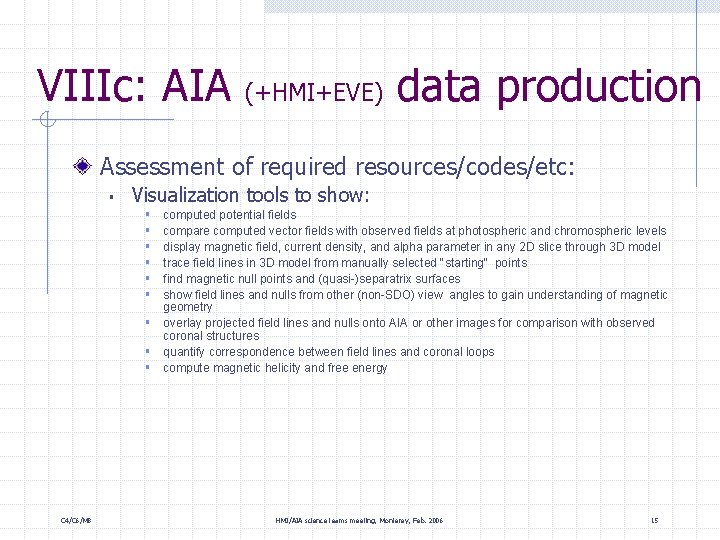
VIIIc: AIA (+HMI+EVE) data production Assessment of required resources/codes/etc: § Visualization tools to show: § § § § § C 4/C 6/M 8 computed potential fields compare computed vector fields with observed fields at photospheric and chromospheric levels display magnetic field, current density, and alpha parameter in any 2 D slice through 3 D model trace field lines in 3 D model from manually selected "starting" points find magnetic null points and (quasi-)separatrix surfaces show field lines and nulls from other (non-SDO) view angles to gain understanding of magnetic geometry overlay projected field lines and nulls onto AIA or other images for comparison with observed coronal structures quantify correspondence between field lines and coronal loops compute magnetic helicity and free energy HMI/AIA science teams meeting; Monterey; Feb. 2006 15

IX: Business plan: Resources [What data and codes must we have to make SDO a success (at pipeline, supporting, and research levels)? Who will provide the required codes? ] n On ‘critical path’: w Funding for field modeling algorithms, testing of these algorithms, and maintenance for general use (perhaps a dedicated processor cluster? ) w Funding and infrastructure for complementary data, specifically chromospheric (vector-)magnetograms and H imaging C 4/C 6/M 8 HMI/AIA science teams meeting; Monterey; Feb. 2006 16
![X: Business plan: Implementation [Define key milestones, test procedures, and target dates, …] n](http://slidetodoc.com/presentation_image/d825cdfd3ced7b8f614c85d95e486dc9/image-17.jpg "X: Business plan: Implementation [Define key milestones, test procedures, and target dates, …] n")
X: Business plan: Implementation [Define key milestones, test procedures, and target dates, …] n … [Communication: define or list meetings, topical sessions, etc. , where progress can be presented, discussed, evaluated, …] n C 4/C 6/M 8 … HMI/AIA science teams meeting; Monterey; Feb. 2006 17
- Slides: 17