
SDO ACS Subsystem Mission PDR Wendy Morgenstern Attitude
SDO ACS Subsystem Mission PDR Wendy Morgenstern Attitude Control Subsystem (ACS) Lead SDO Preliminary Design Review (PDR) – March 9 -12, 2004 ACS Page-1

ACS Control Modes ACS design includes six control modes - a combination of hardware and software algorithms which controls observatory attitude. • Main processor: Sun Acquisition, Inertial, Science, Delta-V, Delta-H – Sun Acquisition: Acquire and hold a sun pointing attitude. (CSS, IRU, RWA) – Inertial: Acquire and hold any specified target attitude in inertial space. (ST, IRU, RWA) – Science: Acquire and hold required instrument attitude and stability. (GT, ST, IRU, RWA) – Delta-V: Perform orbit maneuvers. (IRU, Thrusters) – Delta-H: Manage system momentum. (IRU, Thrusters, RWA) • ACE Subsystem Data Node (Independent processor): – Safehold: Acquire and hold a power and thermally safe attitude. (CSS, RWA, IRU) SDO Preliminary Design Review (PDR) – March 9 -12, 2004 ACS Page-2
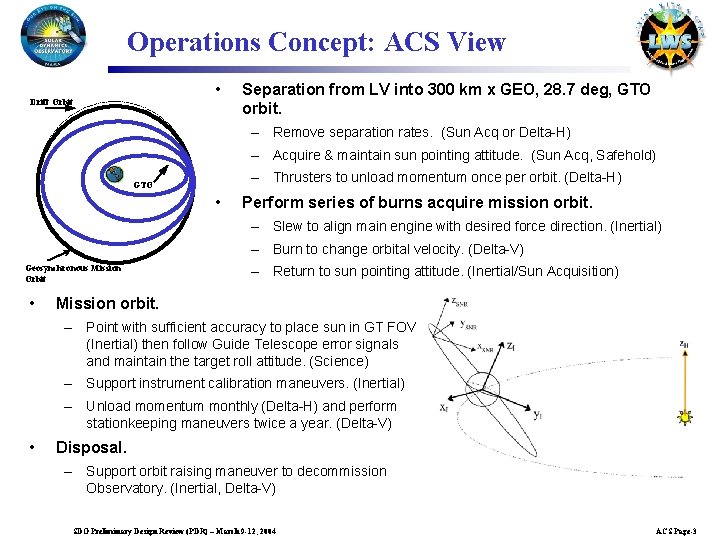
Operations Concept: ACS View • Drift Orbit Separation from LV into 300 km x GEO, 28. 7 deg, GTO orbit. – Remove separation rates. (Sun Acq or Delta-H) – Acquire & maintain sun pointing attitude. (Sun Acq, Safehold) – Thrusters to unload momentum once per orbit. (Delta-H) GTO • Perform series of burns acquire mission orbit. – Slew to align main engine with desired force direction. (Inertial) – Burn to change orbital velocity. (Delta-V) Geosynchronous Mission Orbit • – Return to sun pointing attitude. (Inertial/Sun Acquisition) Mission orbit. – Point with sufficient accuracy to place sun in GT FOV (Inertial) then follow Guide Telescope error signals and maintain the target roll attitude. (Science) – Support instrument calibration maneuvers. (Inertial) – Unload momentum monthly (Delta-H) and perform stationkeeping maneuvers twice a year. (Delta-V) • Disposal. – Support orbit raising maneuver to decommission Observatory. (Inertial, Delta-V) SDO Preliminary Design Review (PDR) – March 9 -12, 2004 ACS Page-3
![ACS Level 3: Driving Requirements • Damp worst case separation rates as necessary. [Delta-H]](http://slidetodoc.com/presentation_image_h2/0eea2a2eae7be93931f7b937ed817ba3/image-4.jpg "ACS Level 3: Driving Requirements • Damp worst case separation rates as necessary. [Delta-H]")
ACS Level 3: Driving Requirements • Damp worst case separation rates as necessary. [Delta-H] – • • • Acquire and hold sun pointing attitude within 30 minutes given initial momentum corresponding to either: [Safehold, Sun Acquisition] – Rates of [0. 25, 0. 25] deg/sec or two GTO orbits (300 km x GEO) accumulation. [MRD#4. 2. 1. 3, 4. 2. 6. 4. 1] – Five weeks of GEO orbit accumulation. [MRD#4. 2. 5. 2, 4. 2. 6. 4] Support Science Operations [Science, Inertial] – Provide 25 arcsec (3 s, X/Y/Z) attitude knowledge. [MRD#4. 2. 2. 1] – Hold the observatory attitude (Y/Z) to within 30 arcsec (Y/Z) of the commanded attitude or within 1 arcsec (3 s, Y/Z) of the prime Guide Telescope (GT) error signals when available. [MRD#4. 2. 3. 2, 4. 2. 3. 3] – Hold the observatory roll attitude (X) to within 30 arcsec. [MRD#4. 2. 3. 5] – Calculate a science target aligning HMI’s ‘north’ with the solar spin axis. [MRD#4. 2. 3. 5] – Meet the observatory level jitter requirements. [MRD#2. 5. 5. 6] Command Antenna Pointing System (APS) to orient HGA. – • Remove rates of [1, 2, 2] deg/sec, (3 s, X/Y/Z) within 15 minutes. [MRD#4. 2. 1. 2, 4. 2. 1. 4, 4. 2. 5. 1, ] Provide HGAS appropriate position and rate commands consistent with the HGAS pointing and Observatory jitter requirements. [MRD#4. 5. 1. 3, 464 -MECSM-REQ-0027] Maneuvers – Delivered on-axis change in velocity shall be within 5%, 3 s, of commanded value. [MRD#4. 2. 4. 1, 464 -PROP-ANYS-0013] – During GTO, unload momentum once per orbit. [MRD#4. 2. 6. 4. 1] – During GEO, unload momentum once every 4 weeks. [MRD#4. 2. 5. 2] SDO Preliminary Design Review (PDR) – March 9 -12, 2004 ACS Page-4
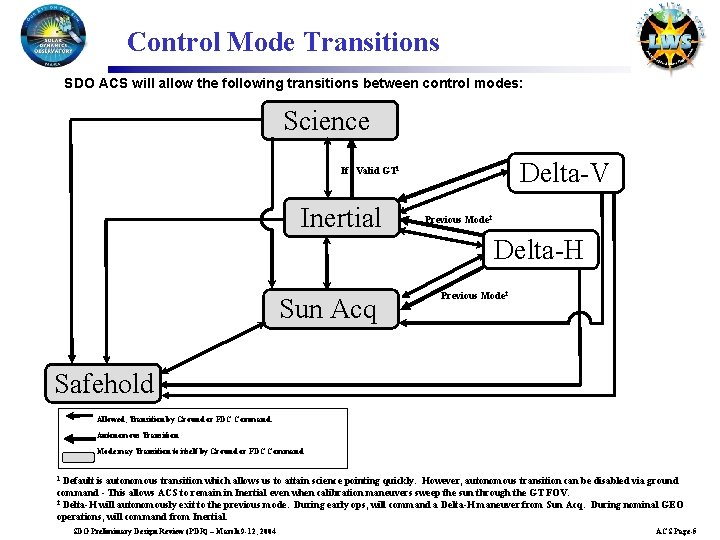
Control Mode Transitions SDO ACS will allow the following transitions between control modes: Science Delta-V If Valid GT 1 Inertial Previous Mode 2 Delta-H Sun Acq Previous Mode 2 Safehold Allowed, Transition by Ground or FDC Command. Autonomous Transition Mode may Transition to itself by Ground or FDC Command Default is autonomous transition which allows us to attain science pointing quickly. However, autonomous transition can be disabled via ground command - This allows ACS to remain in Inertial even when calibration maneuvers sweep the sun through the GT FOV. 2 Delta-H will autonomously exit to the previous mode. During early ops, will command a Delta-H maneuver from Sun Acq. During nominal GEO operations, will command from Inertial. 1 SDO Preliminary Design Review (PDR) – March 9 -12, 2004 ACS Page-5
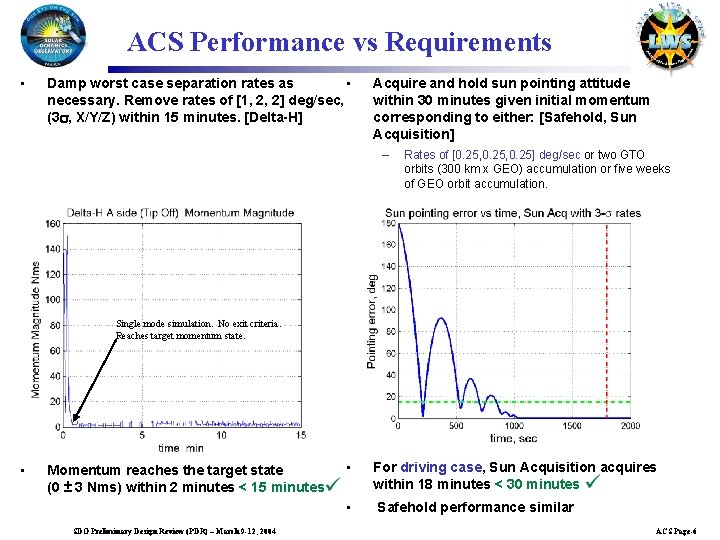
ACS Performance vs Requirements • Damp worst case separation rates as • necessary. Remove rates of [1, 2, 2] deg/sec, (3 s, X/Y/Z) within 15 minutes. [Delta-H] Acquire and hold sun pointing attitude within 30 minutes given initial momentum corresponding to either: [Safehold, Sun Acquisition] – Rates of [0. 25, 0. 25] deg/sec or two GTO orbits (300 km x GEO) accumulation or five weeks of GEO orbit accumulation. Single mode simulation. No exit criteria. Reaches target momentum state. • Momentum reaches the target state (0 ± 3 Nms) within 2 minutes < 15 minutes SDO Preliminary Design Review (PDR) – March 9 -12, 2004 • For driving case, Sun Acquisition acquires within 18 minutes < 30 minutes • Safehold performance similar ACS Page-6
![ACS Performance vs Requirements • Support Science Operations [Science, Inertial] – Provide 25 arcsec](http://slidetodoc.com/presentation_image_h2/0eea2a2eae7be93931f7b937ed817ba3/image-7.jpg "ACS Performance vs Requirements • Support Science Operations [Science, Inertial] – Provide 25 arcsec")
ACS Performance vs Requirements • Support Science Operations [Science, Inertial] – Provide 25 arcsec (3 s, X/Y/Z) attitude knowledge < 7. 2 arcsec CBE from ADEAS analysis. – Hold the observatory roll attitude (X) to within 30 < 3 arcsec – Hold the observatory attitude (Y/Z) to within 30 arcsec (Y/Z) of the commanded attitude < 3 arcsec – or Within 1 arcsec (3 s, Y/Z) of the prime Guide Telescope (GT) error signals when available < 1 arcsec Slew to Sun from Inertial Attitude [Inertial] SDO Preliminary Design Review (PDR) – March 9 -12, 2004 HMI Calibration Roll [Science] ACS Page-7
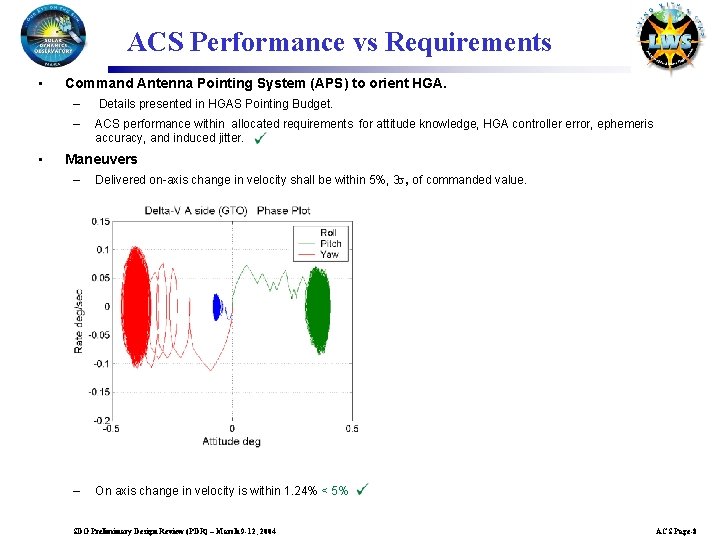
ACS Performance vs Requirements • • Command Antenna Pointing System (APS) to orient HGA. – Details presented in HGAS Pointing Budget. – ACS performance within allocated requirements for attitude knowledge, HGA controller error, ephemeris accuracy, and induced jitter. Maneuvers – Delivered on-axis change in velocity shall be within 5%, 3 s, of commanded value. – On axis change in velocity is within 1. 24% < 5% SDO Preliminary Design Review (PDR) – March 9 -12, 2004 ACS Page-8
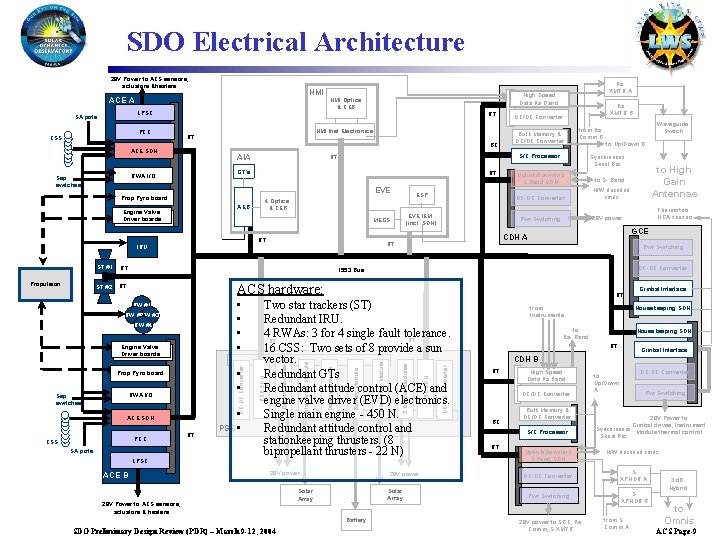
SDO Electrical Architecture 28 V Power to ACS sensors, actuators &heaters HMI ACE A HMI Optics & CEB LPSC SA pots PCC CSS BC ACE SDN AIA RT MEGS RT ST #2 RT DC-DC Converter H/W decoded cmds EVE IEM (incl. SDN) Pwr Switching DC-DC Converter PCC CSS SA pots LPSC ACE B RT 28 V power 28 V Power to ACS sensors, actuators & heaters 28 V power Solar Array Battery SDO Preliminary Design Review (PDR) – March 9 -12, 2004 PSE SDN 3 Output Modules • PSE • DC-DC Converter ACE SDN Solar Array Module RWA I/O Battery Module • • Prop Pyro board Gimbal Interface Deploy Circuits DC-DC Converter Engine Valve Driver boards Solar Array Module RW #4 Thermistors, HGA sensors GCE CDH A Two star trackers (ST) Redundant IRU. 4 RTRWAs: 3 for 4 single fault tolerance. RT 16 CSS: Two sets of 8 provide a sun vector. Redundant GTs Redundant attitude control (ACE) and engine valve driver (EVD) electronics. Single main engine - 450 N. Redundant attitude control and stationkeeping thrusters. (8 bipropellant thrusters - 22 N) 3 Output Modules • • RW #1 RW #2 RW #3 to High Gain Antennae 28 V power ACS hardware: Sep switches to Up/Down B Synchronous Serial Bus 1553 Bus PSE SDN Propulsion RT Waveguide Switch ESP RT IRU ST #1 from Ka Comm B to S- Band 4 Optics & CEB AEB Engine Valve Driver boards Bulk Memory & DC/DC Converter Uplink/Downlink S Band SDN EVE Prop Pyro board Ka XMTR B DC/DC Converter S/C Processor RT GT’s RWA I/O Sep switches RT HMI Inst Electronics RT Ka XMTR A High Speed Data Ka Band RT from Instruments Housekeeping SDN to Ka- Band Housekeeping SDN RT Gimbal Interface CDH B RT High Speed Data Ka Band DC/DC Converter BC Bulk Memory & DC/DC Converter S/C Processor RT DC-DC Converter to Up/Down A Pwr Switching 28 V Power to Gimbal drives, Instrument Synchronous Module thermal control Serial Bus Uplink/Downlink S Band SDN H/W decoded cmds DC-DC Converter S XPNDR A Pwr Switching S XPNDR B 28 V power to SBC, Ka Comm, S XMTR from S Comm A 3 d. B Hybrid to Omnis ACS Page-9
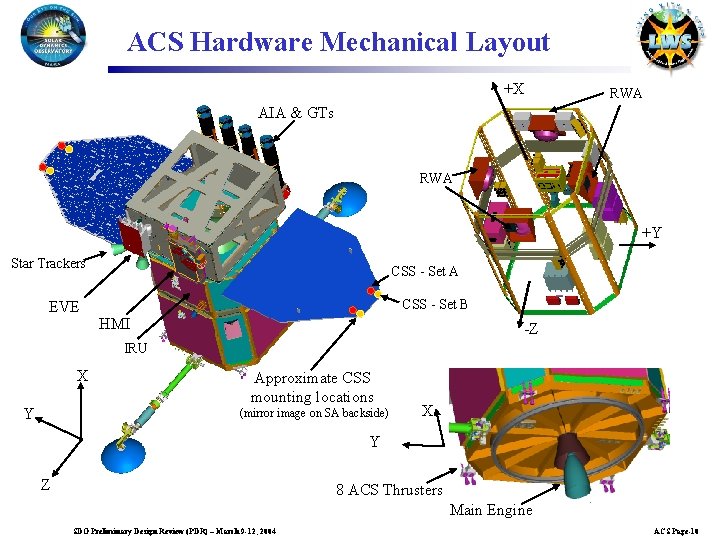
ACS Hardware Mechanical Layout +X RWA AIA & GTs RWA +Y Star Trackers EVE CSS - Set A CSS - Set B HMI -Z IRU X Y Approximate CSS mounting locations (mirror image on SA backside) X Y Z 8 ACS Thrusters Main Engine SDO Preliminary Design Review (PDR) – March 9 -12, 2004 ACS Page-10
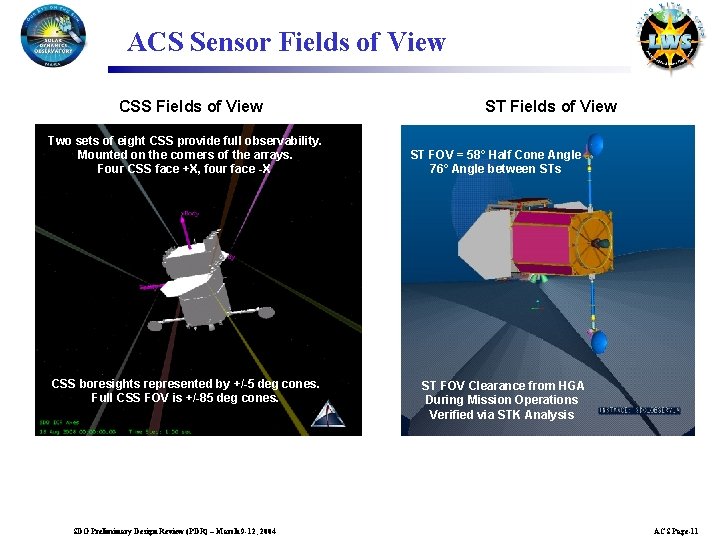
ACS Sensor Fields of View CSS Fields of View Two sets of eight CSS provide full observability. Mounted on the corners of the arrays. Four CSS face +X, four face -X CSS boresights represented by +/-5 deg cones. Full CSS FOV is +/-85 deg cones. SDO Preliminary Design Review (PDR) – March 9 -12, 2004 ST Fields of View ST FOV = 58° Half Cone Angle 76° Angle between STs ST FOV Clearance from HGA During Mission Operations Verified via STK Analysis ACS Page-11
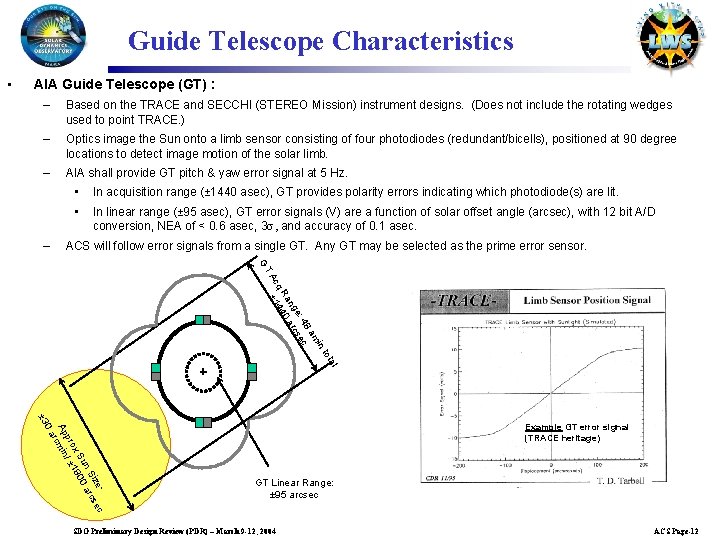
Guide Telescope Characteristics • AIA Guide Telescope (GT) : – Based on the TRACE and SECCHI (STEREO Mission) instrument designs. (Does not include the rotating wedges used to point TRACE. ) – Optics image the Sun onto a limb sensor consisting of four photodiodes (redundant/bicells), positioned at 90 degree locations to detect image motion of the solar limb. – AIA shall provide GT pitch & yaw error signal at 5 Hz. – • In acquisition range (± 1440 asec), GT provides polarity errors indicating which photodiode(s) are lit. • In linear range (± 95 asec), GT error signals (V) are a function of solar offset angle (arcsec), with 12 bit A/D conversion, NEA of < 0. 6 asec, 3 s, and accuracy of 0. 1 asec. ACS will follow error signals from a single GT. Any GT may be selected as the prime error sensor. GT l ota nt mi 8 a : 4 ec ge rcs an 0 a q R 44 Ac ± 1 e: ec Siz rcs un 0 a x S 180 pro / ± Ap min rc 0 a ± 3 Example GT error signal (TRACE heritage) GT Linear Range: ± 95 arcsec SDO Preliminary Design Review (PDR) – March 9 -12, 2004 ACS Page-12

ACS Status • Preliminary Design Review completed as part of the GNC PDR, Dec 11 -12, 2003. – • ACS Level Three Requirements (464 -ACS-REQ-0024) under CM review. – • • Had a very successful and constructive PDR. Many thanks to reviewers and SDO teammates. CCB 12 Feb ‘ 04. Action Item Status. – July’ 03 GNC SRR: 12 action items. 11 closed; 1 pending closure after further review. – Dec’ 03 GNC SRR: 27 action items. 10 submitted formal closure; 3 critical action items remain open. Status for ACS Analysis: – Supporting updates to instrument pointing/jitter requirements. – Initial time domain simulations and preliminary design complete; detailed design in work. – Working Flight Software algorithm delivery/documentation, with attention to automatic code generation. – Pursuing detailed design, development of failure mode requirements. Status for ACS Hardware: – ST, IRU, CSS and RWA Spec&Sow in final draft/project review cycle. – Preparing procurement packages. – ACE Breadboard development on schedule. Last card review completed 20 Feb 04. – Finalizing Hardware/Software ICD. Working Diagnostic software definition. ACE Mechanical Concept Status for Goddard Dynamic Simulator (GDS): – Supports Testing for: ACE box, GCE box, Flight Software, Flatsat (single-string), and I&T. – GDS requirements in draft. Hardware I/F review completed 8 Jan 03. – On track for first delivery to ACE and GCE Box Lab. SDO Preliminary Design Review (PDR) – March 9 -12, 2004 ACS Page-13

ACS Status: Open PDR Action Items • CSS-IRU versus CSS-only Safehold versus CSS-IRU & CSS-only Safehold – AI#46: Two-Tier Safehold • • – – • Issue: Gyroless safehold is valuable, but not as capable as a gyro-based safemode. Action: Add a gyro/CSS based safemode. Will have to develop logic to detect gyro failure and transition to gyroless safemode. AI#49: Hardware versus Software Simplicity in Safehold • Issue: Gyroless safehold not baselined yet. • Action: Thoroughly qualify adding hardware to safehold versus having a slightly more complicated algorithm that would allow for a minimum hardware set. Status: • Working with Systems to define detailed failure requirements and identify whether they are the driving requirements for Safehold momentum capacity. • ACS continuing design work on both CSS-IRU and CSS-only Safehold controllers, improving performance of both. Expect to settle on Safehold architecture by May’ 04. Safehold requirements: – – AI#56: Safehold • Issue: The gyroless mode allows the spacecraft to drift during eclipse which might increase threat for ESD should the solar array get backwards to the sun. Tumble during the eclipse could also adversely effect RF communications. • Action: The systems team should convene with RF, electrical systems and GN&C to determine if a refinement of requirements is necessary and establish if only providing a gyroless mode is sufficient for SDO. Even though complexity might increase slightly, the total system risk might be less. Status: • ACS has added a requirement to adjust Safehold roll attitude, allowing SDO to exit RF null zones. • In addition to Safe Hold redesign, Project is looking at alternate solutions to ESD concern SDO Preliminary Design Review (PDR) – March 9 -12, 2004 ACS Page-14

ACS Status: Open PDR Action Items • At GNC PDR (Dec’ 03), ACS presented two preliminary Safehold design options. – – CSS-only Safehold: ü Uses a minimum, reliable hardware complement, less vulnerable to unanticipated faults. ü Provides a power and thermally safe control mode that does not require IRU operation. 7 Not as robust. Can handle a much smaller range of initial momentum. ü Preliminary design showed momentum capacity of 40 Nms > 36 Nms driving requirement. 7 Free drift in eclipse. Preventing free drift requires increases algorithm complexity. CSS-IRU Safehold: ü Tolerates a wider range of system momentum. ü Preliminary design showed momentum capacity of 75 Nms > 36 Nms driving requirement. ü Similar to Sun Acquisition. I. e. , algorithm more thoroughly tested. ü No roll around the sunline, I. e. , improved communications. 7 Requires IRU operation. No mode will exist that does not require IRU. 7 If the original fault that cause Safehold is the IRU, Safehold is now controlling from a faulty rate signal. • Both preliminary designs meet Safehold requirements. • CSS-only Safehold: 40 Nms 10% capacity margin. • CSS-IRU Safehold: 75 Nms 52% capacity margin. • Both preliminary designs can meet requirements. – • ACS team is exploring design options that should further increase the CSS-only Safehold capacity. ACS working with Systems to refine Safehold requirements and finalize Safehold architecture. SDO Preliminary Design Review (PDR) – March 9 -12, 2004 ACS Page-15
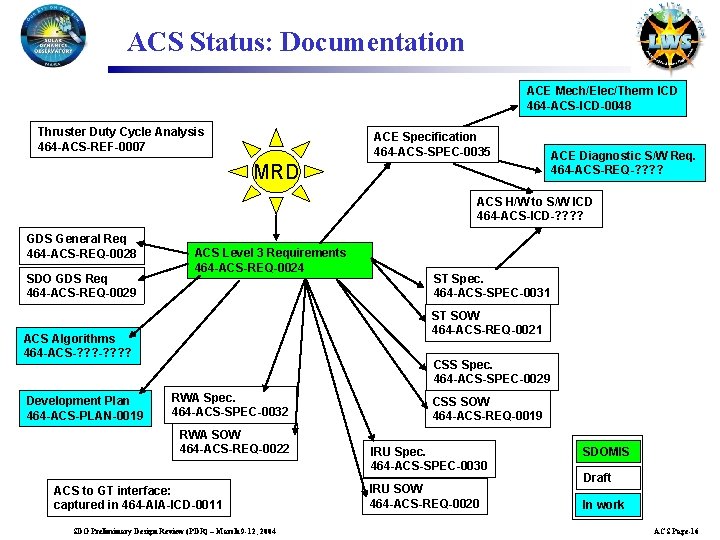
ACS Status: Documentation ACE Mech/Elec/Therm ICD 464 -ACS-ICD-0048 Thruster Duty Cycle Analysis 464 -ACS-REF-0007 ACE Specification 464 -ACS-SPEC-0035 MRD ACE Diagnostic S/W Req. 464 -ACS-REQ-? ? ACS H/W to S/W ICD 464 -ACS-ICD-? ? GDS General Req 464 -ACS-REQ-0028 SDO GDS Req 464 -ACS-REQ-0029 ACS Level 3 Requirements 464 -ACS-REQ-0024 ST SOW 464 -ACS-REQ-0021 ACS Algorithms 464 -ACS-? ? ? ? Development Plan 464 -ACS-PLAN-0019 ST Spec. 464 -ACS-SPEC-0031 CSS Spec. 464 -ACS-SPEC-0029 RWA Spec. 464 -ACS-SPEC-0032 RWA SOW 464 -ACS-REQ-0022 ACS to GT interface: captured in 464 -AIA-ICD-0011 SDO Preliminary Design Review (PDR) – March 9 -12, 2004 CSS SOW 464 -ACS-REQ-0019 IRU Spec. 464 -ACS-SPEC-0030 IRU SOW 464 -ACS-REQ-0020 SDOMIS Draft In work ACS Page-16
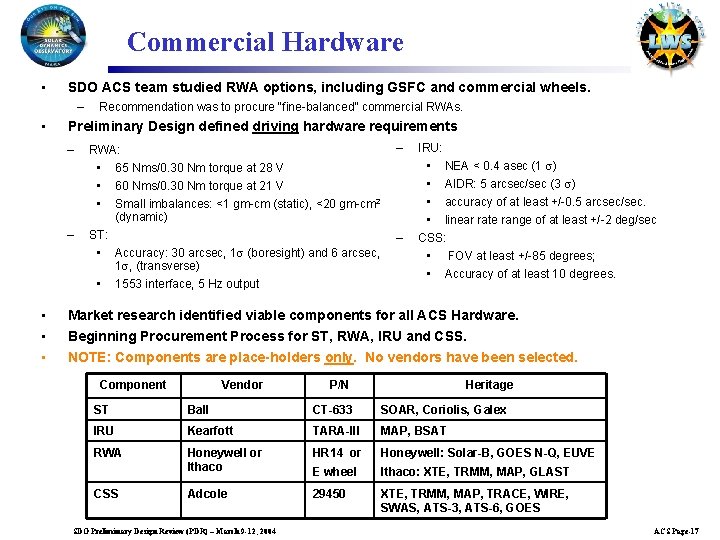
Commercial Hardware • SDO ACS team studied RWA options, including GSFC and commercial wheels. – • Recommendation was to procure “fine-balanced” commercial RWAs. Preliminary Design defined driving hardware requirements – • • • – RWA: 65 Nms/0. 30 Nm torque at 28 V 60 Nms/0. 30 Nm torque at 21 V Small imbalances: <1 gm-cm (static), <20 gm-cm 2 (dynamic) ST: • Accuracy: 30 arcsec, 1 s (boresight) and 6 arcsec, 1 s, (transverse) • 1553 interface, 5 Hz output – IRU: • NEA < 0. 4 asec (1 s) • AIDR: 5 arcsec/sec (3 s) • accuracy of at least +/-0. 5 arcsec/sec. • linear rate range of at least +/-2 deg/sec CSS: • FOV at least +/-85 degrees; • Accuracy of at least 10 degrees. Market research identified viable components for all ACS Hardware. Beginning Procurement Process for ST, RWA, IRU and CSS. NOTE: Components are place-holders only. No vendors have been selected. Component Vendor P/N Heritage ST Ball CT-633 SOAR, Coriolis, Galex IRU Kearfott TARA-III MAP, BSAT RWA Honeywell or Ithaco HR 14 or Honeywell: Solar-B, GOES N-Q, EUVE E wheel Ithaco: XTE, TRMM, MAP, GLAST Adcole 29450 XTE, TRMM, MAP, TRACE, WIRE, SWAS, ATS-3, ATS-6, GOES CSS SDO Preliminary Design Review (PDR) – March 9 -12, 2004 ACS Page-17

ACS Mass: CBE & Margin • Current Best Estimate (CBE) of ACS Mass – ST, IRU, RWA mass based on largest of viable commercial candidates. – Harness mass in Electrical Systems allocation. • Allocation per Observatory Mass Budget (464 -SYS-SPEC-0007), 17 -Nov-03. – ACS allocation: 103 kg SDO Preliminary Design Review (PDR) – March 9 -12, 2004 ACS Page-18
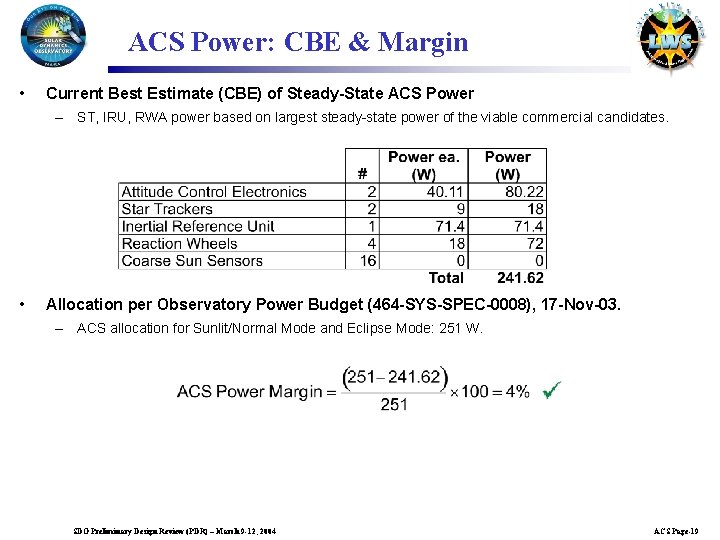
ACS Power: CBE & Margin • Current Best Estimate (CBE) of Steady-State ACS Power – ST, IRU, RWA power based on largest steady-state power of the viable commercial candidates. • Allocation per Observatory Power Budget (464 -SYS-SPEC-0008), 17 -Nov-03. – ACS allocation for Sunlit/Normal Mode and Eclipse Mode: 251 W. SDO Preliminary Design Review (PDR) – March 9 -12, 2004 ACS Page-19
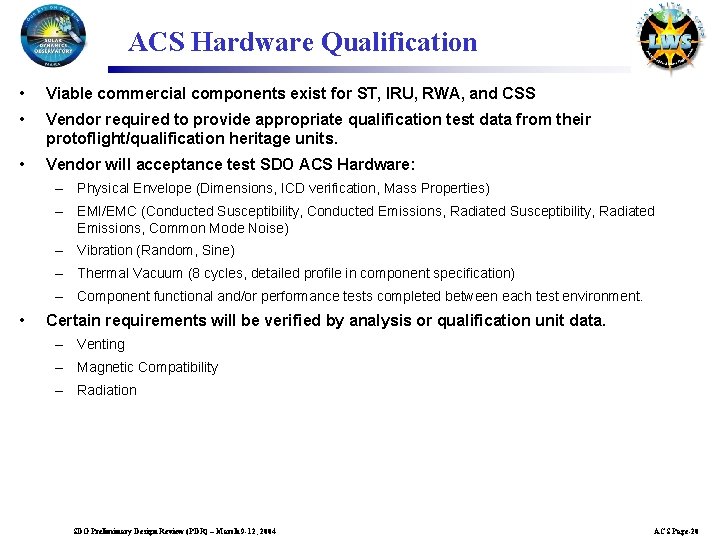
ACS Hardware Qualification • Viable commercial components exist for ST, IRU, RWA, and CSS • Vendor required to provide appropriate qualification test data from their protoflight/qualification heritage units. • Vendor will acceptance test SDO ACS Hardware: – Physical Envelope (Dimensions, ICD verification, Mass Properties) – EMI/EMC (Conducted Susceptibility, Conducted Emissions, Radiated Susceptibility, Radiated Emissions, Common Mode Noise) – Vibration (Random, Sine) – Thermal Vacuum (8 cycles, detailed profile in component specification) – Component functional and/or performance tests completed between each test environment. • Certain requirements will be verified by analysis or qualification unit data. – Venting – Magnetic Compatibility – Radiation SDO Preliminary Design Review (PDR) – March 9 -12, 2004 ACS Page-20
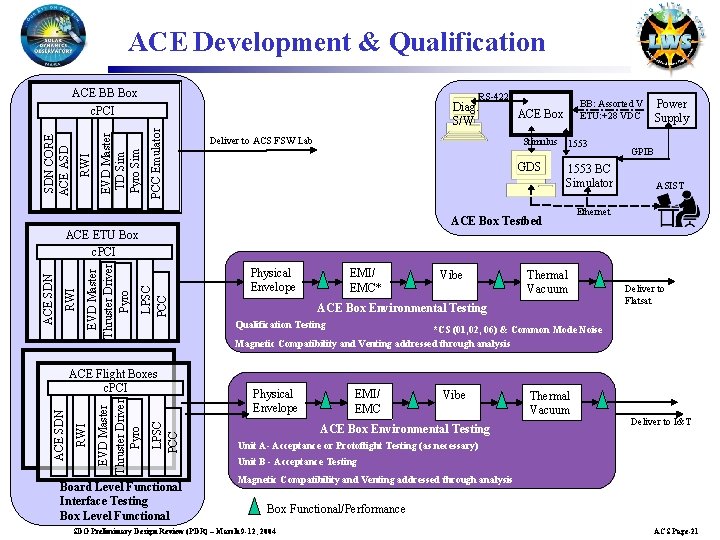
ACE Development & Qualification ACE BB Box RS-422 Diag. S/W PCC Emulator EVD Master TD Sim Pyro Sim RWI SDN CORE ACE ASD c. PCI Deliver to ACS FSW Lab BB: Assorted V ETU: +28 VDC ACE Box Stimulus 1553 GDS 1553 BC Simulator ACE Box Testbed Power Supply GPIB ASIST Ethernet LPSC PCC EVD Master Thruster Driver Pyro RWI ACE SDN ACE ETU Box c. PCI Vibe Thermal Vacuum ACE Box Environmental Testing Deliver to Flatsat *CS (01, 02, 06) & Common Mode Noise Magnetic Compatibility and Venting addressed through analysis LPSC PCC EVD Master Thruster Driver Pyro RWI EMI/ EMC* Qualification Testing ACE Flight Boxes c. PCI ACE SDN Physical Envelope Board Level Functional Interface Testing Box Level Functional Physical Envelope EMI/ EMC Vibe ACE Box Environmental Testing Thermal Vacuum Deliver to I&T Unit A- Acceptance or Protoflight Testing (as necessary) Unit B - Acceptance Testing Magnetic Compatibility and Venting addressed through analysis Box Functional/Performance SDO Preliminary Design Review (PDR) – March 9 -12, 2004 ACS Page-21
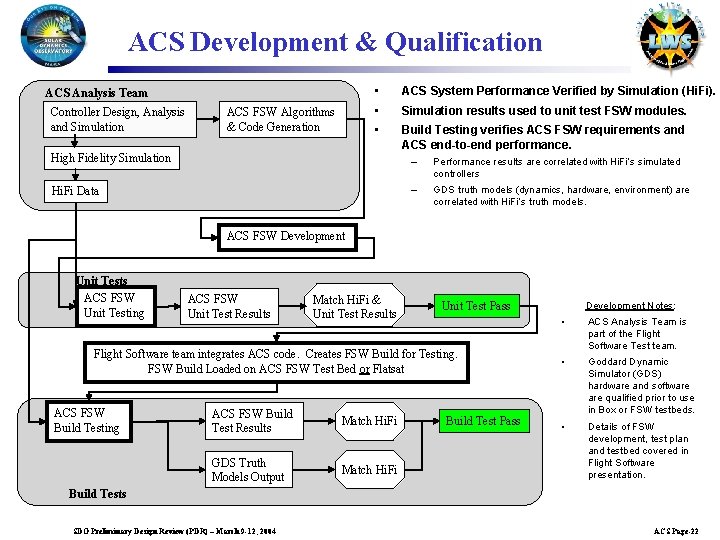
ACS Development & Qualification ACS Analysis Team Controller Design, Analysis and Simulation ACS FSW Algorithms & Code Generation • ACS System Performance Verified by Simulation (Hi. Fi). • Simulation results used to unit test FSW modules. • Build Testing verifies ACS FSW requirements and ACS end-to-end performance. High Fidelity Simulation – Performance results are correlated with Hi. Fi’s simulated controllers Hi. Fi Data – GDS truth models (dynamics, hardware, environment) are correlated with Hi. Fi’s truth models. ACS FSW Development Unit Tests ACS FSW Unit Testing ACS FSW Unit Test Results Match Hi. Fi & Unit Test Results Unit Test Pass Flight Software team integrates ACS code. Creates FSW Build for Testing. FSW Build Loaded on ACS FSW Test Bed or Flatsat ACS FSW Build Testing ACS FSW Build Test Results Match Hi. Fi GDS Truth Models Output Match Hi. Fi Build Test Pass Development Notes: • ACS Analysis Team is part of the Flight Software Test team. • Goddard Dynamic Simulator (GDS) hardware and software qualified prior to use in Box or FSW testbeds. • Details of FSW development, test plan and testbed covered in Flight Software presentation. Build Tests SDO Preliminary Design Review (PDR) – March 9 -12, 2004 ACS Page-22
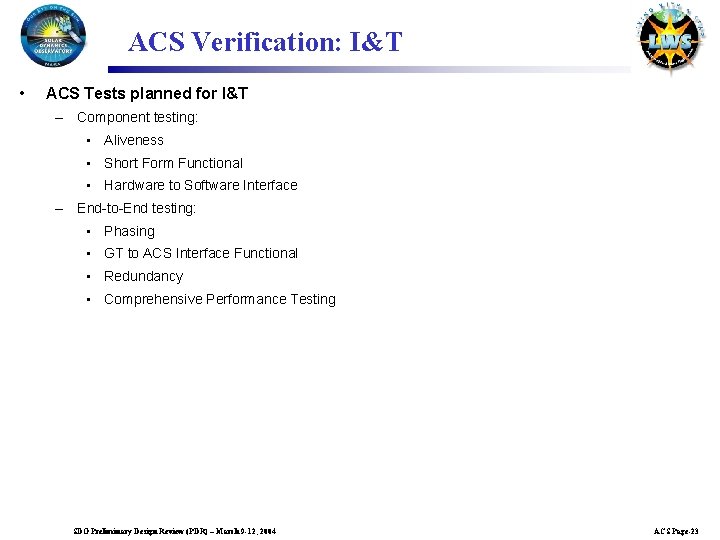
ACS Verification: I&T • ACS Tests planned for I&T – Component testing: • Aliveness • Short Form Functional • Hardware to Software Interface – End-to-End testing: • Phasing • GT to ACS Interface Functional • Redundancy • Comprehensive Performance Testing SDO Preliminary Design Review (PDR) – March 9 -12, 2004 ACS Page-23
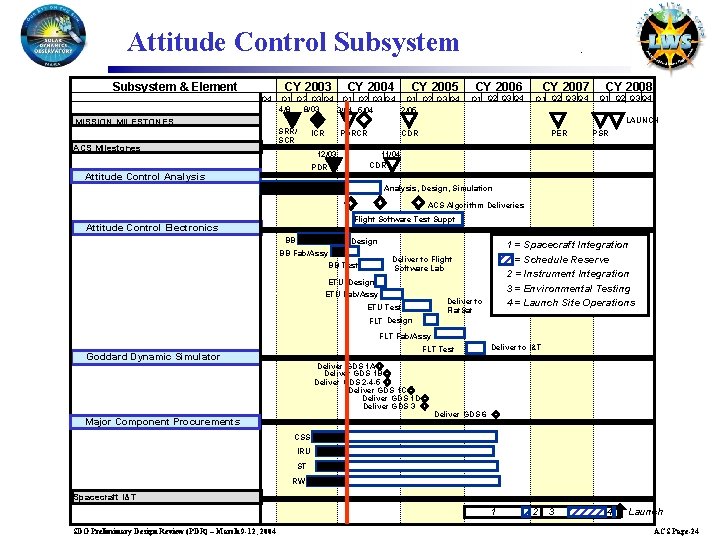
Attitude Control Subsystem & Element CY 2003 Q 4 MISSION MILESTONES ACS Milestones CY 2005 CY 2006 CY 2007 CY 2008 Q 1 Q 2 Q 3 Q 4 4/8 8/03 2/05 3/04 5/04 CY 2004 Q 1 Q 2 Q 3 Q 4 LAUNCH SRR/ SCR PDRCR ICR 12/03 PER PSR 11/04 CDR PDR Attitude Control Analysis CDR Analysis, Design, Simulation ACS Algorithm Deliveries Flight Software Test Suppt Attitude Control Electronics BB Design BB Fab/Assy BB Test 1 = Spacecraft Integration = Schedule Reserve 2 = Instrument Integration 3 = Environmental Testing 4 = Launch Site Operations Deliver to Flight Software Lab ETU Design ETU Fab/Assy Deliver to Flat. Sat ETU Test FLT Design FLT Fab/Assy FLT Test Goddard Dynamic Simulator Deliver GDS 1 A Deliver GDS 1 B Deliver GDS 2 -4 -5 Deliver GDS 1 C Deliver GDS 1 D Deliver GDS 3 Major Component Procurements Deliver to I&T Deliver GDS 6 CSS IRU ST RW Spacecraft I&T 1 SDO Preliminary Design Review (PDR) – March 9 -12, 2004 2 3 4 Launch ACS Page-24
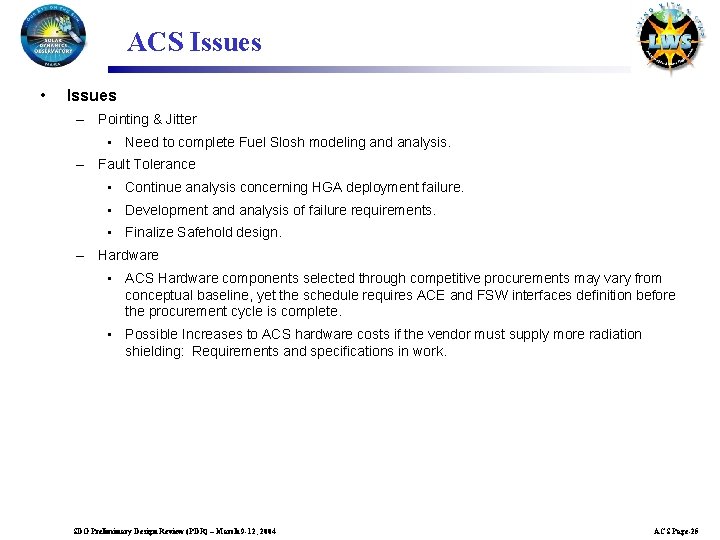
ACS Issues • Issues – Pointing & Jitter • Need to complete Fuel Slosh modeling and analysis. – Fault Tolerance • Continue analysis concerning HGA deployment failure. • Development and analysis of failure requirements. • Finalize Safehold design. – Hardware • ACS Hardware components selected through competitive procurements may vary from conceptual baseline, yet the schedule requires ACE and FSW interfaces definition before the procurement cycle is complete. • Possible Increases to ACS hardware costs if the vendor must supply more radiation shielding: Requirements and specifications in work. SDO Preliminary Design Review (PDR) – March 9 -12, 2004 ACS Page-25
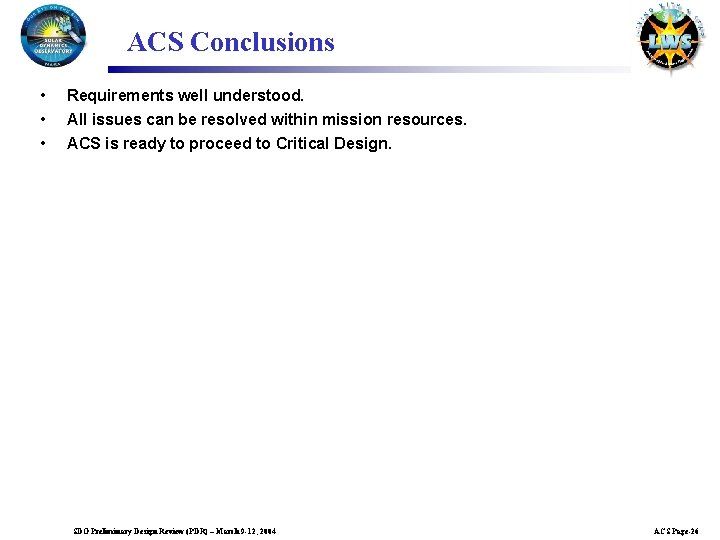
ACS Conclusions • • • Requirements well understood. All issues can be resolved within mission resources. ACS is ready to proceed to Critical Design. SDO Preliminary Design Review (PDR) – March 9 -12, 2004 ACS Page-26
ACS Backup Slides SDO Preliminary Design Review (PDR) – March 9 -12, 2004 ACS Page-27
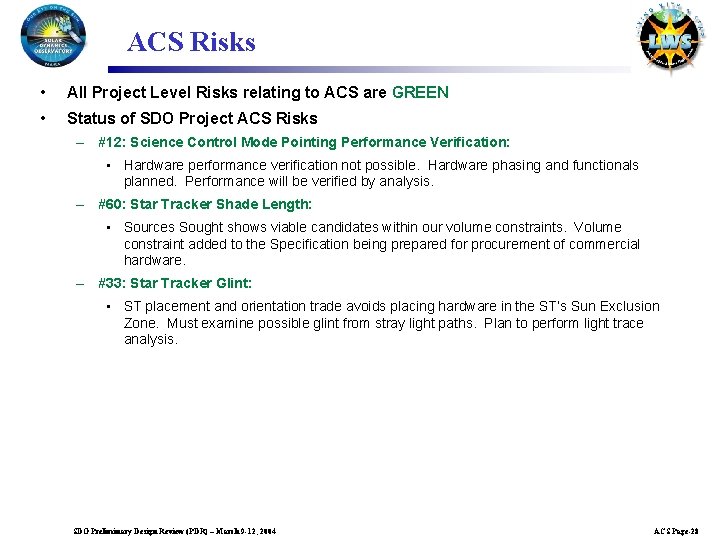
ACS Risks • All Project Level Risks relating to ACS are GREEN • Status of SDO Project ACS Risks – #12: Science Control Mode Pointing Performance Verification: • Hardware performance verification not possible. Hardware phasing and functionals planned. Performance will be verified by analysis. – #60: Star Tracker Shade Length: • Sources Sought shows viable candidates within our volume constraints. Volume constraint added to the Specification being prepared for procurement of commercial hardware. – #33: Star Tracker Glint: • ST placement and orientation trade avoids placing hardware in the ST’s Sun Exclusion Zone. Must examine possible glint from stray light paths. Plan to perform light trace analysis. SDO Preliminary Design Review (PDR) – March 9 -12, 2004 ACS Page-28
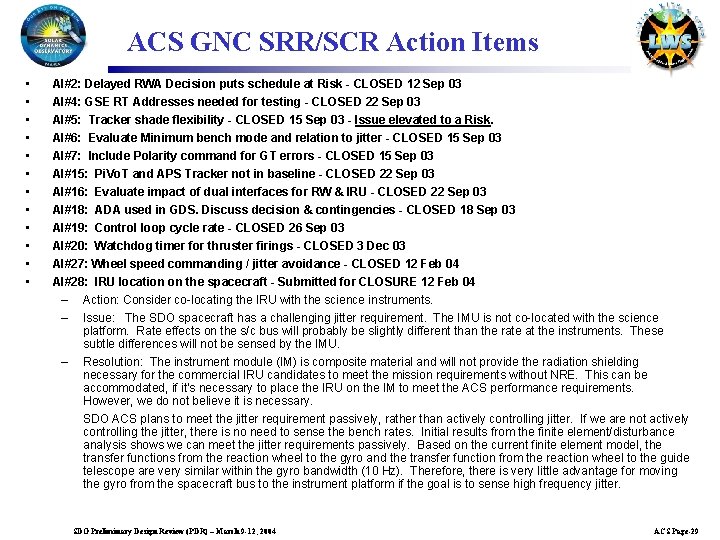
ACS GNC SRR/SCR Action Items • • • AI#2: Delayed RWA Decision puts schedule at Risk - CLOSED 12 Sep 03 AI#4: GSE RT Addresses needed for testing - CLOSED 22 Sep 03 AI#5: Tracker shade flexibility - CLOSED 15 Sep 03 - Issue elevated to a Risk. AI#6: Evaluate Minimum bench mode and relation to jitter - CLOSED 15 Sep 03 AI#7: Include Polarity command for GT errors - CLOSED 15 Sep 03 AI#15: Pi. Vo. T and APS Tracker not in baseline - CLOSED 22 Sep 03 AI#16: Evaluate impact of dual interfaces for RW & IRU - CLOSED 22 Sep 03 AI#18: ADA used in GDS. Discuss decision & contingencies - CLOSED 18 Sep 03 AI#19: Control loop cycle rate - CLOSED 26 Sep 03 AI#20: Watchdog timer for thruster firings - CLOSED 3 Dec 03 AI#27: Wheel speed commanding / jitter avoidance - CLOSED 12 Feb 04 AI#28: IRU location on the spacecraft - Submitted for CLOSURE 12 Feb 04 – Action: Consider co-locating the IRU with the science instruments. – Issue: The SDO spacecraft has a challenging jitter requirement. The IMU is not co-located with the science platform. Rate effects on the s/c bus will probably be slightly different than the rate at the instruments. These subtle differences will not be sensed by the IMU. – Resolution: The instrument module (IM) is composite material and will not provide the radiation shielding necessary for the commercial IRU candidates to meet the mission requirements without NRE. This can be accommodated, if it's necessary to place the IRU on the IM to meet the ACS performance requirements. However, we do not believe it is necessary. SDO ACS plans to meet the jitter requirement passively, rather than actively controlling jitter. If we are not actively controlling the jitter, there is no need to sense the bench rates. Initial results from the finite element/disturbance analysis shows we can meet the jitter requirements passively. Based on the current finite element model, the transfer functions from the reaction wheel to the gyro and the transfer function from the reaction wheel to the guide telescope are very similar within the gyro bandwidth (10 Hz). Therefore, there is very little advantage for moving the gyro from the spacecraft bus to the instrument platform if the goal is to sense high frequency jitter. SDO Preliminary Design Review (PDR) – March 9 -12, 2004 ACS Page-29
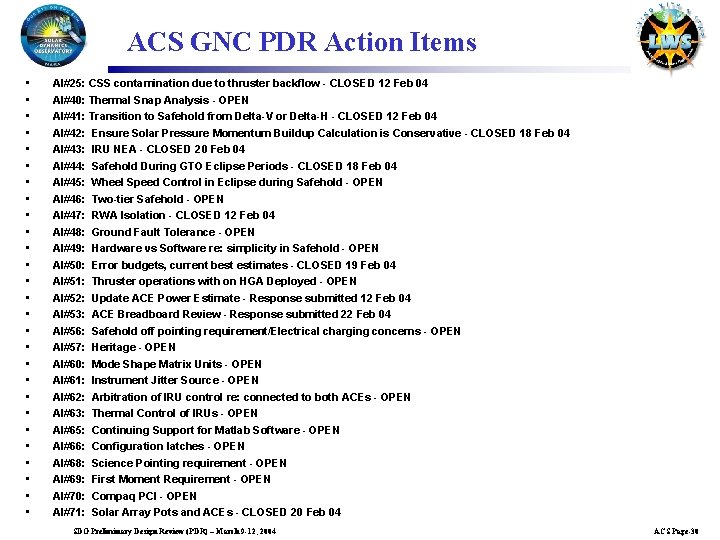
ACS GNC PDR Action Items • • • • • • • AI#25: CSS contamination due to thruster backflow - CLOSED 12 Feb 04 AI#40: Thermal Snap Analysis - OPEN AI#41: Transition to Safehold from Delta-V or Delta-H - CLOSED 12 Feb 04 AI#42: Ensure Solar Pressure Momentum Buildup Calculation is Conservative - CLOSED 18 Feb 04 AI#43: IRU NEA - CLOSED 20 Feb 04 AI#44: Safehold During GTO Eclipse Periods - CLOSED 18 Feb 04 AI#45: Wheel Speed Control in Eclipse during Safehold - OPEN AI#46: Two-tier Safehold - OPEN AI#47: RWA Isolation - CLOSED 12 Feb 04 AI#48: Ground Fault Tolerance - OPEN AI#49: Hardware vs Software re: simplicity in Safehold - OPEN AI#50: Error budgets, current best estimates - CLOSED 19 Feb 04 AI#51: Thruster operations with on HGA Deployed - OPEN AI#52: Update ACE Power Estimate - Response submitted 12 Feb 04 AI#53: ACE Breadboard Review - Response submitted 22 Feb 04 AI#56: Safehold off pointing requirement/Electrical charging concerns - OPEN AI#57: Heritage - OPEN AI#60: Mode Shape Matrix Units - OPEN AI#61: Instrument Jitter Source - OPEN AI#62: Arbitration of IRU control re: connected to both ACEs - OPEN AI#63: Thermal Control of IRUs - OPEN AI#65: Continuing Support for Matlab Software - OPEN AI#66: Configuration latches - OPEN AI#68: Science Pointing requirement - OPEN AI#69: First Moment Requirement - OPEN AI#70: Compaq PCI - OPEN AI#71: Solar Array Pots and ACEs - CLOSED 20 Feb 04 SDO Preliminary Design Review (PDR) – March 9 -12, 2004 ACS Page-30
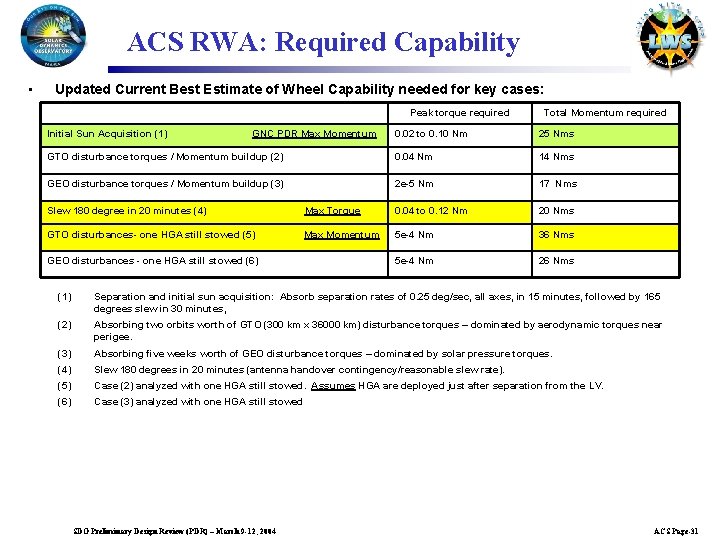
ACS RWA: Required Capability • Updated Current Best Estimate of Wheel Capability needed for key cases: Peak torque required Initial Sun Acquisition (1) GNC PDR Max Momentum Total Momentum required 0. 02 to 0. 10 Nm 25 Nms GTO disturbance torques / Momentum buildup (2) 0. 04 Nm 14 Nms GEO disturbance torques / Momentum buildup (3) 2 e-5 Nm 17 Nms Slew 180 degree in 20 minutes (4) Max Torque 0. 04 to 0. 12 Nm 20 Nms GTO disturbances- one HGA still stowed (5) Max Momentum 5 e-4 Nm 36 Nms 5 e-4 Nm 26 Nms GEO disturbances - one HGA still stowed (6) (1) Separation and initial sun acquisition: Absorb separation rates of 0. 25 deg/sec, all axes, in 15 minutes, followed by 165 degrees slew in 30 minutes, (2) Absorbing two orbits worth of GTO (300 km x 36000 km) disturbance torques – dominated by aerodynamic torques near perigee. (3) Absorbing five weeks worth of GEO disturbance torques – dominated by solar pressure torques. (4) Slew 180 degrees in 20 minutes (antenna handover contingency/reasonable slew rate). (5) Case (2) analyzed with one HGA still stowed. Assumes HGA are deployed just after separation from the LV. (6) Case (3) analyzed with one HGA still stowed SDO Preliminary Design Review (PDR) – March 9 -12, 2004 ACS Page-31
- Slides: 31