
SDNNDN Integrated Big Data Ecosystem for Big Science
SDN/NDN Integrated Big Data Ecosystem for Big Science Edmund Yeh (Northeastern) Harvey Newman (Caltech) Susmit Shannigrahi (Tennesee Tech) Lixia Zhang (UCLA)
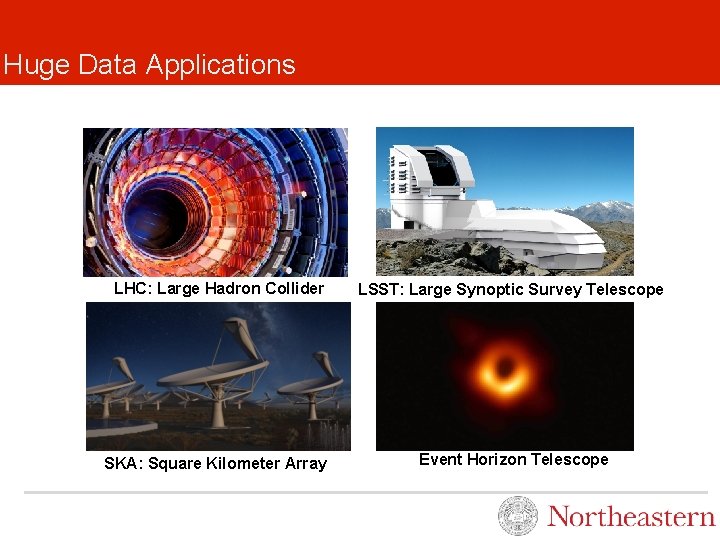
Huge Data Applications LHC: Large Hadron Collider LSST: Large Synoptic Survey Telescope SKA: Square Kilometer Array Event Horizon Telescope
Challenges of Big Data Systems • Huge data applications face similar set of problems: - LHC high energy physics, LSST, LIGO, genomics, medicine • System challenges: - Indexing, security, storage, distribution, analysis, learning - Coordinated use of computing, storage, network resources • Today: domain experts are dealing with these systems problems - Incremental solutions; developed in isolation; replicated efforts • Gap between application needs and existing networks/systems - Current computer networks/systems focus on addresses, processes, servers, connections - Consequently existing security solutions focus on securing data containers and delivery pipes - Applications care about data
Data-Centric Networking • Data-centric approach to system and network design • Providing system support through the whole data lifecycle: - Data production: naming, securing data directly - Delivering data using names enables scalable data retrieval - in-network caching - automated joint caching and forwarding - multicast delivery • Common framework to support different application domains • Named Data Networking (NDN): http: //named-data. net
NSF SANDIE Project • NSF CC* SANDIE: SDN Assisted NDN for Data Intensive Experiments (started July 2017) • Team: - Northeastern (PI: E. Yeh), Caltech (PI: H. Newman), Colorado State (PI: C. Papadopoulos/C. Partridge) - In partnership with other LHC sites and NDN project team • Approach: Use SDN-assisted NDN to redesign LHC HEP network; optimize workflow • Solutions: - Development of NDN naming scheme for fast access and efficient communication in HEP and other fields - Deployment of NDN edge caches with SSDs at multiple sites - Simultaneously optimization of caching (“hot” datasets) and forwarding
SANDIE Results • Feasibility of NDN-based data distribution system for LHC first demonstrated at SC 18 (Dallas) • SANDIE demo at SC 19 (Denver) showed greatly improved throughput and delay performance by leveraging: - VIP jointly optimized caching and forwarding algorithms developed by Northeastern (Yeh et al. 2014) - High-speed NDN-DPDK forwarder developed by NIST (Shi et al. 2019) - NDN-DPDK-based consumer and producer developed by Caltech (Iordache, et al. 2019) • Demo over SANDIE transcontinental layer-2 demo testbed (SC 19 – Caltech – Northeastern – Colorado State) • Achieved over 6. 7 Gbps throughput (single thread) between NDN-DPDKbased consumer and producer • Optimized caching and forwarding algorithms decreased download times by a factor of 10.
Next Steps • Deploy, commission first prototype production-ready NDN-based petascale data distribution, caching, access, analysis system serving major science programs • LHC high energy physics program as leading target use case. Bio. Genome, human genome projects, ATLAS, LSST, SKA as future use cases • Leverage NDN protocols, high throughput forwarding/caching methods, computation scheduling and containerization techniques • Integrated with SDN methods and FPGA acceleration subsystems • Deliver LHC data over wide area network at throughputs ~ 100 Gbps • Dramatically decrease download times by using optimizing caching
Discussion • Huge data applications require fundamental network/systems solutions to address common needs • NDN provides data-centric system support through whole data lifecycle - natural fit for LHC and other huge data and computation networks - • High performance NDN: SANDIE showed throughput at 6. 7 Gbps over WAN - NDN-DPDK forwarder - VIP jointly optimized caching and forwarding algorithms • Toward first prototype production-ready NDN huge data system: integration with SDN, FPGA, computation scheduling, containerization • Seeking long-term collaboration with domain science, networking and computer systems communities
- Slides: 8