
SDN Security Matt Bishop Brian Perry University of
SDN Security Matt Bishop, Brian Perry University of California at Davis GEC 22, March 24 th, 2015 1
Network Switches • Conventional switch: closed system – Support manufacturer-specific control interfaces – Control, data planes embedded in them – Changes in protocols, services, etc. usually require replacing or updating switch • SDN: decouple control, data planes – Control plane controlled by a centralized controller on a computer (PC, for example) – Can program switch via controller – Easy to propagate changes in protocols, services, etc. GEC 22, March 24 th, 2015 2
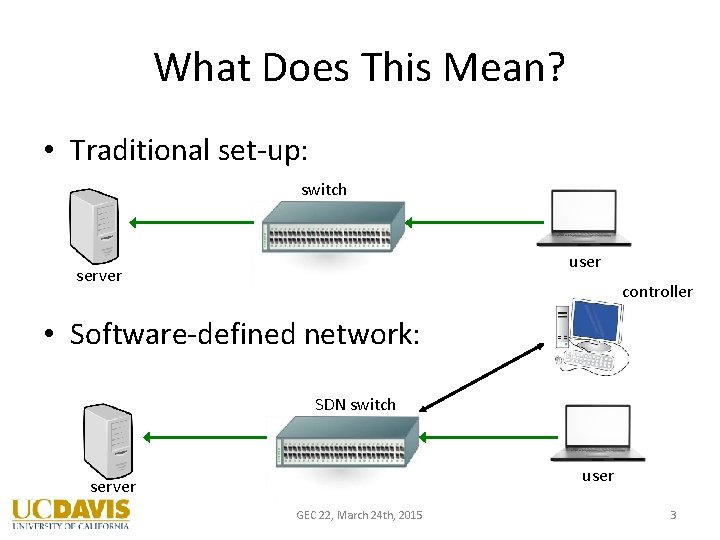
What Does This Mean? • Traditional set-up: switch user server controller • Software-defined network: SDN switch user server GEC 22, March 24 th, 2015 3
Security • Trust, maintenance, resilient design, etc. common to both • Authentication, authorization in SDN network more complicated – As commands and changes come on the fly, need to be sure these come from an authorized source – Can have dynamic policy for handling flows – “Apps” can perform additional security functions GEC 22, March 24 th, 2015 4
Security Using the Switch • Switch provides, assists security mechanisms – Open. Flow Random Host Mutation – Provide data for anomaly-based intrusion detection (more accurate than ISP-driven IDS) – Enforce dynamic access control policies based on flow-level information – Various security applications • Edge-based authentication gateways • Security application development frameworks GEC 22, March 24 th, 2015 5
Security of the Switch • Software – Verify • Various groups doing this with Open. Flow; not so much with others • Check for misconfigurations within a single flow table – Implement a security enforcement kernel – Lots of control/data plane interactions can disrupt operations • Link to controller(? ) – Ensure connection to controller is secured (TLS) – Disable passive listening (require authentication) GEC 22, March 24 th, 2015 6
Our Approach • Controller is a ordinary computer — with all the vulnerabilities of an ordinary computer – So, attack that – Once in control of the controller, have fun! • Also applies if we can impersonate the controller – Here’s where the listener port comes into play • This also considers misconfigurations downloaded from the controller – Must assume humans are fallible GEC 22, March 24 th, 2015 7
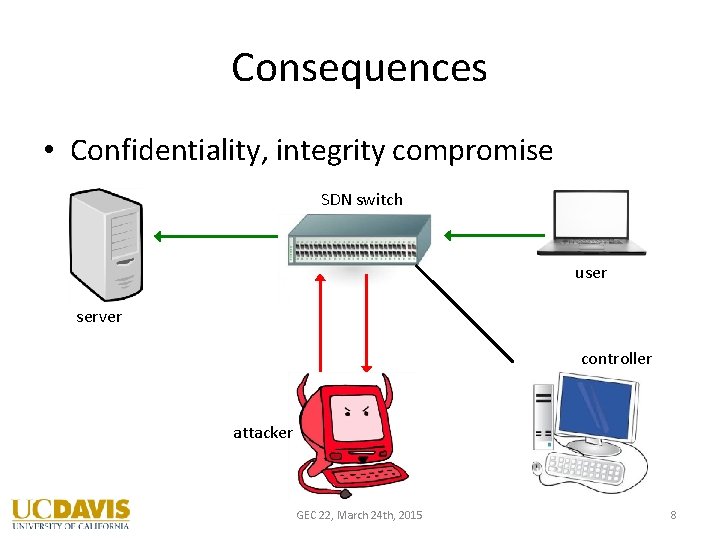
Consequences • Confidentiality, integrity compromise SDN switch user server controller attacker GEC 22, March 24 th, 2015 8
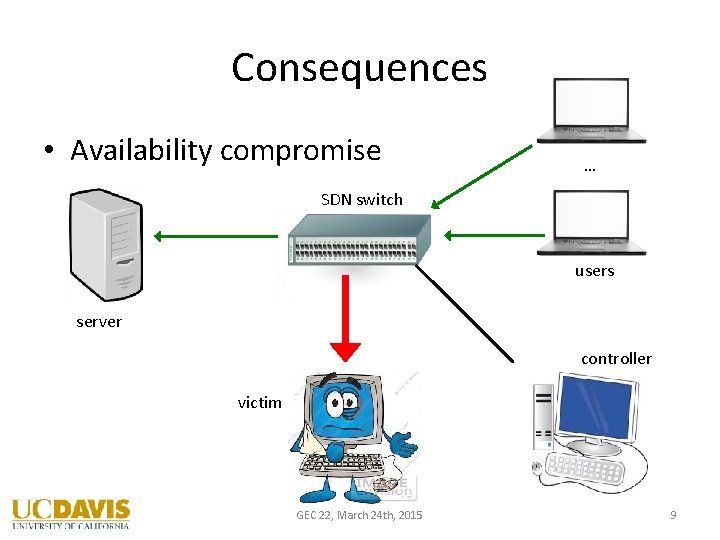
Consequences • Availability compromise … SDN switch users server controller victim GEC 22, March 24 th, 2015 9
Key Points • You can gain security with SDN, but you can also lose security (and vice versa) • Security problems with SDN can wreak havoc on networks that depend on them – Like GENI • Introducing powerful technology also introduces the risk of that power being used against you – And the threats may not come from where you expect! GEC 22, March 24 th, 2015 10
Conclusion • Security of the switch is important • Security of whatever can control the switch even more so – Most computers vulnerable to attack – Best to use dedicated, stripped-down system as controller – If you can isolate it, so much the better GEC 22, March 24 th, 2015 11
Thanks to … • Abhishek Gupta • Saadet Sedef Savas • Steven Templeton Funded by the GENI Projects Office through Contract #950012166, Prime Sponsor (NSF) Award CNS-1344668 GEC 22, March 24 th, 2015 12
About Me Matt Bishop Computer Security Laboratory Department of Computer Science University of California at Davis 1 Shields Ave. Davis, CA 95616 -8562 USA phone: +1 (530) 752 -8060 email: bishop@ucdavis. edu web: http: //seclab. cs. ucdavis. edu/~bishop GEC 22, March 24 th, 2015 Slide #13
- Slides: 13