
SDN Open Stack IBM Platform Computing Outlines SDN
SDN & Open. Stack 邱见 IBM Platform Computing
Outlines • SDN briefing • Open. Stack network component • Open. Stack and SDN
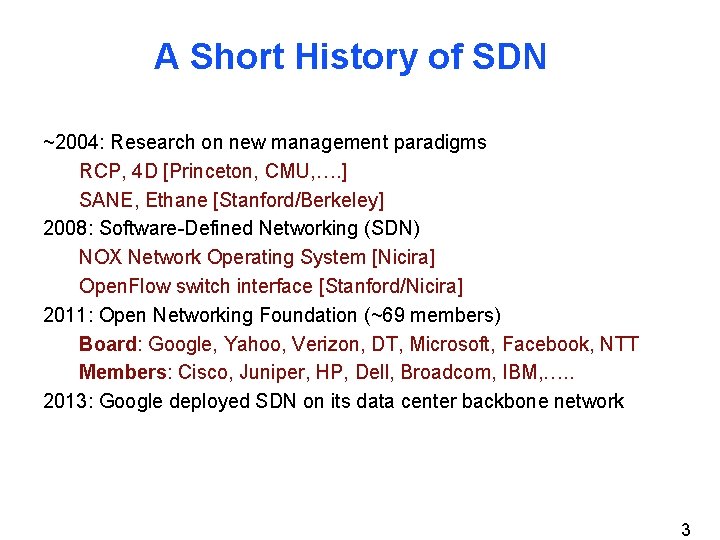
A Short History of SDN ~2004: Research on new management paradigms RCP, 4 D [Princeton, CMU, …. ] SANE, Ethane [Stanford/Berkeley] 2008: Software-Defined Networking (SDN) NOX Network Operating System [Nicira] Open. Flow switch interface [Stanford/Nicira] 2011: Open Networking Foundation (~69 members) Board: Google, Yahoo, Verizon, DT, Microsoft, Facebook, NTT Members: Cisco, Juniper, HP, Dell, Broadcom, IBM, …. . 2013: Google deployed SDN on its data center backbone network 3
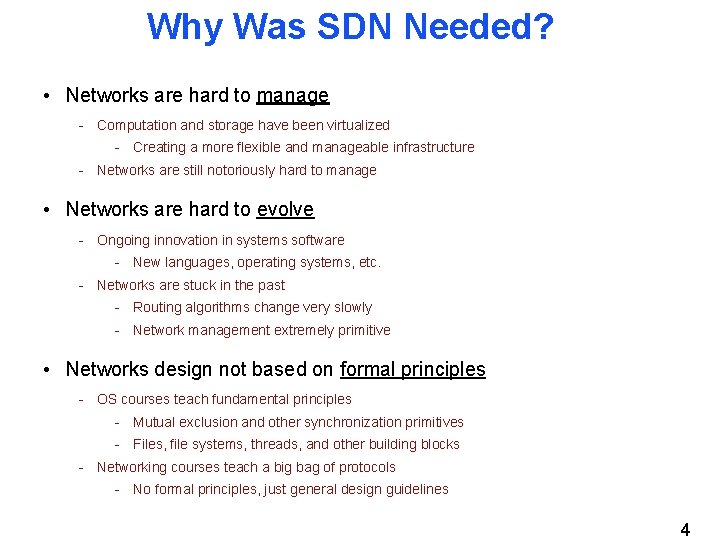
Why Was SDN Needed? • Networks are hard to manage - Computation and storage have been virtualized - Creating a more flexible and manageable infrastructure - Networks are still notoriously hard to manage • Networks are hard to evolve - Ongoing innovation in systems software - New languages, operating systems, etc. - Networks are stuck in the past - Routing algorithms change very slowly - Network management extremely primitive • Networks design not based on formal principles - OS courses teach fundamental principles - Mutual exclusion and other synchronization primitives - Files, file systems, threads, and other building blocks - Networking courses teach a big bag of protocols - No formal principles, just general design guidelines 4
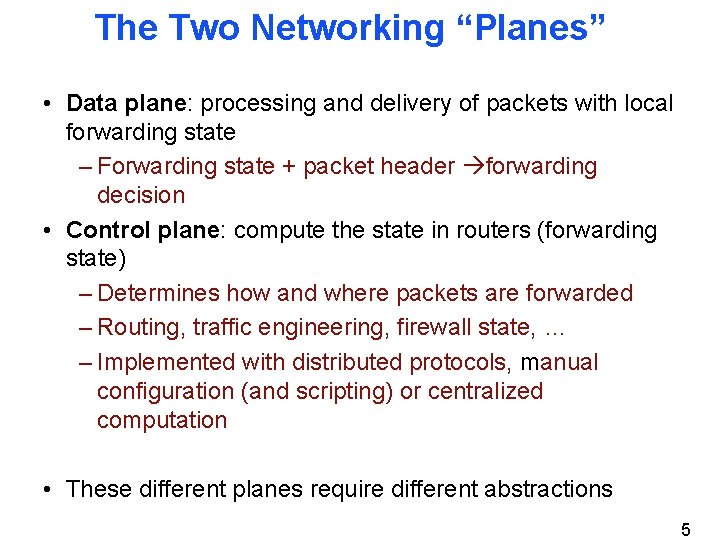
The Two Networking “Planes” • Data plane: processing and delivery of packets with local forwarding state – Forwarding state + packet header forwarding decision • Control plane: compute the state in routers (forwarding state) – Determines how and where packets are forwarded – Routing, traffic engineering, firewall state, … – Implemented with distributed protocols, manual configuration (and scripting) or centralized computation • These different planes require different abstractions 5
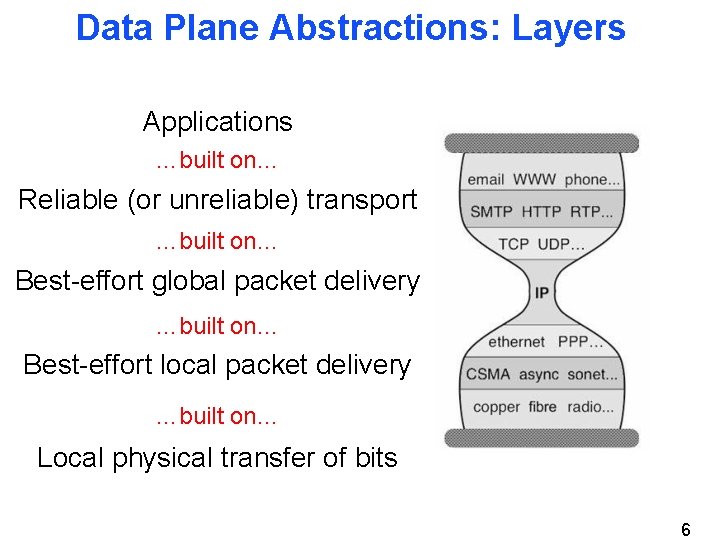
Data Plane Abstractions: Layers Applications …built on… Reliable (or unreliable) transport …built on… Best-effort global packet delivery …built on… Best-effort local packet delivery …built on… Local physical transfer of bits 6
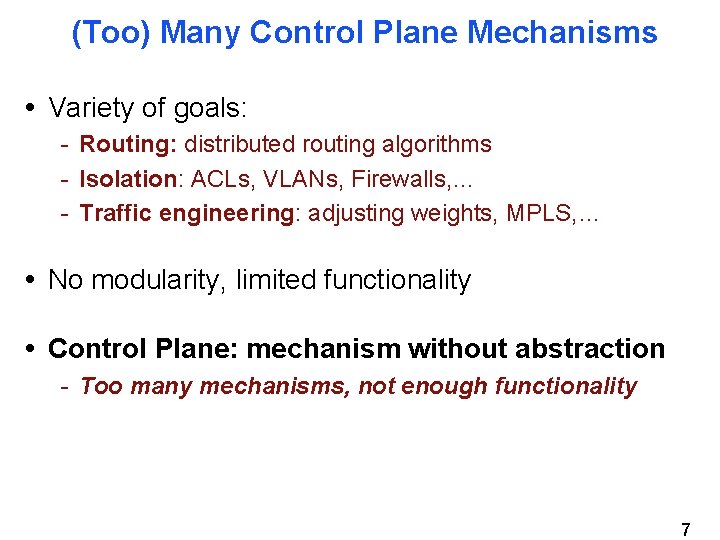
(Too) Many Control Plane Mechanisms • Variety of goals: - Routing: distributed routing algorithms - Isolation: ACLs, VLANs, Firewalls, … - Traffic engineering: adjusting weights, MPLS, … • No modularity, limited functionality • Control Plane: mechanism without abstraction - Too many mechanisms, not enough functionality 7
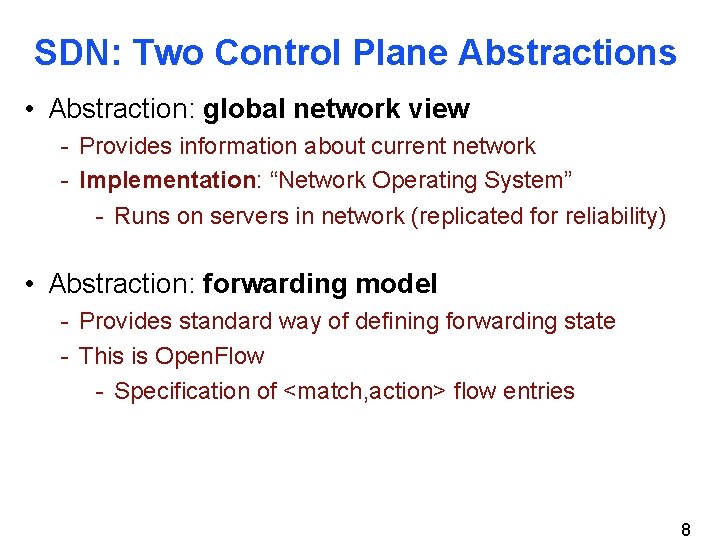
SDN: Two Control Plane Abstractions • Abstraction: global network view - Provides information about current network - Implementation: “Network Operating System” - Runs on servers in network (replicated for reliability) • Abstraction: forwarding model - Provides standard way of defining forwarding state - This is Open. Flow - Specification of <match, action> flow entries 8
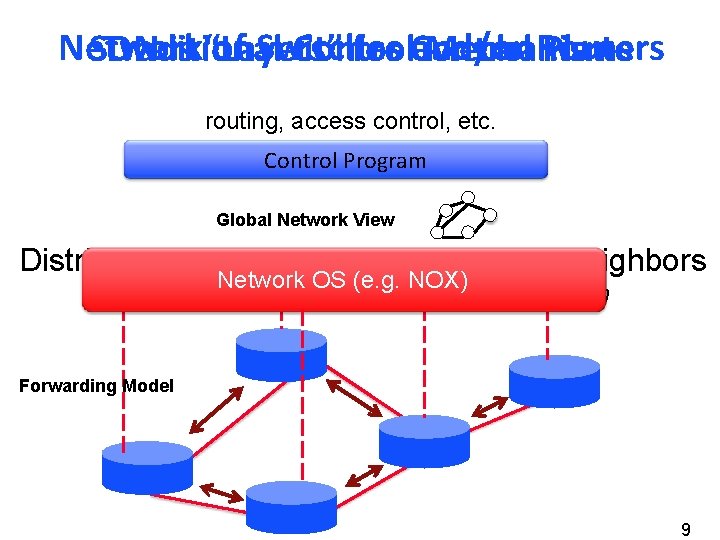
Network of Switches and/or Routers SDN Traditional is “Layers” Control for Control Mechanisms Plane routing, access control, etc. Control Program Global Network View Distributed algorithm running between neighbors Network OS (e. g. NOX) Complicated task-specific distributed algorithm Forwarding Model 9
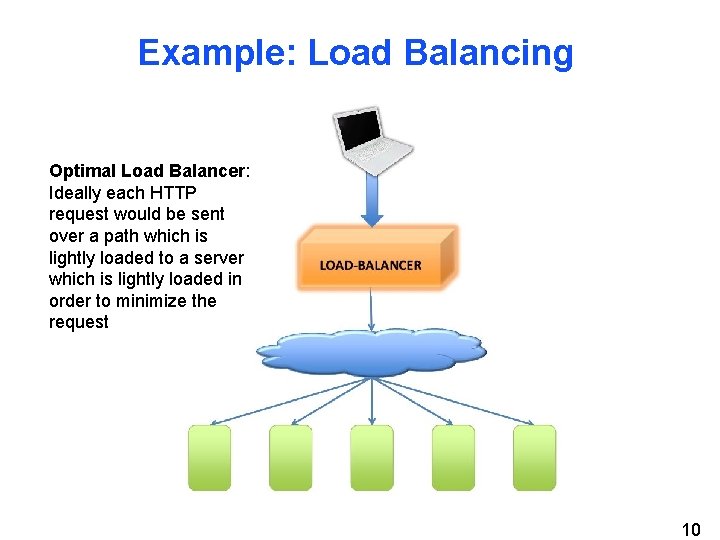
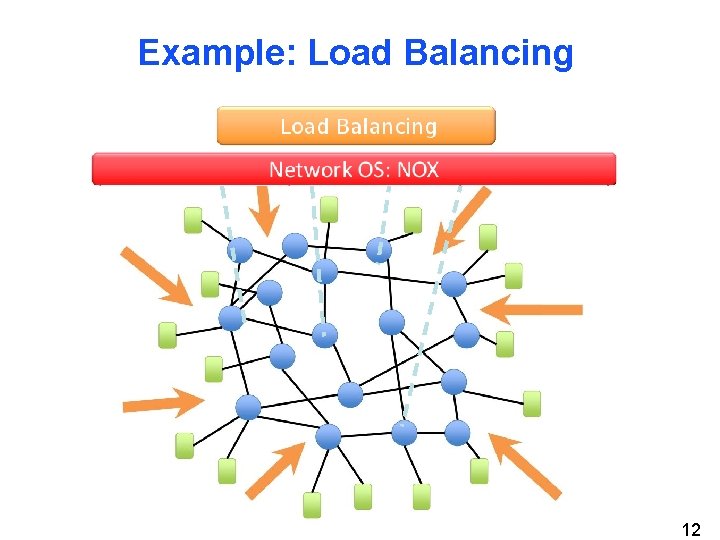
Example: Load Balancing Optimal Load Balancer: Ideally each HTTP request would be sent over a path which is lightly loaded to a server which is lightly loaded in order to minimize the request 10
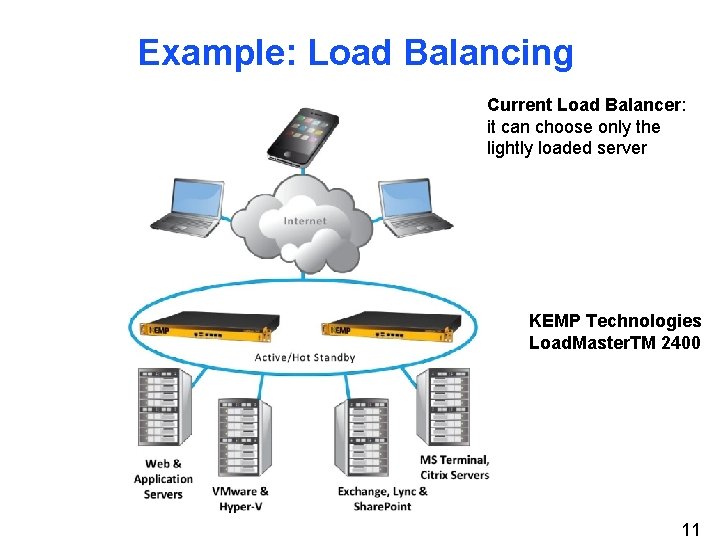
Example: Load Balancing Current Load Balancer: it can choose only the lightly loaded server KEMP Technologies Load. Master. TM 2400 11
Example: Load Balancing 12
Network Virtualization • Introduce new abstraction and new SDN layer • Abstraction: Virtual Topology - Allows operator to express requirements and policies - Via a set of logical switches and their configurations • Layer: Network Hypervisor - Translates those requirements into switch configurations - “Compiler” for virtual topologies 13
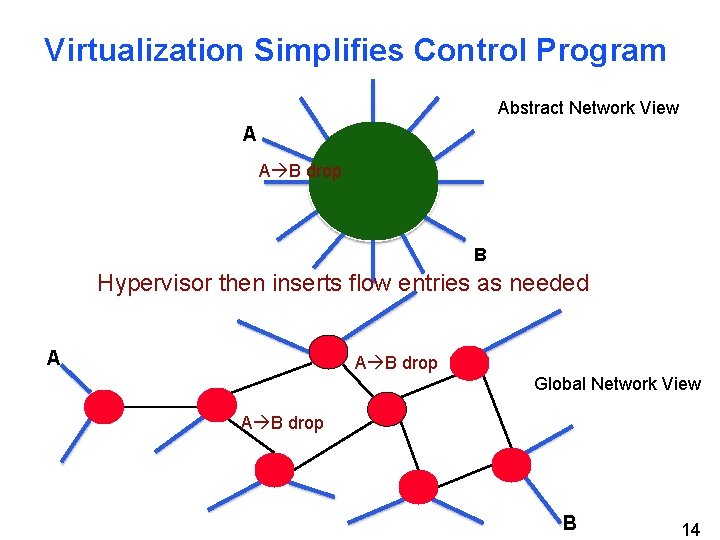
Virtualization Simplifies Control Program Abstract Network View A A B drop B Hypervisor then inserts flow entries as needed A A B drop Global Network View A B drop B 14
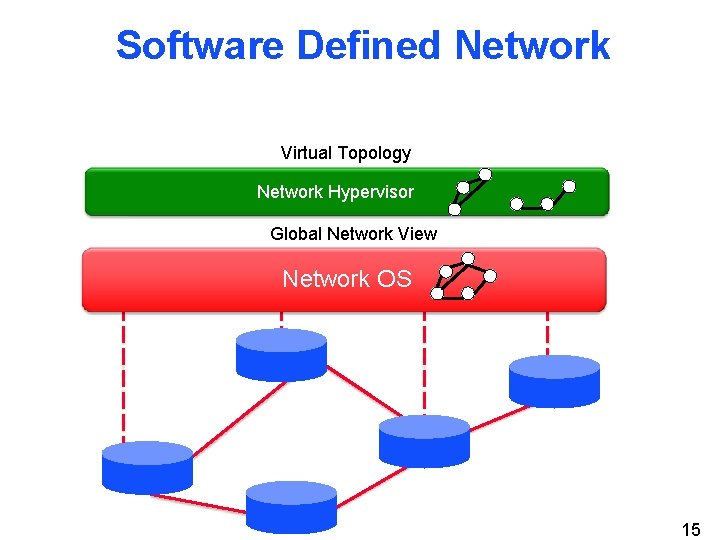
Software Defined Network Virtual Topology Network Hypervisor Control Program Global Network View Network OS 15
Does SDN have larger implications? Aside from providing easier network management, how will SDN change the world of networking? 16
Control/Data Planes Become Separate • Currently control plane tied to data plane • NOS runs on servers: observes/controls data plane • Changes the deployment and business models - Can buy the control plane separately from the switches - Enabling commodity hardware and 3 rd party software • Changes the testing model - Simulator to analyze large-scale control planes 17
Networking Becomes Edge-Oriented • Can implement most control functionality at edge - Access control, Qo. S, mobility, migration, monitoring… • Network core merely delivers packets edge-to-edge - Current protocols do a good job (mostly) • Let edge handle all complexity - Complicated matching, actions - “Overlay” networking via tunnels • This has two important implications 18
1. Makes SDN Incrementally Deployable • Host software often has Open. Flow switch - Open v. Switch (OVS) in Linux, Xen, … • The edge becomes a software switch - Core of network can be legacy hardware • Enables incremental deployment of SDN - Might never need Open. Flow in hardware switches…. 19
2. Networking Becomes Software-Oriented • All complicated forwarding done in software (edge) • And control plane is a program (on a server)… - …not a protocol (on a closed proprietary switch/router) • We are programming the network, not designing it - Focus on modularity and abstractions, not packet headers • Innovation at software, not hardware, speeds • Software lends itself to clean abstractions 20
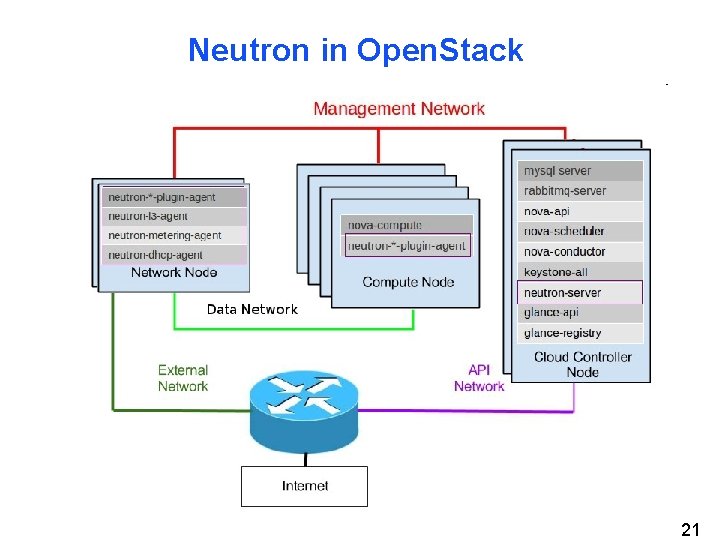
Neutron in Open. Stack 21
Network As A Service • Provides REST APIs to manage network connections for the resources managed by other Open. Stack Services (e. g. Nova) • Technology Agnostic (framework based on “plug-ins”) • Multi-tenancy: Isolation, Abstraction, full control over virtual networks • Modular Design: API specifies service, vendor provides its implementation. Extensions for vendor-specific features. • Standalone Service : It is not exclusive to Open. Stack. Neutron is an autonomous service • Exposes vendor-specific network virtualization and SDN technologies
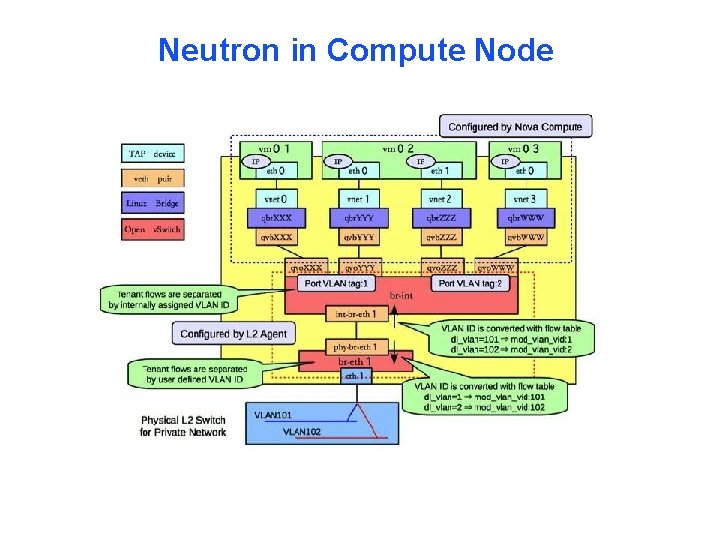
Neutron in Compute Node
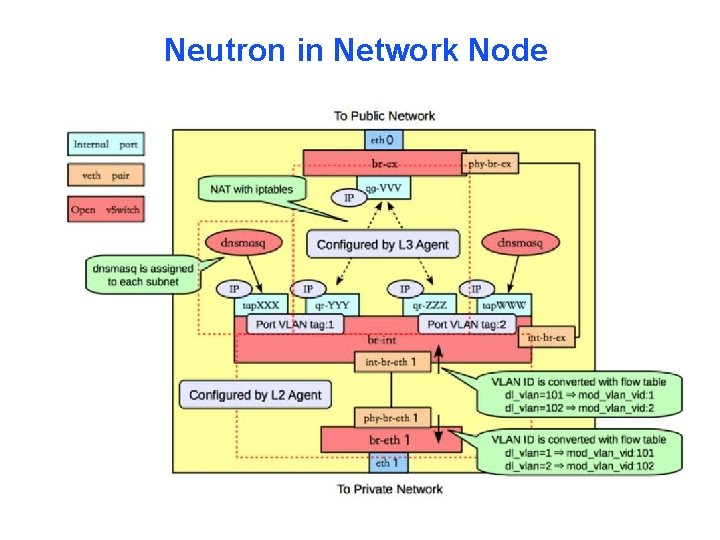
Neutron in Network Node
Neutron in Network Node • Neutron is not SDN, but a framework to enable SDN functionality – – – Nicira Network Virtualization Platform (NVP) Plugin Ryu Open. Flow Controller Plugin NEC Open. Flow Plugin Brocade Neutron Plugin PLUMgrid Plugin IBM SDN-VE Plugin • Starting with Havana release, Modular Layer 2 (ML 2) plugin replaces OVS and Linux. Bridge plugins. – type drivers to support multiple networking technologies – mechanism drivers to facilitate the access to the networking configuration in a transactional model

Thanks!
- Slides: 26