
SDN NFV Open Flow and For CES IETF93
- Slides: 89
SDN & NFV Open. Flow and For. CES IETF-93 Presented by • Yaakov Stein RAD (yaakov_s@rad. com) • Evangelos Haleplidis U of Patras (ehalep@ece. upatras. gr) SDN & NFV, OF & For. CES 1
Why SDN and NFV ? Before explaining what SDN and NFV are we need to explain why SDN and NFV are Its all started with two related trends. . . 1. The blurring of the distinction between computation and communications revealing a fundamental disconnect between software and networking 2. The decrease in profitability of traditional communications service providers along with the increase in profitability of Cloud and Over The Top service providers The 1 st led directly to SDN and the 2 nd to NFV but today both are intertwined SDN & NFV, OF & For. CES 2
1. Computation and communications Once there was little overlap between communications (telephone, radio, TV) and computation (computers) Actually communications devices always ran complex algorithms but these are hidden from the user But this dichotomy has become blurred Most home computers are not used for computation at all rather for entertainment and communications (email, chat, Vo. IP) Cellular telephones have become computers The differentiation can still be seen in the terms algorithm and protocol Protocol design is fundamentally harder since there are two interacting entities (the interoperability problem) SDN academics claim that packet forwarding is a computation problem and protocols as we know them should be avoided SDN & NFV, OF & For. CES 3
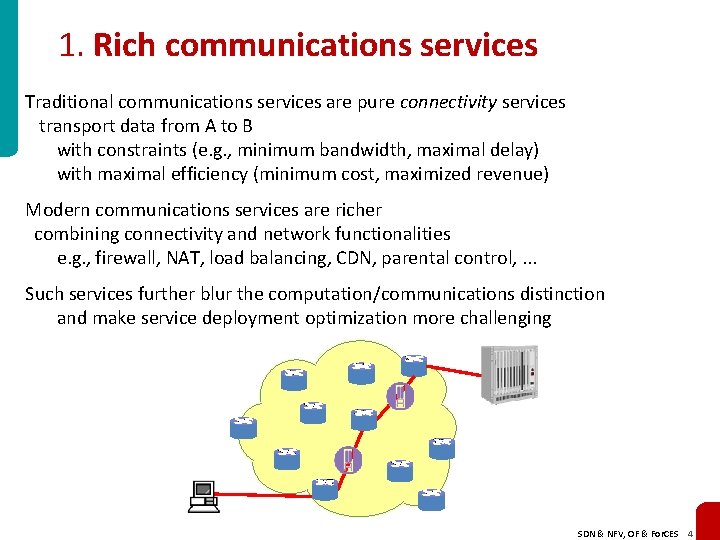
1. Rich communications services Traditional communications services are pure connectivity services transport data from A to B with constraints (e. g. , minimum bandwidth, maximal delay) with maximal efficiency (minimum cost, maximized revenue) Modern communications services are richer combining connectivity and network functionalities e. g. , firewall, NAT, load balancing, CDN, parental control, . . . Such services further blur the computation/communications distinction and make service deployment optimization more challenging SDN & NFV, OF & For. CES 4
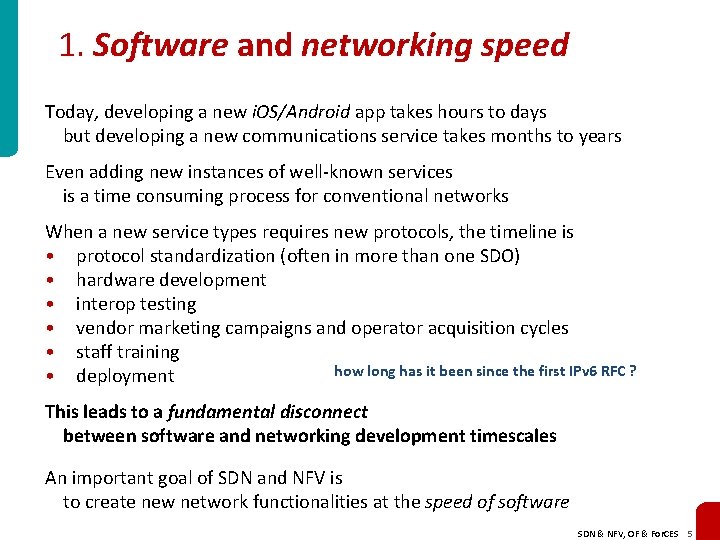
1. Software and networking speed Today, developing a new i. OS/Android app takes hours to days but developing a new communications service takes months to years Even adding new instances of well-known services is a time consuming process for conventional networks When a new service types requires new protocols, the timeline is • protocol standardization (often in more than one SDO) • hardware development • interop testing • vendor marketing campaigns and operator acquisition cycles • staff training how long has it been since the first IPv 6 RFC ? • deployment This leads to a fundamental disconnect between software and networking development timescales An important goal of SDN and NFV is to create new network functionalities at the speed of software SDN & NFV, OF & For. CES 5
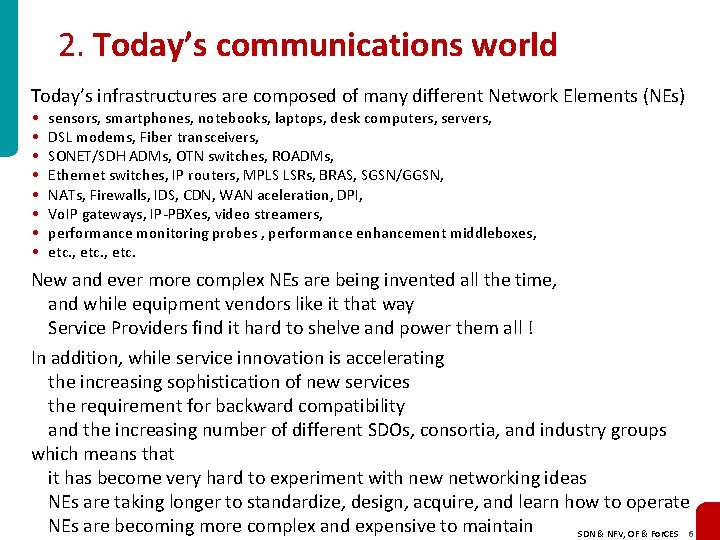
2. Today’s communications world Today’s infrastructures are composed of many different Network Elements (NEs) • • sensors, smartphones, notebooks, laptops, desk computers, servers, DSL modems, Fiber transceivers, SONET/SDH ADMs, OTN switches, ROADMs, Ethernet switches, IP routers, MPLS LSRs, BRAS, SGSN/GGSN, NATs, Firewalls, IDS, CDN, WAN aceleration, DPI, Vo. IP gateways, IP-PBXes, video streamers, performance monitoring probes , performance enhancement middleboxes, etc. New and ever more complex NEs are being invented all the time, and while equipment vendors like it that way Service Providers find it hard to shelve and power them all ! In addition, while service innovation is accelerating the increasing sophistication of new services the requirement for backward compatibility and the increasing number of different SDOs, consortia, and industry groups which means that it has become very hard to experiment with new networking ideas NEs are taking longer to standardize, design, acquire, and learn how to operate NEs are becoming more complex and expensive to maintain SDN & NFV, OF & For. CES 6
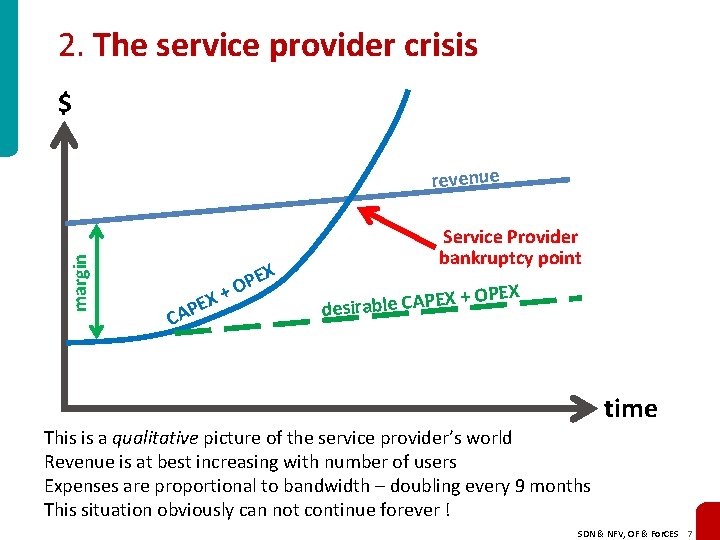
2. The service provider crisis $ margin revenue EX P CA + EX P O Service Provider bankruptcy point EX + O P A C le b a ir s e d PEX time This is a qualitative picture of the service provider’s world Revenue is at best increasing with number of users Expenses are proportional to bandwidth – doubling every 9 months This situation obviously can not continue forever ! SDN & NFV, OF & For. CES 7
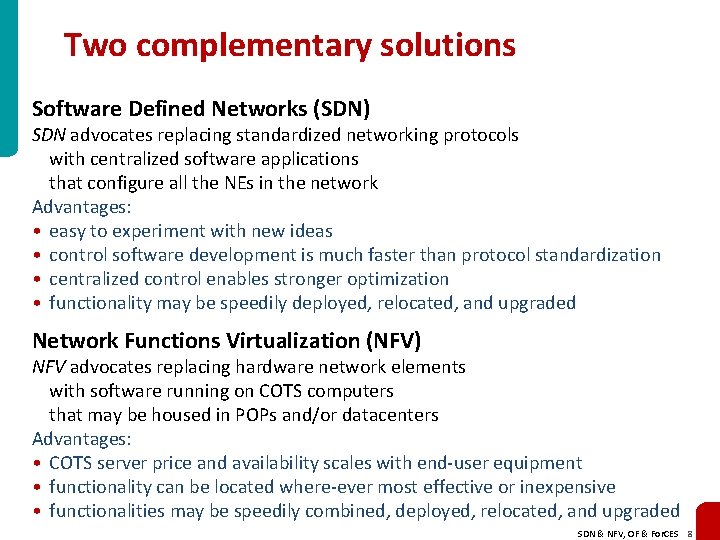
Two complementary solutions Software Defined Networks (SDN) SDN advocates replacing standardized networking protocols with centralized software applications that configure all the NEs in the network Advantages: • easy to experiment with new ideas • control software development is much faster than protocol standardization • centralized control enables stronger optimization • functionality may be speedily deployed, relocated, and upgraded Network Functions Virtualization (NFV) NFV advocates replacing hardware network elements with software running on COTS computers that may be housed in POPs and/or datacenters Advantages: • COTS server price and availability scales with end-user equipment • functionality can be located where-ever most effective or inexpensive • functionalities may be speedily combined, deployed, relocated, and upgraded SDN & NFV, OF & For. CES 8
SDN & NFV, OF & For. CES 9
Abstractions SDN was triggered by the development of networking technologies not keeping up with the speed of software application development Computer science theorists theorized that this derived from not having the required abstractions In CS an abstraction is a representation that reveals semantics needed at a given level while hiding implementation details thus allowing a programmer to focus on necessary concepts without getting bogged down in unnecessary details Programming is fast because programmers exploit abstractions Example: It is very slow to code directly in assembly language (with few abstractions, e. g. opcode mnemonics) It is a bit faster to coding in a low-level language like C (additional abstractions : variables, structures) It is much faster coding in high-level imperative language like Python It is much faster yet coding in a declarative language (coding has been abstracted away) It is fastest coding in a domain-specific language (only contains the needed abstractions) In contrast, in protocol design we return to bit level descriptions every time SDN & NFV, OF & For. CES 10
Packet forwarding abstraction The first abstraction relates to how network elements forward packets At a high enough level of abstraction all network elements perform the same task Abstraction 1 Packet forwarding as a computational problem The function of any network element (NE) is to • receive a packet • observe packet fields • apply algorithms (classification, decision logic) • optionally edit the packet • forward or discard the packet For example • An Ethernet switch observes MAC DA and VLAN tags, performs exact match, forwards the packet • A router observes IP DA, performs LPM, updates TTL, forwards packet • A firewall observes multiple fields, performs regular expression match, optionally discards packet We can replace all of these NEs with a configurable whitebox switch SDN & NFV, OF & For. CES 11
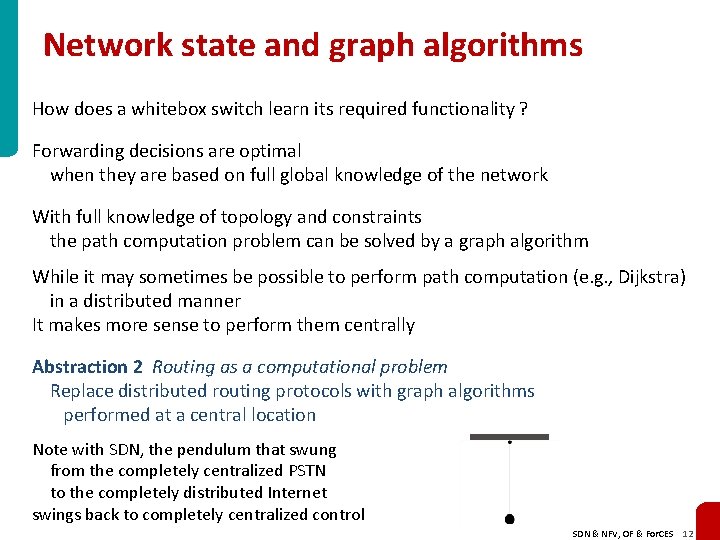
Network state and graph algorithms How does a whitebox switch learn its required functionality ? Forwarding decisions are optimal when they are based on full global knowledge of the network With full knowledge of topology and constraints the path computation problem can be solved by a graph algorithm While it may sometimes be possible to perform path computation (e. g. , Dijkstra) in a distributed manner It makes more sense to perform them centrally Abstraction 2 Routing as a computational problem Replace distributed routing protocols with graph algorithms performed at a central location Note with SDN, the pendulum that swung from the completely centralized PSTN to the completely distributed Internet swings back to completely centralized control SDN & NFV, OF & For. CES 12
Configuring the whitebox switch How does a whitebox switch acquire the information needed to forward that has been computed by an omniscient entity at a central location ? Abstraction 3 Configuration Whitebox switches are directly configured by an SDN controller Conventional network elements have two parts: 1. smart but slow CPUs that create a Forwarding Information Base 2. fast but dumb switch fabrics that use the FIB Whitebox switches only need the dumb part, thus • eliminating distributed protocols • not requiring intelligence The API from the SDN controller down to the whitebox switches is conventionally called the southbound API (e. g. , Open. Flow, For. CES) Note that this SB API is in fact a protocol but is a simple configuration protocol not a distributed routing protocol SDN & NFV, OF & For. CES 13
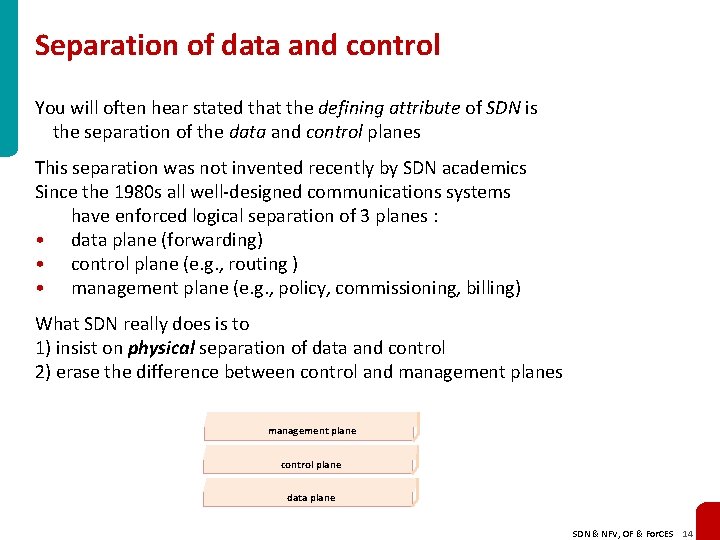
Separation of data and control You will often hear stated that the defining attribute of SDN is the separation of the data and control planes This separation was not invented recently by SDN academics Since the 1980 s all well-designed communications systems have enforced logical separation of 3 planes : • data plane (forwarding) • control plane (e. g. , routing ) • management plane (e. g. , policy, commissioning, billing) What SDN really does is to 1) insist on physical separation of data and control 2) erase the difference between control and management planes management plane control plane data plane SDN & NFV, OF & For. CES 14
Control or management What happened to the management plane ? Traditionally the distinction between control and management was that : • management had a human in the loop • while the control plane was automatic With the introduction of more sophisticated software the human could often be removed from the loop The difference that remains is that • the management plane is slow and centralized • the control plane is fast and distributed So, another way of looking at SDN is to say that it merges the control plane into a single centralized management plane SDN & NFV, OF & For. CES 15
SDN vs. distributed routing Distributed routing protocols are limited to • finding simple connectivity • minimizing number of hops (or other additive cost functions) but find it hard to perform more sophisticated operations, such as • • guaranteeing isolation (privacy) optimizing paths under constraints setting up non-overlapping backup paths (the Suurballe problem) integrating networking functionalities (e. g. , NAT, firewall) into paths This is why MPLS created the Path Computation Element architecture An SDN controller is omniscient (the God box) and holds the entire network description as a graph on which arbitrary optimization calculations can be performed But centralization comes at a price • the controller is a single point of failure (more generally different CAP-theorem trade-offs are involved) • the architecture is limited to a single network • additional (overhead) bandwidth is required • additional set-up delay may be incurred SDN & NFV, OF & For. CES 16
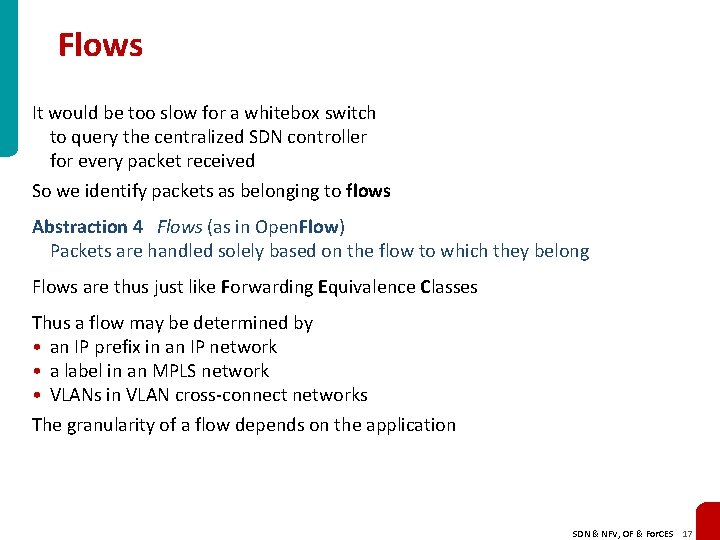
Flows It would be too slow for a whitebox switch to query the centralized SDN controller for every packet received So we identify packets as belonging to flows Abstraction 4 Flows (as in Open. Flow) Packets are handled solely based on the flow to which they belong Flows are thus just like Forwarding Equivalence Classes Thus a flow may be determined by • an IP prefix in an IP network • a label in an MPLS network • VLANs in VLAN cross-connect networks The granularity of a flow depends on the application SDN & NFV, OF & For. CES 17
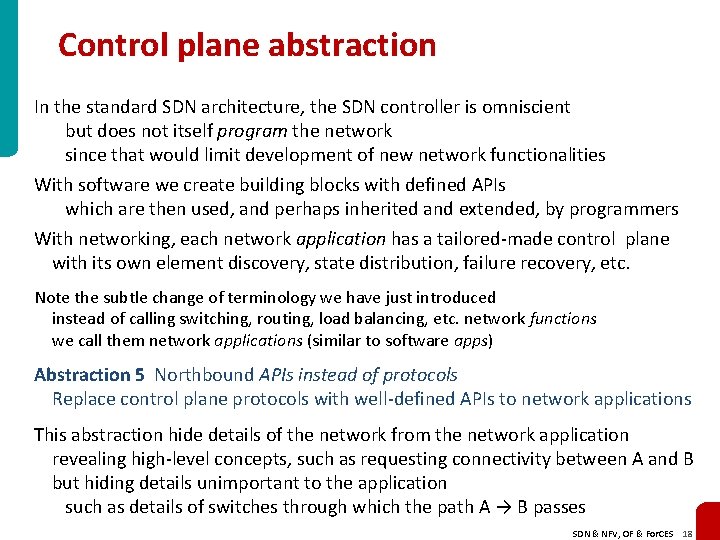
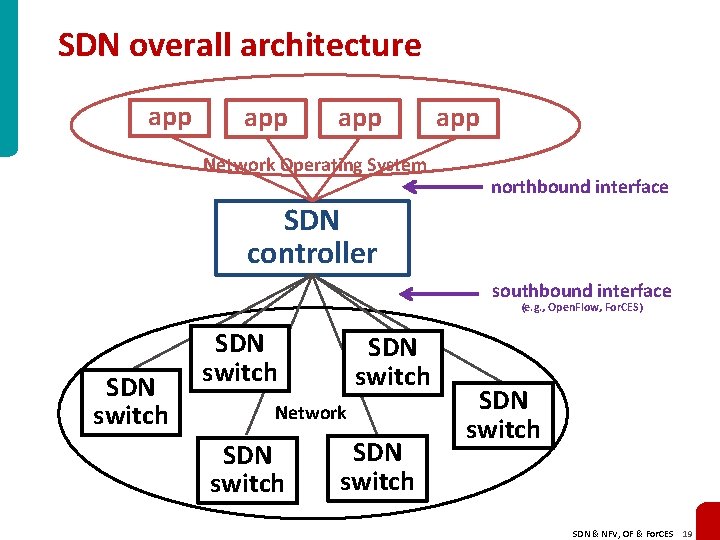
Control plane abstraction In the standard SDN architecture, the SDN controller is omniscient but does not itself program the network since that would limit development of new network functionalities With software we create building blocks with defined APIs which are then used, and perhaps inherited and extended, by programmers With networking, each network application has a tailored-made control plane with its own element discovery, state distribution, failure recovery, etc. Note the subtle change of terminology we have just introduced instead of calling switching, routing, load balancing, etc. network functions we call them network applications (similar to software apps) Abstraction 5 Northbound APIs instead of protocols Replace control plane protocols with well-defined APIs to network applications This abstraction hide details of the network from the network application revealing high-level concepts, such as requesting connectivity between A and B but hiding details unimportant to the application such as details of switches through which the path A → B passes SDN & NFV, OF & For. CES 18
SDN overall architecture app app Network Operating System app northbound interface SDN controller southbound interface (e. g. , Open. Flow, For. CES) SDN switch Network SDN switch SDN & NFV, OF & For. CES 19
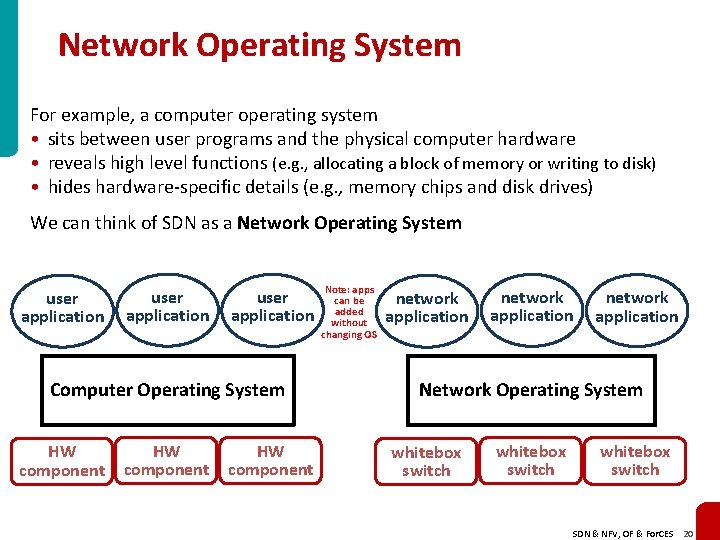
Network Operating System For example, a computer operating system • sits between user programs and the physical computer hardware • reveals high level functions (e. g. , allocating a block of memory or writing to disk) • hides hardware-specific details (e. g. , memory chips and disk drives) We can think of SDN as a Network Operating System user application Computer Operating System HW component Note: apps can be added without changing OS network application Network Operating System whitebox switch SDN & NFV, OF & For. CES 20
SDN overlay model We have been discussing the purist SDN model where SDN builds an entire network using whiteboxes For non-greenfield cases this model requires upgrading (downgrading? ) hardware to whitebox switches An alternative model builds an SDN overlay network The overlay tunnels traffic through the physical network running SDN on top of switches that do not explicitly support SDN Of course you may now need to administer two separate networks SDN & NFV, OF & For. CES 21
Organizations working on SDN The IRTF’s SDNRG • see RFC 7426 The Open Networking Forum (ONF) • responsible for Open. Flow and related work • promoting SDN principles ITU-T SG 13 • working on architectural issues and many open source communities, including : Open. Daylight ON. Lab Open Source SDN (OSSDN) many other controllers SDN & NFV, OF & For. CES 22
NFV SDN & NFV, OF & For. CES 23
Virtualization of computation In the field of computation, there has been a major trend towards virtualization Virtualization here means the creation of a virtual machine (VM) that acts like an independent physical computer A VM is software that emulates hardware (e. g. , an x 86 CPU) over which one can run software as if it is running on a physical computer The VM runs on a host machine and creates a guest machine (e. g. , an x 86 environment) A single host computer may host many fully independent guest VMs and each VM may run different Operating Systems and/or applications For example • a datacenter may have many racks of server cards • each server card may have many (host) CPUs • each CPU may run many (guest) VMs A hypervisor is software that enables creation and monitoring of VMs SDN & NFV, OF & For. CES 24
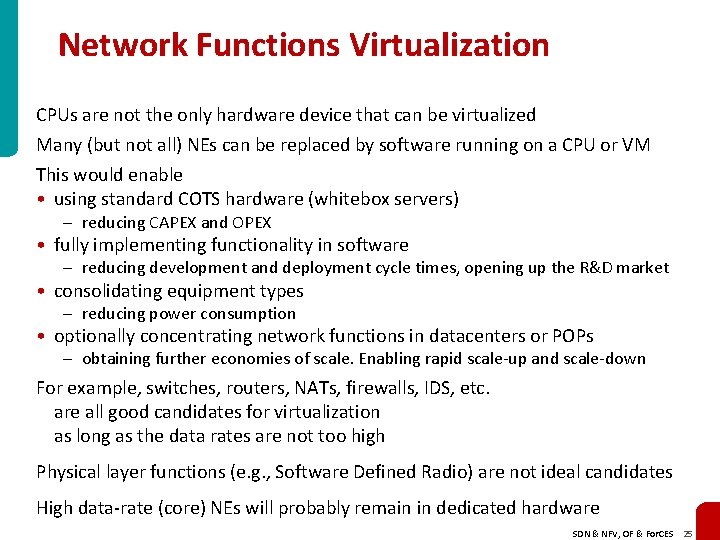
Network Functions Virtualization CPUs are not the only hardware device that can be virtualized Many (but not all) NEs can be replaced by software running on a CPU or VM This would enable • using standard COTS hardware (whitebox servers) – reducing CAPEX and OPEX • fully implementing functionality in software – reducing development and deployment cycle times, opening up the R&D market • consolidating equipment types – reducing power consumption • optionally concentrating network functions in datacenters or POPs – obtaining further economies of scale. Enabling rapid scale-up and scale-down For example, switches, routers, NATs, firewalls, IDS, etc. are all good candidates for virtualization as long as the data rates are not too high Physical layer functions (e. g. , Software Defined Radio) are not ideal candidates High data-rate (core) NEs will probably remain in dedicated hardware SDN & NFV, OF & For. CES 25
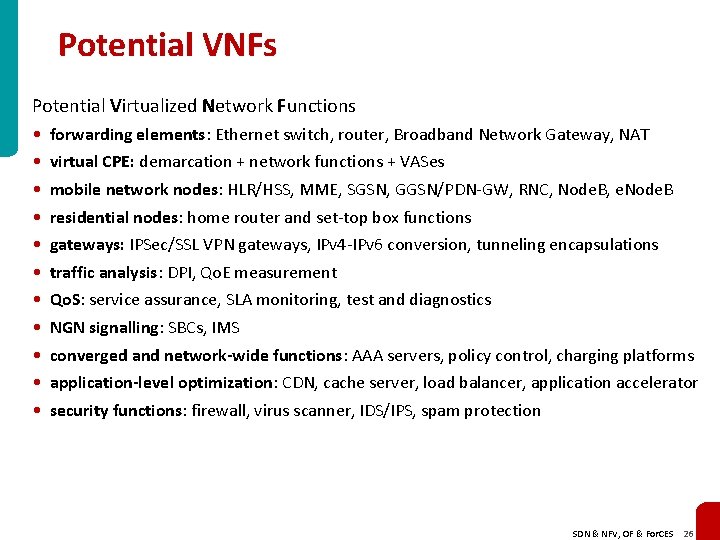
Potential VNFs Potential Virtualized Network Functions • • • forwarding elements: Ethernet switch, router, Broadband Network Gateway, NAT virtual CPE: demarcation + network functions + VASes mobile network nodes: HLR/HSS, MME, SGSN, GGSN/PDN-GW, RNC, Node. B, e. Node. B residential nodes: home router and set-top box functions gateways: IPSec/SSL VPN gateways, IPv 4 -IPv 6 conversion, tunneling encapsulations traffic analysis: DPI, Qo. E measurement Qo. S: service assurance, SLA monitoring, test and diagnostics NGN signalling: SBCs, IMS converged and network-wide functions: AAA servers, policy control, charging platforms application-level optimization: CDN, cache server, load balancer, application accelerator security functions: firewall, virus scanner, IDS/IPS, spam protection SDN & NFV, OF & For. CES 26
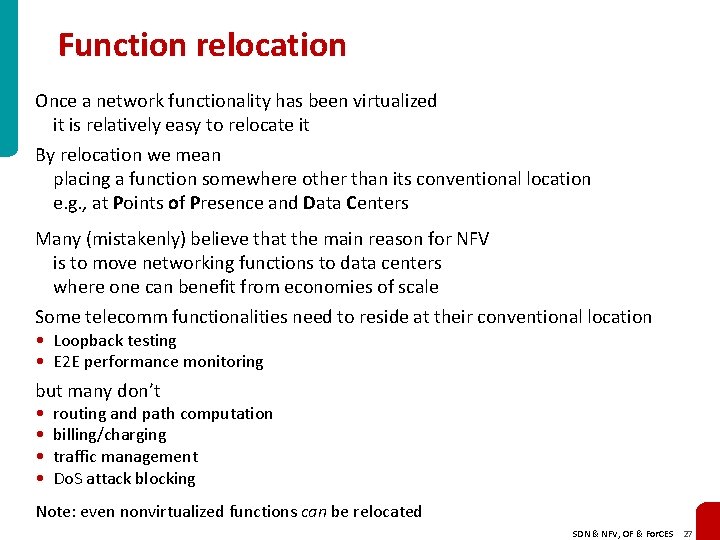
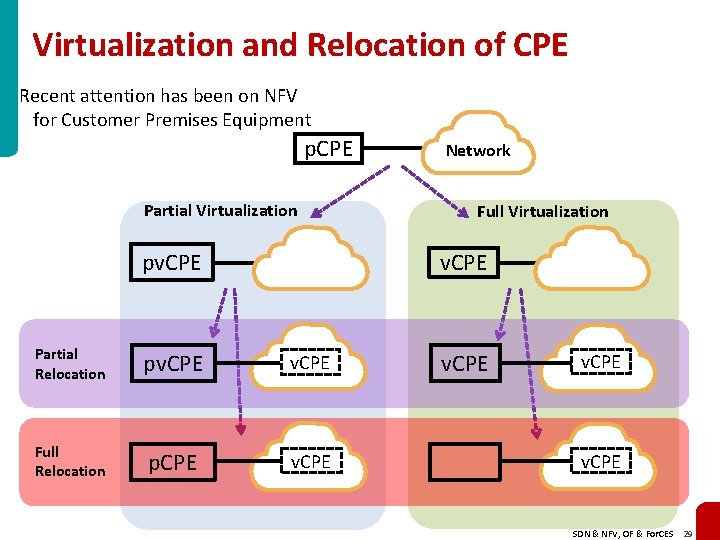
Function relocation Once a network functionality has been virtualized it is relatively easy to relocate it By relocation we mean placing a function somewhere other than its conventional location e. g. , at Points of Presence and Data Centers Many (mistakenly) believe that the main reason for NFV is to move networking functions to data centers where one can benefit from economies of scale Some telecomm functionalities need to reside at their conventional location • Loopback testing • E 2 E performance monitoring but many don’t • • routing and path computation billing/charging traffic management Do. S attack blocking Note: even nonvirtualized functions can be relocated SDN & NFV, OF & For. CES 27
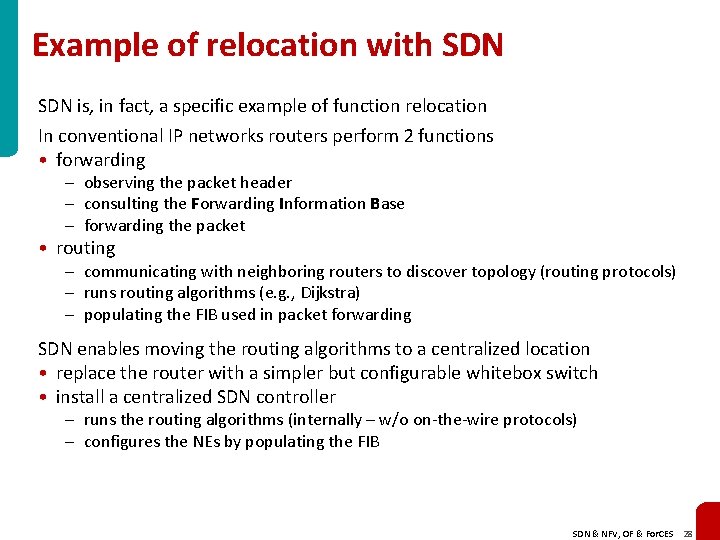
Example of relocation with SDN is, in fact, a specific example of function relocation In conventional IP networks routers perform 2 functions • forwarding – observing the packet header – consulting the Forwarding Information Base – forwarding the packet • routing – communicating with neighboring routers to discover topology (routing protocols) – runs routing algorithms (e. g. , Dijkstra) – populating the FIB used in packet forwarding SDN enables moving the routing algorithms to a centralized location • replace the router with a simpler but configurable whitebox switch • install a centralized SDN controller – runs the routing algorithms (internally – w/o on-the-wire protocols) – configures the NEs by populating the FIB SDN & NFV, OF & For. CES 28
Virtualization and Relocation of CPE Recent attention has been on NFV for Customer Premises Equipment p. CPE Partial Virtualization pv. CPE Network Full Virtualization v. CPE Partial Relocation pv. CPE Full Relocation p. CPE v. CPE SDN & NFV, OF & For. CES 29
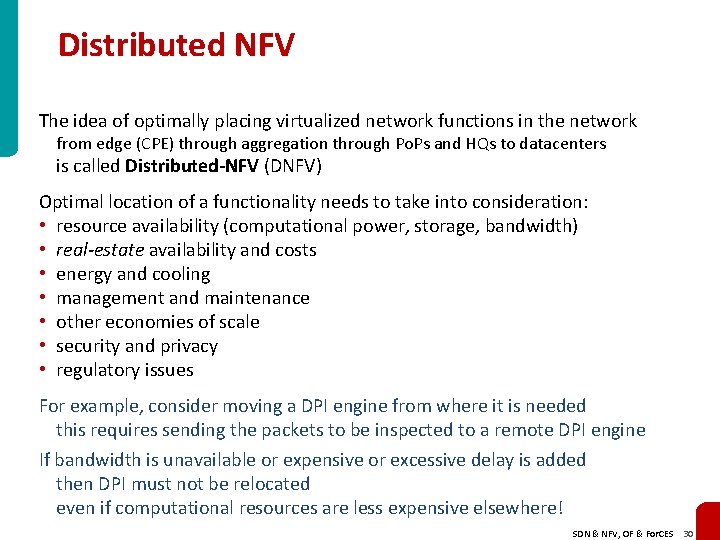
Distributed NFV The idea of optimally placing virtualized network functions in the network from edge (CPE) through aggregation through Po. Ps and HQs to datacenters is called Distributed-NFV (DNFV) Optimal location of a functionality needs to take into consideration: • resource availability (computational power, storage, bandwidth) • real-estate availability and costs • energy and cooling • management and maintenance • other economies of scale • security and privacy • regulatory issues For example, consider moving a DPI engine from where it is needed this requires sending the packets to be inspected to a remote DPI engine If bandwidth is unavailable or expensive or excessive delay is added then DPI must not be relocated even if computational resources are less expensive elsewhere! SDN & NFV, OF & For. CES 30
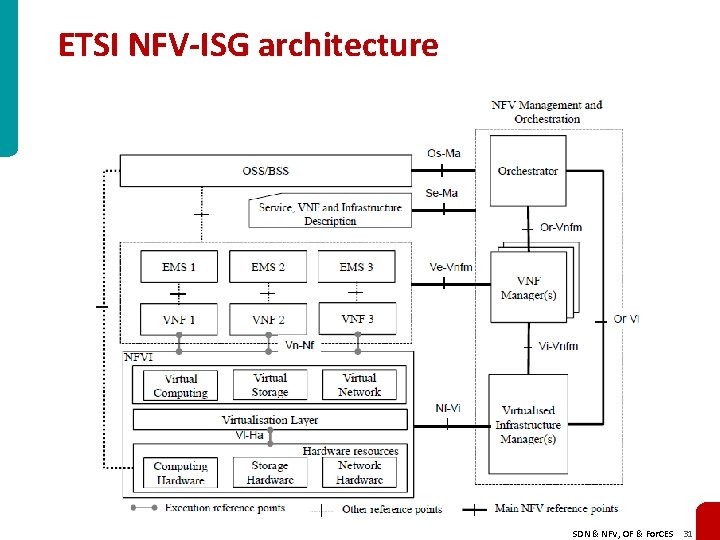
ETSI NFV-ISG architecture SDN & NFV, OF & For. CES 31
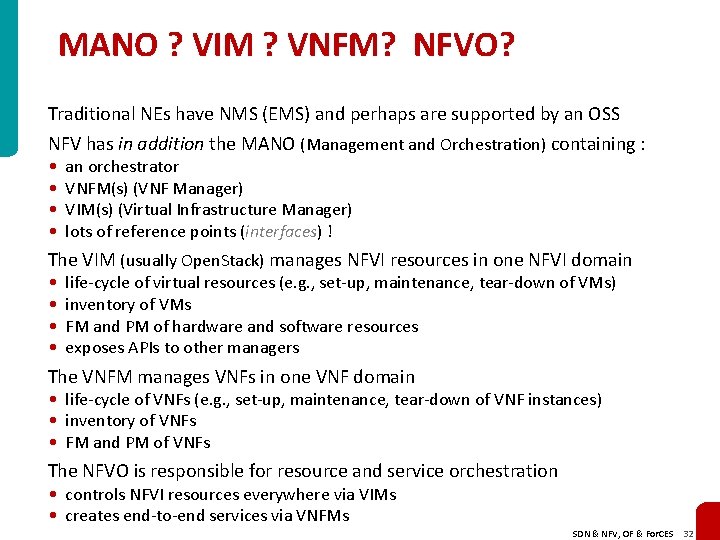
MANO ? VIM ? VNFM? NFVO? Traditional NEs have NMS (EMS) and perhaps are supported by an OSS NFV has in addition the MANO (Management and Orchestration) containing : • • an orchestrator VNFM(s) (VNF Manager) VIM(s) (Virtual Infrastructure Manager) lots of reference points (interfaces) ! The VIM (usually Open. Stack) manages NFVI resources in one NFVI domain • • life-cycle of virtual resources (e. g. , set-up, maintenance, tear-down of VMs) inventory of VMs FM and PM of hardware and software resources exposes APIs to other managers The VNFM manages VNFs in one VNF domain • life-cycle of VNFs (e. g. , set-up, maintenance, tear-down of VNF instances) • inventory of VNFs • FM and PM of VNFs The NFVO is responsible for resource and service orchestration • controls NFVI resources everywhere via VIMs • creates end-to-end services via VNFMs SDN & NFV, OF & For. CES 32
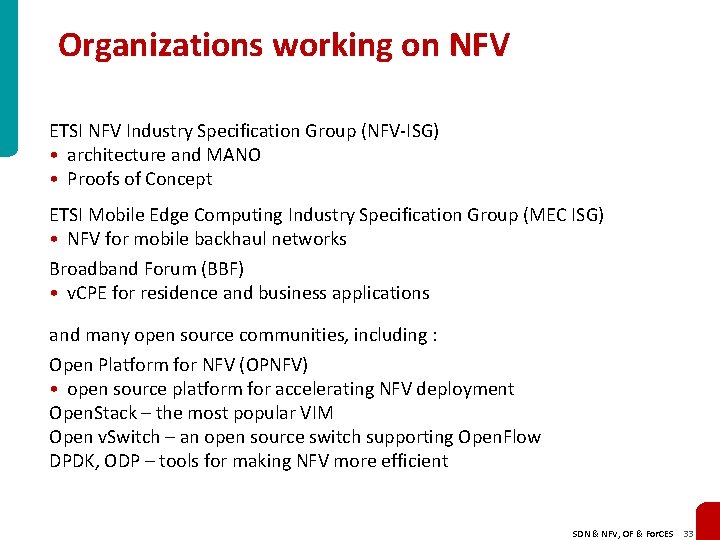
Organizations working on NFV ETSI NFV Industry Specification Group (NFV-ISG) • architecture and MANO • Proofs of Concept ETSI Mobile Edge Computing Industry Specification Group (MEC ISG) • NFV for mobile backhaul networks Broadband Forum (BBF) • v. CPE for residence and business applications and many open source communities, including : Open Platform for NFV (OPNFV) • open source platform for accelerating NFV deployment Open. Stack – the most popular VIM Open v. Switch – an open source switch supporting Open. Flow DPDK, ODP – tools for making NFV more efficient SDN & NFV, OF & For. CES 33
Open. Flow SDN & NFV, OF & For. CES 34
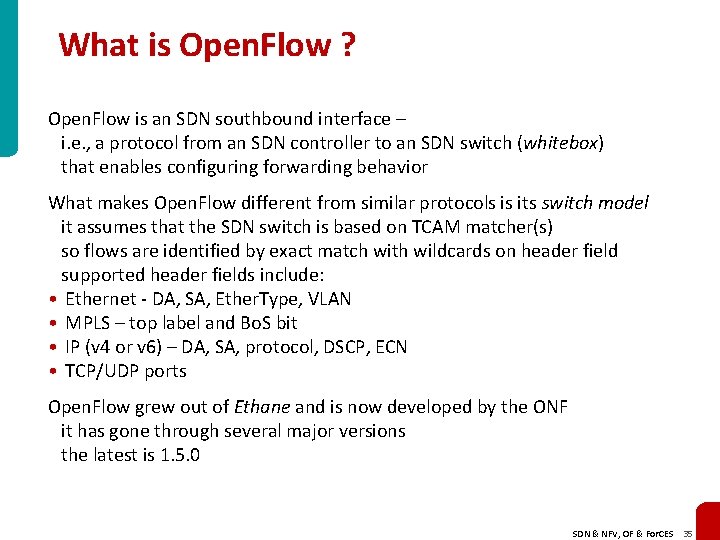
What is Open. Flow ? Open. Flow is an SDN southbound interface – i. e. , a protocol from an SDN controller to an SDN switch (whitebox) that enables configuring forwarding behavior What makes Open. Flow different from similar protocols is its switch model it assumes that the SDN switch is based on TCAM matcher(s) so flows are identified by exact match with wildcards on header field supported header fields include: • Ethernet - DA, SA, Ether. Type, VLAN • MPLS – top label and Bo. S bit • IP (v 4 or v 6) – DA, SA, protocol, DSCP, ECN • TCP/UDP ports Open. Flow grew out of Ethane and is now developed by the ONF it has gone through several major versions the latest is 1. 5. 0 SDN & NFV, OF & For. CES 35
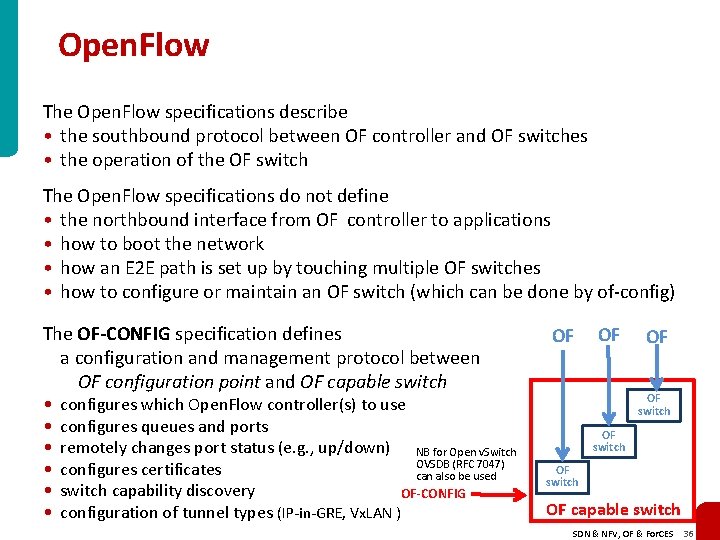
Open. Flow The Open. Flow specifications describe • the southbound protocol between OF controller and OF switches • the operation of the OF switch The Open. Flow specifications do not define • the northbound interface from OF controller to applications • how to boot the network • how an E 2 E path is set up by touching multiple OF switches • how to configure or maintain an OF switch (which can be done by of-config) The OF-CONFIG specification defines a configuration and management protocol between OF configuration point and OF capable switch • • • configures which Open. Flow controller(s) to use configures queues and ports remotely changes port status (e. g. , up/down) NB for Open v. Switch OVSDB (RFC 7047) configures certificates can also be used switch capability discovery OF-CONFIG configuration of tunnel types (IP-in-GRE, Vx. LAN ) OF OF switch OF capable switch SDN & NFV, OF & For. CES 36
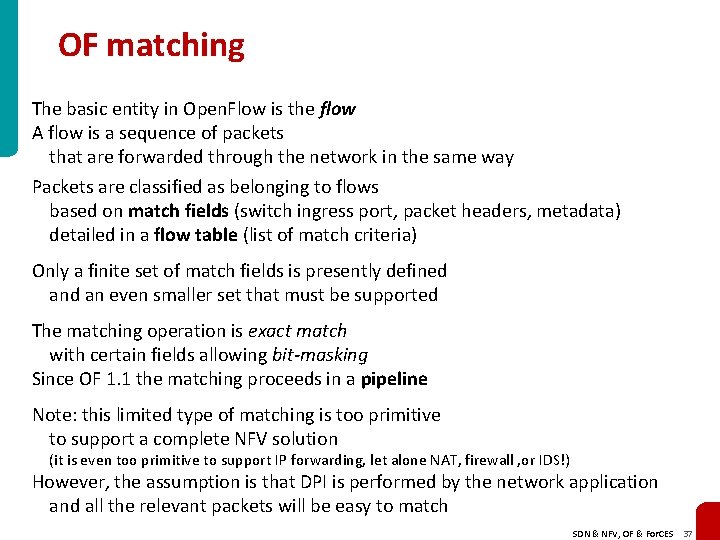
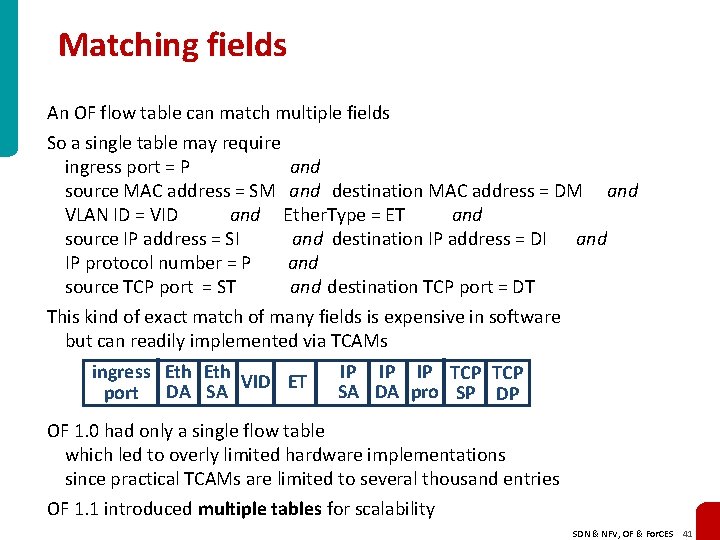
OF matching The basic entity in Open. Flow is the flow A flow is a sequence of packets that are forwarded through the network in the same way Packets are classified as belonging to flows based on match fields (switch ingress port, packet headers, metadata) detailed in a flow table (list of match criteria) Only a finite set of match fields is presently defined an even smaller set that must be supported The matching operation is exact match with certain fields allowing bit-masking Since OF 1. 1 the matching proceeds in a pipeline Note: this limited type of matching is too primitive to support a complete NFV solution (it is even too primitive to support IP forwarding, let alone NAT, firewall , or IDS!) However, the assumption is that DPI is performed by the network application and all the relevant packets will be easy to match SDN & NFV, OF & For. CES 37
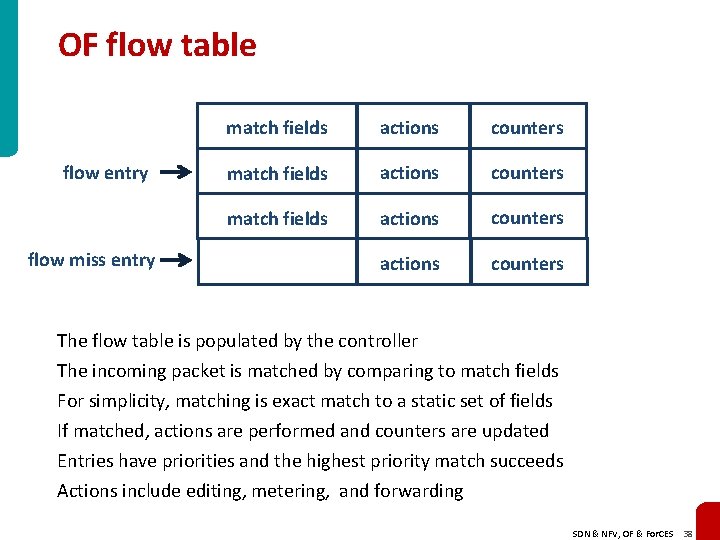
OF flow table flow entry flow miss entry match fields actions counters The flow table is populated by the controller The incoming packet is matched by comparing to match fields For simplicity, matching is exact match to a static set of fields If matched, actions are performed and counters are updated Entries have priorities and the highest priority match succeeds Actions include editing, metering, and forwarding SDN & NFV, OF & For. CES 38
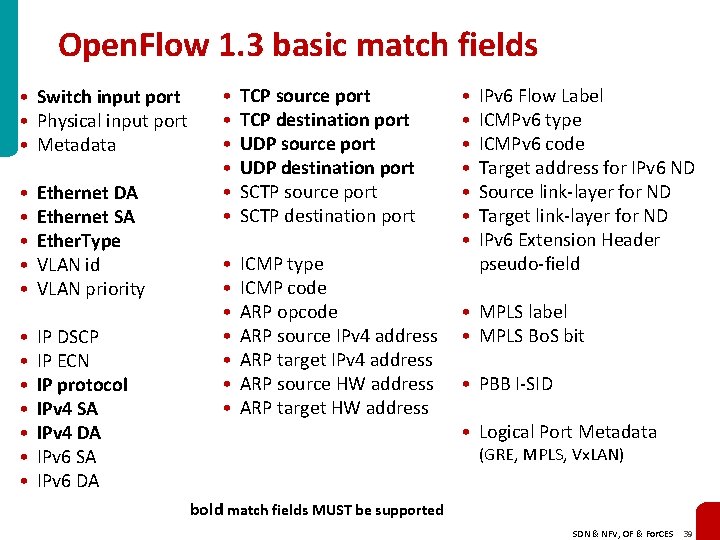
Open. Flow 1. 3 basic match fields • Switch input port • Physical input port • Metadata • • • Ethernet DA Ethernet SA Ether. Type VLAN id VLAN priority • • IP DSCP IP ECN IP protocol IPv 4 SA IPv 4 DA IPv 6 SA IPv 6 DA • • • TCP source port TCP destination port UDP source port UDP destination port SCTP source port SCTP destination port • • ICMP type ICMP code ARP opcode ARP source IPv 4 address ARP target IPv 4 address ARP source HW address ARP target HW address • • IPv 6 Flow Label ICMPv 6 type ICMPv 6 code Target address for IPv 6 ND Source link-layer for ND Target link-layer for ND IPv 6 Extension Header pseudo-field • MPLS label • MPLS Bo. S bit • PBB I-SID • Logical Port Metadata (GRE, MPLS, Vx. LAN) bold match fields MUST be supported SDN & NFV, OF & For. CES 39
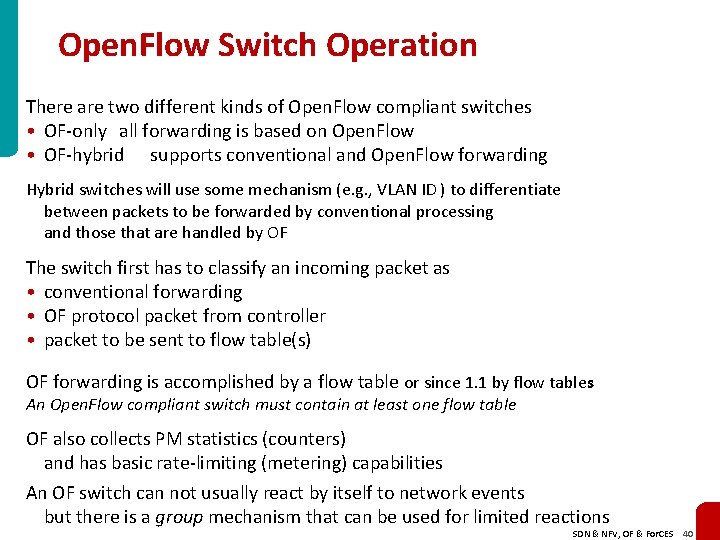
Open. Flow Switch Operation There are two different kinds of Open. Flow compliant switches • OF-only all forwarding is based on Open. Flow • OF-hybrid supports conventional and Open. Flow forwarding Hybrid switches will use some mechanism (e. g. , VLAN ID ) to differentiate between packets to be forwarded by conventional processing and those that are handled by OF The switch first has to classify an incoming packet as • conventional forwarding • OF protocol packet from controller • packet to be sent to flow table(s) OF forwarding is accomplished by a flow table or since 1. 1 by flow tables An Open. Flow compliant switch must contain at least one flow table OF also collects PM statistics (counters) and has basic rate-limiting (metering) capabilities An OF switch can not usually react by itself to network events but there is a group mechanism that can be used for limited reactions SDN & NFV, OF & For. CES 40
Matching fields An OF flow table can match multiple fields So a single table may require ingress port = P and source MAC address = SM and destination MAC address = DM and VLAN ID = VID and Ether. Type = ET and source IP address = SI and destination IP address = DI and IP protocol number = P and source TCP port = ST and destination TCP port = DT This kind of exact match of many fields is expensive in software but can readily implemented via TCAMs ingress Eth VID ET port DA SA IP IP IP TCP SA DA pro SP DP OF 1. 0 had only a single flow table which led to overly limited hardware implementations since practical TCAMs are limited to several thousand entries OF 1. 1 introduced multiple tables for scalability SDN & NFV, OF & For. CES 41
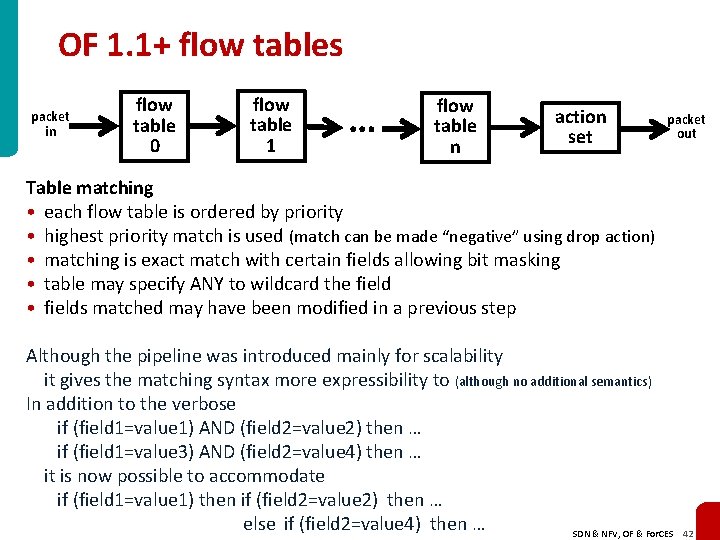
OF 1. 1+ flow tables packet in flow table 0 flow table 1 … flow table n action set packet out Table matching • each flow table is ordered by priority • highest priority match is used (match can be made “negative” using drop action) • matching is exact match with certain fields allowing bit masking • table may specify ANY to wildcard the field • fields matched may have been modified in a previous step Although the pipeline was introduced mainly for scalability it gives the matching syntax more expressibility to (although no additional semantics) In addition to the verbose if (field 1=value 1) AND (field 2=value 2) then … if (field 1=value 3) AND (field 2=value 4) then … it is now possible to accommodate if (field 1=value 1) then if (field 2=value 2) then … else if (field 2=value 4) then … SDN & NFV, OF & For. CES 42
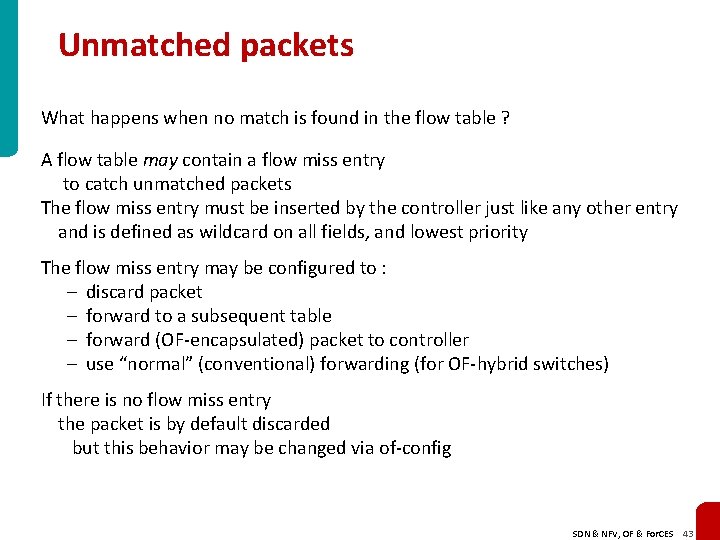
Unmatched packets What happens when no match is found in the flow table ? A flow table may contain a flow miss entry to catch unmatched packets The flow miss entry must be inserted by the controller just like any other entry and is defined as wildcard on all fields, and lowest priority The flow miss entry may be configured to : – discard packet – forward to a subsequent table – forward (OF-encapsulated) packet to controller – use “normal” (conventional) forwarding (for OF-hybrid switches) If there is no flow miss entry the packet is by default discarded but this behavior may be changed via of-config SDN & NFV, OF & For. CES 43
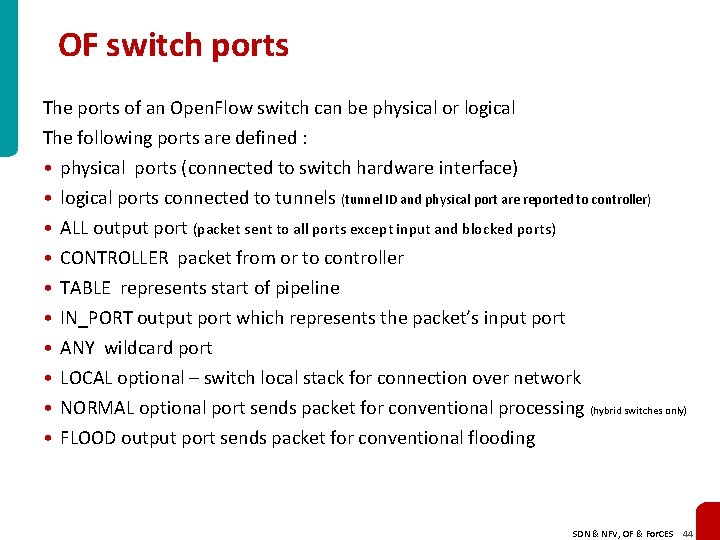
OF switch ports The ports of an Open. Flow switch can be physical or logical The following ports are defined : • physical ports (connected to switch hardware interface) • logical ports connected to tunnels (tunnel ID and physical port are reported to controller) • ALL output port (packet sent to all ports except input and blocked ports) • CONTROLLER packet from or to controller • TABLE represents start of pipeline • IN_PORT output port which represents the packet’s input port • ANY wildcard port • LOCAL optional – switch local stack for connection over network • NORMAL optional port sends packet for conventional processing (hybrid switches only) • FLOOD output port sends packet for conventional flooding SDN & NFV, OF & For. CES 44
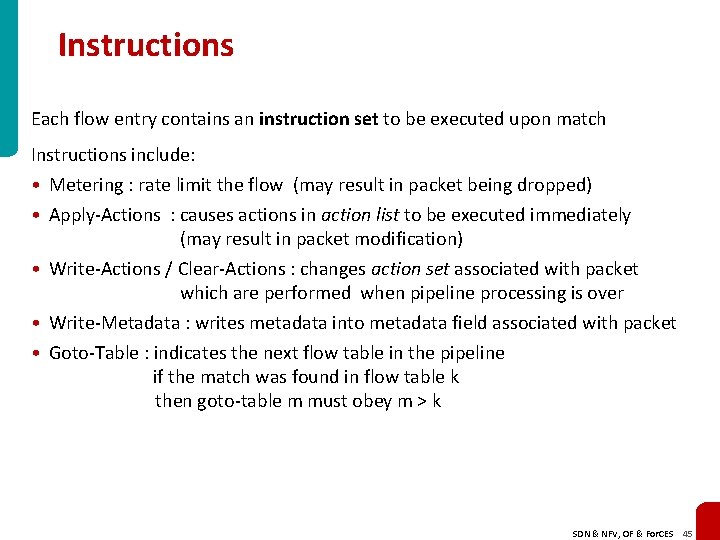
Instructions Each flow entry contains an instruction set to be executed upon match Instructions include: • Metering : rate limit the flow (may result in packet being dropped) • Apply-Actions : causes actions in action list to be executed immediately (may result in packet modification) • Write-Actions / Clear-Actions : changes action set associated with packet which are performed when pipeline processing is over • Write-Metadata : writes metadata into metadata field associated with packet • Goto-Table : indicates the next flow table in the pipeline if the match was found in flow table k then goto-table m must obey m > k SDN & NFV, OF & For. CES 45
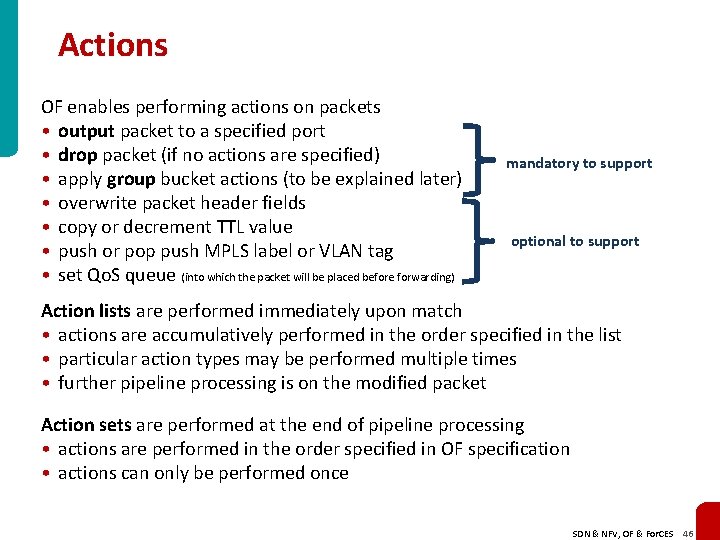
Actions OF enables performing actions on packets • output packet to a specified port • drop packet (if no actions are specified) • apply group bucket actions (to be explained later) • overwrite packet header fields • copy or decrement TTL value • push or pop push MPLS label or VLAN tag • set Qo. S queue (into which the packet will be placed before forwarding) mandatory to support optional to support Action lists are performed immediately upon match • actions are accumulatively performed in the order specified in the list • particular action types may be performed multiple times • further pipeline processing is on the modified packet Action sets are performed at the end of pipeline processing • actions are performed in the order specified in OF specification • actions can only be performed once SDN & NFV, OF & For. CES 46
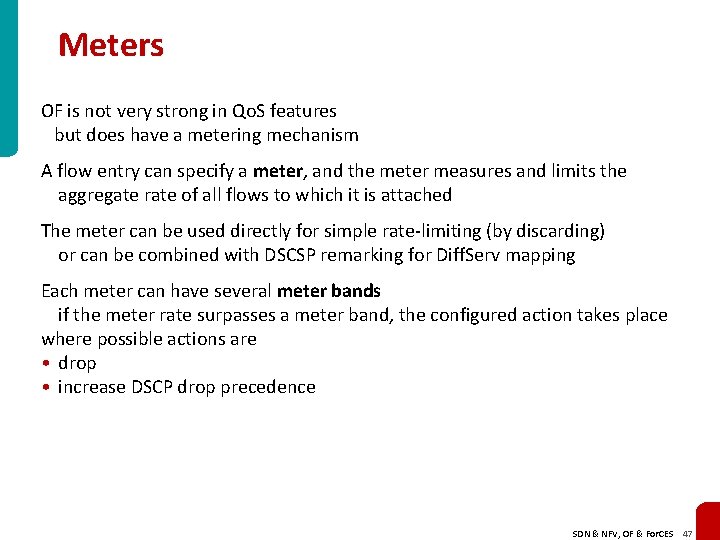
Meters OF is not very strong in Qo. S features but does have a metering mechanism A flow entry can specify a meter, and the meter measures and limits the aggregate rate of all flows to which it is attached The meter can be used directly for simple rate-limiting (by discarding) or can be combined with DSCSP remarking for Diff. Serv mapping Each meter can have several meter bands if the meter rate surpasses a meter band, the configured action takes place where possible actions are • drop • increase DSCP drop precedence SDN & NFV, OF & For. CES 47
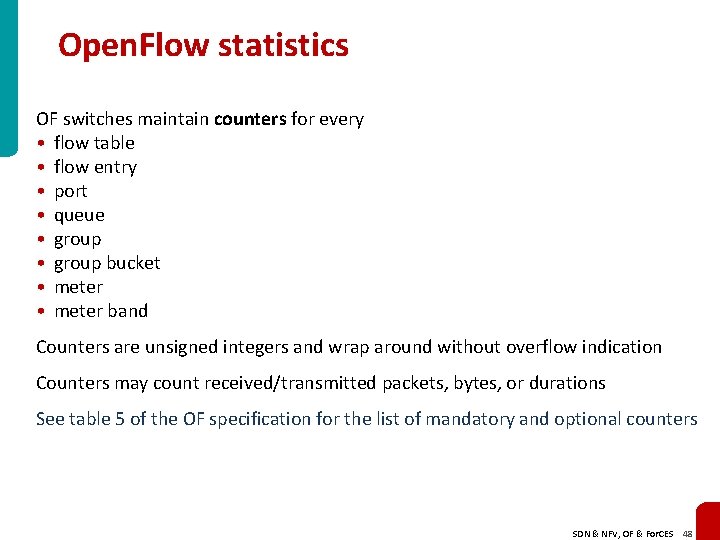
Open. Flow statistics OF switches maintain counters for every • flow table • flow entry • port • queue • group bucket • meter band Counters are unsigned integers and wrap around without overflow indication Counters may count received/transmitted packets, bytes, or durations See table 5 of the OF specification for the list of mandatory and optional counters SDN & NFV, OF & For. CES 48
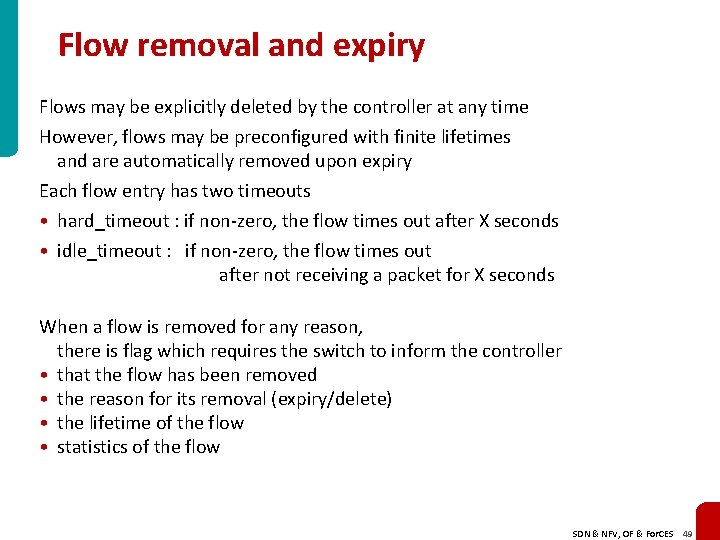
Flow removal and expiry Flows may be explicitly deleted by the controller at any time However, flows may be preconfigured with finite lifetimes and are automatically removed upon expiry Each flow entry has two timeouts • hard_timeout : if non-zero, the flow times out after X seconds • idle_timeout : if non-zero, the flow times out after not receiving a packet for X seconds When a flow is removed for any reason, there is flag which requires the switch to inform the controller • that the flow has been removed • the reason for its removal (expiry/delete) • the lifetime of the flow • statistics of the flow SDN & NFV, OF & For. CES 49
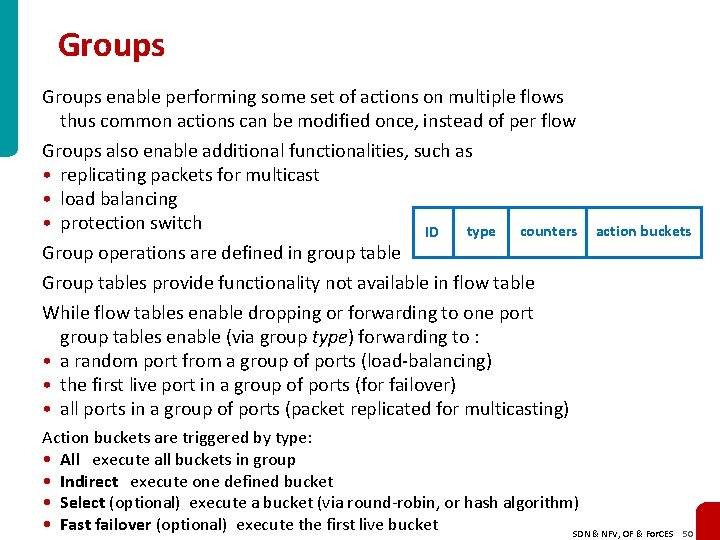
Groups enable performing some set of actions on multiple flows thus common actions can be modified once, instead of per flow Groups also enable additional functionalities, such as • replicating packets for multicast • load balancing • protection switch type counters ID Group operations are defined in group table Group tables provide functionality not available in flow table While flow tables enable dropping or forwarding to one port group tables enable (via group type) forwarding to : • a random port from a group of ports (load-balancing) • the first live port in a group of ports (for failover) • all ports in a group of ports (packet replicated for multicasting) action buckets Action buckets are triggered by type: • All execute all buckets in group • Indirect execute one defined bucket • Select (optional) execute a bucket (via round-robin, or hash algorithm) • Fast failover (optional) execute the first live bucket SDN & NFV, OF & For. CES 50
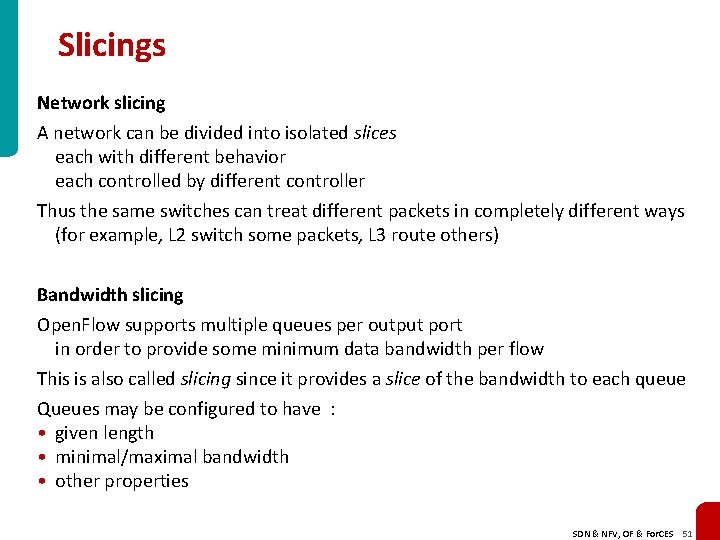
Slicings Network slicing A network can be divided into isolated slices each with different behavior each controlled by different controller Thus the same switches can treat different packets in completely different ways (for example, L 2 switch some packets, L 3 route others) Bandwidth slicing Open. Flow supports multiple queues per output port in order to provide some minimum data bandwidth per flow This is also called slicing since it provides a slice of the bandwidth to each queue Queues may be configured to have : • given length • minimal/maximal bandwidth • other properties SDN & NFV, OF & For. CES 51
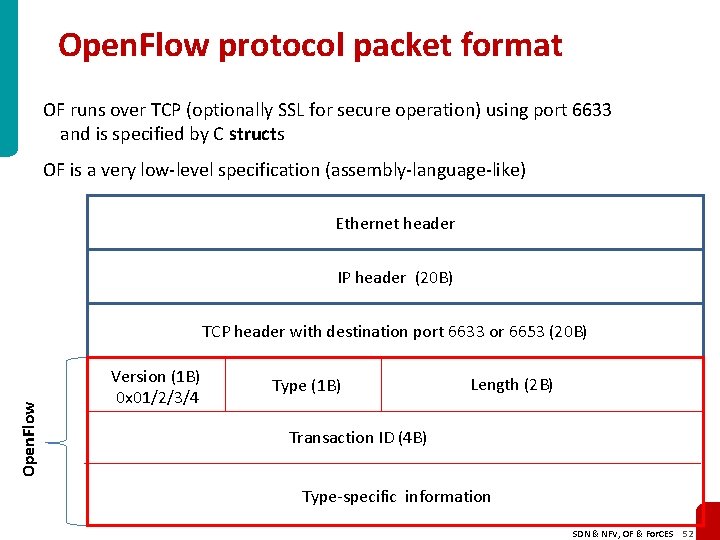
Open. Flow protocol packet format OF runs over TCP (optionally SSL for secure operation) using port 6633 and is specified by C structs OF is a very low-level specification (assembly-language-like) Ethernet header IP header (20 B) Open. Flow TCP header with destination port 6633 or 6653 (20 B) Version (1 B) 0 x 01/2/3/4 Type (1 B) Length (2 B) Transaction ID (4 B) Type-specific information SDN & NFV, OF & For. CES 52
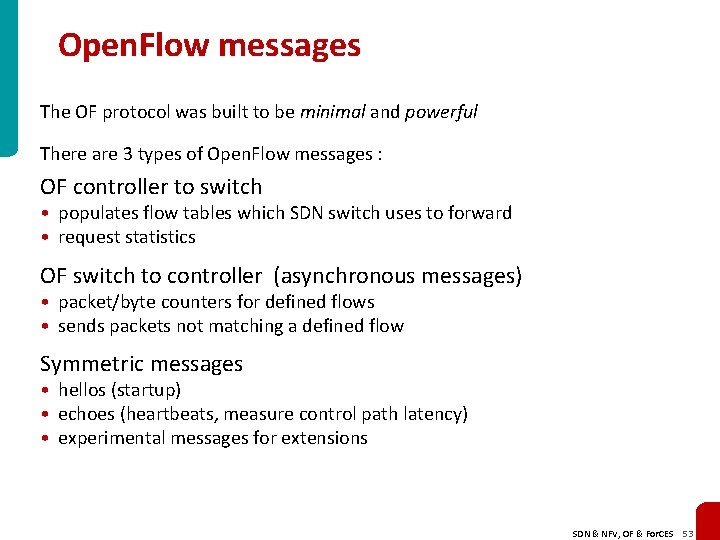
Open. Flow messages The OF protocol was built to be minimal and powerful There are 3 types of Open. Flow messages : OF controller to switch • populates flow tables which SDN switch uses to forward • request statistics OF switch to controller (asynchronous messages) • packet/byte counters for defined flows • sends packets not matching a defined flow Symmetric messages • hellos (startup) • echoes (heartbeats, measure control path latency) • experimental messages for extensions SDN & NFV, OF & For. CES 53
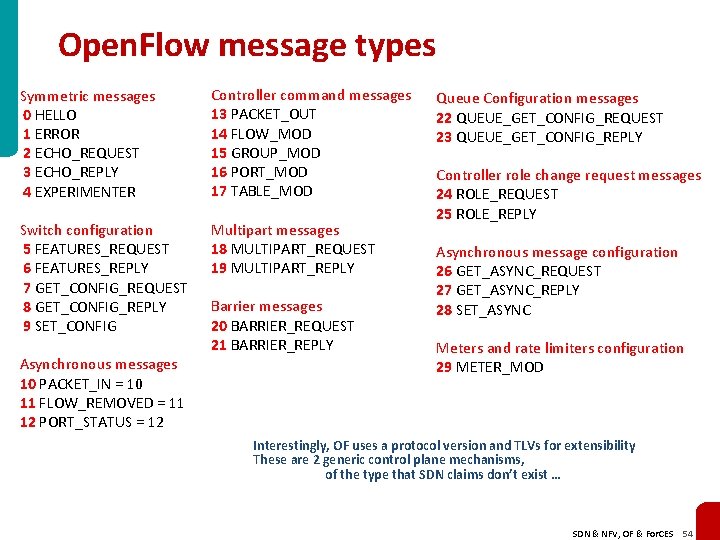
Open. Flow message types Symmetric messages 0 HELLO 1 ERROR 2 ECHO_REQUEST 3 ECHO_REPLY 4 EXPERIMENTER Controller command messages 13 PACKET_OUT 14 FLOW_MOD 15 GROUP_MOD 16 PORT_MOD 17 TABLE_MOD Switch configuration 5 FEATURES_REQUEST 6 FEATURES_REPLY 7 GET_CONFIG_REQUEST 8 GET_CONFIG_REPLY 9 SET_CONFIG Multipart messages 18 MULTIPART_REQUEST 19 MULTIPART_REPLY Asynchronous messages 10 PACKET_IN = 10 11 FLOW_REMOVED = 11 12 PORT_STATUS = 12 Barrier messages 20 BARRIER_REQUEST 21 BARRIER_REPLY Queue Configuration messages 22 QUEUE_GET_CONFIG_REQUEST 23 QUEUE_GET_CONFIG_REPLY Controller role change request messages 24 ROLE_REQUEST 25 ROLE_REPLY Asynchronous message configuration 26 GET_ASYNC_REQUEST 27 GET_ASYNC_REPLY 28 SET_ASYNC Meters and rate limiters configuration 29 METER_MOD Interestingly, OF uses a protocol version and TLVs for extensibility These are 2 generic control plane mechanisms, of the type that SDN claims don’t exist … SDN & NFV, OF & For. CES 54
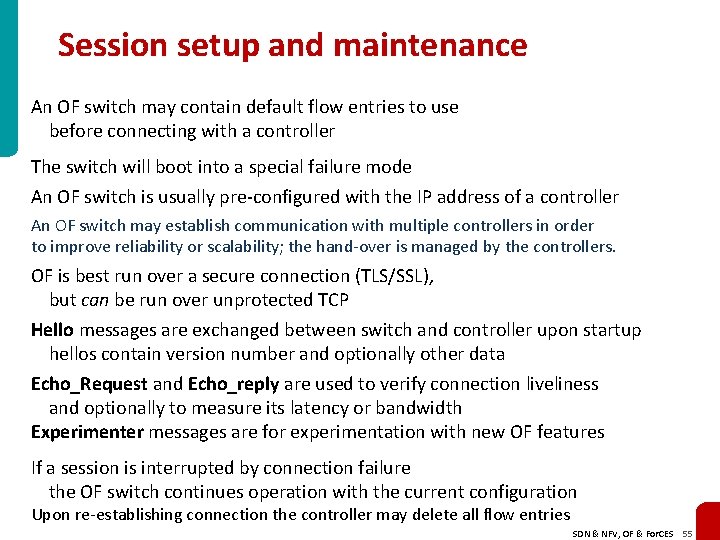
Session setup and maintenance An OF switch may contain default flow entries to use before connecting with a controller The switch will boot into a special failure mode An OF switch is usually pre-configured with the IP address of a controller An OF switch may establish communication with multiple controllers in order to improve reliability or scalability; the hand-over is managed by the controllers. OF is best run over a secure connection (TLS/SSL), but can be run over unprotected TCP Hello messages are exchanged between switch and controller upon startup hellos contain version number and optionally other data Echo_Request and Echo_reply are used to verify connection liveliness and optionally to measure its latency or bandwidth Experimenter messages are for experimentation with new OF features If a session is interrupted by connection failure the OF switch continues operation with the current configuration Upon re-establishing connection the controller may delete all flow entries SDN & NFV, OF & For. CES 55
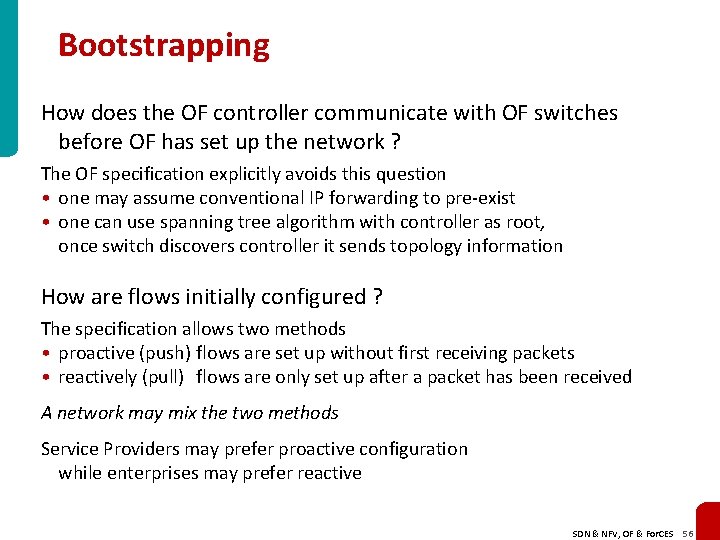
Bootstrapping How does the OF controller communicate with OF switches before OF has set up the network ? The OF specification explicitly avoids this question • one may assume conventional IP forwarding to pre-exist • one can use spanning tree algorithm with controller as root, once switch discovers controller it sends topology information How are flows initially configured ? The specification allows two methods • proactive (push) flows are set up without first receiving packets • reactively (pull) flows are only set up after a packet has been received A network may mix the two methods Service Providers may prefer proactive configuration while enterprises may prefer reactive SDN & NFV, OF & For. CES 56
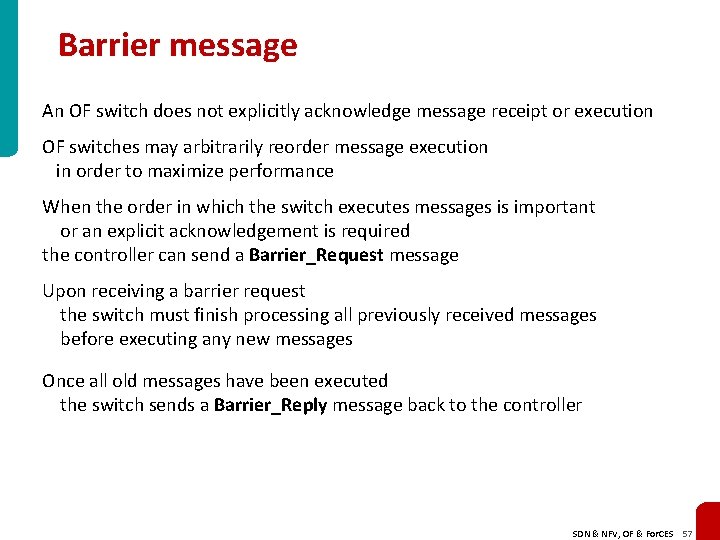
Barrier message An OF switch does not explicitly acknowledge message receipt or execution OF switches may arbitrarily reorder message execution in order to maximize performance When the order in which the switch executes messages is important or an explicit acknowledgement is required the controller can send a Barrier_Request message Upon receiving a barrier request the switch must finish processing all previously received messages before executing any new messages Once all old messages have been executed the switch sends a Barrier_Reply message back to the controller SDN & NFV, OF & For. CES 57
For. CES SDN & NFV, OF & For. CES 58
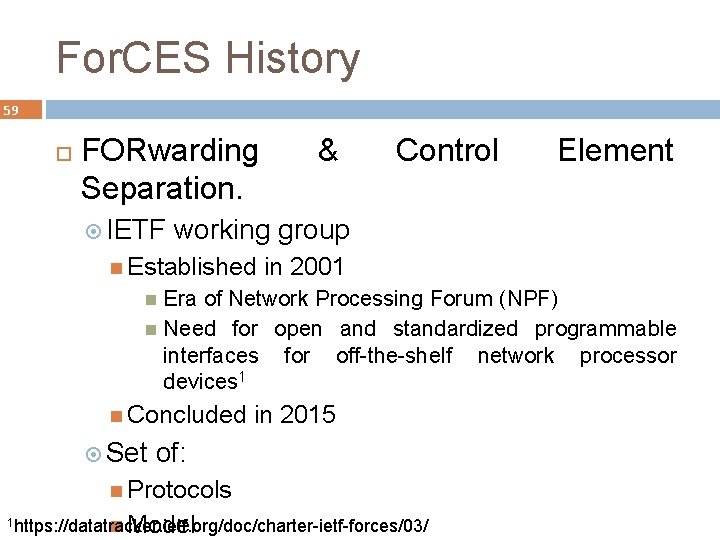
For. CES History 59 FORwarding Separation. IETF & Control Element working group Established in 2001 Era of Network Processing Forum (NPF) Need for open and standardized programmable interfaces for off-the-shelf network processor devices 1 Concluded Set in 2015 of: Protocols Model 1 https: //datatracker. ietf. org/doc/charter-ietf-forces/03/
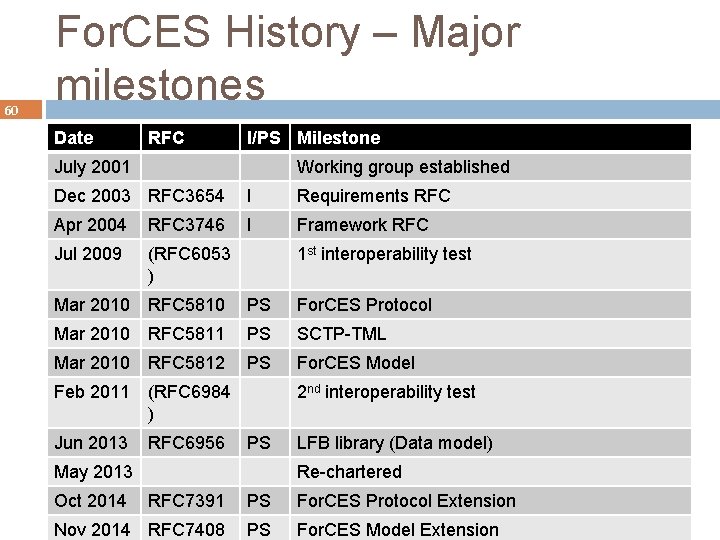
60 For. CES History – Major milestones Date RFC I/PS Milestone July 2001 Working group established Dec 2003 RFC 3654 I Requirements RFC Apr 2004 RFC 3746 I Framework RFC Jul 2009 (RFC 6053 ) Mar 2010 RFC 5810 PS For. CES Protocol Mar 2010 RFC 5811 PS SCTP-TML Mar 2010 RFC 5812 PS For. CES Model Feb 2011 (RFC 6984 ) Jun 2013 RFC 6956 1 st interoperability test 2 nd interoperability test PS May 2013 Oct 2014 LFB library (Data model) Re-chartered RFC 7391 PS For. CES Protocol Extension Nov 2014 RFC 7408 PS For. CES Model Extension
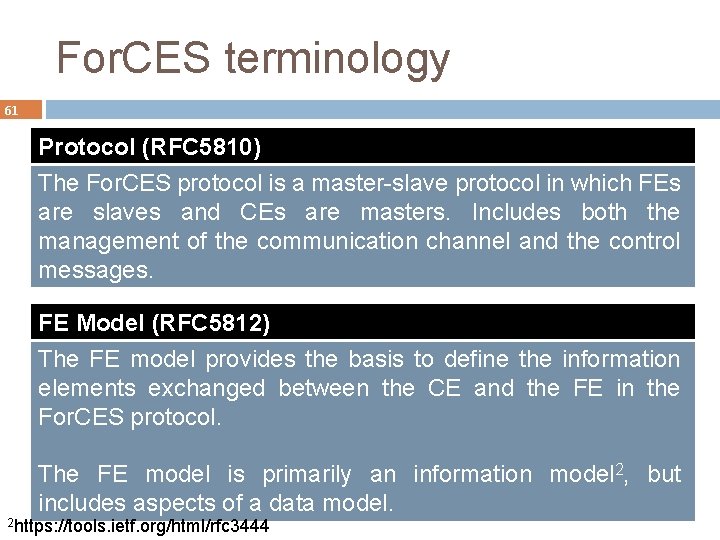
For. CES terminology 61 Protocol (RFC 5810) The For. CES protocol is a master-slave protocol in which FEs are slaves and CEs are masters. Includes both the management of the communication channel and the control messages. FE Model (RFC 5812) The FE model provides the basis to define the information elements exchanged between the CE and the FE in the For. CES protocol. The FE model is primarily an information model 2, but includes aspects of a data model. 2 https: //tools. ietf. org/html/rfc 3444
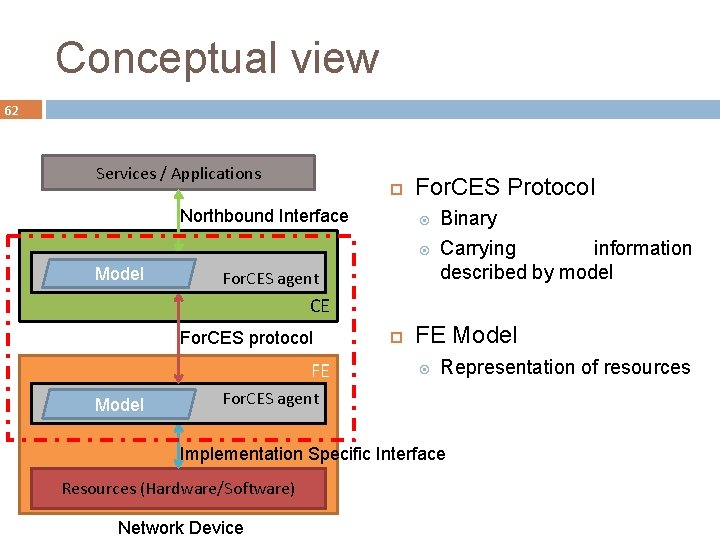
Conceptual view 62 Services / Applications Northbound Interface For. CES Protocol Model For. CES agent Binary Carrying information described by model CE For. CES protocol FE Model Representation of resources For. CES agent Implementation Specific Interface Resources (Hardware/Software) Network Device
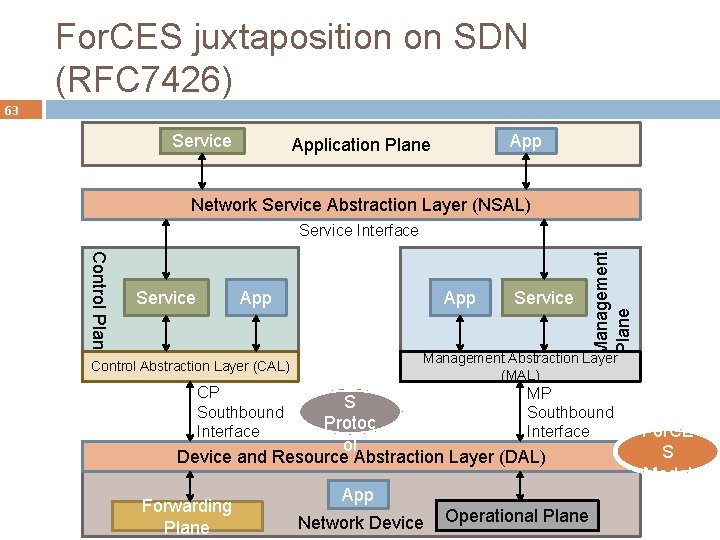
For. CES juxtaposition on SDN (RFC 7426) 63 Service Application Plane Network Service Abstraction Layer (NSAL) Control Plane Service App Service Management Plane . Service Interface Management Abstraction Layer (MAL) Control Abstraction Layer (CAL) For. CE MP S Southbound Protoc Interface ol Device and Resource Abstraction Layer (DAL) CP Southbound Interface Forwarding Plane App Network Device Operational Plane For. CE S Model
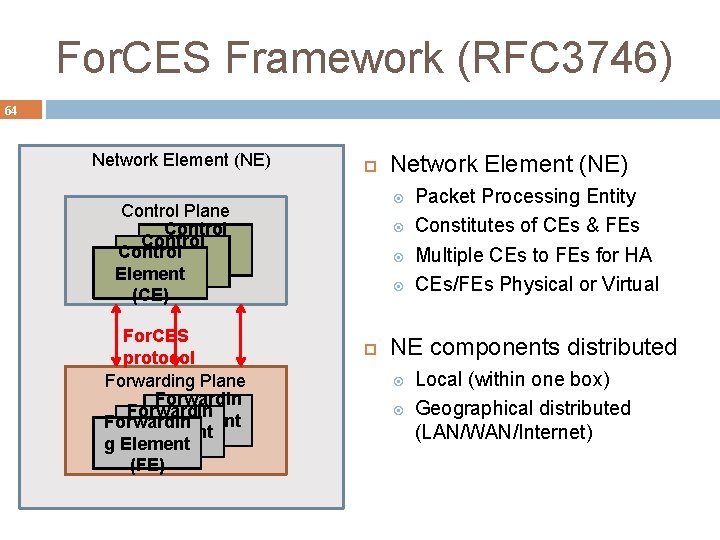
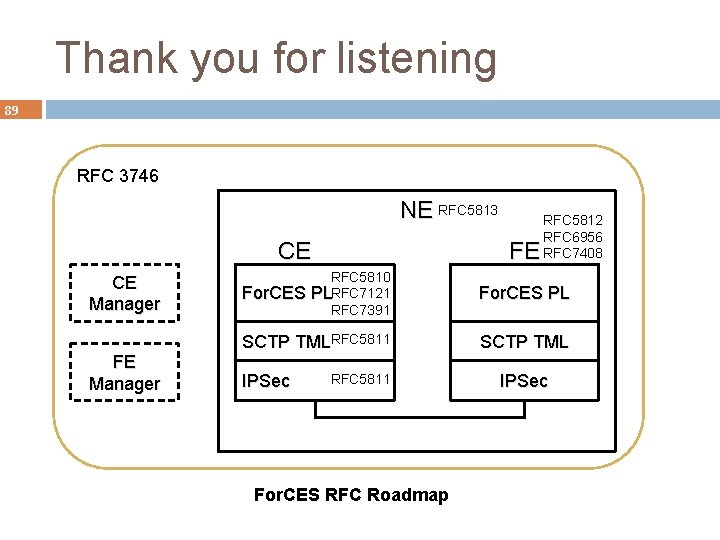
For. CES Framework (RFC 3746) 64 Network Element (NE) Control Plane Control Element(CE) For. CES protocol Forwarding Plane Forwardin g Element (FE) Network Element (NE) Packet Processing Entity Constitutes of CEs & FEs Multiple CEs to FEs for HA CEs/FEs Physical or Virtual NE components distributed Local (within one box) Geographical distributed (LAN/WAN/Internet)
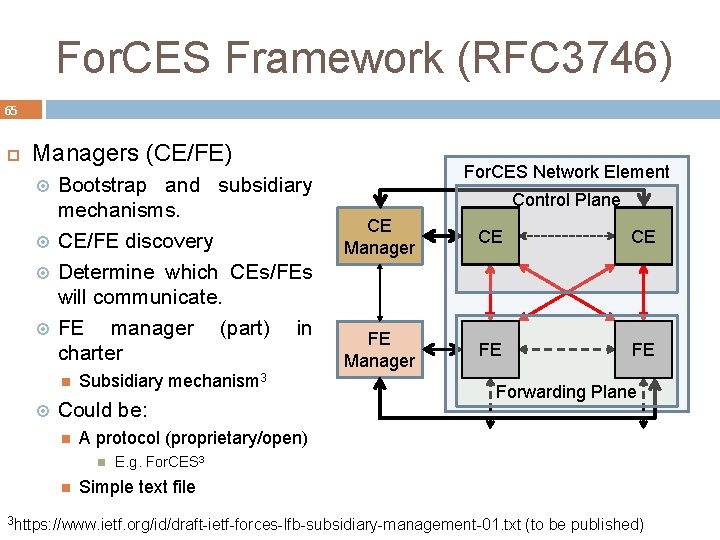
For. CES Framework (RFC 3746) 65 Managers (CE/FE) Bootstrap and subsidiary mechanisms. CE/FE discovery Determine which CEs/FEs will communicate. FE manager (part) in charter Subsidiary mechanism 3 Could be: Control Plane CE Manager CE CE FE Manager FE FE Forwarding Plane A protocol (proprietary/open) For. CES Network Element E. g. For. CES 3 Simple text file 3 https: //www. ietf. org/id/draft-ietf-forces-lfb-subsidiary-management-01. txt (to be published)
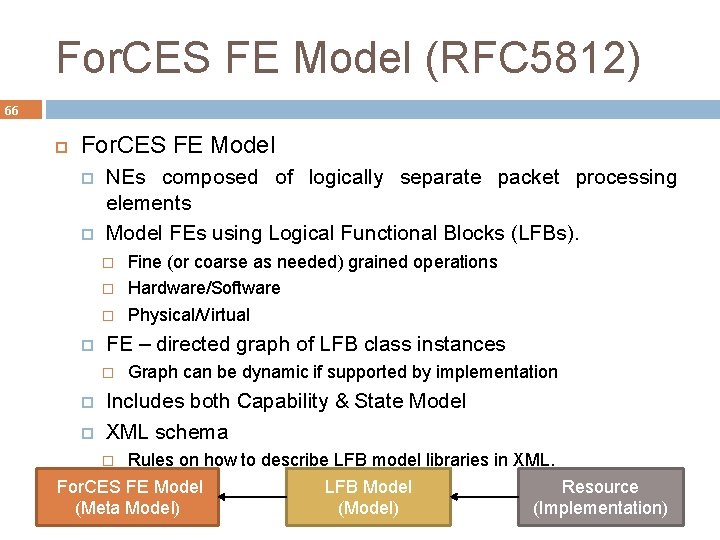
For. CES FE Model (RFC 5812) 66 For. CES FE Model NEs composed of logically separate packet processing elements Model FEs using Logical Functional Blocks (LFBs). FE – directed graph of LFB class instances Fine (or coarse as needed) grained operations Hardware/Software Physical/Virtual Graph can be dynamic if supported by implementation Includes both Capability & State Model XML schema Rules on how to describe LFB model libraries in XML. For. CES FE Model LFB Model Resource (Meta Model) (Implementation)
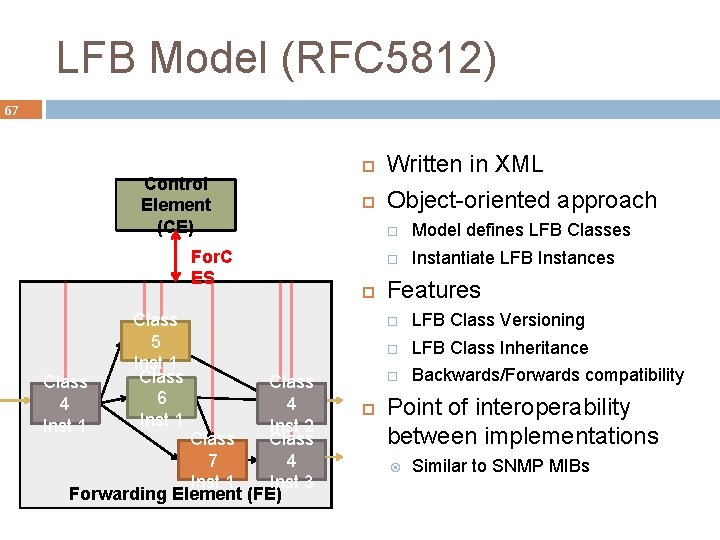
LFB Model (RFC 5812) 67 Control Element (CE) For. C ES Class 4 Inst 1 Class 5 Inst 1 Class 6 Inst 1 Class 4 Inst 2 Class 7 4 Inst 1 Inst 3 Forwarding Element (FE) Written in XML Object-oriented approach Model defines LFB Classes Instantiate LFB Instances Features LFB Class Versioning LFB Class Inheritance Backwards/Forwards compatibility Point of interoperability between implementations Similar to SNMP MIBs
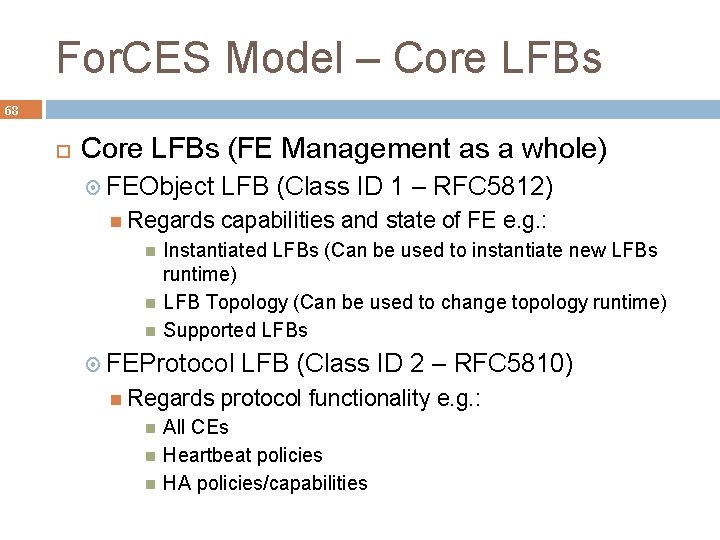
For. CES Model – Core LFBs 68 Core LFBs (FE Management as a whole) FEObject Regards LFB (Class ID 1 – RFC 5812) capabilities and state of FE e. g. : Instantiated LFBs (Can be used to instantiate new LFBs runtime) LFB Topology (Can be used to change topology runtime) Supported LFBs FEProtocol Regards LFB (Class ID 2 – RFC 5810) protocol functionality e. g. : All CEs Heartbeat policies HA policies/capabilities
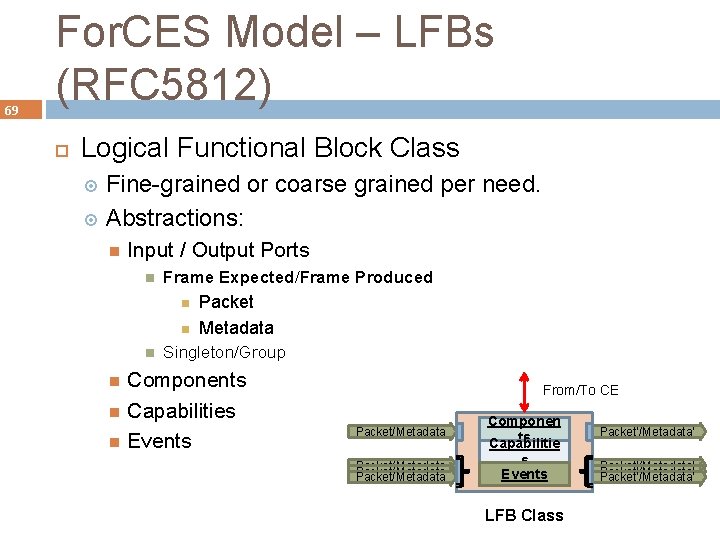
69 For. CES Model – LFBs (RFC 5812) Logical Functional Block Class Fine-grained or coarse grained per need. Abstractions: Input / Output Ports Frame Expected/Frame Produced Packet Metadata Singleton/Group Components Capabilities Events From/To CE Packet/Metadata Componen ts Capabilitie Packet’/Metadata’ Packet/Metadata s Events Packet’/Metadata’ LFB Class
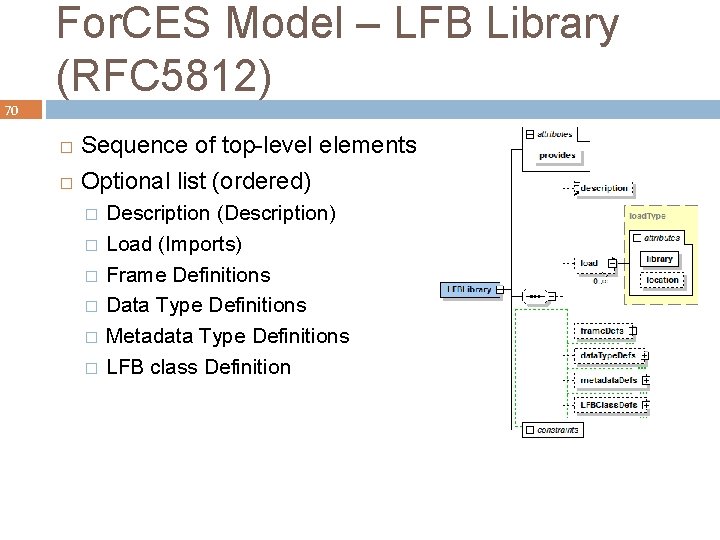
For. CES Model – LFB Library (RFC 5812) 70 Sequence of top-level elements � Optional list (ordered) � � � � Description (Description) Load (Imports) Frame Definitions Data Type Definitions Metadata Type Definitions LFB class Definition
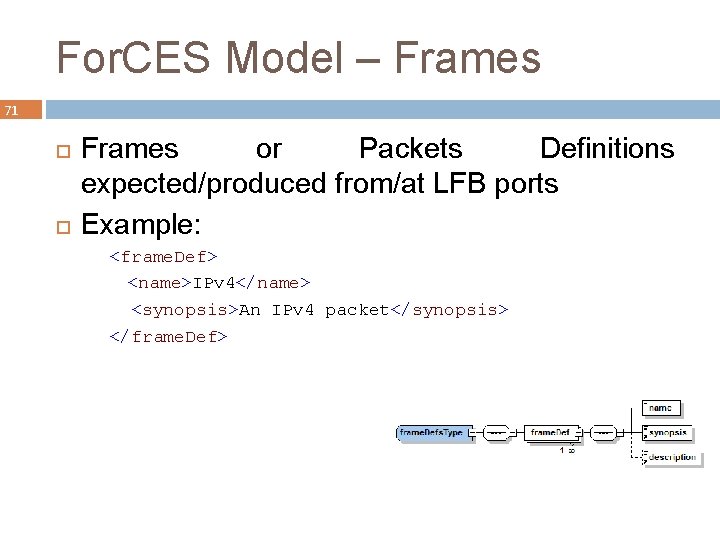
For. CES Model – Frames 71 Frames or Packets Definitions expected/produced from/at LFB ports Example: <frame. Def> <name>IPv 4</name> <synopsis>An IPv 4 packet</synopsis> </frame. Def>
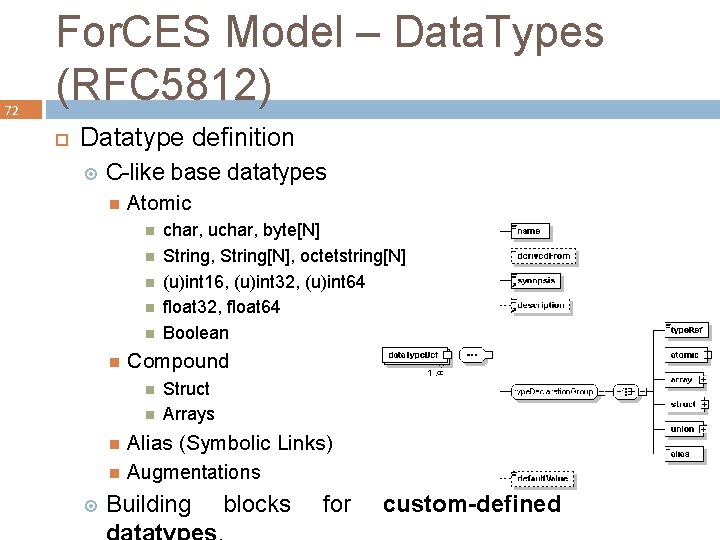
72 For. CES Model – Data. Types (RFC 5812) Datatype definition C-like base datatypes Atomic Compound char, uchar, byte[N] String, String[N], octetstring[N] (u)int 16, (u)int 32, (u)int 64 float 32, float 64 Boolean Struct Arrays Alias (Symbolic Links) Augmentations Building blocks for custom-defined
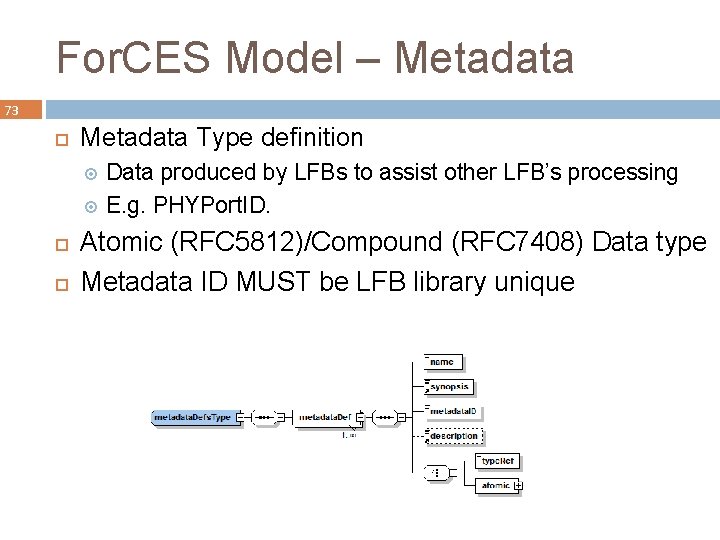
For. CES Model – Metadata 73 Metadata Type definition Data produced by LFBs to assist other LFB’s processing E. g. PHYPort. ID. Atomic (RFC 5812)/Compound (RFC 7408) Data type Metadata ID MUST be LFB library unique
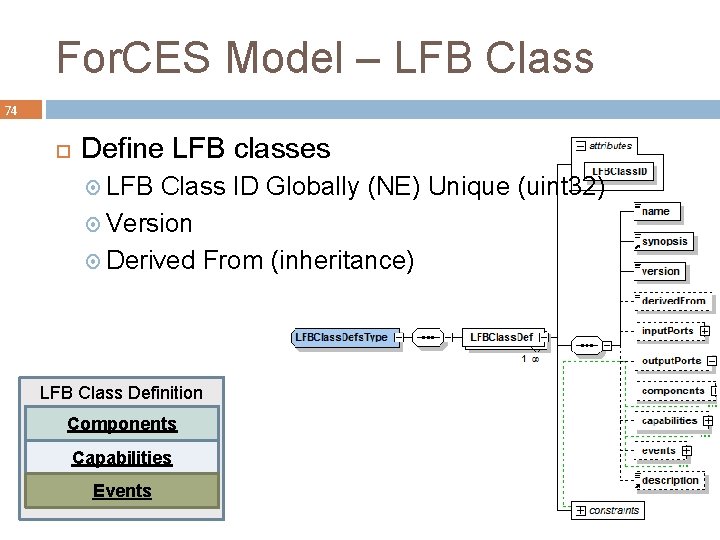
For. CES Model – LFB Class 74 Define LFB classes LFB Class ID Globally (NE) Unique (uint 32) Version Derived From (inheritance) LFB Class Definition Components Capabilities Events
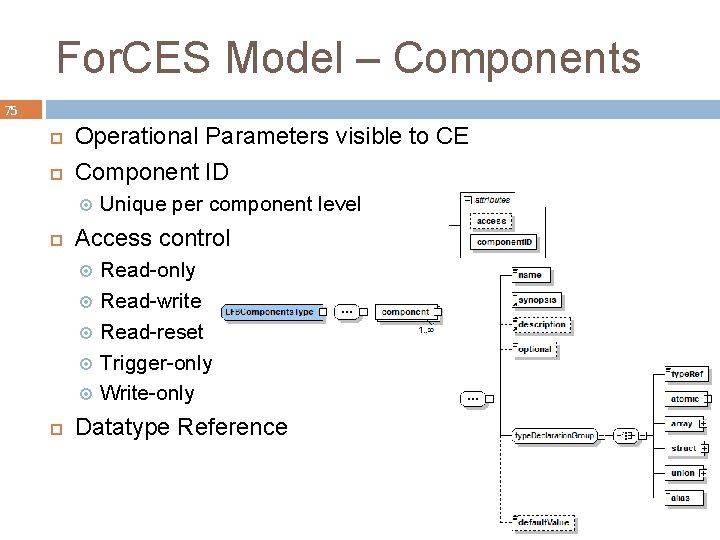
For. CES Model – Components 75 Operational Parameters visible to CE Component ID Access control Unique per component level Read-only Read-write Read-reset Trigger-only Write-only Datatype Reference
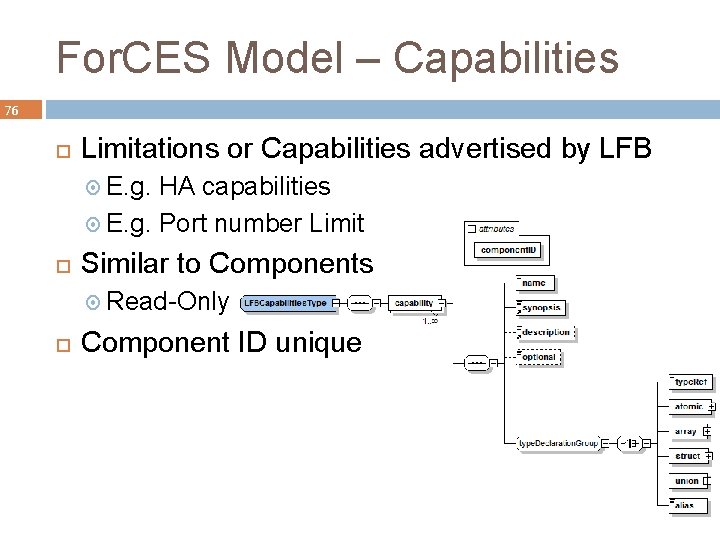
For. CES Model – Capabilities 76 Limitations or Capabilities advertised by LFB E. g. HA capabilities E. g. Port number Limit Similar to Components Read-Only Component ID unique
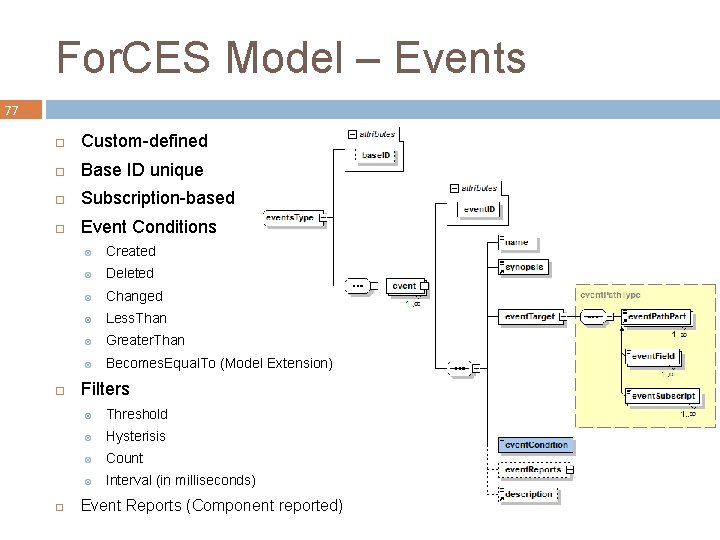
For. CES Model – Events 77 Custom-defined Base ID unique Subscription-based Event Conditions Created Deleted Changed Less. Than Greater. Than Becomes. Equal. To (Model Extension) Filters Threshold Hysterisis Count Interval (in milliseconds) Event Reports (Component reported)
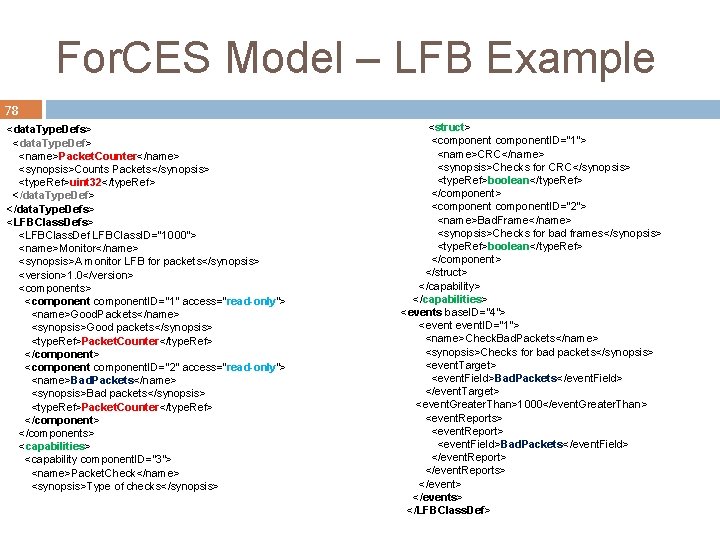
For. CES Model – LFB Example 78 <data. Type. Defs> <data. Type. Def> <name>Packet. Counter</name> <synopsis>Counts Packets</synopsis> <type. Ref>uint 32</type. Ref> </data. Type. Defs> <LFBClass. Def LFBClass. ID="1000"> <name>Monitor</name> <synopsis>A monitor LFB for packets</synopsis> <version>1. 0</version> <components> <component. ID="1" access="read-only"> <name>Good. Packets</name> <synopsis>Good packets</synopsis> <type. Ref>Packet. Counter</type. Ref> </component> <component. ID="2" access="read-only"> <name>Bad. Packets</name> <synopsis>Bad packets</synopsis> <type. Ref>Packet. Counter</type. Ref> </components> <capabilities> <capability component. ID="3"> <name>Packet. Check</name> <synopsis>Type of checks</synopsis> <struct> <component. ID="1"> <name>CRC</name> <synopsis>Checks for CRC</synopsis> <type. Ref>boolean</type. Ref> </component> <component. ID="2"> <name>Bad. Frame</name> <synopsis>Checks for bad frames</synopsis> <type. Ref>boolean</type. Ref> </component> </struct> </capability> </capabilities> <events base. ID=“ 4"> <event. ID="1"> <name>Check. Bad. Packets</name> <synopsis>Checks for bad packets</synopsis> <event. Target> <event. Field>Bad. Packets</event. Field> </event. Target> <event. Greater. Than>1000</event. Greater. Than> <event. Reports> <event. Report> <event. Field>Bad. Packets</event. Field> </event. Reports> </events> </LFBClass. Def>
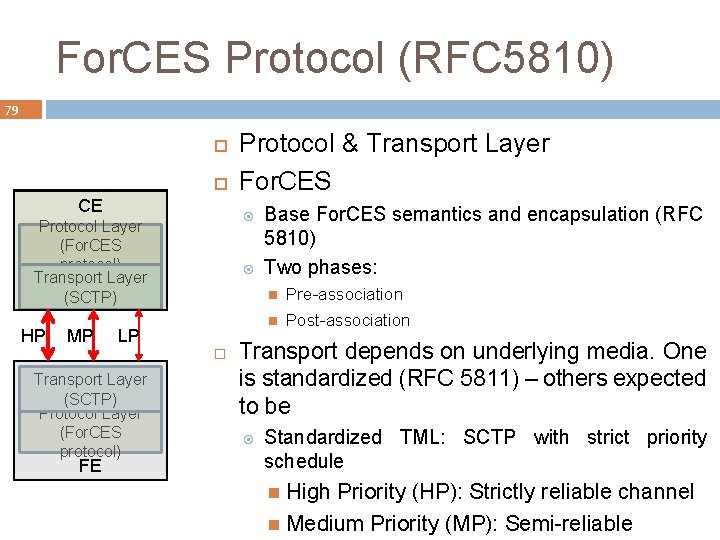
For. CES Protocol (RFC 5810) 79 CE Protocol Layer (For. CES protocol) Transport Layer (SCTP) HP MP FE Base For. CES semantics and encapsulation (RFC 5810) Two phases: LP Transport Layer (SCTP) Protocol Layer (For. CES protocol) Protocol & Transport Layer For. CES Pre-association Post-association Transport depends on underlying media. One is standardized (RFC 5811) – others expected to be Standardized TML: SCTP with strict priority schedule High Priority (HP): Strictly reliable channel Medium Priority (MP): Semi-reliable
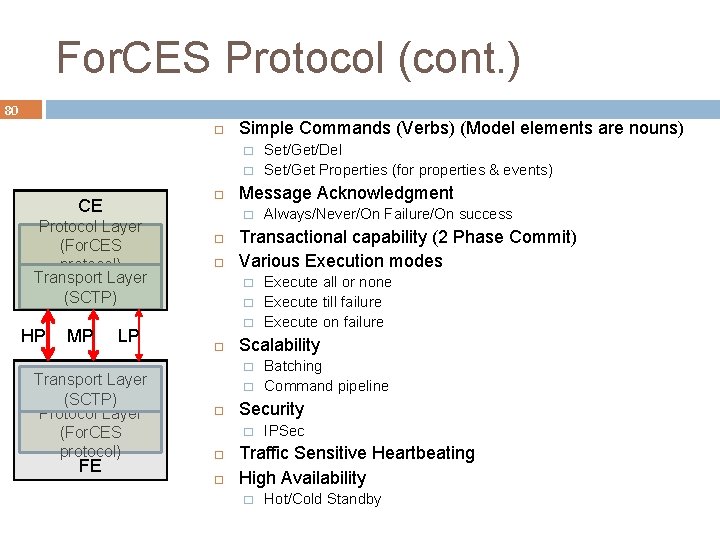
For. CES Protocol (cont. ) 80 Simple Commands (Verbs) (Model elements are nouns) � � CE Protocol Layer (For. CES protocol) Transport Layer (SCTP) HP MP LP Transport Layer (SCTP) Protocol Layer (For. CES protocol) FE Message Acknowledgment � � � � Batching Command pipeline Security � Execute all or none Execute till failure Execute on failure Scalability � Always/Never/On Failure/On success Transactional capability (2 Phase Commit) Various Execution modes � Set/Get/Del Set/Get Properties (for properties & events) IPSec Traffic Sensitive Heartbeating High Availability � Hot/Cold Standby
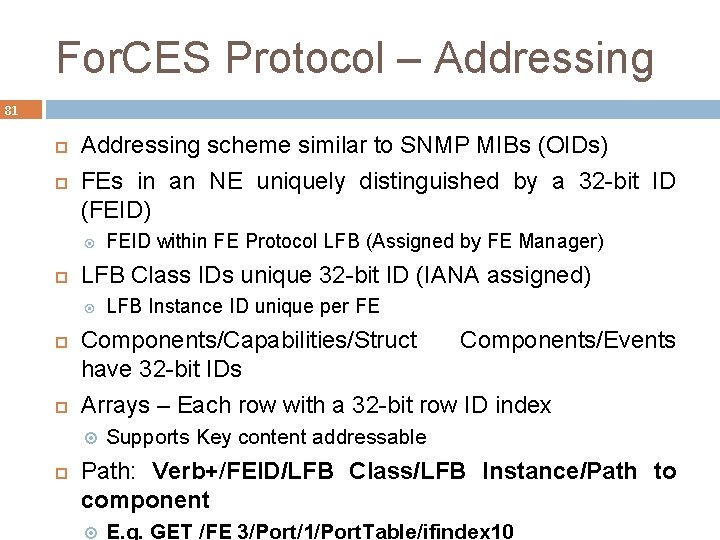
For. CES Protocol – Addressing 81 Addressing scheme similar to SNMP MIBs (OIDs) FEs in an NE uniquely distinguished by a 32 -bit ID (FEID) LFB Class IDs unique 32 -bit ID (IANA assigned) LFB Instance ID unique per FE Components/Capabilities/Struct Components/Events have 32 -bit IDs Arrays – Each row with a 32 -bit row ID index FEID within FE Protocol LFB (Assigned by FE Manager) Supports Key content addressable Path: Verb+/FEID/LFB Class/LFB Instance/Path to component E. g. GET /FE 3/Port/1/Port. Table/ifindex 10
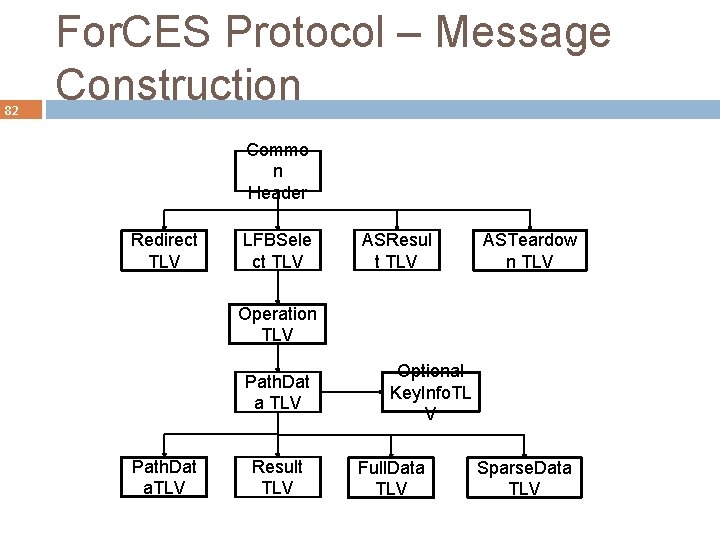
82 For. CES Protocol – Message Construction Commo n Header Redirect TLV LFBSele ct TLV ASResul t TLV ASTeardow n TLV Operation TLV Path. Dat a. TLV Result TLV Optional Key. Info. TL V Full. Data TLV Sparse. Data TLV
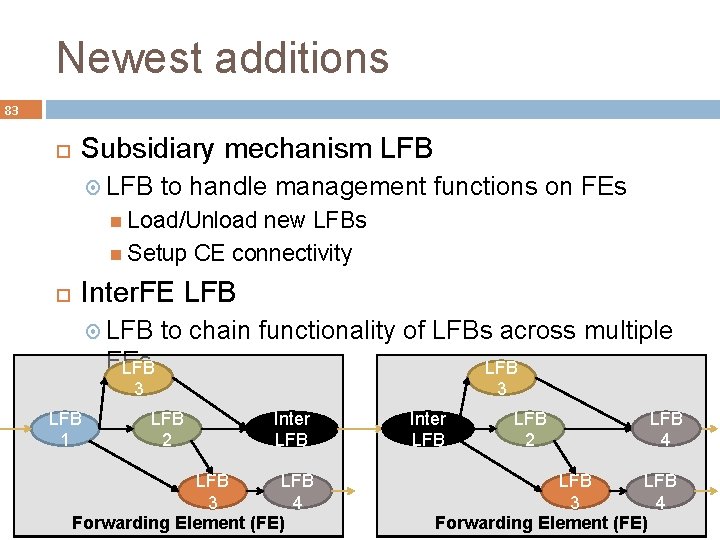
Newest additions 83 Subsidiary mechanism LFB to handle management functions on FEs Load/Unload new LFBs Setup CE connectivity Inter. FE LFB to chain functionality of LFBs across multiple FEs LFB 3 3 LFB 1 LFB 2 Inter LFB LFB 3 4 Forwarding Element (FE) Inter LFB 2 LFB 4 LFB 3 4 Forwarding Element (FE)
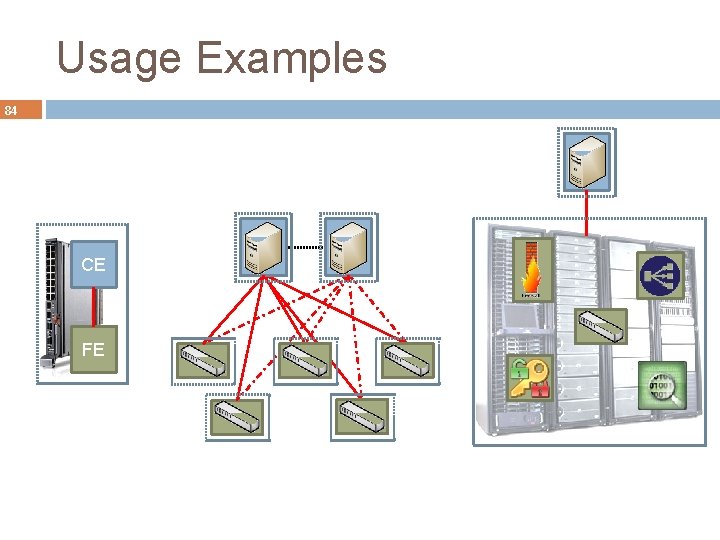
Usage Examples 84 CE FE FE
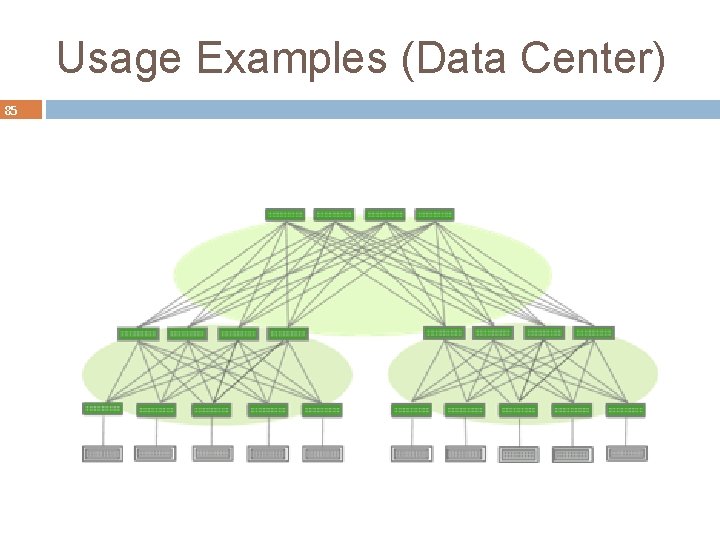
Usage Examples (Data Center) 85
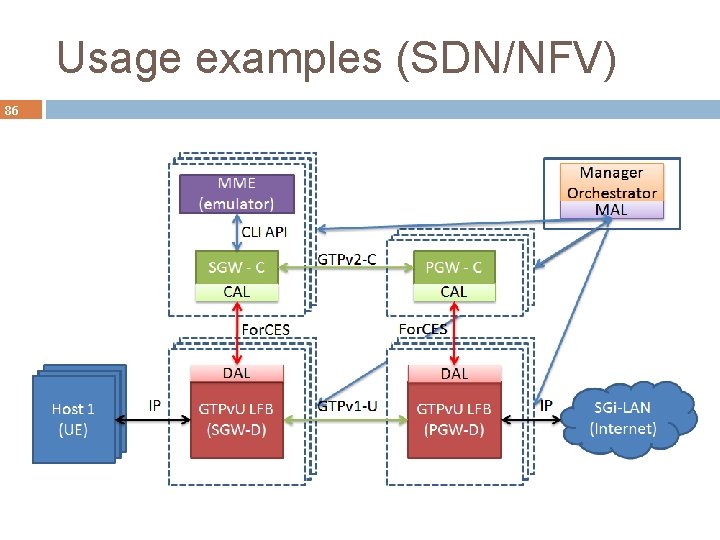
Usage examples (SDN/NFV) 86
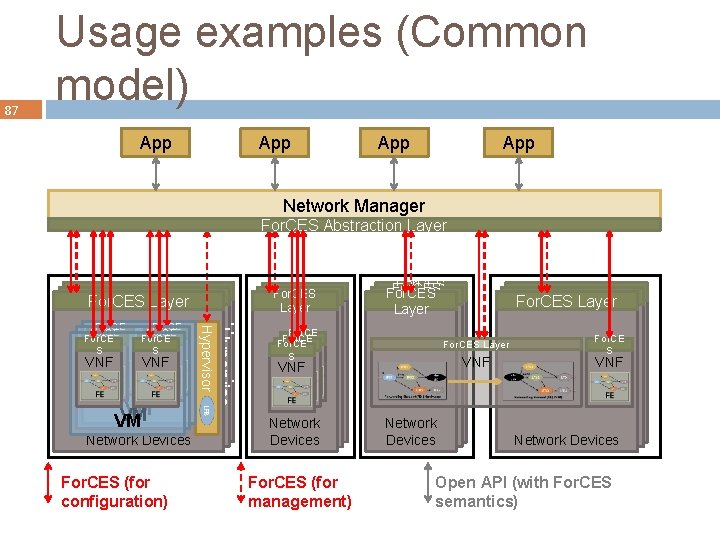
87 Usage examples (Common model) App App Network Manager For. CES Abstraction Layer For. CES Layer VNF VNF VNF VM VM VM Network Devices Network For. CES (for configuration) Hyperviso VNF VNF VNF Hypervisor rr For. CE S S VNF SSVNF S VNF VNF VNF For. CE S VNF VN For. CES Layer For. CES Layer VNFF VNF FF Network Devices For. CES (for management) For. CESLayeryer Layer For. CES Layer VNF Network Devices For. CE S VNF Network. Devices Network Devices Open API (with For. CES semantics)
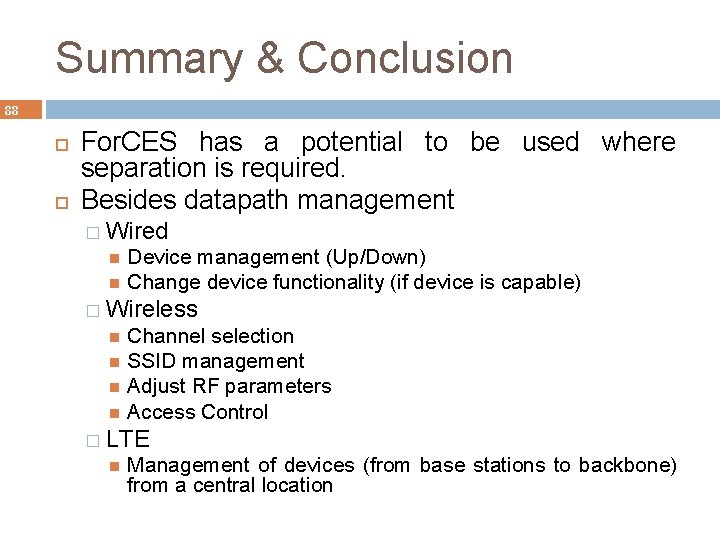
Summary & Conclusion 88 For. CES has a potential to be used where separation is required. Besides datapath management � Wired Device management (Up/Down) Change device functionality (if device is capable) � Wireless Channel selection SSID management Adjust RF parameters Access Control � LTE Management of devices (from base stations to backbone) from a central location
Thank you for listening 89 RFC 3746 NE RFC 5813 CE CE Manager FE RFC 5812 RFC 6956 RFC 7408 RFC 5810 PLRFC 7121 RFC 7391 For. CES PL SCTP TMLRFC 5811 SCTP TML For. CES IPSec RFC 5811 For. CES RFC Roadmap IPSec