
SDLS Satellite Data Link System SYSTEM PRESENTATION ICAO

- Slides: 36
SDLS (Satellite Data Link System) SYSTEM PRESENTATION ICAO ACP Working Group C - Toulouse October 2003 ACP WGC 6/WP 19 Reproduction interdite © Alcatel Espace Reproduction forbidden
PRESENTATION PLAN t PART I - INTRODUCTION & CONTEXT t PART II - SDLS SYSTEM DESIGN PRESENTATION t PART III - PROJECT STATUS AND WAY FORWARD Reproduction interdite © Alcatel Espace Reproduction forbidden
PART I - INTRODUCTION & CONTEXT Reproduction interdite © Alcatel Espace Reproduction forbidden
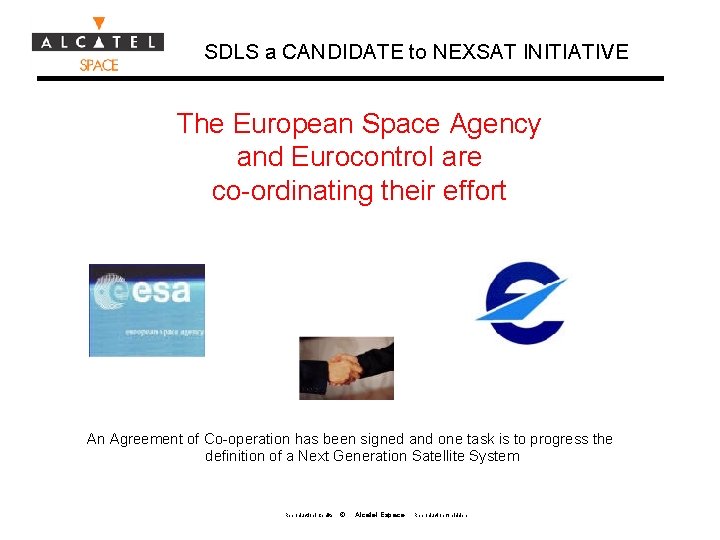
SDLS a CANDIDATE to NEXSAT INITIATIVE The European Space Agency and Eurocontrol are co-ordinating their effort An Agreement of Co-operation has been signed and one task is to progress the definition of a Next Generation Satellite System Reproduction interdite © Alcatel Espace Reproduction forbidden
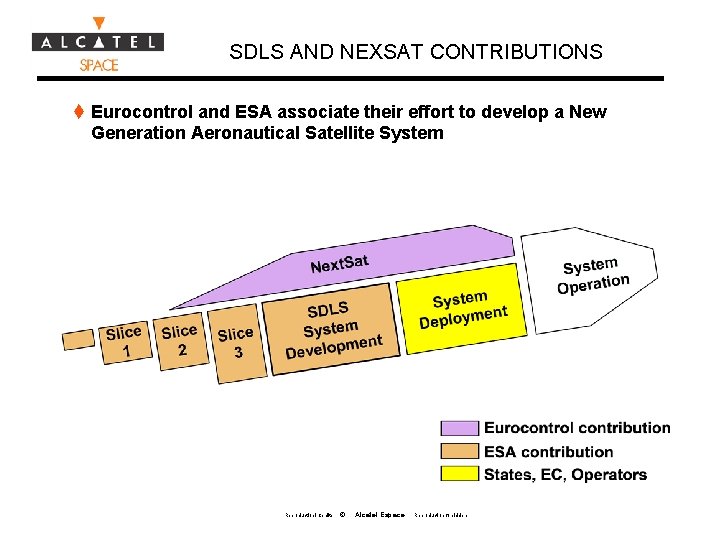
SDLS AND NEXSAT CONTRIBUTIONS t Eurocontrol and ESA associate their effort to develop a New Generation Aeronautical Satellite System Reproduction interdite © Alcatel Espace Reproduction forbidden
SDLS MISSIONS t SDLS Definition SDLS is as a potential Next Generation Aeronautical Communication System t SDLS Missions Ä as specified in Eurocontrol Mission Requirement Document, in line with Nexsat initiative ü Complement the VHF communication system in Europe ü Support datalink applications deployment in dense Airspace Ä World-wide coverage / Regional deployment capabilities ü Supports communications needs on remote and oceanic airspace ü Interoperable / Open architecture Reproduction interdite © Alcatel Espace Reproduction forbidden
SDLS GENERAL CONCEPT t Safety dedicated system (ATS and AOC communication) Ä Operation in protected radio-spectrum band ( L-band AMS(R)S ) Ä Network security through clearly segregated system Ä Controlled network with Guaranteed Performances t Low cost infrastructure and operational cost Ä Light and easy to install terminal ü Omnidirectional antenna ü Mono-Transmission Channel terminal ü Based on up-to-date communication technology Ä Compatible to proven Bent-pipe Geostationary satellites Ä Distributed network implementation capability (reduced ground network infrastructure) Ä Capability for low cost GES implementation (in Ku band) Ä Optimised network architecture (Spectrum efficiency) Reproduction interdite © Alcatel Espace Reproduction forbidden
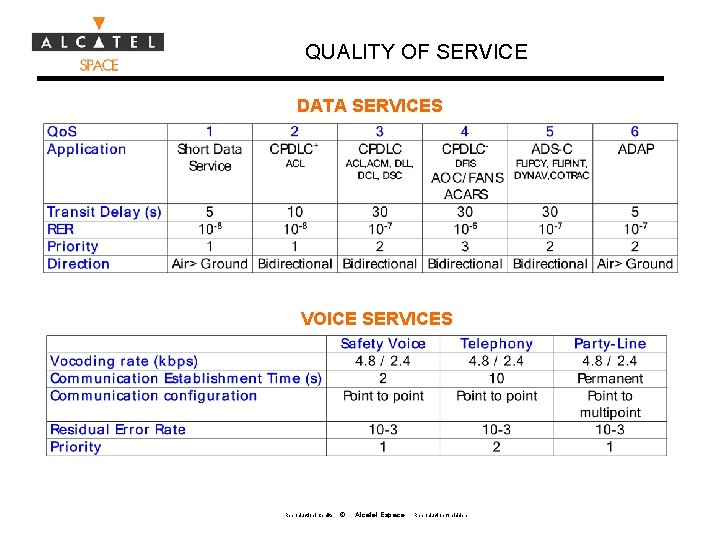
SDLS SERVICES t Services supported : ÄATM services (Services link 2000+) ÄAOC services (including support of ACARS) ÄCritical Short data services ÄVoice services (Point to Point, Party Line) Reproduction interdite © Alcatel Espace Reproduction forbidden
QUALITY OF SERVICE DATA SERVICES VOICE SERVICES Reproduction interdite © Alcatel Espace Reproduction forbidden
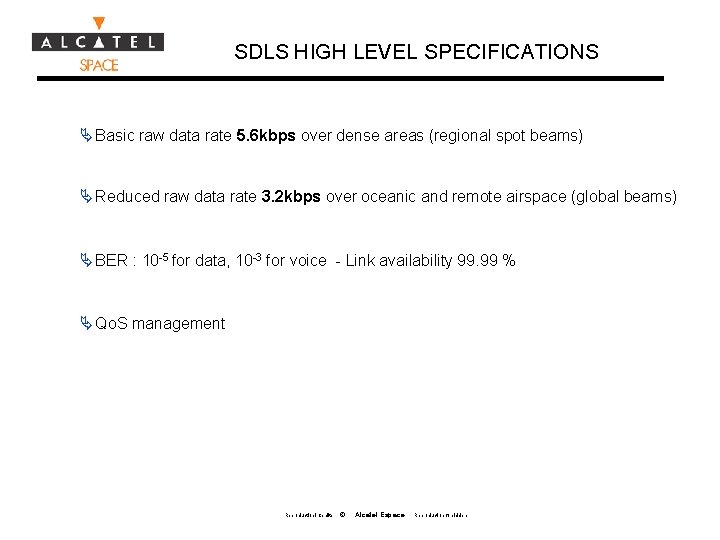
SDLS HIGH LEVEL SPECIFICATIONS Ä Basic raw data rate 5. 6 kbps over dense areas (regional spot beams) Ä Reduced raw data rate 3. 2 kbps over oceanic and remote airspace (global beams) Ä BER : 10 -5 for data, 10 -3 for voice - Link availability 99. 99 % Ä Qo. S management Reproduction interdite © Alcatel Espace Reproduction forbidden
PART II - SDLS DESIGN PRESENTATION Reproduction interdite © Alcatel Espace Reproduction forbidden
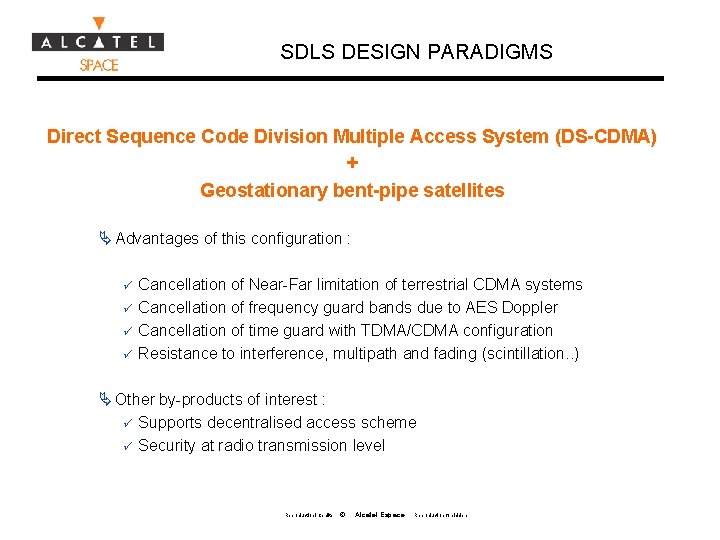
SDLS DESIGN PARADIGMS Direct Sequence Code Division Multiple Access System (DS-CDMA) + Geostationary bent-pipe satellites Ä Advantages of this configuration : ü ü Cancellation of Near-Far limitation of terrestrial CDMA systems Cancellation of frequency guard bands due to AES Doppler Cancellation of time guard with TDMA/CDMA configuration Resistance to interference, multipath and fading (scintillation. . ) Ä Other by-products of interest : ü Supports decentralised access scheme ü Security at radio transmission level Reproduction interdite © Alcatel Espace Reproduction forbidden
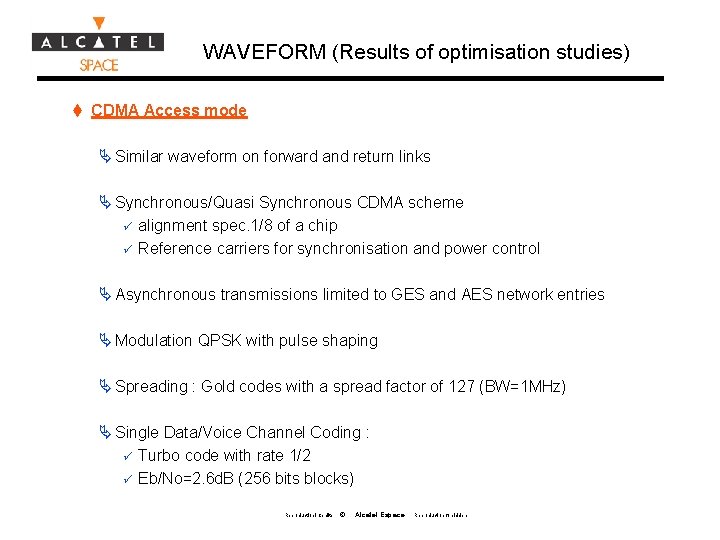
WAVEFORM (Results of optimisation studies) t CDMA Access mode Ä Similar waveform on forward and return links Ä Synchronous/Quasi Synchronous CDMA scheme ü alignment spec. 1/8 of a chip ü Reference carriers for synchronisation and power control Ä Asynchronous transmissions limited to GES and AES network entries Ä Modulation QPSK with pulse shaping Ä Spreading : Gold codes with a spread factor of 127 (BW=1 MHz) Ä Single Data/Voice Channel Coding : ü Turbo code with rate 1/2 ü Eb/No=2. 6 d. B (256 bits blocks) Reproduction interdite © Alcatel Espace Reproduction forbidden
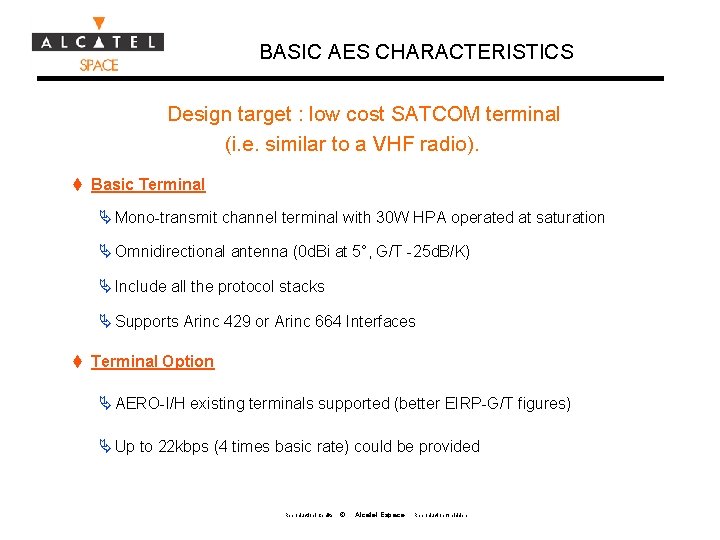
BASIC AES CHARACTERISTICS Design target : low cost SATCOM terminal (i. e. similar to a VHF radio). t Basic Terminal Ä Mono-transmit channel terminal with 30 W HPA operated at saturation Ä Omnidirectional antenna (0 d. Bi at 5°, G/T -25 d. B/K) Ä Include all the protocol stacks Ä Supports Arinc 429 or Arinc 664 Interfaces t Terminal Option Ä AERO-I/H existing terminals supported (better EIRP-G/T figures) Ä Up to 22 kbps (4 times basic rate) could be provided Reproduction interdite © Alcatel Espace Reproduction forbidden
Current LINK BUDGET - MOBILE LINK Reproduction interdite © Alcatel Espace Reproduction forbidden
Possible Data Rate Improvement on future platforms Reproduction interdite © Alcatel Espace Reproduction forbidden
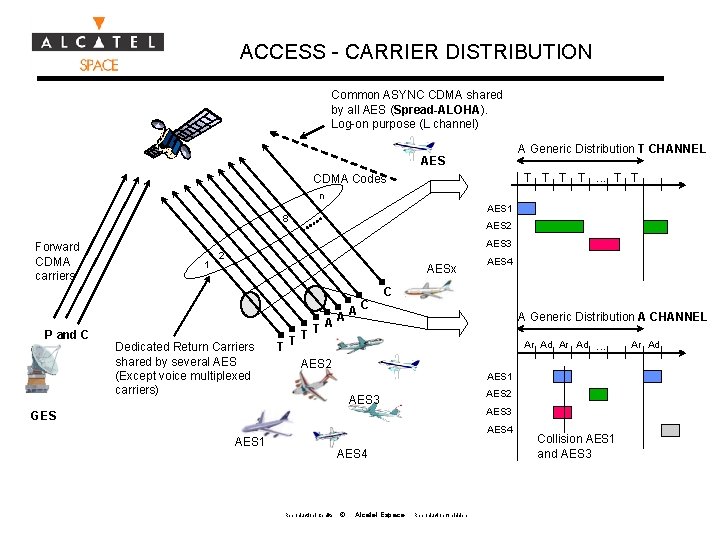
ACCESS - CARRIER DISTRIBUTION Common ASYNC CDMA shared by all AES (Spread-ALOHA). Log-on purpose (L channel) A Generic Distribution T CHANNEL AES T T T CDMA Codes T. . . T T n AES 1 8 Forward CDMA carriers P and C AES 2 AES 3 1 2 AESx Dedicated Return Carriers shared by several AES (Except voice multiplexed carriers) AA T T TT AES 2 AC AES 4 C A Generic Distribution A CHANNEL Ar Ad AES 1 AES 2 AES 3 GES AES 4 AES 1 AES 4 Reproduction interdite © . . . Alcatel Espace Reproduction forbidden Collision AES 1 and AES 3 Ar Ad
ACCESS - CARRIER DEFINITION Typical payloads / bursts P, T, C : 150 bytes (Long Block Data Unit) A : Ar : 32 bytes (Short Block Data Unit) Ad : 8 bytes (Super Short Block Data Unit) Reproduction interdite © Alcatel Espace Reproduction forbidden
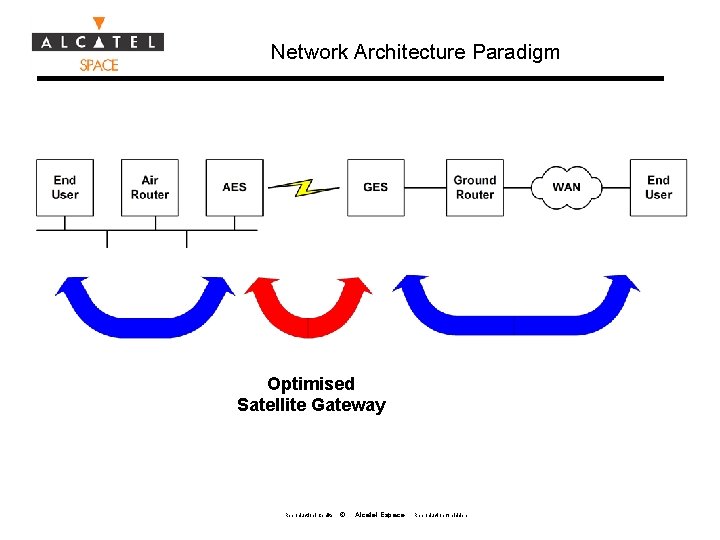
Network Architecture Paradigm Optimised Satellite Gateway Reproduction interdite © Alcatel Espace Reproduction forbidden
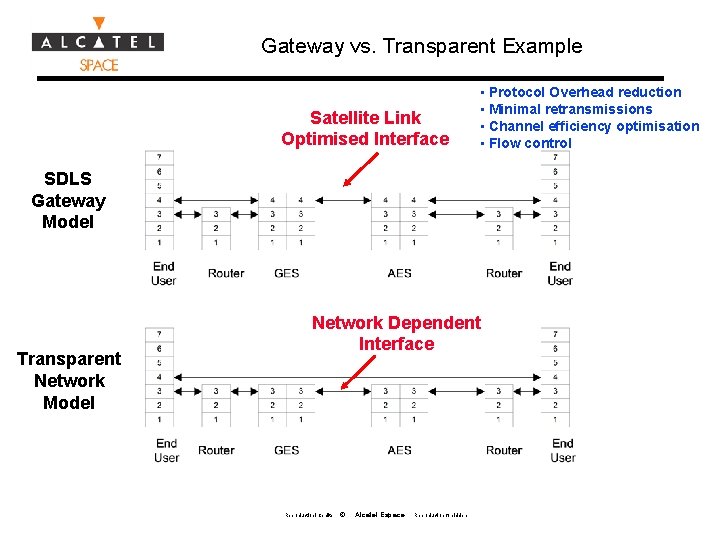
Gateway vs. Transparent Example Satellite Link Optimised Interface • Protocol Overhead reduction • Minimal retransmissions • Channel efficiency optimisation • Flow control SDLS Gateway Model Transparent Network Model Network Dependent Interface Reproduction interdite © Alcatel Espace Reproduction forbidden
Qo. S Management Reproduction interdite © Alcatel Espace Reproduction forbidden
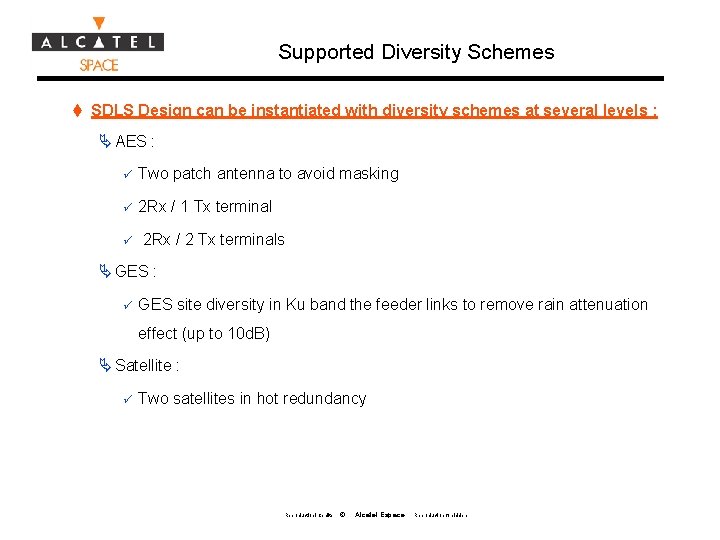
Supported Diversity Schemes t SDLS Design can be instantiated with diversity schemes at several levels : Ä AES : ü Two patch antenna to avoid masking ü 2 Rx / 1 Tx terminal ü 2 Rx / 2 Tx terminals Ä GES : ü GES site diversity in Ku band the feeder links to remove rain attenuation effect (up to 10 d. B) Ä Satellite : ü Two satellites in hot redundancy Reproduction interdite © Alcatel Espace Reproduction forbidden
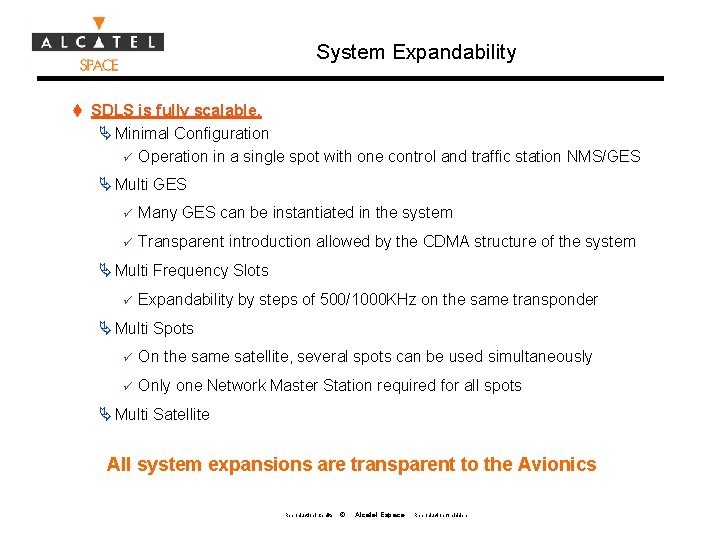
System Expandability t SDLS is fully scalable. Ä Minimal Configuration ü Operation in a single spot with one control and traffic station NMS/GES Ä Multi GES ü Many GES can be instantiated in the system ü Transparent introduction allowed by the CDMA structure of the system Ä Multi Frequency Slots ü Expandability by steps of 500/1000 KHz on the same transponder Ä Multi Spots ü On the same satellite, several spots can be used simultaneously ü Only one Network Master Station required for all spots Ä Multi Satellite All system expansions are transparent to the Avionics Reproduction interdite © Alcatel Espace Reproduction forbidden
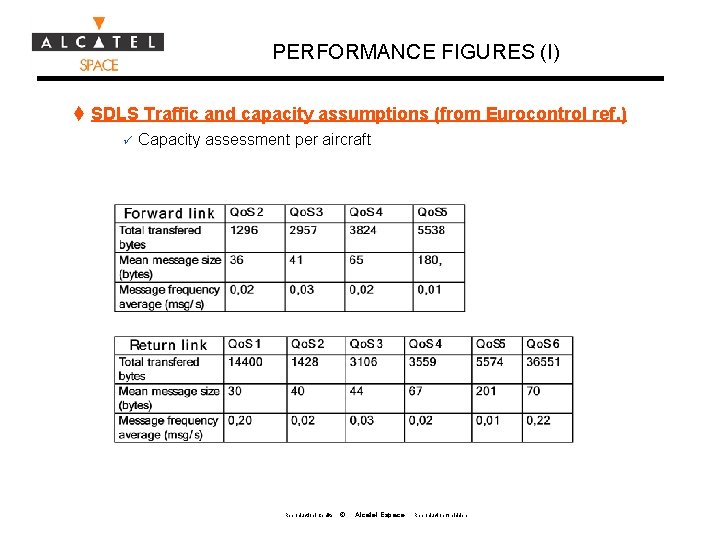
PERFORMANCE FIGURES (I) t SDLS Traffic and capacity assumptions (from Eurocontrol ref. ) ü Capacity assessment per aircraft Reproduction interdite © Alcatel Espace Reproduction forbidden
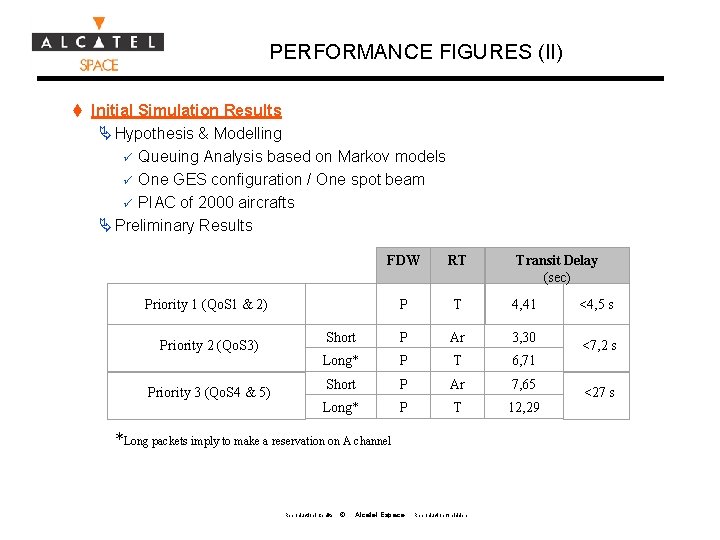
PERFORMANCE FIGURES (II) t Initial Simulation Results Ä Hypothesis & Modelling ü Queuing Analysis based on Markov models ü One GES configuration / One spot beam ü PIAC of 2000 aircrafts Ä Preliminary Results FDW RT P T 4, 41 Short P Ar 3, 30 Long* P T 6, 71 Short P Ar 7, 65 Long* P T 12, 29 Priority 1 (Qo. S 1 & 2) Priority 2 (Qo. S 3) Priority 3 (Qo. S 4 & 5) *Long packets imply to make a reservation on A channel Reproduction interdite © Alcatel Espace Reproduction forbidden Transit Delay (sec) <4, 5 s <7, 2 s <27 s
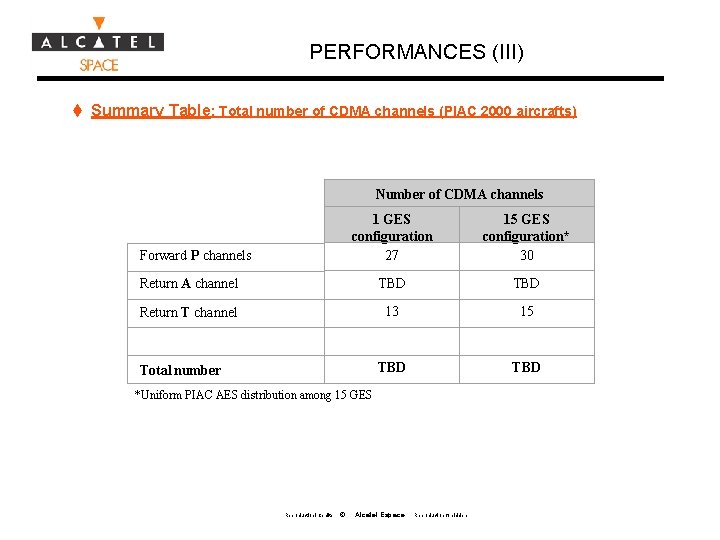
PERFORMANCES (III) t Summary Table: Total number of CDMA channels (PIAC 2000 aircrafts) Number of CDMA channels 1 GES configuration 27 15 GES configuration* 30 Return A channel TBD Return T channel 13 15 TBD Forward P channels Total number *Uniform PIAC AES distribution among 15 GES Reproduction interdite © Alcatel Espace Reproduction forbidden
COST FIGURES (I) SDLS Service Unit Costs: Results for Data Cost Hypothesis : Space capacity lease from 1 to 2 M€/year/MHz/39 d. BW Reproduction interdite © Alcatel Espace Reproduction forbidden
COST FIGURES (II) SDLS Service Unit Costs: Results for voice Cost Hypothesis : Space capacity lease from 1 to 2 M€/year/MHz/39 d. BW Reproduction interdite © Alcatel Espace Reproduction forbidden
PART III - PROJECT STATUS Reproduction interdite © Alcatel Espace Reproduction forbidden
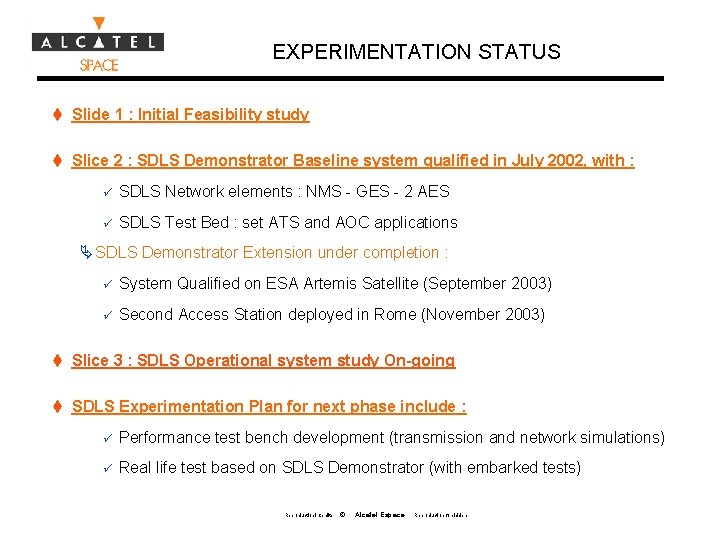
EXPERIMENTATION STATUS t Slide 1 : Initial Feasibility study t Slice 2 : SDLS Demonstrator Baseline system qualified in July 2002, with : ü SDLS Network elements : NMS - GES - 2 AES ü SDLS Test Bed : set ATS and AOC applications Ä SDLS Demonstrator Extension under completion : ü System Qualified on ESA Artemis Satellite (September 2003) ü Second Access Station deployed in Rome (November 2003) t Slice 3 : SDLS Operational system study On-going t SDLS Experimentation Plan for next phase include : ü Performance test bench development (transmission and network simulations) ü Real life test based on SDLS Demonstrator (with embarked tests) Reproduction interdite © Alcatel Espace Reproduction forbidden
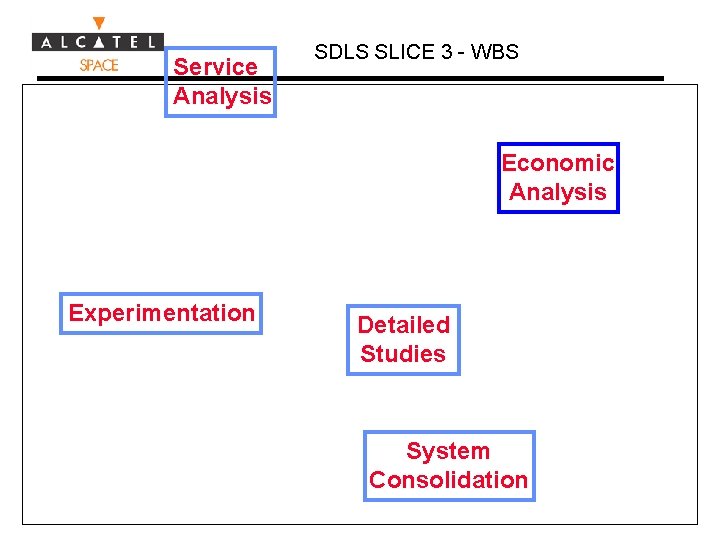
Service Analysis SDLS SLICE 3 - WBS Economic Analysis Experimentation Detailed Studies System Consolidation Reproduction interdite © Alcatel Espace Reproduction forbidden
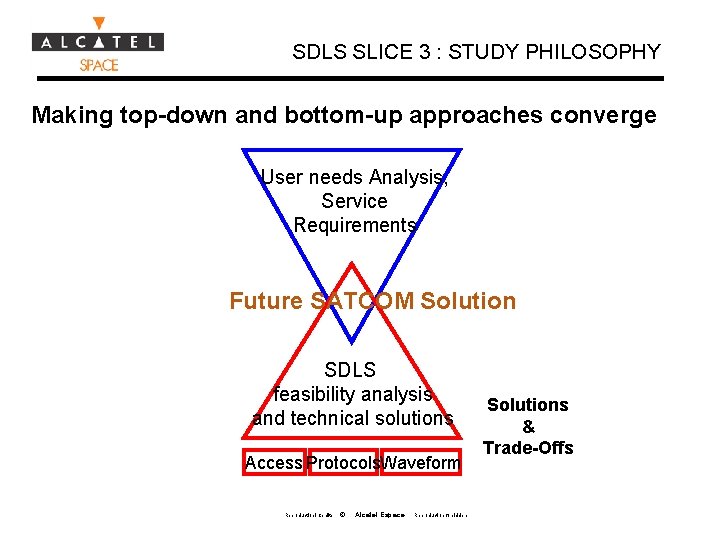
SDLS SLICE 3 : STUDY PHILOSOPHY Making top-down and bottom-up approaches converge User needs Analysis, Service Requirements Future SATCOM Solution SDLS feasibility analysis and technical solutions Access Protocols. Waveform Reproduction interdite © Alcatel Espace Reproduction forbidden Solutions & Trade-Offs
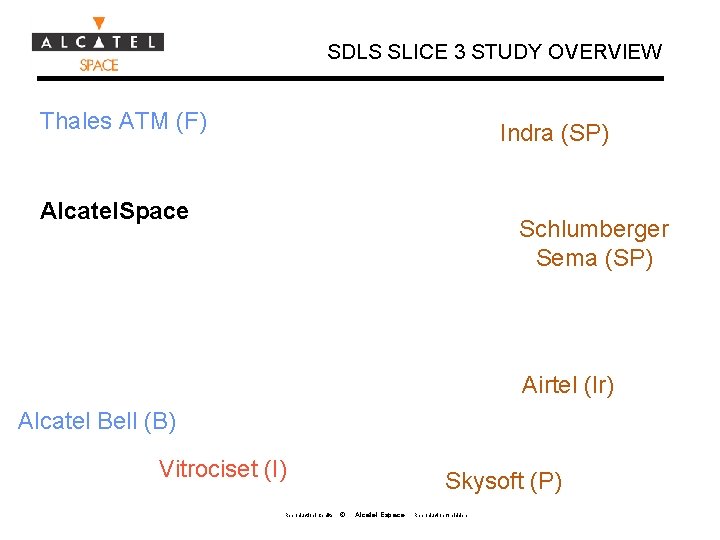
SDLS SLICE 3 STUDY OVERVIEW Thales ATM (F) Indra (SP) Alcatel. Space Schlumberger Sema (SP) Airtel (Ir) Alcatel Bell (B) Vitrociset (I) Reproduction interdite Skysoft (P) © Alcatel Espace Reproduction forbidden
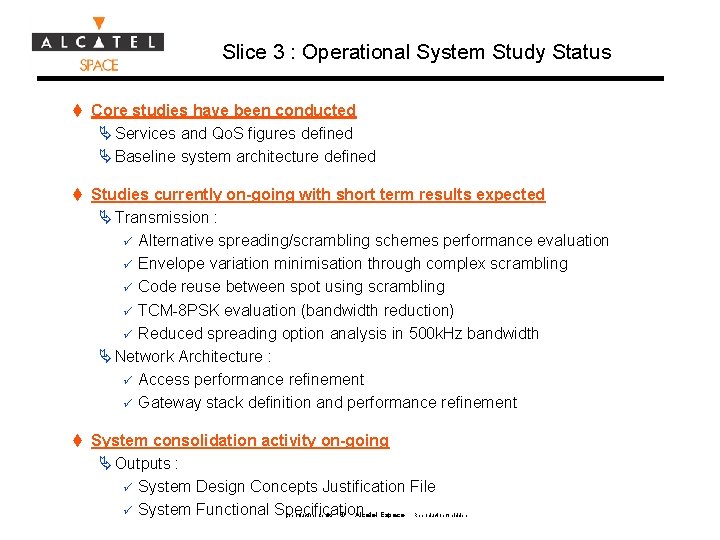
Slice 3 : Operational System Study Status t Core studies have been conducted Ä Services and Qo. S figures defined Ä Baseline system architecture defined t Studies currently on-going with short term results expected Ä Transmission : ü Alternative spreading/scrambling schemes performance evaluation ü Envelope variation minimisation through complex scrambling ü Code reuse between spot using scrambling ü TCM-8 PSK evaluation (bandwidth reduction) ü Reduced spreading option analysis in 500 k. Hz bandwidth Ä Network Architecture : ü Access performance refinement ü Gateway stack definition and performance refinement t System consolidation activity on-going Ä Outputs : ü System Design Concepts Justification File ü System Functional Specification © Alcatel Espace Reproduction interdite Reproduction forbidden
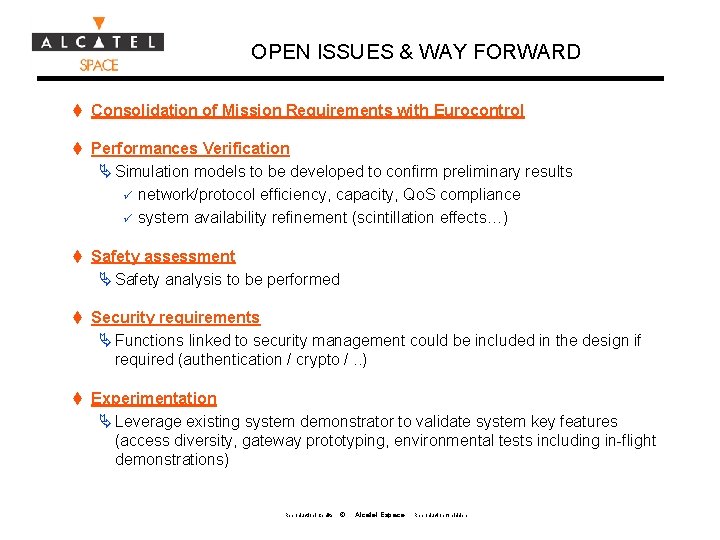
OPEN ISSUES & WAY FORWARD t Consolidation of Mission Requirements with Eurocontrol t Performances Verification Ä Simulation models to be developed to confirm preliminary results ü network/protocol efficiency, capacity, Qo. S compliance ü system availability refinement (scintillation effects…) t Safety assessment Ä Safety analysis to be performed t Security requirements Ä Functions linked to security management could be included in the design if required (authentication / crypto /. . ) t Experimentation Ä Leverage existing system demonstrator to validate system key features (access diversity, gateway prototyping, environmental tests including in-flight demonstrations) Reproduction interdite © Alcatel Espace Reproduction forbidden
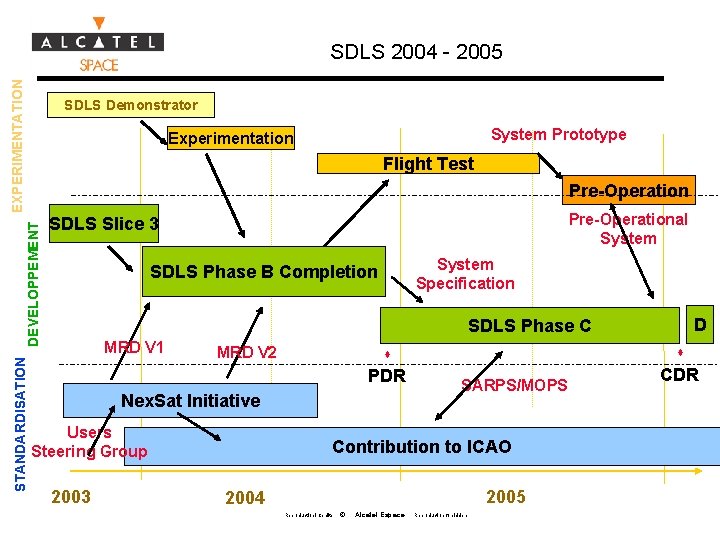
EXPERIMENTATION SDLS 2004 - 2005 SDLS Demonstrator System Prototype Experimentation Flight Test STANDARDISATION DEVELOPPEMENT Pre-Operational System SDLS Slice 3 SDLS Phase B Completion System Specification SDLS Phase C MRD V 1 MRD V 2 s PDR Nex. Sat Initiative Users Steering Group 2003 SARPS/MOPS Contribution to ICAO 2005 2004 Reproduction interdite © Alcatel Espace Reproduction forbidden D s CDR