
SDJS Efficient Statistics in Wireless Networks Albert Krohn

“SDJS: Efficient Statistics in Wireless Networks” Albert Krohn, Michael Beigl, Sabin Wendhack Tec. O (Telecooperation Office) Institut für Telematik Universität Karlsruhe www. teco. edu

SDJS: research and application area § WSN (wireless sensor network) n n Battery powered Low computation capabilities § MANET (mobile ad hoc networks) n n Fast changing environment Devices frequently join and leave a group § BAN (body area network), § PAN (personal area networks) n n Sensors attached to people Many small devices § Ubiquitous and Pervasive Computing n n n Settings with many devices (typically >100) Battery powered Mid computation capabilities Albert Krohn, Michael Beigl, Sabin Wendhack, Tec. O, Universität Karlsruhe

SDJS: Synchronous Distributed Jam Signalling What is SDJS? § Method for ultra fast estimation of a parameter of a group of devices § Novel transmission scheme § Extension of standard wireless ad hoc protocol § Synchronous, parallel, superimposing jam signals § Works infrastructure less § For highly mobile settings with high number of networked devices Example for this talk: “How many devices are present in the cell? ” Albert Krohn, Michael Beigl, Sabin Wendhack, Tec. O, Universität Karlsruhe
Related Work Example: “How many devices are present in the cell? ” § Budianu et al. 2003: n n n Collect IDs from the Devices and do a Good-Turing estimation, can be done iteratively Targeted on large scale networks, not on speed Also probabilistic § Vogt 2002: n n For passive RFID Using a slotted aloha protocol, where tags randomly select a slot Adaptive frame size Time to estimate 200 nodes with 99% reliability > 3 sec. (assuming ISO 18000 RFID standard) § Normal “ping” on 802. 11 b: n Around 5 seconds (best case) for 100 stations Albert Krohn, Michael Beigl, Sabin Wendhack, Tec. O, Universität Karlsruhe

Motivation Idea of SDJS Example: “How many devices are present in the cell? ” §Novel: §Traditional: Ping & HELO, OLEH n. Slow, each node answers n. Packet implosion, collisions n. High bandwidth necessary n“deterministic” n. Generic functionality of data transport in the network n. Same mechanisms for all information flow n Specific solution for collecting data of the same context n. Reduce redundant overhead n. Reduce transported information to necessary minimum n. SDJS: include the physical layer n. Ultra Fast and efficient: typ. 1000 x faster n. Probabilistic, but adjustable accuracy/reliability (trade-off) n Albert Krohn, Michael Beigl, Sabin Wendhack, Tec. O, Universität Karlsruhe
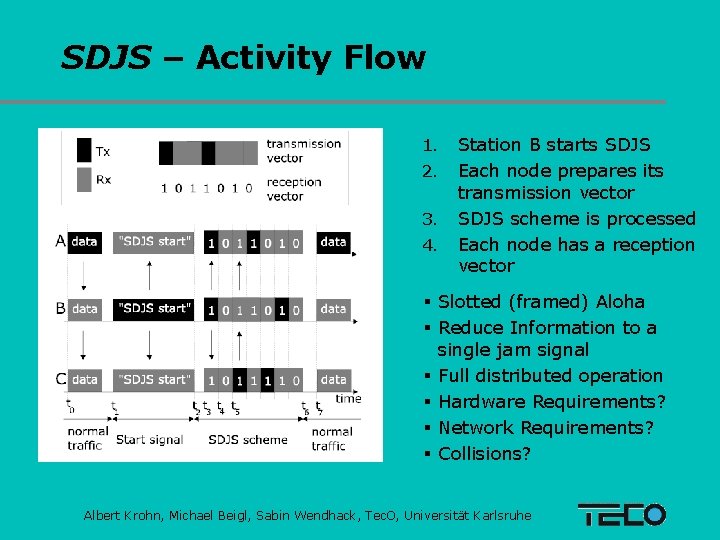
SDJS – Activity Flow 1. 2. 3. 4. Station B starts SDJS Each node prepares its transmission vector SDJS scheme is processed Each node has a reception vector § Slotted (framed) Aloha § Reduce Information to a single jam signal § Full distributed operation § Hardware Requirements? § Network Requirements? § Collisions? Albert Krohn, Michael Beigl, Sabin Wendhack, Tec. O, Universität Karlsruhe

SDJS – The duck hunter problem Example: “How many devices are present in the cell? ” § Estimation of the real number from a given number of signals (the reception vector) § Classical “Duck Hunter Problem” § Solution: surjective mapping, partition theory How many hunters were there? Group of hunters Albert Krohn, Michael Beigl, Sabin Wendhack, Tec. O, Universität Karlsruhe
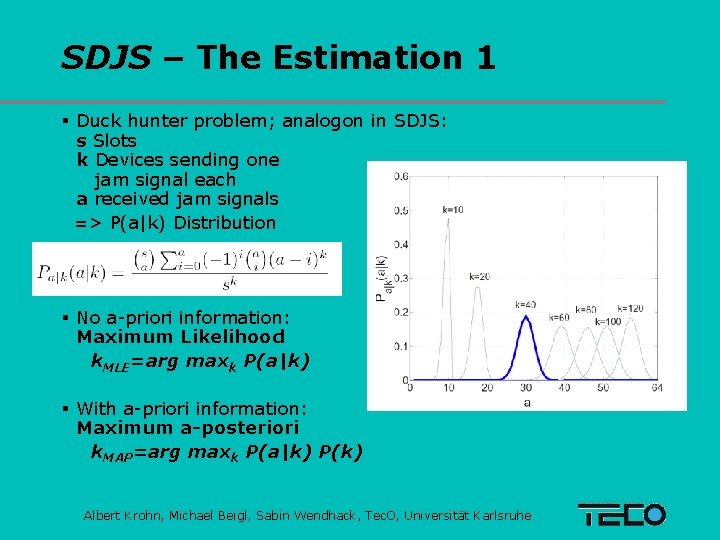
SDJS – The Estimation 1 § Duck hunter problem; analogon in SDJS: s Slots k Devices sending one jam signal each a received jam signals => P(a|k) Distribution § No a-priori information: Maximum Likelihood k. MLE=arg maxk P(a|k) § With a-priori information: Maximum a-posteriori k. MAP=arg maxk P(a|k) P(k) Albert Krohn, Michael Beigl, Sabin Wendhack, Tec. O, Universität Karlsruhe
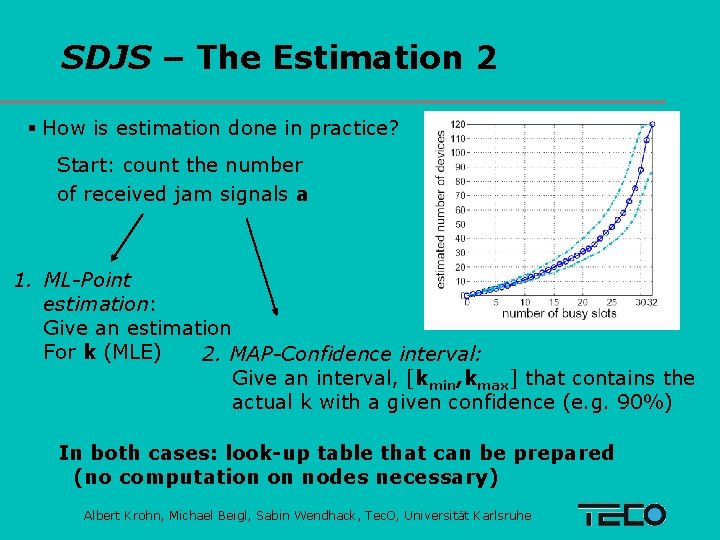
SDJS – The Estimation 2 § How is estimation done in practice? Start: count the number of received jam signals a 1. ML-Point estimation: Give an estimation For k (MLE) 2. MAP-Confidence interval: Give an interval, [kmin, kmax] that contains the actual k with a given confidence (e. g. 90%) In both cases: look-up table that can be prepared (no computation on nodes necessary) Albert Krohn, Michael Beigl, Sabin Wendhack, Tec. O, Universität Karlsruhe

SDJS – Accuracy and Noise § Noise: false positives and detection errors during carrier sense affect the estimation § Accuracy vs. Speed trade-off: accuracy depends on number of slots s Albert Krohn, Michael Beigl, Sabin Wendhack, Tec. O, Universität Karlsruhe

SDJS – The Implementation § Tec. O’s particle computer § Wireless sensor platform with 8 Bit 20 Mhz processor § 4 k. RAM, 4 MBit Flash § 125 kbit/s wireless communication § Customized ad hoc protocol n n n Find a partner <20 ms Low power Low collisions § Development tools § Over 1000 produced, large developer community all over the world Albert Krohn, Michael Beigl, Sabin Wendhack, Tec. O, Universität Karlsruhe

SDJS – The Experiment § Setting in an office with up to 50 particle computer § Impressive prove of concept: theory and real world setting are nearly identical Albert Krohn, Michael Beigl, Sabin Wendhack, Tec. O, Universität Karlsruhe

SDJS – Conclusion § SDJS is n n n An extension to wireless radio protocols Efficient group communication for very specific tasks Probabilistic by nature § SDJS can n n Efficiently and fast estimate parameters (1000 x faster) Achieve adjustable accuracy (speed – accuracy trade off) § Overall performance of SDJS depends severely on the underlying technology Albert Krohn, Michael Beigl, Sabin Wendhack, Tec. O, Universität Karlsruhe

“SDJS: Efficient Statistics in Wireless Networks” Thank you for your attention! Albert Krohn, Michael Beigl, Sabin Wendhack Tec. O (Telecooperation Office) Institut für Telematik Universität Karlsruhe www. teco. edu
- Slides: 14