
SCTP vs TCP A Comparison of Transport Protocols


![References • [CT 90] D. Clark and D. Tennenhouse, Architectural Consideration for a New](https://slidetodoc.com/presentation_image_h2/902b31a3924dc347091d79b7a2717292/image-30.jpg "References • [CT 90] D. Clark and D. Tennenhouse, Architectural Consideration for a New")
- Slides: 30
SCTP v/s TCP – A Comparison of Transport Protocols for Web Traffic Rajesh Rajamani (raj@cs. wisc. edu) June 03, 2002
Outline • Motivation • Introduction to SCTP • Server Architecture • Experimental Design • Parameters • Results • Conclusion June 03, 2002 2
Motivation • Many applications need reliable message delivery – they do so by delineating a TCP stream • TCP provides both strict-ordering and reliability – many applications may not need both June 03, 2002 3
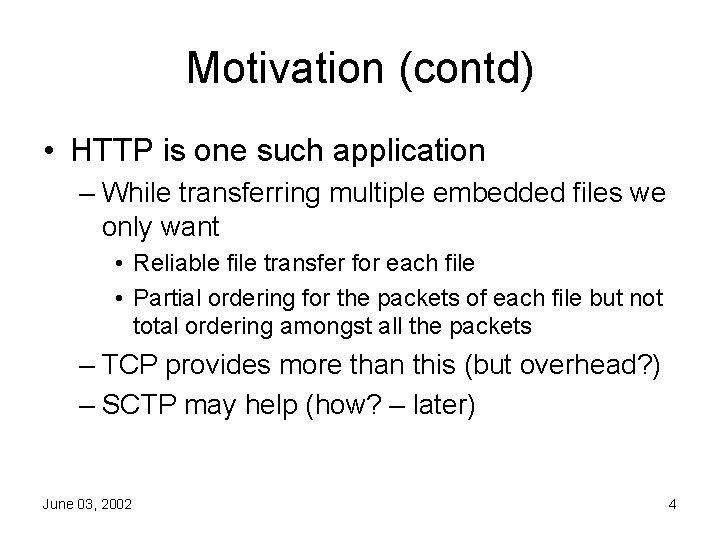
Motivation (contd) • HTTP is one such application – While transferring multiple embedded files we only want • Reliable file transfer for each file • Partial ordering for the packets of each file but not total ordering amongst all the packets – TCP provides more than this (but overhead? ) – SCTP may help (how? – later) June 03, 2002 4
What is SCTP? • Originally designed to support PSTN signaling messages over IP Networks • It is a reliable transport protocol operating on top of a connectionless packet network such as IP (same level as TCP) June 03, 2002 5
Major Differences from TCP • SCTP is message oriented • SCTP has the concept of an association instead of a connection – Each association can have multiple streams • SCTP separates reliable transfer of datagrams from the delivery mechanism • SCTP supports multihoming • Connection Setup June 03, 2002 6
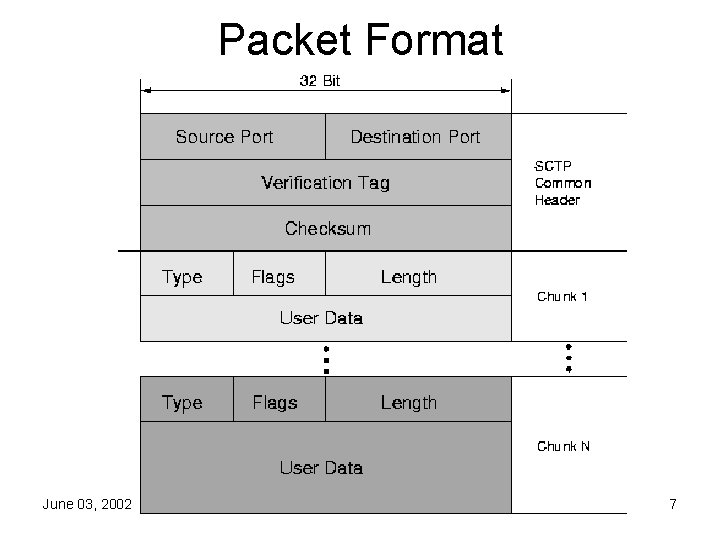
Packet Format June 03, 2002 7
Similarities to TCP • Similar Flow Control and Congestion Control Strategies employed – Slow Start and Congestion Avoidance phases – Selective Acknowledgement – Fast Retransmit – Slight differences for supporting multihoming • Known to co-exist well with TCP June 03, 2002 8
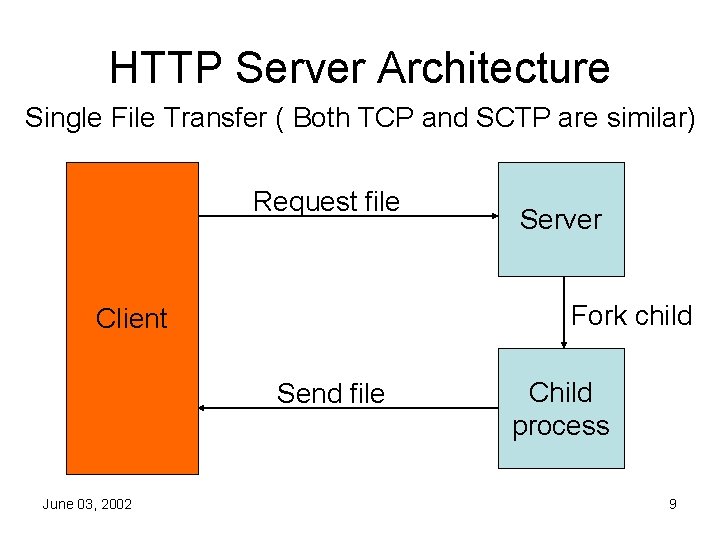
HTTP Server Architecture Single File Transfer ( Both TCP and SCTP are similar) Request file Fork child Client Send file June 03, 2002 Server Child process 9
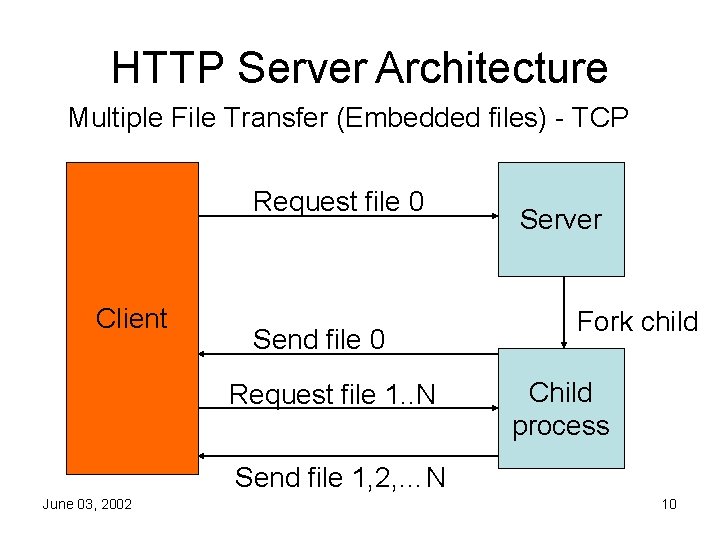
HTTP Server Architecture Multiple File Transfer (Embedded files) - TCP Request file 0 Client Send file 0 Request file 1. . N Server Fork child Child process Send file 1, 2, …N June 03, 2002 10
HTTP Server Architecture Multiple Files Transfer (Embedded Files) - SCTP Request file 0 Client Send file 0 – stream 0 Request files 1. . N June 03, 2002 Send file 1 – stream 1 Send file N – stream N Server Fork child Child process 11
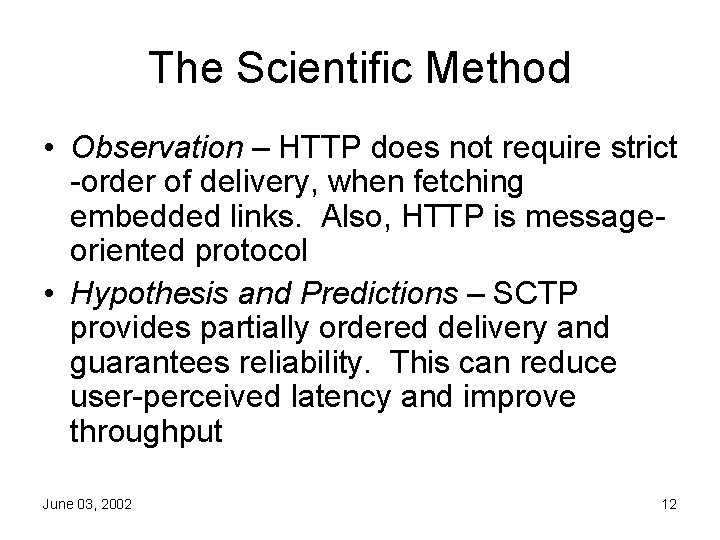
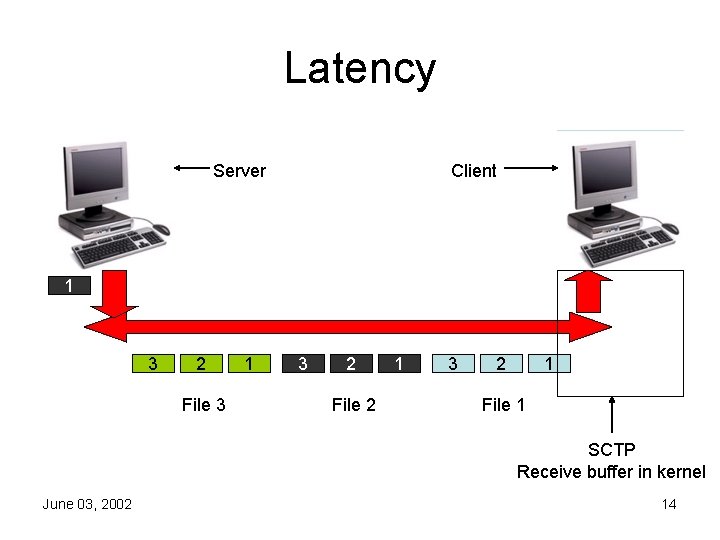
The Scientific Method • Observation – HTTP does not require strict -order of delivery, when fetching embedded links. Also, HTTP is messageoriented protocol • Hypothesis and Predictions – SCTP provides partially ordered delivery and guarantees reliability. This can reduce user-perceived latency and improve throughput June 03, 2002 12
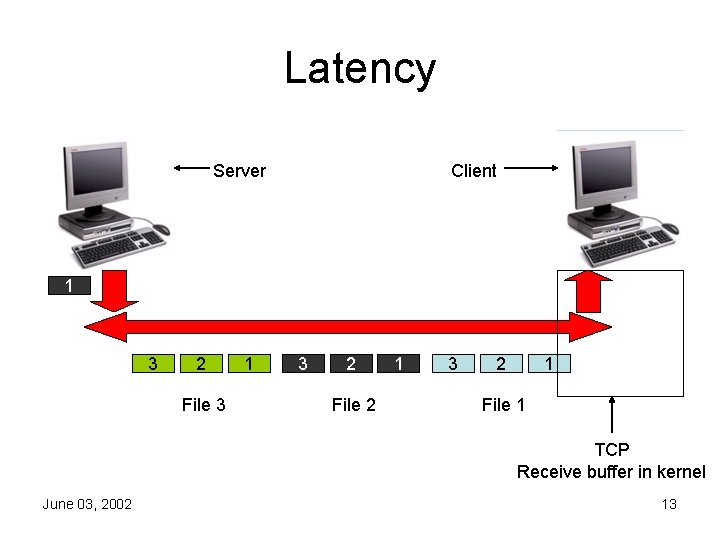
Latency Server Client 1 3 2 File 3 1 3 2 File 2 1 3 2 1 File 1 TCP Receive buffer in kernel June 03, 2002 13
Latency Server Client 1 3 2 File 3 1 3 2 File 2 1 3 2 1 File 1 SCTP Receive buffer in kernel June 03, 2002 14
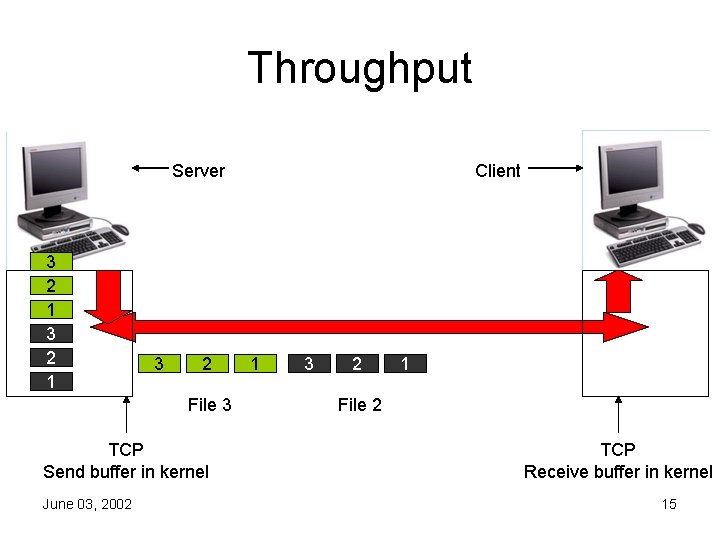
Throughput Server 3 2 1 3 2 File 3 TCP Send buffer in kernel June 03, 2002 Client 1 3 2 1 File 2 TCP Receive buffer in kernel 15
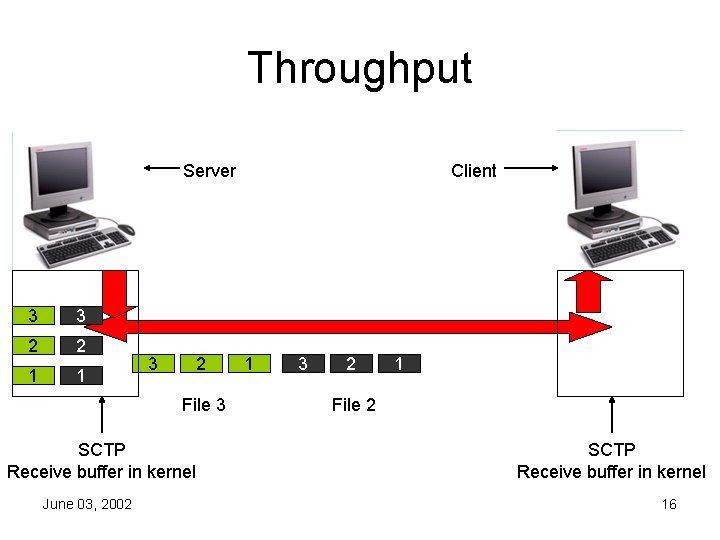
Throughput Server 3 3 2 2 1 1 3 2 File 3 SCTP Receive buffer in kernel June 03, 2002 Client 1 3 2 1 File 2 SCTP Receive buffer in kernel 16
Experimental Design • Free. BSD kernel implementation of SCTP and TCP Reno • HTTP 1. 1 Server and Client – Similar implementations for TCP/SCTP • Dummynet to simulate interconnection network June 03, 2002 17
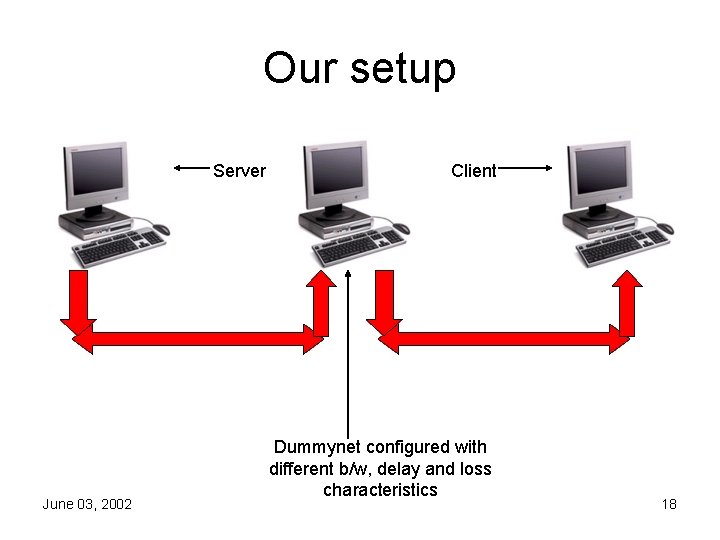
Our setup Server June 03, 2002 Client Dummynet configured with different b/w, delay and loss characteristics 18
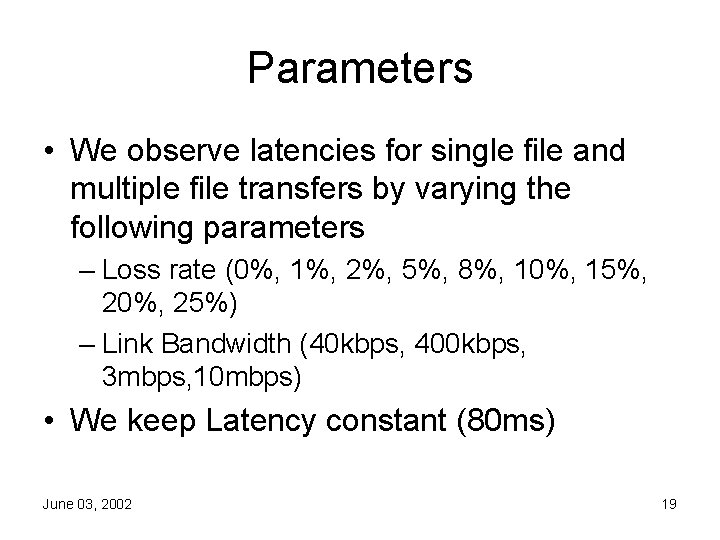
Parameters • We observe latencies for single file and multiple file transfers by varying the following parameters – Loss rate (0%, 1%, 2%, 5%, 8%, 10%, 15%, 20%, 25%) – Link Bandwidth (40 kbps, 400 kbps, 3 mbps, 10 mbps) • We keep Latency constant (80 ms) June 03, 2002 19
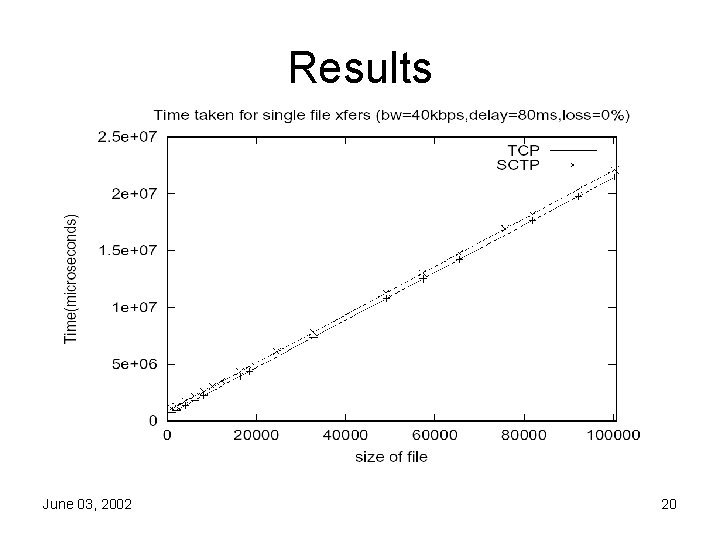
Results June 03, 2002 20
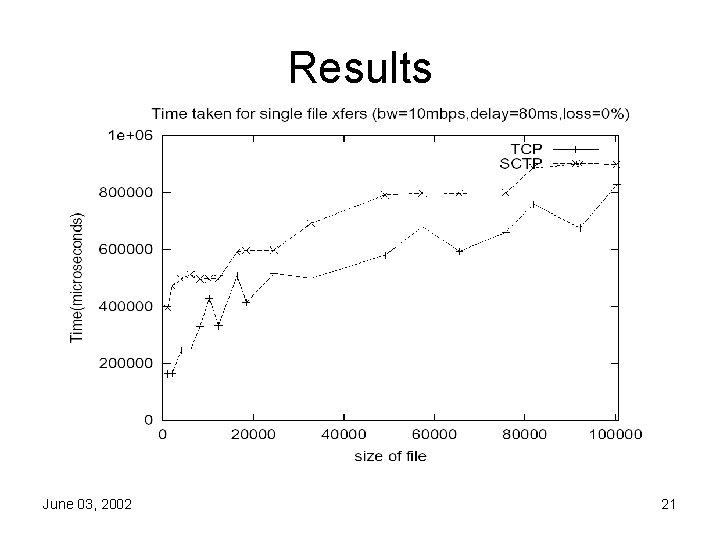
Results June 03, 2002 21
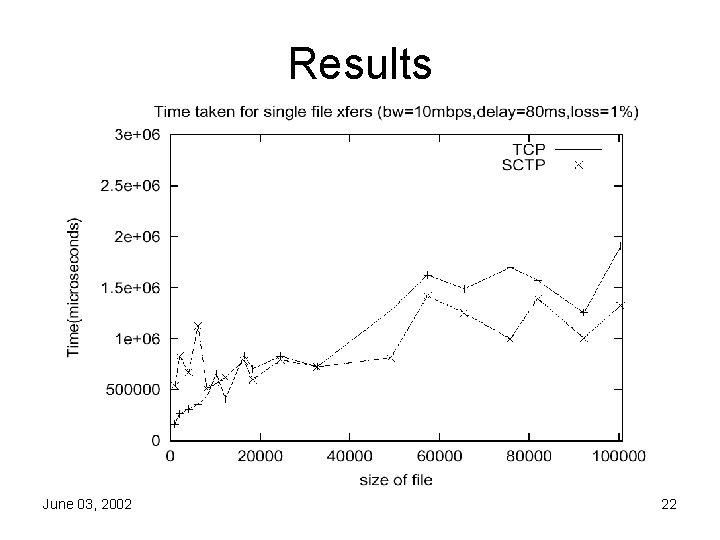
Results June 03, 2002 22
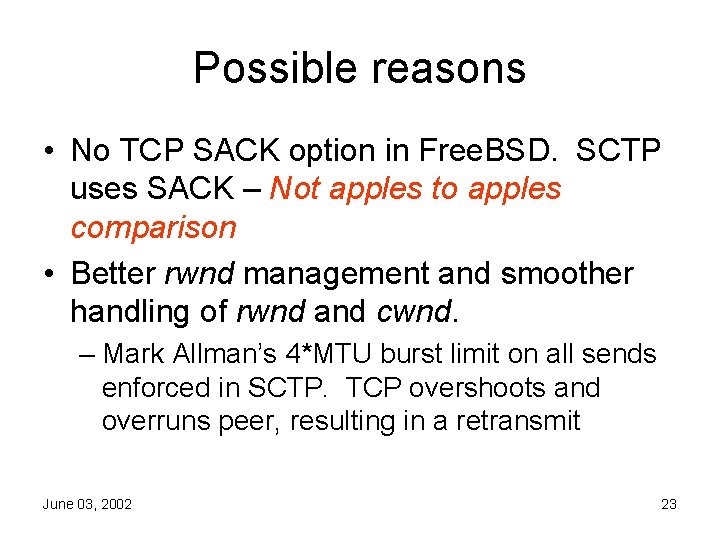
Possible reasons • No TCP SACK option in Free. BSD. SCTP uses SACK – Not apples to apples comparison • Better rwnd management and smoother handling of rwnd and cwnd. – Mark Allman’s 4*MTU burst limit on all sends enforced in SCTP. TCP overshoots and overruns peer, resulting in a retransmit June 03, 2002 23
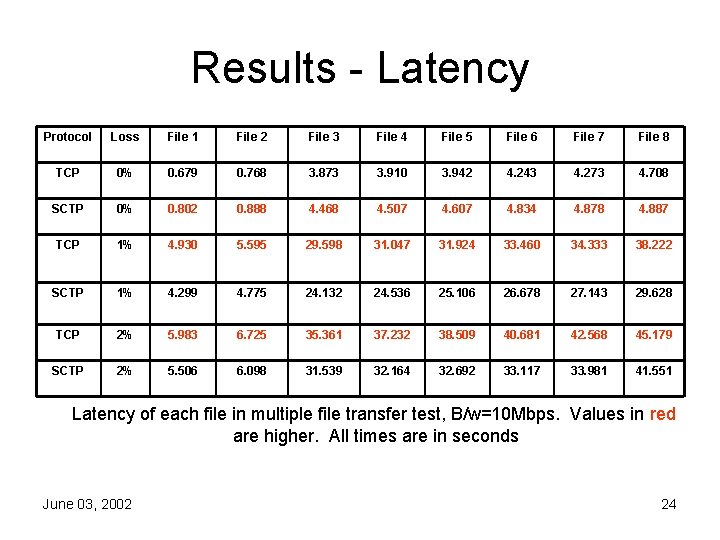
Results - Latency Protocol Loss File 1 File 2 File 3 File 4 File 5 File 6 File 7 File 8 TCP 0% 0. 679 0. 768 3. 873 3. 910 3. 942 4. 243 4. 273 4. 708 SCTP 0% 0. 802 0. 888 4. 468 4. 507 4. 607 4. 834 4. 878 4. 887 TCP 1% 4. 930 5. 595 29. 598 31. 047 31. 924 33. 460 34. 333 38. 222 SCTP 1% 4. 299 4. 775 24. 132 24. 536 25. 106 26. 678 27. 143 29. 628 TCP 2% 5. 983 6. 725 35. 361 37. 232 38. 509 40. 681 42. 568 45. 179 SCTP 2% 5. 506 6. 098 31. 539 32. 164 32. 692 33. 117 33. 981 41. 551 Latency of each file in multiple file transfer test, B/w=10 Mbps. Values in red are higher. All times are in seconds June 03, 2002 24
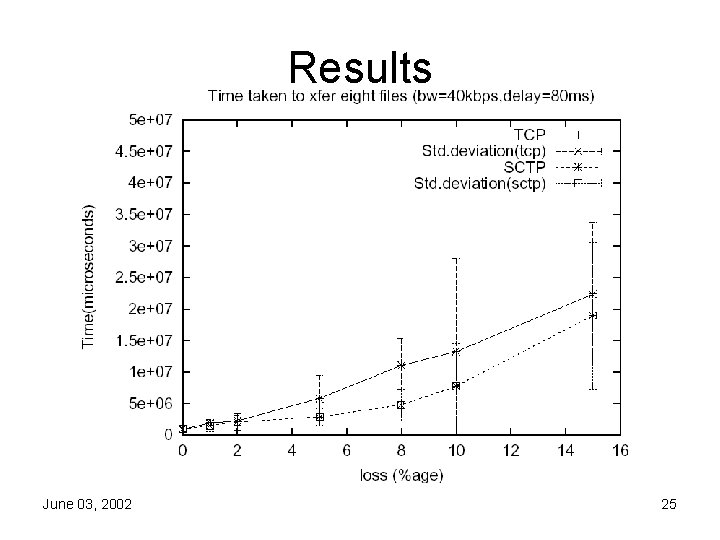
Results June 03, 2002 25
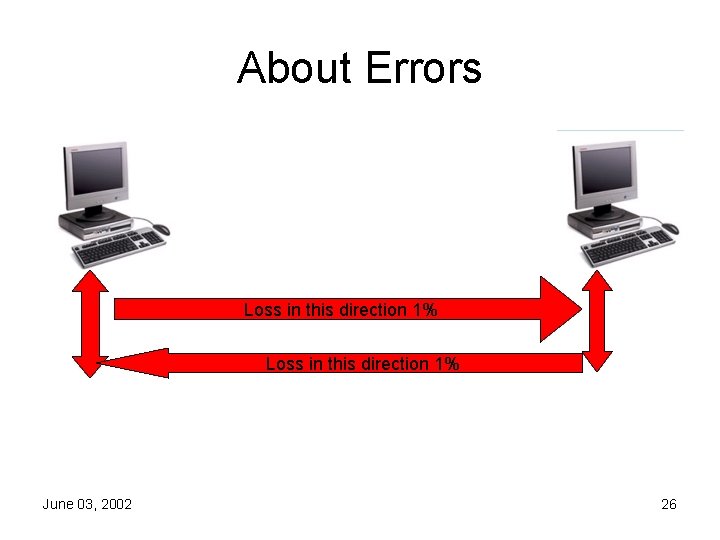
About Errors Loss in this direction 1% June 03, 2002 26
Conclusions • The current SCTP implementation performs almost as well as TCP when there are no losses – However, there is an extra overhead in sending messages instead of just a stream of bytes • SCTP seems to perform better in the presence of losses, because it does not enforce strictly ordered delivery • More graphs available at http: //www. cs. wisc. edu/~raj/sctp June 03, 2002 27
Implications • SCTP can be a viable transport protocol for HTTP traffic, because – – It helps reduce user-perceived latency and also improves throughput – Uses a 4 -way handshake and also uses an encrypted cookie, which offer better protection against SYN floods and Do. S attacks – Multihoming feature can be exploited to transparently allow mobile users to switch between networks June 03, 2002 28
Questions? June 03, 2002 29
References • [CT 90] D. Clark and D. Tennenhouse, Architectural Consideration for a New Generation of Protocols, In Proc. of ACM SIGCOMM '90. • RFC 2960 (http: //www. rfc-editor. org) • http: //tdrwww. exp-math. uni-essen. de/pages/forschung/sctp_fb/ • [JST 2000] A. Jungmaier, et. al, Performance Evaluation of the Stream Control Transmission Protocol, In Proc. of the IEEE conference on High Performance Switching and Routing, June 2000. June 03, 2002 30