
Scrum Patterns James O Coplien Gertrud Cope Mean



- Slides: 39
Scrum Patterns James O. Coplien Gertrud & Cope
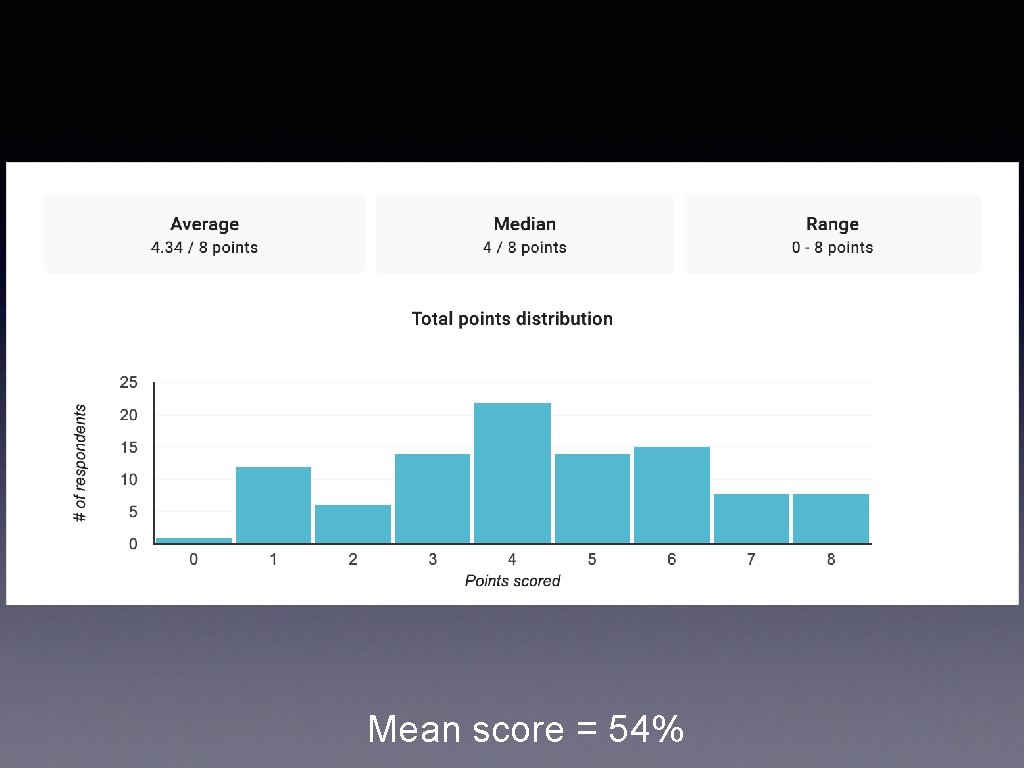
Mean score = 54%
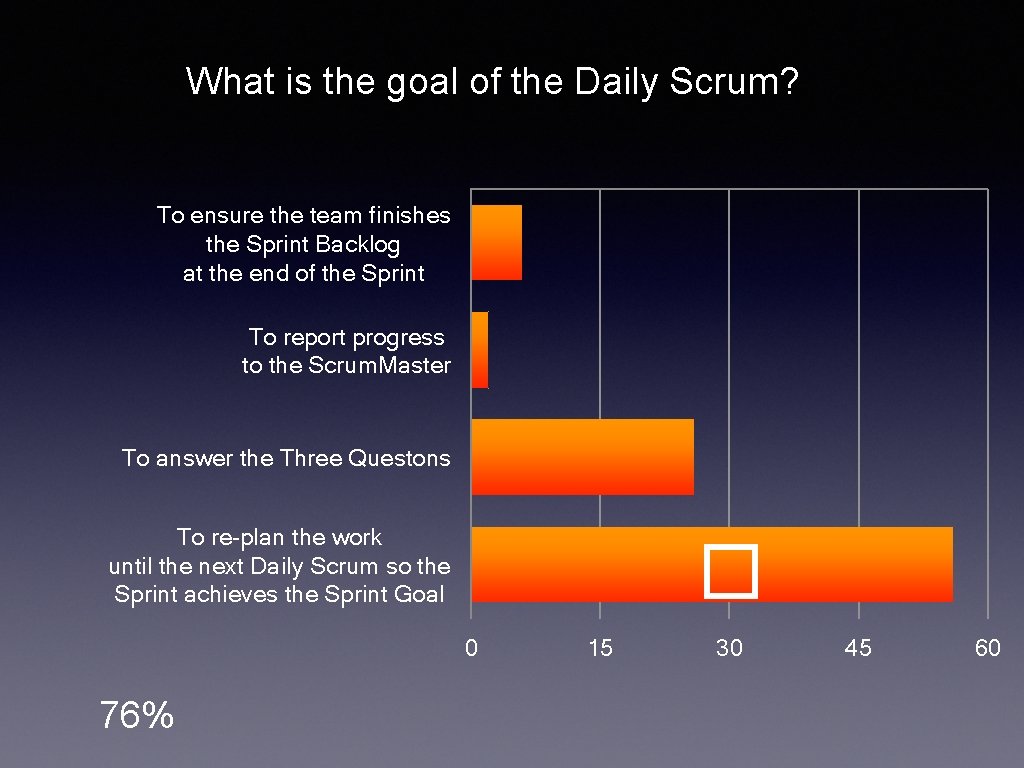
What is the goal of the Daily Scrum? To ensure the team finishes the Sprint Backlog at the end of the Sprint To report progress to the Scrum. Master To answer the Three Questons To re-plan the work until the next Daily Scrum so the Sprint achieves the Sprint Goal � 0 76% 15 30 45 60
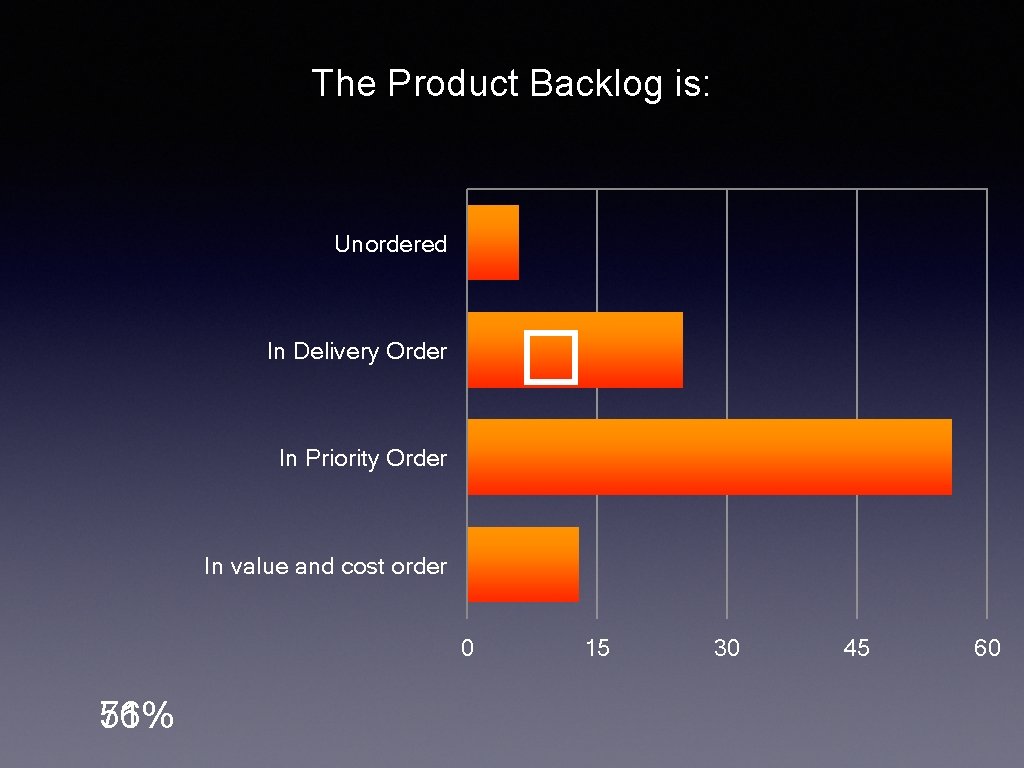
The Product Backlog is: Unordered � In Delivery Order In Priority Order In value and cost order 0 76% 51% 15 30 45 60
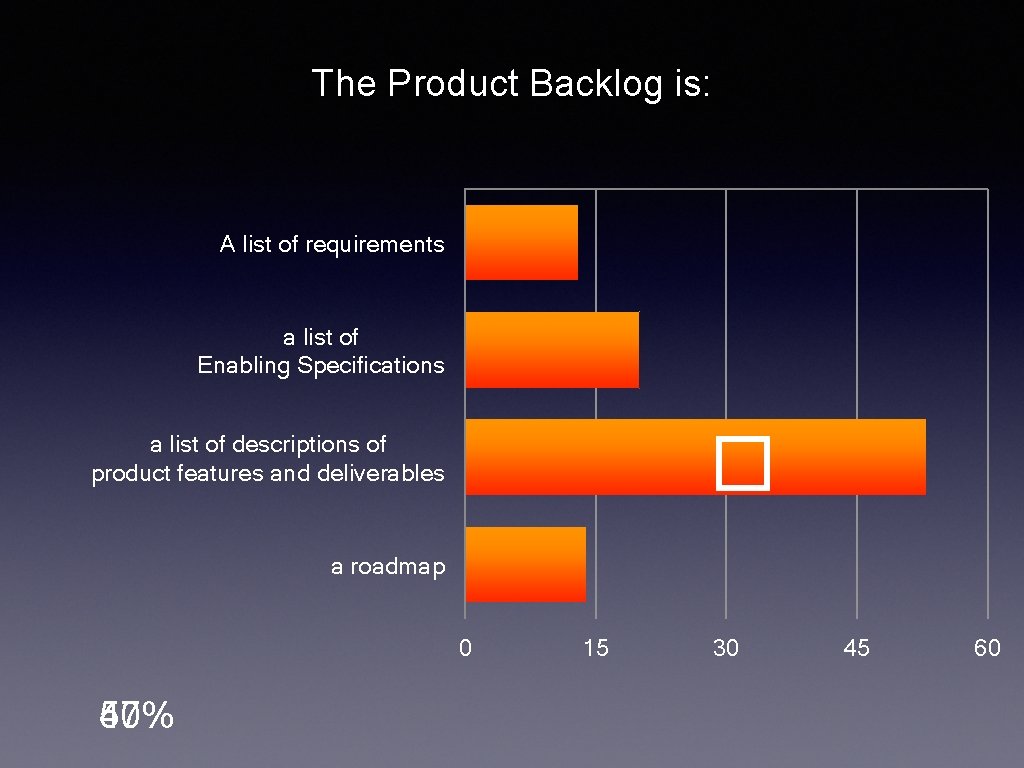
The Product Backlog is: A list of requirements a list of Enabling Specifications � a list of descriptions of product features and deliverables a roadmap 0 47% 50% 15 30 45 60
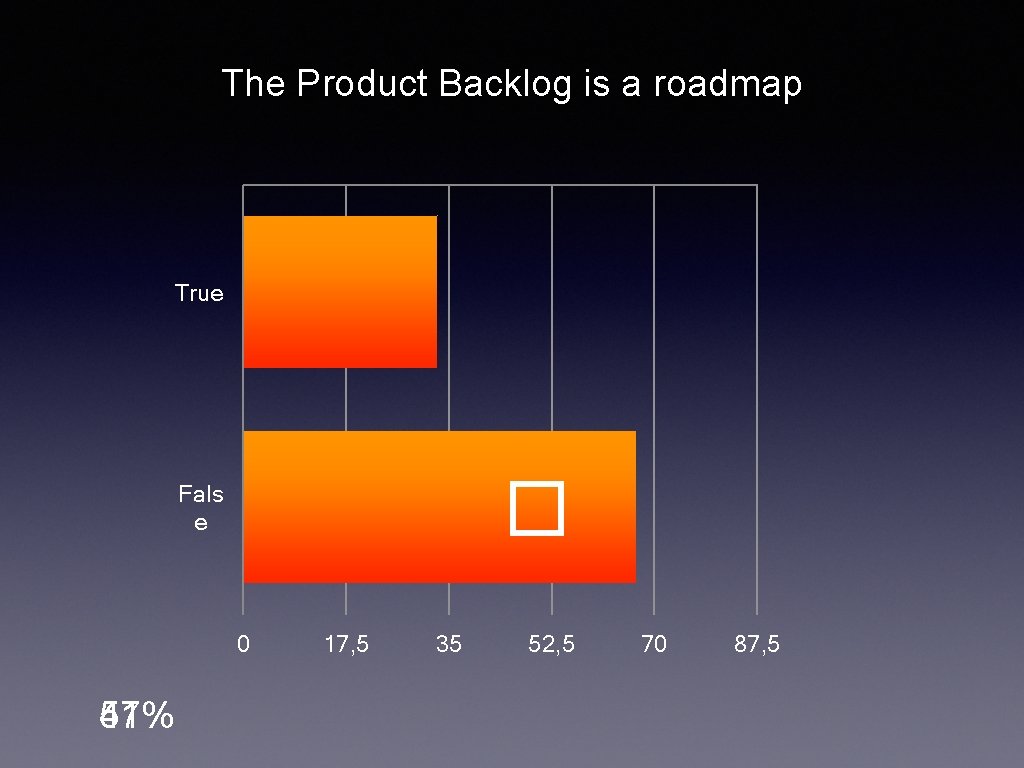
The Product Backlog is a roadmap True � Fals e 0 51% 47% 17, 5 35 52, 5 70 87, 5
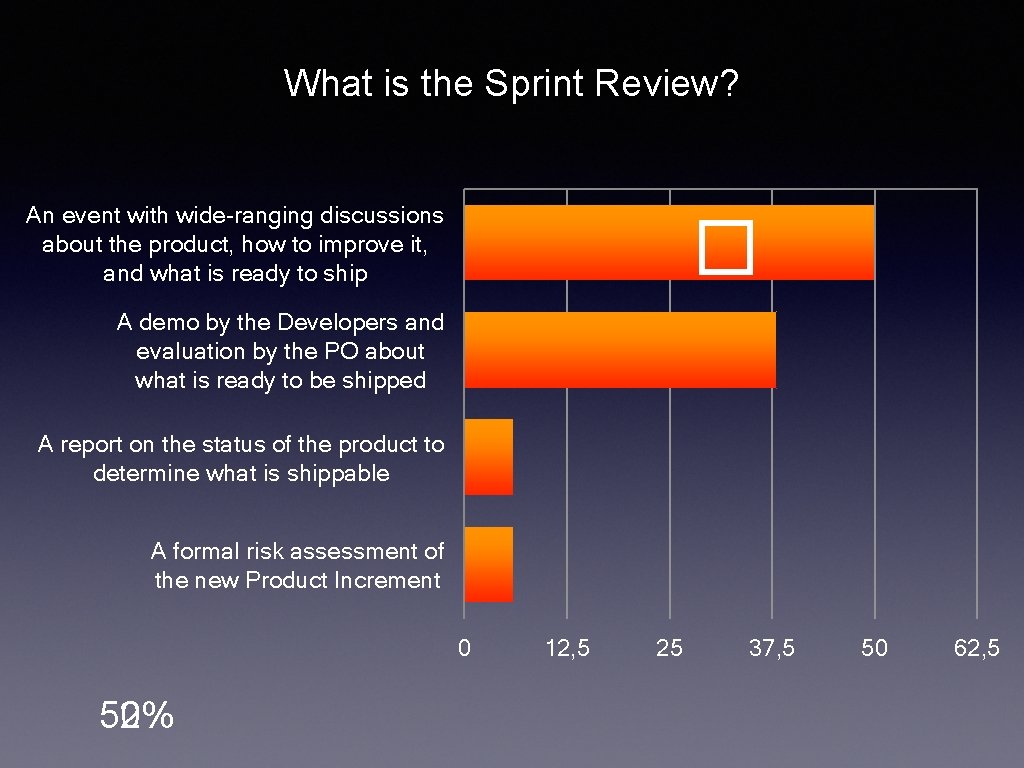
What is the Sprint Review? An event with wide-ranging discussions about the product, how to improve it, and what is ready to ship � A demo by the Developers and evaluation by the PO about what is ready to be shipped A report on the status of the product to determine what is shippable A formal risk assessment of the new Product Increment 0 50% 52% 12, 5 25 37, 5 50 62, 5
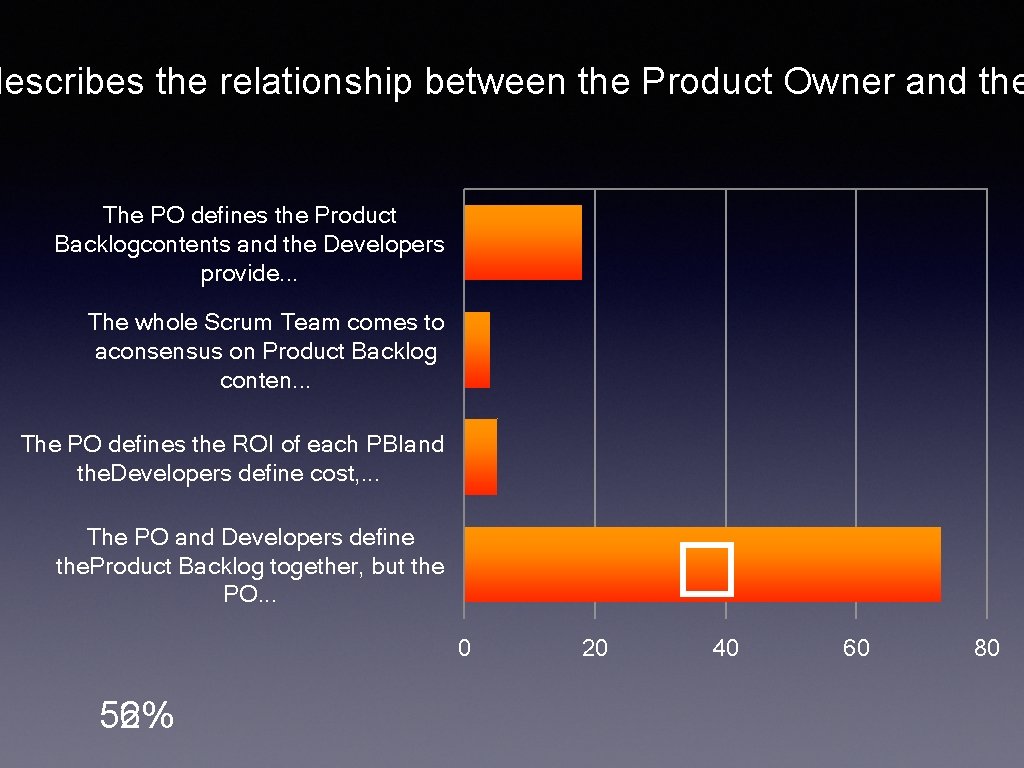
describes the relationship between the Product Owner and the The PO defines the Product Backlogcontents and the Developers provide. . . The whole Scrum Team comes to aconsensus on Product Backlog conten. . . The PO defines the ROI of each PBIand the. Developers define cost, . . . The PO and Developers define the. Product Backlog together, but the PO. . . � 0 52% 56% 20 40 60 80
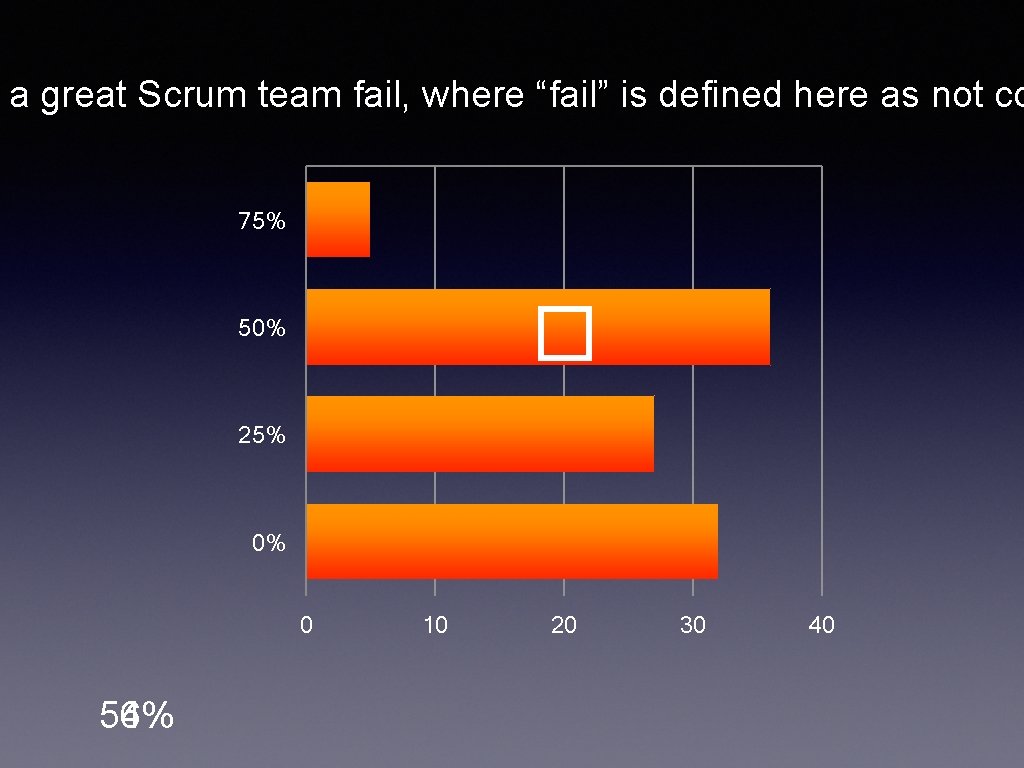
a great Scrum team fail, where “fail” is defined here as not co 75% � 50% 25% 0% 0 56% 54% 10 20 30 40
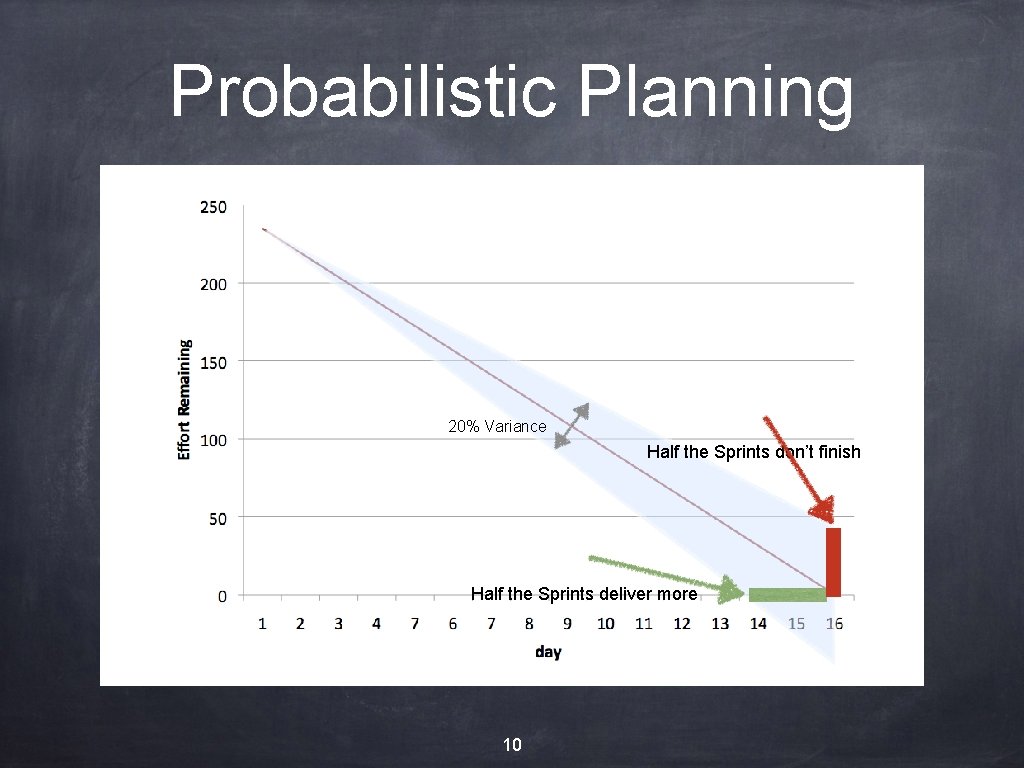
Probabilistic Planning 20% Variance Half the Sprints don’t finish Half the Sprints deliver more 10
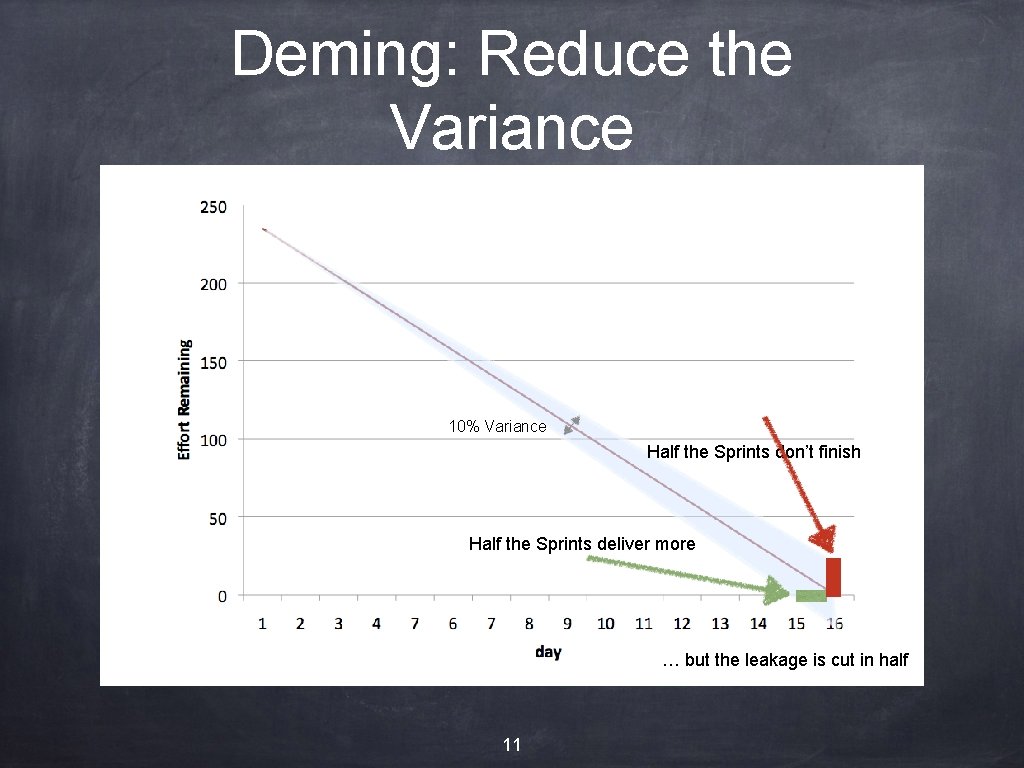
Deming: Reduce the Variance 10% Variance Half the Sprints don’t finish Half the Sprints deliver more … but the leakage is cut in half 11
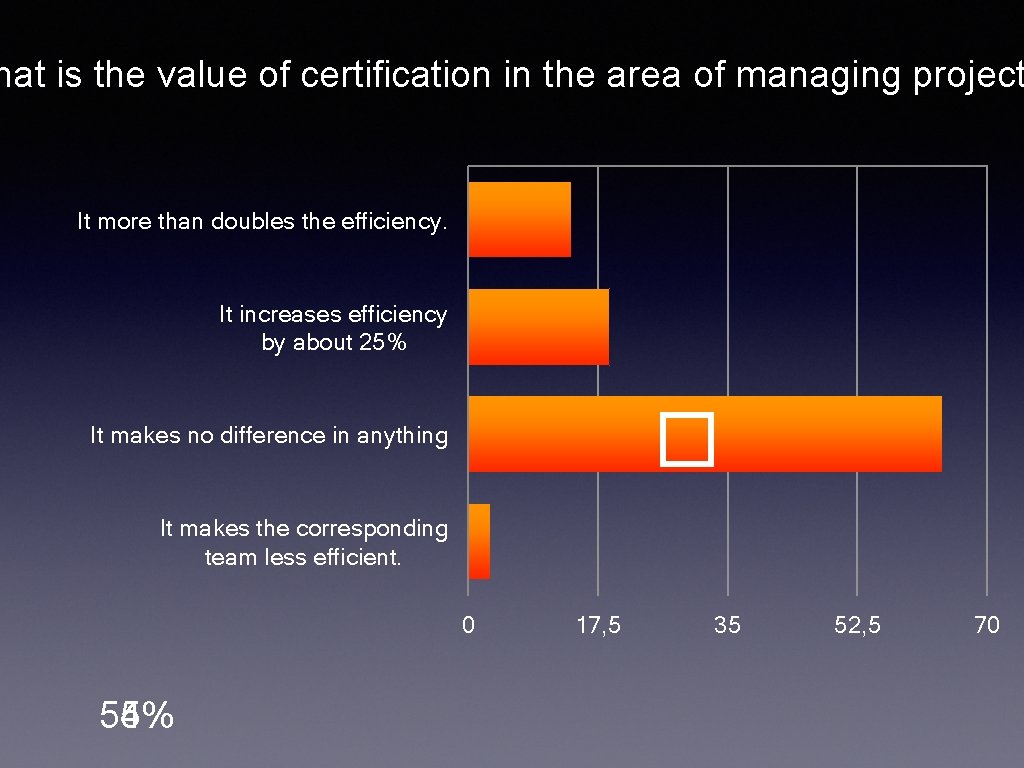
hat is the value of certification in the area of managing project It more than doubles the efficiency. It increases efficiency by about 25% � It makes no difference in anything It makes the corresponding team less efficient. 0 54% 55% 17, 5 35 52, 5 70
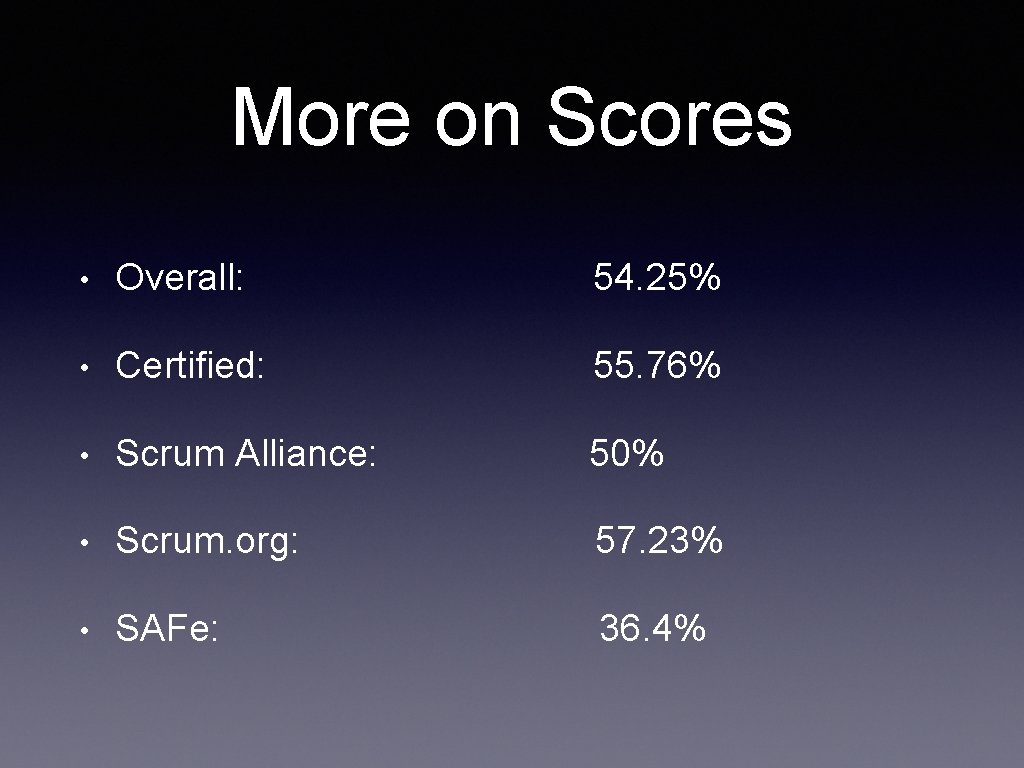
More on Scores • Overall: 54. 25% • Certified: 55. 76% • Scrum Alliance: 50% • Scrum. org: 57. 23% • SAFe: 36. 4%
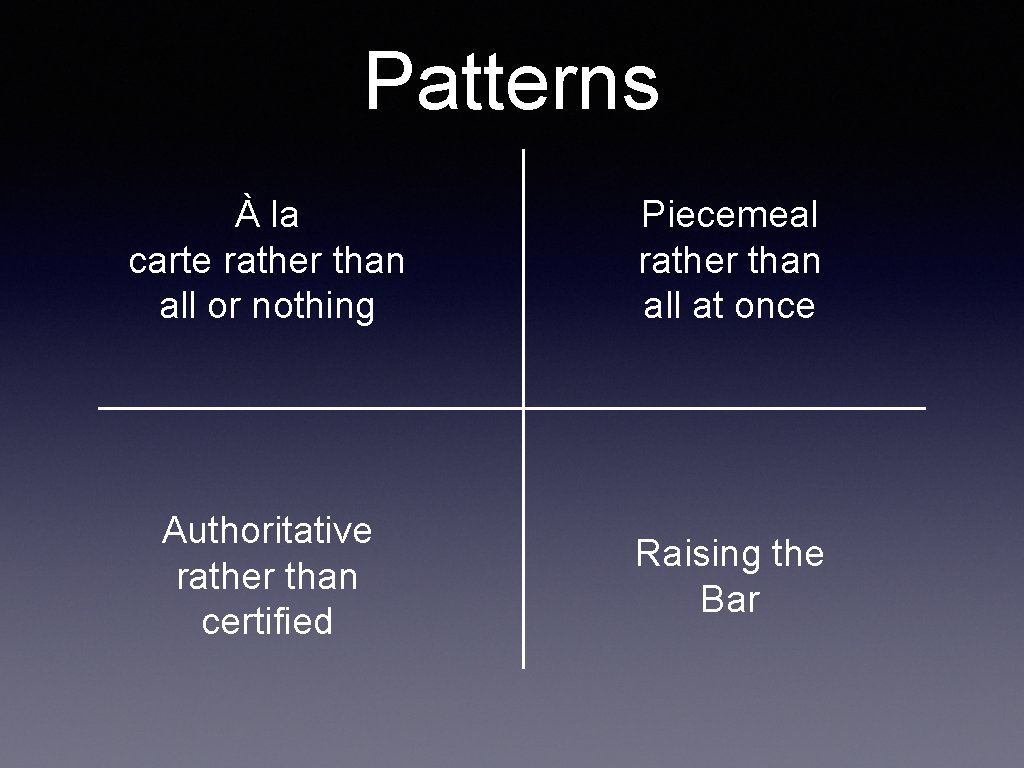
Patterns À la carte rather than all or nothing Piecemeal rather than all at once Authoritative rather than certified Raising the Bar
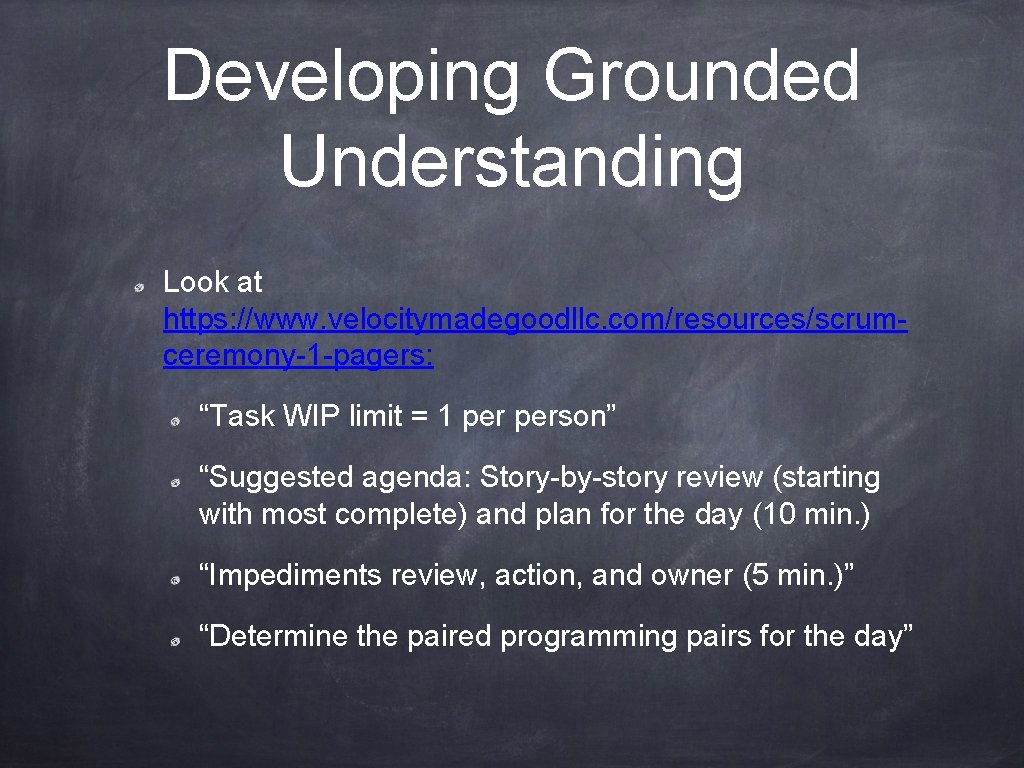
Developing Grounded Understanding Look at https: //www. velocitymadegoodllc. com/resources/scrumceremony-1 -pagers: “Task WIP limit = 1 person” “Suggested agenda: Story-by-story review (starting with most complete) and plan for the day (10 min. ) “Impediments review, action, and owner (5 min. )” “Determine the paired programming pairs for the day”
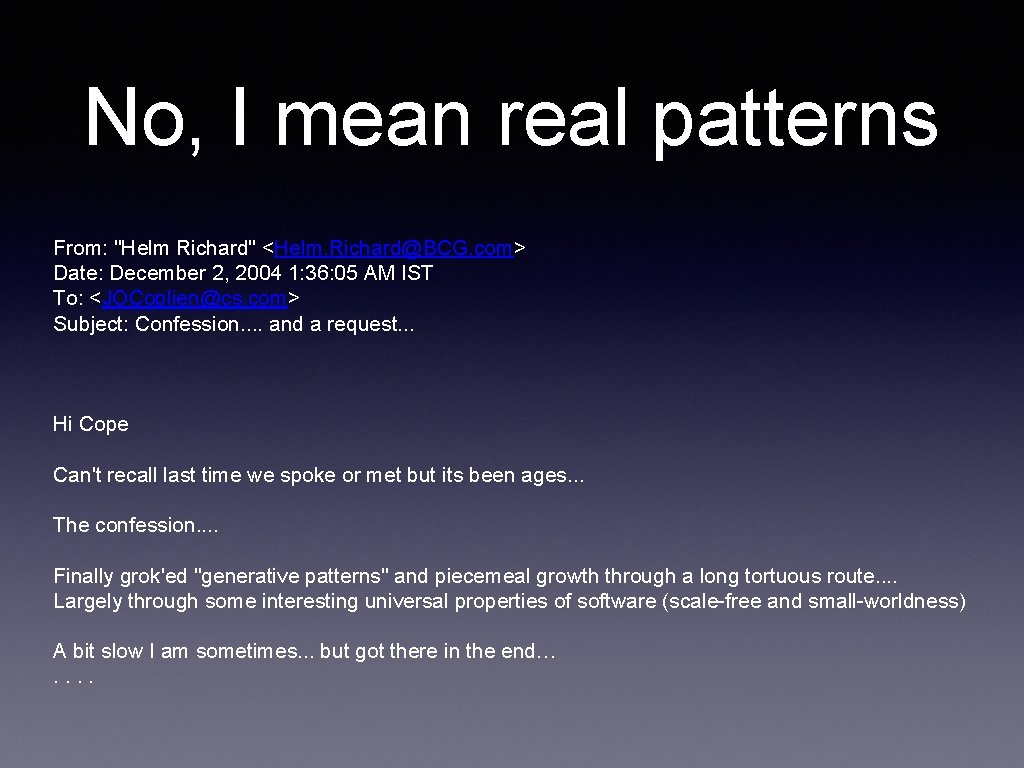
No, I mean real patterns From: "Helm Richard" <Helm. Richard@BCG. com> Date: December 2, 2004 1: 36: 05 AM IST To: <JOCoplien@cs. com> Subject: Confession. . and a request. . . Hi Cope Can't recall last time we spoke or met but its been ages. . . The confession. . Finally grok'ed "generative patterns" and piecemeal growth through a long tortuous route. . Largely through some interesting universal properties of software (scale-free and small-worldness) A bit slow I am sometimes. . . but got there in the end…. .
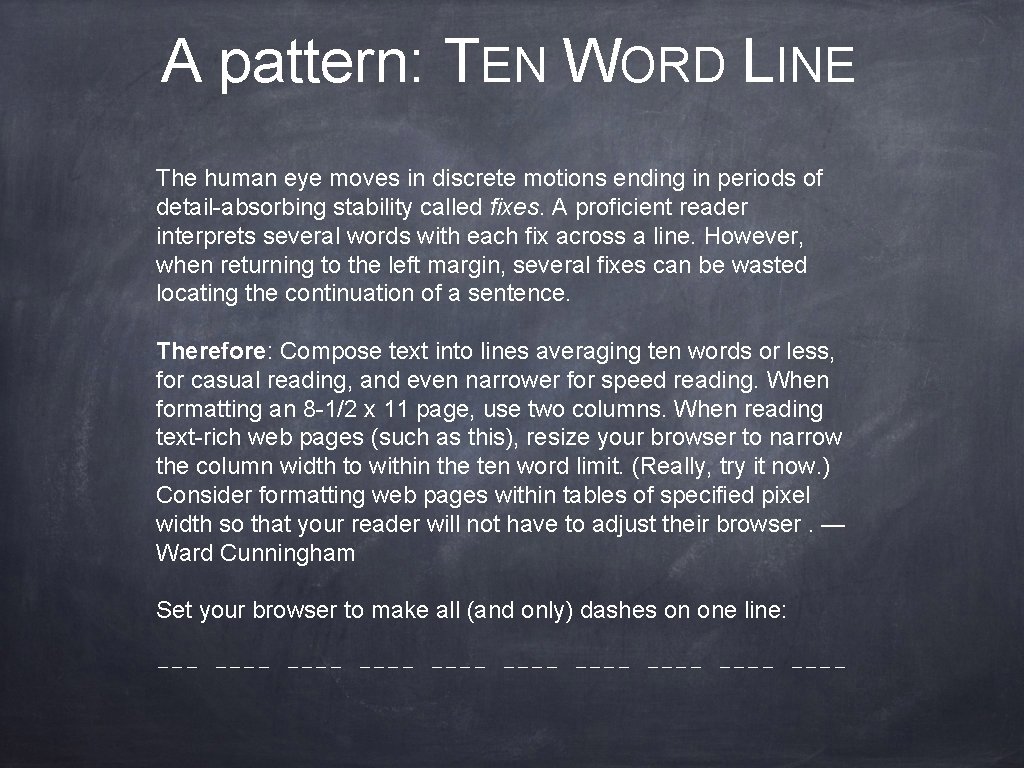
A pattern: TEN WORD LINE The human eye moves in discrete motions ending in periods of detail-absorbing stability called fixes. A proficient reader interprets several words with each fix across a line. However, when returning to the left margin, several fixes can be wasted locating the continuation of a sentence. Therefore: Compose text into lines averaging ten words or less, for casual reading, and even narrower for speed reading. When formatting an 8 -1/2 x 11 page, use two columns. When reading text-rich web pages (such as this), resize your browser to narrow the column width to within the ten word limit. (Really, try it now. ) Consider formatting web pages within tables of specified pixel width so that your reader will not have to adjust their browser. — Ward Cunningham Set your browser to make all (and only) dashes on one line: ---- ---- ----
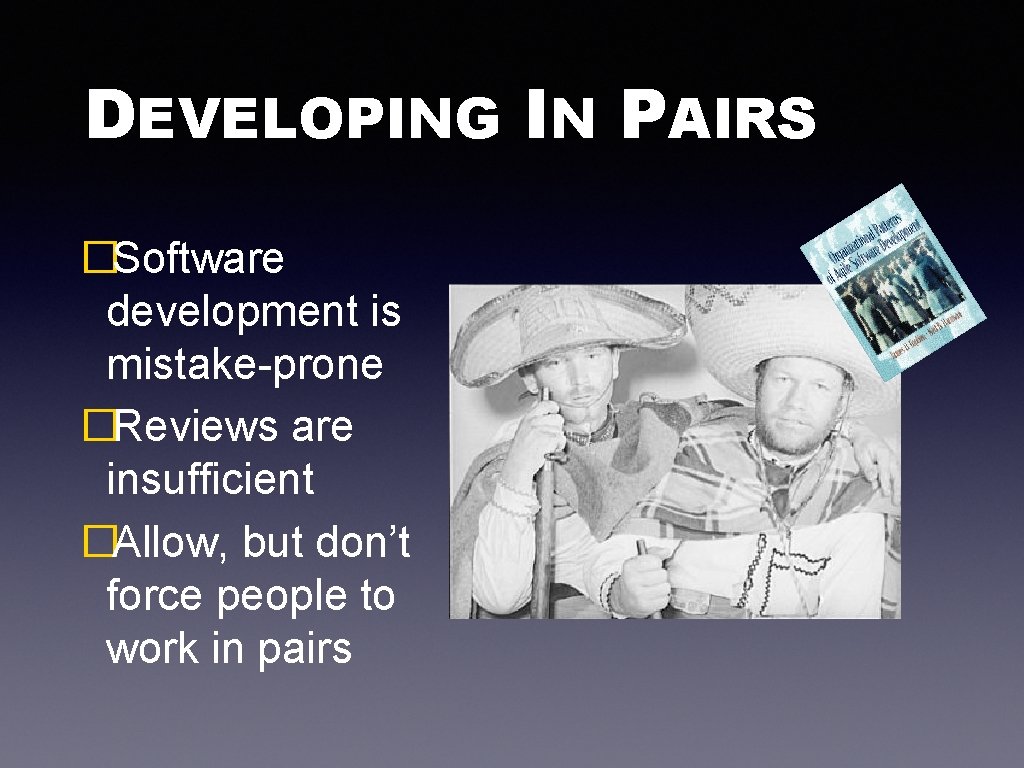
DEVELOPING IN PAIRS �Software development is mistake-prone �Reviews are insufficient �Allow, but don’t force people to work in pairs
Patterns: Time-proven forms • Tom Gilb: “A term coined by Jim Coplien in 1995. ” • Trygve Reenskaug: “Anne Lise Skaar and I did a large (75000 lines Smalltalk code) project combining literate programming and pair programming in the middle to late 80 ties. ” • Larry Constantine: “My name comes up in connection with pair programming because I taught and wrote about the practice ("The Benefits of Visibility" Computer Language Magazine 9, 2, 1992) years before the advent of agile, but I most decidedly did not invent it. I learned about the technique from P. J. Plauger who used it as a production programming technique at Whitesmiths Ltd. , where I saw it in 1978 or 1979 being used to code C compilers for the PDP-11. ” • Ed Yourdon: “PJ Plauger … was instrumental in persuading me to get UNIX in our company (which had a $10, 000 license fee at the time, a sum of money which Plauger lent the company, interestfree!). And even the dumb typewriter-like terminals at the time cost about $3, 000 -- so we couldn't afford to get very many of them… Consequently, Plauger told the motley crew of programmers in our place that they should ‘pair up’ and share the terminals; it simply reflected the fact that hardware was still more expensive than people. ” • Jerry Weinberg: “I learned to pair program (on paper--we didn't even have terminals back in the 1950 s) in Los Angeles, from Bernie Dimsdale, who learned it from John von Neuman. I don't know if it has any history before then, but that's way back to Aberdeen Proving Grounds in the 40 s. ” • Ed Yourdon again: “It's gonna go all the way back to Charles Babbage, or Lady Lovelace!” • Brian Kernighan: “I have no recollection of any of the history of pair programming, and I certainly have no involvement with it at all. ”
How do you read a pattern? DAILY SCRUM § 29 . . . a SCRUM TEAM has been formed and it is ready to start, or has started a SPRINT. As such, the Scrum team has created a SPRINT BACKLOG and is working to achieve the SPRINT GOAL. Yet, in the words of Field Marshall von Moltke, “no plan of operations extends with any certainty beyond the first contact with the main hostile force. ” * * * G&C 21
Pattern forces The team makes progress in a SPRINT by finishing SPRINT BACKLOG ITEMs, but given the complexity of the work, the characteristics, size and quantity of tasks change frequently — sometimes minute by minute. Because of the changing nature of the work, the team needs to adopt a new ordering at least once a day to move beyond mediocrity. On the other hand, too much re-planning and re-estimating wastes time and suffocates developers. But too little replanning and re-estimating leads to blockages that cause delays or obsolete plans that no longer represent reality G&C
Solution Therefore: Have a short event every day to replan the SPRINT, focusing on the next 24 hours. Strictly time-box the meeting to keep focus on the daily plan and to avoid robbing time from development. Keep the meeting to 15 minutes or less. The team manages itself to its timebox, and the SCRUMMASTER will enforce this aspect of the process if necessary. Many teams stand during the meeting to emphasize the short duration of the meeting. G&C
More Solution In order to plan, you must know where you are, as well as what problems are standing in the way. And you need a complete picture. One approach is for each person in the DEVELOPMENT TEAM to answer the following three questions: What did I do yesterday that helped the DEVELOPMENT TEAM meet the SPRINT GOAL? What will I do today to help the DEVELOPMENT TEAM meet the SPRINT GOAL? Do I see any impediment that hinders me or the DEVELOPMENT TEAM from meeting the SPRINT GOAL? * * * G&C
Resulting Context The ethos of the Daily Scrum is a reality check: will we meet the SPRINT GOAL? The result of the Daily Scrum is a new daily plan grounded in reality, and generates a team that is more prone to cooperate and that has a better shared vision and understanding of what they are doing together. The team becomes better attuned to the landscape of impediments in which they are working. The ritual of Daily Scrums helps a sense of team identity emerge from a group of people. It brings them together to refocus on their shared purpose and common identity. It reinforces TEAM PRIDE. In some way, it is a daily version of FACE-TO-FACE BEFORE WORKING REMOTELY. G&C
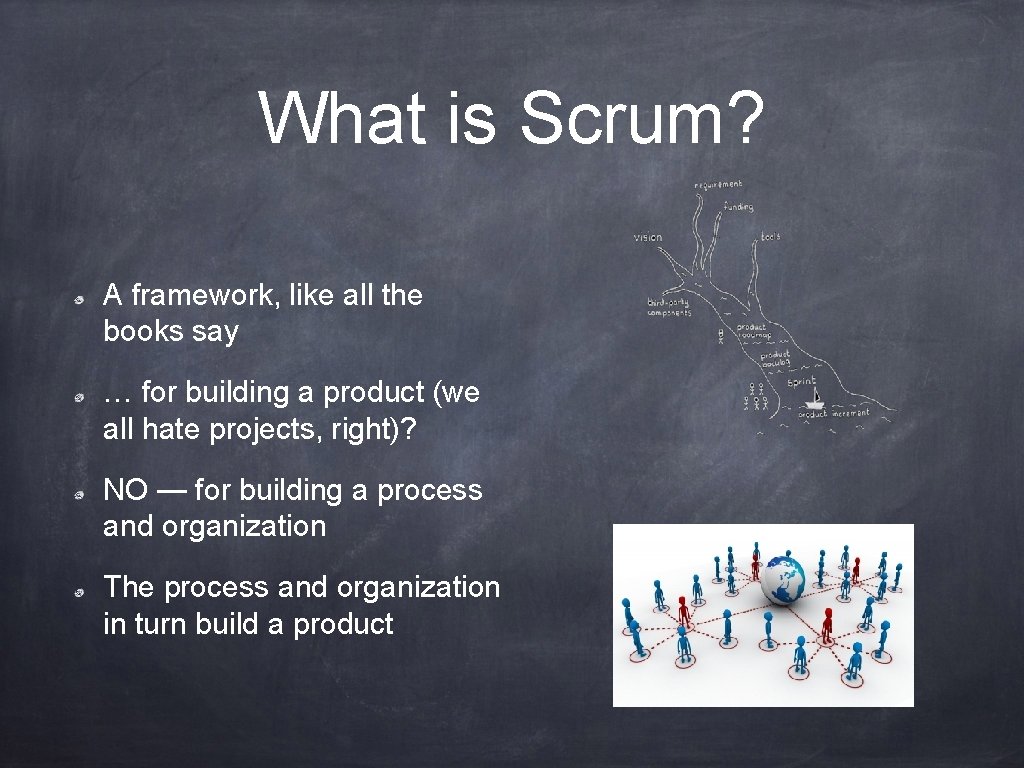
What is Scrum? A framework, like all the books say … for building a product (we all hate projects, right)? NO — for building a process and organization The process and organization in turn build a product
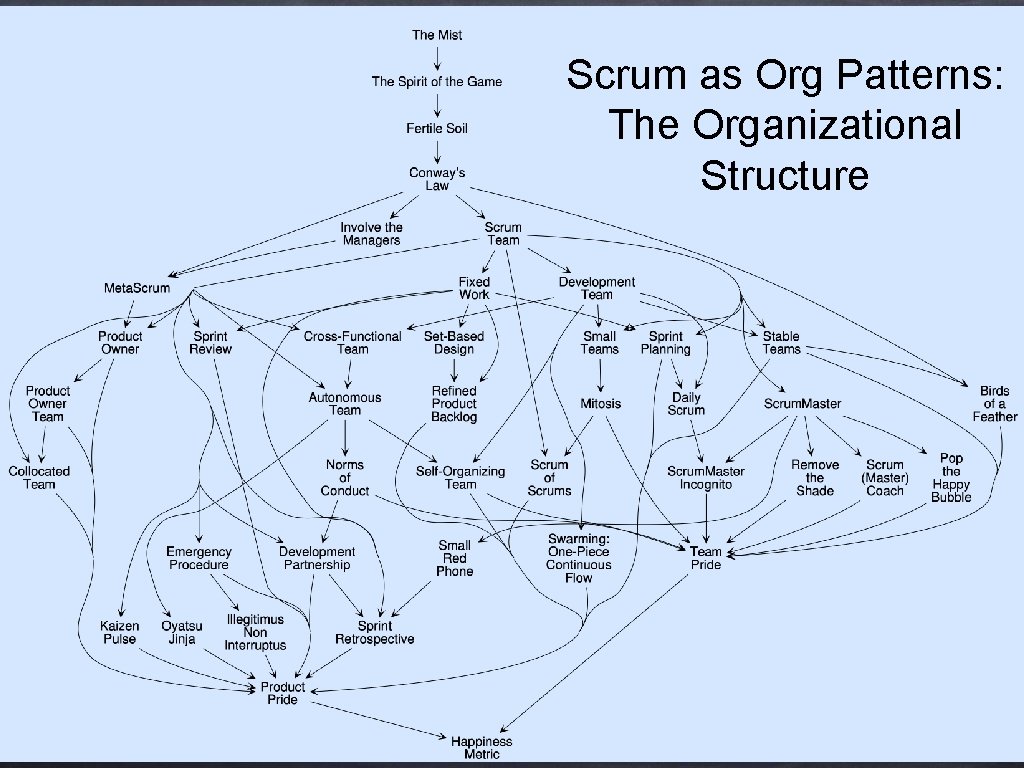
Scrum as Org Patterns: The Organizational Structure
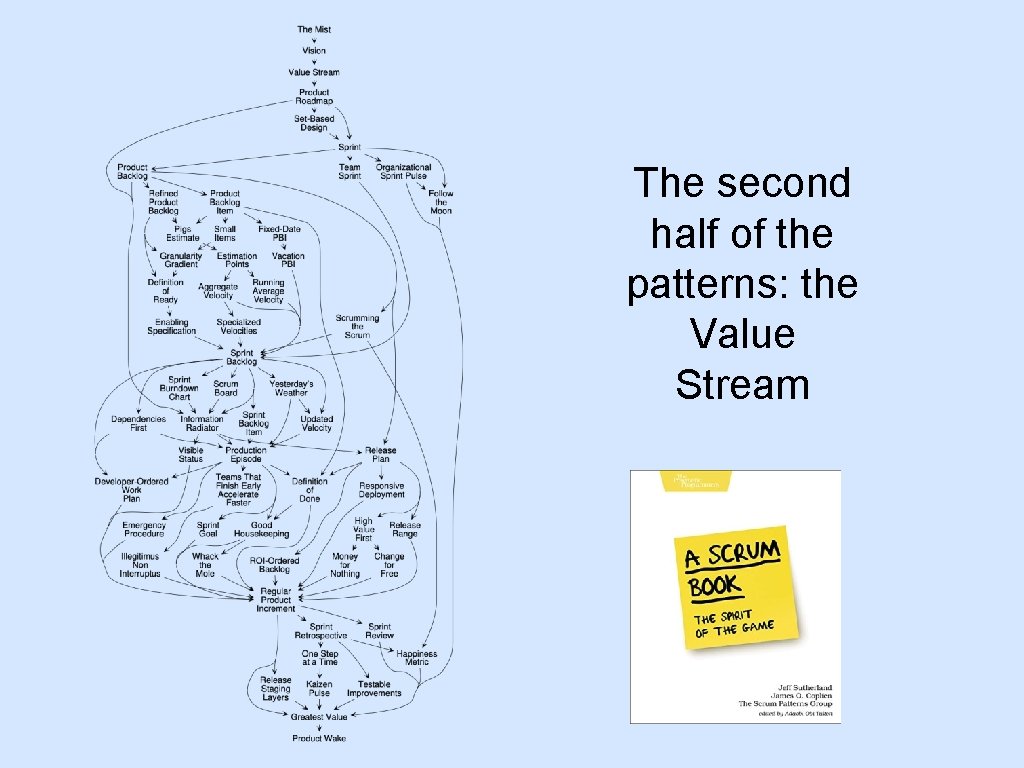
The second half of the patterns: the Value Stream
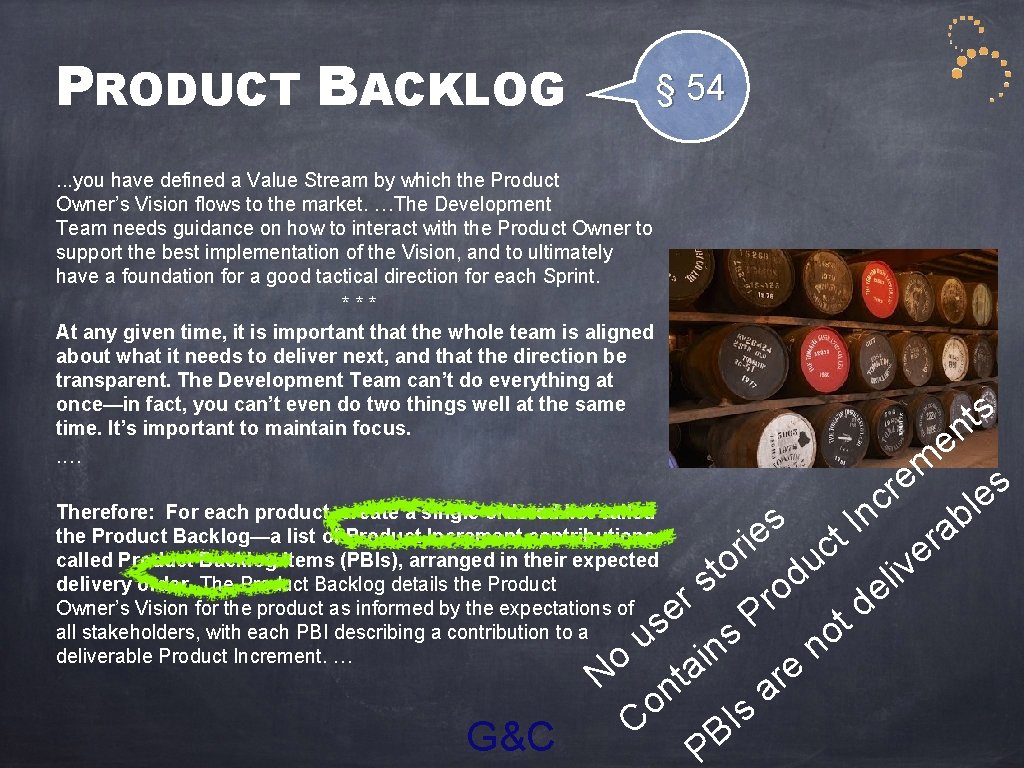
PRODUCT BACKLOG. . . you have defined a Value Stream by which the Product Owner’s Vision flows to the market. …The Development Team needs guidance on how to interact with the Product Owner to support the best implementation of the Vision, and to ultimately have a foundation for a good tactical direction for each Sprint. *** At any given time, it is important that the whole team is aligned about what it needs to deliver next, and that the direction be transparent. The Development Team can’t do everything at once—in fact, you can’t even do two things well at the same time. It’s important to maintain focus. . … § 54 e s t n m e s r e c l Therefore: For each product, create a single ordered list called n b s I the Product Backlog—a list of Product Increment contributions a e t r i r c e called Product Backlog Items (PBIs), arranged in their expected o u v t i d l delivery order. The Product Backlog details the Product s o e r r Owner’s Vision for the product as informed by the expectations of d e P t s all stakeholders, with each PBI describing a contribution to a o u ins n deliverable Product Increment. … o e r N nta a o s I C B G&C P
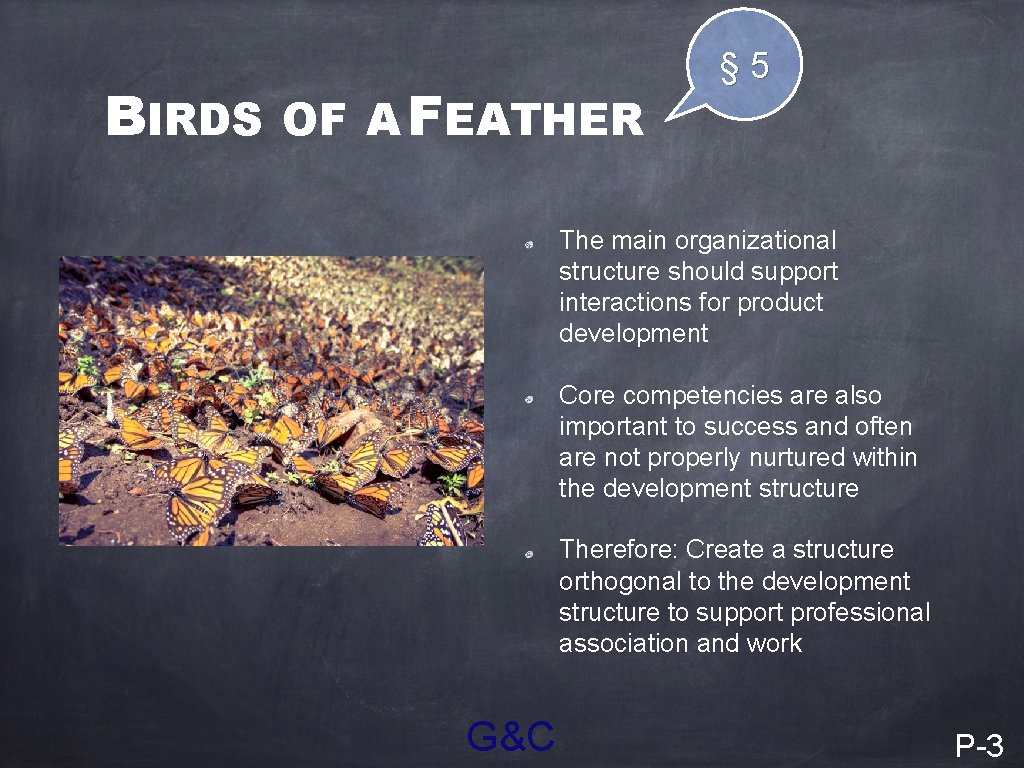
BIRDS OF A FEATHER § 5 The main organizational structure should support interactions for product development Core competencies are also important to success and often are not properly nurtured within the development structure Therefore: Create a structure orthogonal to the development structure to support professional association and work G&C P-3
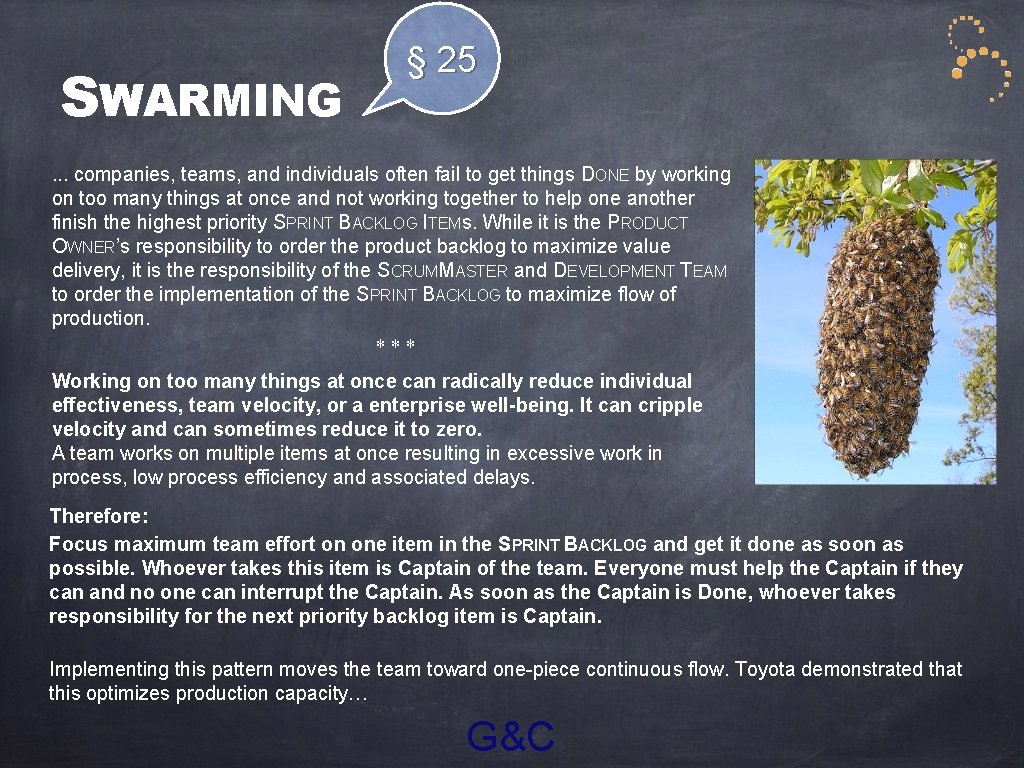
SWARMING § 25 . . . companies, teams, and individuals often fail to get things DONE by working on too many things at once and not working together to help one another finish the highest priority SPRINT BACKLOG ITEMs. While it is the PRODUCT OWNER’s responsibility to order the product backlog to maximize value delivery, it is the responsibility of the SCRUMMASTER and DEVELOPMENT TEAM to order the implementation of the SPRINT BACKLOG to maximize flow of production. *** Working on too many things at once can radically reduce individual effectiveness, team velocity, or a enterprise well-being. It can cripple velocity and can sometimes reduce it to zero. A team works on multiple items at once resulting in excessive work in process, low process efficiency and associated delays. Therefore: Focus maximum team effort on one item in the SPRINT BACKLOG and get it done as soon as possible. Whoever takes this item is Captain of the team. Everyone must help the Captain if they can and no one can interrupt the Captain. As soon as the Captain is Done, whoever takes responsibility for the next priority backlog item is Captain. Implementing this pattern moves the team toward one-piece continuous flow. Toyota demonstrated that this optimizes production capacity… G&C
GOOD HOUSEKEEPING • Velocity is limited because a team spends time dealing with too many bugs. • However, keeping a bug list causes numerous problems… In short, deferring the fixing of bugs until later is borrowing against your future velocity. • Therefore: • Fix all bugs in less than a day. Aim to have a completely clean base of code at the end of every day. § 80
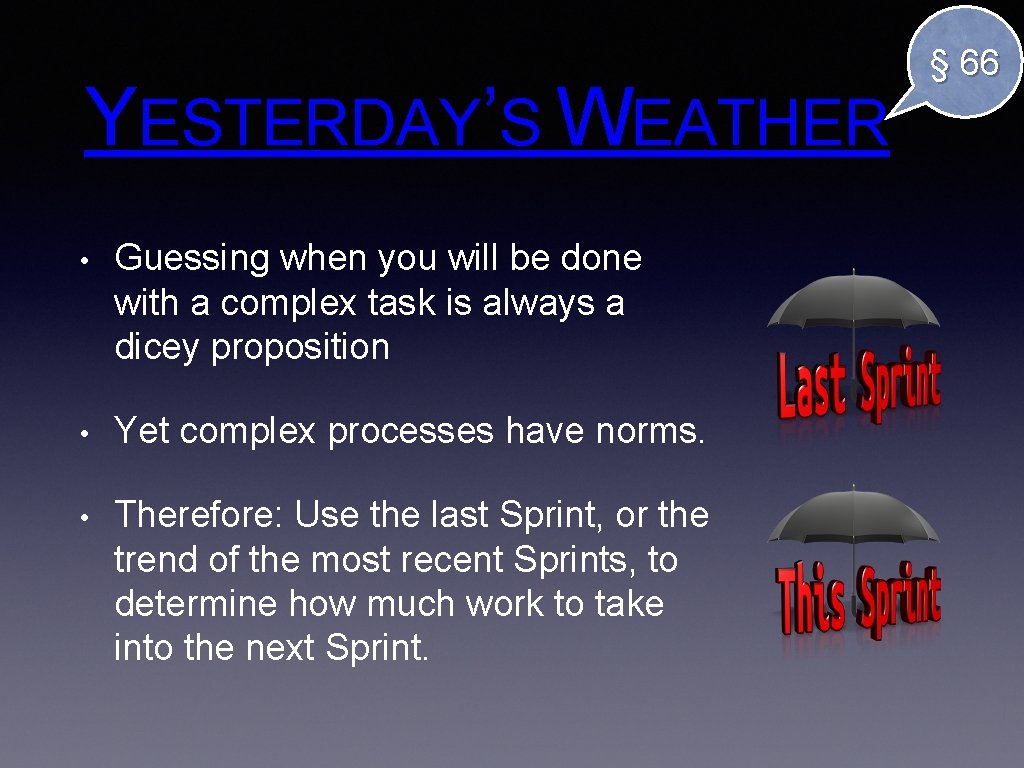
YESTERDAY’S WEATHER • Guessing when you will be done with a complex task is always a dicey proposition • Yet complex processes have norms. • Therefore: Use the last Sprint, or the trend of the most recent Sprints, to determine how much work to take into the next Sprint. § 66
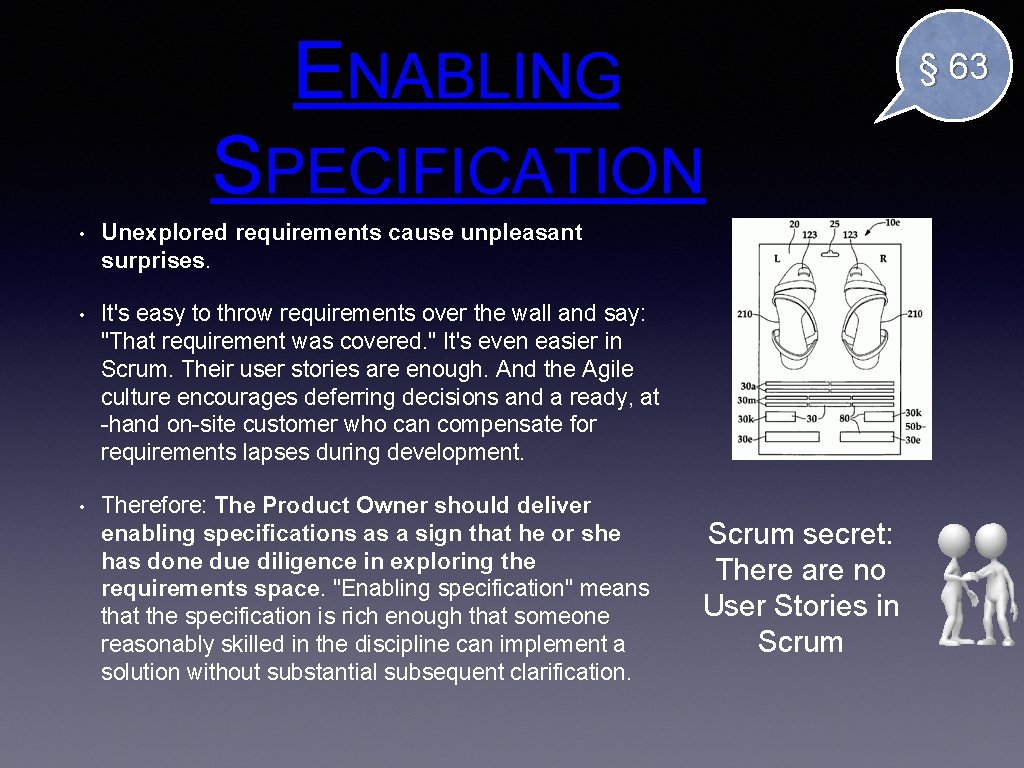
ENABLING § 63 SPECIFICATION • Unexplored requirements cause unpleasant surprises. • It's easy to throw requirements over the wall and say: "That requirement was covered. " It's even easier in Scrum. Their user stories are enough. And the Agile culture encourages deferring decisions and a ready, at -hand on-site customer who can compensate for requirements lapses during development. • Therefore: The Product Owner should deliver enabling specifications as a sign that he or she has done due diligence in exploring the requirements space. "Enabling specification" means that the specification is rich enough that someone reasonably skilled in the discipline can implement a solution without substantial subsequent clarification. Scrum secret: There are no User Stories in Scrum
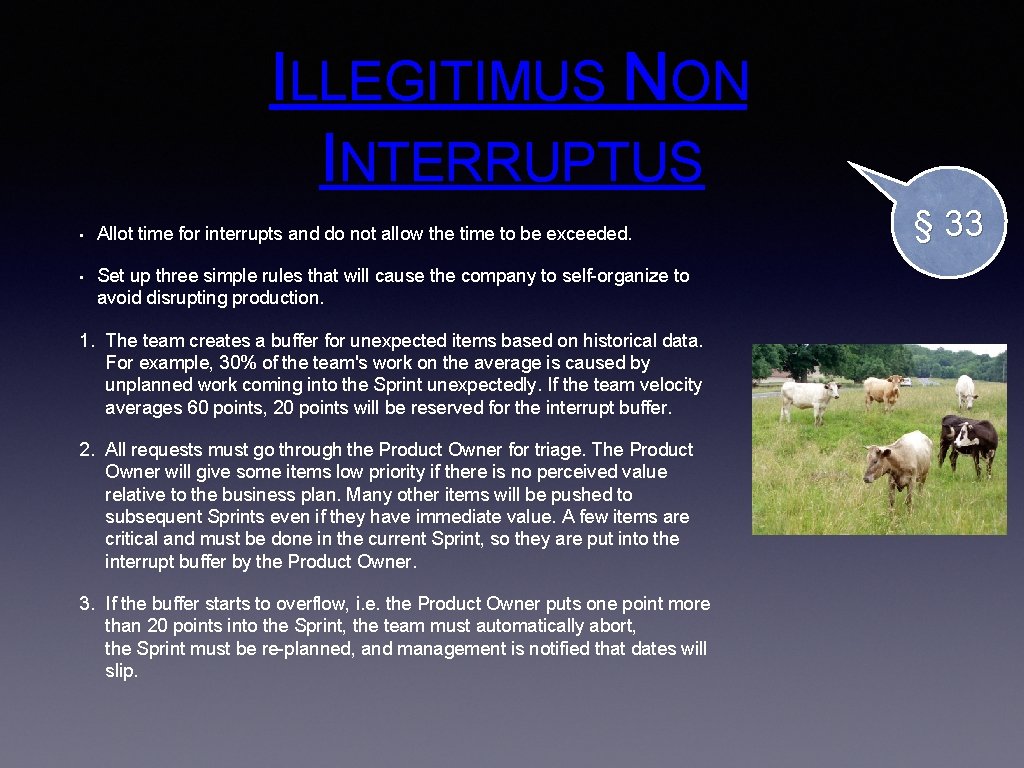
ILLEGITIMUS NON INTERRUPTUS • Allot time for interrupts and do not allow the time to be exceeded. • Set up three simple rules that will cause the company to self-organize to avoid disrupting production. 1. The team creates a buffer for unexpected items based on historical data. For example, 30% of the team's work on the average is caused by unplanned work coming into the Sprint unexpectedly. If the team velocity averages 60 points, 20 points will be reserved for the interrupt buffer. 2. All requests must go through the Product Owner for triage. The Product Owner will give some items low priority if there is no perceived value relative to the business plan. Many other items will be pushed to subsequent Sprints even if they have immediate value. A few items are critical and must be done in the current Sprint, so they are put into the interrupt buffer by the Product Owner. 3. If the buffer starts to overflow, i. e. the Product Owner puts one point more than 20 points into the Sprint, the team must automatically abort, the Sprint must be re-planned, and management is notified that dates will slip. § 33
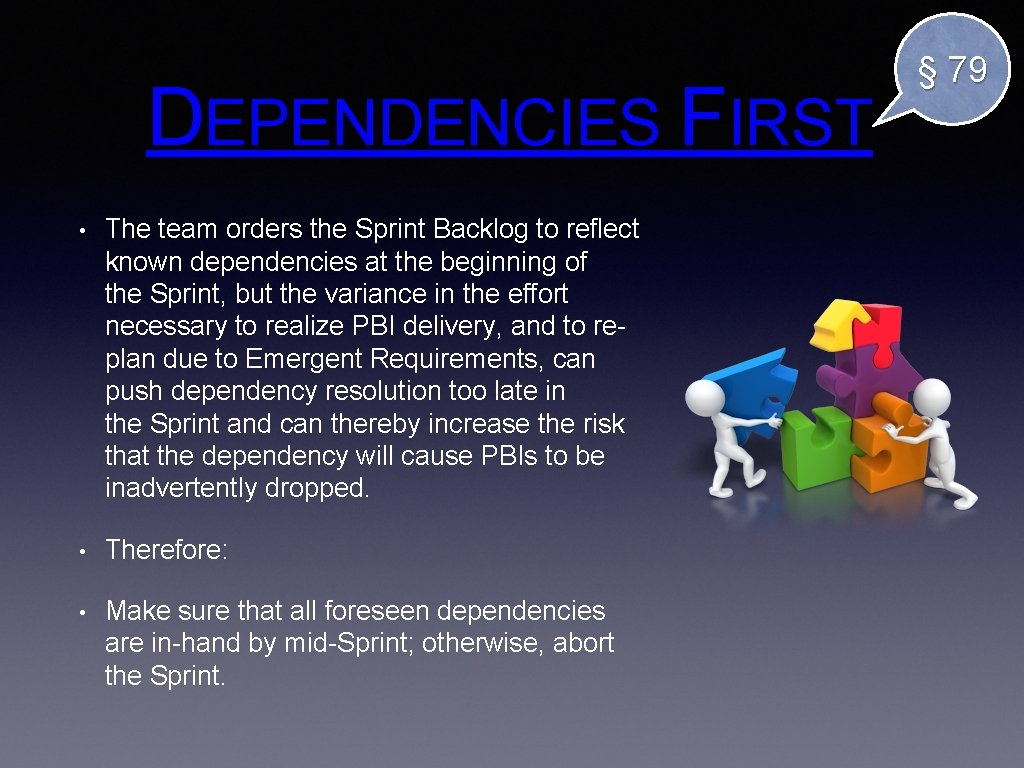
DEPENDENCIES FIRST • The team orders the Sprint Backlog to reflect known dependencies at the beginning of the Sprint, but the variance in the effort necessary to realize PBI delivery, and to replan due to Emergent Requirements, can push dependency resolution too late in the Sprint and can thereby increase the risk that the dependency will cause PBIs to be inadvertently dropped. • Therefore: • Make sure that all foreseen dependencies are in-hand by mid-Sprint; otherwise, abort the Sprint. § 79
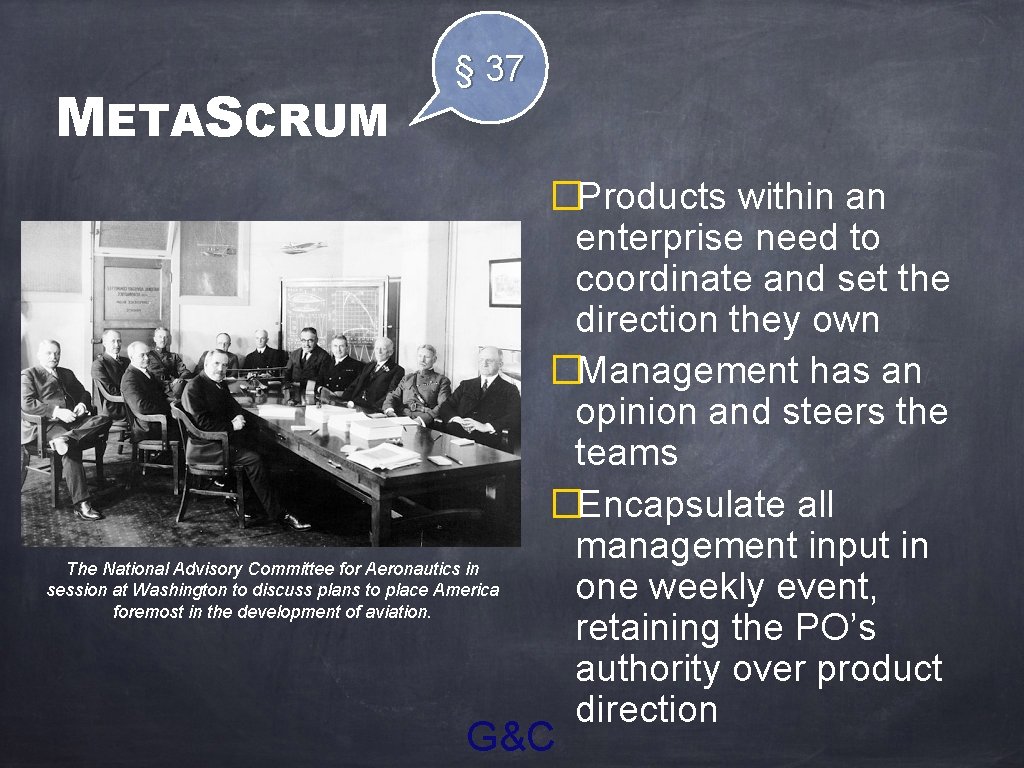
METASCRUM § 37 The National Advisory Committee for Aeronautics in session at Washington to discuss plans to place America foremost in the development of aviation. �Products within an enterprise need to coordinate and set the direction they own �Management has an opinion and steers the teams �Encapsulate all management input in one weekly event, retaining the PO’s authority over product direction G&C
More… amazon. com scrumbook. org facebook. com/scrumplop Courses: gertrudandcope. com