
Scrotal Masses in Adolescent Males Bumps and Lumps
Scrotal Masses in Adolescent Males Bumps and Lumps Allison Eliscu, MD, FAAP Rev. Aug 2012
Hydroceles
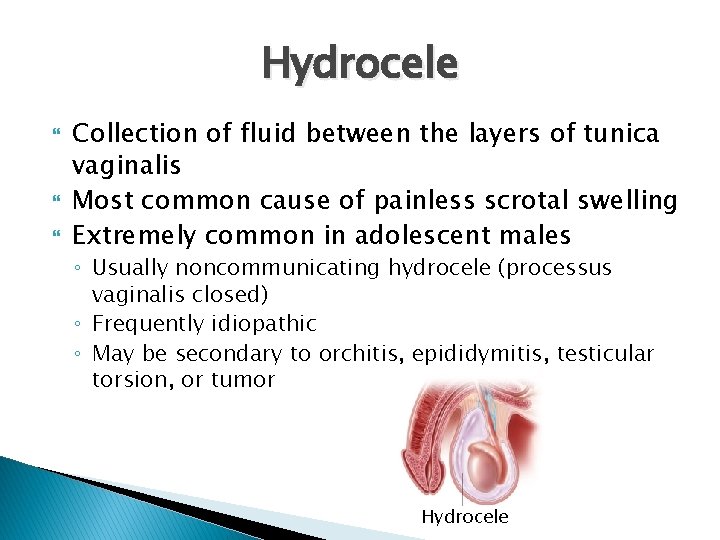
Hydrocele Collection of fluid between the layers of tunica vaginalis Most common cause of painless scrotal swelling Extremely common in adolescent males ◦ Usually noncommunicating hydrocele (processus vaginalis closed) ◦ Frequently idiopathic ◦ May be secondary to orchitis, epididymitis, testicular torsion, or tumor Hydrocele
Clinical Presentation of Hydrocele Usually incidental finding on examination Usually asymptomatic unless associated with trauma, torsion, or infection Patients may complain of dragging sensation
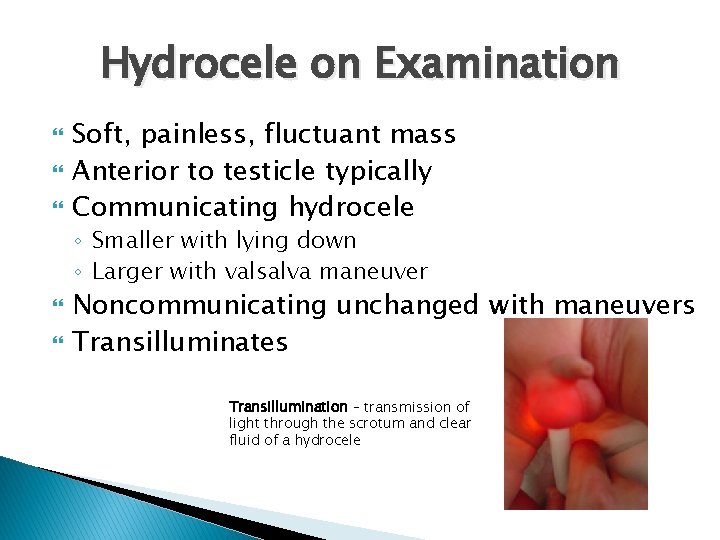
Hydrocele on Examination Soft, painless, fluctuant mass Anterior to testicle typically Communicating hydrocele ◦ Smaller with lying down ◦ Larger with valsalva maneuver Noncommunicating unchanged with maneuvers Transilluminates Transillumination – transmission of light through the scrotum and clear fluid of a hydrocele
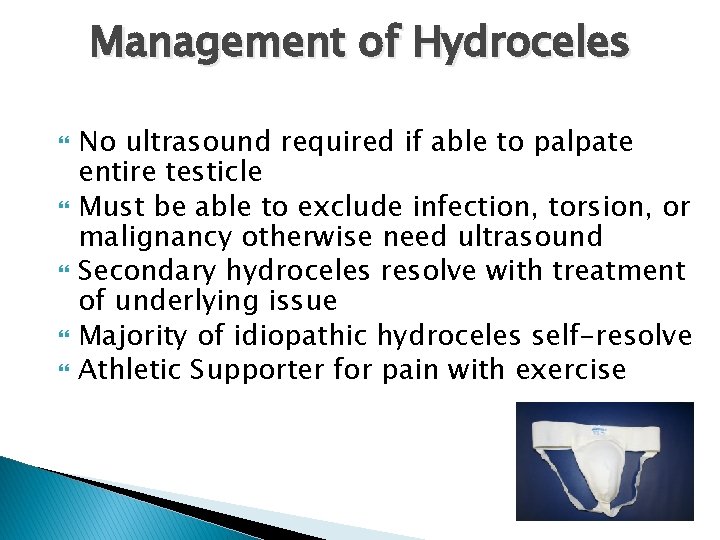
Management of Hydroceles No ultrasound required if able to palpate entire testicle Must be able to exclude infection, torsion, or malignancy otherwise need ultrasound Secondary hydroceles resolve with treatment of underlying issue Majority of idiopathic hydroceles self-resolve Athletic Supporter for pain with exercise
Spermatoceles
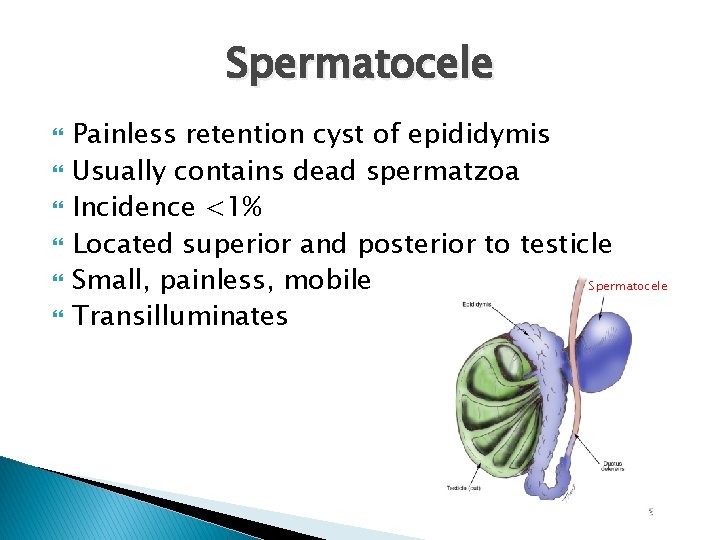
Spermatocele Painless retention cyst of epididymis Usually contains dead spermatzoa Incidence <1% Located superior and posterior to testicle Small, painless, mobile Spermatocele Transilluminates
Management of Spermatocele Diagnosis may be made by physical exam May need ultrasound to confirm diagnosis No treatment necessary

Varicoceles
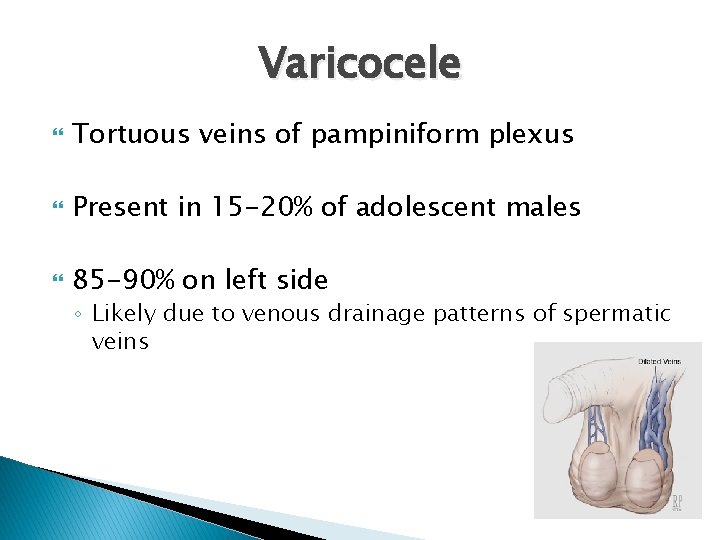
Varicocele Tortuous veins of pampiniform plexus Present in 15 -20% of adolescent males 85 -90% on left side ◦ Likely due to venous drainage patterns of spermatic veins
Clinical Presentation of Varicocele Typically asymptomatic incidental finding on physical exam Patients may complain of dull ache or fullness Feels like bag of worms above testicle Larger with valsalva maneuver Smaller in supine position May develop testicular atrophy on affected size
What’s the Harm in a Bag of Worms? 80% of adult males w/ varicocele have normal fertility BUT 40% of infertile men have varicocele Impaired venous circulation may decrease quality of sperm
Managing Varicocele Determine testicular volume ◦ Physical exam or ultrasound (most accurate) Decreased volume indicates decreased spermatogenesis More accurate indicators of fertility: ◦ **These are not recommended routinely yet, still undergoing research to determine if should be routine** Basal LH and FSH levels - elevated levels indicative of problem Semen analysis
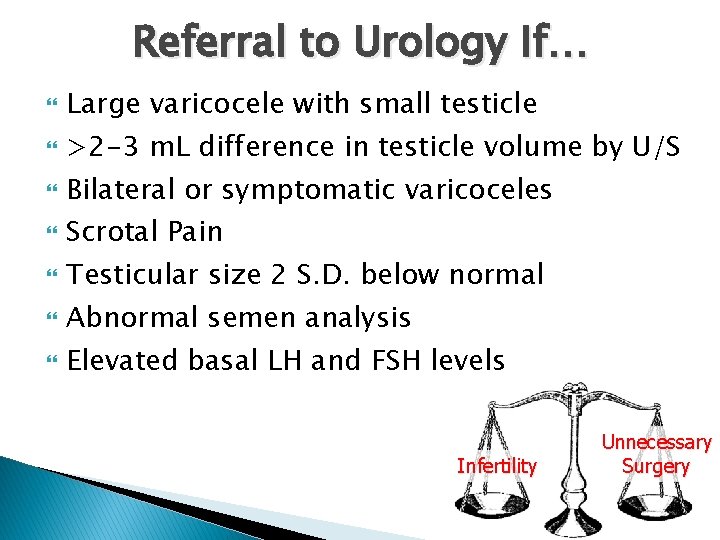
Referral to Urology If… Large varicocele with small testicle >2 -3 m. L difference in testicle volume by U/S Bilateral or symptomatic varicoceles Scrotal Pain Testicular size 2 S. D. below normal Abnormal semen analysis Elevated basal LH and FSH levels Infertility Unnecessary Surgery
Testicular Tumors
Testicular Tumor Epidemiology Most common solid cancer in 15 -34 yo males Risk factors: ◦ ◦ ◦ ◦ Cryptorchidism (undescended testicle)* Family history of testicular cancer HIV infection Prior germ cell tumor (intra or extragonadal) Prior tumor in contralateral testicle History of mumps orchitis Trauma * Most significant risk factor
A Little Note on Cryptorchidism Most significant risk factor for developing testicular cancer Patients with history of cryptorchidism ◦ 2. 5 -11 times higher risk of cancer ◦ BUT only 1 -5% pts w/ prior undescended testis actually develop cancer (not 100%) ◦ Incidence may be decreased by early orchiopexy BUT 90% of germ cell tumors occur in patients with NO history of cryptorchidism
Testicular Tumors – Hx and PE History: ◦ Painless mass found on exam ◦ Dull achy feeling or heaviness (30 -40%) ◦ Acute testicular pain (10%) – due to hemorrhage or infarction) Physical Exam: ◦ Firm, nontender mass ◦ Does not transilluminate ◦ Reactive hydrocele may be present
Diagnosis/Management Testicular ultrasound is very accurate test If U/S unequivical, testicular MRI may help determine if mass is benign or malignant Chest X-ray Look for metastases CT scan of abdomen and pelvis Immediate referral to urologist or oncologist
� Why Self-Testicular Exam To Do…or Not To Do? is it controversial? ◦ Specificity, sensitivity, and PPV unknown ◦ Does not appear to change mortality –due to low incidence of disease and high survival rates � We recommend teaching males >15 yo how to do exam and encouraging monthly exams ◦ *Stress importance in patients with risk factors � How ◦ ◦ to do self-exam? Best done after warm shower to relax scrotal tissue Roll testicle between thumb and index/middle fingers Feel for lumps, hardness, or thickness Compare to last exam and opposite side
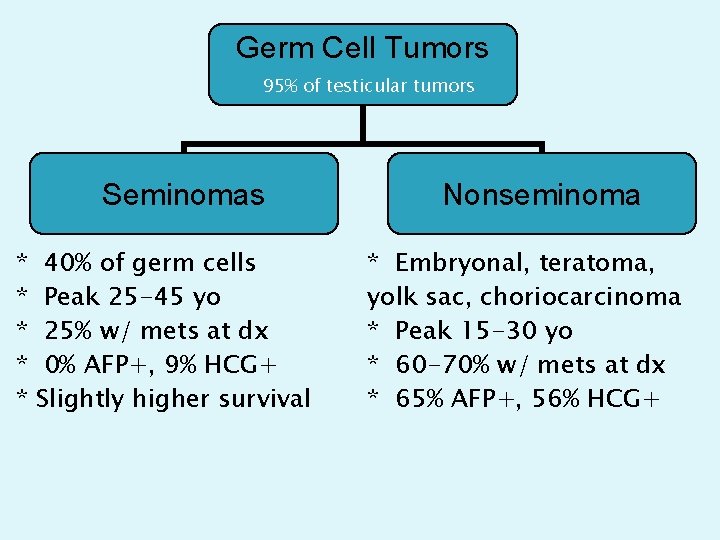
Germ Cell Tumors 95% of (95%) testicular tumors Seminomas * * * 40% of germ cells Peak 25 -45 yo 25% w/ mets at dx 0% AFP+, 9% HCG+ Slightly higher survival Nonseminoma * Embryonal, teratoma, yolk sac, choriocarcinoma * Peak 15 -30 yo * 60 -70% w/ mets at dx * 65% AFP+, 56% HCG+
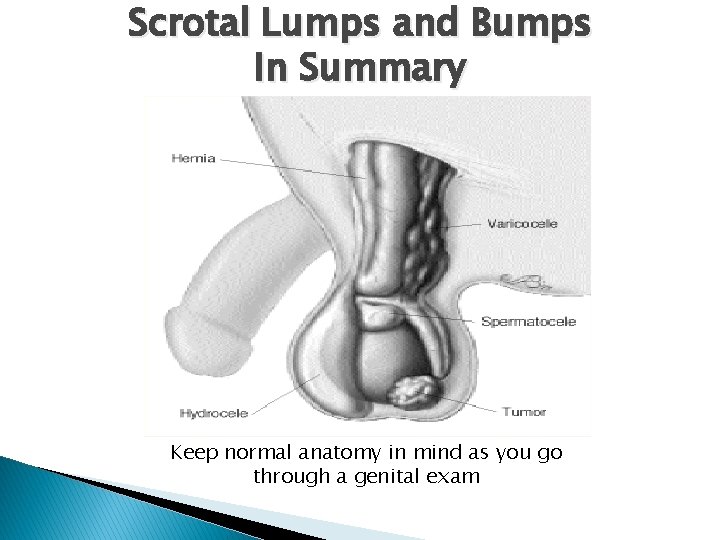
Scrotal Lumps and Bumps In Summary Keep normal anatomy in mind as you go through a genital exam
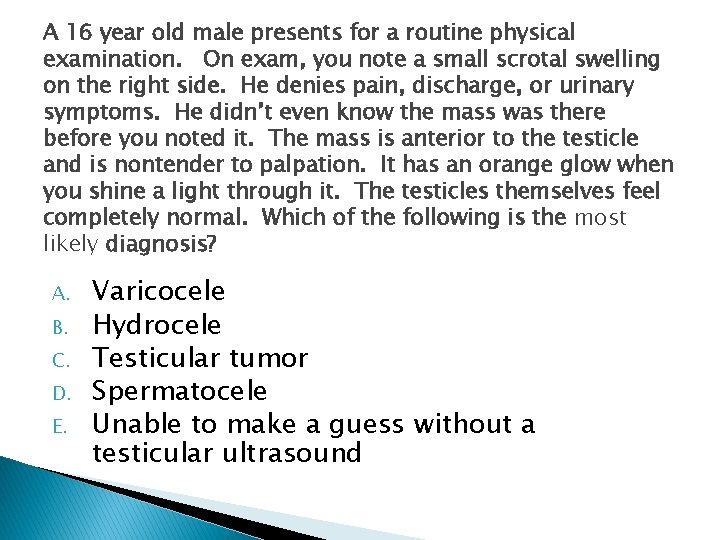
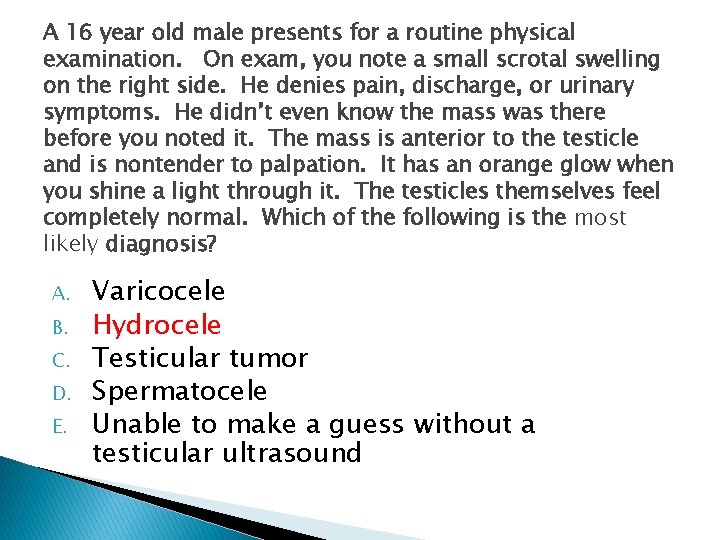
A 16 year old male presents for a routine physical examination. On exam, you note a small scrotal swelling on the right side. He denies pain, discharge, or urinary symptoms. He didn’t even know the mass was there before you noted it. The mass is anterior to the testicle and is nontender to palpation. It has an orange glow when you shine a light through it. The testicles themselves feel completely normal. Which of the following is the most likely diagnosis? A. B. C. D. E. Varicocele Hydrocele Testicular tumor Spermatocele Unable to make a guess without a testicular ultrasound
A 16 year old male presents for a routine physical examination. On exam, you note a small scrotal swelling on the right side. He denies pain, discharge, or urinary symptoms. He didn’t even know the mass was there before you noted it. The mass is anterior to the testicle and is nontender to palpation. It has an orange glow when you shine a light through it. The testicles themselves feel completely normal. Which of the following is the most likely diagnosis? A. B. C. D. E. Varicocele Hydrocele Testicular tumor Spermatocele Unable to make a guess without a testicular ultrasound
Answer: B. This patient has a small, asymptomatic mass anterior to the testicle with a completely normal adjacent testicle which is consistent with a hydrocele. This mass transilluminates (light passes through it) which is also consistent with a hydrocele. A varicocele is superior to the testicle and does not transilluminate. Testicular tumors are not able to be separated from the testicle and do not transilluminate. Spermatoceles are usually superioposterior to the testicle and may transilluminate since they are fluid filled.
An 18 year old male presents for a routine physical examination. He has no complaints. On exam, you find a nontender swelling superior to the left testicle which does not transilluminate and seems to resemble a bag of worms. The testicle itself is normal without tenderness or masses and seems to be symmetric to the unaffected side. You suspect a varicocele. Which of the following is the most appropriate next step in management? A. B. C. D. Reassurance that this is normal and recheck in a few months Recommend sperm analysis to check fertility Immediate referral to urologist for ligation of varicocele Empirically treat him for gonorrhea and chlamydia
An 18 year old male presents for a routine physical examination. He has no complaints. On exam, you find a nontender swelling superior to the left testicle which does not transilluminate and seems to resemble a bag of worms. The testicle itself is normal without tenderness or masses and seems to be symmetric to the unaffected side. You suspect a varicocele. Which of the following is the most appropriate next step in management? A. B. C. D. Reassurance that this is normal and recheck in a few months Recommend sperm analysis to check fertility Immediate referral to urologist for ligation of varicocele Empirically treat him for gonorrhea and chlamydia
Answer: A. Varicoceles are common masses in adolescents which are frequently asymptomatic and incidentally found on exam. There is less of a concern about fertility if the testicle on the affected side appears to be the same size as the testicle on the unaffected side. If this is difficult to determine on exam, a testicular ultrasound should be performed to rule-out hypotrophy which would indicate decreased spermatogenesis. Patients with extremely large, symptomatic, or bilateral varicoceles should be referred to a urologist for evaluation and management. They may recommend a sperm analysis or LH/FSH levels to check fertility levels. Gonorrhea and chlamydia do not cause varicoceles.
A 20 year old male presents to your office complaining of a bump in the genital area. He recently started doing monthly self -testicular exams and he found a new bump last week. He reports that it is nontender and he has no discharge or urinary complaints. He has not other complaints and an unremarkable past medical history. On exam, you note a small, indurated, nontender mass on the left testicle which cannot be separated from the testicle and does not transilluminate. There is no swelling and the contralateral side is normal. Which of the following is the most appropriate next step in management? A. B. C. D. Reassurance that this is normal and recheck it in a few months Immediate referral to urologist Testicular ultrasound Empirically treat him for gonorrhea and chlamydia
A 20 year old male presents to your office complaining of a bump in the genital area. He recently started doing monthly self -testicular exams and he found a new bump last week. He reports that it is nontender and he has no discharge or urinary complaints. He has not other complaints and an unremarkable past medical history. On exam, you note a small, indurated, nontender mass on the left testicle which cannot be separated from the testicle and does not transilluminate. There is no swelling and the contralateral side is normal. Which of the following is the most appropriate next step in management? A. B. C. D. Reassurance that this is normal and recheck it in a few months Immediate referral to urologist Testicular ultrasound Empirically treat him for gonorrhea and chlamydia
Answer: C. A nontender, indurated testicular mass which can not be separated from the testicle and does not transilluminate is a testicular tumor until proven otherwise. This patient should have an immediate ultrasound to get more information about the mass followed by an immediate referral to a urologist or oncologist for further management. This should not wait a few months. If you suspect epididymitits (painful mass superoposterior to the testicle with dysuria and possibly urethral discharge), then the patient should be empirically treated for gonorrhea and chlamydia. However this patient’s examination is not consistent with epididymitis.
Recommended Reading � Brenner JS, Ojo A. Causes of Painless Scrotal Swelling in Children and Adolescents. Up. To. Date Online. Updated February 2, 2009. � Adelman WP, Joffe A. Controversies in Male Adolescent Health: Varicocele, circumcision, and testicular self-examination. Curr Opin Pediatr. 2004 Aug; 16(4): 363 -7. � Diamond DA. Adolescent Varicocele. Curr Opin Urol. 2007; 17: 263 -7. � Rubenstein RA, Dogra VS, Seftel AD, Resnick MI. Benign Intrascrotal Lesions. J Urol. 2004 May; 171(5): 1765 -72.
- Slides: 33