
Scribbling Stage 2 to 4 years old Young
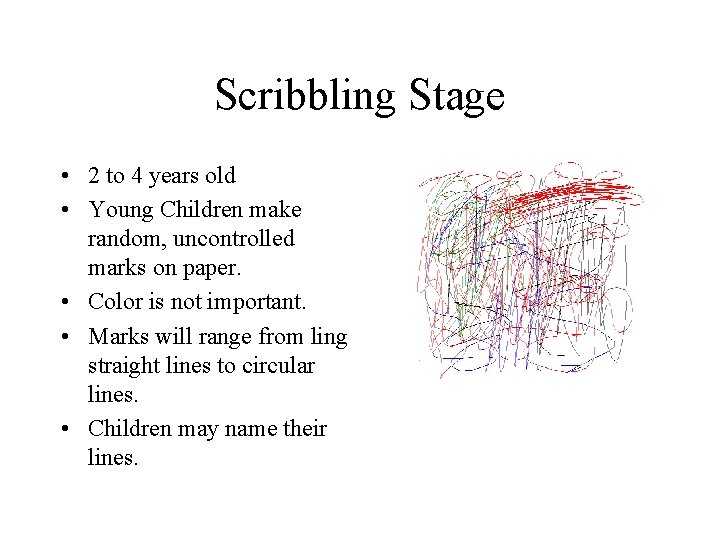
Scribbling Stage • 2 to 4 years old • Young Children make random, uncontrolled marks on paper. • Color is not important. • Marks will range from ling straight lines to circular lines. • Children may name their lines.
Scribbling Stage • The child is learning to • Their marks display master motions by their emotions. repeating them. • Happiness, enjoyment, • Walking, talking, release and gain of eating, drawing motor skills • It is important to • Coloring book swill encourage the child to only restrict the child’s make marks. progress.
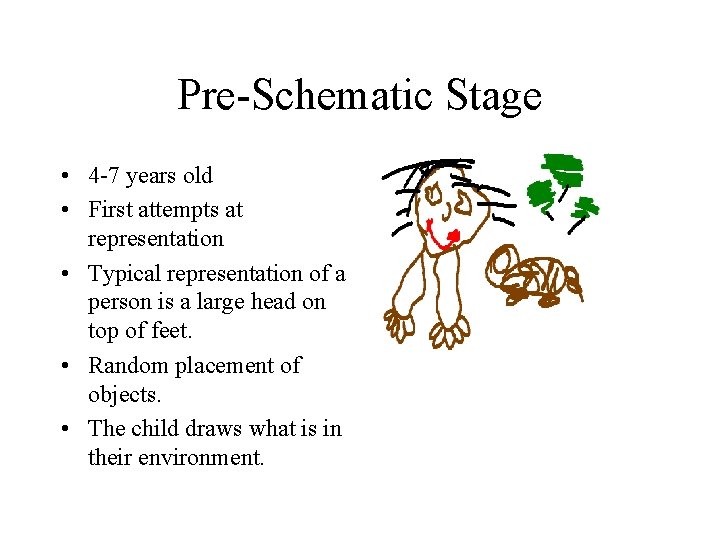
Pre-Schematic Stage • 4 -7 years old • First attempts at representation • Typical representation of a person is a large head on top of feet. • Random placement of objects. • The child draws what is in their environment.

Pre-schematic Stage • The child is discovering “real” relationships. • He will draw the important details as he sees them. • Things that are most important will be big/ • Coloring books force children to accept pre conceived ideas of what is “real”. • They force children to “stay with in the lines’ instead of creating their own. • Coloring books stunt the creative growth of children.
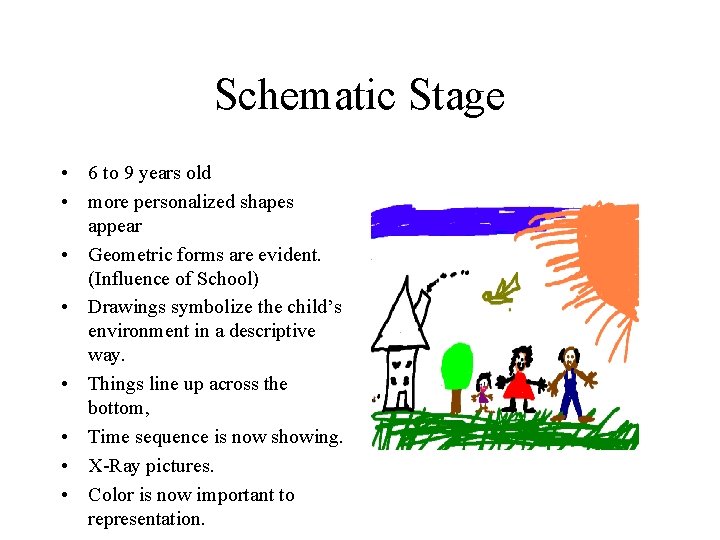
Schematic Stage • 6 to 9 years old • more personalized shapes appear • Geometric forms are evident. (Influence of School) • Drawings symbolize the child’s environment in a descriptive way. • Things line up across the bottom, • Time sequence is now showing. • X-Ray pictures. • Color is now important to representation.
Schematic Stage • Scheme - TO PLAN • Asking a child to “Tell me about your picture” • Children are showing will help them grow their thought processes intellectually and now. creatively. • They are distinguishing where things “fit” in their world.
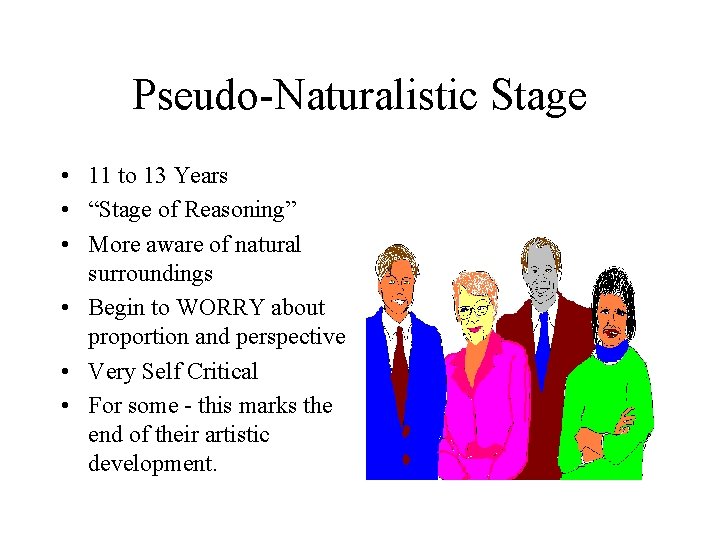
Pseudo-Naturalistic Stage • 11 to 13 Years • “Stage of Reasoning” • More aware of natural surroundings • Begin to WORRY about proportion and perspective • Very Self Critical • For some - this marks the end of their artistic development.
Pseudo-Naturalism • Children are now showing focus on real gender diversion. • Very critical of their art at this age. • Detail is important • Perspective and showing things in correct proportion are important. • Product is now more important to the child than the process.
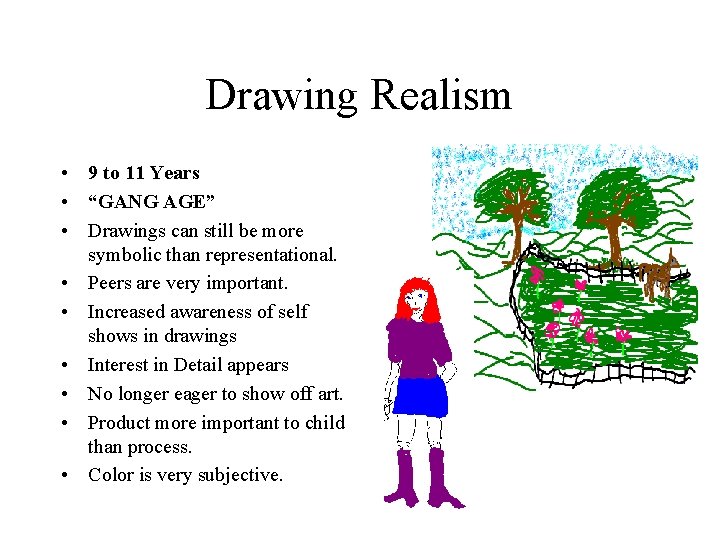
Drawing Realism • 9 to 11 Years • “GANG AGE” • Drawings can still be more symbolic than representational. • Peers are very important. • Increased awareness of self shows in drawings • Interest in Detail appears • No longer eager to show off art. • Product more important to child than process. • Color is very subjective.
Drawing Realism • Age of “Self Discovery” • Children are now using their art to illustrate their place in the world. • They want to make things look “real” • Peers are very important and many children’s progress will depend on how their peers, parents and teachers react to their art. • Children are not eager to show their art for fear of rejection.
- Slides: 10